
The UK buy-to-let market is experiencing a remarkable resurgence in 2026, with institutional landlords and professional investors driving unprecedented growth. As new lending surges by 28% year-on-year and rental yields consistently exceed 7%, the need for robust, yield-focused building survey protocols has never been more critical. Surveying the 2026 Buy-to-Let Boom: Building Survey Protocols for Institutional Landlord Investments represents a fundamental shift in how professional landlords approach property acquisition, risk assessment, and portfolio optimization in an evolving regulatory landscape.
This comprehensive guide explores the specialized surveying methodologies that institutional investors are deploying to capitalize on renewed market demand while mitigating risk across diverse property portfolios. 🏢
Key Takeaways
- Buy-to-let lending has grown at 7% quarterly, with a 28% year-on-year increase in lending value and 23% rise in loan volumes, signaling strong institutional confidence[1]
- Specialized building surveys are essential for institutional landlords to assess yield potential, compliance risks, and long-term maintenance costs before acquisition
- Rental yields exceeding 7% in key markets demand comprehensive property condition assessments to protect investment returns[9]
- The Renters' Rights Act requires enhanced survey protocols focusing on compliance, energy efficiency, and tenant retention factors[3]
- Five-year growth forecasts of 22-28% across UK regions make thorough pre-acquisition surveys critical for portfolio performance[5]
Understanding the 2026 Buy-to-Let Market Resurgence

Current Market Dynamics
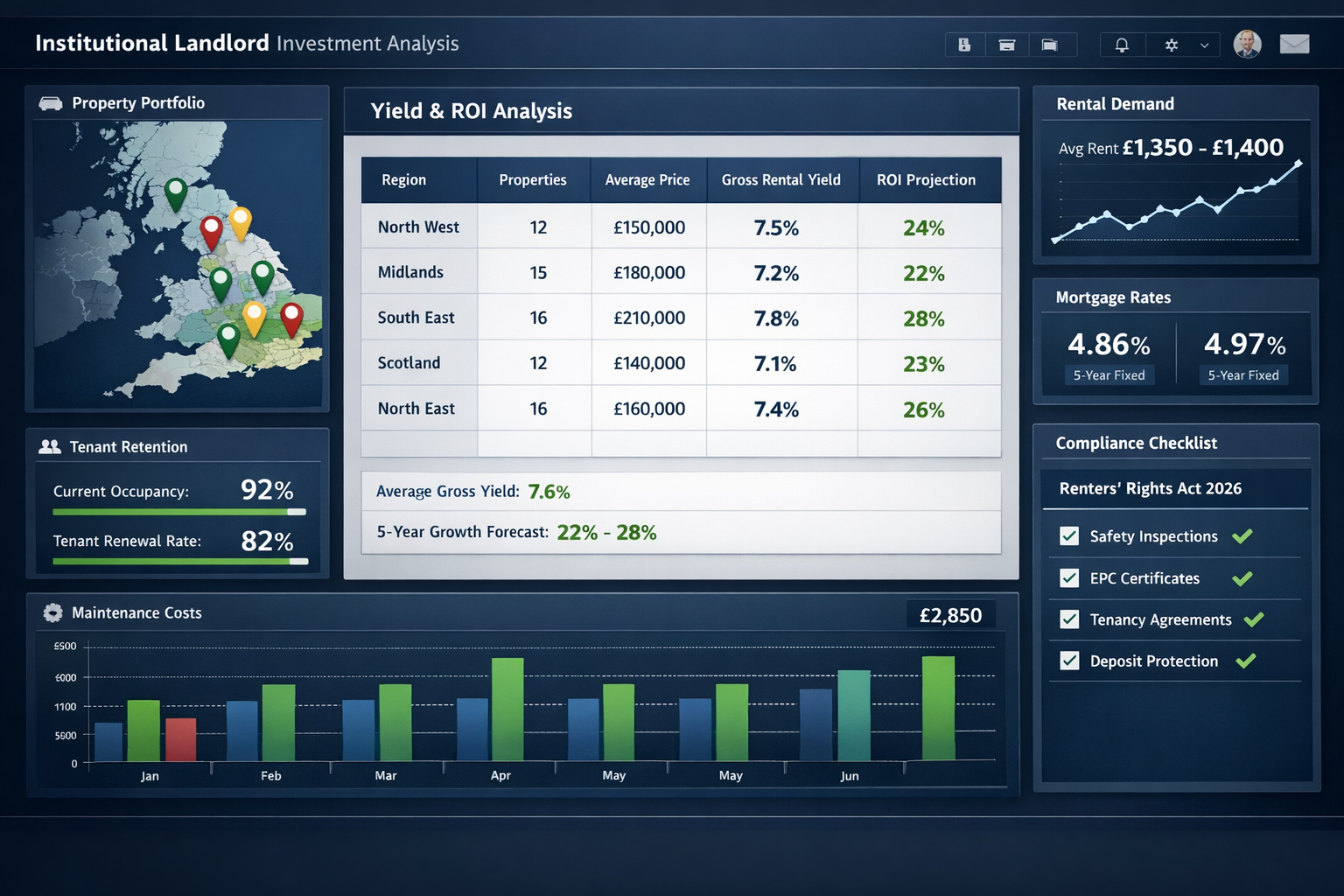
The buy-to-let sector is experiencing a significant revival in 2026, driven by multiple converging factors. Recent data reveals that BTL lending has grown at an average quarterly rate of 7% over the past year, with UK Finance reporting new buy-to-let lending rose 28% year-on-year by value and 23% by the number of loans issued[1]. This growth trajectory demonstrates renewed confidence among institutional investors and professional landlords.
Remortgaging activity has recorded even stronger growth, with an average quarterly increase of 12% as borrowers respond to improving mortgage rates[1]. Two-year fixed rates are now available at approximately 4.86%, while five-year fixes stand at 4.97%[4], creating favorable conditions for portfolio expansion and refinancing strategies.
Regional Investment Opportunities
Property stock levels are higher than at the same point last year, giving investors more choice and comparison time[3]. This increased availability, combined with strong rental demand, creates optimal conditions for strategic acquisitions. Savills forecasts average UK property value growth of 22.2% over five years, with Yorkshire and The Humber and the North West projected at +28.8%, and Scotland, Wales, and the North East at +27.6%[5].
Expat investor activity has surged dramatically, with a 23% year-on-year volume rise and 28% value increase in expat buy-to-let investments, with average gross rental yields exceeding 7%[9]. This international interest underscores the attractiveness of UK rental markets to sophisticated investors seeking stable returns.
Rental Market Fundamentals
Strong tenant demand persists across the UK, with average private rents rising 4-5% annually toward the end of 2025, reaching £1,350–£1,400 monthly[3]. Well-maintained properties with strong energy efficiency ratings attract the highest tenant interest[3], making comprehensive building surveys essential for identifying improvement opportunities that maximize rental appeal.
Core Components of Surveying the 2026 Buy-to-Let Boom: Building Survey Protocols
Risk-Focused Assessment Frameworks
Institutional landlords require survey protocols that extend far beyond standard residential assessments. Yield-focused surveys must evaluate properties through the lens of long-term investment performance, tenant retention potential, and regulatory compliance. These specialized assessments incorporate:
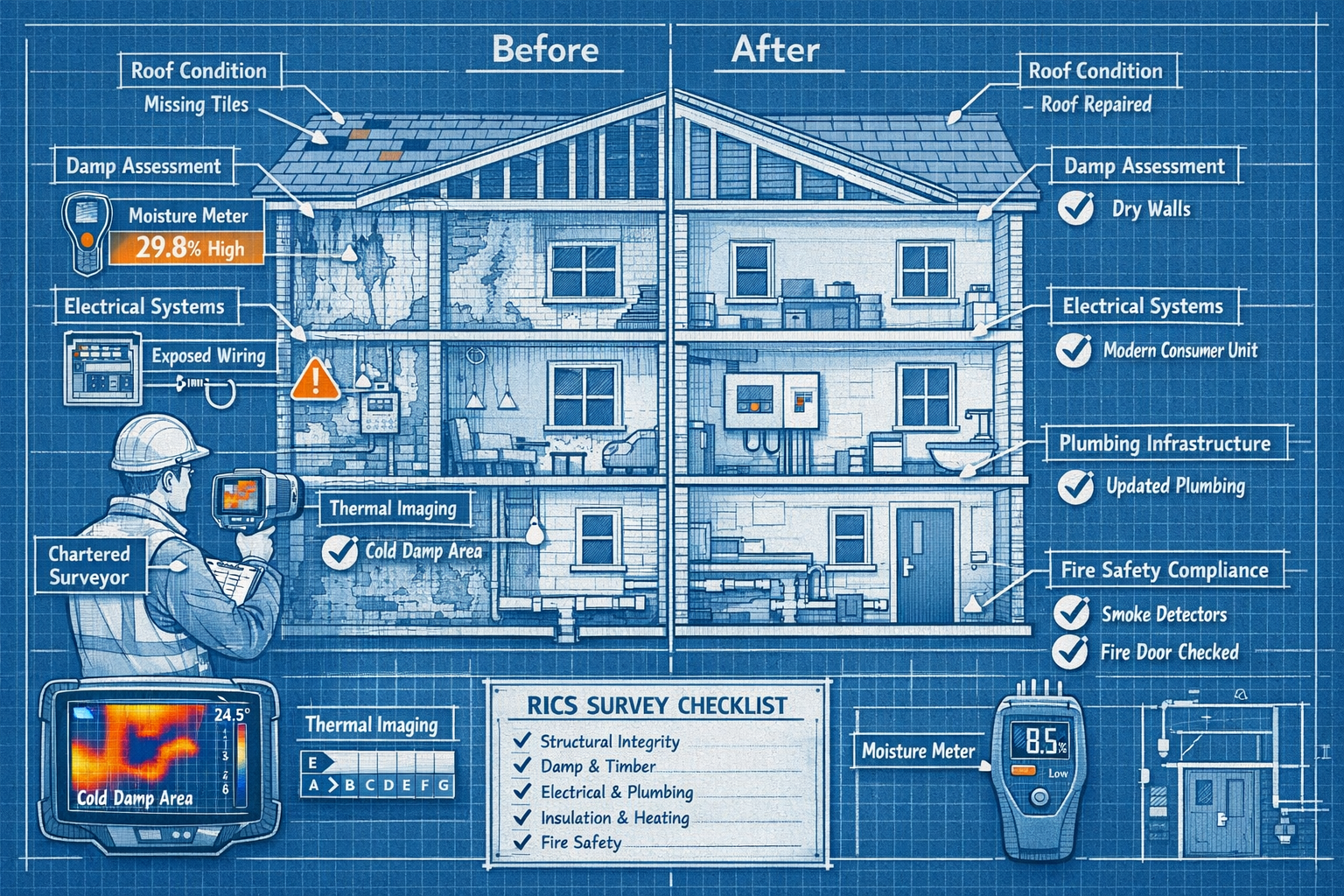
Structural integrity analysis examining foundations, load-bearing walls, roof structures, and potential subsidence risks that could impact property values and rental income continuity. A comprehensive RICS building survey provides the detailed technical analysis institutional investors require.
Building systems evaluation assessing the condition and remaining lifespan of electrical installations, plumbing systems, heating infrastructure, and ventilation. These elements directly impact maintenance costs and tenant satisfaction over the investment horizon.
Energy efficiency assessment has become critical under the Renters' Rights Act, with landlords focusing more closely on compliance, maintenance, and tenant retention[3]. Properties with poor EPC ratings face rental restrictions and require capital investment to meet minimum standards.
Compliance and Regulatory Mapping
The 2026 regulatory environment demands enhanced survey protocols that identify compliance gaps before acquisition. Survey checklists must now include:
- Fire safety compliance assessments, particularly for multi-unit properties
- Electrical safety certification requirements and upgrade costs
- Gas safety installation standards and annual inspection protocols
- Damp and mold risk evaluation in light of enhanced tenant protections
- Accessibility compliance for properties subject to equality legislation
A stock condition survey provides institutional landlords with comprehensive portfolio-wide assessments that identify compliance risks across multiple properties simultaneously.
Maintenance Cost Forecasting
Accurate capital expenditure forecasting is essential for institutional investment models. Survey protocols must quantify:
| Component | Assessment Focus | Investment Impact |
|---|---|---|
| Roof Systems | Remaining lifespan, repair vs. replacement costs | High – typically £5,000-£15,000+ |
| Heating Infrastructure | Boiler age, efficiency ratings, upgrade requirements | Medium – £2,000-£4,000 replacement |
| Windows & Doors | Thermal efficiency, security standards, condition | Medium – £3,000-£8,000 for replacements |
| Electrical Systems | Consumer unit compliance, rewiring requirements | High – £3,000-£6,000 for full rewire |
| Plumbing | Pipe materials, water pressure, drainage condition | Medium – £1,500-£4,000 for upgrades |
These cost projections enable institutional investors to model accurate net yields and compare acquisition opportunities on a like-for-like basis.
Advanced Survey Methodologies for Institutional Portfolios
Technology-Enhanced Inspection Protocols
Modern institutional landlords are deploying advanced survey technologies to enhance assessment accuracy and efficiency. Digital survey tools include:
Thermal imaging cameras that identify heat loss, insulation deficiencies, and hidden moisture problems invisible to visual inspection. These tools are particularly valuable for assessing energy efficiency improvement potential and identifying damp issues that could impact tenant health and property condition.
Moisture meters and hygrometers provide objective measurements of dampness levels in walls, floors, and ceilings, enabling surveyors to distinguish between active water ingress and historic staining that poses no ongoing risk.
Drone surveys offer cost-effective roof and chimney inspections for multi-story properties, reducing access costs while providing detailed photographic evidence of condition. Our drone survey services enable comprehensive external assessments without scaffolding or cherry picker expenses.
Portfolio-Level Assessment Strategies
Institutional investors managing multiple properties benefit from standardized survey protocols that enable portfolio-wide analysis. Batch surveying approaches include:
Standardized reporting templates that present findings in consistent formats, allowing direct comparison of condition, risk, and investment requirements across different properties. This standardization facilitates data-driven acquisition decisions and portfolio optimization.
Risk scoring matrices that assign numerical ratings to structural condition, compliance status, and maintenance requirements, enabling portfolio managers to prioritize capital expenditure and identify underperforming assets.
Comparative yield analysis that factors survey findings into rental income projections, void period estimates, and maintenance cost forecasts to calculate accurate net yields for each potential acquisition.
Specialized Survey Types for BTL Investors
Different property types and investment strategies require tailored survey approaches:
New build properties demand specialized assessment protocols despite their recent construction. Our guide on whether you need a survey on a new build explains the critical issues that can affect even newly constructed rental properties.
Commercial-to-residential conversions require commercial building surveys that assess suitability for residential use, building regulation compliance, and conversion cost accuracy.
Period properties need specialist expertise to evaluate historic construction methods, conservation area restrictions, and traditional material maintenance requirements that impact long-term costs.
Case Studies: Institutional Survey Protocols in Action
Case Study 1: Regional Portfolio Expansion
A London-based institutional investor deployed comprehensive survey protocols when expanding into the North West market in early 2026. Targeting the projected 28.8% five-year growth forecast for the region[5], the investor commissioned detailed RICS building surveys for 12 terraced properties in Manchester and Liverpool.
Survey findings revealed:
- Three properties required immediate electrical rewiring (£18,000 total)
- Five properties needed cavity wall insulation to achieve minimum EPC ratings (£12,500)
- Two properties had significant damp issues requiring £8,000 in remedial work
By factoring these costs into acquisition negotiations, the investor reduced purchase prices by £45,000 across the portfolio and completed remedial works before tenant placement, achieving 6.8% gross yields within three months of completion.
Case Study 2: Expat Investor Due Diligence
An expat investor based in Dubai, part of the 23% year-on-year surge in overseas BTL investment[9], required remote survey coordination for a six-property portfolio acquisition in Birmingham. The investor commissioned comprehensive building surveys with detailed photographic documentation and video walkthroughs.
The survey protocol identified:
- Roof repairs required on two properties (£9,000)
- Outdated heating systems in four properties (£12,000 for replacements)
- Minor cosmetic issues across all properties (£6,000)
The detailed documentation enabled the overseas investor to make informed decisions without traveling to the UK, negotiate price reductions totaling £22,000, and schedule all remedial works before completion, ensuring properties were tenant-ready immediately.
Case Study 3: Compliance-Focused Acquisition
A professional landlord expanding their portfolio in response to strong rental demand commissioned surveys specifically focused on Renters' Rights Act compliance. The specific defect survey approach concentrated on:
- Fire safety compliance in HMO properties
- Electrical installation condition reports
- Gas safety certification status
- Damp and mold risk assessment
- Energy efficiency ratings and improvement potential
Results demonstrated:
- Two properties required fire door upgrades (£3,500)
- One property needed electrical consumer unit replacement (£1,200)
- All properties required smoke and CO detector upgrades (£800)
By addressing these compliance issues pre-acquisition, the landlord avoided potential enforcement action, protected tenant safety, and positioned the portfolio for strong retention rates in a competitive rental market.
Optimizing Survey Protocols for Maximum Investment Returns
Yield-Focused Survey Specifications
Institutional landlords should commission surveys with specific yield optimization objectives. Survey briefs should request:
Rental income impact assessment evaluating how identified defects or improvement opportunities affect achievable rent levels. For example, a property with a dated kitchen might achieve £1,200 monthly rent, while a £6,000 kitchen upgrade could increase rental income to £1,350 monthly, delivering a 30% annual return on the improvement investment.
Tenant retention analysis identifying property features that impact tenant satisfaction and tenancy duration. Properties requiring frequent tenant turnover incur marketing costs, void periods, and referencing expenses that significantly reduce net yields.
Maintenance cost projections quantifying annual maintenance budgets based on property age, condition, and component lifecycles. Accurate maintenance forecasting prevents unexpected capital calls and enables realistic yield calculations.
Timing and Survey Scheduling
Understanding how long building surveys take is essential for institutional acquisition timelines. Most comprehensive building surveys require:
- Site inspection: 2-4 hours depending on property size and complexity
- Report preparation: 5-7 working days for detailed documentation
- Total timeline: 7-10 working days from instruction to report delivery
For portfolio acquisitions, parallel survey scheduling can compress overall timelines while maintaining assessment quality. Coordinating multiple surveyors enables simultaneous property inspections, reducing the time between offer acceptance and completion.
Selecting Qualified Survey Professionals
Institutional investors should engage chartered surveyors with specific buy-to-let expertise. Selection criteria include:
✅ RICS qualification ensuring professional standards and indemnity insurance
✅ BTL specialization with understanding of rental market dynamics and compliance requirements
✅ Local market knowledge providing context for property values and rental demand
✅ Technology capabilities offering thermal imaging, drone surveys, and digital reporting
✅ Portfolio experience demonstrating capacity to handle multi-property assessments
Our team of chartered surveyors in London and across the UK specializes in institutional landlord requirements, delivering the comprehensive assessments that professional investors demand.
Integrating Survey Findings into Investment Decisions
Financial Modeling and Yield Calculations
Survey findings must be systematically integrated into investment models to calculate accurate returns. Key metrics include:
Gross yield calculation:
(Annual Rental Income ÷ Total Property Cost) × 100
Where Total Property Cost = Purchase Price + Survey-Identified Repairs + Acquisition Costs
Net yield calculation:
((Annual Rental Income – Annual Costs) ÷ Total Property Cost) × 100
Where Annual Costs = Maintenance + Management Fees + Insurance + Void Periods + Compliance Costs
Survey reports provide the detailed cost data required for accurate yield modeling, enabling investors to compare opportunities objectively and identify the highest-performing acquisitions.
Negotiation Strategies Based on Survey Results
Comprehensive survey findings provide powerful negotiation leverage. Effective strategies include:
Itemized cost deductions presenting survey-identified repairs as specific price reduction requests backed by professional assessment and contractor quotations.
Conditional offers making purchase offers subject to seller completing specific repairs or providing price reductions equivalent to remedial work costs.
Completion timeline adjustments requesting extended completion periods to enable pre-completion repairs, reducing immediate post-acquisition capital requirements.
Professional survey reports from qualified chartered surveyors carry significant weight in negotiations, as sellers and their agents recognize the credibility of RICS-accredited assessments.
Portfolio Risk Management
Survey protocols enable institutional investors to manage portfolio-wide risk exposure. Risk management applications include:
Diversification analysis ensuring portfolio composition balances high-yield, higher-risk properties with stable, lower-maintenance assets based on survey condition assessments.
Capital expenditure planning scheduling major works across the portfolio to smooth cash flow requirements and avoid concentrated capital calls.
Insurance optimization using survey documentation to support insurance valuations and ensure adequate coverage for identified risks.
Exit strategy preparation maintaining current survey documentation to facilitate rapid portfolio sales or refinancing when market conditions warrant strategic changes.
Future-Proofing Buy-to-Let Investments Through Comprehensive Surveys
Anticipating Regulatory Changes
The regulatory environment for buy-to-let properties continues to evolve. Forward-looking survey protocols should assess:
Energy efficiency trajectory evaluating the cost and feasibility of achieving higher EPC ratings as minimum standards increase. Properties currently rated E or D may require substantial investment to meet future C-rating requirements.
Decarbonization potential assessing suitability for heat pump installation, solar panel deployment, and other low-carbon technologies that may become mandatory or provide competitive advantages in rental markets.
Accessibility compliance identifying properties that could be adapted to meet enhanced accessibility standards, potentially accessing specialized rental markets or avoiding future retrofit requirements.
Technology Integration Opportunities
Modern rental properties increasingly compete on technology features. Survey assessments should evaluate:
- Broadband infrastructure and fiber connectivity potential
- Smart home technology compatibility
- Electric vehicle charging installation feasibility
- Security system integration capabilities
Properties offering these features command rental premiums and attract high-quality tenants with strong retention rates, improving long-term investment performance.
Climate Resilience Assessment
Climate change impacts are becoming material considerations for long-term property investments. Survey protocols should incorporate:
Flood risk evaluation using Environment Agency data and site-specific drainage assessments to identify properties vulnerable to increased flooding frequency.
Overheating risk assessing thermal performance and ventilation adequacy as summer temperatures increase, particularly for top-floor flats and properties with poor insulation.
Storm damage vulnerability evaluating roof condition, chimney stability, and tree proximity to identify properties requiring preventive maintenance or insurance considerations.
Conclusion
Surveying the 2026 Buy-to-Let Boom: Building Survey Protocols for Institutional Landlord Investments represents a fundamental evolution in professional property investment methodology. As buy-to-let lending surges by 28% year-on-year and rental yields consistently exceed 7%, comprehensive survey protocols have become essential tools for institutional investors seeking to capitalize on market opportunities while managing risk effectively[1][9].
The resurgence of the BTL market in 2026 creates exceptional opportunities for professional landlords who deploy robust due diligence processes. With five-year growth forecasts projecting 22-28% property value increases across key UK regions[5], the properties acquired today will form the foundation of high-performing portfolios for years to come.
Actionable Next Steps
For institutional investors and professional landlords looking to capitalize on the 2026 buy-to-let boom:
- Commission comprehensive building surveys for all potential acquisitions, ensuring reports address yield optimization, compliance risks, and maintenance cost forecasting
- Engage RICS-qualified surveyors with specific buy-to-let expertise and local market knowledge to ensure assessments align with investment objectives
- Integrate survey findings systematically into financial models, calculating accurate net yields that account for all survey-identified costs
- Develop standardized survey protocols across your portfolio to enable comparative analysis and data-driven acquisition decisions
- Schedule regular condition assessments for existing portfolio properties to identify maintenance requirements before they impact tenant satisfaction or rental income
The institutional landlords who will thrive in the 2026 buy-to-let boom are those who recognize that comprehensive survey protocols are not costs to be minimized, but strategic investments that protect returns, reduce risk, and optimize portfolio performance. By deploying the survey methodologies outlined in this guide, professional investors can confidently navigate the current market resurgence and build portfolios positioned for sustained success.
To discuss your specific survey requirements or commission comprehensive assessments for your buy-to-let portfolio, explore our range of survey services or contact our team of experienced chartered surveyors today. 📊
References
[1] Btl Lending Data Shows Landlords Still Investing – https://thenegotiator.co.uk/news/rental-market/btl-lending-data-shows-landlords-still-investing/
[2] How Does Property Investment Stack Up In 2026 – https://www.buyassociationgroup.com/en-gb/news/how-does-property-investment-stack-up-in-2026/
[3] 197 February – https://www.fraser-reeves.co.uk/blog/197-february-
[4] Landlord Press Review February 2026 – https://www.rentila.co.uk/blog/landlord-press-review-february-2026/
[5] Why Buy To Let Is Still Worth It In 2026 – https://www.propertynotify.co.uk/investment/why-buy-to-let-is-still-worth-it-in-2026/
[6] Buy To Let Market Update February 2026 – https://www.nrla.org.uk/news/buy-to-let-market-update-february-2026
[7] Base Rate Cut Looms New Pressures For Landlords – https://www.mfbrokers.co.uk/resources/news-and-insights/base-rate-cut-looms-new-pressures-for-landlords
[8] Is Buy To Let A Good Investment In 2026 A Landlords Guide – https://certificates4uk.co.uk/is-buy-to-let-a-good-investment-in-2026-a-landlords-guide/
[9] mpamag – https://www.mpamag.com/uk/mortgage-types/buy-to-let/expat-buy-to-let-a-growing-market-hiding-in-plain-sight/566568
