
The global data centre industry is experiencing unprecedented growth in 2026, with investment reaching historic levels and construction projects transforming skylines across the UK. As developers race to meet surging demand for digital infrastructure, one critical yet often overlooked aspect threatens to delay projects and inflate costs: party wall agreements. Understanding Party Wall Surveys for Data Centre Expansions: Navigating Agreements in the 2026 Investment Surge has become essential for investors, developers, and property owners alike.
With nearly 100 GW of new data centres scheduled between 2026 and 2030—effectively doubling global capacity—the sector is expanding at a remarkable 14% compound annual growth rate (CAGR) through 2030[1]. This explosive growth, particularly in UK regions beyond London, brings unique challenges when construction involves shared boundaries with neighbouring properties. The stakes are high: construction costs have climbed to $10.7 million per MW in 2025, with forecasts predicting a further 6% increase to $11.3 million per MW in 2026[1].
Key Takeaways
- 🏗️ Global data centre investment will require up to $3 trillion by 2030, creating urgent demand for streamlined party wall processes in expansion projects[1]
- 📋 Party wall notices are legally mandatory under the Party Wall etc. Act 1996 for UK data centre developments affecting shared boundaries
- ⚡ Severe capacity constraints (vacancy rates at just 1%) mean delays from party wall disputes can cost millions in lost revenue[2]
- 🗺️ UK regions beyond London—including Manchester, Birmingham, and Edinburgh—are experiencing concentrated data centre growth requiring specialized party wall expertise
- ⏱️ Proactive party wall planning can reduce project delays by 30-60 days, critical when committed capacity exceeds active construction by more than double in major markets[4]
Understanding Party Wall Requirements for Data Centre Construction Projects

What Makes Data Centre Expansions Different?
Data centre developments present unique party wall challenges that distinguish them from traditional commercial or residential construction. These facilities require deep excavations for cooling systems, extensive foundation work to support heavy equipment loads, and continuous construction activity that can impact neighbouring properties for extended periods.
The Party Wall etc. Act 1996 governs all construction work in England and Wales that affects shared walls, boundary lines, or involves excavation near neighbouring properties. For data centre projects, this typically includes:
- Excavation within 3-6 metres of adjoining properties for cooling infrastructure
- Structural modifications to existing shared walls for utility access
- Foundation work that may affect neighbouring building stability
- Vibration-intensive activities from pile driving and heavy machinery
Key Triggers for Party Wall Notices in 2026 Data Centre Projects
Understanding when you need a party wall agreement is crucial for project planning. Data centre expansions typically trigger party wall requirements in these scenarios:
| Work Type | Party Wall Trigger | Notice Period Required |
|---|---|---|
| New building on boundary line | Section 1 notice | 1 month minimum |
| Work to existing party wall | Section 2 notice | 2 months minimum |
| Excavation within 3m (deeper than neighbour's foundation) | Section 6 notice | 1 month minimum |
| Excavation within 6m (affecting foundation support) | Section 6 notice | 1 month minimum |
Important: Multiple notice types may apply to a single data centre project, requiring coordinated planning and extended timelines.
Party Wall Surveys for Data Centre Expansions: Navigating Agreements in the 2026 Investment Surge Across UK Regions
The Regional Investment Landscape Beyond London
While London has traditionally dominated UK data centre development, 2026 marks a significant shift toward regional diversification. Manchester, Birmingham, Edinburgh, Bristol, and other cities are attracting substantial investment due to:
- ⚡ Lower power costs and greater grid capacity availability
- 🏢 Affordable land for large-scale campus developments
- 🌡️ Cooler climates reducing cooling infrastructure requirements
- 🔌 Proximity to renewable energy sources supporting sustainability goals
This regional expansion creates new party wall challenges. Unlike London's established commercial districts with experienced property owners, regional developments often involve:
- Mixed-use neighbourhoods with residential adjoining owners unfamiliar with commercial construction
- Industrial conversions where existing party walls weren't designed for data centre loads
- Greenfield sites requiring boundary work with agricultural landowners
Investor Priorities and Party Wall Risk Management
Global data centre sector investment totalling $3 trillion by 2030 (including $1.2 trillion in real estate asset value creation)[1] demands rigorous risk management. Savvy investors now incorporate party wall compliance into due diligence processes.
Critical investor considerations include:
- Timeline certainty: With vacancy rates at just 1% (down from 5% in 2020)[2], every day of delay represents lost revenue opportunity
- Cost predictability: Party wall disputes can add 5-15% to construction budgets through legal fees, surveyor costs, and delay penalties
- Reputational protection: Contentious neighbour relationships can complicate future expansions and community relations
"The gap between committed and live capacity—where committed capacity is more than double the volume actively under construction in several major markets—means developers cannot afford party wall delays."[4]
Navigating the Party Wall Process for Large-Scale Data Centre Developments
Step 1: Early Identification and Strategic Planning
Successful Party Wall Surveys for Data Centre Expansions: Navigating Agreements in the 2026 Investment Surge begins 6-9 months before construction. This timeline allows for:
- Comprehensive boundary surveys identifying all affected properties
- Preliminary neighbour consultations to gauge potential concerns
- Schedule coordination accounting for notice periods and potential disputes
Engaging qualified party wall surveyors with data centre experience is essential. These specialists understand the unique technical requirements and can communicate effectively with both commercial and residential adjoining owners.
Step 2: Preparing and Serving Notices
How to write a party wall letter that complies with legal requirements while maintaining positive neighbour relations requires careful attention to detail.
Essential notice components include:
- 📍 Precise description of proposed works with technical drawings
- 📅 Intended start date (minimum notice periods apply)
- 🏗️ Construction methodology explaining impact mitigation measures
- 👤 Building owner details and appointed surveyor contact information
- ⚖️ Rights explanation informing neighbours of their options under the Act
Pro tip: For data centre projects affecting multiple properties, consider hosting an information session where neighbours can ask questions and review plans before formal notices are served.
Step 3: Responding to Neighbour Concerns
Adjoining owners have three options upon receiving a party wall notice:
- Consent in writing (simplest outcome, no award required)
- Dissent or fail to respond within 14 days (triggers surveyor appointment)
- Request modifications to proposed works
In the high-stakes data centre sector, even consensual agreements benefit from party wall awards that document:
- Condition surveys establishing pre-construction property status
- Access arrangements for monitoring during construction
- Damage resolution procedures if issues arise
- Cost allocation for survey fees and any remedial work
Step 4: The Party Wall Award Process
When neighbours dissent or don't respond, the formal award process begins. Understanding what party wall surveyors do helps developers navigate this phase efficiently.
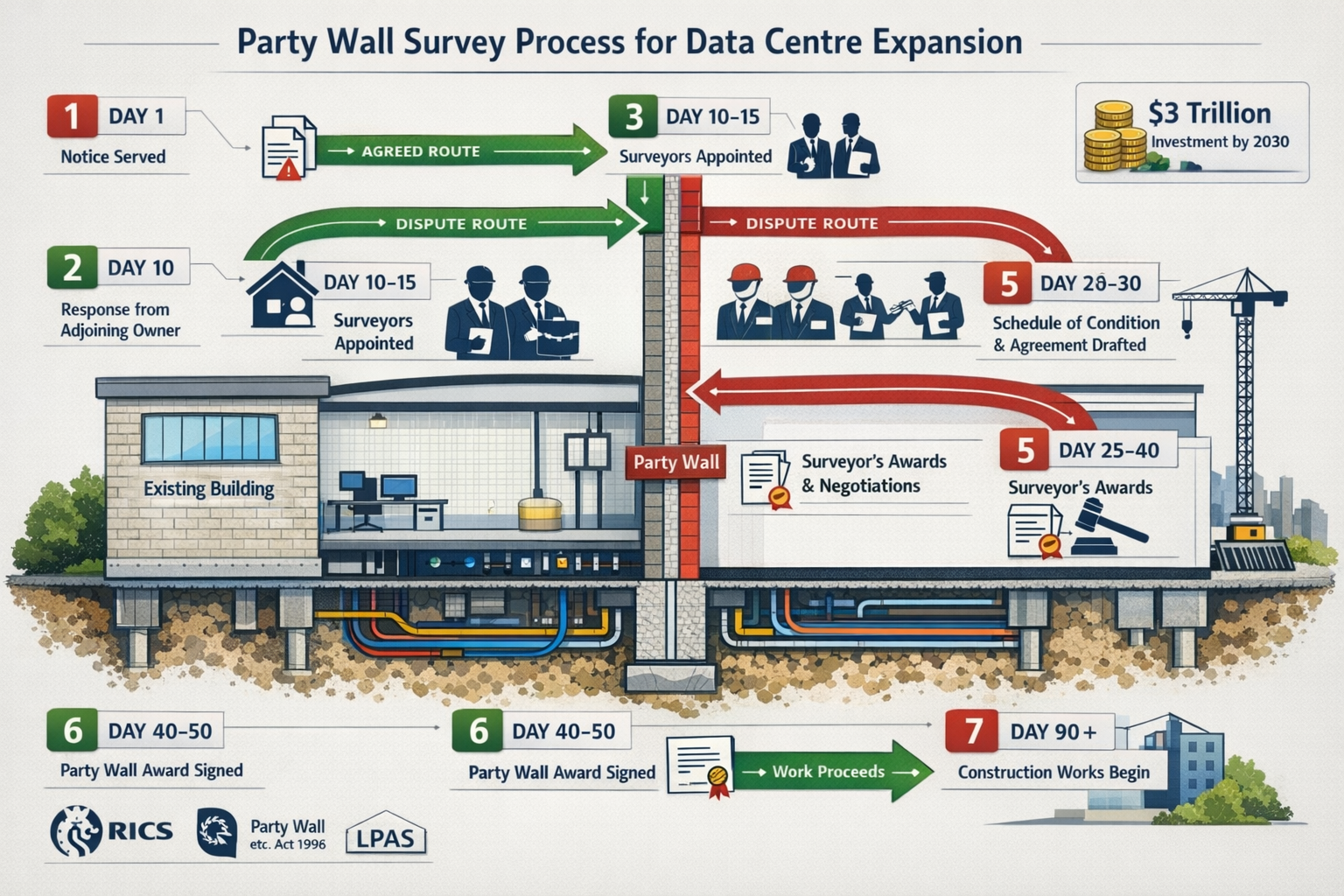
Award timeline for data centre projects:
- Days 1-14: Neighbour response period
- Days 15-21: Surveyor appointments (building owner's surveyor and adjoining owner's surveyor, or agreed surveyor)
- Days 22-45: Site inspections, condition surveys, technical review
- Days 46-60: Award drafting and negotiation
- Days 61-75: Award finalization and service
- Day 76+: Construction may commence (subject to appeal period)
Cost considerations: Data centre projects typically incur £3,000-£8,000 in surveyor fees per affected property, though complex cases involving multiple boundaries or technical disputes can exceed £15,000.
Addressing Common Challenges in Data Centre Party Wall Agreements
Challenge 1: Technical Complexity and Neighbour Understanding
Data centre construction involves specialized systems unfamiliar to most property owners:
- Liquid cooling infrastructure requiring deep excavation
- Backup generator installations with noise and vibration concerns
- Electrical substations and transformer installations
- 24/7 construction schedules to meet aggressive delivery timelines
Solution approach:
- Provide simplified visual explanations alongside technical drawings
- Offer site tours of similar completed facilities
- Engage community liaison officers for ongoing communication
- Prepare impact mitigation plans addressing specific neighbour concerns
Challenge 2: Construction Across Multiple Boundaries
With more than 35 gigawatts of capacity under construction across North America alone (with delivery anticipated in 2027-2028)[2], UK projects are similarly scaling up. Large campus developments may affect 10-20+ neighbouring properties simultaneously.
Management strategies:
- Centralized coordination: Appoint a lead surveyor to manage multiple awards consistently
- Standardized documentation: Create template awards adaptable to individual circumstances
- Phased notice serving: Stagger notices to manage surveyor workload and negotiation timelines
- Group information sessions: Address common concerns collectively while respecting individual rights
Challenge 3: Dealing with Absent or Unresponsive Owners
Regional data centre sites sometimes involve:
- Overseas property investors difficult to contact
- Corporate entities with complex decision-making hierarchies
- Disputed ownership requiring legal clarification
When no party wall notice can be served to an identifiable owner, developers must:
- Conduct reasonable searches through Land Registry and local records
- Attempt multiple contact methods (registered post, site visits, public notices)
- Apply to court for surveyor appointment if owner cannot be located
- Document all efforts to demonstrate compliance with statutory requirements
Challenge 4: Balancing Speed with Compliance
The pressure to deliver capacity quickly—driven by severe capacity constraints with vacancy rates at historic lows[2]—can tempt developers to cut corners. However, proceeding without proper party wall compliance risks:
- ⚠️ Injunctions halting construction entirely
- 💰 Retrospective awards with penalty costs
- ⚖️ Litigation from damaged neighbours
- 📉 Investor confidence loss affecting future funding
Best practice: Build comprehensive party wall timelines into project schedules from the outset, treating compliance as a critical path item rather than an administrative formality.
Specialized Considerations for 2026 Data Centre Developments
Sustainability and Party Wall Implications
Modern data centres increasingly incorporate renewable energy systems and advanced cooling technologies that create additional party wall considerations:
- Ground-source heat pumps requiring extensive excavation near boundaries
- Solar panel installations on shared roofs or walls
- Rainwater harvesting systems affecting drainage patterns
- Battery storage facilities with structural load implications
These sustainable features, while environmentally beneficial, must be fully disclosed in party wall notices with clear technical specifications.
Future-Proofing Party Wall Awards
Given the rapid evolution of data centre technology, awards should anticipate future modifications and expansions. Consider including provisions for:
- Phased development rights covering planned multi-year build-outs
- Technology upgrade allowances for equipment refreshes
- Capacity expansion frameworks enabling additional floors or annexes
- Decommissioning protocols for eventual facility retirement
Regional Regulatory Variations
While the Party Wall etc. Act 1996 applies throughout England and Wales, Scotland operates under different legislation (common law and specific statutory provisions). Data centre developers working across UK regions must understand these variations:
Scotland: No statutory party wall framework; relies on common law principles and Building (Scotland) Act requirements. Professional advice from Scottish-qualified surveyors is essential.
Northern Ireland: Separate party wall provisions under local legislation requiring specialized knowledge.
Wales: Party Wall etc. Act 1996 applies, but Welsh language notice requirements may apply in certain areas.
Cost-Benefit Analysis: Investing in Proper Party Wall Procedures
Direct Costs of Compliance
For a typical 10 MW data centre expansion affecting 5 neighbouring properties:
| Cost Category | Estimated Range |
|---|---|
| Party wall surveyor fees (building owner) | £15,000-£25,000 |
| Adjoining owners' surveyor fees (building owner pays) | £15,000-£40,000 |
| Condition surveys and documentation | £5,000-£10,000 |
| Legal review and advice | £8,000-£15,000 |
| Total compliance investment | £43,000-£90,000 |
Costs of Non-Compliance or Delays
Compare compliance costs against potential delay impacts:
- Construction delay: 60 days at $10.7 million per MW = approximately $107 million project value at risk
- Revenue delay: 60 days of 10 MW capacity at market rates = $400,000-$800,000 in lost revenue
- Litigation costs: Neighbour disputes can exceed £100,000-£500,000 in legal fees and settlements
- Reputational damage: Difficult to quantify but can affect future site acquisitions and community relations
The mathematics are clear: Investing £50,000-£90,000 in proper party wall procedures represents less than 0.1% of a typical data centre construction budget while mitigating risks worth millions.
Building a Party Wall Strategy for Multi-Site Data Centre Portfolios

Developing Standardized Protocols
Organizations planning multiple data centre developments across UK regions should establish:
1. Preferred surveyor networks
- Maintain relationships with RICS party wall surveyors in each target region
- Negotiate framework agreements for consistent service delivery
- Ensure surveyors understand data centre technical requirements
2. Template documentation libraries
- Standardized notice templates adaptable to specific projects
- Technical drawing packages explaining common data centre systems
- FAQ documents addressing typical neighbour concerns
- Award frameworks covering standard provisions
3. Internal compliance checklists
- Project milestone integration (party wall notices triggered at planning approval)
- Budget allocation protocols (surveyor fees in initial cost estimates)
- Risk assessment criteria (flagging high-risk boundaries early)
- Stakeholder communication plans (keeping investors informed of party wall status)
Learning from Precedent Cases
The 2026 investment surge provides opportunities to learn from early movers. Successful developers share these common practices:
✅ Early engagement: Beginning party wall processes before planning permission is finalized
✅ Transparent communication: Providing neighbours with comprehensive information packages
✅ Generous timelines: Adding 30-day buffers to statutory minimum notice periods
✅ Professional representation: Using experienced surveyors rather than attempting DIY approaches
✅ Documented everything: Maintaining detailed records of all communications and agreements
Conclusion: Turning Party Wall Compliance into Competitive Advantage
As the data centre sector navigates the 2026 investment surge—with $3 trillion in global investment required by 2030[1] and construction costs climbing to $11.3 million per MW[1]—Party Wall Surveys for Data Centre Expansions: Navigating Agreements in the 2026 Investment Surge represents both a critical compliance requirement and a strategic opportunity.
Developers who master party wall processes gain significant advantages:
- Faster project delivery through streamlined approvals and reduced disputes
- Cost predictability with accurate budgeting for surveyor fees and contingencies
- Enhanced reputation as responsible developers who respect neighbouring property rights
- Reduced legal risk through comprehensive documentation and professional guidance
- Improved community relations supporting future expansion plans
Actionable Next Steps for Data Centre Developers
For projects in planning stages:
- 📋 Commission boundary surveys identifying all potentially affected properties
- 🔍 Engage qualified party wall surveyors with data centre experience
- 📅 Build comprehensive party wall timelines into project schedules (6-9 months pre-construction)
- 💰 Allocate appropriate budgets (£10,000-£15,000 per affected property minimum)
For projects approaching construction:
- ✉️ Serve party wall notices immediately (don't wait for final planning approval)
- 🤝 Schedule neighbour consultation meetings to address concerns proactively
- 📸 Commission pre-construction condition surveys of all adjoining properties
- 📝 Prepare comprehensive impact mitigation plans for inclusion in awards
For organizations building multi-site portfolios:
- 🏗️ Develop standardized party wall protocols and template documentation
- 🤝 Establish relationships with regional surveyor networks across target markets
- 📊 Create internal tracking systems monitoring party wall compliance across all projects
- 🎓 Train project managers on party wall requirements and best practices
The unprecedented growth in data centre development throughout 2026 and beyond creates both challenges and opportunities. By treating party wall compliance as a strategic priority rather than an administrative burden, developers position themselves for success in this competitive, high-stakes sector.
Understanding the complete party wall process and working with experienced professionals ensures that legal requirements become project enablers rather than obstacles. As capacity constraints intensify and investment capital flows into UK regions beyond London, those who navigate party wall agreements efficiently will capture the greatest share of this historic infrastructure expansion.
References
[1] Data Center Outlook – https://www.jll.com/en-us/insights/market-outlook/data-center-outlook
[2] route-fifty – https://www.route-fifty.com/infrastructure/2026/02/data-center-growth-goes-full-steam-ahead-across-us/411549/
[3] 2026 Construction Outlook Mixed Trends – https://dailyreporter.com/2026/01/14/2026-construction-outlook-mixed-trends/
[4] Dc Delivery Constraints Data Centre Construction Implications For Enterprise Cloud Strategy In 2026 – https://www.cloudcomputing-news.net/news/dc-delivery-constraints-data-centre-construction-implications-for-enterprise-cloud-strategy-in-2026/
[5] Data Centres – https://www.brownejacobson.com/insights/2026-horizon-scanning-in-construction/data-centres
[6] Data Center Compliance In 2026 What Changed What S Next And How To Prepare – https://www.datacenterknowledge.com/compliance/data-center-compliance-in-2026-what-changed-what-s-next-and-how-to-prepare
