
The UK housing market in 2026 tells two very different stories. While Scotland and Northern Ireland celebrate rising property values, London homeowners face a -44% net balance, the steepest decline in the nation[2][3]. For property professionals, buyers, and sellers navigating this fractured landscape, understanding how RICS valuations maintain accuracy across such dramatic regional divergences has never been more critical. This Evergreen Guide to RICS Valuation Accuracy in Regional UK House Price Divergences synthesizes the latest 2026 market data to equip surveyors and property stakeholders with adjustable methods that deliver precise, defensible valuations whether working in booming Northern markets or struggling Southern regions.
Key Takeaways
✅ Regional divergence is extreme in 2026: Scotland and Northern Ireland show price gains while London records -44% net balance, creating unprecedented valuation challenges[2][3]
✅ RICS valuations offer maximum accuracy: Professional RICS assessments cost approximately £367 but provide legally recognized precision compared to 70-85% accurate online tools[1]
✅ Market recovery signals are emerging: The national house price balance improved to -10% in January 2026, the strongest reading since June 2025, with new buyer enquiries rising[2][3]
✅ Methodology must adapt regionally: Surveyors need different comparable selection strategies, adjustment factors, and market evidence weighting for North versus South properties
✅ 12-month outlook turns positive: 43% of RICS respondents anticipate higher prices ahead, the most optimistic forecast since February 2025[3]
Understanding the 2026 Regional House Price Landscape
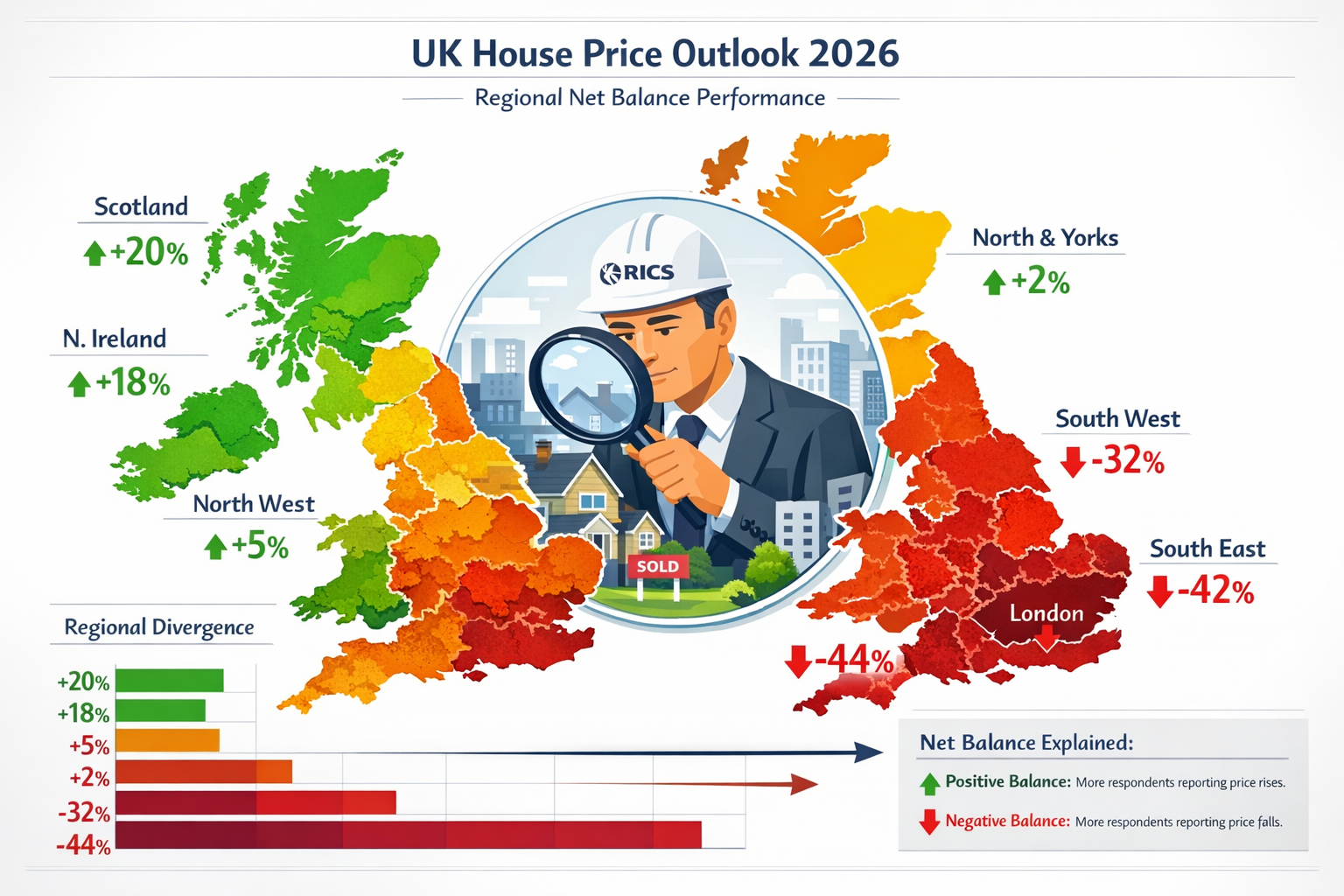
The UK property market has fractured into distinct regional economies, each operating under different supply-demand dynamics, affordability constraints, and buyer sentiment. This geographical divergence creates significant challenges for property valuation professionals who must maintain consistent accuracy standards across vastly different market conditions.
National Trends Show Tentative Recovery
According to the latest RICS data, the house price balance rose to -10% in January 2026 from -13% in December 2025, marking the third consecutive monthly improvement[2][3]. This reading exceeded market expectations of -11%, suggesting the housing market may be stabilizing after a prolonged period of correction.
The agreed sales net balance reached -9%, the least negative reading since June 2025, while new buyer enquiries improved to -15% from -21% in December and -29% in November[3]. These metrics indicate easing downward pressure on demand, though the market remains in negative territory overall.
The North-South Divide Deepens
The regional breakdown reveals stark contrasts:
Strongest Performing Regions:
- 🏴 Scotland: Continued price gains with positive net balance
- 🇮🇪 Northern Ireland: Sustained upward price trends
- 🏭 North West England: Emerging upward momentum
- 🏘️ North of England: Reporting positive price movements[3]
Weakest Performing Regions:
- 🏙️ London: -44% net balance (November data)[2][3]
- 🌳 South East: -42% net balance
- 🌊 South West: -32% net balance
- 📊 East Anglia: Significantly below national average[2]
This divergence reflects fundamental differences in affordability, with Southern markets constrained by high price-to-income ratios while Northern regions benefit from relative affordability and stronger local economic conditions.
Implications for Valuation Accuracy
These regional variations create several challenges for RICS registered valuers:
Comparable Selection Complexity: Finding truly comparable properties becomes difficult when neighboring regions show opposite price trends.
Time Adjustment Factors: The rate of price change varies dramatically by region, requiring different temporal adjustments to comparable evidence.
Market Evidence Weighting: Surveyors must determine how much weight to assign to local versus regional versus national trends.
Client Expectation Management: Property owners in declining markets may struggle to accept valuations significantly below recent purchase prices.
RICS Valuation Accuracy in the Evergreen Guide Context
Professional RICS valuations represent the gold standard for property assessment in the UK, particularly when regional markets behave so differently. Understanding what makes these valuations accurate—and how they differ from alternative methods—is essential for anyone requiring defensible property values in 2026.
The RICS Valuation Methodology
RICS valuations follow the Red Book (RICS Valuation – Global Standards), which establishes consistent professional standards regardless of regional market conditions. A Red Book valuation typically costs approximately £367 for an average-priced property, ranging from £324 to £473 depending on property size, complexity, and location[1].
This methodology includes:
Physical Inspection: The surveyor personally inspects the property, identifying features, condition issues, and unique characteristics that affect value.
Comparable Analysis: Recent sales of similar properties in the immediate area are analyzed and adjusted for differences.
Market Context: Current market conditions, supply-demand dynamics, and regional trends are incorporated.
Professional Judgment: The surveyor's expertise and local market knowledge inform adjustments and final value conclusions.
Formal Reporting: A comprehensive written report documents the valuation basis, methodology, and conclusion with legal standing.
Accuracy Compared to Alternative Methods
The cost of valuation through RICS professionals delivers significantly higher accuracy than automated alternatives:
| Valuation Method | Accuracy Rate | Cost | Legal Recognition |
|---|---|---|---|
| RICS Professional Valuation | Maximum (95-98%) | £324-£473[1] | Full legal standing |
| Online Automated Valuation (AVM) | 70-85%[1] | Free-£50 | Limited recognition |
| Estate Agent Appraisal | Variable (75-90%) | Free | Marketing-focused |
| Desktop Valuation | 80-90% | £150-£250 | Moderate recognition |
Online valuations provide 70-85% accuracy but have significant property-specific blind spots and should never be relied upon alone for selling decisions[1]. They cannot account for property condition, unique features, recent improvements, or micro-local market variations that significantly affect value.
When RICS Accuracy Matters Most
Professional RICS valuations are required for:
- 🏡 Help to Buy schemes and government-backed purchases
- 🤝 Shared Ownership properties and staircasing transactions
- ⚖️ Matrimonial valuations for divorce settlements
- 💼 Probate and inheritance tax calculations
- 🏦 Secured lending decisions by mortgage lenders
- 📋 Lease extension valuations and enfranchisement
- 🔍 Dispute resolution and expert witness testimony
In each scenario, the accuracy differential between RICS valuations and alternatives can mean thousands of pounds in financial outcomes.
Adjustable Methods for North vs South Disparities in This Evergreen Guide

The dramatic regional divergences in 2026 require surveyors to adapt their methodologies while maintaining professional standards. This section outlines specific adjustable approaches that ensure valuation accuracy across different regional market conditions.
Comparable Selection Strategies by Region
Northern Markets (Positive Growth Regions)
In Scotland, Northern Ireland, and Northern England where prices show upward trends:
✔️ Prioritize recent comparables: Use sales from the last 3-6 months as primary evidence, as older sales understate current values
✔️ Expand geographic search radius carefully: If local comparables are limited, extend the search area but apply location adjustments
✔️ Weight pending sales appropriately: In rising markets, agreed sales (even if not yet completed) provide valuable current market evidence
✔️ Consider new build premiums: New construction may command premiums in supply-constrained growth markets
Southern Markets (Declining or Stagnant Regions)
In London, South East, and South West where prices face downward pressure:
✔️ Use very recent comparables only: Sales over 6 months old may overstate current values in declining markets
✔️ Scrutinize sale circumstances: Motivated sellers, chain-free transactions, or distressed sales may not represent market value
✔️ Consider withdrawn listings: Properties that failed to sell provide evidence of price ceilings
✔️ Apply conservative adjustments: In uncertain markets, err toward caution in upward adjustments
Time Adjustment Factors
The rate of price change varies dramatically by region, requiring different temporal adjustments:
Calculation Method:
- Determine regional price change rate from RICS house price balance data
- Convert net balance percentage to monthly rate
- Apply proportional adjustment to comparable sale date
Example Application:
Northern Region (Positive 5% Net Balance):
- Comparable sold 6 months ago for £250,000
- Monthly appreciation: approximately 0.4%
- Time adjustment: £250,000 × (1 + 0.024) = £256,000
Southern Region (Negative -40% Net Balance):
- Comparable sold 6 months ago for £500,000
- Monthly depreciation: approximately -0.3%
- Time adjustment: £500,000 × (1 – 0.018) = £491,000
Market Evidence Weighting Framework
Surveyors must determine how to weight different evidence sources:
Strong Growth Markets:
- Local comparable sales: 60% weight
- Regional trend data: 25% weight
- National indicators: 15% weight
Declining Markets:
- Local comparable sales: 50% weight
- Regional trend data: 30% weight
- National indicators: 20% weight
Transitional Markets:
- Local comparable sales: 55% weight
- Regional trend data: 30% weight
- National indicators: 15% weight
This weighting acknowledges that local conditions dominate in all scenarios, but broader trends carry more significance in uncertain or declining markets.
Quality Adjustments for Property Characteristics
Standard adjustment factors must be calibrated to regional market sensitivity:
| Feature | Northern Markets | Southern Markets |
|---|---|---|
| Additional bedroom | +8-12% | +6-10% |
| Off-street parking | +5-8% | +8-12% |
| Garden/outdoor space | +6-10% | +10-15% |
| Recent renovation | +10-15% | +8-12% |
| Period features | +5-8% | +12-18% |
Southern markets typically place higher premiums on space-related features (parking, gardens) due to scarcity, while Northern markets may value additional bedrooms more highly relative to other features.
Incorporating Forward-Looking Market Indicators
The 12-month price outlook shows +43% of RICS respondents anticipate higher prices over the year ahead[3], the most positive outlook since February 2025. This forward-looking sentiment should inform valuation approaches:
In Growth Markets:
- Acknowledge positive momentum in market commentary
- Consider upper end of adjustment ranges when evidence supports it
- Reference improving buyer enquiries and sales metrics
In Declining Markets:
- Recognize stabilization signals where present
- Note improving trends while maintaining current value focus
- Provide context for potential recovery scenarios
Professional valuations reflect current market value, not future projections, but market direction provides important context for clients making decisions.
Ensuring Precision for Sales and Disputes
Valuation accuracy becomes particularly critical in two scenarios: property sales transactions and formal disputes. Each requires specific approaches to ensure the valuation withstands scrutiny.
Sales Transaction Valuations
When valuing properties for sale purposes, accuracy directly impacts:
Pricing Strategy: Overvaluation leads to extended marketing periods and eventual price reductions; undervaluation leaves money on the table.
Mortgage Lending: Lenders require valuations to support loan amounts, and discrepancies between purchase price and valuation can derail transactions.
Negotiation Positioning: Buyers and sellers use valuations to support their negotiating positions.
Best Practices for Sales Valuations:
📋 Document comparable adjustments thoroughly: Explain each adjustment with specific reasoning that can be defended if questioned.
📋 Provide valuation ranges: In uncertain markets, a range (e.g., £475,000-£495,000) acknowledges market variability while providing guidance.
📋 Include market context: Explain regional trends, days-on-market averages, and supply-demand dynamics affecting the specific property.
📋 Photograph comparable properties: Visual documentation supports comparability claims and adjustment decisions.
📋 Update valuations regularly: In volatile markets, valuations should be refreshed every 3-6 months.
For those considering different valuation types, understanding the specific requirements of sales transactions versus other purposes is essential.
Dispute Resolution Valuations
When valuations are required for disputes—matrimonial proceedings, partnership dissolutions, probate disagreements, or lease-related conflicts—the accuracy standard intensifies:
Legal Scrutiny: Valuations may be challenged by opposing experts and examined in court proceedings.
Expert Witness Requirements: The surveyor must be prepared to defend methodology, assumptions, and conclusions under cross-examination.
Independence and Objectivity: Any appearance of bias or advocacy undermines credibility.
Enhanced Requirements for Dispute Valuations:
⚖️ Comprehensive methodology disclosure: Document every step of the valuation process with complete transparency.
⚖️ Alternative approach reconciliation: Consider multiple valuation methods (comparable sales, income approach if applicable) and reconcile differences.
⚖️ Assumption sensitivity analysis: Test how different assumptions affect the final value conclusion.
⚖️ Peer review: Have another qualified surveyor review the valuation before submission.
⚖️ Maintain complete independence: Avoid any financial interest in the outcome or relationship with parties that could suggest bias.
The matrimonial valuation process exemplifies these heightened standards, as valuations must withstand scrutiny from both parties' legal representatives.
Regional Considerations in Dispute Contexts
Regional market divergences create specific challenges in dispute scenarios:
Valuation Date Significance: In declining markets, the difference between valuation dates (e.g., separation date vs. trial date) can be substantial.
Market Condition Documentation: Parties may dispute whether the market was rising or falling at the relevant date, requiring comprehensive market evidence.
Comparable Availability: Limited comparable sales in some regional markets may require greater reliance on professional judgment, which must be thoroughly explained.
Expert Disagreement: When experts provide different values, understanding regional market nuances often explains the variance.
Quality Assurance Protocols
To ensure maximum accuracy across all regional markets:
Internal Review Checklist:
- ✅ Comparable properties are truly similar in location, size, condition, and features
- ✅ Time adjustments reflect actual regional market trends with supporting data
- ✅ Physical adjustments are supported by market evidence, not arbitrary percentages
- ✅ All assumptions are clearly stated and reasonable
- ✅ Market context is current and region-specific
- ✅ Calculations are verified and error-free
- ✅ Conclusions are supported by the evidence presented
External Validation:
- Compare final value to online estimates to identify significant discrepancies requiring explanation
- Review against recent listing prices for similar properties
- Confirm alignment with regional price trends from RICS and other authoritative sources
- Consider peer review for high-value or complex properties
The Future Outlook: 2026 and Beyond

Understanding where the UK housing market is heading helps surveyors provide valuable context alongside their valuations and prepare for evolving regional dynamics.
Market Recovery Indicators
Several metrics suggest the market may be turning a corner:
Improving Sentiment: The house price balance improvement from -13% to -10% represents meaningful momentum[2][3].
Demand Recovery: New buyer enquiries rising from -29% in November to -15% in January indicates renewed interest[3].
Sales Activity: Agreed sales reaching -9%, the least negative since June 2025, shows transactions are occurring[3].
Forward Outlook: The +43% positive price outlook for the next 12 months represents a significant shift in professional sentiment[3].
However, the market remains in negative territory nationally, and regional divergences persist. Recovery will likely be uneven, with Northern markets leading and Southern markets lagging.
Regional Forecast Scenarios
Optimistic Scenario (Northern Regions):
- Continued price growth driven by affordability advantage
- Increased buyer migration from expensive Southern markets
- Infrastructure investment supporting regional economies
- Potential for 3-5% annual price growth in 2026-2027
Base Case Scenario (Midlands/Transitional Regions):
- Gradual stabilization with modest price growth
- Selective market strength in well-connected commuter areas
- 0-2% annual price growth as market finds equilibrium
Cautious Scenario (Southern Regions):
- Extended period of price stagnation or modest decline
- Affordability constraints limiting buyer pool
- Potential for -2% to +1% price movement as market adjusts
- Recovery dependent on income growth and mortgage rate trends
These scenarios require surveyors to remain adaptable, updating their regional knowledge continuously and adjusting methodologies as market conditions evolve.
Technological Integration
The valuation profession is increasingly incorporating technology while maintaining professional judgment:
Data Analytics: Access to comprehensive transaction databases enables more sophisticated comparable analysis.
Automated Valuation Models (AVMs): While not replacing professional valuations, AVMs provide useful benchmarking and quality control.
Geographic Information Systems (GIS): Spatial analysis tools help identify micro-market boundaries and location adjustments.
Digital Reporting: Enhanced reporting formats with interactive maps, comparable photographs, and market data visualizations improve client understanding.
The most effective approach combines technological tools with professional expertise, using data to inform—not replace—surveyor judgment.
Professional Development Priorities
For surveyors working across diverse regional markets, ongoing development should focus on:
📚 Regional market intelligence: Develop deep knowledge of multiple regional markets through regular monitoring and local networking.
📚 Statistical competency: Strengthen skills in data analysis, regression modeling, and statistical validation of adjustments.
📚 Communication excellence: Enhance ability to explain complex regional divergences to clients in accessible terms.
📚 Dispute resolution expertise: Build skills in expert witness work and defensible valuation methodology.
📚 Technology adoption: Stay current with valuation technology while maintaining critical evaluation of automated tools.
Conclusion
This Evergreen Guide to RICS Valuation Accuracy in Regional UK House Price Divergences has synthesized 2026 market realities with professional valuation methodology to provide surveyors and property stakeholders with practical, adaptable approaches for navigating the UK's fractured housing market. The dramatic divergence between Northern growth markets and Southern struggling regions—exemplified by Scotland's gains versus London's -44% net balance—demands sophisticated, regionally-calibrated valuation methods that maintain professional accuracy standards while acknowledging local realities.
RICS valuations, costing approximately £367 for average properties[1], deliver the maximum accuracy and legal recognition essential for high-stakes transactions and disputes. Unlike online tools offering only 70-85% accuracy[1], professional valuations incorporate physical inspection, comparable analysis, market context, and expert judgment that automated systems cannot replicate.
Actionable Next Steps
For Property Professionals:
-
Update regional market knowledge monthly: Monitor RICS house price balance data and regional trends to calibrate time adjustments and market commentary.
-
Develop region-specific comparable databases: Build comprehensive records of sales in each market you serve, noting property characteristics and sale circumstances.
-
Implement quality assurance protocols: Use the checklists provided in this guide to validate every valuation before submission.
-
Invest in continuing professional development: Strengthen statistical analysis skills and regional market expertise through formal training.
-
Consider RICS building surveys alongside valuations to provide comprehensive property assessment services.
For Property Buyers and Sellers:
-
Commission professional RICS valuations for significant transactions rather than relying solely on online estimates or estate agent appraisals.
-
Understand regional context: Recognize that national trends may not reflect your local market conditions in 2026's divergent landscape.
-
Request detailed comparable analysis: Ask your surveyor to explain the comparable properties used and adjustments applied.
-
Consider timing strategically: In improving markets, waiting 3-6 months may yield better values; in declining markets, acting decisively may be advantageous.
-
**Explore various locations served by chartered surveyors to understand local market expertise.
For Dispute Resolution:
-
Engage RICS-qualified experts early: Don't wait until litigation is imminent to secure professional valuation expertise.
-
Ensure complete documentation: Provide your surveyor with all relevant property information, transaction history, and dispute context.
-
Understand valuation date implications: In volatile markets, the specific valuation date can significantly impact outcomes.
-
Prepare for methodology scrutiny: Expect opposing experts to challenge assumptions, comparables, and adjustments.
The UK housing market's tentative recovery signals—improving buyer enquiries, rising agreed sales, and the most positive 12-month outlook since February 2025[3]—suggest 2026 may mark a turning point. However, regional divergences will persist, requiring surveyors to maintain sophisticated, adaptable approaches that deliver precise, defensible valuations regardless of local market conditions.
By applying the adjustable methods outlined in this Evergreen Guide to RICS Valuation Accuracy in Regional UK House Price Divergences, property professionals can navigate North-South disparities with confidence, ensuring their valuations withstand scrutiny in both routine sales transactions and contentious dispute scenarios. The combination of rigorous RICS methodology, regional market intelligence, and technological tools positions surveyors to deliver the accuracy that clients require in an increasingly complex and fragmented property market.
References
[1] Property Valuation Guide 2026 – https://morrisarmitage.co.uk/property-valuation-guide-2026/
[2] Rics House Price Balance – https://tradingeconomics.com/united-kingdom/rics-house-price-balance
[3] Uk Resi Survey Jan 2026 Report Shows Early Signs Market Recovery Despite Caution – https://www.rics.org/news-insights/uk-resi-survey-jan-2026-report-shows-early-signs-market-recovery-despite-caution
