
When a city announces plans to upgrade aging water mains running beneath residential streets, property owners often face an unexpected challenge: their private boundaries intersect with critical public infrastructure. As municipalities across the UK accelerate water system improvements in 2026, Party Wall Agreements for Water Infrastructure Expansions 2026: Survey Protocols for Municipal Projects have become essential tools for balancing public necessity with private property rights. These specialized agreements ensure that utility expansions proceed smoothly while protecting homeowners from structural damage and financial liability.
The intersection of municipal infrastructure needs and private property boundaries creates unique legal and technical challenges. Unlike typical residential party wall scenarios, water infrastructure projects involve complex engineering requirements, regulatory compliance, and the involvement of multiple stakeholders. Understanding the proper survey protocols and notice procedures has never been more critical.
Key Takeaways
✅ Municipal water infrastructure projects crossing property boundaries require formal party wall procedures, even when undertaken by public authorities, protecting both property owners and utility providers.
✅ Specialized survey protocols for water infrastructure differ significantly from residential party wall work, incorporating condition assessments, monitoring requirements, and compliance with EPA standards for 2026.
✅ Professional surveyors serve as mediators between municipal authorities and property owners, ensuring fair awards that address construction impacts while enabling essential infrastructure upgrades.
✅ Early notification and documentation are crucial—municipal projects must follow strict timelines for party wall notices, typically 60-90 days before construction commences.
✅ Cost allocation frameworks in water infrastructure party wall agreements differ from residential projects, with municipalities typically bearing surveyor fees while maintaining accountability for damage remediation.
Understanding Party Wall Requirements for Municipal Water Projects
The Legal Framework for Infrastructure Expansions
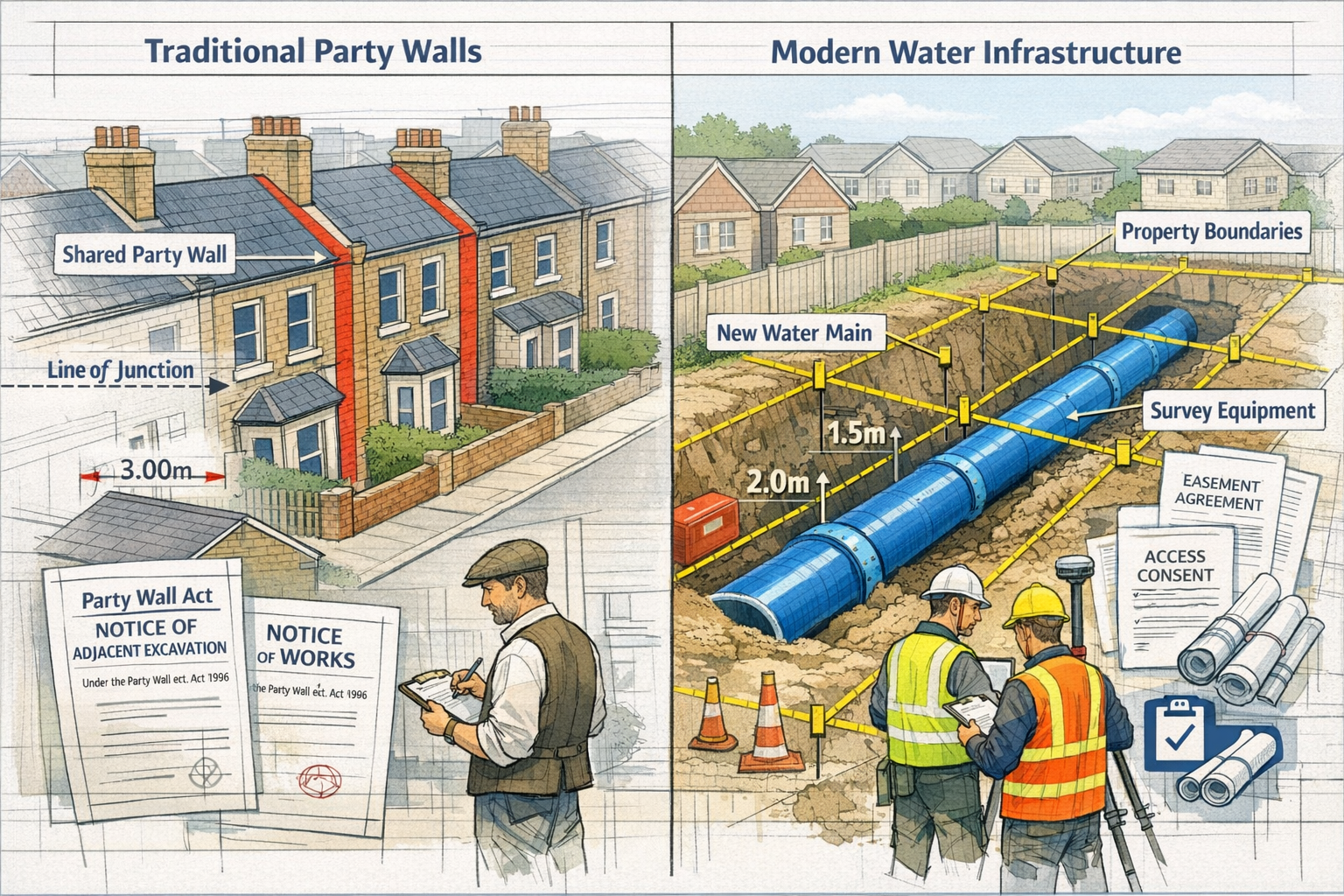
Municipal water infrastructure expansions in 2026 operate under a complex regulatory framework that combines traditional party wall legislation with modern environmental and utility standards. While the Party Wall etc. Act 1996 primarily addresses private property disputes, its principles extend to public infrastructure projects that affect private boundaries.
Key legislative considerations include:
- Statutory authority: Water companies and municipal utilities possess statutory powers to access private land for infrastructure work, but these powers don't eliminate party wall obligations
- Environmental compliance: EPA's 2026 Municipal Separate Storm Sewer System (MS4) permit updates impose additional monitoring and documentation requirements[1]
- Lead service line replacement: National water program goals prioritize replacing lead infrastructure, accelerating the pace of invasive boundary work[2]
- State-level variations: Local jurisdictions may impose additional notice requirements beyond federal standards
The integration of party wall protocols with utility regulations creates a dual compliance framework. Municipal projects must satisfy both property law requirements and environmental protection standards, making qualified party wall surveyors essential to navigate these overlapping obligations.
When Water Infrastructure Triggers Party Wall Procedures
Not all municipal water work requires party wall agreements. Understanding the specific triggers helps property owners and municipalities identify when formal procedures apply.
Scenarios requiring party wall agreements:
🔧 Excavation within 3 meters of neighboring foundations that extends below foundation depth
💧 Installation of new water mains requiring trenching along shared boundary lines
🏗️ Replacement of aging infrastructure necessitating temporary support structures on adjacent properties
⚡ Combined water and storm sewer systems requiring extensive excavation affecting multiple properties
📊 Pressure testing and monitoring installations requiring permanent access points on private land
The EPA's updated MS4 permit requirements for 2026 include enhanced benchmark monitoring for impaired waters, which may necessitate additional access to private properties for water quality testing equipment[1]. These installations, while temporary, can trigger party wall obligations if they involve structural modifications or boundary excavations.
Distinguishing Municipal Projects from Residential Party Wall Work
Party Wall Agreements for Water Infrastructure Expansions 2026: Survey Protocols for Municipal Projects differ substantially from typical residential applications. These distinctions affect everything from notice periods to award terms.
| Aspect | Residential Party Wall | Municipal Water Infrastructure |
|---|---|---|
| Project scale | Single boundary, 2-3 properties | Multiple properties, extended corridors |
| Timeline | Weeks to months | Months to years with phased work |
| Regulatory oversight | Local building control | EPA, state agencies, utility regulators |
| Cost responsibility | Building owner | Typically municipal authority |
| Access requirements | Limited, specific work periods | Extended, may include permanent easements |
| Technical complexity | Structural only | Structural + environmental + utility standards |
Municipal projects also face unique challenges related to public accountability and budget constraints. Unlike private developers, water authorities must balance infrastructure needs against taxpayer costs while maintaining service continuity. This creates additional pressure on party wall surveyors to craft efficient, fair agreements.
Survey Protocols for Water Infrastructure Party Wall Assessments
Pre-Construction Condition Surveys: Enhanced Standards
The foundation of any party wall agreement lies in comprehensive pre-construction condition surveys. For water infrastructure projects, these assessments require enhanced protocols that account for the unique risks of utility work.
Essential survey components include:
-
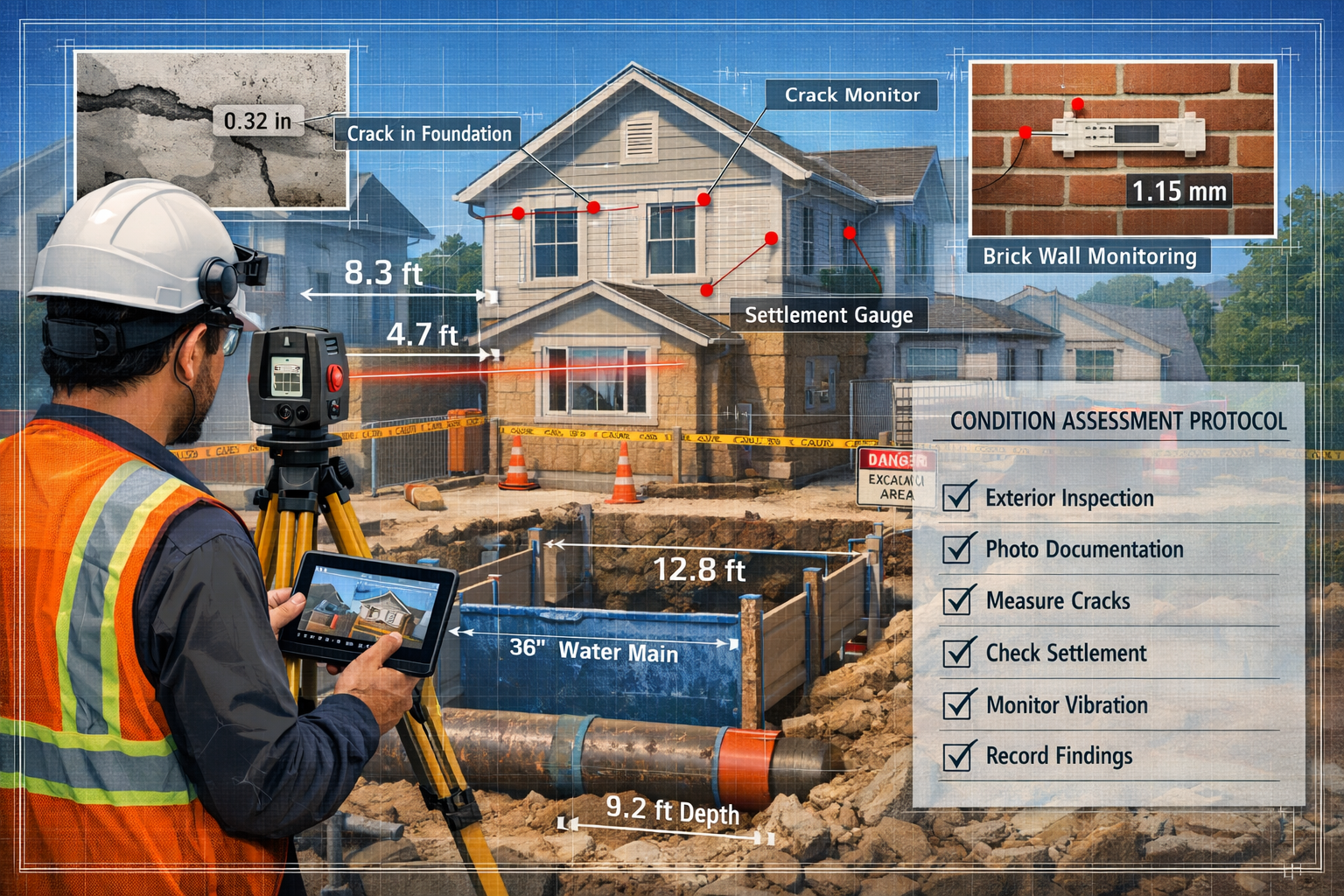
Structural integrity assessment: Detailed documentation of foundation conditions, wall stability, and existing defects in properties within the zone of influence
-
Photographic evidence: High-resolution imagery of all potentially affected areas, including basements, exterior walls, driveways, and landscaping
-
Vibration sensitivity analysis: Identification of vulnerable features (plaster, historic materials, sensitive equipment) that may be affected by excavation vibration
-
Utility mapping: Documentation of existing private utility connections that may intersect with municipal work
-
Groundwater and drainage evaluation: Assessment of existing drainage patterns and potential impacts from dewatering operations
-
Environmental baseline: Soil and water quality documentation, particularly important given EPA's 2026 emphasis on impaired waters protection[1]
Professional surveyors conducting these assessments must possess expertise beyond typical residential party wall work. Understanding soil mechanics, groundwater behavior, and utility engineering becomes essential when evaluating potential impacts from deep excavations and pressurized water systems.
Monitoring Protocols During Active Construction
Unlike residential renovations that might last weeks, municipal water infrastructure projects often extend across months or years. This extended timeline necessitates robust monitoring protocols to detect and address issues before they escalate.
Recommended monitoring frameworks:
📍 Structural movement monitoring: Installation of crack gauges, settlement markers, and periodic level surveys to track any building movement
📊 Vibration monitoring: Real-time sensors during high-impact activities like pile driving or rock breaking, with predetermined threshold limits
💧 Groundwater level tracking: Monitoring wells to ensure dewatering operations don't cause settlement in adjacent properties
🔍 Weekly visual inspections: Regular site visits by appointed surveyors during active excavation phases
📸 Photographic progression: Dated imagery documenting work stages and property conditions throughout construction
The frequency and intensity of monitoring should be proportionate to risk. Properties with shallow foundations, historic construction, or previous structural issues warrant more intensive oversight. RICS party wall surveyors typically establish monitoring schedules in the initial party wall award, with provisions for increased frequency if concerning trends emerge.
Post-Completion Verification and Remediation
The conclusion of construction doesn't end party wall obligations. Post-completion surveys verify that properties remain in substantially the same condition as documented pre-construction, accounting for reasonable wear and tear.
Post-completion protocol steps:
✅ Final condition survey: Comprehensive reassessment using identical methodology to pre-construction survey
✅ Comparative analysis: Side-by-side review of before/after documentation to identify any construction-related damage
✅ Remediation scheduling: Development of repair schedules for any identified damage, with cost allocation according to the party wall award
✅ Permanent works verification: Confirmation that all permanent infrastructure installations comply with award specifications
✅ Landscaping and surface restoration: Verification that driveways, gardens, and other surface features are properly restored
Green Communities certification criteria emphasize water conservation in buildings, which may influence remediation standards when municipal work affects private water systems[3]. Surveyors should ensure that any repairs or replacements meet current efficiency standards, potentially upgrading systems beyond their original condition.
Notice Procedures and Award Frameworks for Municipal Projects
Serving Party Wall Notices for Infrastructure Work
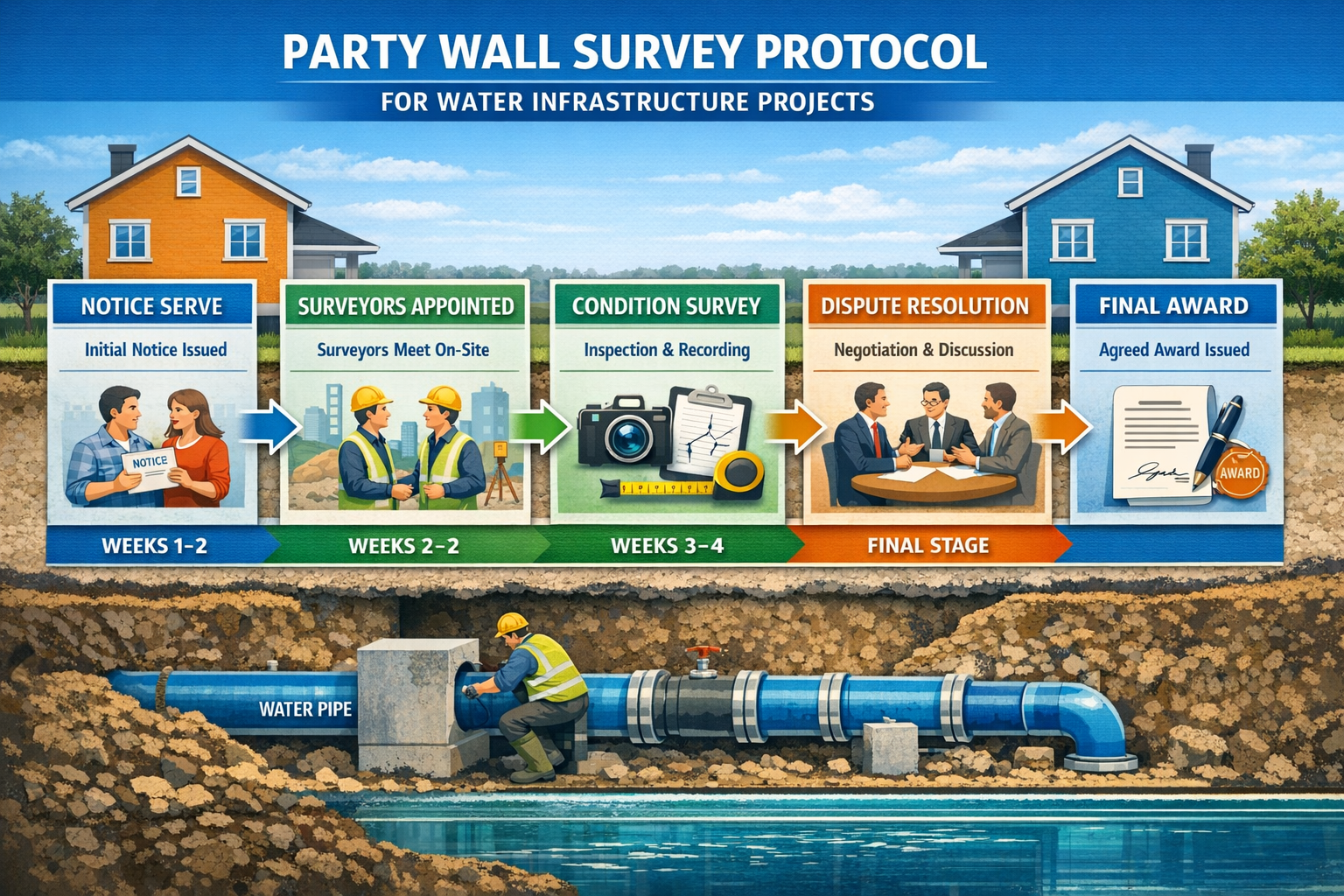
The notice process for Party Wall Agreements for Water Infrastructure Expansions 2026: Survey Protocols for Municipal Projects follows statutory requirements while accommodating the scale and complexity of municipal work.
Notice timeline and requirements:
⏰ Minimum notice periods:
- Two months for excavation work
- One month for work directly to party walls or structures
- Extended periods advisable for large-scale infrastructure projects (60-90 days recommended)
📝 Notice content must specify:
- Exact nature and extent of proposed work
- Expected start date and project duration
- Plans showing excavation depths and proximity to boundaries
- Contact information for the building owner (municipal authority)
- Rights of adjoining owners to consent or dissent
🏘️ Multiple property considerations: When projects affect numerous properties, municipalities may use standardized notice forms, but each must be individually served and tracked
Given the fragmentation of water supply management structures across municipalities[5], coordination between different governmental entities becomes crucial. A single project might involve the water authority, city engineering department, and county utilities, each with different legal standing. Understanding when party wall agreements are legally required helps clarify which entity bears responsibility for notice service.
Appointing Surveyors in Municipal Infrastructure Cases
The surveyor appointment process for large-scale infrastructure projects presents unique challenges. Unlike residential scenarios with two parties, municipal projects may involve dozens of affected property owners.
Appointment frameworks:
Option 1: Agreed Surveyor Model
- Single surveyor acts for both municipality and all affected owners
- Efficient for straightforward projects with minimal dispute risk
- Requires unanimous consent from all parties
- Cost-effective but may create perceived conflicts of interest
Option 2: Dual Surveyor Model
- Municipality appoints one surveyor
- Affected owners collectively appoint another surveyor
- The two surveyors work together and may appoint a third surveyor if disputes arise
- Provides stronger advocacy for property owners but increases costs
Option 3: Hybrid Approach
- Agreed surveyor for low-risk properties
- Individual surveyors for high-risk or complex situations
- Balances efficiency with appropriate protection
Who pays for party wall surveyors becomes particularly important in municipal projects. Typically, the building owner (the municipality) bears all reasonable surveyor fees, but budget constraints may create pressure to minimize costs. Professional surveyors must balance efficiency with thoroughness, ensuring adequate protection without unnecessary expense.
Drafting Awards for Water Infrastructure Expansions
Party wall awards for municipal infrastructure projects must address complexities beyond typical residential agreements. These documents serve as binding contracts governing work execution, monitoring, and remediation.
Critical award provisions:
📋 Scope of permitted work: Detailed specifications of excavation depths, support methods, equipment limitations, and construction techniques
⏱️ Work hours and access: Permitted construction hours, weekend/holiday restrictions, and advance notice requirements for property access
🛡️ Protection measures: Required temporary supports, vibration limits, dust suppression, and noise mitigation
💰 Cost allocation: Clear framework for who pays surveyor fees, monitoring costs, and potential remediation expenses
🔧 Remediation standards: Specifications for repair quality, materials matching, and timeline for completing remedial work
⚖️ Dispute resolution: Procedures for addressing disagreements during construction, including third surveyor appointment mechanisms
📊 Monitoring and reporting: Frequency of surveys, reporting formats, and threshold triggers for work suspension
EPA rule changes affecting state water quality challenges may impose additional requirements that must be incorporated into party wall awards[4]. For example, if work affects areas with impaired water quality, awards might include specific environmental protection measures beyond standard construction protocols.
Special Considerations for Phased Infrastructure Projects
Many municipal water infrastructure expansions proceed in phases over several years. This creates unique challenges for party wall agreements.
Phased project strategies:
🔄 Master agreement approach: Single comprehensive award covering all anticipated phases, with activation triggers for each stage
📅 Phase-specific awards: Separate notices and awards for each construction phase, allowing flexibility as project scope evolves
🔍 Condition survey timing: Decision points for whether to conduct new baseline surveys for each phase or rely on previous documentation
💡 Adaptive monitoring: Frameworks for adjusting monitoring intensity based on observed impacts from earlier phases
The fragmented nature of water governance structures means that different phases might be managed by different entities[5]. Awards should clearly specify how responsibility transfers between phases and which entity bears ongoing obligations.
Mediating Disputes in Municipal Infrastructure Party Wall Cases
Common Dispute Scenarios and Prevention Strategies
Despite best efforts, disputes arise in complex infrastructure projects. Understanding common conflict points enables proactive prevention.
Frequent dispute triggers:
⚠️ Access disagreements: Property owners restricting access beyond reasonable limits, or municipalities demanding excessive access rights
⚠️ Timeline conflicts: Construction delays affecting property owners' plans, or owner-imposed restrictions delaying critical public infrastructure
⚠️ Damage attribution: Disputes over whether observed damage resulted from construction or pre-existing conditions
⚠️ Remediation standards: Disagreements about repair quality or whether improvements beyond original condition are warranted
⚠️ Cost recovery: Conflicts over which expenses are "reasonable" and recoverable under party wall provisions
Prevention strategies include:
✅ Overcommunication: Regular updates to affected property owners about project progress and upcoming high-impact activities
✅ Transparent documentation: Comprehensive photographic and written records that clearly establish baseline conditions
✅ Reasonable flexibility: Municipalities accommodating reasonable owner requests for scheduling or access modifications
✅ Prompt response protocols: Established procedures for addressing owner concerns within defined timeframes
✅ Community liaison officers: Dedicated municipal staff serving as single points of contact for affected residents
Professional party wall dispute resolution requires surveyors to balance advocacy with pragmatism, seeking solutions that enable essential infrastructure work while fairly protecting property rights.
The Surveyor's Mediation Role in Infrastructure Projects
Surveyors appointed for municipal infrastructure party wall agreements serve dual roles as technical experts and mediators. This mediation function becomes particularly critical when public interest in infrastructure improvements conflicts with private property concerns.
Effective mediation practices:
🤝 Neutral facilitation: Even when appointed by one party, maintaining objectivity and focusing on fair outcomes
📊 Data-driven decision-making: Grounding recommendations in objective measurements and industry standards rather than emotional positions
💬 Active listening: Understanding underlying concerns that may not be explicitly stated in formal objections
🎯 Creative problem-solving: Identifying alternative approaches that satisfy both infrastructure needs and property protection
📜 Clear communication: Translating technical and legal complexities into accessible language for all stakeholders
The complete party wall process for infrastructure projects often involves community meetings, individual consultations, and ongoing dialogue throughout construction. Surveyors who excel in these environments combine technical expertise with strong interpersonal skills.
Third Surveyor Appointments and Final Determinations
When appointed surveyors cannot reach agreement, the Party Wall Act provides for third surveyor appointment. This mechanism becomes particularly important in municipal projects where public and private interests may fundamentally conflict.
Third surveyor considerations:
🎓 Enhanced expertise requirements: Third surveyors for infrastructure cases should possess specialized knowledge of utility construction, geotechnical engineering, and municipal law
⚖️ Balancing public and private interests: Recognizing legitimate public infrastructure needs while protecting individual property rights
💼 Expedited timelines: Infrastructure projects often operate under tight schedules; third surveyors must work efficiently without compromising thoroughness
📋 Precedent awareness: Understanding how determinations may affect similar future projects across the municipality
💰 Cost implications: Third surveyor fees add to project costs; their involvement should resolve disputes definitively rather than prolonging conflict
Recent regulatory changes, including EPA rules to speed project approvals, create pressure to minimize delays[4]. However, rushing party wall procedures risks inadequate property protection and subsequent litigation that ultimately causes greater delays.
Emerging Trends and Future Considerations for 2026
Integration with Smart City Infrastructure
As municipalities modernize water systems in 2026, many projects incorporate smart monitoring technologies. These installations create new party wall considerations.
Smart infrastructure implications:
📡 Permanent sensor installations: Water quality monitors, pressure sensors, and flow meters may require ongoing access to private property
🔌 Power and connectivity requirements: Smart devices need electrical connections and data transmission capabilities, potentially affecting property boundaries
🖥️ Data privacy concerns: Sensors monitoring water usage or quality near private properties raise privacy questions that party wall awards should address
🔧 Maintenance access: Unlike traditional infrastructure requiring infrequent access, smart systems may need regular servicing
Party wall agreements should specify the scope, duration, and limitations of access rights for smart infrastructure, distinguishing between construction access and ongoing operational requirements.
Climate Resilience and Adaptive Infrastructure
Climate change drives infrastructure investments in flood management, drought resilience, and extreme weather protection. These projects often involve extensive work affecting multiple properties.
Climate-driven infrastructure considerations:
🌊 Green infrastructure installations: Rain gardens, bioswales, and permeable surfaces that may cross property boundaries
💧 Stormwater management systems: Enhanced capacity requirements under updated MS4 permits[1]
🏗️ Flood barrier installations: Temporary or permanent flood protection affecting shared boundaries
♻️ Water recycling systems: Greywater and rainwater harvesting infrastructure serving multiple properties
These projects align with water conservation goals emphasized in green building standards[3], but their boundary-crossing nature requires careful party wall management.
Regulatory Evolution and Compliance Frameworks
The regulatory landscape for water infrastructure continues evolving. Party wall surveyors must stay current with changing requirements.
2026 regulatory focus areas:
✅ Lead service line replacement acceleration: National programs prioritizing lead removal will increase invasive boundary work[2]
✅ Enhanced environmental monitoring: Stricter impaired waters protection requiring additional assessment protocols[1]
✅ Streamlined approval processes: Regulatory changes limiting state challenges to federal permits may accelerate project timelines[4]
✅ Equity and environmental justice: Increased focus on ensuring infrastructure improvements benefit disadvantaged communities
These regulatory shifts affect party wall procedures by changing project scopes, timelines, and documentation requirements. Surveyors must integrate compliance obligations into traditional party wall frameworks.
Conclusion
Party Wall Agreements for Water Infrastructure Expansions 2026: Survey Protocols for Municipal Projects represent a critical intersection of property law, municipal engineering, and public policy. As aging water systems demand urgent upgrades and climate pressures accelerate infrastructure investment, the volume and complexity of these projects will only increase.
Successful navigation of this landscape requires specialized expertise that extends beyond traditional party wall knowledge. Professional surveyors must understand utility engineering, environmental regulations, municipal governance structures, and community engagement alongside conventional structural assessment skills.
Key Success Factors
🎯 Early engagement: Municipalities should initiate party wall procedures well before construction timelines pressure decision-making
📋 Comprehensive documentation: Thorough baseline surveys and ongoing monitoring protect all parties from disputes
🤝 Collaborative approaches: Viewing party wall procedures as partnership opportunities rather than adversarial requirements
⚖️ Balanced frameworks: Awards that enable essential infrastructure while genuinely protecting property rights
💡 Adaptive strategies: Flexibility to adjust procedures as projects evolve and new challenges emerge
Actionable Next Steps
For Property Owners:
- Stay informed about planned municipal infrastructure projects in your area
- Respond promptly to party wall notices, seeking professional surveyor advice when needed
- Document your property's current condition before construction begins
- Maintain open communication with municipal project managers
For Municipal Authorities:
- Integrate party wall procedures into project planning from the earliest stages
- Budget adequately for surveyor fees and potential remediation costs
- Establish clear internal protocols for notice service and award compliance
- Invest in community liaison resources to facilitate smooth property owner relations
For Professional Surveyors:
- Develop specialized expertise in utility construction and municipal infrastructure
- Build relationships with water authorities and engineering departments
- Stay current on evolving environmental and utility regulations
- Cultivate mediation skills alongside technical competencies
The infrastructure challenges facing municipalities in 2026 and beyond are substantial. Water system upgrades cannot be delayed without risking public health and environmental harm. Yet these essential improvements must proceed in ways that respect property rights and protect individual homeowners from unfair burden.
Well-executed party wall procedures provide the framework for achieving both objectives. By following established protocols, engaging qualified professionals, and maintaining focus on fair outcomes, municipalities and property owners can work together to build the resilient water infrastructure our communities need.
The surveyor's role in this process—as technical expert, mediator, and guardian of both public and private interests—has never been more important. As infrastructure demands grow and regulatory requirements evolve, the principles underlying party wall law remain constant: neighbor should not harm neighbor, work should proceed with proper notice and protection, and disputes should be resolved fairly through professional expertise rather than litigation.
References
[1] Proposed 2026 Msgp Fact Sheet – https://www.epa.gov/system/files/documents/2024-12/proposed-2026-msgp-fact-sheet.pdf
[2] Fy 2025 2026 Ow Npg – https://www.epa.gov/system/files/documents/2024-07/fy-2025-2026-ow-npg.pdf
[3] Checklist – https://www.greencommunitiesonline.org/checklist
[4] 62390 Epa Rule To Speed Project Approvals Limits Scope Of State Clean Water Challenges – https://www.enr.com/articles/62390-epa-rule-to-speed-project-approvals-limits-scope-of-state-clean-water-challenges
[5] Civic%20federation%20divided%20waters%20final%20 %20correction%2010 29 25 – https://civicfed.org/sites/default/files/2025-10/Civic%20Federation%20Divided%20Waters%20Final%20-%20Correction%2010-29-25.pdf
