
The UK rental property landscape is undergoing its most significant transformation in decades. With the Renters' Rights Act 2025 receiving Royal Assent on October 27, 2025, and partial implementation beginning May 1, 2026, buy-to-let investors face a new regulatory reality that fundamentally reshapes property valuations, rental yields, and portfolio management strategies[3]. Understanding the Impact of 2026 Renters' Rights Act on Buy-to-Let Valuations: Surveyor Due Diligence Checklist has become essential for landlords, institutional investors, and property professionals navigating this legislative shift.
The abolition of Section 21 "no-fault" evictions, mandatory conversion of fixed-term tenancies to rolling contracts, and stricter rent increase limitations represent more than regulatory adjustments—they signal a fundamental recalibration of risk, return expectations, and property values across the buy-to-let sector[2][4]. For surveyors conducting valuations in 2026, traditional assessment methodologies must now incorporate legislative compliance factors, tenant security provisions, and portfolio flexibility constraints that directly impact investment performance.
Key Takeaways
- 🏛️ Legislative Timeline: The Renters' Rights Act 2025 received Royal Assent on October 27, 2025, with critical provisions including Section 21 abolition taking effect May 1, 2026, followed by the Private Rented Sector Landlord Database later in 2026[3][4]
- 📉 Valuation Adjustments: Buy-to-let properties now require downward valuation adjustments reflecting reduced portfolio flexibility, with possession grounds requiring 12+ month tenancy thresholds for landlords seeking to sell or occupy properties[2]
- 💷 Rental Yield Impacts: One in five landlords plan to compensate for bidding ban restrictions by advertising properties at higher initial rents, while 53% will research comparable listings to establish pricing[2]
- ✅ Enhanced Due Diligence: Surveyors must now verify compliance with stricter documentation requirements, rent review clause validity, and landlord database registration status as core valuation factors[4]
- ⚖️ Tribunal Risk Mitigation: First-tier Tribunal decisions on rent challenges can only maintain or reduce proposed rents, eliminating upward adjustment risk for tenants and creating new pricing considerations for landlords[1]
Understanding the 2026 Renters' Rights Act: Core Provisions Affecting Valuations
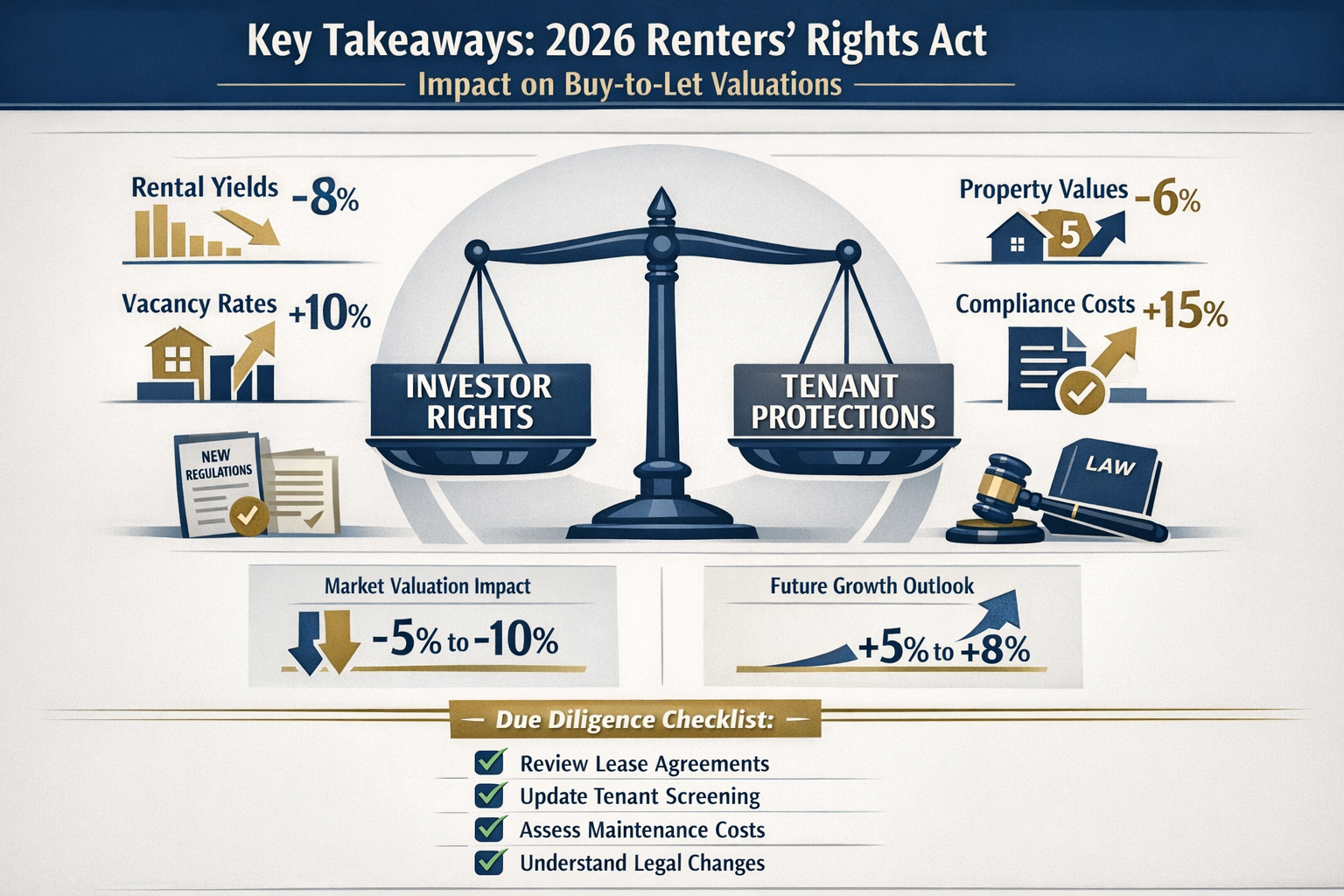
The Renters' Rights Act 2025 introduces sweeping changes that directly impact how surveyors assess buy-to-let property values. These legislative provisions fundamentally alter the risk-return profile of rental investments, requiring updated valuation methodologies that account for reduced landlord flexibility and enhanced tenant protections.
Abolition of Section 21 and Conversion to Periodic Tenancies
From May 1, 2026, the abolition of Section 21 "no-fault" evictions eliminates landlords' ability to regain possession without specific grounds[2][4]. All existing fixed-term assured shorthold tenancies automatically convert to rolling periodic contracts, removing the certainty of predetermined tenancy end dates that previously facilitated portfolio management and property sales.
This change creates immediate valuation implications:
- Properties can no longer be marketed with guaranteed vacant possession timelines
- Exit strategies for institutional investors become more complex and time-dependent
- Cash flow projections must account for extended tenant retention periods
- Capital value assessments require risk premiums for possession uncertainty
For surveyors conducting homebuyer surveys or investment property valuations, understanding these tenure changes is critical to accurate market value determination.
Rent Increase Limitations and Tribunal Adjustments
The Act restricts rent increases to once per year through Section 13 notices only, with rent review clauses in existing tenancy agreements becoming null and void from May 1, 2026[1][2]. This represents a significant departure from previous practices where landlords could implement mid-tenancy increases through contractual provisions.
Critical tribunal changes include:
| Previous System | New System (2026) |
|---|---|
| Tribunals could increase, maintain, or reduce challenged rents | Tribunals can only maintain or reduce proposed rents[1] |
| Upward adjustments possible based on market evidence | Upward adjustments only permitted if delayed implementation causes tenant "undue hardship"[1] |
| Risk for tenants challenging increases | Risk eliminated for tenants, shifted entirely to landlords |
These provisions fundamentally alter rental yield projections and require surveyors to incorporate conservative income growth assumptions when valuing buy-to-let portfolios.
Possession Ground Restrictions and Portfolio Flexibility
Landlords seeking to sell properties or move into rental units face new 12-month tenancy thresholds before accessing relevant possession grounds[2]. Ground 1A (selling) and Ground 1 (landlord/family occupation) both require tenancies to exceed 12 months, creating significant portfolio management constraints.
This restriction impacts valuations by:
- Reducing liquidity for buy-to-let assets requiring vacant possession
- Extending holding periods beyond investor timelines
- Increasing transaction costs through extended notice periods
- Creating valuation discounts for properties with recently commenced tenancies
Surveyors must now assess tenancy commencement dates and remaining periods before possession grounds become available when conducting structural surveys for investment properties.
National Private Rented Sector Landlord Database
The introduction of a mandatory landlord database in the second implementation phase later in 2026 creates new compliance visibility requirements[4]. This database will publicly document landlord compliance records, property standards, and management practices, directly impacting property marketability and valuation.
Properties associated with landlords demonstrating poor compliance records may experience:
- 📊 Valuation discounts reflecting reputational risk
- 🔍 Enhanced scrutiny during due diligence processes
- ⚠️ Reduced investor demand from institutional buyers
- 📋 Higher insurance premiums for non-compliant portfolios
Impact of 2026 Renters' Rights Act on Buy-to-Let Valuations: Market Response and Pricing Adjustments
The legislative changes are already reshaping landlord behavior and market pricing dynamics, with direct implications for property valuations and investment returns. Understanding these market responses is essential for accurate surveyor assessments in 2026.
Initial Rent Pricing Strategies and Market Positioning
Research indicates that 20% of landlords plan to compensate for the bidding ban by advertising properties at higher initial asking rents, while 53% will research comparable listings to establish pricing, with 19% relying on agent advice[2]. This behavioral shift suggests potential upward pressure on advertised rents as landlords seek to maximize initial tenancy income before rent increase restrictions take effect.
Valuation implications include:
- Higher initial rent capitalizations potentially inflating property values
- Increased market volatility as pricing strategies diverge
- Greater importance of comparable evidence in valuation assessments
- Need for surveyor skepticism regarding unsustainable rental levels
Surveyors must distinguish between sustainable market rents and artificially inflated asking prices when conducting investment valuations. Understanding what chartered surveyors do in this context becomes crucial for accurate market analysis.
Rental Yield Compression and Investment Returns
The combination of possession restrictions, rent increase limitations, and enhanced tenant security creates downward pressure on rental yields through multiple mechanisms:
- Extended void periods due to possession ground delays
- Reduced rent growth from once-annual increase limitations
- Increased management costs for compliance documentation
- Higher tenant retention reducing turnover rent reset opportunities
Institutional investors accustomed to specific yield thresholds may require valuation adjustments of 5-15% depending on property type, location, and existing tenancy circumstances. Properties with long-established tenancies at below-market rents face particular valuation challenges under the new regime.
Portfolio Composition and Asset Selection
The Act creates valuation differentials based on property characteristics and tenant profiles. Surveyors must now incorporate legislative compliance factors when assessing relative property values:
Premium valuation factors:
- ✅ Properties with strong compliance documentation
- ✅ Recent refurbishments meeting current standards
- ✅ Locations with strong rental demand supporting market rents
- ✅ Landlords with clean database records
Valuation discount factors:
- ❌ Properties requiring significant compliance expenditure
- ❌ Below-market rents with limited increase potential
- ❌ Tenancies commenced within past 12 months
- ❌ Landlords with documented compliance failures
Surveyor Due Diligence Checklist for Buy-to-Let Valuations Under the 2026 Act
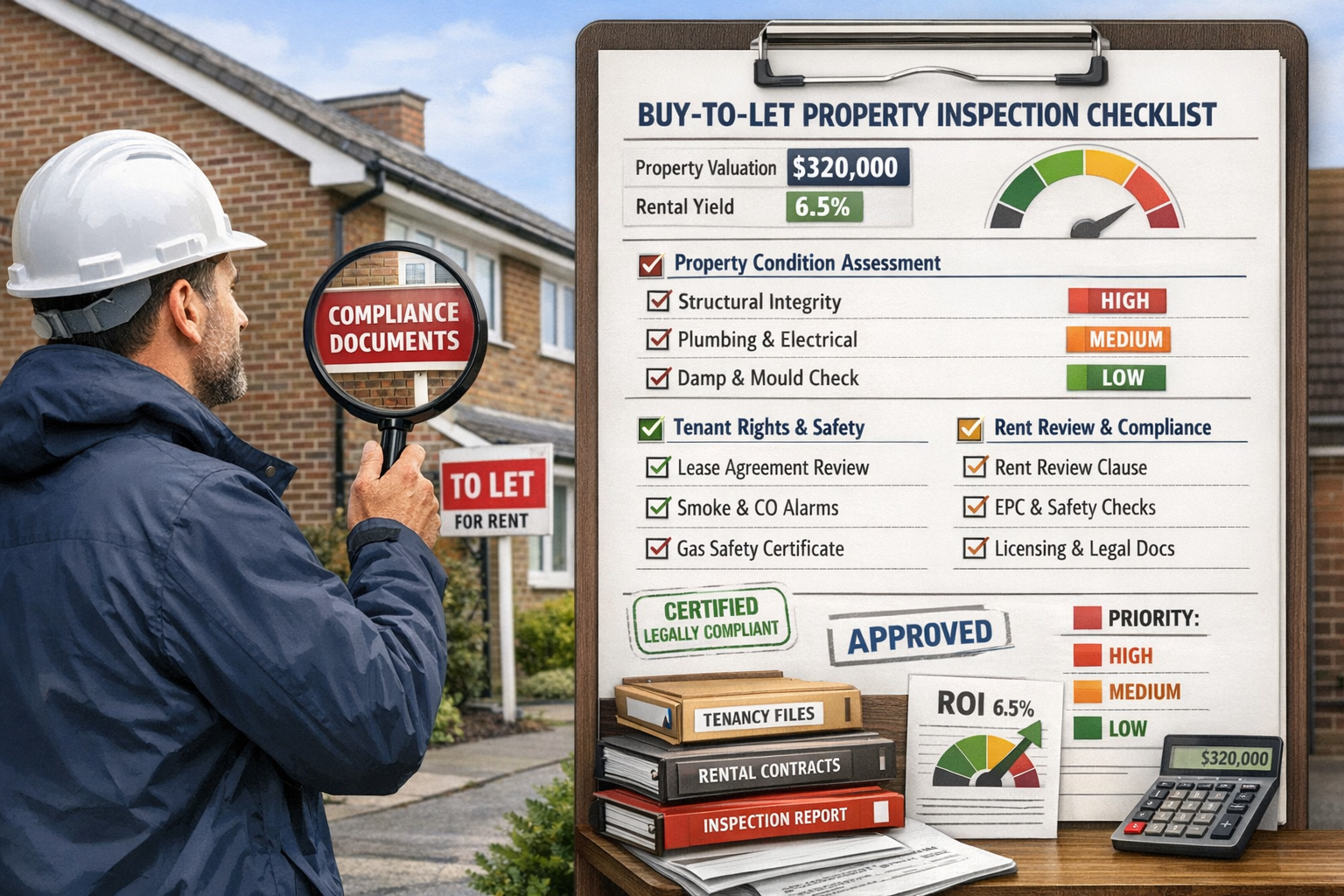
Professional surveyors conducting buy-to-let valuations in 2026 must implement enhanced due diligence protocols that incorporate legislative compliance, tenant security provisions, and regulatory risk factors. This comprehensive checklist ensures accurate valuation assessments reflecting the new regulatory environment.
Pre-Valuation Documentation Review
Before conducting physical property inspections, surveyors should verify essential documentation affecting property value and investment viability:
Tenancy Agreement Analysis:
- Review current tenancy agreements for rent review clause provisions (now void from May 1, 2026)[1]
- Verify tenancy commencement dates and time remaining before possession grounds become available[2]
- Confirm conversion status from fixed-term AST to periodic tenancy
- Assess current rent levels against comparable market evidence
- Identify any Section 13 notices served and tribunal challenge history
Landlord Compliance Verification:
- Confirm landlord database registration status (when implemented later in 2026)[4]
- Review compliance record for documented violations or enforcement actions
- Verify all required safety certificates (gas, electrical, EPC)
- Assess property licensing compliance where applicable
- Examine deposit protection scheme compliance
Financial Performance Assessment:
- Obtain 3-year rental income history with void period documentation
- Review maintenance expenditure and capital improvement records
- Assess tenant turnover rates and average tenancy durations
- Calculate effective rental yields after void periods and management costs
- Project income growth under once-annual increase limitations[2]
This documentation review forms the foundation for accurate valuation assessments. Surveyors should reference the ultimate house survey checklist for comprehensive inspection protocols.
Physical Property Inspection Priorities
The 2026 legislative framework elevates certain property condition factors that directly impact valuation under enhanced tenant protection provisions:
Structural and Safety Compliance:
- Assess property condition against Decent Homes Standard requirements
- Identify deferred maintenance potentially triggering tenant complaints
- Evaluate heating system efficiency and compliance with minimum standards
- Examine damp, mold, and ventilation issues affecting habitability
- Document any hazards under Housing Health and Safety Rating System (HHSRS)
Properties with identified compliance deficiencies require capital expenditure adjustments in valuation calculations, with costs deducted from gross property value. Surveyors should consider commissioning structural engineering assessments for properties with significant condition concerns.
Energy Efficiency and Future-Proofing:
- Verify current EPC rating and trajectory toward minimum standards
- Assess insulation, glazing, and heating system upgrade requirements
- Calculate capital expenditure for achieving target EPC ratings
- Evaluate renewable energy installation feasibility
- Consider future regulatory requirements in long-term value projections
Tenant Experience Factors:
- Assess property presentation and marketability to quality tenants
- Evaluate amenity provision relative to comparable properties
- Consider location factors affecting tenant demand and retention
- Review access, parking, and outdoor space provisions
- Assess noise insulation and privacy between units (for multi-lets)
Valuation Methodology Adjustments
Traditional buy-to-let valuation approaches require modification to reflect the 2026 legislative framework. Surveyors should implement these adjusted methodologies:
Income Capitalization Approach:
Adjusted Net Operating Income =
(Current Market Rent × Occupancy Rate Adjustment)
- Management Costs
- Maintenance Reserve
- Compliance Costs
- Void Period Allowance (increased for possession restrictions)

Property Value = Adjusted NOI / (Capitalization Rate + Legislative Risk Premium)
Legislative risk premiums of 0.5-2.0% should be added to capitalization rates depending on:
- Landlord compliance record quality
- Property condition and maintenance standards
- Tenancy circumstances and possession ground availability
- Local market rental demand dynamics
Comparable Sales Adjustment:
When using comparable evidence, surveyors must adjust for:
| Adjustment Factor | Typical Range | Application |
|---|---|---|
| Tenancy status (vacant vs. occupied) | -5% to -15% | Occupied properties with possession restrictions |
| Compliance documentation quality | -3% to -8% | Poor records or database issues |
| Recent capital improvements | +2% to +10% | Compliance-enhancing upgrades |
| Below-market rent differential | -10% to -25% | Limited increase potential under new rules |
| Landlord database rating | -5% to +5% | When database becomes operational |
Discounted Cash Flow Analysis:
For institutional investors, DCF models must incorporate:
- Conservative rent growth assumptions (maximum once-annual increases)[2]
- Extended holding period scenarios due to possession restrictions
- Increased exit timeline uncertainty
- Higher management and compliance costs
- Tenant retention rate adjustments
Surveyors should provide sensitivity analysis showing valuation ranges under different legislative compliance and market scenarios.
Reporting Requirements and Risk Disclosure
Valuation reports for buy-to-let properties in 2026 must include enhanced legislative risk disclosures and compliance assessments:
Mandatory Report Sections:
-
Legislative Compliance Summary: Document landlord database status, safety certificate compliance, and any identified violations[4]
-
Tenancy Status Analysis: Detail current tenancy circumstances, possession ground availability timelines, and rent increase limitations[1][2]
-
Income Sustainability Assessment: Evaluate current rent levels against market comparables and project sustainable income under once-annual increase restrictions
-
Capital Expenditure Requirements: Itemize compliance-related improvements needed and adjust valuation accordingly
-
Risk Factor Disclosure: Clearly communicate valuation uncertainties related to tribunal challenges, possession restrictions, and regulatory changes
-
Market Context: Provide local market rental demand analysis and comparable transaction evidence
Professional surveyors should reference understanding survey home reports for comprehensive reporting standards applicable to investment properties.
Special Considerations for Portfolio Valuations
Institutional investors holding multiple properties require portfolio-level assessments incorporating:
Portfolio Composition Analysis:
- Diversification across tenancy commencement dates to maintain possession ground availability
- Geographic distribution affecting regulatory enforcement intensity
- Property type mix balancing regulatory risk exposure
- Tenant demographic profiles and retention likelihood
Aggregated Risk Assessment:
- Concentration risk from single landlord database record
- Systematic compliance vulnerabilities across portfolio
- Management capacity for enhanced documentation requirements[4]
- Financial capacity for required capital improvements
Strategic Value Adjustments:
- Economies of scale in compliance management
- Portfolio reputation effects from database visibility
- Bulk disposal challenges under possession restrictions
- Long-term hold value vs. near-term exit scenarios
Strategic Implications for Buy-to-Let Investors and Market Outlook
The Impact of 2026 Renters' Rights Act on Buy-to-Let Valuations: Surveyor Due Diligence Checklist extends beyond technical assessment protocols to fundamental investment strategy considerations. Understanding these strategic implications helps surveyors provide comprehensive advisory services to clients navigating the transformed rental market.
Market Segmentation and Investor Positioning
The legislative changes create distinct market segments with different risk-return profiles:
Professional Landlord Segment 🏆:
- Well-capitalized investors with compliance infrastructure
- Properties meeting or exceeding regulatory standards
- Strong documentation and database records
- Premium valuations reflecting lower regulatory risk
Transitioning Landlord Segment ⚠️:
- Investors adapting to new compliance requirements
- Properties requiring moderate capital expenditure
- Developing documentation systems
- Moderate valuation discounts pending compliance improvements
Exit-Oriented Landlord Segment 📉:
- Investors seeking portfolio disposal
- Properties with deferred maintenance or compliance gaps
- Limited willingness to invest in upgrades
- Significant valuation discounts reflecting condition and regulatory risk
Surveyors must identify which segment properties belong to and adjust valuation approaches accordingly. For investors considering lease extension valuations or other property transactions, understanding these market dynamics is essential.
Tenant Demand Dynamics and Rental Market Outlook
Despite regulatory restrictions, underlying tenant demand remains strong across most UK markets, supporting rental values for compliant properties. The Act's tenant protection provisions may actually increase demand for professionally managed rental housing from households seeking security and quality.
Positive demand factors:
- 👥 Continued housing supply constraints
- 💼 Employment growth in major urban centers
- 🏠 Homeownership affordability challenges
- 🔒 Enhanced tenant security attracting quality renters
Negative supply factors:
- 📉 Landlord exits reducing available stock
- 🏗️ Limited new rental housing construction
- 💷 Higher capital requirements deterring new entrants
- ⚖️ Regulatory complexity creating barriers
This supply-demand imbalance suggests that well-positioned, compliant properties may maintain or increase values despite regulatory headwinds, while non-compliant assets face significant devaluation pressure.
Long-Term Value Preservation Strategies
Surveyors advising buy-to-let investors should emphasize value preservation strategies aligned with the 2026 regulatory framework:
Proactive Compliance Investment:
- Prioritize capital improvements addressing regulatory requirements
- Implement robust documentation systems before database launch[4]
- Establish professional property management relationships
- Maintain safety certificates and inspection records
Tenant Relationship Management:
- Focus on tenant retention to minimize turnover costs
- Implement fair rent increase practices within annual limitations[2]
- Address maintenance requests promptly to prevent tribunal disputes
- Build positive landlord database reputation
Portfolio Optimization:
- Dispose of non-compliant properties before valuation deterioration
- Concentrate holdings in strong demand locations
- Upgrade remaining properties to premium compliance standards
- Consider specialist sectors (student housing, build-to-rent) with different regulatory frameworks
Conclusion
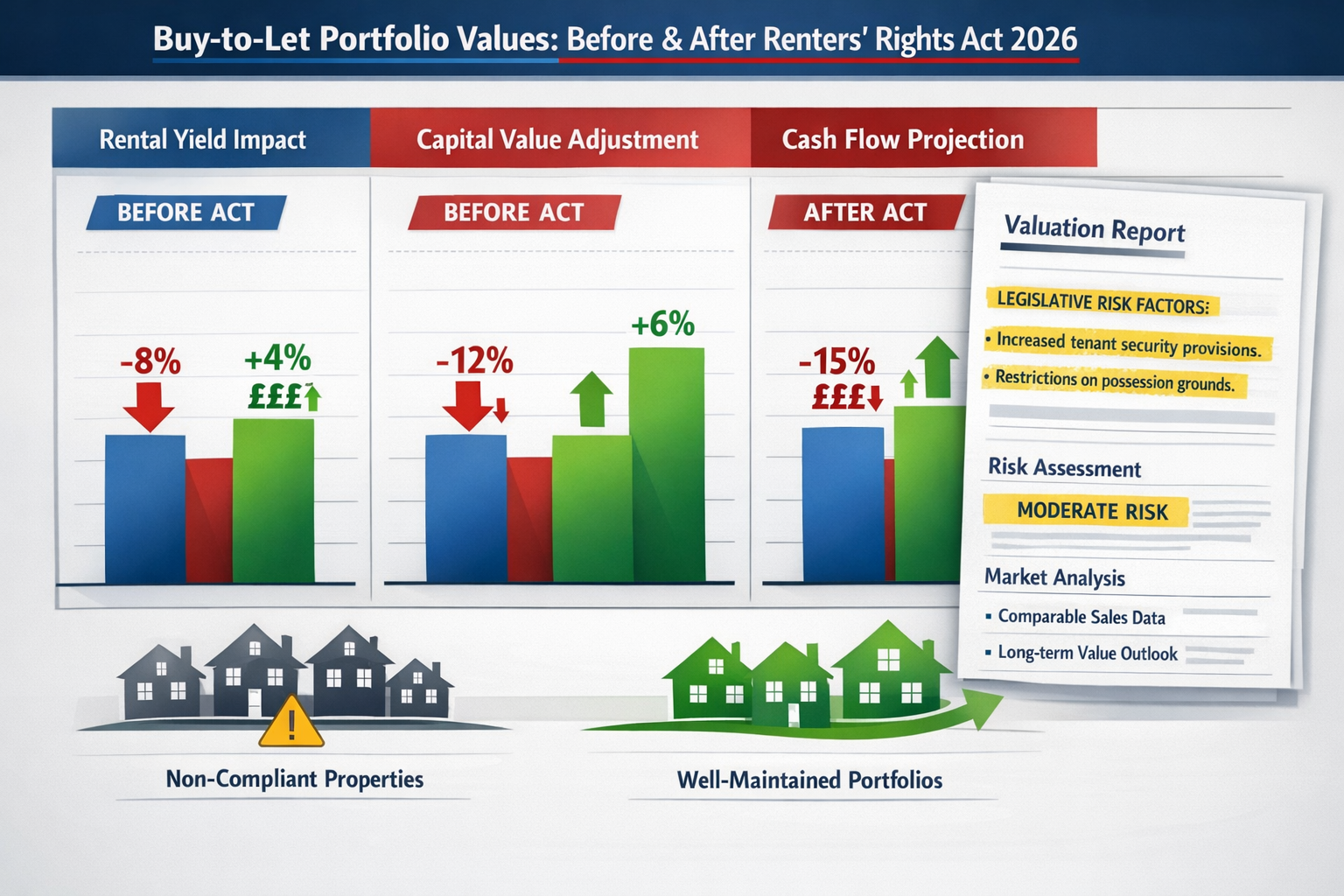
The Impact of 2026 Renters' Rights Act on Buy-to-Let Valuations: Surveyor Due Diligence Checklist represents a fundamental shift in how rental property investments are assessed, managed, and valued. With the Act receiving Royal Assent on October 27, 2025, and critical provisions including Section 21 abolition taking effect May 1, 2026, surveyors must adapt valuation methodologies to reflect enhanced tenant protections, possession restrictions, and compliance requirements[3][4].
The abolition of no-fault evictions, conversion of fixed-term tenancies to rolling contracts, and limitation of rent increases to once annually through Section 13 notices create measurable impacts on rental yields, portfolio flexibility, and property values[1][2]. Surveyors conducting buy-to-let valuations must now incorporate legislative compliance factors, landlord database status, and possession ground availability timelines as core valuation determinants.
Actionable Next Steps
For Property Surveyors:
- ✅ Implement enhanced due diligence protocols incorporating the comprehensive checklist outlined above
- ✅ Develop valuation adjustment frameworks reflecting legislative risk premiums and compliance costs
- ✅ Update comparable evidence databases to reflect post-Act transaction patterns
- ✅ Enhance reporting standards to include mandatory legislative compliance disclosures
For Buy-to-Let Investors:
- 📋 Commission comprehensive property surveys addressing compliance requirements before May 1, 2026 implementation
- 📋 Review existing tenancy agreements and rent levels against market comparables
- 📋 Develop capital expenditure plans for properties requiring compliance improvements
- 📋 Establish documentation systems in preparation for landlord database registration[4]
For Property Professionals:
- 🎓 Engage professional surveying services familiar with the 2026 legislative framework
- 🎓 Conduct portfolio reviews identifying high-risk and high-opportunity assets
- 🎓 Develop strategic plans balancing regulatory compliance with investment returns
- 🎓 Monitor tribunal decisions and enforcement patterns as implementation progresses
The transformed rental landscape creates both challenges and opportunities. Properties with strong compliance records, quality tenant relationships, and professional management infrastructure will command premium valuations, while non-compliant assets face significant devaluation pressure. By implementing rigorous due diligence protocols and adapting valuation methodologies to the new regulatory reality, surveyors provide essential guidance helping investors navigate the 2026 Renters' Rights Act successfully.
For professional surveying services addressing buy-to-let valuations under the new legislative framework, consider consulting chartered surveyors in London or other specialist locations to ensure comprehensive assessment and accurate valuation in this transformed market environment.
References
[1] Renters Rights Rent – https://theindependentlandlord.com/renters-rights-rent/
[2] Renters Rights Bill A Letting Agents Guide – https://blog.goodlord.co/renters-rights-bill-a-letting-agents-guide
[3] Renters Rights Act The New Reality For Buy To Let – https://www.propertynotify.co.uk/renters-rights-act/renters-rights-act-the-new-reality-for-buy-to-let/
[4] Renters Rights Act Why Process And Paperwork Matter More Than Ever For Landlords – https://www.stephenrimmer.com/news/renters-rights-act-why-process-and-paperwork-matter-more-than-ever-for-landlords/
[5] mpamag – https://www.mpamag.com/uk/mortgage-types/buy-to-let/reform-puts-renters-rights-act-in-the-firing-line/566424
[6] Selling A Rental Property In 2026 How The New Renters Rights Bill Affects You – https://www.gorvinsresidential.com/selling-a-rental-property-in-2026-how-the-new-renters-rights-bill-affects-you/
