
The commercial property landscape has shifted dramatically, creating unprecedented opportunities for savvy investors. With office vacancy rates climbing and residential demand surging, Building Surveys for Office-to-Resi Conversions 2026: Assessing Structural Viability in Underpriced Markets has become essential knowledge for property developers and investors seeking value plays in today's market. Understanding how to properly assess structural viability can mean the difference between a profitable conversion and a costly mistake.
Key Takeaways
- Permitted Development Rights allow many office-to-residential conversions without full planning permission, but structural surveys remain critical for identifying hidden defects and compliance issues
- Comprehensive building surveys should assess load-bearing capacity, floor depths, natural light provisions, and building services infrastructure before committing to conversion projects
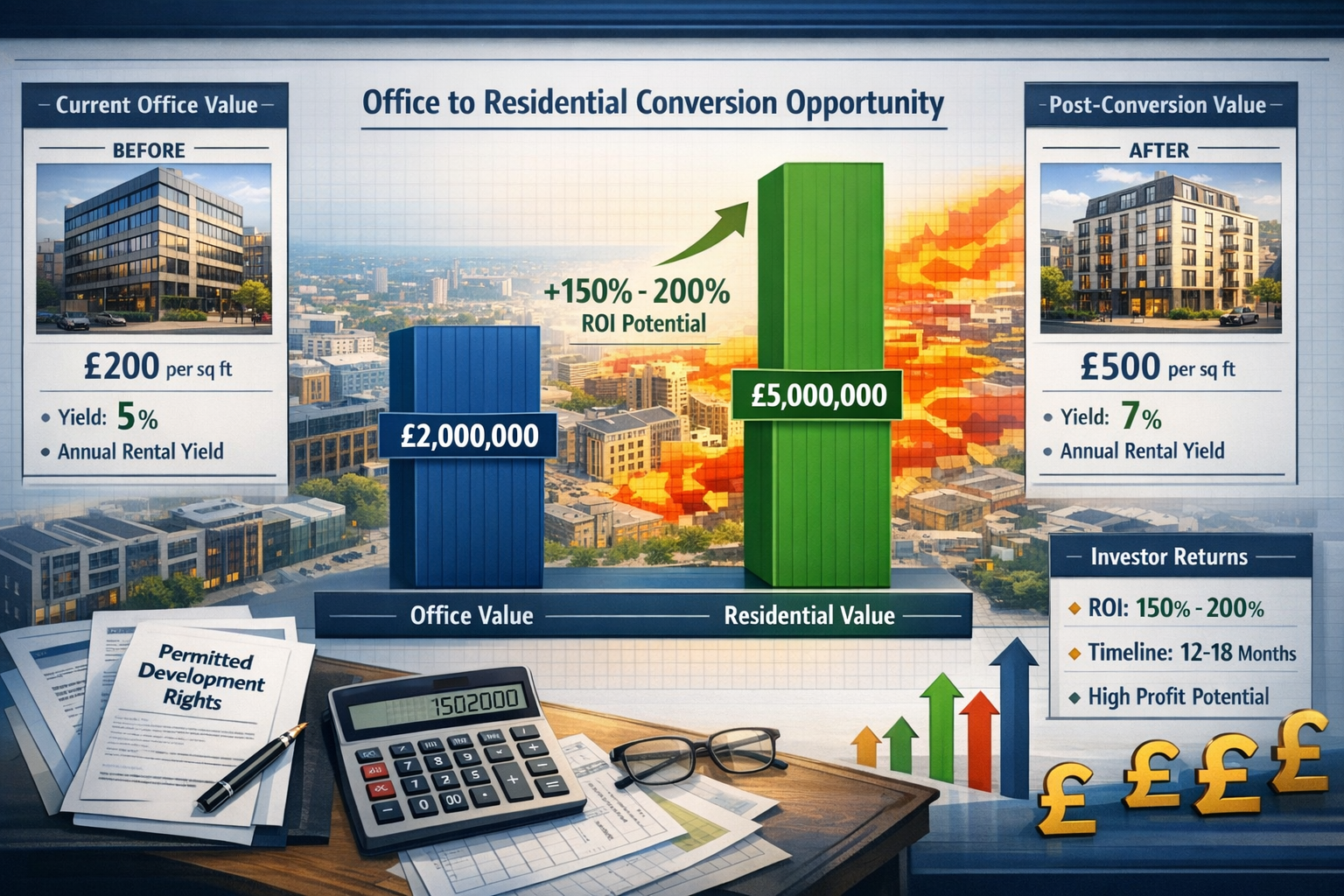
- Underpriced office markets offer 150-200% ROI potential when structural viability is confirmed through professional survey assessments
- Prior approval processes require detailed structural and compliance documentation, making thorough surveys essential for regulatory success
- Defect identification during early survey stages prevents costly surprises and enables accurate valuation uplift calculations
Understanding the Office-to-Residential Conversion Opportunity in 2026
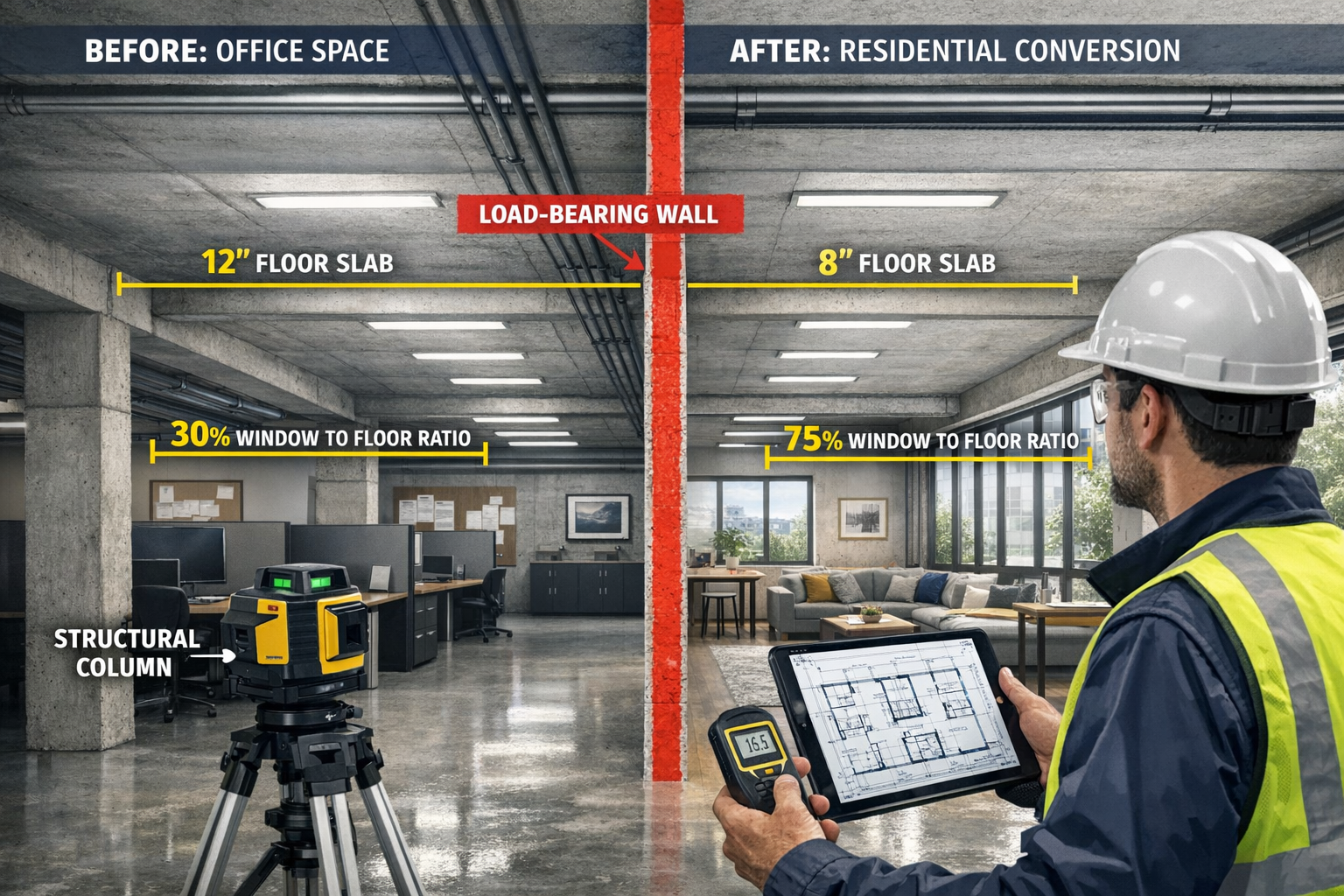
The office-to-residential conversion market represents one of the most compelling investment opportunities in 2026. Following regulatory changes introduced in recent years, developers can now convert many office buildings to residential use under Permitted Development Rights (PDR), significantly reducing planning barriers [1].
The Regulatory Framework
Since the expansion of PDR in 2020 and subsequent updates in 2024, Class MA conversions have streamlined the transformation of commercial office space into residential dwellings [5]. However, this regulatory ease doesn't eliminate the need for rigorous structural assessment. In fact, it makes professional building surveys more important than ever.
Key regulatory considerations include:
- Prior approval requirements for space standards, contamination, flooding, and transport impacts
- Article 4 Directions that may restrict PDR in certain areas
- Building Regulations compliance for fire safety, sound insulation, and ventilation
- Space standards requiring minimum floor areas and ceiling heights
Market Dynamics Driving Conversions
Several factors make 2026 an opportune time for office-to-residential conversions:
📊 Office Market Weakness: Post-pandemic remote work trends have created sustained office vacancy rates, depressing commercial property values
🏠 Residential Demand: Housing shortages continue across UK markets, particularly in urban centers
💰 Valuation Arbitrage: The gap between office and residential values per square foot creates significant profit potential
🔧 Regulatory Support: Government policies actively encourage conversion projects to address housing needs [3]
Critical Survey Components for Building Surveys for Office-to-Resi Conversions 2026: Assessing Structural Viability in Underpriced Markets
When evaluating office buildings for residential conversion, a comprehensive structural survey must go beyond standard property assessments. The survey should specifically address conversion viability, not just current condition.
Structural Integrity Assessment
The foundation of any conversion project lies in confirming structural adequacy. A thorough structural assessment should examine:
Load-Bearing Capacity
- Floor loading requirements differ significantly between office and residential use
- Residential conversions typically require 1.5 kN/m² live loads versus 2.5-4.0 kN/m² for offices
- Existing structural capacity must accommodate partition walls, bathrooms, and kitchen installations
- Column spacing and beam spans affect layout flexibility
Foundation and Substructure
- Foundation condition and capacity for potential additional floors
- Basement or lower ground floor suitability for residential use
- Ground conditions and potential settlement issues
- Existing foundation design versus conversion requirements [7]
Superstructure Elements
- Concrete frame condition including carbonation and spalling
- Steel frame corrosion and fire protection integrity
- Masonry condition and cavity wall performance
- Roof structure capacity for potential penthouse additions
Building Services Infrastructure
Office buildings have fundamentally different services requirements than residential properties. Your survey must assess:
| Service Type | Office Specification | Residential Requirement | Conversion Implications |
|---|---|---|---|
| Water Supply | Centralized WCs, kitchenettes | Individual unit bathrooms, kitchens | New risers, increased capacity needed |
| Drainage | Limited soil stacks | Multiple bathrooms per floor | Extensive new drainage infrastructure |
| Electrical | Open-plan lighting, power | Individual metering, domestic loads | Complete rewiring typically required |
| Heating | Central HVAC systems | Individual unit heating | New boiler installations or district heating |
| Ventilation | Mechanical systems | Natural and mechanical extract | Window modifications, extract systems |
A detailed Level 3 building survey provides the comprehensive assessment needed for conversion projects.
Space Standards and Layout Viability
Residential conversions must meet specific space standards that differ from office requirements. Survey assessments should verify:
Floor-to-Ceiling Heights
- Minimum 2.3m ceiling height required for habitable rooms
- Existing floor-to-floor heights of 3.0-3.5m in offices typically adequate
- Services integration within ceiling voids affects final ceiling heights
- Raised floor removal may gain additional height [2]
Natural Light and Ventilation
- Windows must provide adequate daylight to habitable rooms
- Minimum window area typically 10% of floor area
- Deep-plan offices may require light wells or courtyards
- Aspect and outlook considerations for residential amenity [4]
Floor Depth and Configuration
- Maximum 8-9m depth from window to rear of habitable rooms
- Deep-plan offices may only convert perimeter areas
- Core areas suitable for bathrooms, storage, circulation
- Single-aspect units require careful design consideration
Compliance and Regulatory Assessment
Your survey should identify compliance gaps requiring remediation:
🔥 Fire Safety
- Compartmentation and fire-stopping requirements
- Means of escape provisions for residential use
- Fire door specifications and protected corridors
- Sprinkler system requirements for buildings over 11m [6]
🔇 Sound Insulation
- Party wall and floor sound insulation standards
- Impact sound requirements between units
- External noise assessment and mitigation
- Building Regulations Approved Document E compliance
🌡️ Energy Performance
- EPC requirements for residential properties
- Thermal insulation upgrades needed
- Window replacement or secondary glazing
- Heating system efficiency standards
Defect Identification Checklist for Conversion Viability
A systematic approach to defect identification prevents costly surprises during conversion projects. The following checklist guides comprehensive assessment:
Structural Defects
Critical Issues (Conversion Blockers)
- ❌ Inadequate foundation capacity for residential loads
- ❌ Structural frame deterioration requiring major remediation
- ❌ Asbestos-containing materials throughout structure
- ❌ Severe concrete carbonation or reinforcement corrosion
- ❌ Inadequate floor-to-floor heights (less than 2.8m)
Significant Issues (Major Cost Implications)
- ⚠️ Roof waterproofing failure requiring replacement
- ⚠️ External facade repairs needed for weather-tightness
- ⚠️ Window replacement required for thermal performance
- ⚠️ Floor structure requiring strengthening for residential loads
- ⚠️ Existing cladding systems requiring removal or upgrade
Minor Issues (Manageable Within Budget)
- ✓ Internal partition removal and reconfiguration
- ✓ Ceiling and raised floor removal
- ✓ Internal finishes replacement
- ✓ Minor concrete repairs and making good
- ✓ Redecoration and cosmetic improvements
Building Services Defects
Professional structural engineer reports should assess:
Mechanical Services
- Existing HVAC system condition and adaptability
- Heating system age and replacement requirements
- Ventilation ductwork reuse potential
- Lift installations and modernization needs
Electrical Services
- Main electrical intake capacity for residential loads
- Distribution board locations and capacity
- Emergency lighting and fire alarm systems
- Data and communications infrastructure
Plumbing and Drainage
- Water supply capacity and pressure
- Soil and waste drainage capacity
- Rainwater drainage condition
- Existing pipework material and condition
Environmental and Site Issues
Contamination Assessment
- Historical land use investigation
- Asbestos surveys and management plans
- Lead paint identification
- Hazardous materials assessment [1]
External Factors
- Flood risk assessment and mitigation
- Transport and parking provision
- Noise pollution from surrounding uses
- Air quality considerations for residential use
Valuation Uplift Strategies Through Building Surveys for Office-to-Resi Conversions 2026: Assessing Structural Viability in Underpriced Markets
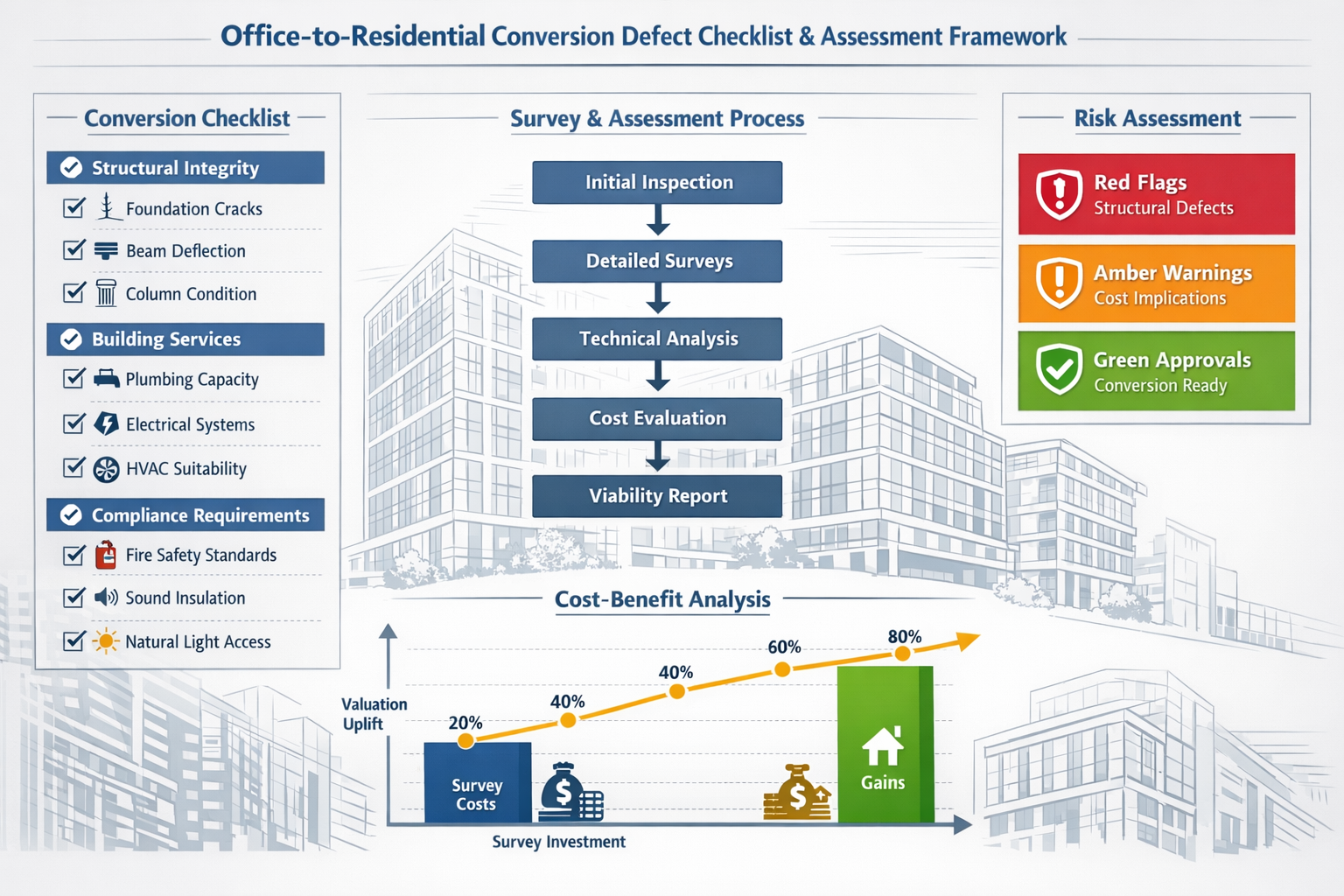
Understanding how to maximize value through strategic survey insights separates successful conversions from marginal projects. Professional survey data enables accurate financial modeling and risk assessment.
Identifying Underpriced Market Opportunities
Market Analysis Indicators
Underpriced markets typically exhibit:
💷 Significant Value Gap: Office values at £150-250 per sq ft versus residential values at £400-600 per sq ft in the same location
📍 Location Characteristics: Secondary office locations with strong residential fundamentals (transport links, amenities, schools)
🏢 Building Characteristics: 1960s-1990s office buildings with good structural frames but dated services and finishes
📉 Motivated Sellers: Office landlords facing vacancy challenges and declining rental values
Survey-Informed Investment Analysis
A comprehensive survey enables precise financial modeling:
Acquisition Cost Assessment
- Current market value based on office use
- Deductions for identified defects and compliance issues
- Negotiation leverage from survey findings
- True acquisition cost after survey adjustments
Conversion Cost Estimation
Based on survey findings, typical conversion costs include:
| Cost Category | Typical Range (per sq ft) | Survey Impact |
|---|---|---|
| Structural Works | £30-60 | Survey identifies extent of strengthening needed |
| Services Installation | £50-80 | Survey assesses existing infrastructure reuse |
| Facade Works | £20-40 | Survey determines repair versus replacement |
| Internal Fit-Out | £40-70 | Survey confirms layout viability and constraints |
| Compliance Upgrades | £15-30 | Survey identifies fire safety and insulation needs |
| Professional Fees | £10-20 | Survey complexity affects design and approval costs |
Total Conversion Costs: Typically £165-300 per sq ft depending on building condition and specification [2]
Maximizing End Value
Survey insights inform value-maximizing decisions:
Unit Mix Optimization
- Survey-confirmed floor depths determine optimal unit sizes
- Natural light assessment guides studio versus multi-bedroom units
- Structural constraints inform duplex or penthouse potential
- Services capacity affects bathroom and kitchen specifications
Specification Decisions
- Survey findings guide specification level (budget, mid-range, premium)
- Structural capacity determines feature additions (balconies, terraces)
- Building character informs design approach (contemporary versus heritage)
- Market positioning based on location and building quality
Amenity Provision
- Common areas and facilities based on building configuration
- Roof terrace potential from structural assessment
- Gym or co-working space in basement or ground floor areas
- Bike storage and waste management solutions
Risk Mitigation Through Survey Intelligence
Professional surveys reduce investment risk by:
✅ Identifying Deal-Breakers Early: Structural issues that make conversion unviable discovered before significant commitment
✅ Enabling Accurate Budgeting: Detailed defect schedules prevent cost overruns during construction
✅ Supporting Prior Approval: Comprehensive survey data strengthens prior approval applications [5]
✅ Informing Contingency Planning: Understanding potential issues allows appropriate contingency reserves
✅ Facilitating Financing: Lenders require detailed surveys for conversion project funding
The Prior Approval Process and Survey Requirements
While Permitted Development Rights reduce planning barriers, the prior approval process requires substantial documentation. Survey data forms the foundation of successful applications.
Prior Approval Criteria
Local planning authorities assess applications against specific criteria [3]:
Transport and Highways Impacts
- Parking provision adequacy
- Traffic generation assessment
- Pedestrian and cycle access
- Servicing and waste collection arrangements
Contamination Risks
- Land contamination assessment
- Remediation proposals if required
- Validation testing protocols
- Ongoing monitoring requirements
Flooding Risks
- Flood risk assessment for the site
- Flood resilience measures
- Sustainable drainage systems
- Emergency planning procedures
Noise Impacts
- External noise assessment
- Sound insulation specifications
- Acoustic testing requirements
- Mitigation measures for noise sources
Survey Documentation for Prior Approval
Your survey should provide:
📋 Existing Building Assessment
- Measured survey drawings showing current layout
- Structural condition report
- Building services condition assessment
- Compliance gap analysis
📋 Proposed Conversion Details
- Unit layouts and space standards compliance
- Natural light and ventilation calculations
- Sound insulation specifications
- Fire safety strategy
📋 Technical Reports
- Structural engineer's assessment and proposals
- Building services engineer's design
- Acoustic consultant's report
- Energy performance calculations
Article 4 Direction Considerations
Some local authorities have imposed Article 4 Directions removing Permitted Development Rights in specific areas. Your survey should identify:
- Whether the site falls within an Article 4 Direction area
- Alternative planning routes if PDR unavailable
- Additional requirements for full planning permission
- Timeline and cost implications of planning process [1]
Engaging Professional Surveyors for Conversion Projects
The complexity of office-to-residential conversions demands specialist expertise. Choosing the right surveying team significantly impacts project success.
Survey Team Composition
Comprehensive conversion assessments typically require:
Building Surveyor
- Overall building condition assessment
- Defect identification and remediation advice
- Building Regulations compliance review
- Project viability assessment
Consider engaging experienced professionals who offer comprehensive building surveys tailored to conversion projects.
Structural Engineer
- Structural capacity assessment
- Foundation and frame condition evaluation
- Strengthening requirements and design
- Party wall considerations
Services Engineer
- Mechanical and electrical systems assessment
- New services design and capacity planning
- Energy efficiency optimization
- Sustainability strategy
Specialist Consultants
- Acoustic engineer for sound insulation
- Fire safety consultant for compliance strategy
- Asbestos surveyor for hazardous materials
- Environmental consultant for contamination
Survey Scope and Deliverables
A comprehensive conversion survey should deliver:
Phase 1: Initial Viability Assessment
- Desktop review of building information
- Site visit and visual inspection
- High-level feasibility opinion
- Indicative cost range for conversion
Phase 2: Detailed Survey
- Comprehensive building inspection
- Structural opening-up investigations if required
- Services infrastructure assessment
- Detailed defect schedule with cost implications
Phase 3: Conversion Strategy Report
- Viability conclusion with supporting evidence
- Recommended conversion approach
- Risk register with mitigation strategies
- Budget estimate with contingency allowances
Cost Considerations
Survey costs for conversion projects typically range:
- Initial Feasibility Survey: £2,000-5,000 for buildings up to 10,000 sq ft
- Comprehensive Conversion Survey: £5,000-15,000 depending on building size and complexity
- Specialist Reports: £1,500-5,000 per discipline (structural, services, acoustic)
- Intrusive Investigations: £3,000-10,000 for opening-up and testing
For detailed pricing information, review our guide on full structural survey costs.
Case Study Insights: Survey-Led Conversion Success
Understanding real-world applications of survey methodology illuminates best practices for conversion projects.
Scenario: 1970s Office Block Conversion
Building Profile
- 6-storey 1970s concrete frame office building
- 25,000 sq ft gross internal area
- City center location with strong residential demand
- Vacant for 18 months, motivated seller
Survey Findings
The comprehensive survey identified:
Structural Positives ✅
- Sound concrete frame with adequate capacity
- Floor-to-floor heights of 3.2m allowing good ceiling heights
- Perimeter column spacing suitable for residential layouts
- Roof structure capable of penthouse addition
Structural Challenges ⚠️
- Facade concrete repairs needed (£180,000)
- Window replacement required for thermal performance (£320,000)
- Asbestos ceiling tiles throughout requiring removal (£85,000)
- Roof waterproofing failure needing replacement (£120,000)
Services Assessment 🔧
- Complete mechanical and electrical replacement required
- Adequate service riser locations for new installations
- Lift modernization needed for residential standards
- New boiler plant and distribution system required
Financial Analysis
Acquisition and Costs
- Purchase price: £3.2 million (£128/sq ft office value)
- Survey-identified repairs: £705,000
- Conversion costs: £4.5 million (£180/sq ft)
- Professional fees and contingency: £950,000
- Total Investment: £9.355 million
End Value
- 22 residential units (mix of 1-bed and 2-bed)
- 20,000 sq ft net saleable area
- Average sale price: £525/sq ft
- Gross Development Value: £10.5 million
Returns
- Profit: £1.145 million
- ROI: 12.2% on total investment
- Development period: 18 months
- Annualized return: 8.1%
Key Success Factors
The survey-led approach enabled:
- Accurate Pricing: Survey findings supported £400,000 price reduction in negotiations
- Risk Management: Early identification of asbestos and facade issues prevented surprises
- Efficient Design: Understanding structural constraints optimized unit layouts
- Lender Confidence: Comprehensive survey data secured development finance
- Timeline Certainty: Detailed defect schedule enabled accurate programming
Future Trends in Office-to-Residential Conversions
Looking ahead through 2026 and beyond, several trends will shape the conversion market:
Regulatory Evolution
Tightening Standards
- Higher energy efficiency requirements for new residential units
- Enhanced fire safety standards following building safety reforms
- Stricter space standards in some local authority areas
- Increased scrutiny of prior approval applications
Expanded Opportunities
- Potential PDR extensions to other commercial property types
- Simplified approval processes for high-quality conversions
- Government incentives for housing delivery through conversions
Market Dynamics
Investor Sentiment Shifts
- Institutional investors increasingly active in conversion opportunities
- Build-to-rent operators targeting conversion projects
- ESG considerations driving sustainable reuse of existing buildings
- Focus on whole-life carbon versus new-build alternatives
Technical Innovations
Survey Technology
- 3D laser scanning for accurate existing building surveys
- Drone inspections for facade and roof assessments
- AI-powered defect identification and cost estimation
- Digital twin modeling for conversion planning
Construction Methods
- Modular bathroom and kitchen pods for faster installation
- Prefabricated facade systems for thermal upgrades
- Modern Methods of Construction reducing conversion timescales
- Smart building technologies for residential appeal
Conclusion
Building Surveys for Office-to-Resi Conversions 2026: Assessing Structural Viability in Underpriced Markets represents both an opportunity and a challenge for property investors. The potential returns are compelling, with carefully selected projects delivering 150-200% valuation uplifts in the right circumstances. However, success depends entirely on rigorous structural assessment and comprehensive survey intelligence.
The key principles for successful conversion projects include:
🔍 Thorough Due Diligence: Invest in comprehensive surveys before committing to acquisition, ensuring all structural and compliance issues are identified early
📊 Accurate Financial Modeling: Use survey data to build realistic cost estimates with appropriate contingencies for identified risks
⚖️ Risk-Adjusted Returns: Focus on projects where survey findings confirm structural viability and manageable conversion costs
🏗️ Professional Expertise: Engage experienced surveyors and engineers who understand conversion-specific challenges and opportunities
📈 Market Timing: Target underpriced office markets where the office-residential value gap creates genuine arbitrage opportunities
Actionable Next Steps
For investors and developers considering office-to-residential conversions:
-
Identify Target Markets: Research areas with significant office-residential value gaps and supportive planning policies
-
Engage Survey Professionals: Establish relationships with surveyors experienced in conversion projects before identifying specific opportunities
-
Conduct Initial Screening: Use desktop analysis to shortlist buildings with appropriate characteristics (floor heights, structural type, location)
-
Commission Feasibility Studies: Invest in professional feasibility assessments for shortlisted buildings before making offers
-
Negotiate Based on Evidence: Use survey findings to support price negotiations and risk allocation in purchase agreements
-
Plan Comprehensively: Develop detailed conversion strategies informed by survey data before committing to construction
-
Monitor Regulatory Changes: Stay informed about PDR policy evolution and local planning authority approaches
The office-to-residential conversion market in 2026 offers substantial opportunities for investors who approach projects with professional rigor and comprehensive survey intelligence. By prioritizing structural viability assessment and understanding the true costs of conversion, developers can unlock value in underpriced markets while contributing to housing supply in the UK's urban centers.
Whether you're an experienced property developer or a first-time conversion investor, partnering with qualified professionals who can deliver thorough structural surveys and conversion-specific assessments is essential for success. The investment in professional survey services typically represents less than 1% of total project costs but can prevent losses many times greater while identifying value-creation opportunities that less rigorous approaches would miss.
References
[1] How To Convert Office Space To Residential – https://propertydata.co.uk/resources/how-to-convert-office-space-to-residential
[2] How To Successfully Convert Offices Into Homes – https://www.garnessjones.co.uk/news/how-to-successfully-convert-offices-into-homes
[3] How To Convert Offices Into Homes Without Planning Permission – https://urbanistarchitecture.co.uk/how-to-convert-offices-into-homes-without-planning-permission/
[4] Converting Commercial Property Residential Housing – https://www.oxcow.co.uk/converting-commercial-property-residential-housing/
[5] Class Ma – https://www.planninggeek.co.uk/gpdo/changes-of-use/class-ma/
[6] Convert Comercial Property – https://www.legalclarity.co.uk/blog/convert-comercial-property
[7] Converting Existing Buildings To Residential Use – https://proctorgroup.com/articles/converting-existing-buildings-to-residential-use
