
Imagine walking through a property that hasn't been built yet, testing different furniture layouts in real-time, or monitoring every mechanical system in a commercial building from thousands of miles away—all while watching live data update before your eyes. This isn't science fiction. Real-Time 3D Digital Twins: Transforming Property Visualization and Decision-Making represents the most significant technological leap in real estate and construction since computer-aided design revolutionized the industry decades ago.
In 2026, the property sector stands at a pivotal crossroads. Digital twins are no longer experimental pilots confined to tech-forward corporations—they've entered mainstream building operations, fundamentally changing how developers, investors, facility managers, and property owners interact with physical spaces[7]. These sophisticated virtual replicas combine spatial geometry with continuous streams of operational data, creating "living models" that evolve alongside their physical counterparts[3].
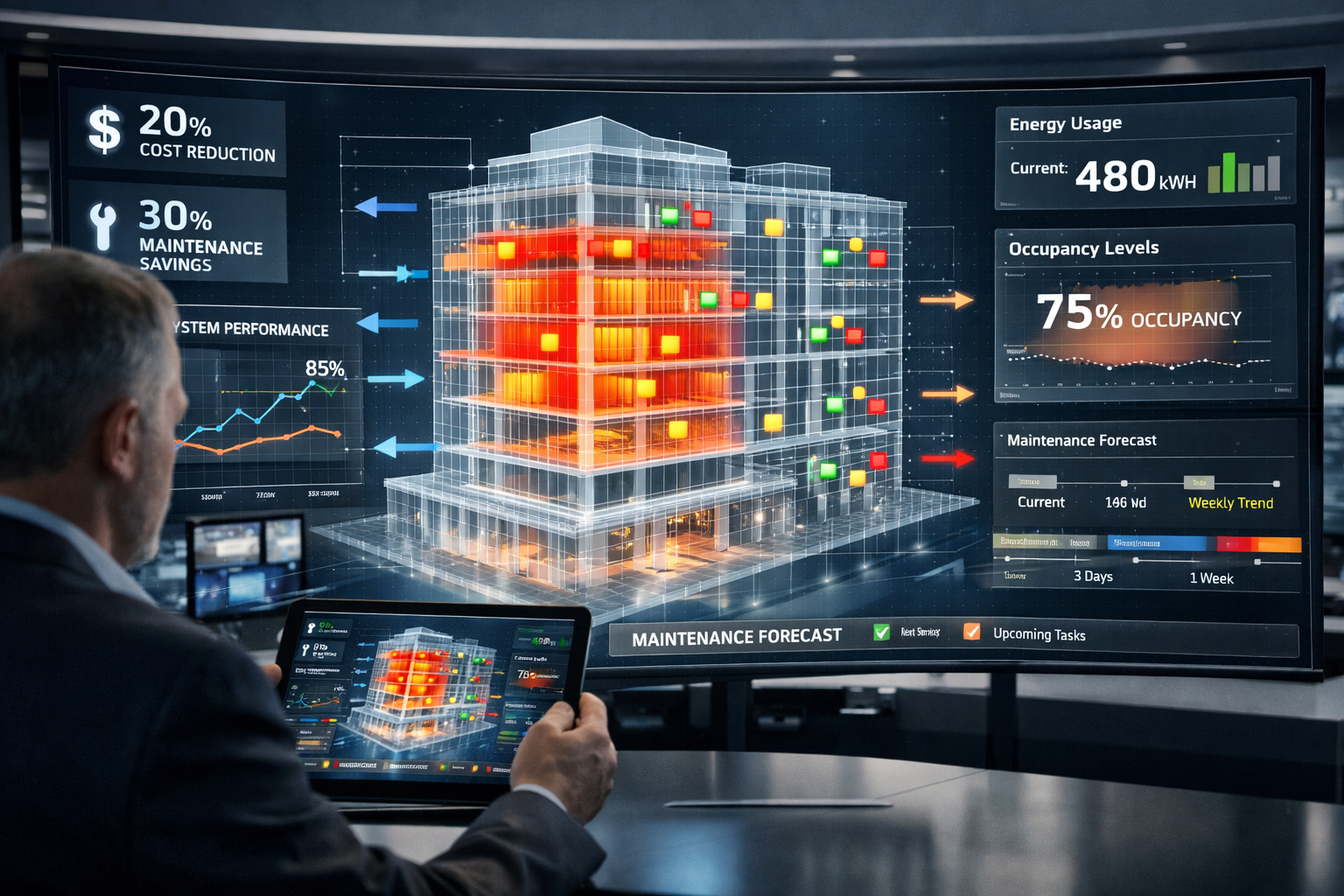
The transformation extends far beyond impressive visualizations. Early adopters are already experiencing 10-20% reductions in operating costs through improved predictive maintenance and performance monitoring[5], while some organizations report maintenance cost savings up to 30% by predicting component failures before catastrophic breakdowns occur[3]. For property professionals who embrace this technology now, the competitive advantage window remains open—but competitors are adapting rapidly.
Key Takeaways
- 🏗️ Real-time digital twins integrate four core components: sensor data collection, 3D visualization tools (CAD/BIM), IoT integration for live data streaming, and machine learning analytics for predictive optimization
- 💰 Significant cost reductions: Organizations implementing digital twins achieve 10-20% operating cost reductions and up to 30% maintenance cost savings through predictive analytics
- 🔄 Evolution beyond static tours: The industry has moved from basic 3D walkthroughs to living models that continuously update with real-time operational data
- 🤖 AI-powered automation: Artificial intelligence automatically categorizes building components from LiDAR scans, dramatically reducing creation time and costs
- 📊 Competitive advantage: 2026 marks a transformational year where early adopters gain significant market position advantages while competitors rapidly adapt
Understanding Real-Time 3D Digital Twins: Transforming Property Visualization and Decision-Making
What Makes a Digital Twin "Real-Time"?
The distinction between traditional 3D models and real-time 3D digital twins lies in their fundamental nature. Traditional models remain static snapshots—beautiful but frozen in time. Real-time digital twins, conversely, function as living entities that continuously synchronize with their physical counterparts through constant data exchange[1].
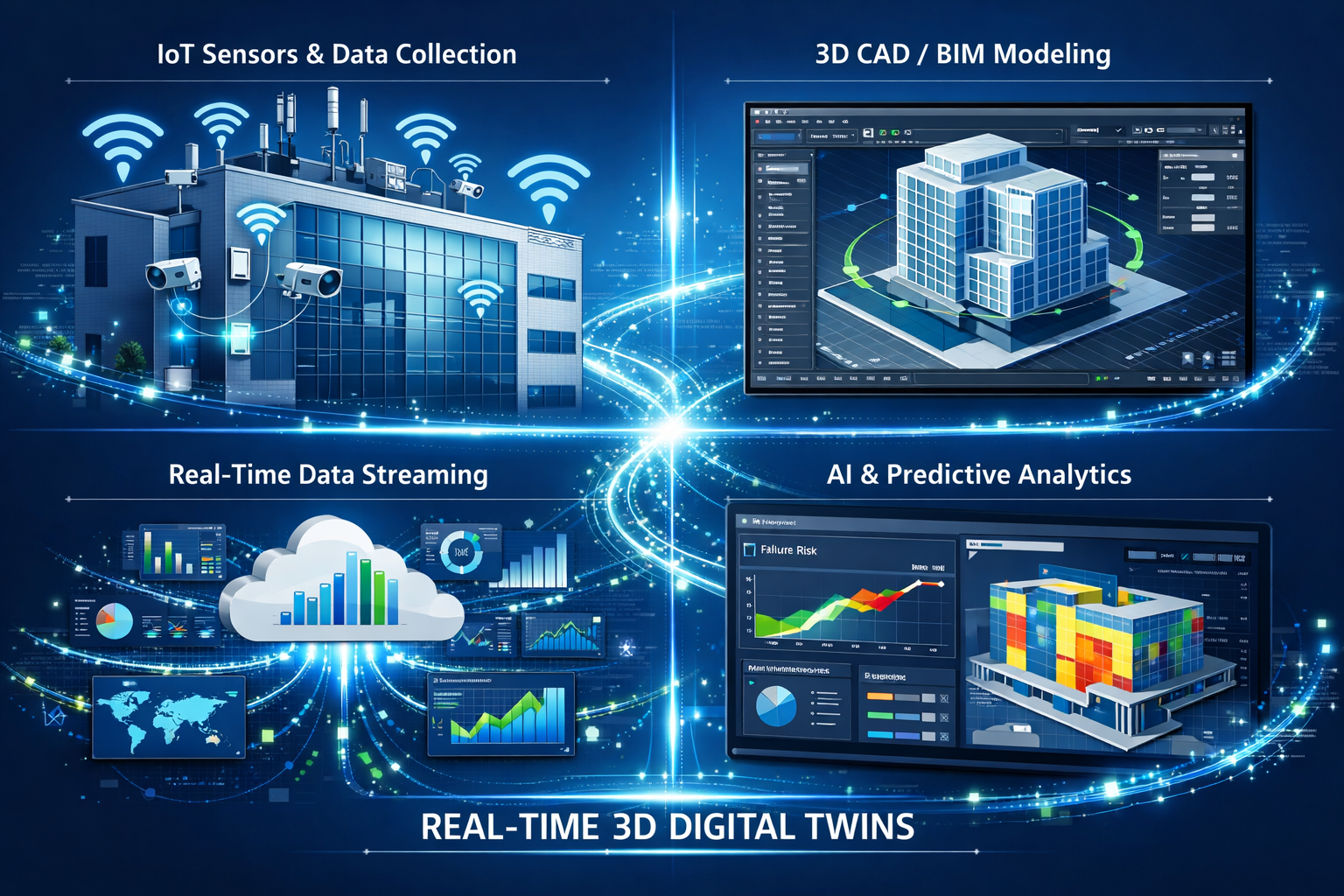
This synchronization happens through four essential technical components working in harmony:
- Sensor Data Collection: Physical sensors embedded throughout properties capture environmental conditions, equipment performance, occupancy patterns, and structural behavior
- 3D Visualization Tools: CAD and BIM software creates detailed spatial geometry representing every wall, window, mechanical system, and architectural element
- IoT Integration: Internet of Things devices stream live data continuously, updating the virtual model in real-time
- Machine Learning Analytics: AI algorithms process incoming data to identify patterns, predict failures, and optimize performance[1]
When these components work together, property stakeholders gain unprecedented visibility. A facility manager can observe HVAC performance fluctuations as they happen, watch occupancy patterns shift throughout the day, and receive alerts when equipment operates outside normal parameters—all within an interactive 3D environment that mirrors physical reality.
The Technology Behind Interactive 3D Models
Creating accurate digital twins requires sophisticated capture technology. LiDAR (Light Detection and Ranging) scanning has emerged as the industry standard, using laser pulses to measure millions of points across building surfaces. These measurements create detailed "point clouds"—dense collections of spatial coordinates that define every surface, corner, and feature with millimeter-level precision[5].
The breakthrough in 2026 involves how artificial intelligence processes this raw data. Previously, human technicians spent countless hours manually categorizing scanned elements—identifying which walls bear structural loads, which partitions serve decorative purposes, and which systems require monitoring. Modern AI algorithms now automatically scan LiDAR data to categorize building components, distinguishing load-bearing walls from decorative partitions without human intervention[3]. This automation has dramatically reduced both the cost and time required to create comprehensive digital twins.
Point cloud validation methodology establishes another critical advantage. Regular laser scanning creates a feedback loop ensuring virtual models remain continuously synchronized with physical reality[5]. When construction teams modify a building or equipment degrades over time, periodic rescanning updates the digital twin, maintaining its reliability as a trustworthy decision-making tool rather than speculative representation.
For property professionals seeking comprehensive documentation, building surveys provide essential baseline data that digital twin technology can enhance and extend throughout a property's lifecycle.
How Live Data Updates Transform Property Intelligence
The transformative power of Real-Time 3D Digital Twins: Transforming Property Visualization and Decision-Making becomes apparent when examining operational scenarios. Consider a commercial office building equipped with hundreds of sensors monitoring temperature, humidity, air quality, lighting levels, and equipment performance.
In a traditional building management system, this data appears as spreadsheets, graphs, and dashboard widgets—abstract representations disconnected from physical context. Digital twins revolutionize this experience by layering IoT data onto 3D models, creating intuitive visual representations where stakeholders see exactly where issues occur within the building's spatial context[1].
When a pump begins operating abnormally, the digital twin highlights its exact location within the mechanical room, displays its performance metrics against historical baselines, and uses AI to predict the likely failure timeframe[3]. Maintenance technicians access precise part specifications and location details before arriving on-site, reducing diagnostic time and preventing extended downtime.
This capability extends beyond mechanical systems. Property managers monitor:
- Occupancy patterns: Real-time visualization of which spaces see heavy use and which remain underutilized
- Energy consumption: Spatial heat maps showing energy usage across different zones
- Environmental conditions: Temperature, humidity, and air quality variations throughout the building
- Security status: Access points, camera coverage, and movement patterns
- Space utilization: Meeting room booking rates, desk occupancy in flexible workspaces, and circulation patterns
The ability to monitor these metrics remotely through interactive 3D interfaces eliminates many physical site visits[1]. Facility managers navigate virtual replicas from anywhere, inspecting conditions and making informed decisions without travel delays.
The Four Pillars of Real-Time 3D Digital Twin Implementation
Pillar 1: Advanced Sensor Networks and Data Collection
Effective digital twins depend on comprehensive data collection infrastructure. Modern buildings incorporate diverse sensor types, each serving specific monitoring purposes:
| Sensor Type | Data Collected | Application |
|---|---|---|
| Environmental Sensors | Temperature, humidity, air quality, light levels | HVAC optimization, occupant comfort |
| Equipment Monitors | Vibration, temperature, power consumption, runtime | Predictive maintenance, performance tracking |
| Occupancy Sensors | Motion detection, desk usage, room occupancy | Space utilization, energy management |
| Structural Sensors | Strain, settlement, vibration, moisture | Building health, early warning systems |
| Utility Meters | Electricity, water, gas consumption | Cost allocation, efficiency optimization |
| Security Devices | Access logs, camera feeds, alarm status | Safety management, compliance |
The sensor network's sophistication determines the digital twin's intelligence level. Basic implementations might monitor only major mechanical systems, while advanced deployments track thousands of data points across every building aspect.
Edge computing plays an increasingly important role in 2026. Rather than transmitting all raw sensor data to cloud servers, edge devices process information locally, sending only meaningful insights and alerts[7]. This approach reduces bandwidth requirements, improves response times, and maintains functionality even during network disruptions.
For properties undergoing significant modifications, understanding party wall procedures becomes essential when installing sensor networks that may affect shared structures.
Pillar 2: 3D Modeling and BIM Integration
Building Information Modeling (BIM) provides the geometric foundation for digital twins. Unlike simple 3D renderings, BIM models contain rich metadata about every building component—materials, specifications, installation dates, warranty information, and maintenance requirements.
The integration between BIM and real-time data creates powerful synergies. When a digital twin indicates an HVAC component requires attention, the system instantly provides:
- Manufacturer specifications embedded in the BIM model
- Installation documentation and warranty status
- Maintenance history from facility management systems
- Replacement part numbers and supplier information
- Access requirements and safety considerations
This comprehensive information environment eliminates the fragmented documentation that traditionally plagues facility management. Instead of searching through filing cabinets, email archives, and multiple software systems, technicians access everything through a single spatial interface.
Cloud-based collaboration platforms have transformed how project teams interact with these models. Multiple stakeholders—architects, engineers, contractors, clients—can simultaneously explore the same digital twin, adding annotations, testing design alternatives, and resolving conflicts in real-time regardless of physical location[1]. This collaborative capability proves particularly valuable during design and construction phases when rapid iteration and stakeholder alignment determine project success.
Professional chartered surveyors increasingly incorporate digital twin data into their assessments, providing clients with enhanced insights beyond traditional survey methodologies.
Pillar 3: IoT Integration and Continuous Synchronization
The Internet of Things serves as the nervous system connecting physical buildings to their digital counterparts. Modern IoT platforms handle the complex orchestration required to collect data from diverse devices, normalize formats, ensure security, and maintain continuous synchronization.
Protocol compatibility presents ongoing challenges. Buildings contain equipment from dozens of manufacturers, each potentially using different communication protocols. Advanced IoT platforms provide translation layers that standardize these varied data streams into consistent formats the digital twin can process.
Security considerations demand careful attention. Each connected sensor represents a potential vulnerability in the building's digital infrastructure. Industry-leading implementations employ:
- Network segmentation: Isolating IoT devices from critical business systems
- Encryption: Protecting data transmission between sensors and central systems
- Authentication: Ensuring only authorized devices communicate with the platform
- Regular updates: Maintaining current firmware across all connected devices
- Anomaly detection: Identifying unusual communication patterns that might indicate compromise
The continuous synchronization between physical and digital creates a feedback loop that improves over time. As the system accumulates historical data, machine learning algorithms develop increasingly accurate baselines for normal operation. Deviations from these baselines trigger alerts with progressively fewer false positives as the system learns building-specific patterns.
Pillar 4: AI-Powered Analytics and Predictive Intelligence
Artificial intelligence transforms raw data into actionable intelligence. The volume of information generated by comprehensive sensor networks far exceeds human processing capacity—a large commercial building might generate millions of data points daily. AI algorithms excel at identifying meaningful patterns within this overwhelming information flow.
Predictive maintenance represents one of the most valuable AI applications. Traditional maintenance follows fixed schedules—changing filters quarterly, inspecting equipment annually—regardless of actual condition. This approach results in either premature replacement (wasting resources) or delayed intervention (risking failures).
Digital twins enable condition-based maintenance where AI monitors equipment performance continuously, predicting failures before they occur[3]. When a pump's vibration signature changes subtly, power consumption increases marginally, or temperature fluctuates outside normal ranges, the system recognizes these early warning signs and schedules intervention before catastrophic failure.
The financial impact proves substantial. Organizations implementing AI-powered predictive maintenance through digital twins report:
- 10-20% reduction in operating costs through optimized maintenance scheduling[5]
- Up to 30% reduction in maintenance costs by preventing emergency repairs[3]
- Extended equipment lifespan through optimal operating conditions
- Reduced downtime from scheduled interventions versus emergency failures
- Lower inventory costs through just-in-time parts ordering
Energy optimization provides another high-impact application. AI analyzes occupancy patterns, weather forecasts, utility rate structures, and equipment efficiency curves to optimize HVAC, lighting, and other systems. The algorithms continuously adjust setpoints, schedule equipment operation during off-peak rate periods, and pre-condition spaces based on predicted occupancy—all while maintaining occupant comfort.
For comprehensive property assessments that complement digital twin technology, commercial property surveyors provide expert analysis of building conditions and valuation.
Real-Time 3D Digital Twins: Transforming Property Visualization Across the Lifecycle
Pre-Construction: Virtual Prototyping and Stakeholder Engagement
The transformation begins before ground breaking. Developers create realistic digital replicas before construction begins, allowing buyers and investors to explore properties that exist only as architectural plans[1]. This capability fundamentally changes how projects secure financing and pre-sales.
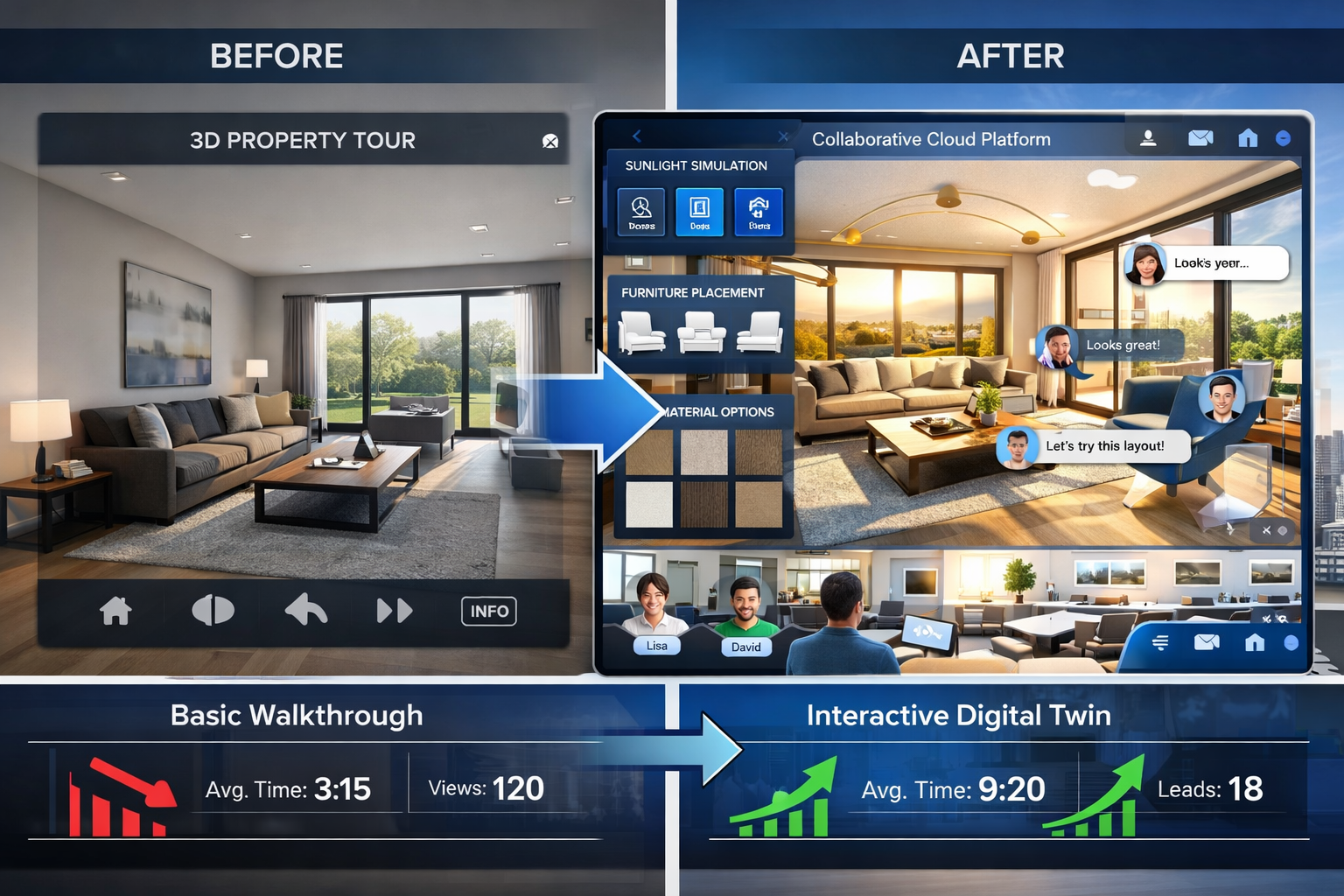
Traditional marketing relied on static renderings, floor plans, and architect's drawings—representations requiring significant imagination to translate into lived experience. Digital twins eliminate this translation barrier by providing immersive, interactive experiences where prospective buyers:
- Explore different layouts by moving walls and reconfiguring spaces
- Test furniture arrangements with accurate dimensions and spatial relationships
- Visualize daylight conditions at different times of day and seasons
- Experience material selections by swapping finishes, colors, and textures
- Simulate views from various vantage points throughout the property
This interactivity dramatically increases engagement. Rather than passively viewing presentations, stakeholders actively participate in design refinement, developing emotional connections to properties before construction begins.
Environmental simulation adds another dimension to pre-construction digital twins. Developers model:
- Solar exposure: Identifying optimal window placement and shading requirements
- Wind patterns: Assessing outdoor space comfort and structural loads
- Acoustic performance: Predicting sound transmission between spaces
- Energy performance: Estimating operational costs under various design scenarios
- Accessibility compliance: Verifying circulation paths meet regulatory requirements
These simulations enable design optimization before committing to construction, when changes cost pennies rather than pounds. The ability to test alternatives virtually reduces expensive change orders and ensures final buildings perform as intended.
Construction Phase: Progress Monitoring and Quality Assurance
During construction, digital twins serve as living project management tools that track progress against schedules, verify quality, and coordinate complex trades. Regular laser scanning compares actual construction against design intent, identifying discrepancies before they compound into expensive problems[5].
4D BIM extends three-dimensional models with the fourth dimension: time. Construction sequences animate within the digital twin, showing how the building evolves from foundation to completion. Project managers visualize:
- Schedule dependencies: Understanding which activities must complete before others begin
- Resource allocation: Identifying periods requiring peak labor or equipment
- Logistics planning: Coordinating material deliveries and storage
- Safety planning: Identifying high-risk activities and mitigation measures
- Progress verification: Comparing actual completion against planned schedules
When reality diverges from plan—an inevitable occurrence in complex construction projects—the digital twin becomes a collaborative problem-solving environment. Teams gather virtually within the 3D model, examining conflicts, testing solutions, and coordinating responses without requiring everyone to travel to the physical site.
Quality assurance benefits significantly from digital twin integration. Automated comparison between as-built laser scans and design models identifies deviations exceeding tolerance thresholds. This automated verification proves far more reliable than manual inspection, catching issues that human observers might miss.
Understanding how long surveys take helps property professionals plan comprehensive assessments that can feed into digital twin development during construction verification.
Operations and Facility Management: The Living Building Model
Post-construction, digital twins transition from project delivery tools to operational intelligence platforms that optimize building performance throughout the property lifecycle. This operational phase delivers the most substantial long-term value, as buildings spend decades in operation after months or years in construction.
Facility managers layer IoT data onto 3D models to monitor occupancy, energy usage, and maintenance needs in real-time[1]. The visual interface provides intuitive understanding that traditional building management systems struggle to deliver. Rather than interpreting abstract graphs and alarms, managers see:
- Color-coded heat maps showing temperature variations across floors
- Animated flow diagrams illustrating HVAC air distribution
- Alert icons positioned at exact equipment locations
- Occupancy visualizations revealing space utilization patterns
- Energy consumption overlays highlighting inefficient zones
This spatial context accelerates decision-making. When an occupant reports discomfort, facility managers immediately see that zone's current conditions, recent trends, and equipment serving that area—all within seconds rather than the hours traditional systems require.
Remote inspection capability proves particularly valuable for organizations managing distributed property portfolios. Portfolio managers navigate virtual replicas of buildings across different cities or countries, conducting detailed inspections without travel costs or time delays[1]. This remote accessibility proved essential during pandemic restrictions and continues delivering value through reduced travel expenses and carbon emissions.
The integration with work order systems creates closed-loop maintenance management. When the digital twin identifies an issue requiring attention, it automatically generates work orders with:
- Precise equipment location within the 3D model
- Current and historical performance data
- Maintenance history and previous interventions
- Required parts and tools
- Safety considerations and access requirements
- Estimated time and skill level needed
Technicians access this information through mobile devices, viewing the same 3D model while on-site to navigate directly to problem locations. Upon completion, they update the digital twin with intervention details, building a comprehensive maintenance history that improves future predictions.
For properties requiring detailed condition documentation, dilapidation surveys establish baseline conditions that digital twins can monitor for changes over time.
Renovation and Adaptive Reuse: Informed Transformation
When properties require renovation or adaptive reuse, digital twins provide comprehensive as-built documentation that accelerates design and reduces surprises during construction. Traditional renovation projects often encounter unexpected conditions—undocumented modifications, concealed structural elements, or systems differing from original drawings.
Laser scanning creates accurate as-built models revealing actual conditions rather than relying on potentially outdated documentation. Renovation teams:
- Design with confidence knowing exact dimensions and existing conditions
- Identify conflicts early between new designs and existing infrastructure
- Plan demolition precisely understanding what lies behind walls and ceilings
- Coordinate trades effectively with accurate spatial information
- Minimize change orders by discovering issues during design rather than construction
The historical data accumulated during operational phases informs renovation decisions. Energy consumption patterns reveal inefficient systems requiring upgrade priority. Occupancy data identifies underutilized spaces suitable for repurposing. Maintenance records highlight equipment nearing end-of-life requiring replacement during renovation rather than separately.
This evidence-based approach to renovation planning improves return on investment by focusing resources where they deliver maximum impact. Rather than uniform upgrades, property owners target interventions addressing specific performance gaps identified through years of operational data.
Competitive Advantages: Real-Time 3D Digital Twins Transforming Property Visualization and Decision-Making
Accelerated Sales Cycles and Enhanced Marketing
The property market increasingly demands remote visualization capabilities that enable prospective tenants and investors to explore properties without physical visits. Interactive 3D tours accessible from web browsers or VR headsets shorten sales cycles and boost engagement[1].
Traditional property marketing required coordinating schedules for physical viewings—a process consuming days or weeks as stakeholders traveled to sites. Digital twins eliminate this friction, enabling:
- Immediate access: Prospects explore properties within minutes of expressing interest
- Unlimited availability: Virtual tours occur 24/7 without scheduling constraints
- Global reach: International investors participate without travel costs
- Detailed exploration: Prospects spend more time examining properties than typical physical tours allow
- Comparative analysis: Stakeholders easily compare multiple properties side-by-side
Engagement metrics from digital twin implementations demonstrate substantial improvements over traditional marketing. Organizations report:
- Longer viewing sessions: Prospects spend 3-5x more time exploring virtual properties versus static listings
- Higher qualification rates: Self-guided exploration ensures serious prospects contact sales teams
- Reduced time-to-lease: Properties with interactive tours lease 30-40% faster
- Premium pricing: Enhanced visualization supports premium positioning
- Broader audience: Virtual access expands prospect pools beyond geographic constraints
The customization capability proves particularly powerful for pre-construction sales. Buyers configure finishes, layouts, and features within the digital twin, creating personalized visualizations of their specific unit. This customization builds emotional connection and commitment, reducing sales cycle friction.
For property transactions requiring professional valuation, understanding the complete guide to home surveying ensures comprehensive assessment alongside digital twin marketing.
Risk Mitigation and Informed Decision-Making
Real-Time 3D Digital Twins: Transforming Property Visualization and Decision-Making significantly reduces risk across property ownership and development. The comprehensive visibility into building conditions, performance trends, and predictive analytics enables proactive rather than reactive management.
Early warning systems detect developing issues before they escalate into expensive problems. Subtle changes in structural behavior, gradual equipment degradation, or emerging moisture intrusion trigger alerts when intervention remains simple and affordable. This early detection prevents:
- Catastrophic equipment failures requiring emergency repairs at premium costs
- Water damage from slow leaks that compound over time
- Structural issues from progressive settlement or deterioration
- Code violations from gradually degrading safety systems
- Tenant dissatisfaction from declining environmental conditions
The documentation capability proves invaluable during disputes or insurance claims. Comprehensive historical records from digital twins provide objective evidence of conditions, maintenance activities, and timeline of events. This documentation:
- Accelerates insurance claim processing with detailed damage documentation
- Supports defense against liability claims with maintenance history evidence
- Facilitates dispute resolution with objective condition records
- Demonstrates compliance with regulatory requirements
- Validates warranty claims with usage and maintenance data
For properties involved in party wall disputes, digital twin documentation of pre-existing conditions proves particularly valuable in establishing baseline conditions and resolving disagreements.
Investment due diligence benefits substantially from digital twin access. Prospective buyers or lenders examine:
- Actual operating costs versus seller representations
- Equipment condition and remaining useful life
- Energy efficiency and potential improvement opportunities
- Maintenance history revealing deferred maintenance or recurring issues
- Space utilization indicating revenue optimization potential
This transparency reduces information asymmetry between buyers and sellers, enabling more accurate valuations and reducing post-acquisition surprises.
Operational Excellence and Sustainability
The 10-20% operating cost reductions achieved through digital twin implementation[5] create substantial competitive advantages in markets where margins determine success. These savings compound annually, generating significant value over property lifecycles.
Energy optimization represents the largest single savings category. AI-powered systems continuously adjust building operations based on:
- Real-time occupancy: Conditioning only occupied spaces
- Weather forecasts: Pre-conditioning buildings before temperature extremes
- Utility rate structures: Shifting loads to off-peak periods
- Equipment efficiency curves: Operating systems at optimal performance points
- Renewable energy availability: Maximizing self-consumption of solar generation
Organizations implementing comprehensive energy optimization through digital twins report 20-30% energy cost reductions within the first year, with ongoing improvements as AI algorithms accumulate more operational data and refine optimization strategies.
Sustainability reporting increasingly demands detailed documentation of environmental performance. Digital twins automatically collect and organize the data required for:
- LEED certification and ongoing performance verification
- Carbon footprint reporting for ESG disclosure requirements
- Energy Performance Certificates demonstrating compliance
- Green building ratings supporting premium positioning
- Tenant sustainability reporting enabling occupants to meet their own ESG goals
This automated reporting eliminates manual data collection and compilation, reducing administrative burden while improving accuracy and auditability.
The competitive positioning benefits extend beyond cost savings. Properties demonstrating superior environmental performance, operational transparency, and technological sophistication attract premium tenants willing to pay higher rents for enhanced experiences and alignment with their sustainability commitments.
Implementation Roadmap: Getting Started with Real-Time 3D Digital Twins
Assessing Readiness and Defining Objectives
Successful digital twin implementation begins with clear objective definition aligned with business priorities. Organizations should identify specific problems to solve or opportunities to capture rather than implementing technology for its own sake.
Common implementation objectives include:
- Reduce operating costs through predictive maintenance and energy optimization
- Improve tenant satisfaction with enhanced environmental quality and responsive service
- Accelerate leasing through immersive marketing and virtual tours
- Enhance asset value with comprehensive documentation and performance optimization
- Support sustainability goals through detailed monitoring and optimization
- Streamline operations across distributed property portfolios
Readiness assessment evaluates existing capabilities and identifies gaps requiring attention:
| Assessment Area | Key Questions |
|---|---|
| Data Infrastructure | What building data currently exists? What format? What quality? |
| Connectivity | Does reliable network infrastructure exist throughout properties? |
| Equipment | Are building systems compatible with monitoring integration? |
| Skills | Does the team possess necessary technical capabilities? |
| Stakeholder Buy-in | Do decision-makers understand value and support investment? |
| Budget | Are adequate resources available for implementation and ongoing operation? |
Organizations with limited existing infrastructure might begin with pilot projects targeting specific buildings or systems rather than attempting comprehensive portfolio-wide deployment. Successful pilots demonstrate value, build internal expertise, and inform broader rollout strategies.
Selecting Technology Partners and Platforms
The digital twin ecosystem includes numerous technology providers offering varied capabilities, integration approaches, and business models. Platform selection significantly impacts implementation success and long-term value realization.
Evaluation criteria should address:
- Integration capability: Can the platform connect with existing building systems and business applications?
- Scalability: Will the solution grow with expanding requirements and property portfolios?
- Customization: Does the platform adapt to specific workflows and requirements?
- User experience: Can non-technical stakeholders easily access and interpret information?
- Security: Does the solution meet cybersecurity requirements and industry standards?
- Support: What implementation assistance, training, and ongoing support does the vendor provide?
- Total cost of ownership: What are initial and recurring costs including licenses, services, and infrastructure?
Vendor evaluation should include reference checks with similar organizations, proof-of-concept testing with actual building data, and assessment of vendor financial stability and market position. The digital twin market remains dynamic in 2026, with consolidation and evolution continuing—selecting established vendors with strong track records reduces implementation risk.
Open standards versus proprietary platforms represents an important consideration. Open standards facilitate integration with diverse systems and reduce vendor lock-in, while proprietary platforms might offer superior integration within their ecosystem but create switching costs and compatibility limitations.
Phased Deployment and Change Management
Phased implementation manages risk and builds momentum through incremental value delivery. A typical deployment progression includes:
Phase 1: Foundation (Months 1-3)
- Create accurate 3D models through laser scanning or BIM development
- Establish network infrastructure and connectivity
- Deploy initial sensor networks for critical systems
- Configure platform and integrate initial data sources
- Train core team members
Phase 2: Expansion (Months 4-6)
- Expand sensor coverage to additional systems and zones
- Integrate additional data sources (utility meters, access systems, etc.)
- Develop custom dashboards and analytics
- Extend access to broader stakeholder groups
- Refine AI models with accumulated operational data
Phase 3: Optimization (Months 7-12)
- Implement advanced analytics and predictive capabilities
- Integrate with work order and maintenance management systems
- Deploy mobile access for field technicians
- Expand to additional properties in portfolio
- Measure and document value realization
Change management determines whether technical capabilities translate into actual value. Successful implementations address:
- Stakeholder communication: Regular updates on progress, value delivered, and upcoming capabilities
- Training programs: Role-specific instruction ensuring all users can effectively leverage the platform
- Process redesign: Updating workflows to incorporate digital twin insights
- Performance metrics: Tracking adoption, usage patterns, and business outcomes
- Continuous improvement: Gathering feedback and iterating on implementation
Resistance to change commonly emerges from team members comfortable with existing processes. Addressing this resistance requires demonstrating how digital twins make their work easier rather than creating additional burden, involving them in implementation decisions, and celebrating early wins that validate the transformation.
For properties requiring baseline documentation before digital twin implementation, professional building surveys provide comprehensive condition assessments that establish initial digital twin accuracy.
Future Trends: The Evolution of Real-Time 3D Digital Twins
Integration with Augmented and Virtual Reality
The convergence of digital twins with augmented reality (AR) and virtual reality (VR) creates immersive experiences that further enhance property visualization and operational efficiency. In 2026, this integration is moving from experimental applications into practical deployment[7].
Augmented reality overlays enable field technicians to view digital twin data while looking at physical equipment through smartphone or tablet cameras. This capability provides:
- Visual work instructions overlaid on actual equipment
- Real-time performance data displayed alongside physical systems
- Maintenance history accessible by pointing devices at equipment
- Part identification with automatic lookup of specifications and suppliers
- Safety warnings highlighting hazards and required precautions
Virtual reality environments allow stakeholders to experience properties at full scale regardless of physical location. Applications include:
- Design reviews: Walking through buildings before construction begins
- Training: Familiarizing facility staff with building systems and emergency procedures
- Remote collaboration: Multiple stakeholders meeting virtually within the same space
- Marketing: Immersive property tours for prospective tenants or buyers
- Planning: Testing renovation scenarios and space reconfigurations
The technology continues improving rapidly, with headset costs declining, resolution increasing, and user experiences becoming more intuitive and comfortable for extended sessions.
Artificial Intelligence Advancement and Autonomous Buildings
AI capabilities continue advancing, moving digital twins toward increasingly autonomous building operations. Current systems require human decision-making based on AI recommendations; future implementations will execute optimization strategies automatically within parameters established by property managers[7].
Autonomous capabilities emerging in 2026 include:
- Self-optimizing HVAC: Systems that continuously adjust to minimize energy consumption while maintaining comfort
- Predictive space allocation: Automatically adjusting workspace configurations based on predicted demand
- Dynamic pricing: Real-time adjustment of parking, meeting room, or amenity pricing based on demand
- Automated procurement: Ordering replacement parts when predictive maintenance identifies upcoming needs
- Energy trading: Buying and selling electricity based on building demand, renewable generation, and market prices
Generative design represents another frontier where AI explores thousands of design alternatives, identifying optimal configurations that human designers might never consider. Applications include:
- Space planning: Generating layout options that maximize functionality and efficiency
- Retrofit design: Identifying optimal improvement combinations for renovation projects
- Equipment sizing: Determining ideal capacity for mechanical systems
- Material selection: Choosing finishes and components that optimize performance and cost
- Sustainability optimization: Configuring buildings to achieve carbon neutrality or net-positive energy
These autonomous capabilities raise important questions about human oversight, liability, and control. The industry continues developing frameworks that balance automation benefits with appropriate human supervision and intervention capabilities.
Blockchain Integration and Digital Property Records
Blockchain technology integration with digital twins creates immutable records of property history, transactions, and conditions. This convergence addresses long-standing challenges in property markets around trust, transparency, and transaction friction[8].
Smart contracts automatically execute based on conditions verified through digital twin data:
- Performance-based leases: Rent adjustments tied to verified environmental quality metrics
- Maintenance guarantees: Automatic payment releases when digital twin confirms work completion
- Energy performance contracts: Payments to efficiency contractors based on verified savings
- Insurance claims: Automated processing when digital twin documents qualifying events
- Regulatory compliance: Automatic demonstration of code adherence through continuous monitoring
Property tokenization enables fractional ownership of real estate assets, with digital twins providing transparent performance data to token holders. This transparency reduces information asymmetry and enables more liquid real estate markets.
Provenance tracking creates comprehensive property histories recording:
- Construction materials and methods
- All renovations and modifications
- Maintenance activities and equipment replacements
- Energy and water consumption trends
- Occupancy and utilization patterns
- Environmental certifications and ratings
This permanent record increases property values by reducing uncertainty for buyers and lenders while supporting sustainability claims with verifiable evidence.
Conclusion: Embracing the Digital Twin Revolution
Real-Time 3D Digital Twins: Transforming Property Visualization and Decision-Making represents far more than incremental technological improvement—it fundamentally reshapes how the property industry operates. The convergence of 3D modeling, IoT sensors, AI analytics, and cloud collaboration creates capabilities that seemed like science fiction just years ago.
The evidence supporting adoption grows increasingly compelling. Organizations implementing digital twins achieve 10-20% operating cost reductions, up to 30% maintenance savings, accelerated sales cycles, enhanced tenant satisfaction, and improved sustainability performance[3][5]. These benefits compound over time as AI algorithms refine their predictions and organizations develop expertise in leveraging digital twin insights.
The year 2026 marks a pivotal transition point where digital twins move from competitive advantage to competitive necessity[7]. Early adopters currently enjoy significant market positioning benefits, but competitors are adapting rapidly. The window for gaining first-mover advantages remains open but narrowing.
Actionable Next Steps
For property professionals ready to embrace this transformation:
- Assess your current state: Evaluate existing data, infrastructure, and capabilities to identify gaps and opportunities
- Define clear objectives: Establish specific, measurable goals aligned with business priorities rather than implementing technology for its own sake
- Start with a pilot: Select a single property or system for initial implementation to build expertise and demonstrate value before broader rollout
- Engage stakeholders: Communicate vision, involve team members in planning, and address concerns proactively
- Select partners carefully: Evaluate technology vendors thoroughly, checking references and conducting proof-of-concept testing
- Plan for change: Develop comprehensive change management strategies addressing training, process redesign, and cultural adaptation
- Measure and communicate value: Track metrics demonstrating business impact and share successes to build momentum
The digital twin revolution is not coming—it's here. Organizations that embrace this transformation position themselves for sustained competitive advantage in an industry being fundamentally reshaped by technology. Those that delay risk falling permanently behind competitors who leverage superior intelligence, efficiency, and stakeholder experiences enabled by real-time 3D digital twins.
The future of property belongs to those who can see it—not just as static physical assets, but as dynamic, intelligent systems continuously optimizing performance and creating value through the seamless integration of physical and digital realities.
References
[1] What Is 3d Digital Twin Technology How It S Built And Why It S Changing Real Estate – https://home.realsee.ai/en/article/what-is-3d-digital-twin-technology-how-it-s-built-and-why-it-s-changing-real-estate
[2] Increasing Customer Engagement Via Real Time Visualization Through Digital Twin For A Real Estate Company – https://www.brillio.com/insights/case-study/increasing-customer-engagement-via-real-time-visualization-through-digital-twin-for-a-real-estate-company/
[3] Digital Twin Technology Why The Future Of Real Estate Is A Virtual Replica – https://nerdbot.com/2026/01/27/digital-twin-technology-why-the-future-of-real-estate-is-a-virtual-replica/
[4] Digital Twins Are Changing The Game In Real Estate – https://trerc.tamu.edu/blog/digital-twins-are-changing-the-game-in-real-estate/
[5] Virtual Design Construction Vdc Trends 2026 Ai Digital Twins Technology – https://www.clearedge3d.com/blogs/virtual-design-construction-vdc-trends-2026-ai-digital-twins-technology/
[6] Real Time 3d Digital Twins For Property Development Interactive Models That Update Live – https://nottinghillsurveyors.com/blog/real-time-3d-digital-twins-for-property-development-interactive-models-that-update-live
[7] What Do Digital Twins Hold For 2026 From Visualisation To Smart Building Operations – https://www.twinview.com/insights/what-do-digital-twins-hold-for-2026-from-visualisation-to-smart-building-operations
[8] Digital Twin Digital Enterprise Time Travel – https://www.siemens.com/en-us/company/insights/digital-twin-digital-enterprise-time-travel/
