
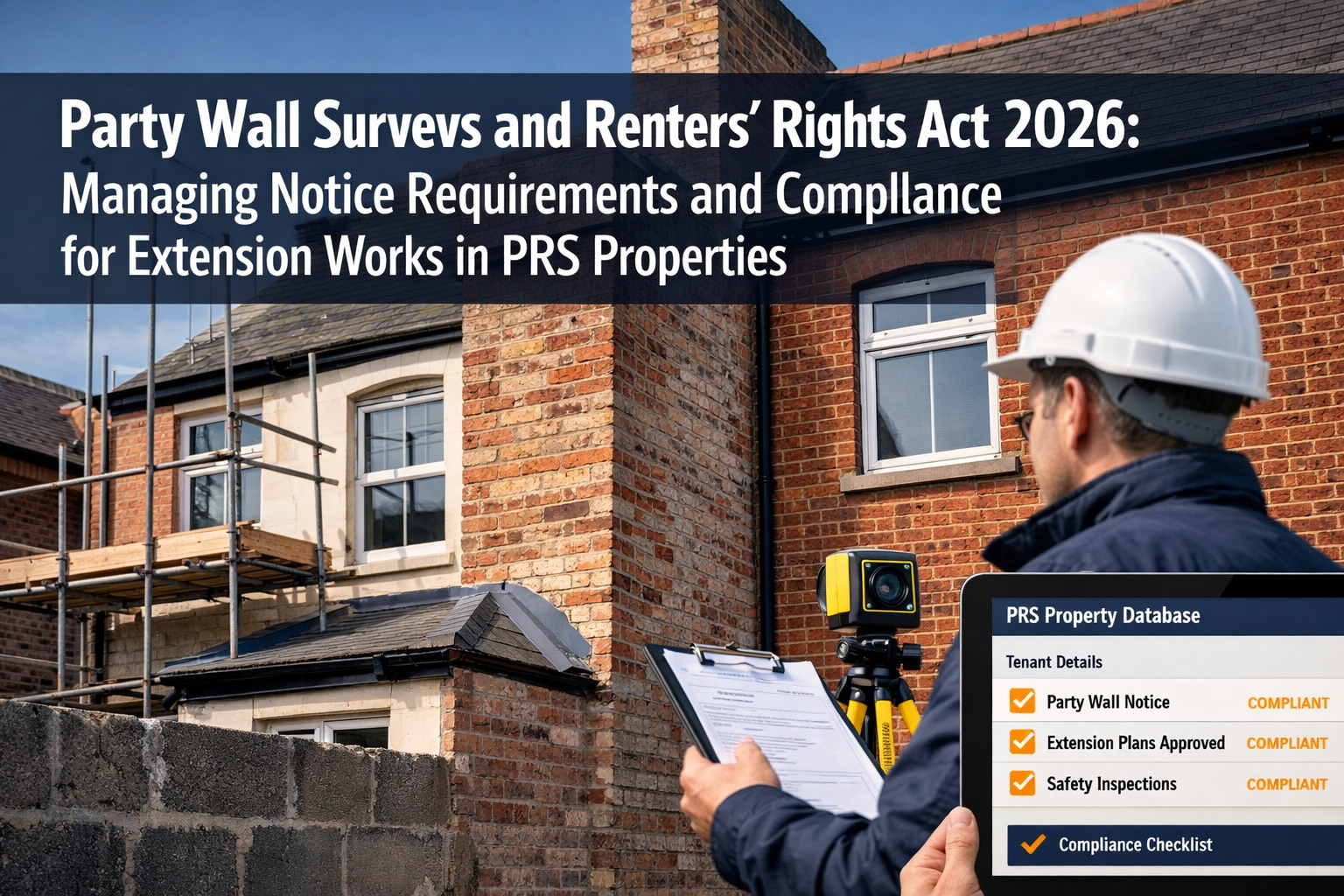
The 2026 Renters' Rights Act has fundamentally restructured how landlords and surveyors approach extension works in private rented sector (PRS) properties, with over 4.4 million rental properties now subject to new centralized database registration and enhanced tenant notification protocols[1]. For surveyors managing party wall procedures, the intersection of traditional Party Wall etc. Act 1996 requirements with the new PRS compliance framework creates a complex regulatory landscape that demands updated protocols and meticulous documentation.
Understanding Party Wall Surveys and Renters' Rights Act 2026: Managing Notice Requirements and Compliance for Extension Works in PRS Properties has become essential for surveyors, landlords, and property professionals navigating this transformed regulatory environment. The centralized PRS database introduced in 2026 fundamentally altered landlord operations, particularly regarding party wall procedures and tenant rights in private rented sector properties[1].
Key Takeaways
- PRS Database registration is now mandatory before serving party wall notices for extension works in rental properties, creating a new compliance prerequisite[1]
- Tenant rights have been repositioned as central to all party wall notice procedures, requiring enhanced notification protocols beyond traditional adjoining owner requirements[3]
- New Section 8 ground requirements affect how landlords can proceed with extension works while tenancies are active, impacting party wall survey timing[3]
- Updated surveyor protocols must integrate both Party Wall Act 1996 procedures and 2026 Renters' Rights Act compliance requirements
- Documentation standards have increased significantly, requiring comprehensive records of tenant notifications alongside traditional party wall paperwork
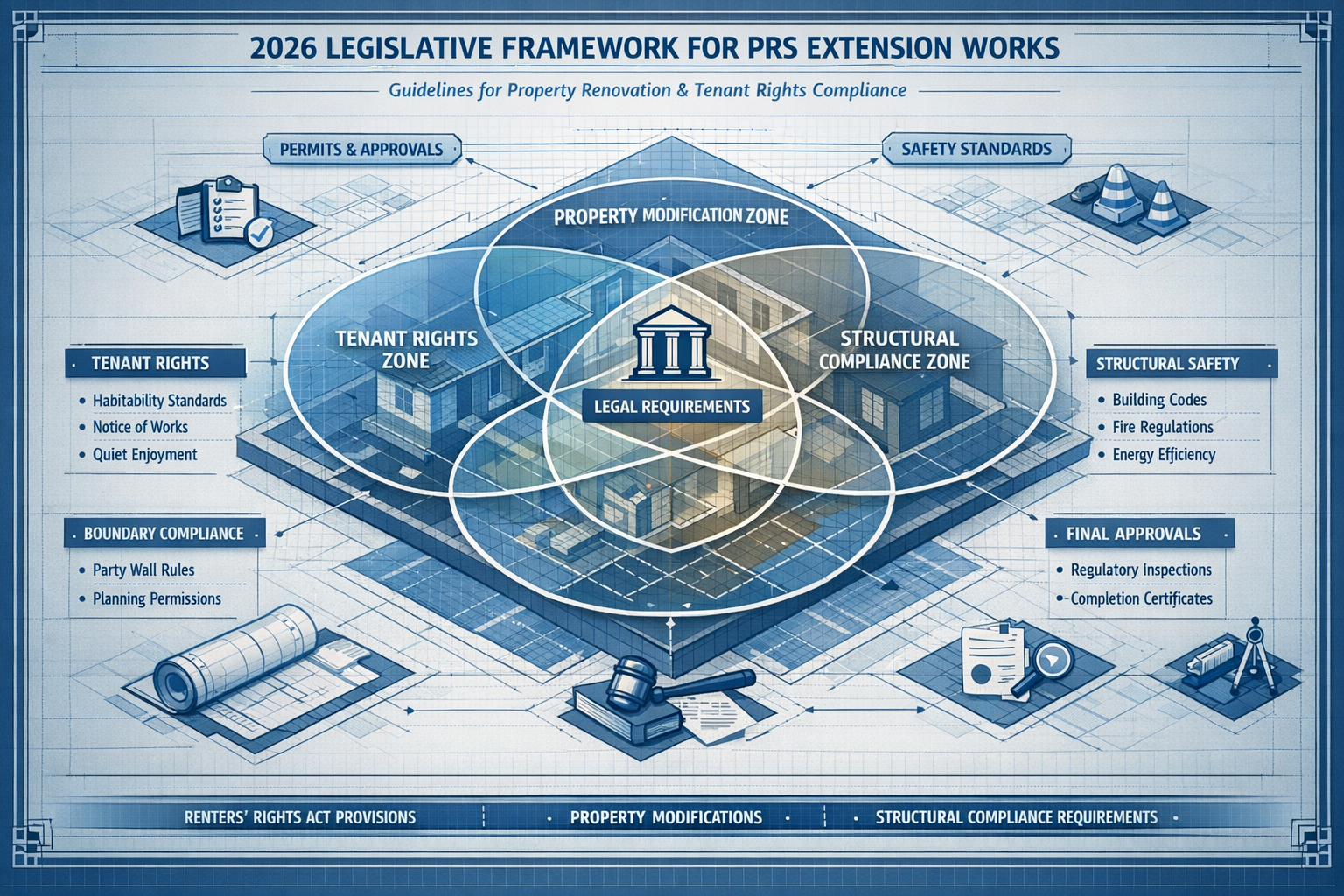
Understanding the 2026 Legislative Framework for PRS Extension Works
The PRS Database Registration Requirement
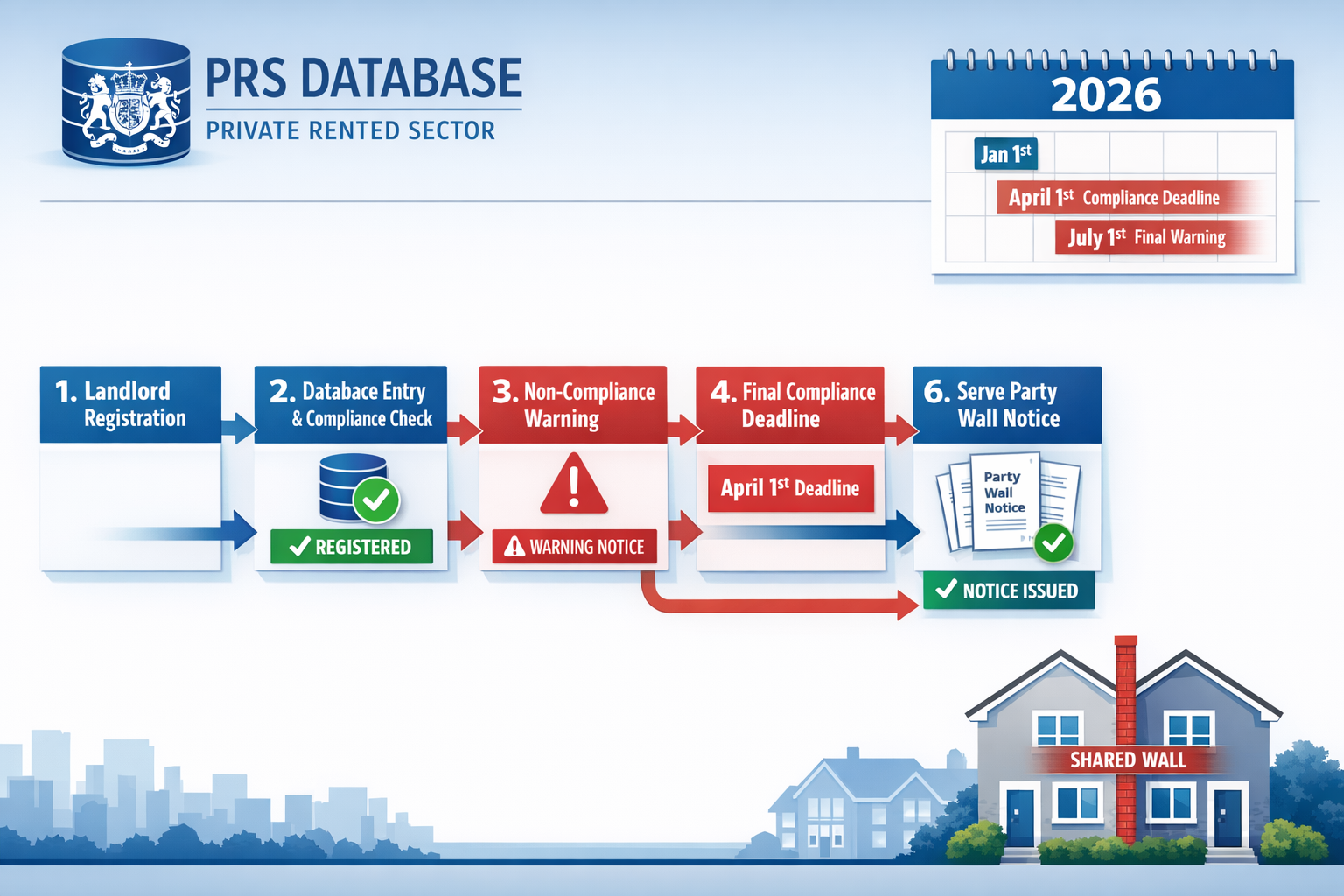
The centralized PRS database introduced under the Renters' Rights Act 2026 represents the most significant shift in landlord compliance obligations in decades. Every landlord operating in the private rented sector must now register their properties before undertaking any significant works, including extensions that trigger party wall procedures[1].
This registration requirement creates a new prerequisite step in the party wall process. Surveyors must now verify PRS database compliance before advising on or serving party wall notices. The database contains:
- Property registration details and compliance status
- Current tenancy information and tenant contact details
- Landlord verification and certification records
- Historical compliance and enforcement actions
- Planned works notifications and approvals
Key compliance point: Party wall notices served by unregistered landlords may face challenges regarding their validity, potentially delaying projects and creating legal complications[1].
Integration with Traditional Party Wall Procedures
The Party Wall etc. Act 1996 remains the governing legislation for party wall matters, but its application in PRS properties now requires careful coordination with Renters' Rights Act requirements. Understanding the Party Wall Act remains foundational, but surveyors must now layer additional compliance steps.
The traditional party wall process involves:
- Initial assessment of proposed works
- Service of appropriate notices (typically 2 months for Line of Junction works, 1 month for other notifiable works)
- Awaiting consent or dissent from adjoining owners
- Appointment of surveyors if dissent occurs
- Preparation of a Party Wall Award outlining the works and protections
In PRS properties, this process now includes:
- ✅ PRS database verification before notice service
- ✅ Enhanced tenant notification requirements
- ✅ Section 8 ground compliance assessment
- ✅ Tenant rights documentation throughout the process
- ✅ Coordinated timing with tenancy agreements and notice periods
Section 8 Ground Requirements for Landlord-Initiated Works
The 2026 changes introduce new Section 8 ground requirements for landlord-initiated works in PRS properties, fundamentally affecting how extension works and compliance procedures must be managed[3]. These grounds establish when landlords can proceed with significant works that may affect tenant occupation.
Section 8 grounds relevant to extension works include:
| Ground | Application | Impact on Party Wall Process |
|---|---|---|
| Ground 6A | Substantial refurbishment or extension works | Landlord must demonstrate works cannot be reasonably completed with tenant in situ |
| Ground 6B | Works requiring vacant possession | Enhanced notice periods apply (typically 4-6 months) |
| Ground 6C | Health and safety compliance works | Expedited procedures may apply if urgent |
Surveyors must now assess whether proposed extension works fall under these grounds and advise landlords accordingly. When you need a party wall agreement becomes more complex when tenancy rights intersect with construction timelines[3].
Party Wall Surveys and Renters' Rights Act 2026: Notice Service Protocols for PRS Properties
Enhanced Tenant Notification Requirements
Tenant rights have been repositioned as central to all party wall notices and procedures for institutional buy-to-let properties under the 2026 legislative changes[3]. This represents a fundamental shift from previous practice where tenants were often treated as secondary parties in party wall matters.
New notification protocols require:
📋 Dual notification system – Both landlord (as building owner) and tenant (as occupier) must receive appropriate notices
📋 Plain language explanations – Technical party wall notices must be accompanied by accessible summaries explaining tenant rights
📋 Extended notice periods – Minimum 14 days additional notice to tenants beyond standard party wall timelines
📋 Right to representation – Tenants must be informed of their right to appoint their own surveyor or seek independent advice
📋 Impact assessments – Clear documentation of how works will affect tenant occupation, access, and amenity
What does a party wall surveyor do now extends to ensuring tenant rights are protected throughout the process, not just adjoining owner interests.
Coordinating Party Wall Notices with Tenancy Agreements
The timing of party wall notices in PRS properties requires careful coordination with existing tenancy agreements and renewal dates. Strategic timing can significantly reduce compliance complexity and potential disputes.
Best practice timing strategies:
- Pre-tenancy planning – Serve party wall notices before new tenancies commence where possible
- Renewal coordination – Align major works with natural tenancy break points
- Notice stacking – Coordinate Section 8 notices with party wall notice periods to minimize delays
- Buffer periods – Build additional time into project schedules to accommodate tenant consultation requirements
Example timeline for rear extension in PRS property:
- Month 1: Verify PRS database registration and compliance
- Month 2: Serve Section 8 notice to tenant (if required for vacant possession)
- Month 2: Simultaneously serve party wall notices to adjoining owners
- Month 3-4: Tenant consultation period and party wall surveyor appointments
- Month 4-5: Party wall award preparation and finalization
- Month 6: Tenant vacation (if required) and commencement of works
Documentation Standards and Record-Keeping
The 2026 regulatory framework demands significantly enhanced documentation standards. Surveyors must maintain comprehensive records demonstrating compliance with both party wall and tenant rights requirements.
Essential documentation includes:
✅ PRS database registration certificates with current status verification
✅ Tenant notification records with proof of service and acknowledgment
✅ Section 8 ground assessments with supporting justification
✅ Party wall notice service records for all parties
✅ Tenant consultation responses and any concerns raised
✅ Party wall awards incorporating tenant protection provisions
✅ Ongoing monitoring reports during construction phase
✅ Completion certificates confirming works compliance
This documentation serves multiple purposes: demonstrating regulatory compliance, protecting against future disputes, and providing evidence of proper procedure if enforcement actions arise.
Managing Extension Works Compliance: Practical Surveyor Protocols
Pre-Works Assessment and Planning
Effective management of Party Wall Surveys and Renters' Rights Act 2026: Managing Notice Requirements and Compliance for Extension Works in PRS Properties begins with comprehensive pre-works assessment. Surveyors should implement a systematic evaluation framework:
Step 1: Property Status Verification
- Confirm PRS database registration status
- Review current tenancy agreements and terms
- Identify all adjoining properties and ownership structures
- Assess whether adjoining properties are also PRS rentals (requiring additional coordination)
Step 2: Works Classification
Determine which party wall notice types apply. For extension works, this typically involves:
- Party Structure Notice (Section 2) – for works to existing party walls
- Line of Junction Notice (Section 1) – for new walls built on or astride the boundary
- 3/6 Meter Notice (Section 6) – for excavations near adjoining properties
Understanding party structure notices is particularly important for extension works that involve existing party walls.
Step 3: Tenant Impact Assessment
Evaluate how proposed works will affect tenant occupation:
- Noise and disruption levels – Will works make property uninhabitable?
- Access requirements – Will contractors need access through tenant spaces?
- Amenity reduction – Will works temporarily reduce usable space or facilities?
- Duration estimates – How long will disruptive phases last?
This assessment determines whether Section 8 grounds apply and what tenant protections must be incorporated into the party wall award.
Surveyor Appointment and Role Clarification
The surveyor's role in PRS extension works extends beyond traditional party wall functions. Clear role definition prevents confusion and ensures all compliance requirements are addressed.
Expanded surveyor responsibilities include:
🔍 Compliance verification – Confirming PRS database registration before proceeding
🔍 Multi-party coordination – Managing communications between landlord, tenant, and adjoining owners
🔍 Tenant rights advocacy – Ensuring tenant protections are incorporated into awards
🔍 Documentation management – Maintaining enhanced records for regulatory compliance
🔍 Dispute resolution – Addressing conflicts between landlord works requirements and tenant rights
When finding qualified party wall surveyors, landlords should specifically seek professionals experienced with PRS compliance requirements. RICS party wall surveyors with updated training on the 2026 legislative changes are particularly valuable.
Surveyor appointment options in PRS scenarios:
- Agreed Surveyor – Single surveyor acting for both parties (most cost-effective)
- Two Surveyors – Building owner's surveyor and adjoining owner's surveyor
- Tenant's Independent Advisor – Separate professional advising tenant on rights (increasingly common)
Award Preparation with Tenant Protection Provisions
Party wall awards for PRS extension works must now incorporate specific tenant protection provisions beyond traditional structural safeguards. This represents a significant evolution in award drafting practice.
Essential tenant protection clauses:
1. Access and Notice Provisions
- Minimum 48-hour notice for contractor access to rental property
- Restricted working hours (typically 8am-6pm weekdays, limited weekend work)
- Emergency contact procedures for tenant concerns
2. Amenity Protections
- Temporary alternative facilities if works disrupt essential services
- Dust and noise mitigation measures with specific standards
- Compensation mechanisms for amenity reduction during works
3. Security and Safety Requirements
- Secure separation between work areas and tenant spaces
- Insurance coverage confirmation for tenant belongings
- Health and safety compliance certification
4. Monitoring and Reporting
- Regular progress updates to tenant
- Inspection rights allowing tenant to verify compliance
- Dispute resolution procedures accessible to tenants
5. Completion and Remediation
- Timelines for completing works and restoring full amenity
- Standards for reinstatement of any tenant areas affected
- Final inspection and sign-off procedures
Understanding the party wall process now requires incorporating these additional provisions throughout award preparation.
Ongoing Compliance Monitoring During Works
The 2026 framework requires active monitoring throughout the construction phase, not just initial compliance at the notice stage. Surveyors should establish monitoring protocols that address both party wall and tenant rights requirements.
Recommended monitoring framework:
📊 Weekly site inspections during active construction phases
📊 Tenant feedback mechanisms allowing concerns to be raised promptly
📊 Photographic documentation of works progress and any issues
📊 Compliance checklists verifying adherence to award provisions
📊 Incident reporting for any breaches or unexpected impacts
📊 Variation procedures for addressing necessary changes to approved works
This enhanced monitoring helps prevent minor issues escalating into formal party wall disputes and demonstrates good faith compliance with tenant rights obligations.
Cost Implications and Fee Structures Under the 2026 Framework
Updated Fee Expectations for PRS Party Wall Work
The additional compliance requirements introduced by the Renters' Rights Act 2026 have naturally impacted surveyor fees for PRS extension projects. Landlords should expect 15-25% higher surveyor costs compared to owner-occupied properties due to the enhanced work involved[1].
How much does a party wall surveyor cost in 2026 for PRS properties typically includes:
Base party wall surveyor fees:
- Simple extension works: £800-£1,200 per surveyor
- Complex works with multiple adjoining properties: £1,500-£3,000 per surveyor
Additional PRS compliance fees:
- PRS database verification and documentation: £200-£350
- Enhanced tenant consultation and documentation: £300-£500
- Section 8 ground assessment and advice: £250-£400
- Additional monitoring visits during works: £150-£250 per visit
Total typical cost range for PRS extension party wall work: £1,500-£4,500 depending on complexity.
These costs are typically borne by the building owner (landlord) under party wall legislation, though specific allocation should be confirmed in the party wall award.
Cost-Benefit Analysis of Proper Compliance
While enhanced compliance requirements increase upfront costs, proper adherence to Party Wall Surveys and Renters' Rights Act 2026: Managing Notice Requirements and Compliance for Extension Works in PRS Properties protocols delivers significant value:
Benefits of full compliance:
💰 Reduced dispute risk – Proper procedures minimize likelihood of costly disputes or legal challenges
💰 Project timeline protection – Compliance prevents enforcement actions that could halt works
💰 Tenant retention – Professional handling maintains landlord-tenant relationships
💰 Property value protection – Properly documented works support future valuations
💰 Regulatory penalty avoidance – Non-compliance can result in fines up to £30,000 per property[1]
Costs of non-compliance:
- Enforcement actions and fines from housing authorities
- Tenant compensation claims for rights violations
- Project delays while retrospective compliance is achieved
- Legal costs defending challenges to improper procedures
- Reputational damage affecting future lettings
The cost-benefit analysis clearly favors investment in proper compliance from the outset.
Future Developments and Ongoing Guidance Updates
RICS Consultation on Updated Party Wall Guidance
RICS launched a consultation on updated party wall guidance in 2026, with James Kavanagh indicating this initiative aims to shape updated guidance for professionals working under the Party Wall etc. Act 1996[2]. This consultation specifically addresses the integration of Renters' Rights Act requirements with traditional party wall procedures.
Key areas under consultation:
- Standardized protocols for PRS database verification
- Template language for tenant protection provisions in awards
- Best practice guidance for multi-party communication management
- Updated fee guidance reflecting enhanced compliance work
- Dispute resolution procedures incorporating tenant rights
Surveyors should actively participate in this consultation process and monitor for published guidance updates expected in late 2026.
Anticipated Regulatory Refinements
As the 2026 framework beds in, regulatory refinements are expected based on early implementation experiences. Likely areas for clarification include:
🔄 Notice period harmonization – Streamlining overlapping notice requirements
🔄 Digital notification standards – Approved methods for electronic service of notices
🔄 Tenant surveyor appointment protocols – Clarifying when tenants can appoint separate surveyors
🔄 Emergency works procedures – Expedited processes for urgent structural issues
🔄 Cross-border considerations – Coordination with Scottish and Welsh rental sector reforms
Surveyors should maintain awareness of regulatory developments through professional bodies and industry publications.
Conclusion: Navigating the New Compliance Landscape
The integration of Party Wall Surveys and Renters' Rights Act 2026: Managing Notice Requirements and Compliance for Extension Works in PRS Properties represents a fundamental shift in how extension projects must be managed in the private rented sector. The centralized PRS database, enhanced tenant rights, and new Section 8 ground requirements create a more complex but ultimately more balanced regulatory framework.
For surveyors, success in this new landscape requires:
✅ Updated knowledge of both Party Wall Act 1996 and Renters' Rights Act 2026 requirements
✅ Enhanced documentation practices demonstrating comprehensive compliance
✅ Multi-stakeholder coordination skills managing landlord, tenant, and adjoining owner interests
✅ Proactive planning building additional time into project schedules for compliance steps
✅ Ongoing professional development staying current with guidance updates and regulatory refinements
For landlords undertaking extension works, the key message is clear: early engagement with qualified surveyors experienced in PRS compliance is essential. The additional upfront investment in proper procedures protects against far more costly enforcement actions, disputes, and project delays.
Actionable Next Steps
For Landlords Planning Extension Works:
- Verify PRS database registration before any planning or notice service
- Engage an experienced party wall surveyor with 2026 compliance knowledge early in the planning process
- Review current tenancy agreements to identify optimal timing for works
- Budget appropriately for enhanced compliance costs (15-25% above standard party wall fees)
- Establish clear communication channels with tenants from the outset
For Surveyors Managing PRS Extension Projects:
- Implement updated checklists covering both party wall and tenant rights requirements
- Develop template documentation for PRS compliance verification and tenant notifications
- Build additional time into project schedules for enhanced consultation requirements
- Establish monitoring protocols for ongoing compliance during construction
- Participate in RICS consultation to shape emerging best practice guidance
For Tenants in Properties Undergoing Extension Works:
- Understand your rights under both tenancy agreements and party wall procedures
- Request clear information about how works will affect your occupation
- Document all communications regarding the works and any concerns
- Consider independent advice if significant disruption is anticipated
- Engage constructively with the process while ensuring your rights are protected
The 2026 regulatory framework ultimately aims to balance property owners' legitimate development rights with enhanced protections for tenants and adjoining owners. By understanding and properly implementing these requirements, surveyors can facilitate successful extension projects that respect all parties' interests while maintaining full regulatory compliance.
References
[1] Party Wall Notice Requirements For Prs Database Compliance Works Surveyor Tactics Post Renters Rights Act Registration In 2026 – https://nottinghillsurveyors.com/blog/party-wall-notice-requirements-for-prs-database-compliance-works-surveyor-tactics-post-renters-rights-act-registration-in-2026
[2] Rics Launches Consultation On Party Wall Guidance – https://thenegotiator.co.uk/news/regulation-law-news/rics-launches-consultation-on-party-wall-guidance/
[3] Party Wall Surveys For Renters Rights Act Compliance Managing Notices When Landlord Initiated Works Face New Section 8 Ground Requirements – https://nottinghillsurveyors.com/blog/party-wall-surveys-for-renters-rights-act-compliance-managing-notices-when-landlord-initiated-works-face-new-section-8-ground-requirements
