
From May 1, 2026, the UK rental landscape undergoes its most significant transformation in decades. Section 21 no-fault evictions vanish entirely, fixed-term tenancies automatically convert to periodic arrangements, and rent review mechanisms face unprecedented restrictions. For property surveyors, landlords, and investors, these changes demand a fundamental recalibration of buy-to-let (BTL) valuations—reshaping yield calculations, risk assessments, and investment appeal across the entire sector.
Understanding how the Renters' Rights Act 2026 and BTL Valuations: Adjusting Property Assessments Post-Section 21 Abolition and Rent Review Rules intersect is now critical for accurate property assessments. The legislation removes key landlord flexibilities that previously underpinned investment strategies and valuation methodologies, forcing surveyors to adopt new frameworks that reflect diminished control, extended holding periods, and constrained rental income growth.
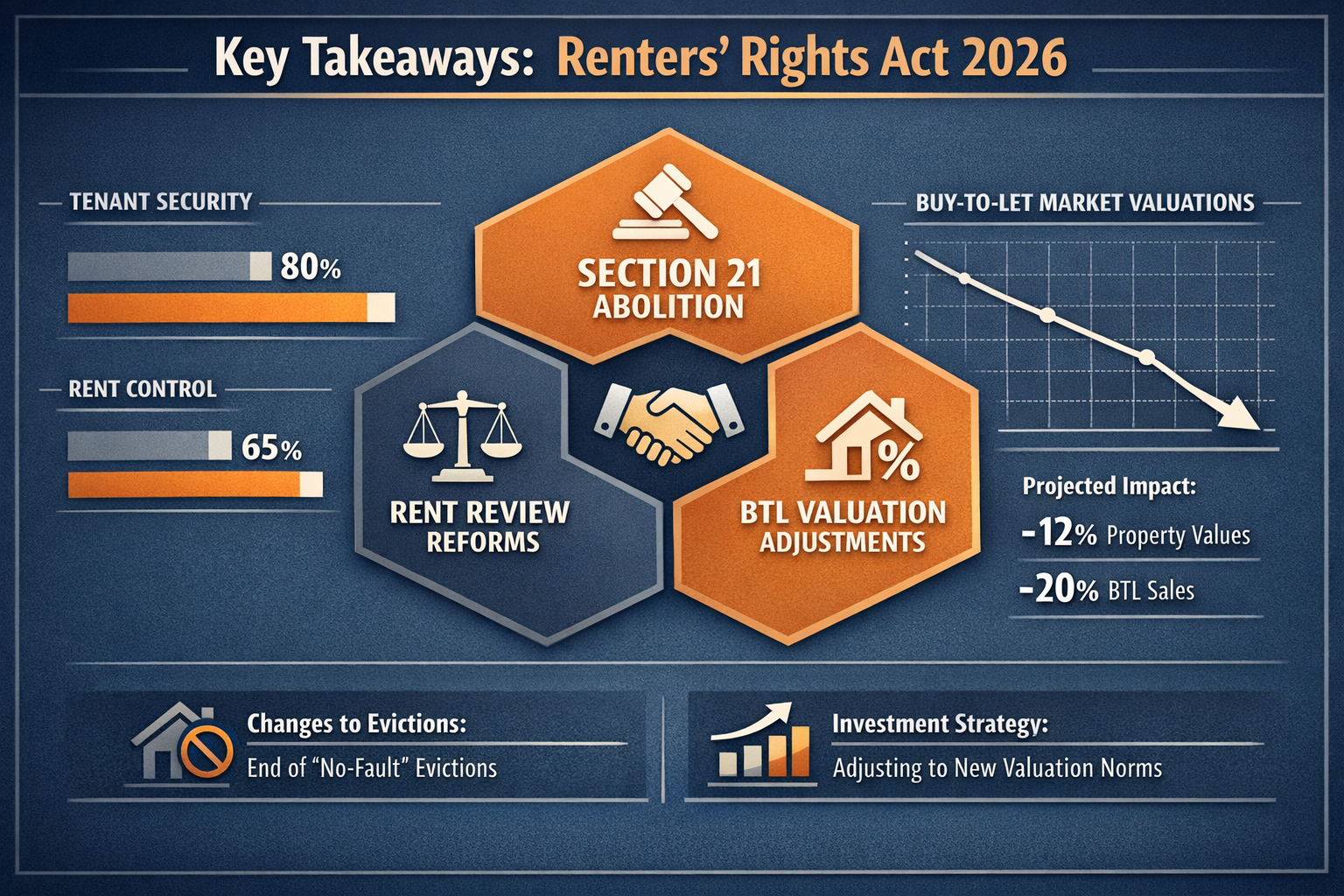
Key Takeaways
- 🚫 Section 21 abolition eliminates no-fault evictions from May 1, 2026, removing a critical exit strategy that previously supported higher BTL valuations
- 📅 All fixed-term ASTs convert to periodic tenancies automatically, fundamentally altering lease structure assumptions in property assessments
- 💷 Rent increases limited to once annually via Section 13 notices only, with 1 in 5 tenants expected to challenge increases through tribunal appeals
- ⏱️ Extended notice periods require landlords to provide four months' notice versus tenants' two months, impacting exit timing and investment liquidity
- 📊 Yield recalibrations necessary as reduced flexibility, tribunal risks, and constrained rental growth compress investment returns and property values
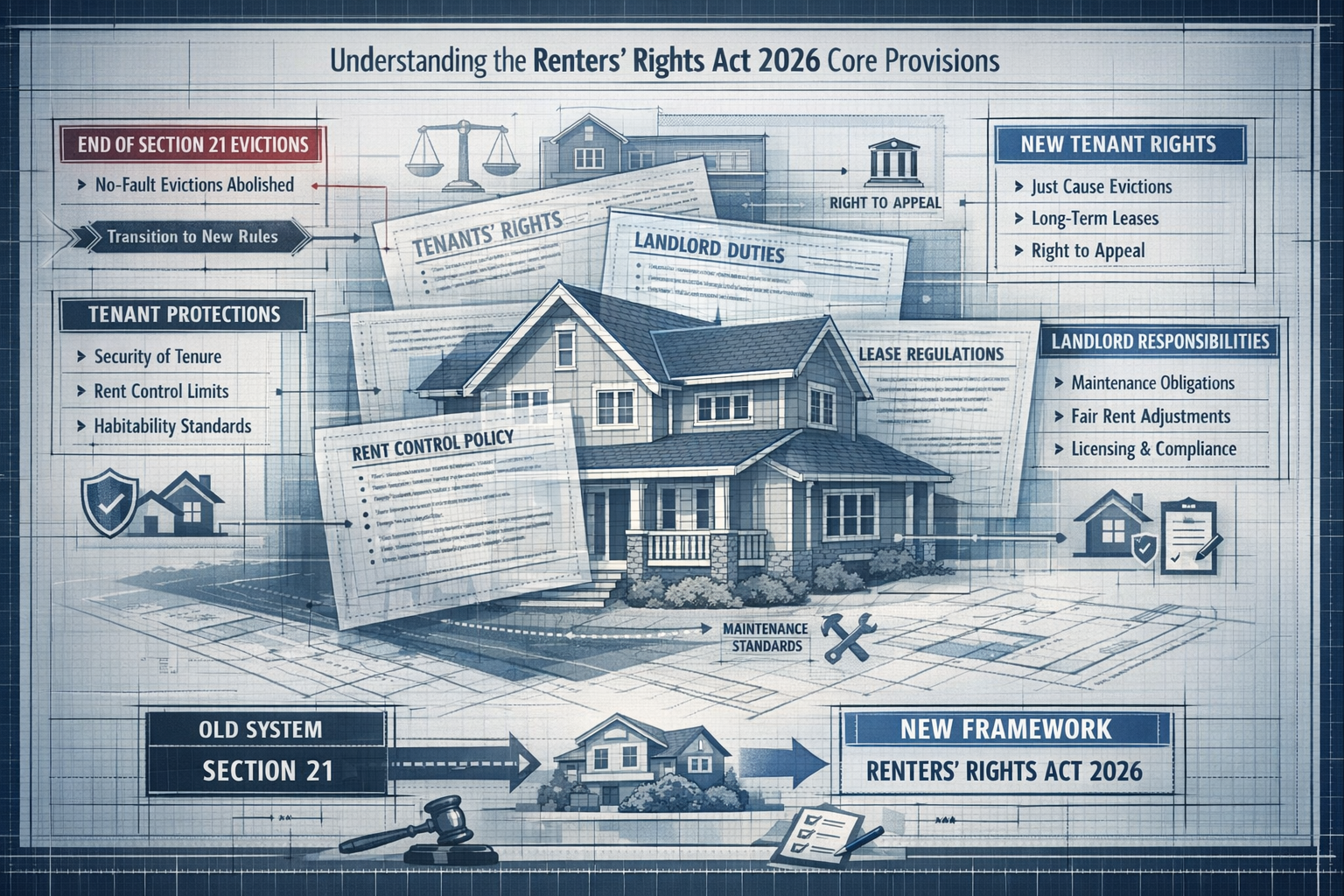
Understanding the Renters' Rights Act 2026 Core Provisions
The Renters' Rights Act 2026 represents the most comprehensive overhaul of private rental sector (PRS) regulation in modern UK history. The legislation implements two distinct phases, with Phase 1 beginning May 1, 2026, introducing core tenancy reforms that directly impact property valuations[1].
Section 21 Abolition: The End of No-Fault Evictions
The complete abolition of Section 21 evictions removes landlords' ability to serve no-fault eviction notices[1]. This mechanism previously allowed property owners to regain possession without providing specific grounds, offering a critical exit strategy that supported investment flexibility and risk management.
Key implications for BTL valuations include:
- Reduced exit flexibility affecting investment liquidity assumptions
- Extended holding periods when tenant issues arise
- Increased reliance on Section 8 grounds requiring evidence of breach
- Higher legal costs associated with possession proceedings
For property surveyors conducting BTL assessments, this change necessitates adjusting risk premiums and yield expectations to reflect diminished landlord control.
Automatic Conversion to Periodic Tenancies
From May 1, 2026, all fixed-term assured shorthold tenancies (ASTs) automatically convert to periodic tenancies[1]. Properties shift to rolling monthly arrangements with no fixed expiration dates, fundamentally altering lease structure assumptions that previously underpinned valuation methodologies.
This transition impacts:
- Tenancy security increasing from fixed terms to indefinite periods
- Portfolio planning as landlords lose certainty over tenancy end dates
- Refinancing strategies affected by absence of natural break clauses
- Investment modeling requiring adjustment for perpetual tenancy scenarios
Rent Review Restrictions Under the New Framework
The Act introduces stringent limitations on rent increases. Landlords can increase rent only once per year via Section 13 notices, eliminating previous rent review clauses and mutual written agreement options[1]. This restriction on rental income growth directly impacts yield calculations and investment returns.
Additionally, tenants can challenge rent increases in the First-tier Tribunal for just £47[1], with data suggesting 1 in 5 tenants will appeal any rent increase. This creates potential delays, uncertainty in rental income projections, and additional administrative costs that must be factored into property assessments.
Renters' Rights Act 2026 and BTL Valuations: How Section 21 Abolition Changes Investment Calculations
The removal of Section 21 fundamentally alters the risk-return profile of BTL investments. Surveyors conducting Red Book valuations must now incorporate additional risk factors that previously carried lower weighting in assessment methodologies.
Yield Compression and Capitalization Rate Adjustments
Without the safety net of no-fault evictions, BTL properties face increased operational risk. This translates to:
Yield adjustments typically ranging from 0.25% to 0.75% depending on:
- Property location and tenant demographics
- Local tribunal processing times
- Historical possession claim success rates
- Portfolio diversification levels
For example, a BTL property previously valued at £400,000 with a 5.5% gross yield might see capitalization rate adjustments reducing value by £15,000-£45,000 when accounting for diminished landlord flexibility.
Extended Holding Period Impacts
Landlords must now provide four months' notice to terminate tenancies, compared to tenants' two-month requirement[1]. This asymmetry affects:
- Cash flow modeling with longer vacancy risk periods
- Exit strategy timing for portfolio restructuring
- Refinancing windows becoming less predictable
- Investment liquidity reducing overall market appeal
Surveyors must incorporate extended holding assumptions into discounted cash flow (DCF) models, particularly for properties targeting specific exit timeframes.
Legal Cost Provisions in Valuation Models
With Section 21 removed, landlords relying on possession proceedings face increased legal expenses. Typical costs now include:
| Possession Route | Estimated Cost Range | Timeline |
|---|---|---|
| Section 8 (arrears) | £1,500-£3,000 | 4-8 months |
| Section 8 (breach) | £2,000-£4,500 | 6-12 months |
| Tribunal appeals | £500-£1,500 | 2-4 months |
These costs must be factored into operating expense projections, reducing net operating income (NOI) and consequently affecting property valuations through income capitalization approaches.
Adjusting Property Assessments Post-Section 21: New Valuation Frameworks for 2026
Professional surveyors must adopt revised methodologies that accurately reflect the post-reform investment landscape. The traditional approaches require significant modification to account for regulatory constraints introduced by the Renters' Rights Act 2026 and BTL Valuations: Adjusting Property Assessments Post-Section 21 Abolition and Rent Review Rules.
Modified Income Capitalization Approach
The income approach remains fundamental to BTL valuations, but requires adjustment for:
Constrained rental growth assumptions:
- Annual increases limited to Section 13 notice mechanisms
- 20% probability of tenant tribunal challenges[1]
- Average 3-6 month delays when appeals occur
- Market rent adjustments potentially below inflation
Revised formula considerations:
Property Value = (Net Operating Income – Legal Reserve – Tribunal Risk Provision) / Adjusted Capitalization Rate
Where the adjusted capitalization rate incorporates:
- Base market rate
- Section 21 abolition risk premium (+0.25-0.75%)
- Rent review restriction factor (+0.15-0.35%)
- Extended notice period liquidity discount (+0.10-0.25%)
Comparable Sales Analysis Modifications
When using comparable sales for BTL valuations, surveyors must distinguish between:
- Pre-reform transactions (completed before May 1, 2026)
- Post-reform transactions reflecting new regulatory environment
Adjustments typically include:
✅ Downward adjustments of 5-12% for pre-reform comparables
✅ Location-specific multipliers based on local tribunal efficiency
✅ Tenant demographic factors affecting challenge likelihood
✅ Property condition premiums for lower-maintenance assets
Risk-Adjusted Discounted Cash Flow Models
For commercial valuations and larger BTL portfolios, DCF models must incorporate:
Enhanced risk scenarios:
- Base case: Compliant tenant, annual rent reviews at inflation
- Moderate case: One tribunal challenge per 5-year period
- Adverse case: Multiple challenges, extended possession proceedings
Probability-weighted outcomes provide more accurate valuations than single-point estimates in the new regulatory environment.
Rent Review Rules Impact on BTL Property Assessments
The restriction to annual Section 13 rent increases fundamentally constrains rental income growth potential, directly affecting investment yields and property values.
Section 13 Notice Mechanism and Valuation Implications
Under the new framework, landlords must:
- Provide formal Section 13 notice for any rent increase
- Allow minimum one-month notice period before increase takes effect
- Accept only one increase per 12-month period[1]
- Face potential tribunal review of proposed increases
This creates several valuation challenges:
Rental growth modeling must account for:
- Inability to respond quickly to market rent changes
- Potential tribunal reductions below proposed increases
- Administrative costs of formal notice procedures
- Tenant retention incentives to avoid challenge risks
First-Tier Tribunal Challenge Risks
The £47 tribunal appeal fee creates a low barrier for tenant challenges[1]. With 1 in 5 tenants expected to appeal increases[1], surveyors must incorporate challenge probability into rental income projections.
Tribunal outcomes typically result in:
- Rent increases reduced by 15-40% from proposed levels
- Processing delays of 2-4 months
- Additional legal representation costs
- Potential relationship damage affecting tenancy stability
For a property with £1,500 monthly rent and proposed 5% increase (£75/month), a tribunal challenge might result in:
- Approved increase: £40/month (2.67%)
- Delayed implementation: 3 months
- Lost income: £105 (3 months × £35 difference)
- Legal costs: £500-£800
- Net impact: Negative £600-£900 for single challenge
These factors must be incorporated into valuation factors analysis for accurate BTL assessments.
Inflation Protection Erosion
Previously, landlords could implement rent reviews through mutual agreement or fixed-term renewal negotiations. The restriction to annual Section 13 increases, combined with tribunal challenge risks, creates inflation protection erosion that affects long-term investment returns.
Impact scenarios:
| Inflation Rate | Traditional Rent Review | Section 13 w/ Challenge Risk | Value Impact |
|---|---|---|---|
| 3% annual | 3% achieved | 2.1% achieved (30% reduction) | -8% over 10 years |
| 4% annual | 4% achieved | 2.6% achieved (35% reduction) | -12% over 10 years |
| 5% annual | 5% achieved | 3.0% achieved (40% reduction) | -16% over 10 years |
Strategic Considerations for Landlords and Investors Post-Reform
The Renters' Rights Act 2026 and BTL Valuations: Adjusting Property Assessments Post-Section 21 Abolition and Rent Review Rules require investors to reconsider fundamental portfolio strategies and acquisition criteria.

Property Selection Criteria Shifts
Successful BTL investment post-reform prioritizes:
Lower-maintenance properties:
- Modern construction with reduced repair obligations
- Properties with updated systems (heating, electrical, plumbing)
- Reduced likelihood of tenant complaints triggering disputes
Tenant demographic targeting:
- Professional tenants with stable employment
- Lower propensity for rent challenge appeals
- Longer average tenancy durations
Location considerations:
- Areas with strong rental demand and low vacancy rates
- Regions with efficient tribunal processing
- Markets with stable rather than volatile rent growth
Portfolio Diversification Strategies
Risk mitigation becomes paramount under the new framework. Effective strategies include:
✅ Geographic diversification across tribunal jurisdictions
✅ Property type mixing (houses, flats, HMOs) with varying risk profiles
✅ Tenant mix optimization balancing professional, family, and student tenants
✅ Holding period staggering to manage refinancing and exit timing
Professional Valuation Importance
Given the complexity of adjustments required for accurate post-reform BTL valuations, professional surveyor involvement becomes essential. Comprehensive condition survey reports provide critical documentation for:
- Baseline property condition establishing maintenance obligations
- Evidence supporting possession claims under Section 8 grounds
- Refinancing applications requiring updated valuations
- Portfolio restructuring decisions based on comparative property performance
Professional valuations incorporating reform impacts also support:
- Capital gains tax calculations when disposing of properties
- Probate valuations for inherited BTL portfolios
- Freehold valuations for mixed-use investment properties
Phase 2 Implementation and Future Valuation Considerations
While Phase 1 begins May 1, 2026, Phase 2 follows in late 2026, introducing additional dispute resolution processes and PRS infrastructure[1]. Surveyors must anticipate further adjustments as the full regulatory framework materializes.
Anticipated Phase 2 Impacts
Expected developments include:
- Enhanced ombudsman schemes for landlord-tenant disputes
- Property portal requirements increasing administrative compliance
- Decent Homes Standard potentially mandating property improvements
- Landlord registration systems affecting market transparency
Each element carries valuation implications requiring ongoing methodology refinement.
Market Adjustment Period Expectations
Historical regulatory changes suggest a 12-24 month market adjustment period following major reforms. During this transition:
- Transaction volumes typically decline 15-25%
- Yield spreads widen between compliant and non-compliant properties
- Valuation uncertainty increases, requiring larger confidence intervals
- Professional advice demand rises significantly
Surveyors must communicate these uncertainties clearly in valuation reports, potentially using range valuations rather than single-point estimates during the adjustment period.
Long-Term Sector Evolution
The reforms will likely accelerate existing trends:
Institutional investor growth:
- Professional landlords better equipped to manage regulatory complexity
- Economies of scale in compliance and legal costs
- Potential yield compression as institutional capital enters market
Amateur landlord exits:
- Smaller portfolios (1-3 properties) facing disproportionate compliance burden
- Increased sales to owner-occupiers or institutional buyers
- Market share shift toward professional sector
These structural changes will influence valuation approaches as the market matures under the new regulatory framework.
Practical Steps for Accurate BTL Valuations in 2026
Surveyors, landlords, and investors should implement specific practices to ensure accurate property assessments under the Renters' Rights Act 2026 and BTL Valuations: Adjusting Property Assessments Post-Section 21 Abolition and Rent Review Rules.
Documentation and Record-Keeping
Comprehensive documentation becomes critical for supporting valuations:
📋 Maintain detailed records of:
- All tenancy agreements and notice periods
- Rent review history and tenant responses
- Property maintenance and improvement costs
- Tribunal interactions and outcomes
- Legal expenses related to tenancy management
This documentation supports evidence-based valuation adjustments and provides transparency for lenders, investors, and tax authorities.
Engaging Professional Surveyors
Given the complexity of post-reform valuations, professional surveyor engagement offers significant value:
- RICS-qualified valuers understand regulatory implications
- Local market expertise informs location-specific adjustments
- Tribunal data access supports challenge risk quantification
- Lender relationships facilitate financing based on accurate valuations
For properties requiring detailed assessment, consider comprehensive services including homebuyer surveys for acquisition decisions or specific defect reports for properties with identified issues.
Ongoing Market Monitoring
The post-reform market will evolve continuously. Effective monitoring includes:
✅ Quarterly tribunal decision reviews for local jurisdiction trends
✅ Comparable sales tracking distinguishing pre and post-reform transactions
✅ Yield spread analysis across property types and locations
✅ Regulatory update monitoring for Phase 2 implementation details
Financial Planning Adjustments
Investors should recalibrate financial planning to reflect new realities:
Conservative assumptions:
- Rental growth at 60-70% of inflation expectations
- Legal/tribunal cost reserves of 0.5-1% of rental income
- Extended void periods of 6-8 weeks between tenancies
- Refinancing flexibility reduced by 15-20%
Stress testing:
- Model scenarios with multiple tribunal challenges
- Assess portfolio viability under adverse possession timelines
- Evaluate impact of tenant retention incentives on yields
Conclusion
The Renters' Rights Act 2026 and BTL Valuations: Adjusting Property Assessments Post-Section 21 Abolition and Rent Review Rules fundamentally reshape the UK buy-to-let investment landscape. From May 1, 2026, the complete abolition of Section 21 no-fault evictions, automatic conversion to periodic tenancies, and strict rent review limitations remove critical landlord flexibilities that previously underpinned property valuations and investment strategies.
Professional surveyors must now recalibrate BTL assessments to reflect:
- Reduced exit flexibility requiring risk premium adjustments of 0.25-0.75%
- Constrained rental growth with 1 in 5 tenants challenging increases
- Extended holding periods affecting liquidity and refinancing
- Increased legal costs for possession proceedings and tribunal defenses
For landlords and investors, success in the post-reform environment demands careful property selection prioritizing lower-maintenance assets, professional tenant targeting, and strategic portfolio diversification. The importance of professional valuation services has never been greater, as accurate assessments require sophisticated modeling incorporating regulatory constraints, tribunal challenge probabilities, and market adjustment factors.
Next Steps
For landlords:
- Commission professional BTL valuations incorporating reform impacts
- Review existing portfolios for properties most affected by changes
- Develop tenant retention strategies to minimize turnover costs
- Establish legal cost reserves and tribunal response procedures
For investors:
5. Adjust acquisition criteria to prioritize reform-resilient properties
6. Recalibrate yield expectations and investment return models
7. Engage RICS-qualified surveyors for due diligence on new acquisitions
8. Monitor Phase 2 implementation for additional valuation impacts
For surveyors:
9. Update valuation methodologies incorporating Section 21 abolition
10. Develop tribunal challenge risk assessment frameworks
11. Build comparable databases distinguishing pre and post-reform transactions
12. Communicate valuation uncertainties clearly during market adjustment period
The reforms represent a fundamental shift in landlord-tenant dynamics, but with proper assessment methodologies and strategic adaptation, the BTL sector will continue offering viable investment opportunities for those who understand and accurately value properties within the new regulatory framework.
References
[1] Renters Rights Bill A Letting Agents Guide – https://blog.goodlord.co/renters-rights-bill-a-letting-agents-guide
[4] The Renters Rights Act Information Sheet 2026 What You Need To Know – https://www.mondaq.com/unitedstates/landlord-tenant-leases/1766818/the-renters-rights-act-information-sheet-2026-what-you-need-to-know
