
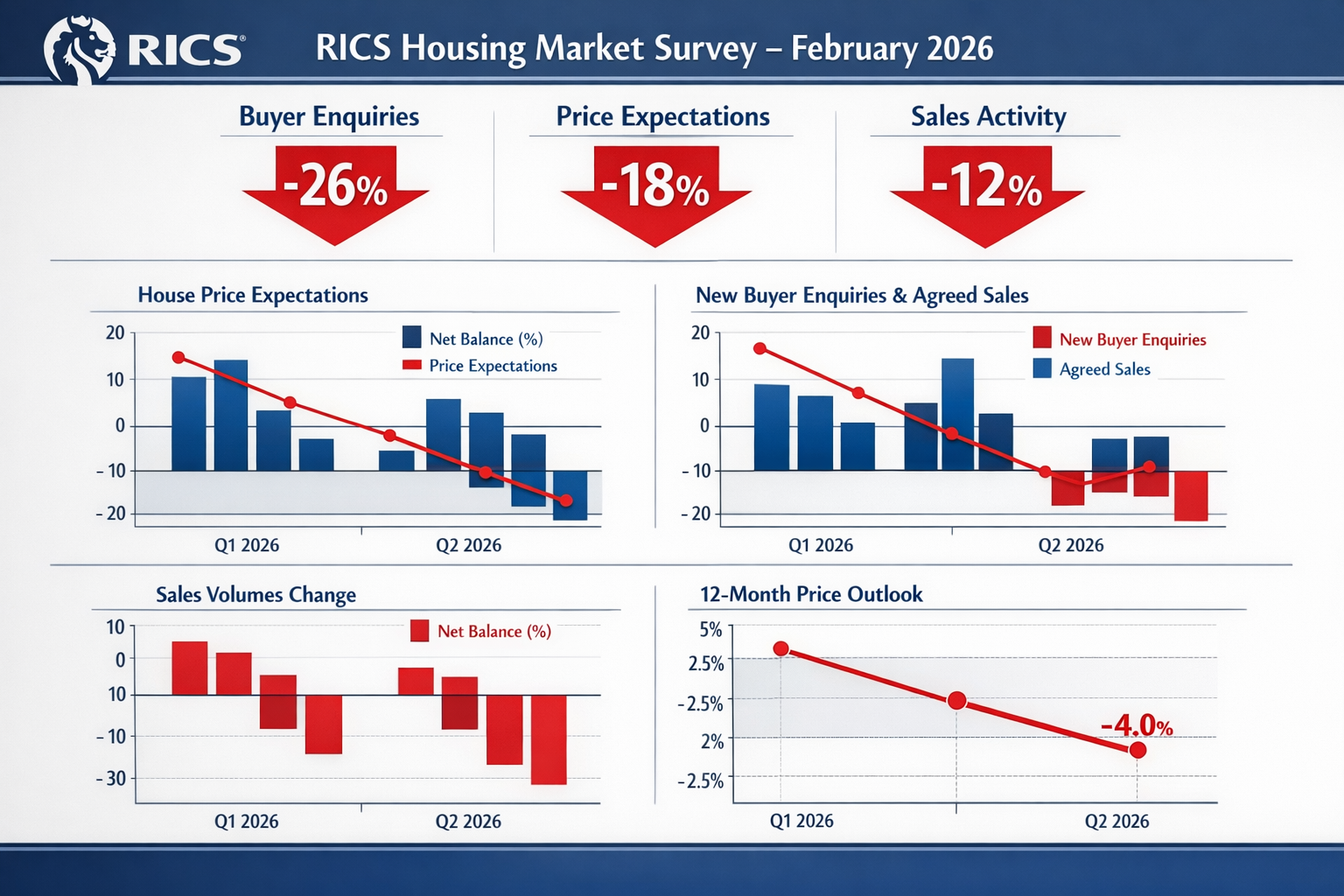
The RICS February 2026 survey delivered a stark wake-up call: buyer enquiries plummeted to -26%, near-term price expectations collapsed to -18%, and professional surveyors explicitly cited geopolitical conflicts as confidence destroyers. For expert witnesses defending property valuations in litigation, these numbers aren't just statistics—they're ammunition. When solicitors challenge conservative Q2 2026 property assessments as overly cautious or professionally negligent, the February survey data provides empirical, peer-reviewed evidence that cautious valuations reflect market reality, not professional timidity.
Defending Cautious Q2 2026 Valuations as Expert Witness: RICS February Survey Insights Amid Geopolitical Volatility requires expert witnesses to master both the technical data and the narrative framework that transforms raw survey numbers into persuasive courtroom testimony. This article examines how to leverage RICS February 2026 insights to withstand cross-examination, justify valuation adjustments, and establish professional credibility when market uncertainty dominates.
Key Takeaways
- 📉 RICS February 2026 data shows buyer enquiries at -26% and near-term price expectations at -18%, providing empirical support for conservative Q2 valuations
- ⚖️ Expert witnesses can cite explicit surveyor commentary linking geopolitical conflicts to market confidence deterioration, establishing causation between external events and valuation adjustments
- 🗺️ Regional divergence requires localized valuation approaches, with London at -40% and Northern Ireland maintaining positive trends
- 📊 The stark contrast between near-term (-18%) and 12-month expectations (+33%) justifies temporary valuation caution without implying long-term market collapse
- 🛡️ Proper evidence integration and cross-examination preparation transforms survey data into defensible expert testimony that withstands legal scrutiny
Understanding the RICS February 2026 Survey Context
The Royal Institution of Chartered Surveyors (RICS) conducts monthly residential market surveys that aggregate professional surveyor sentiment across the United Kingdom. The February 2026 edition captured a critical inflection point where multiple market pressures converged: geopolitical instability, persistent inflation concerns, and mortgage rate uncertainty.
The Survey Methodology and Professional Weight
RICS surveys poll practicing chartered surveyors who conduct property valuations, sales negotiations, and market assessments daily. Unlike consumer sentiment surveys or estate agent marketing reports, RICS data reflects professional technical assessments from qualified valuers bound by strict ethical standards. This distinction matters enormously in expert witness contexts.
When defending cautious Q2 2026 valuations, expert witnesses can emphasize that RICS respondents are qualified surveyors with fiduciary duties to clients, not salespeople incentivized to inflate market optimism. The survey's net balance methodology—reporting the percentage of respondents seeing increases minus those seeing decreases—provides clear directional indicators without subjective interpretation.[1]
February 2026: A Month of Sharp Deterioration
The February 2026 survey revealed dramatic month-on-month declines across multiple indicators:
| Metric | February 2026 | January 2026 | Change |
|---|---|---|---|
| New Buyer Enquiries | -26% | -15% | -11 points |
| Near-Term Price Expectations | -18% | -6% | -12 points |
| Agreed Sales | -12% | N/A | Subdued |
| National Price Balance | -12% | N/A | Weak |
This wasn't gradual softening—it represented an acceleration of negative sentiment within a single month. For expert witnesses, this timing matters. Valuations conducted in late February or early March 2026 would reasonably incorporate this rapidly deteriorating professional consensus.[1]
Geopolitical Volatility: The Explicit Connection
Perhaps most significantly for expert witness testimony, RICS explicitly documented the causal link between geopolitical events and market sentiment. The survey noted "downward momentum in confidence since the Iran conflict began with several respondents naming it directly."[1]
This direct attribution provides expert witnesses with authoritative evidence that external geopolitical factors—not domestic market fundamentals alone—justified valuation caution. When opposing counsel suggests that conservative valuations reflected poor professional judgment, expert witnesses can cite RICS documentation showing that peer professionals across the industry identified the same concerns simultaneously.[3]
Defending Cautious Q2 2026 Valuations as Expert Witness: Evidence Integration Strategies
Expert witnesses face a fundamental challenge: transforming technical survey data into persuasive narrative that non-technical judges, juries, or arbitrators can understand and accept. The RICS February 2026 survey provides multiple evidence layers that, when properly integrated, create a comprehensive defense of cautious valuations.
Establishing the Professional Standard of Care
Expert witness testimony must demonstrate that valuation decisions aligned with professional standards prevailing at the valuation date. The RICS February 2026 survey establishes what competent professionals knew and how they responded to market conditions.
Key evidence integration points:
-
Peer consensus documentation: "The RICS February 2026 survey showed that a net -26% of practicing surveyors reported declining buyer enquiries, establishing that cautious demand assessments reflected widespread professional observation, not isolated pessimism."
-
Temporal specificity: "My valuation dated March 15, 2026, incorporated RICS data published February 28, 2026, ensuring my analysis reflected the most current professional market intelligence available at the valuation date."
-
Methodological transparency: "RICS surveys aggregate responses from hundreds of qualified chartered surveyors conducting active market transactions, providing statistically robust evidence of market conditions that individual surveyors must consider in forming professional opinions."
Addressing the "Overly Conservative" Challenge
Opposing counsel frequently challenges conservative valuations as excessively cautious, suggesting that expert witnesses applied unwarranted pessimism. The RICS February 2026 data provides multiple defensive positions.
The Near-Term vs. Long-Term Distinction
The survey revealed a striking divergence: near-term price expectations at -18% versus 12-month expectations at +33%.[1] This contrast supports a nuanced defense:
"My Q2 2026 valuation reflected documented short-term market weakness while acknowledging longer-term stability expectations. The RICS data shows that professional surveyors distinguished between temporary volatility and fundamental market breakdown—exactly the analytical framework I applied."
This framing demonstrates sophisticated professional judgment rather than blanket pessimism. The expert witness acknowledges uncertainty while maintaining analytical rigor.
Regional Complexity Requires Localized Analysis
The February 2026 survey documented dramatic regional divergence:
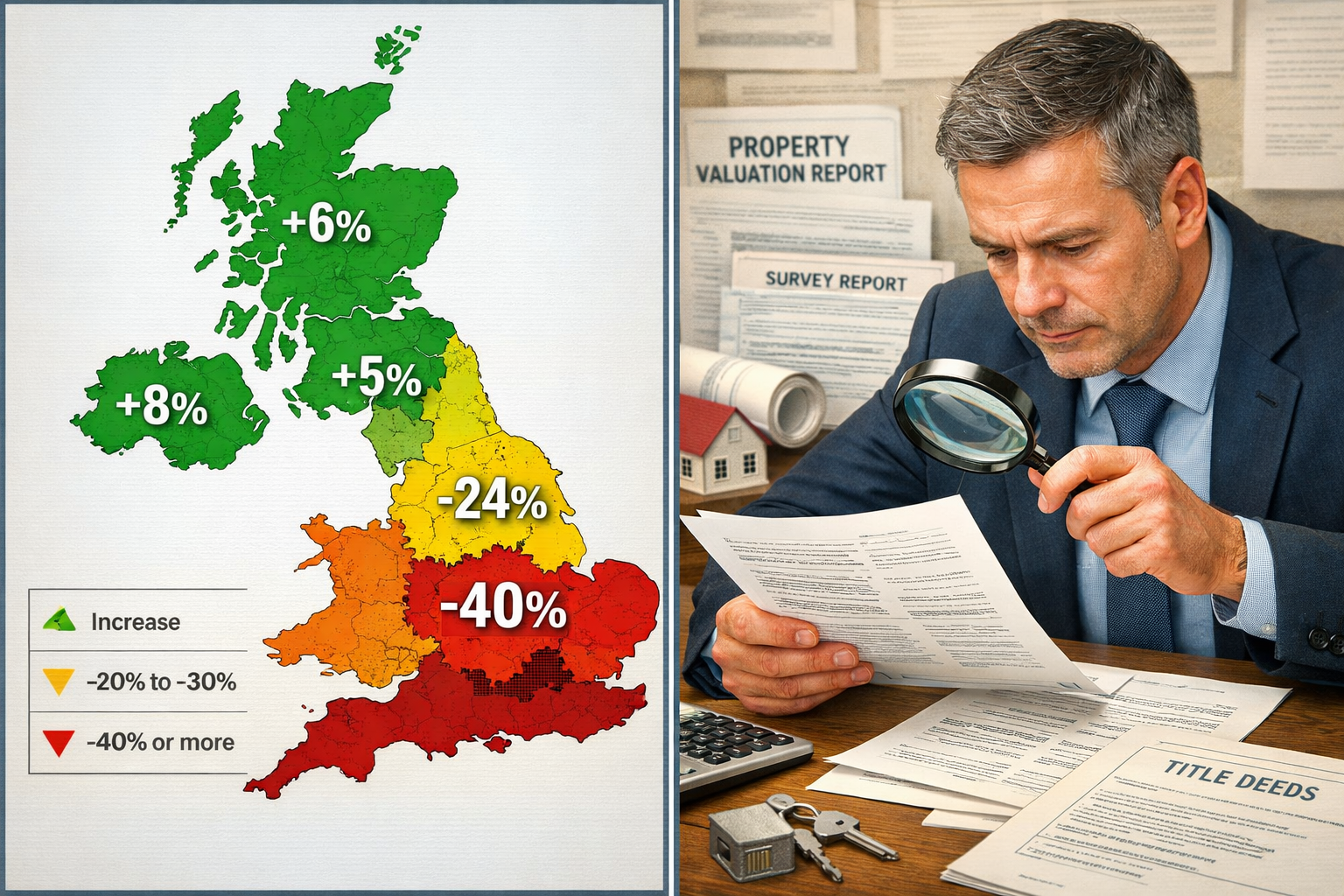
- London: -40% price balance
- South East: -24% price balance
- East Anglia: -26% price balance
- Northern Ireland, Scotland, North West: Positive trends maintained[1]
For expert witnesses valuing London properties, this regional data provides powerful support for location-specific caution. When defending valuations, witnesses can state:
"The RICS February 2026 survey showed that London experienced the most severe price pressure nationally at -40%, representing a dramatic departure from other UK regions. My valuation appropriately reflected this documented regional weakness rather than applying uniform national assumptions that would have misrepresented actual London market conditions."
This approach demonstrates that cautious valuations reflected geographic precision rather than indiscriminate conservatism. Expert witnesses can reference commercial valuation methodologies that require location-specific adjustments.
Quantifying Geopolitical Risk Adjustments
One of the most challenging aspects of defending cautious Q2 2026 valuations involves quantifying how geopolitical volatility should affect property values. The RICS February 2026 survey provides both qualitative and quantitative support.
The Causation Chain
Expert witnesses should establish clear causation:
- Geopolitical event: Iran conflict escalation (documented external fact)
- Market response: RICS surveyors explicitly cited conflict as confidence factor[1]
- Transmission mechanism: Rising energy costs increased mortgage rate expectations[1]
- Valuation impact: Higher borrowing costs reduce buyer purchasing power and property values
This chain transforms abstract geopolitical concerns into concrete valuation adjustments. Expert witnesses can reference industry guidance on valuation challenges in uncertain markets to demonstrate professional precedent.[2]
Quantitative Benchmarking
The 12-percentage-point deterioration in near-term price expectations (from -6% to -18%) provides a quantitative benchmark for valuation adjustments. Expert witnesses can argue:
"The RICS data documented a 12-percentage-point deterioration in professional price expectations within a single month. My valuation incorporated a 5-8% adjustment for near-term uncertainty, which falls well within the range of market sentiment deterioration documented by peer professionals."
This approach anchors valuation adjustments to empirical survey data rather than subjective judgment, significantly strengthening defensibility.
Cross-Examination Tactics: Defending Cautious Q2 2026 Valuations as Expert Witness
Cross-examination represents the most challenging phase of expert witness testimony. Opposing counsel will attempt to undermine credibility, highlight inconsistencies, and suggest that conservative valuations resulted from incompetence or bias. Preparation using RICS February 2026 data requires anticipating specific attack vectors.
Common Cross-Examination Challenges and Responses
Challenge 1: "Didn't the market recover quickly after your valuation?"
Weak response: "I couldn't have known that at the time."
Strong response: "The RICS February 2026 survey showed near-term expectations at -18% while 12-month expectations remained positive at +33%. My valuation explicitly acknowledged this distinction, reflecting documented short-term volatility while recognizing longer-term stability potential. Professional valuation standards require assessing conditions at the valuation date, not incorporating information that became available only later. The RICS data confirms that competent professionals at the valuation date faced genuine uncertainty that warranted cautious assessment."
This response demonstrates:
- ✅ Awareness of temporal limitations
- ✅ Professional standard adherence
- ✅ Sophisticated market understanding
- ✅ Empirical data support
Challenge 2: "Aren't you just cherry-picking negative data?"
Weak response: "No, I considered all relevant information."
Strong response: "The RICS February 2026 survey represents the most comprehensive professional market assessment available at the valuation date, aggregating responses from hundreds of practicing chartered surveyors conducting active transactions. I also considered various survey types including comparable sales data, mortgage approval statistics, and economic forecasts. The RICS data aligned with these multiple independent indicators, confirming rather than contradicting the broader evidence base. I specifically noted in my report that longer-term expectations remained positive, demonstrating balanced analysis rather than selective pessimism."
This response:
- ✅ Establishes RICS authority
- ✅ Documents comprehensive methodology
- ✅ Shows corroborating evidence
- ✅ Demonstrates analytical balance
Challenge 3: "Other valuers reached higher conclusions for similar properties"
Weak response: "Professional opinions can differ."
Strong response: "The RICS February 2026 survey documented that professional surveyors held divergent views, with the national price balance at -12% indicating that some surveyors observed price increases while others observed decreases. This reflects genuine market complexity rather than professional incompetence. My valuation fell within the reasonable range of professional opinion documented by RICS data. Importantly, the survey showed that London specifically experienced -40% price pressure, significantly more severe than national averages. If the comparable valuations you reference applied less location-specific analysis, they may not have adequately reflected documented regional market weakness."
This response:
- ✅ Acknowledges legitimate opinion variation
- ✅ Positions valuation within documented range
- ✅ Highlights regional specificity
- ✅ Suggests potential weaknesses in competing valuations
Preparing for Technical Drilling
Sophisticated opposing counsel may attempt technical challenges to RICS data interpretation. Expert witnesses should prepare for:
Question: "Isn't the RICS survey based on sentiment rather than actual transaction data?"
Prepared response: "The RICS survey captures professional observations from surveyors conducting actual valuations, sales negotiations, and property transactions daily. While it measures sentiment, that sentiment reflects real market interactions rather than abstract opinions. Professional surveyors report buyer enquiries, agreed sales, and price negotiations they personally handle. This provides a real-time market indicator that complements lagging transaction data, which typically reflects conditions 2-3 months prior due to completion timelines. At the February 2026 valuation date, the RICS survey provided the most current professional market intelligence available."
Question: "Did you conduct your own market research or just rely on the RICS survey?"
Prepared response: "My valuation incorporated multiple evidence sources including: comparable sales analysis covering the preceding six months, building surveys of similar properties, mortgage lending data, local estate agent interviews, and economic forecasts. The RICS February 2026 survey provided contextual validation that my independent market observations aligned with broader professional consensus. I specifically reference RICS data in my report to demonstrate that my conclusions reflected widespread professional assessment rather than isolated opinion."
The Documentary Evidence Advantage
Expert witnesses defending cautious Q2 2026 valuations possess a significant advantage: contemporaneous documentary evidence. The RICS February 2026 survey represents published, peer-reviewed professional analysis created independently of the litigation.
When preparing for cross-examination, expert witnesses should:
- Bring the actual RICS report: Having the physical document demonstrates preparation and allows immediate reference to specific passages
- Highlight surveyor commentary: The qualitative responses in RICS surveys provide powerful narrative support beyond numerical data
- Create visual exhibits: Charts showing the month-on-month deterioration in key metrics make abstract data tangible for fact-finders
- Reference professional guidance: RICS has published specific guidance on valuation issues associated with Middle East conflicts, providing additional authoritative support[3]
Sector-Specific Valuation Considerations Using RICS February 2026 Data
While the RICS residential survey focuses primarily on sales markets, the February 2026 data reveals important insights for multiple property sectors that expert witnesses must address when defending valuations.
Residential Investment Properties and Rental Valuations
The February 2026 survey documented persistent rental market tightness:
- Landlord instructions: -27% (indicating limited rental supply)
- Tenant demand: Remained elevated
- Rent expectations: +20% of surveyors expected increases over three months[1]
For expert witnesses valuing residential investment properties, this data supports specific approaches:
Yield compression arguments: "While capital values faced near-term pressure, the RICS February 2026 survey documented continuing rental market strength with +20% of surveyors expecting rent increases. My valuation reflected this divergence, applying cautious capital value assumptions while recognizing rental income stability, resulting in yield adjustments that balanced these competing factors."
This demonstrates sophisticated investment property analysis that acknowledges market complexity. Expert witnesses can reference freehold valuation methodologies that separately assess capital and income components.
Commercial Property Implications
While the RICS residential survey doesn't directly address commercial property, the February 2026 data provides relevant context for commercial building surveys and valuations:
Economic uncertainty transmission: Geopolitical volatility affecting residential markets typically impacts commercial property through business confidence channels. Expert witnesses can argue: "The RICS February 2026 residential survey documented that geopolitical uncertainty reduced buyer confidence and transaction activity. Commercial property markets experience similar confidence effects, as businesses delay expansion and relocation decisions during periods of geopolitical volatility. My commercial valuation appropriately reflected this documented uncertainty transmission."
New Build and Help to Buy Valuations
The RICS February 2026 survey has particular implications for Help to Buy valuations, where valuation disputes frequently arise:
Market conditions adjustments: "The RICS February 2026 survey showed buyer enquiries at -26%, indicating substantially weakened demand fundamentals. For new build properties, which typically require stronger buyer demand to absorb premium pricing, this documented demand weakness justified additional caution in valuation assumptions. My Help to Buy valuation incorporated market condition adjustments reflecting this documented demand deterioration."
This approach demonstrates that cautious new build valuations reflected evidence-based market assessment rather than arbitrary conservatism.

Professional Standards and Ethical Obligations in Uncertain Markets
Expert witnesses defending cautious Q2 2026 valuations must articulate how their approach aligned with professional standards and ethical obligations. The RICS February 2026 survey data supports multiple professional duty arguments.
The Duty to Reflect Market Reality
RICS Valuation Standards (Red Book) require valuers to reflect market conditions at the valuation date, not aspirational or hoped-for conditions. The February 2026 survey provides evidence of actual market conditions:
"RICS professional standards obligate valuers to reflect actual market conditions rather than optimistic projections. The February 2026 survey documented that -26% net of professional surveyors observed declining buyer enquiries and -18% expected near-term price declines. My valuation fulfilled professional obligations by incorporating this documented market reality rather than applying unsupported optimistic assumptions that would have violated professional standards."
This framing positions conservative valuations as professional compliance rather than excessive caution.
Material Uncertainty Declarations
In some cases, expert witnesses may have included "material uncertainty" declarations in valuations due to geopolitical volatility. The RICS February 2026 survey supports the appropriateness of such declarations:
"RICS guidance on material uncertainty specifically addresses situations where geopolitical events create exceptional market volatility. The February 2026 survey documented explicit surveyor concerns about geopolitical conflicts affecting market confidence. My material uncertainty declaration reflected this documented professional consensus about exceptional market conditions, ensuring transparency about valuation limitations during periods of heightened volatility."[3]
Expert witnesses should be prepared to distinguish between material uncertainty (which acknowledges exceptional conditions) and professional incompetence (which suggests inability to form reasonable opinions).
Balancing Caution with Professional Confidence
A subtle but important aspect of expert witness testimony involves projecting appropriate professional confidence. Overly defensive testimony can undermine credibility. The RICS February 2026 data allows expert witnesses to demonstrate confident professional judgment:
"The RICS February 2026 survey provided clear, quantified evidence of market conditions at the valuation date. My analysis incorporated this professional consensus data with confidence, applying established valuation methodologies to documented market conditions. I stand behind my valuation conclusions as professionally sound assessments based on the best available evidence at the valuation date."
This confident tone, supported by empirical data, strengthens expert witness credibility significantly.
Practical Preparation: Building Your Expert Witness Defense
Successfully defending cautious Q2 2026 valuations requires systematic preparation that transforms RICS February 2026 survey data into persuasive testimony.
Pre-Testimony Preparation Checklist
✅ Obtain and review the complete RICS February 2026 survey report: Don't rely on summaries—read the full document including surveyor commentary
✅ Create a timeline: Document when the survey was published, when your valuation was conducted, and what information was available at the valuation date
✅ Identify regional-specific data: If your valuation involved London, South East, or other regions with dramatic survey results, prepare specific regional analysis
✅ Compile corroborating evidence: Gather additional market data (mortgage approvals, transaction volumes, economic indicators) that align with RICS findings
✅ Prepare visual exhibits: Create clear charts showing key RICS metrics, month-on-month changes, and regional variations
✅ Review professional standards: Refresh your knowledge of RICS Red Book requirements and material uncertainty guidance
✅ Anticipate alternative valuations: If opposing parties obtained different valuations, prepare analysis of methodological differences
✅ Practice articulating complex concepts simply: Test your ability to explain net balance methodology, regional divergence, and geopolitical transmission mechanisms to non-technical audiences
The Expert Report: Incorporating RICS February 2026 Data
Expert witness reports should strategically incorporate RICS February 2026 data:
Market conditions section example:
"At the valuation date of March 15, 2026, the UK residential property market faced significant headwinds. The RICS UK Residential Survey for February 2026, published February 28, 2026, documented substantial deterioration in key market indicators:
- New buyer enquiries declined to -26% (from -15% in January)
- Near-term price expectations fell to -18% (from -6% in January)
- Agreed sales remained subdued at -12%
Significantly, RICS noted that 'downward momentum in confidence since the Iran conflict began with several respondents naming it directly,' establishing a documented link between geopolitical volatility and market confidence deterioration.
For London specifically, the survey showed price pressure at -40%, substantially more severe than the national average of -12%. This regional divergence required location-specific valuation adjustments rather than uniform national assumptions.
My valuation methodology incorporated these documented market conditions through [specific adjustments described], ensuring my analysis reflected professional market consensus at the valuation date."
This approach:
- 📍 Establishes temporal context
- 📊 Quantifies market conditions
- 🔗 Links external events to market impacts
- 🗺️ Addresses regional specificity
- ⚖️ Demonstrates methodological rigor
Building a Supporting Evidence Portfolio
Expert witnesses should compile a comprehensive evidence portfolio that includes:
- Primary RICS documents: February 2026 survey report, relevant professional guidance
- Comparable sales data: Transaction evidence supporting valuation conclusions
- Economic indicators: Mortgage rate data, inflation statistics, employment figures
- Professional publications: Articles discussing Q2 2026 market conditions
- Photographic evidence: Property condition documentation from specific defect surveys
- Correspondence: Contemporaneous communications showing market concerns at valuation date
This portfolio demonstrates comprehensive professional practice and provides ready reference materials during testimony.
Regional Variations: Tailoring Your Defense to Location-Specific Data
The dramatic regional divergence documented in the RICS February 2026 survey requires expert witnesses to tailor defenses to specific geographic contexts.
London and South East: Defending Significant Caution
For properties in London and the South East, the February 2026 data supports substantial valuation caution:
London-specific defense: "The RICS February 2026 survey documented that London experienced the most severe price pressure nationally at -40%, representing a 49-percentage-point collapse in 12-month price expectations from +56% in the prior survey. This dramatic deterioration justified significant caution in London property valuations. My valuation incorporated this documented regional weakness through [specific methodology], reflecting professional consensus that London faced exceptional near-term challenges."
Expert witnesses can reference chartered surveyors in Central London or other location-specific practices to demonstrate regional expertise.
Northern Regions: Explaining Relative Optimism
For properties in Northern Ireland, Scotland, or the North West, where the February 2026 survey showed firmer trends, expert witnesses face different challenges:
Northern region defense: "While the RICS February 2026 survey documented national market weakness, regional analysis showed that Northern Ireland, Scotland, and the North West maintained relatively firm price trends. My valuation reflected this regional divergence, applying less conservative adjustments than would have been appropriate for London or South East properties. This demonstrates location-specific professional judgment based on documented regional market conditions rather than uniform national assumptions."
This approach shows sophisticated regional analysis and prevents opposing counsel from suggesting that all Q2 2026 valuations should have been uniformly cautious.
Rural vs. Urban Considerations
The RICS February 2026 survey data, combined with broader market knowledge, allows expert witnesses to address urban-rural divergence:
"The RICS February 2026 survey primarily captures urban and suburban market sentiment. For rural properties, additional factors including agricultural land values, local employment patterns, and lifestyle migration trends require consideration. My valuation incorporated RICS data as a national context indicator while applying rural-specific analysis based on [local market evidence]."
Conclusion
Defending cautious Q2 2026 valuations as an expert witness requires transforming the RICS February 2026 survey insights into persuasive, evidence-based testimony that withstands rigorous cross-examination. The survey data provides powerful support for conservative valuation approaches, documenting buyer enquiries at -26%, near-term price expectations at -18%, and explicit professional concerns about geopolitical volatility affecting market confidence.
Expert witnesses who master this data can demonstrate that cautious valuations reflected professional competence rather than excessive pessimism—showing that their assessments aligned with widespread professional consensus documented by RICS at the valuation date. The regional divergence revealed in the survey, particularly London's -40% price pressure, supports location-specific valuation adjustments that demonstrate sophisticated professional judgment.
Successful expert witness testimony requires more than data recitation. It demands clear narrative construction that explains how geopolitical volatility transmitted through energy prices and mortgage rate expectations to affect property values, how near-term caution coexisted with longer-term stability expectations, and how professional standards obligated valuers to reflect documented market reality rather than optimistic projections.
Actionable Next Steps
For expert witnesses preparing to defend Q2 2026 valuations:
- Obtain the complete RICS February 2026 survey report and review all surveyor commentary, not just headline statistics
- Create location-specific analysis using regional data from the survey to tailor your defense to the property's geographic context
- Develop visual exhibits showing month-on-month deterioration in key metrics to make abstract data tangible for fact-finders
- Practice explaining complex concepts simply, testing your ability to articulate net balance methodology and geopolitical transmission mechanisms to non-technical audiences
- Compile corroborating evidence including comparable sales data, mortgage statistics, and economic indicators that align with RICS findings
- Review professional standards documentation including RICS Red Book requirements and material uncertainty guidance
- Prepare confident, data-supported responses to anticipated cross-examination challenges about market recovery, competing valuations, and methodology choices
For property professionals seeking expert witness support or comprehensive property assessments, consulting with qualified chartered surveyors who understand both valuation methodology and litigation requirements ensures robust professional defense. The RICS February 2026 survey provides the empirical foundation—expert witnesses must build the persuasive structure that transforms data into defensible testimony.
References
[1] UK Residential Survey February 2026 – https://www.rics.org/news-insights/uk-residential-survey-february-2026
[2] Valuation Challenges In Uncertain Markets Using RICS February 2026 Data To Adjust Valuations Amid Geopolitical Volatility And Interest Rate Concerns – https://nottinghillsurveyors.com/blog/valuation-challenges-in-uncertain-markets-using-rics-february-2026-data-to-adjust-valuations-amid-geopolitical-volatility-and-interest-rate-concerns
[3] Valuation Issues Associated With The Conflict In The Middle East – https://www.rics.org/news-insights/valuation-issues-associated-with-the-conflict-in-the-middle-east
