
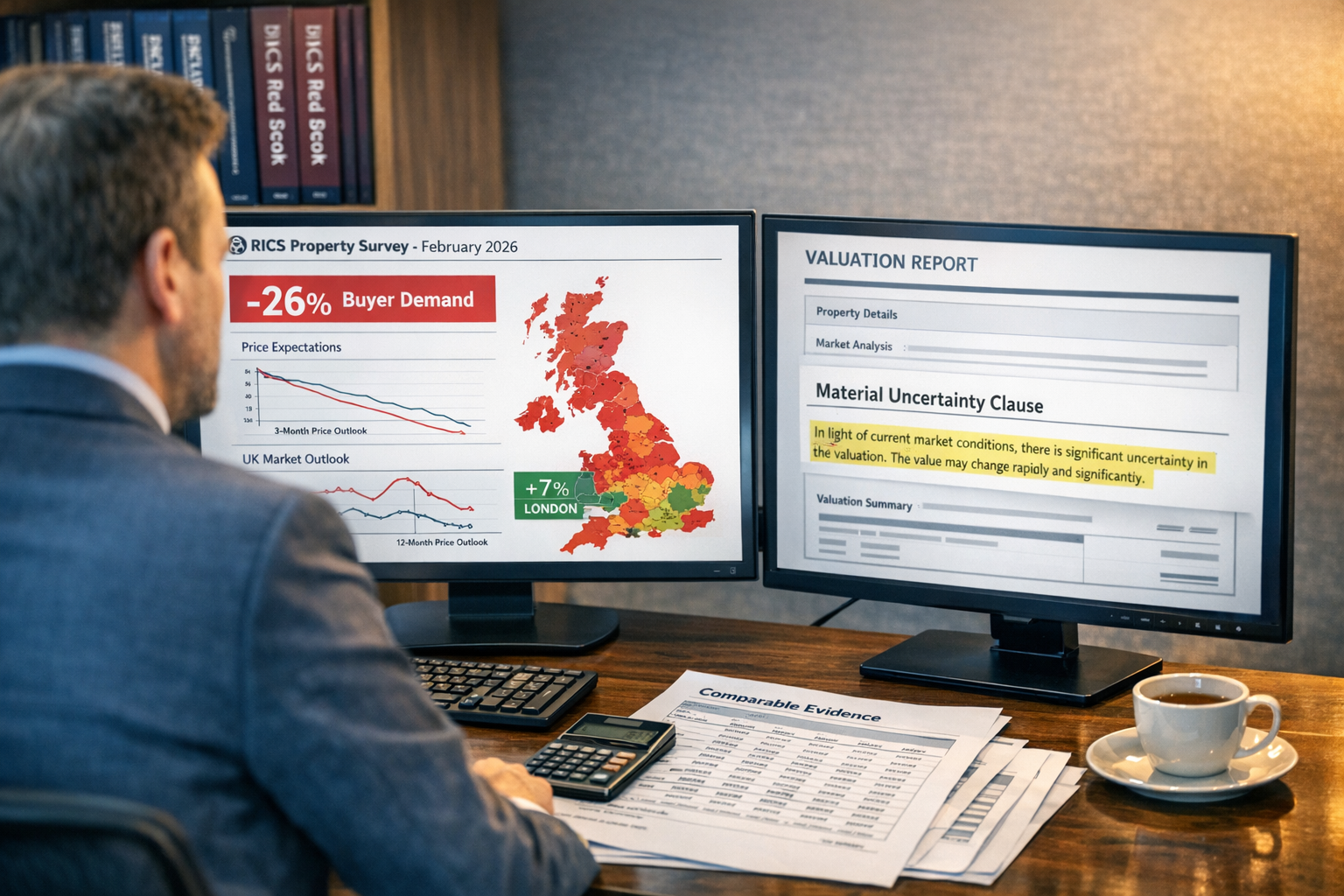
Buyer demand in the UK residential property market collapsed by 26% in February 2026, marking one of the sharpest monthly contractions recorded by RICS surveyors in recent years.[1] This dramatic deterioration—an 11-point decline from January's already-negative -15% net balance—signals that Valuation Challenges in Uncertain Markets: Using RICS February 2026 Data to Adjust Valuations Amid Geopolitical Volatility and Interest Rate Concerns have moved from theoretical risk to immediate operational reality for property professionals across the United Kingdom.
The confluence of geopolitical instability, persistent inflation above central bank targets, and energy price shocks has created a perfect storm for property valuers. London's 12-month price outlook plummeted 49 points between early January and February 2026, falling from +56% to just +7%.[1] This unprecedented swing demonstrates how rapidly market sentiment can shift when macroeconomic foundations become unstable.
For chartered surveyors and RICS registered valuers, these conditions demand sophisticated methodological adjustments that go far beyond standard valuation protocols. The February 2026 RICS data provides critical benchmarks for understanding current market dynamics and implementing evidence-based valuation adjustments.
Key Takeaways
✅ Buyer demand contracted by 26% in February 2026, creating significant challenges for comparable evidence reliability and requiring valuers to expand search parameters and apply time adjustments to older transactions.
✅ Near-term price expectations fell to -18% net balance, indicating immediate valuation pressure that necessitates conservative approaches to current market value assessments while maintaining awareness of longer-term recovery scenarios.
✅ Regional variations are extreme, with London experiencing a 49-point swing in 12-month outlook, requiring location-specific adjustment strategies rather than national-level assumptions.
✅ Material uncertainty clauses require sophisticated application beyond standard boilerplate language, with detailed methodological justifications for evidence selection and adjustment protocols.
✅ Energy price volatility and geopolitical conflict are maintaining upward pressure on mortgage rates, directly impacting discount rate calculations and mortgage-backed valuation assumptions for the foreseeable future.
Understanding the February 2026 Market Context and Valuation Implications
The RICS UK Residential Market Survey for February 2026 paints a sobering picture of current market conditions. The -26% net balance for new buyer enquiries represents not just a statistical decline but a fundamental shift in market psychology driven by external macroeconomic pressures.[1]
Buyer Sentiment and Transaction Volume Impacts
When buyer enquiries contract this sharply, the immediate consequence for valuers is a reduction in reliable comparable evidence. Agreed sales activity posted a -12% net balance in February, indicating that the pipeline of recent transactions—the lifeblood of comparative valuation methodology—has significantly narrowed.[1]
This creates several specific challenges:
- Temporal gaps between the valuation date and the most recent comparable transactions widen
- Sample size limitations reduce statistical confidence in comparable evidence analysis
- Selection bias risks increase when valuers must choose from limited available transactions
- Market direction uncertainty makes it difficult to determine whether recent transactions represent peak, trough, or transitional pricing
For professionals conducting various types of valuations, these constraints require fundamental adjustments to evidence gathering and analysis protocols.
Regional Divergence and London's Dramatic Outlook Shift
The most striking feature of the February 2026 data is the extreme regional variation in market expectations. London's 12-month price outlook collapsed from +56% to +7%—a 49-point swing that reflects the capital's particular sensitivity to financial sector confidence, international buyer sentiment, and interest rate expectations.[1]
| Region | 12-Month Price Outlook | Key Drivers |
|---|---|---|
| 🏙️ London | +7% (down 49 points) | Financial sector uncertainty, international buyer retreat |
| 🏘️ Southeast | Variable | Commuter belt sensitivity to mortgage rates |
| 🏴 Regional Markets | More stable | Lower exposure to international capital flows |
This regional divergence means that valuers cannot apply uniform national-level adjustments. A valuation in Notting Hill requires fundamentally different risk assessments and comparable evidence weighting than valuations in less volatile regional markets.
Interest Rate Expectations and Mortgage Market Impacts
RICS Head of Market Research Tarrant Parsons warned that oil and energy price spikes would maintain upward pressure on mortgage rates, which would "remain higher for longer."[1] This assessment has direct implications for valuation methodology, particularly:
- Discount rate calculations in income-approach valuations must reflect elevated and persistent interest rate environments
- Mortgage-backed buyer affordability constraints reduce effective demand at given price points
- Investment yield expectations shift as alternative fixed-income investments become more attractive relative to property
For specialists conducting lease extension valuations or probate valuations, these interest rate dynamics affect both current market value assessments and future value projections required for financial planning purposes.
Valuation Challenges in Uncertain Markets: Methodological Adjustments Using February 2026 RICS Data
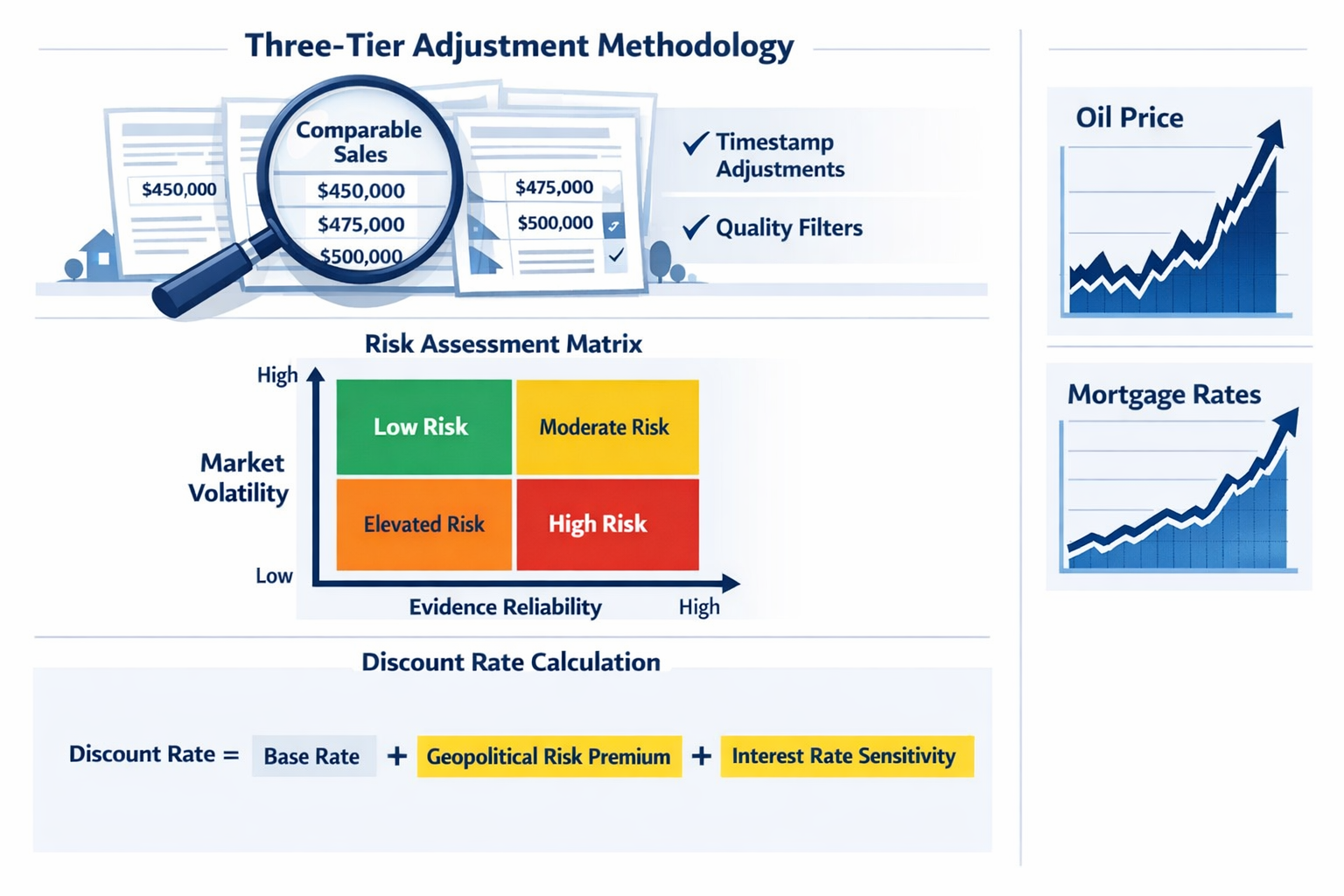
The February 2026 market conditions require valuers to implement specific methodological adjustments that address both data limitations and elevated uncertainty. These adjustments must be transparent, defensible, and aligned with RICS Valuation Global Standards.
Comparable Evidence Selection and Adjustment Protocols
With agreed sales activity at -12% net balance, valuers face a fundamental challenge: the pool of recent, directly comparable transactions has contracted significantly.[1] This necessitates several tactical adjustments:
1. Temporal Expansion with Time Adjustments ⏰
When recent comparables are scarce, valuers must expand the temporal search window. However, this requires explicit time adjustments that account for market movement between the comparable transaction date and the valuation date.
Given that near-term price expectations fell to -18% net balance in February from -6% in January,[1] valuers should apply negative time adjustments to comparables from late 2025 or early 2026 to reflect the deteriorating price environment.
Recommended approach:
- Document the monthly rate of price change indicated by RICS survey data for the relevant region
- Apply proportional adjustments to comparables based on the time gap
- Provide sensitivity analysis showing valuation outcomes under different time adjustment scenarios
2. Geographic Expansion with Location Adjustments 📍
When local comparables are insufficient, expanding the geographic search area becomes necessary. However, this requires careful location adjustments that account for neighborhood-specific characteristics.
For chartered surveyors in Central London, this might mean using comparables from adjacent neighborhoods with explicit adjustments for:
- Transport connectivity differences
- School catchment area variations
- Local amenity quality disparities
- Micro-market prestige factors
3. Quality and Condition Adjustments 🏠
With limited comparables, valuers may need to use transactions involving properties with different quality specifications or condition levels. This requires systematic adjustment protocols:
- Specification differences: Adjust for variations in finishes, fixtures, and fittings
- Condition disparities: Account for properties requiring renovation versus turnkey condition
- Energy efficiency: Reflect growing importance of EPC ratings in buyer decision-making
- Outdoor space: Adjust for garden, terrace, or balcony presence and quality
Discount Rate Adjustments for Interest Rate Volatility
For income-approach valuations—particularly relevant for ATED valuations and non-domicile tax valuations—the expectation that mortgage rates will "remain higher for longer" requires explicit discount rate adjustments.[1]
Standard discount rate formula:
Discount Rate = Risk-Free Rate + Property Risk Premium + Market Volatility Premium
In February 2026 conditions, valuers should:
✅ Increase the market volatility premium by 50-100 basis points to reflect geopolitical uncertainty
✅ Extend the time horizon for elevated interest rate assumptions beyond typical 12-month forecasts
✅ Document alternative scenarios showing valuation sensitivity to different interest rate trajectories
✅ Reference RICS survey data explicitly as evidence for volatility premium adjustments
Scenario Analysis and Sensitivity Testing
Given the elevated uncertainty reflected in the February 2026 data, single-point valuations provide insufficient information for decision-making. Valuers should implement scenario-based approaches that present:
- Base case valuation: Using most likely assumptions given current market conditions
- Downside scenario: Reflecting continued deterioration in buyer demand and price expectations
- Recovery scenario: Incorporating the +17% 12-month sales expectations that suggest medium-term stabilization[1]
This approach is particularly important for Help to Buy valuations and Right to Buy valuations, where government schemes require defensible valuation methodologies.
Implementing Material Uncertainty Clauses and Special Assumptions in Volatile Conditions
The RICS Valuation Global Standards provide specific guidance on applying material uncertainty clauses when market conditions limit the availability of reliable comparable evidence.[3] However, the February 2026 conditions require more sophisticated application than standard boilerplate language.

When Material Uncertainty Clauses Are Appropriate
RICS guidance (VPGA 10) emphasizes that material uncertainty clauses should be used when:
- Market transaction volumes are significantly reduced, limiting comparable evidence—clearly applicable given the -12% agreed sales net balance[1]
- Market price volatility is elevated, creating uncertainty about current market value—reflected in the -18% near-term price expectations[1]
- External factors (geopolitical events, macroeconomic shocks) create unusual market conditions—directly relevant to current energy price volatility and conflict-driven uncertainty[2]
Drafting Effective Material Uncertainty Clauses
Standard boilerplate material uncertainty language is insufficient in current conditions. Effective clauses should:
- Specify the nature of the uncertainty (e.g., "geopolitical volatility affecting buyer confidence" or "limited transaction evidence due to sharp demand contraction")
- Reference specific data points from RICS surveys or other authoritative sources
- Explain the methodological implications (e.g., "reliance on older comparables with time adjustments" or "broader geographic search parameters")
- Avoid suggesting the valuation is unreliable—instead, explain that professional judgment has been applied within recognized constraints
Example enhanced material uncertainty clause:
"This valuation is provided subject to material valuation uncertainty. The RICS UK Residential Market Survey for February 2026 recorded a -26% net balance for new buyer enquiries and -12% for agreed sales, representing a significant contraction in market activity. This has reduced the availability of recent, directly comparable transaction evidence. Consequently, this valuation relies on comparables from Q4 2025 with time adjustments reflecting the -18% near-term price expectation recorded in February 2026. While professional judgment has been applied in accordance with RICS standards, readers should be aware that market conditions remain volatile and values may change materially over short timeframes."
Special Assumptions and Departure Provisions
In some cases, material uncertainty may be so significant that valuers need to invoke special assumptions or departure provisions from standard valuation methodology.
Special assumptions might include:
- Assuming a normalized market condition for long-term strategic planning purposes
- Assuming specific future events (interest rate changes, geopolitical resolution) for scenario analysis
- Assuming alternative use or development potential when current use market is severely constrained
These must be clearly flagged and explained in the valuation report, with explicit statements that the valuation would differ under different assumptions.
Documentation and Professional Liability Considerations
Enhanced documentation is essential in volatile market conditions to:
- Support professional judgment decisions if valuations are later questioned
- Demonstrate compliance with RICS standards and professional obligations
- Manage client expectations about valuation reliability and potential value changes
- Provide audit trail for quality assurance and peer review processes
Valuers should maintain detailed working papers that document:
- Comparable search strategies and selection criteria
- Adjustment calculations and justifications
- Alternative scenarios considered
- Data sources consulted and reliability assessments
- Professional judgment decisions and rationale
This documentation becomes particularly important for reinstatement cost valuations and other specialized valuation types where methodology may be scrutinized by insurers or tax authorities.
Geopolitical Volatility and Energy Price Impacts on Valuation Assumptions
The February 2026 market deterioration cannot be understood without reference to the broader geopolitical context that has created macroeconomic instability. Multiple destabilizing factors including Supreme Court tariff rulings and fresh uncertainty about Federal Reserve policy direction have affected macroeconomic assumptions underlying property valuations.[2]
Oil and Energy Price Volatility
Energy price spikes have two distinct impacts on property valuations:
- Direct impact on mortgage rates: Higher energy costs contribute to inflation persistence, reducing the likelihood of central bank rate cuts and maintaining elevated mortgage rates[1]
- Indirect impact on buyer affordability: Increased household energy expenditure reduces disposable income available for housing costs
Valuers must incorporate these dynamics into their assumptions about:
- Buyer affordability constraints at different price points
- Rental yield expectations as tenants face similar energy cost pressures
- Property running costs for larger properties with higher energy consumption
- Energy efficiency premiums as buyers increasingly value lower operating costs
Inflation Dynamics and Real Value Considerations
Inflation remains stubbornly above the Federal Reserve's 2% target, and supply-side energy shocks are expected to complicate inflation dynamics.[2] This creates challenges for valuations that extend beyond immediate market value assessments:
- Long-term projections for lease extension calculations or development appraisals must account for uncertain inflation trajectories
- Real versus nominal value distinctions become critical for estate planning and tax purposes
- Indexation assumptions in rental agreements and ground rent calculations require careful justification
For professionals conducting shared ownership valuations, inflation assumptions directly affect staircasing calculations and future value projections.
Geopolitical Risk Premiums in Investment Valuations
Investment property valuations require explicit consideration of geopolitical risk through:
- Elevated discount rates reflecting increased uncertainty about future cash flows
- Reduced capitalization periods reflecting shorter investment horizons in volatile conditions
- Enhanced due diligence on tenant covenant strength and lease security
- Scenario analysis incorporating potential geopolitical escalation or resolution
Tactical Approaches for Surveyors: Practical Implementation Strategies
Beyond theoretical frameworks, surveyors need practical implementation strategies for adjusting valuations in current market conditions. The following tactical approaches integrate February 2026 RICS data with professional best practices.
1. Establish Regional Benchmarking Protocols 📊
Given the extreme regional variation in market expectations, surveyors should:
- Maintain regional databases tracking RICS survey metrics month-over-month for relevant geographic areas
- Create adjustment matrices that translate RICS net balance figures into percentage adjustments for comparable evidence
- Monitor local market intelligence through estate agent networks and auction results to supplement RICS national data
- Document regional divergence explicitly in valuation reports to justify location-specific methodologies
2. Implement Enhanced Comparable Evidence Verification 🔍
With transaction volumes reduced, the quality of individual comparables becomes more critical:
- Verify transaction circumstances: Confirm sales were arm's-length transactions without special conditions
- Contact selling agents: Obtain additional information about property condition, marketing period, and negotiation dynamics
- Cross-reference multiple data sources: Use Land Registry data, Rightmove/Zoopla listings, and local market intelligence
- Apply reliability weightings: Give greater weight to more recent, better-verified comparables in analysis
3. Develop Client Communication Frameworks 💬
Managing client expectations in volatile markets requires proactive communication:
- Pre-instruction discussions: Explain current market conditions and potential valuation uncertainty before accepting instructions
- Interim updates: For valuations with extended timelines, provide updates on market changes
- Report presentation meetings: Walk clients through methodology, assumptions, and limitations in person when possible
- Post-valuation monitoring: Offer to review valuations if market conditions change materially within short timeframes
4. Leverage Technology and Data Analytics 💻
Modern valuation practice should incorporate technology solutions:
- Automated comparable search tools: Use PropTech platforms to expand comparable evidence searches efficiently
- Statistical analysis software: Apply regression analysis to identify key value drivers and adjustment factors
- Market monitoring dashboards: Track RICS survey data, interest rates, and economic indicators in real-time
- Scenario modeling tools: Use spreadsheet models or specialized software to generate multiple valuation scenarios quickly
5. Maintain Continuing Professional Development 📚
Volatile market conditions demand enhanced professional competence:
- Attend RICS technical updates: Participate in webinars and seminars on valuation in uncertain markets
- Engage with peer networks: Share experiences and approaches with fellow professionals
- Review case studies: Study how valuations were adjusted during previous market disruptions (2008 financial crisis, COVID-19 pandemic)
- Update methodology documentation: Revise internal valuation protocols to reflect current best practices
Looking Ahead: Medium-Term Market Expectations and Valuation Planning
While February 2026 data reflects significant near-term challenges, the RICS survey also provides insights into medium-term expectations that should inform valuation planning.
12-Month Sales Expectations Signal Potential Stabilization
Despite near-term pessimism, 12-month sales expectations posted a +17% net balance, suggesting that surveyors anticipate some market stabilization by mid-2026.[1] This creates a valuation challenge: how to balance current weakness against anticipated recovery.
Recommended approach:
- Distinguish between current market value and investment value: Current market value reflects today's constrained conditions; investment value may incorporate recovery expectations
- Use explicit time horizons: Specify whether valuations reflect current conditions or incorporate forward-looking assumptions
- Provide bridging scenarios: Show how values might evolve from current levels to anticipated mid-2026 conditions
Monitoring Indicators for Methodology Adjustments
Surveyors should establish trigger points for reviewing and adjusting valuation methodologies as market conditions evolve:
- RICS buyer enquiry net balance: If this improves above -15%, consider reducing time adjustments and volatility premiums
- Agreed sales activity: Recovery above -5% net balance would indicate improving comparable evidence availability
- Price expectations: Sustained improvement in near-term outlook would justify less conservative valuation approaches
- Interest rate trajectory: Central bank policy changes would require immediate discount rate recalibration
Building Resilient Valuation Practices
The February 2026 market conditions highlight the importance of building resilient valuation practices that can adapt to changing conditions:
- Maintain flexible methodologies: Develop valuation frameworks that can accommodate different market conditions without fundamental restructuring
- Document decision frameworks: Create clear protocols for when to apply different adjustment levels
- Invest in data infrastructure: Build databases and analytical tools that support rapid methodology adaptation
- Cultivate diverse expertise: Ensure valuation teams have experience across different market cycles and conditions
Understanding the cost of valuations in current market conditions also requires recognition that enhanced methodology and documentation may require additional professional time and expertise.
Conclusion
The Valuation Challenges in Uncertain Markets: Using RICS February 2026 Data to Adjust Valuations Amid Geopolitical Volatility and Interest Rate Concerns represent a defining moment for property professionals. The dramatic contraction in buyer demand (-26% net balance), sharp decline in near-term price expectations (-18% net balance), and extreme regional variations—particularly London's 49-point outlook collapse—demand sophisticated methodological responses that go beyond standard valuation protocols.[1]
Surveyors must implement comprehensive adjustment strategies that address:
✅ Comparable evidence limitations through expanded temporal and geographic searches with explicit adjustments
✅ Interest rate volatility through enhanced discount rate premiums and scenario analysis
✅ Material uncertainty through sophisticated clauses that specify rather than obscure valuation challenges
✅ Regional divergence through location-specific benchmarking and adjustment protocols
✅ Geopolitical risk through explicit consideration of energy prices and macroeconomic instability
The February 2026 RICS data provides authoritative benchmarks for implementing these adjustments in a transparent, defensible manner aligned with professional standards.
Actionable Next Steps for Property Professionals
- Review current valuation protocols: Assess whether existing methodologies adequately address February 2026 market conditions
- Update material uncertainty language: Replace boilerplate clauses with specific, data-referenced explanations
- Implement regional monitoring: Establish systems to track RICS survey metrics for relevant geographic areas
- Enhance documentation practices: Ensure working papers provide complete audit trails for professional judgment decisions
- Communicate proactively with clients: Set realistic expectations about valuation reliability and potential value volatility
- Invest in continuing professional development: Participate in RICS technical updates on valuation in uncertain markets
- Build scenario analysis capabilities: Develop tools and frameworks for presenting multiple valuation outcomes under different assumptions
The market volatility reflected in the February 2026 RICS data will not persist indefinitely. However, the professional capabilities developed to address these challenges—enhanced methodology, sophisticated documentation, scenario-based thinking—will serve surveyors well across all market conditions. By implementing rigorous, transparent approaches grounded in authoritative data, property professionals can maintain valuation quality and professional standards even amid unprecedented uncertainty.
For comprehensive valuation services that incorporate these sophisticated methodological approaches, chartered surveyors with expertise in volatile market conditions provide essential professional guidance for property owners, investors, and financial institutions navigating the challenges of 2026.
References
[1] Uk Residential Survey February 2026 – https://www.rics.org/news-insights/uk-residential-survey-february-2026
[2] Charts Data Markets Q1 2026 Geopolitical Conflict War Oil Prices Us Tariffs Inflation Clearnomics – https://www.kitces.com/blog/charts-data-markets-q1-2026-geopolitical-conflict-war-oil-prices-us-tariffs-inflation-clearnomics/
[3] Real Estate Valuation Extreme Conditions – https://ww3.rics.org/uk/en/journals/property-journal/real-estate-valuation-extreme-conditions.html
[4] Valuation Adjustments For March 2026 Rics Survey Navigating Softer House Prices And Middle East Conflict Impacts – https://nottinghillsurveyors.com/blog/valuation-adjustments-for-march-2026-rics-survey-navigating-softer-house-prices-and-middle-east-conflict-impacts
