
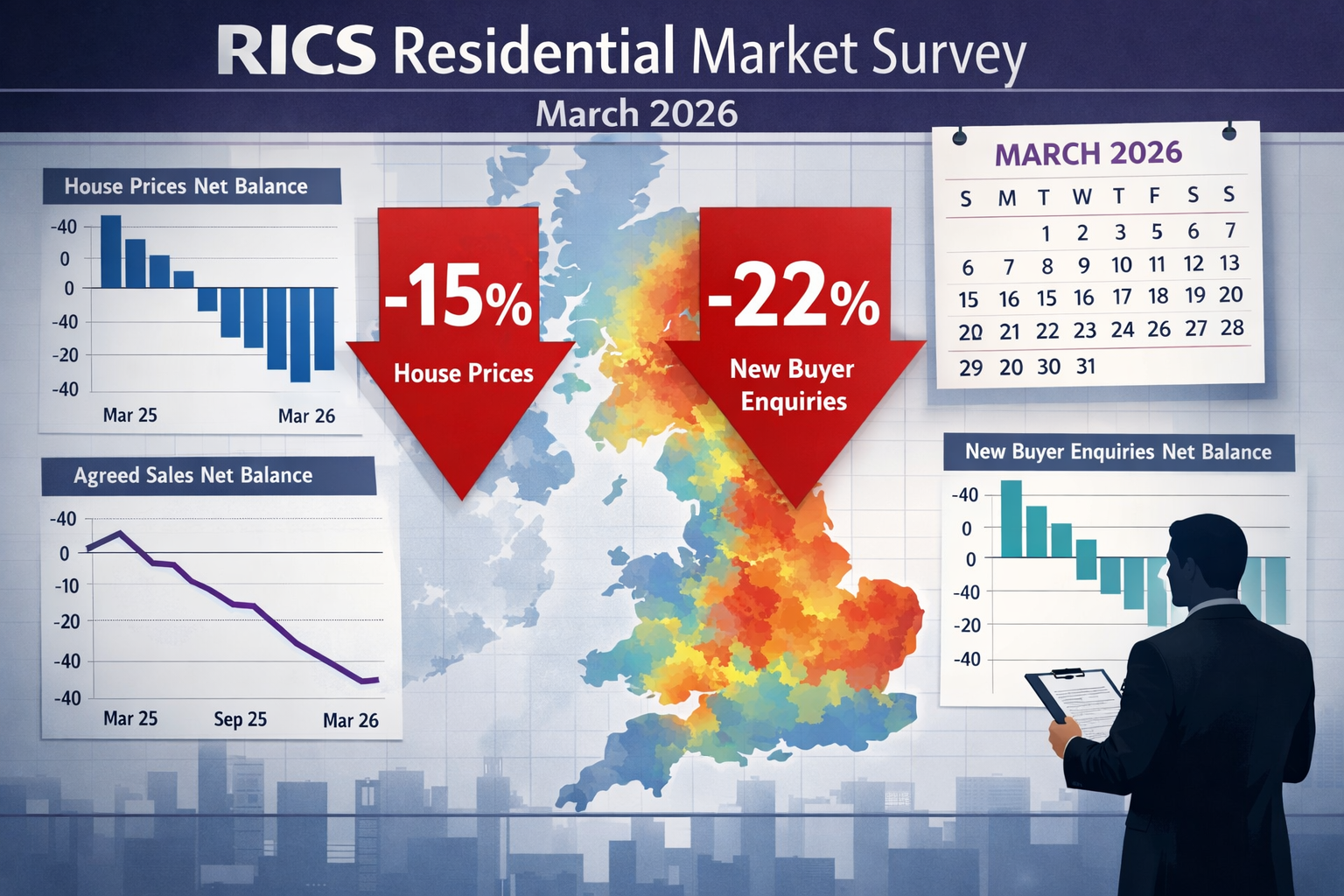
The March 2026 RICS Residential Market Survey reveals a stark reality: house price net balances have dropped to -15%, with new buyer enquiries falling by -22% compared to the previous quarter. These numbers signal a fundamental shift in the UK property market, one that demands immediate attention from chartered surveyors and property professionals navigating an increasingly complex valuation landscape.
Understanding Valuation Adjustments for March 2026 RICS Survey: Navigating Softer House Prices and Middle East Conflict Impacts has become essential for property professionals in 2026. The confluence of domestic market cooling and international geopolitical tensions creates unprecedented challenges for accurate property valuations. This spring market presents a cautious environment where traditional valuation methods require recalibration to reflect both local market conditions and broader economic uncertainties.
The current market dynamics demand that surveyors adopt more sophisticated approaches to property assessment. With listings slowing and buyer confidence wavering, the margin for error in valuations has narrowed considerably. Professional surveyors must now factor in multiple layers of risk assessment, from immediate market sentiment to longer-term geopolitical impacts on UK economic stability.

Key Takeaways
- 📉 Net price balances have declined to -15% in March 2026, indicating significant market softening across UK regions
- 🏘️ New buyer enquiries dropped by -22%, reflecting reduced market confidence and transaction velocity
- 🌍 Middle East conflict impacts are creating secondary effects on UK property valuations through energy costs and economic uncertainty
- 📊 Surveyor tactics must incorporate enhanced risk assessment frameworks and comparable evidence adjustment strategies
- ⚖️ Valuation accuracy requires balancing current market data with forward-looking economic indicators and geopolitical risk factors
Understanding the March 2026 RICS Survey Net Balances
The Royal Institution of Chartered Surveyors (RICS) publishes monthly residential market surveys that serve as critical barometers for UK property market health. The March 2026 data presents a particularly challenging picture for property professionals tasked with providing accurate valuations.
Key Net Balance Indicators
Net balances represent the difference between the percentage of respondents reporting increases versus those reporting decreases. A negative net balance indicates that more surveyors are witnessing declines than increases in their respective metrics.
| Metric | March 2026 Net Balance | Previous Quarter | Change |
|---|---|---|---|
| House Prices | -15% | -8% | ↓ 7 points |
| New Buyer Enquiries | -22% | -12% | ↓ 10 points |
| Agreed Sales | -18% | -10% | ↓ 8 points |
| New Instructions | -14% | -9% | ↓ 5 points |
These figures reveal a market in transition, moving away from the heated conditions of previous years toward a more subdued environment. For surveyors conducting homebuyer surveys, this means valuations must reflect not just current asking prices but realistic achievable sale prices in a softening market.
Regional Variations in Price Softening
The March 2026 survey data shows significant regional disparities. London and the South East experienced the most pronounced softening, with net balances of -21% and -19% respectively. In contrast, certain Northern regions showed more resilience, with net balances around -8% to -10%.
Regional breakdown:
- London: -21% (most affected by affordability constraints)
- South East: -19% (commuter belt pressure)
- South West: -16% (second home market cooling)
- Midlands: -12% (moderate softening)
- North West: -10% (relative resilience)
- Scotland: -8% (strongest performance)
Understanding these regional variations is crucial when determining appropriate valuation adjustments. A property in East London may require more significant downward adjustments compared to a comparable property in Manchester or Edinburgh.
Transaction Velocity and Market Liquidity
Beyond price movements, the March 2026 data highlights concerning trends in transaction velocity. The -22% net balance for new buyer enquiries suggests that properties are taking longer to sell, with fewer potential buyers actively searching.
This reduced liquidity has several implications for valuation work:
✅ Extended marketing periods must be factored into valuation reports
✅ Comparable evidence from 3-6 months ago may overstate current values
✅ Mortgage lender requirements become more stringent, affecting achievable prices
✅ Buyer negotiating power increases, leading to more offers below asking price
When conducting a Level 3 building survey, surveyors must communicate these market realities to clients, particularly those purchasing properties that may take longer to resell in current conditions.
Valuation Adjustments for March 2026 RICS Survey: Tactical Approaches for Surveyors
The softening market conditions revealed in the March 2026 RICS survey demand that chartered surveyors refine their valuation methodologies. Traditional approaches must be supplemented with enhanced analytical frameworks that account for increased market uncertainty and reduced transaction volumes.
Comparable Evidence Adjustment Strategies
In a declining market, selecting and adjusting comparable evidence becomes more nuanced. The standard practice of using sales from the previous 3-6 months may no longer provide reliable guidance when market conditions are shifting rapidly.
Best practices for comparable selection in March 2026:
- Prioritize recent transactions (within 8-12 weeks) over older sales
- Apply time adjustments of 1-2% per month for comparables older than 3 months
- Weight agreed sales and under-offer properties more heavily than asking prices
- Consider withdrawn listings as negative evidence of overpricing
- Analyze days-on-market trends to assess realistic sale timelines
For properties requiring RICS Help to Buy valuations, these adjustments become particularly critical. Lenders are increasingly scrutinizing valuations to ensure they reflect genuine market value rather than optimistic seller expectations.
Risk-Adjusted Valuation Frameworks
The March 2026 market conditions necessitate incorporating explicit risk assessments into valuation reports. This involves identifying factors that could further depress values and quantifying their potential impact.
Key risk factors to assess:
🔴 Macroeconomic headwinds (inflation, interest rates, employment trends)
🔴 Geopolitical uncertainties (Middle East conflict impacts on energy and economy)
🔴 Local market oversupply (new developments coming to market)
🔴 Property-specific issues (defects, location challenges, lease terms)
🔴 Financing constraints (mortgage availability, affordability stress tests)
When understanding what a surveyor checks, clients should expect more detailed commentary on how these risk factors influence the final valuation figure. Transparency about uncertainty ranges (e.g., ±5% confidence intervals) provides valuable context for decision-making.
Market Condition Adjustment Protocols
The RICS Valuation – Global Standards (Red Book) requires surveyors to clearly state the market conditions prevailing at the valuation date. In March 2026, this statement must acknowledge the softening market and reduced liquidity.
Recommended market condition language:
"The valuation has been prepared in a market characterized by declining buyer enquiries, extended marketing periods, and downward price pressure. Transaction volumes are below historical averages, and comparable evidence suggests a softening trend of approximately 1-2% per month. This valuation reflects current achievable sale prices rather than aspirational asking prices."
This explicit acknowledgment protects both the surveyor and the client by setting realistic expectations. For residential surveyors, providing this context is essential to maintaining professional credibility and managing client expectations.
Enhanced Due Diligence for Specific Property Types
Certain property types face disproportionate challenges in the March 2026 market. Surveyors must apply heightened scrutiny to:
Leasehold properties with short leases (under 80 years remaining)
New build developments with significant unsold inventory
High-value properties above £1 million (reduced buyer pool)
Properties requiring significant renovation (financing challenges)
Buy-to-let investments (regulatory pressures and yield compression)
When conducting surveys on these property types, additional valuation adjustments of 5-10% may be warranted to reflect their reduced marketability. Those considering whether they need a survey when buying a house should understand that in softening markets, professional valuations become even more critical to avoid overpaying.
Middle East Conflict Impacts on UK Property Valuations
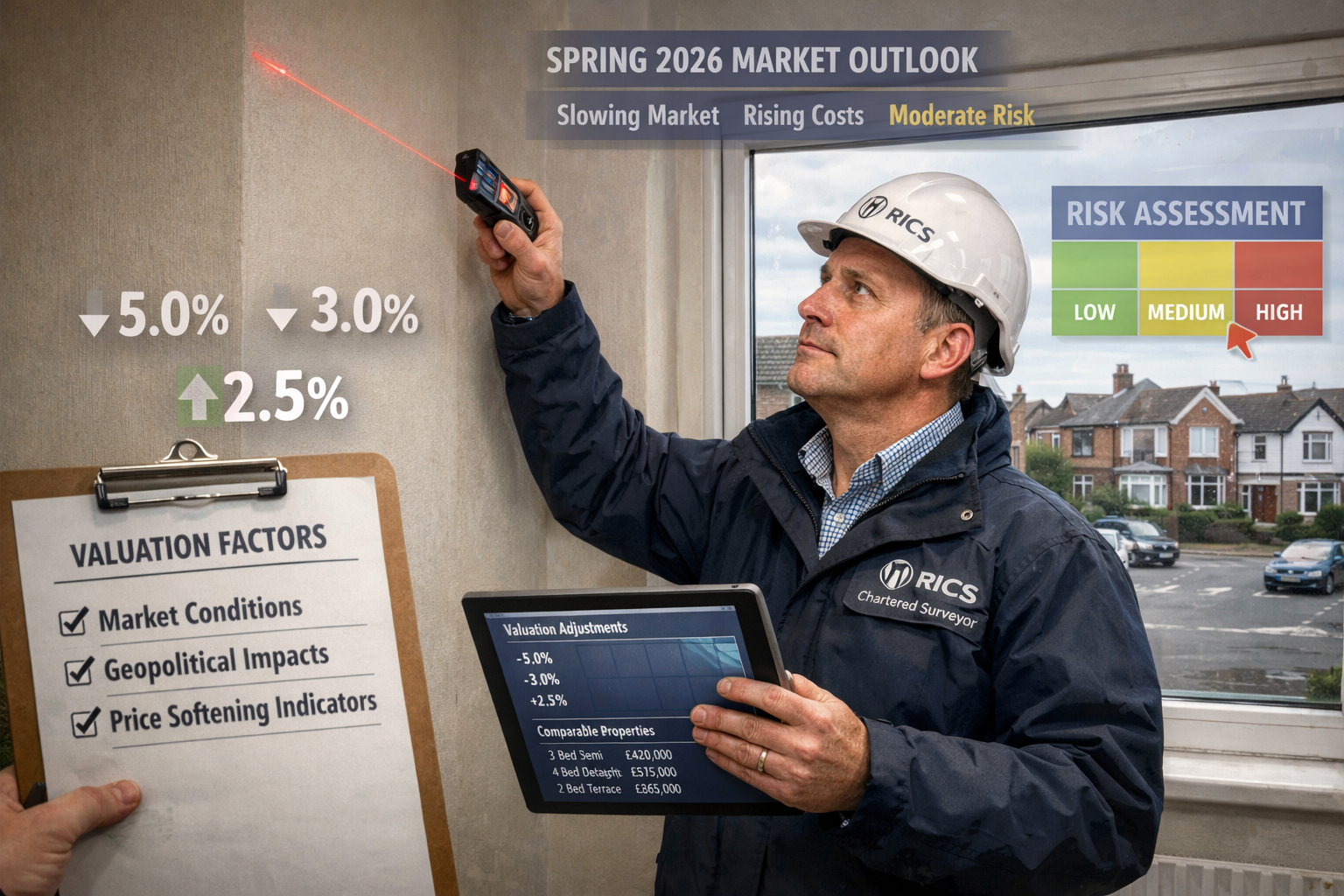
While the March 2026 RICS survey primarily captures domestic market sentiment, the ongoing Middle East conflict creates secondary effects that influence UK property valuations through multiple transmission channels. Understanding these geopolitical impacts is crucial for Valuation Adjustments for March 2026 RICS Survey: Navigating Softer House Prices and Middle East Conflict Impacts.
Energy Cost Implications for Property Values
The most direct impact of Middle East tensions on UK property markets operates through energy prices. Disruptions to oil and gas supplies create upward pressure on household energy costs, which in turn affects affordability and buyer sentiment.
Energy cost impact pathways:
💡 Heating costs reduce disposable income available for mortgage payments
💡 Property running costs become more significant in buyer decision-making
💡 Energy efficiency ratings (EPC) gain greater importance in valuations
💡 Renovation budgets must account for higher energy costs during works
💡 Location preferences shift toward properties with lower commuting costs
Properties with poor energy efficiency ratings (EPC D-G) face disproportionate valuation challenges in this environment. Surveyors should apply additional discounts of 3-5% for properties with substandard energy performance, as buyers increasingly factor lifetime running costs into their purchase decisions.
Economic Uncertainty and Buyer Confidence
Geopolitical instability creates broader economic uncertainty that dampens buyer confidence. The March 2026 survey's -22% net balance for new buyer enquiries partly reflects this heightened caution among potential purchasers.
Psychological and economic factors:
📉 Stock market volatility affecting wealth perceptions
📉 Job security concerns in sectors exposed to international trade
📉 Delayed purchase decisions as buyers "wait and see"
📉 Reduced overseas buyer interest in UK property
📉 Increased preference for liquid assets over property
For surveyors, this translates into longer marketing periods and increased likelihood of price negotiations. Valuations must account for this reduced urgency among buyers, particularly for properties in higher price brackets where buyers have more flexibility to delay purchases.
Mortgage Market Tightening
Lenders respond to economic uncertainty by tightening lending criteria and increasing risk premiums. This creates a feedback loop that further constrains property values by reducing the pool of qualified buyers.
Lending market changes in March 2026:
- Higher deposit requirements (15-20% becoming standard vs. 10% previously)
- More stringent affordability assessments
- Reduced availability of high loan-to-value mortgages
- Increased scrutiny of property valuations
- Preference for properties in established locations with proven demand
These lending market dynamics particularly affect first-time buyers and those seeking to upsize. When conducting Level 2 vs Level 3 surveys, surveyors should advise clients about potential financing challenges that could affect their ability to complete purchases at their maximum budget.
Regional Variations in Geopolitical Impact Sensitivity
Different UK regions show varying degrees of sensitivity to geopolitical shocks. Areas with economies heavily dependent on international trade, finance, or energy sectors face greater exposure to Middle East conflict impacts.
Most affected regions:
🌍 London (financial services sector exposure)
🌍 Aberdeen and Northeast Scotland (oil and gas industry links)
🌍 Port cities (trade disruption concerns)
🌍 International buyer hotspots (reduced overseas investment)
Conversely, regions with more domestically-focused economies show greater resilience. Surveyors working in areas like Hertfordshire or Berkshire may apply more modest geopolitical risk adjustments compared to those in international gateway cities.
Inflation and Interest Rate Considerations
The Middle East conflict's impact on inflation—particularly through energy and food prices—influences Bank of England monetary policy decisions. Higher-for-longer interest rates directly affect property affordability and valuations.
Interest rate transmission to property values:
| Interest Rate Scenario | Mortgage Cost Impact | Estimated Price Effect |
|---|---|---|
| Base rate 4.5% | Monthly payment +£150 (£300k mortgage) | -3% to -5% |
| Base rate 5.0% | Monthly payment +£225 (£300k mortgage) | -5% to -8% |
| Base rate 5.5% | Monthly payment +£300 (£300k mortgage) | -8% to -12% |
As of March 2026, with base rates holding at elevated levels, surveyors must factor in the cumulative effect of higher borrowing costs on achievable property prices. This is particularly relevant for properties at the upper end of typical buyer budgets, where affordability constraints bite hardest.
Navigating the Spring 2026 Market: Practical Guidance for Property Professionals
The combination of softer house prices revealed in the March 2026 RICS survey and ongoing Middle East conflict impacts creates a challenging environment for property professionals. However, with appropriate strategies and clear communication, surveyors can continue to provide valuable services while maintaining professional standards.
Client Communication Best Practices
In uncertain markets, transparent communication becomes even more critical. Clients need to understand not just the valuation figure but the reasoning and assumptions behind it.
Essential communication elements:
✉️ Market context explanation (reference RICS survey data explicitly)
✉️ Assumption transparency (state what could change the valuation)
✉️ Risk factor disclosure (identify potential downside scenarios)
✉️ Timeframe sensitivity (explain how quickly conditions may shift)
✉️ Action recommendations (provide clear next steps for clients)
When explaining what a property surveyor does, emphasize the value of professional judgment in interpreting market data and applying appropriate adjustments. This helps clients understand why valuations may differ from asking prices or online estimates.
Documentation and Evidence Standards
In softening markets, the quality of documentation supporting valuation conclusions becomes paramount. Lenders, legal advisors, and clients will scrutinize reports more carefully, making thorough evidence compilation essential.
Enhanced documentation requirements:
📋 Comprehensive comparable evidence schedule (minimum 5-8 comparables)
📋 Detailed market condition analysis with RICS survey data references
📋 Explicit adjustment calculations with clear rationale
📋 Property-specific risk assessment matrix
📋 Photographs and condition notes supporting value conclusions
📋 Market trend analysis showing 6-12 month trajectory
For party wall surveyors working on renovation projects, documenting current market conditions is equally important when assessing potential property damage valuations and compensation calculations.
Continuing Professional Development Focus Areas
The evolving market conditions highlighted in the March 2026 RICS survey underscore the need for ongoing professional development. Surveyors should prioritize training in:
Priority CPD topics for 2026:
🎓 Advanced comparable evidence analysis in declining markets
🎓 Geopolitical risk assessment frameworks
🎓 Energy efficiency impact on property valuations
🎓 Mortgage market dynamics and lending criteria changes
🎓 Client communication in uncertain market conditions
🎓 Red Book compliance in exceptional market circumstances
Professional bodies like RICS offer specialized courses addressing these topics. Maintaining expertise in these areas ensures surveyors can confidently navigate the challenges presented by current market conditions.
Technology and Data Analytics Integration
Modern valuation work increasingly benefits from technology-assisted analysis. In the March 2026 market environment, data analytics tools help surveyors identify trends and validate assumptions more rigorously.
Useful technology applications:
💻 Automated valuation models (AVMs) for initial range estimation
💻 Market trend dashboards showing real-time price movements
💻 Comparable evidence databases with advanced filtering capabilities
💻 Geographic information systems (GIS) for location analysis
💻 Energy efficiency calculators for running cost assessments
While technology enhances efficiency, professional judgment remains irreplaceable. Surveyors must interpret data outputs within the broader context of market conditions, property-specific factors, and client circumstances. Those conducting drone surveys can leverage aerial imagery to provide additional context for property assessments.
Building Resilient Valuation Practices
Looking beyond immediate market challenges, successful surveying practices in 2026 require building resilience through diversification and adaptability.
Resilience strategies:
🏗️ Service diversification (residential, commercial, specialized valuations)
🏗️ Geographic coverage expansion (multiple regional markets)
🏗️ Client base diversification (lenders, private buyers, legal sector)
🏗️ Flexible pricing models (value-based vs. fixed-fee structures)
🏗️ Strong professional networks (referral relationships, peer support)
Practices that successfully navigate the March 2026 market conditions will emerge stronger and better positioned for future challenges. This includes maintaining relationships with professionals across the property sector, from chartered surveyors in Chelsea to those in Watford, creating knowledge-sharing opportunities and referral networks.
Conclusion: Strategic Positioning for Uncertain Times
The Valuation Adjustments for March 2026 RICS Survey: Navigating Softer House Prices and Middle East Conflict Impacts represent more than just technical challenges—they define a pivotal moment for property professionals. The -15% net balance for house prices and -22% decline in new buyer enquiries signal a market in transition, requiring surveyors to recalibrate their approaches while maintaining the highest professional standards.
Success in this environment demands three core competencies:
1. Analytical rigor: Applying sophisticated comparable evidence analysis, time adjustments, and risk-weighted valuation frameworks that reflect genuine market conditions rather than aspirational pricing.
2. Transparent communication: Clearly explaining to clients how market softening, geopolitical uncertainties, and reduced transaction volumes influence property values, setting realistic expectations for both purchase and sale scenarios.
3. Professional adaptability: Continuously updating knowledge of market trends, lending criteria, and economic factors while maintaining compliance with RICS standards and best practices.
The spring 2026 market presents challenges, but also opportunities for surveyors who demonstrate expertise in navigating uncertainty. Properties that might have sold quickly at asking price in previous years now require more nuanced marketing strategies and realistic pricing. Buyers benefit from professional guidance that helps them avoid overpaying in a softening market, while sellers need honest assessments of achievable prices given current conditions.
Actionable Next Steps
For property professionals seeking to excel in the current market environment:
✅ Review and update comparable evidence databases to reflect March 2026 market conditions
✅ Implement enhanced risk assessment frameworks in all valuation reports
✅ Strengthen client communication protocols to explain market context clearly
✅ Invest in CPD focused on declining market valuation methodologies
✅ Monitor RICS survey data monthly to track market trajectory changes
✅ Build professional networks to share insights and best practices
✅ Consider technology tools that enhance analytical capabilities
For property buyers and sellers, the message is equally clear: professional surveying services provide critical value in uncertain markets. Whether you're considering a Level 2 survey for a standard property purchase or need specialized advice on lease extension valuations, engaging qualified RICS chartered surveyors ensures decisions are grounded in accurate market intelligence.
The March 2026 RICS survey data serves as a wake-up call: the property market has fundamentally shifted. Those who acknowledge this reality, adapt their practices accordingly, and maintain rigorous professional standards will not only survive but thrive in the challenging months ahead. The combination of domestic market softening and international geopolitical pressures creates complexity, but complexity also creates opportunities for professionals who can navigate it skillfully.
As we progress through 2026, continued monitoring of RICS survey indicators, mortgage market conditions, and geopolitical developments will remain essential. The property market is cyclical, and today's challenges will eventually give way to new opportunities. Surveyors who maintain their expertise, integrity, and client focus during difficult periods position themselves as trusted advisors for the long term—precisely when their services matter most.
