
Over 1.28 million UK homes are currently affected by damp and mould — and that is just one of the defect categories appearing with alarming frequency in building survey reports this year [1]. As the UK property market continues to turn over aging Victorian terraces, mid-century estates, and fast-built new-builds, the Defect Risk Hotspots in 2026 UK Housing Stock: What Building Surveyors Are Finding Most Often has become a critical topic for buyers, sellers, and property professionals alike. Understanding where defects cluster, what they cost to fix, and which property types carry the highest risk is no longer optional — it is essential due diligence.
Key Takeaways 🔑
- Damp, mould, and roof defects remain the most frequently flagged issues across all UK property types in 2026
- Victorian terraces, 1960s estates, and new-builds each carry distinct defect profiles that buyers must understand before purchasing
- Unsafe cladding still affects between 5,900 and 7,400 residential buildings over 11 metres in England [5]
- 80% of high flood-risk homes in England are in urban areas, making location-based risk assessment essential [6]
- A professional building survey is the most reliable tool for identifying and budgeting for these defects before exchange
Why Defect Risk Hotspots in 2026 UK Housing Stock Matter More Than Ever
The UK housing stock is one of the oldest in Europe. Approximately 38% of homes were built before 1945, and millions more date from the post-war construction boom of the 1950s and 1960s. These properties were not built to modern standards, and decades of deferred maintenance have compounded their vulnerabilities.
At the same time, the new-build sector — often marketed as a defect-free alternative — has its own well-documented quality issues. Snagging surveys routinely uncover paint and plaster defects, poorly fitted doors, inadequate sealant application, and drainage faults in properties that are months, not decades, old [8].
"A building survey is not a cost — it is insurance against buying someone else's problem."
Understanding the most common defects found in UK housing stock in 2026 allows buyers to:
- Negotiate purchase prices based on repair costs
- Budget accurately for post-purchase remediation
- Avoid properties with latent defects that could escalate into structural emergencies
- Meet mortgage lender requirements for certain property types
For anyone unsure whether a survey is necessary, the complete guide on whether you need a survey when buying a house provides a thorough breakdown of the decision.
The Most Common Defects Found Across All UK Property Types
🏚️ 1. Damp, Condensation, and Mould
Damp is the single most prevalent defect category in UK residential property. With 1.28 million homes affected nationally [1], it appears across property ages and types. Surveyors distinguish between three primary forms:
| Damp Type | Common Cause | Typical Property Age |
|---|---|---|
| Rising damp | Failed or absent DPC | Pre-1950 |
| Penetrating damp | Defective pointing, roofing, or windows | All ages |
| Condensation | Poor ventilation, thermal bridging | Post-1960s, new-builds |
Rising damp is most common in Victorian and Edwardian terraces where the original damp proof course (DPC) has failed or was never installed. Penetrating damp frequently appears in 1960s flat-roofed extensions and properties with deteriorating render. Condensation-related mould is increasingly flagged in well-sealed modern homes where ventilation has been compromised in the pursuit of energy efficiency.
Remediation costs range from £500 for localised treatments to over £15,000 for full DPC installation and replastering. A professional damp survey is the most reliable way to identify the root cause before committing to treatment.
🧱 2. Structural Cracks and Movement
Structural cracking is among the most anxiety-inducing findings in any survey report — and one of the most frequently misunderstood. Not all cracks indicate serious problems, but surveyors use crack width, pattern, and location to assess severity [2].
Key distinctions surveyors make:
- Hairline cracks (under 0.1mm): Typically cosmetic, caused by thermal movement or settlement
- Category 2 cracks (1–5mm): Require monitoring; may indicate differential settlement
- Category 4–5 cracks (15mm+): Serious structural concern; specialist investigation required
Subsidence is a particular concern in parts of London and the South East where shrinkable clay soils are prevalent. Properties near large trees, on slopes, or with a history of drainage issues are at elevated risk. For properties where subsidence is suspected, a dedicated subsidence survey can provide the diagnostic clarity needed before any remediation is planned.
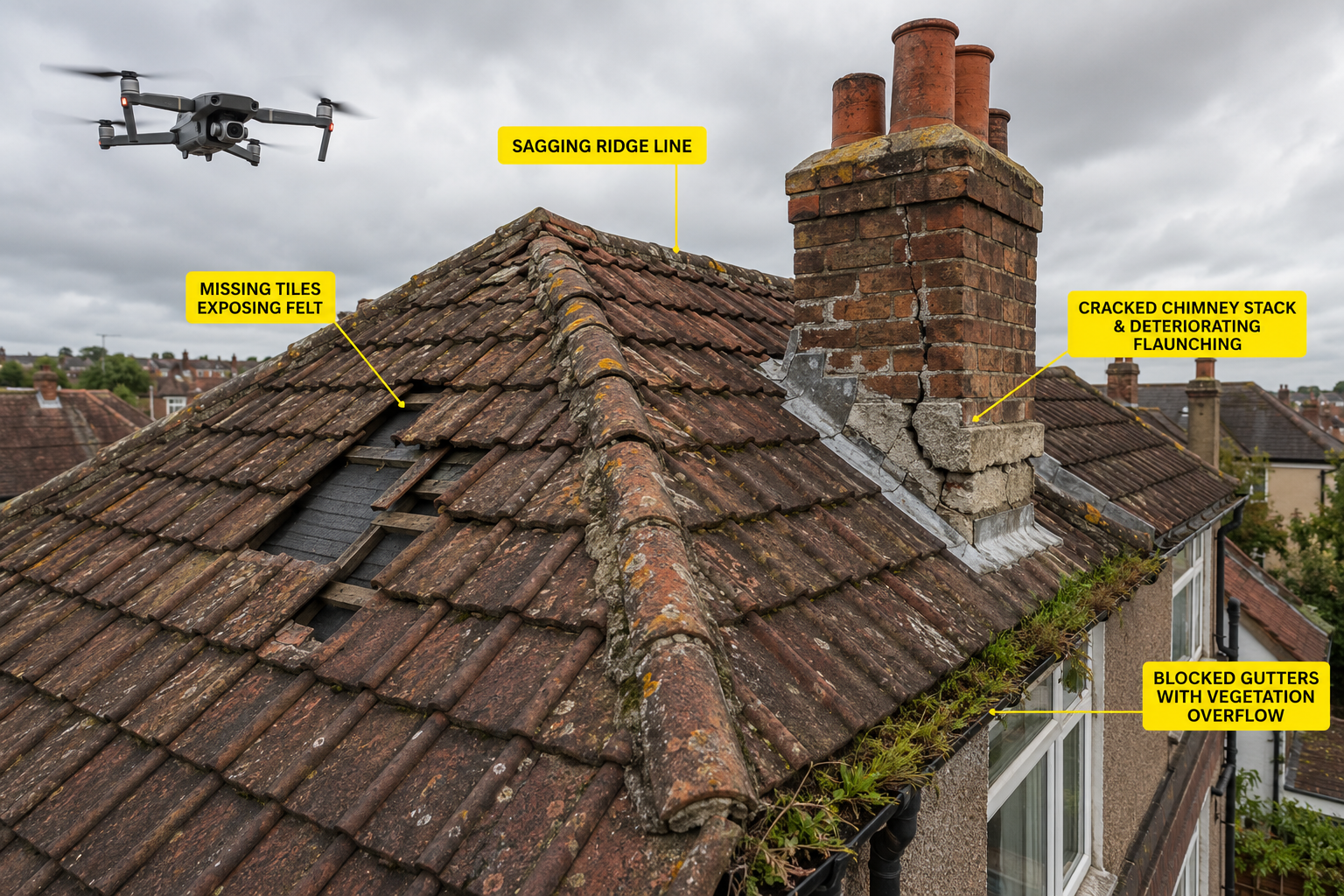
🏠 3. Roof Defects
Roof failures are a consistent finding across all UK property types. Common issues include missing or slipped tiles, deteriorating lead flashings, sagging ridge lines, blocked gutters, and failed flat roof membranes [3].
Typical roof defect costs by severity:
- Missing/slipped tiles: £150–£600 per repair
- Full re-roofing (standard 3-bed semi): £5,000–£12,000
- Flat roof replacement: £1,500–£4,000 per section
- Chimney repointing and flaunching: £500–£2,500
Victorian properties often have original slate roofs that, while durable, are now approaching or exceeding their 100-year lifespan. 1960s estates frequently feature concrete interlocking tiles that have become brittle and are prone to cracking. A specialist roof survey is strongly recommended for any property where the roof age or condition is uncertain.
⚡ 4. Electrical Faults and Outdated Wiring
Outdated electrical installations are a significant safety concern in older UK housing stock. Properties with original rubber-insulated wiring (pre-1960s), aluminium wiring (1960s–70s), or consumer units without RCD protection are flagged as requiring urgent attention [2].
Warning signs surveyors look for:
- Round-pin sockets (pre-1947 wiring)
- Fuse boxes without RCDs or MCBs
- Single-core aluminium wiring
- Lack of earthing on older systems
- Evidence of DIY or unpermitted electrical work
A full rewire of a three-bedroom house typically costs £3,000–£6,000. Given the fire risk associated with deteriorating insulation, this is rarely a defect that can be deferred.
🚿 5. Plumbing and Drainage Problems
Leaking pipes, blocked drains, and corroded plumbing are routine findings in surveys of properties built before the 1980s [2]. Lead pipework — still present in some pre-1970 homes — carries public health implications beyond the immediate repair cost.
Common plumbing defects by property era:
- Victorian/Edwardian: Lead supply pipes, clay drainage, cast iron soil stacks
- 1960s–70s: Corroding galvanised steel pipes, inadequate fall on drainage runs
- 1980s–90s: Failing push-fit joints, early plastic pipework degradation
- New-builds: Poorly sealed connections, inadequate drainage gradients
Defect Profiles by Property Type: Victorian, 1960s, and New-Build
Understanding which defects cluster by property type helps buyers focus their pre-purchase investigation.
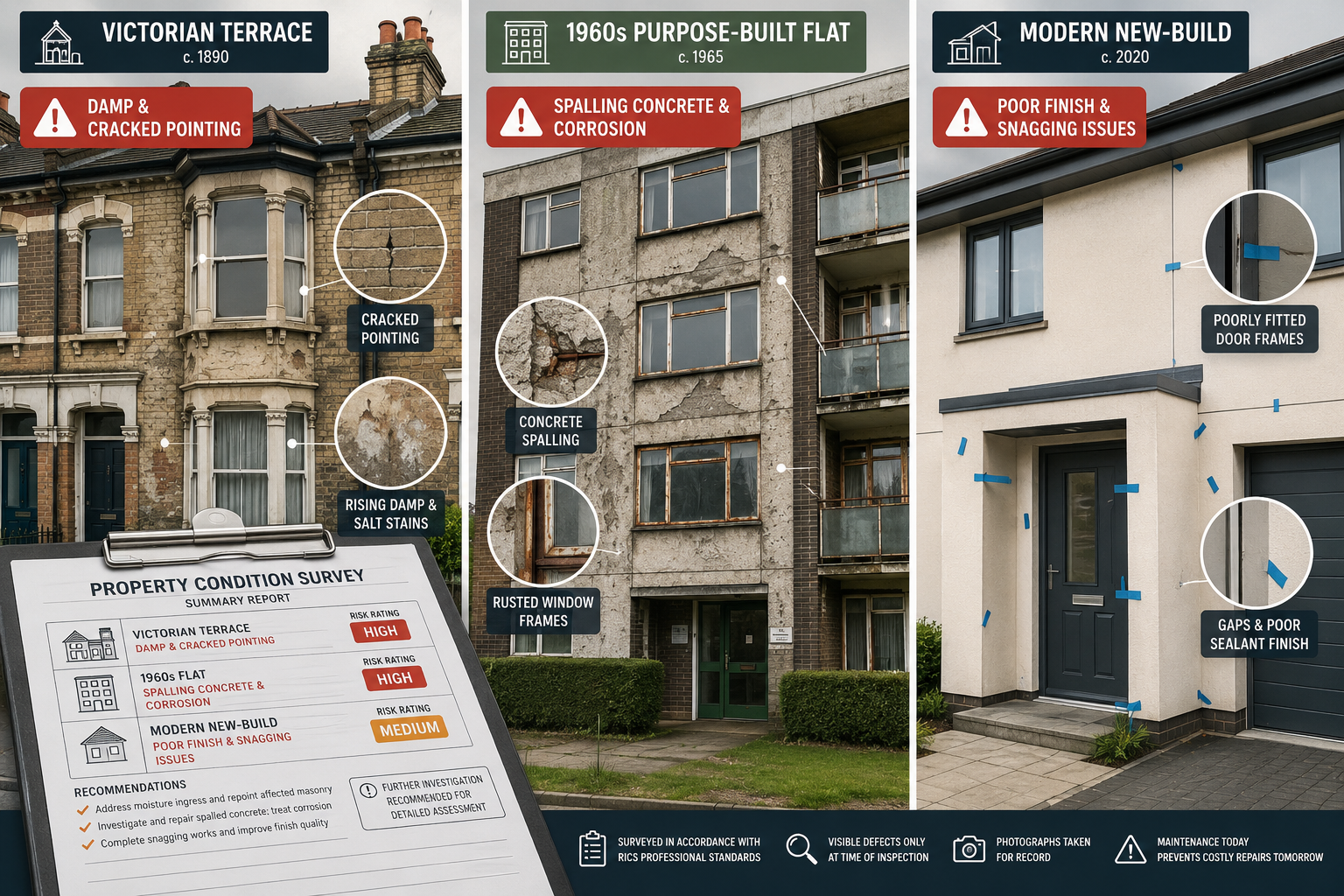
🏘️ Victorian and Edwardian Terraces (Pre-1920)
These properties dominate the housing stock in cities like London, Manchester, Bristol, and Leeds. Their characteristic defects include:
- Failed or absent DPC leading to rising damp
- Solid wall construction with no cavity, making insulation retrofitting complex
- Original single-glazed sash windows with draughts and condensation
- Deteriorating pointing and brickwork (spalling, cracking, erosion) [4]
- Subfloor void issues — blocked air bricks causing timber rot in suspended floors
- Japanese knotweed in rear gardens, particularly in properties backing onto railway embankments or watercourses [7]
⚠️ Japanese knotweed can exploit cracks in foundations, drains, and boundary walls. Its presence must be declared to mortgage lenders and can significantly affect property value if a management plan is not in place [7].
🏢 1960s and 1970s Estates
Post-war housing — particularly system-built and non-traditional construction — presents a distinct and often more complex defect profile.
- Spalling concrete on external facades and balconies [4]
- Non-standard construction (Airey, Wimpey No-Fines, BISF) that many lenders refuse to mortgage without specialist reports
- Flat roofs on extensions and communal areas with failed membranes
- Asbestos-containing materials (ACMs) in textured coatings, floor tiles, and roof sheets
- Poorly maintained communal infrastructure in blocks — lifts, fire doors, shared drainage
For buyers considering a flat in a 1960s or 1970s block, understanding the non-standard construction implications is essential before proceeding.
🏗️ New-Build Properties
The assumption that new-builds are defect-free is one of the most persistent myths in UK property. Snagging surveys consistently reveal [8]:
- Paint and plaster defects (most common)
- Poorly fitted or misaligned doors and windows
- Inadequate sealant around baths, showers, and kitchen units
- Drainage falls that are too shallow, causing standing water
- Missing insulation in roof voids or cavity walls
Regional variation also plays a role — areas with rapid new-build development often show higher defect rates linked to labour shortages and compressed build programmes [10]. A snagging report commissioned before legal completion gives buyers documented leverage to require the developer to remedy defects at their own cost.
Emerging and High-Stakes Defect Categories in 2026
🔥 Unsafe Cladding: Still a Live Crisis
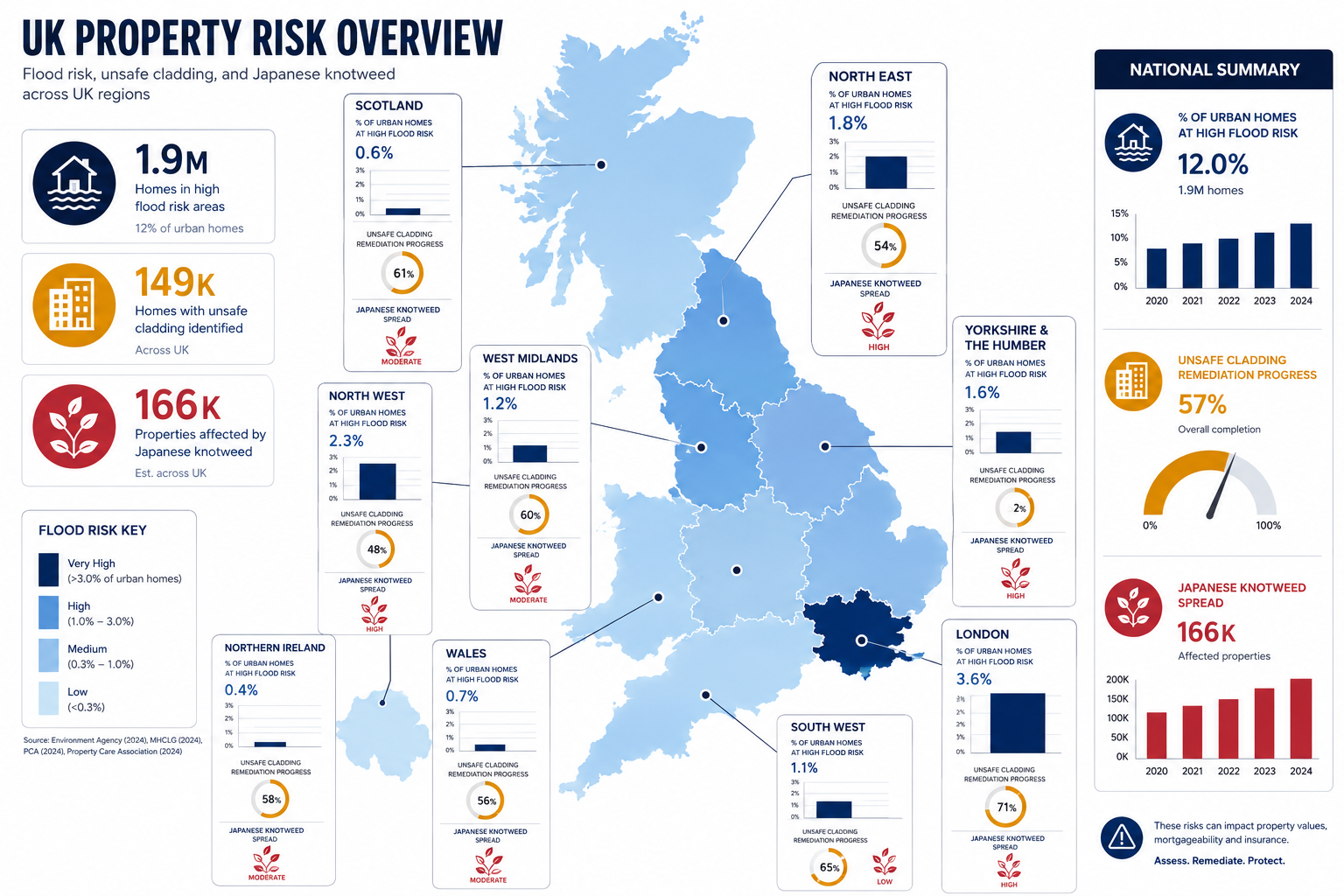
As of April 2026, between 5,900 and 7,400 residential buildings over 11 metres in England have or had unsafe cladding requiring remediation [5]. The Building Safety Regulator has set a target to inspect 40% of higher-risk residential buildings by April 2026, with a focus on those with dangerous cladding [9].
For buyers of flats in medium and high-rise blocks, cladding status is now a critical due diligence step. An EWS1 form (External Wall System assessment) is required by most mortgage lenders for affected buildings. Buyers should verify:
- Whether the building is on the remediation programme
- Who is funding the remediation (developer, leaseholder, or government)
- Whether a Building Safety Fund application has been made
🌊 Flood Risk: An Urban Problem
New research published in 2026 reveals that 80% of homes at high risk of flooding in England are in urban areas — a finding that challenges the assumption that flood risk is primarily a rural concern [6]. Social housing tenants are identified as particularly vulnerable, often living in lower-lying urban areas with ageing drainage infrastructure.
For buyers in flood-prone urban areas, surveyors now routinely assess:
- Proximity to ordinary watercourses and culverted streams
- Evidence of previous flood ingress (tide marks, replaced floor finishes)
- Condition of drainage and flood defence infrastructure
- Flood insurance availability and cost
🌿 Japanese Knotweed and Invasive Species
Japanese knotweed remains a significant concern in survey reports, particularly in properties near railway lines, rivers, and brownfield development sites [7]. Its roots can penetrate building foundations, drainage systems, and boundary structures. Mortgage lenders typically require a professional management plan before approving a loan on affected properties.
How to Interpret and Budget for Survey Findings
A survey report that lists defects is only useful if the buyer can translate findings into financial decisions. The following framework helps:
🟢 Green (Monitor): Hairline cracks, minor condensation, surface-level decoration issues — budget £500–£2,000 for cosmetic remediation.
🟡 Amber (Plan): Roof repairs, localised damp, outdated consumer unit — budget £2,000–£10,000 and plan works within 1–3 years.
🔴 Red (Act Immediately): Structural movement, unsafe electrics, active water ingress, unsafe cladding — budget £10,000–£50,000+ and factor into purchase price negotiation.
Understanding what a chartered surveyor does helps buyers use their report more effectively. A good surveyor does not just list defects — they prioritise them, estimate costs, and recommend specialist investigations where needed.
For targeted investigation of a specific issue flagged in a report, a specific defect report provides focused, expert analysis of a single element such as a crack, damp patch, or roof structure.
Conclusion: Actionable Next Steps for Buyers and Property Owners
The Defect Risk Hotspots in 2026 UK Housing Stock: What Building Surveyors Are Finding Most Often paints a clear picture: no property type is immune, and the cost of ignorance is almost always higher than the cost of investigation.
Here is what to do next:
- ✅ Commission the right survey — a Level 3 Building Survey for older or non-standard properties; a Level 2 HomeBuyer Report for conventional post-1930s homes in reasonable condition
- ✅ Use the survey to negotiate — identified defects are legitimate grounds for price reduction or seller remediation before exchange
- ✅ Prioritise the red flags — structural movement, unsafe electrics, active water ingress, and cladding issues require immediate specialist investigation
- ✅ Check flood risk independently — use the Environment Agency's flood map and ask your surveyor to assess drainage condition
- ✅ For new-builds, always snag — never rely on the developer's own inspection; commission an independent snagging survey before legal completion
- ✅ Seek local expertise — surveyors with deep knowledge of specific areas, such as chartered surveyors in London or chartered surveyors in Surrey, will be familiar with the regional defect patterns most relevant to the property being purchased
The UK housing stock is aging, climate pressures are intensifying, and build quality in the new-build sector remains inconsistent. In 2026, a professional survey is not a luxury — it is the single most important step between an offer and a costly mistake.
References
[1] UK Damp And Mould Crisis Mapped 128 Million Homes Affected Plus Low Cost Tips – https://www.thepropertydaily.co.uk/article/2026/03/06/uk-damp-and-mould-crisis-mapped-128-million-homes-affected-plus-low-cost-tips?utm_source=openai
[2] Common Problems Found In Building Surveys – https://www.surveymerchant.com/blog/common-problems-found-in-building-surveys?utm_source=openai
[3] Common Roof Problems – https://www.housesurveys.co.uk/blog/common-roof-problems.html?utm_source=openai
[4] Facades Spotlight Common Failures Explained – https://www.buildingengineer.org.uk/intelligence/facades-spotlight-common-failures-explained?utm_source=openai
[5] Building Safety Remediation Monthly Data Release April 2026 – https://www.gov.uk/government/publications/building-safety-remediation-monthly-data-release-april-2026/building-safety-remediation-monthly-data-release-april-2026?utm_source=openai
[6] England Homes High Risk Flooding Towns Cities Urban Environment Study – https://www.theguardian.com/environment/2026/apr/29/england-homes-high-risk-flooding-towns-cities-urban-environment-study?utm_source=openai
[7] Top Five Common Defects Identified In Diagnosis Reports – https://www.tcl-surveyors.co.uk/top-five-common-defects-identified-in-diagnosis-reports/?utm_source=openai
[8] Snagging Survey Cost New Build – https://getpine.co.uk/guides/snagging-survey-cost-new-build?utm_source=openai
[9] Building Safety Regulator Reveals 2026 Target For Checking Higher Risk Blocks – https://www.insidehousing.co.uk/news/building-safety-regulator-reveals-2026-target-for-checking-higher-risk-blocks-84149?utm_source=openai
[10] Regional New Build Market Hotspots 2026 – https://www.new-builds.co.uk/blog/regional-new-build-market-hotspots-2026?utm_source=openai
