
Ninety-six percent of institutional investors across Europe plan to increase their allocations to residential living assets — including buy-to-let properties — over the next five years. [2] That single statistic reframes the entire conversation around valuing buy-to-let properties in 2026: surveys for institutional investors amid market rebound are no longer a box-ticking exercise. They are a core pillar of capital deployment strategy.
As interest rates stabilise, rental demand holds firm, and liquidity returns to transparent markets [7], professional landlords and institutional funds alike face a critical question: how do you price a buy-to-let asset accurately enough to act with confidence — and quickly enough to compete?
The answer lies in rigorous, structured surveys combined with a clear-eyed understanding of where the market is heading.
Key Takeaways 📌
- 96% of European institutional investors plan to grow their living sector allocations over the next five years, signalling a structural shift in buy-to-let demand. [2]
- Accurate surveys — including RICS building surveys, drone inspections, and drainage assessments — are essential for pricing risk into buy-to-let valuations.
- Cash flow growth, not cap rate compression, is the dominant valuation driver in 2026. [9]
- Multifamily sentiment has surged, with 76% of respondents reporting positive outlook for core acquisitions — up from 44% just a year earlier. [5]
- Debt market stability means institutional buyers can underwrite with greater confidence, but due diligence on physical condition remains non-negotiable. [8]

Why Survey Quality Defines Buy-to-Let Valuations in 2026
The phrase "buy-to-let valuation" often conjures spreadsheets and yield calculations. But the physical condition of a property is the foundation beneath every number. In a rebounding market, where competition for quality stock is intensifying, a missed structural defect or an undisclosed drainage problem can turn a projected 6% yield into a loss-making liability within 18 months.
The Physical Risk Behind the Yield Number
Institutional investors approaching valuing buy-to-let properties in 2026 understand that surveys serve two distinct functions:
- Risk quantification — identifying defects that affect current value or future capital expenditure
- Negotiation leverage — using survey findings to adjust offer prices or demand remediation before completion
A RICS building survey provides the most comprehensive physical assessment available for residential property. For buy-to-let portfolios, particularly those involving older or converted stock, this level of scrutiny is not optional — it is the baseline.
💬 "Liquidity is returning selectively to markets with transparency and pricing clarity." — Knight Frank Active Capital Survey 2026 [7]
That transparency starts at the property level. Investors who can demonstrate clean, fully surveyed assets attract better financing terms and faster transaction timelines.
What a Comprehensive Survey Covers for BTL Investors
For institutional-grade due diligence, a single survey type is rarely sufficient. A layered approach typically includes:
| Survey Type | Primary Purpose | BTL Relevance |
|---|---|---|
| RICS Level 3 Building Survey | Full structural assessment | Essential for pre-1980s stock |
| Drainage Survey | Condition of underground drainage | Critical for HMOs and converted flats |
| Roof Survey | Roof structure and covering condition | High capex risk if missed |
| Drone Survey | Aerial inspection of inaccessible areas | Efficient for portfolio-level review |
| Asbestos Survey | Presence of hazardous materials | Mandatory for pre-2000 properties |
| Stock Condition Survey | Portfolio-wide condition baseline | Standard for institutional acquisitions |
For investors acquiring multiple units simultaneously, a stock condition survey provides a standardised condition baseline across an entire portfolio — enabling consistent pricing, maintenance forecasting, and asset management planning.
Drainage surveys deserve special mention. Drainage defects are among the most expensive and disruptive issues in residential property, yet they are invisible to a standard visual inspection. For HMOs and converted buildings — both popular buy-to-let formats — underground drainage systems are under significantly greater stress than in single-family homes.
The Institutional Investor Landscape: Survey Data Driving Market Rebound Confidence

The rebound in buy-to-let investment is not speculative. It is being driven by hard data from major institutional surveys, and understanding that data is essential context for anyone valuing buy-to-let properties in 2026: surveys for institutional investors amid market rebound.
Sentiment Has Shifted Decisively
CBRE's Q4 2025 Multifamily Underwriting Survey found that 76% of respondents reported positive sentiment toward core multifamily acquisitions — a dramatic rise from 44% just twelve months earlier. [5] This is not a marginal improvement; it represents a fundamental repositioning of institutional capital toward residential income assets.
Similarly, CBRE's broader investor intentions data shows that 95% of investors plan to purchase more or the same amount of real estate assets in 2026 compared to the prior year. [1] The hesitancy that characterised 2023 and 2024 has largely dissipated.
Cap Rates, Cash Flow, and Valuation Methodology
Two competing forces shape buy-to-let valuations in 2026:
🔽 Compressing cap rates — In the senior living segment, 71% of investors expect cap rates to tighten through 2026, reflecting rising asset values relative to income. [4] This trend is migrating into mainstream residential BTL markets.
📈 Cash flow primacy — Morgan Stanley's 2026 real estate outlook explicitly prioritises cash-flow growth over cap rate compression as the key value driver in the current cycle. [9] For buy-to-let investors, this means rental income trajectory matters more than headline yield at acquisition.
These two dynamics create a valuation tension that surveys help resolve. A property with strong rental fundamentals but deferred maintenance has a very different risk-adjusted value than its gross yield suggests. A full structural survey quantifies that gap precisely.
Debt Markets: Stable Enough to Underwrite
CBRE's 2026 North American Investor Intentions Survey reveals that over 70% of investors plan to maintain the same debt-to-equity ratio as the previous year, with 49% willing to tolerate one year of negative leverage. [8] In the UK context, this translates to a market where institutional buyers are underwriting with discipline — not desperation.
SitusAMC's analysis confirms that commercial real estate valuations held flat to slightly positive in Q4 2025, with stability expected to continue into 2026. [3] For buy-to-let valuers, this provides a more predictable comparable transaction base than the volatile 2022–2024 period.
Neuberger Berman notes that institutional allocators are regaining conviction in real estate, with equity deployment expected to accelerate through 2026. [6] This creates upward pressure on quality assets — and downward pressure on the time available to complete due diligence before competing bids emerge.
The European Living Sector: A Structural Tailwind
Cushman & Wakefield's European Living Investor Survey confirms that 96% of institutional investors intend to increase allocations to living assets over the next five years. [2] The UK buy-to-let market sits squarely within this structural trend, benefiting from:
- 🏙️ Persistent undersupply of quality rental housing in major cities
- 📊 Strong rental growth in urban and commuter belt locations
- 🏦 Improving financing conditions as rates stabilise
- 🌍 Cross-border capital seeking transparent, liquid markets
Knight Frank's Active Capital Survey 2026 adds that 63% of respondents intend to include core investments within their strategies, representing approximately $37 billion of deployable capital. [7] A meaningful share of that capital is targeting UK residential income assets.
Practical Strategies for Accurate BTL Pricing in a Stabilising Market
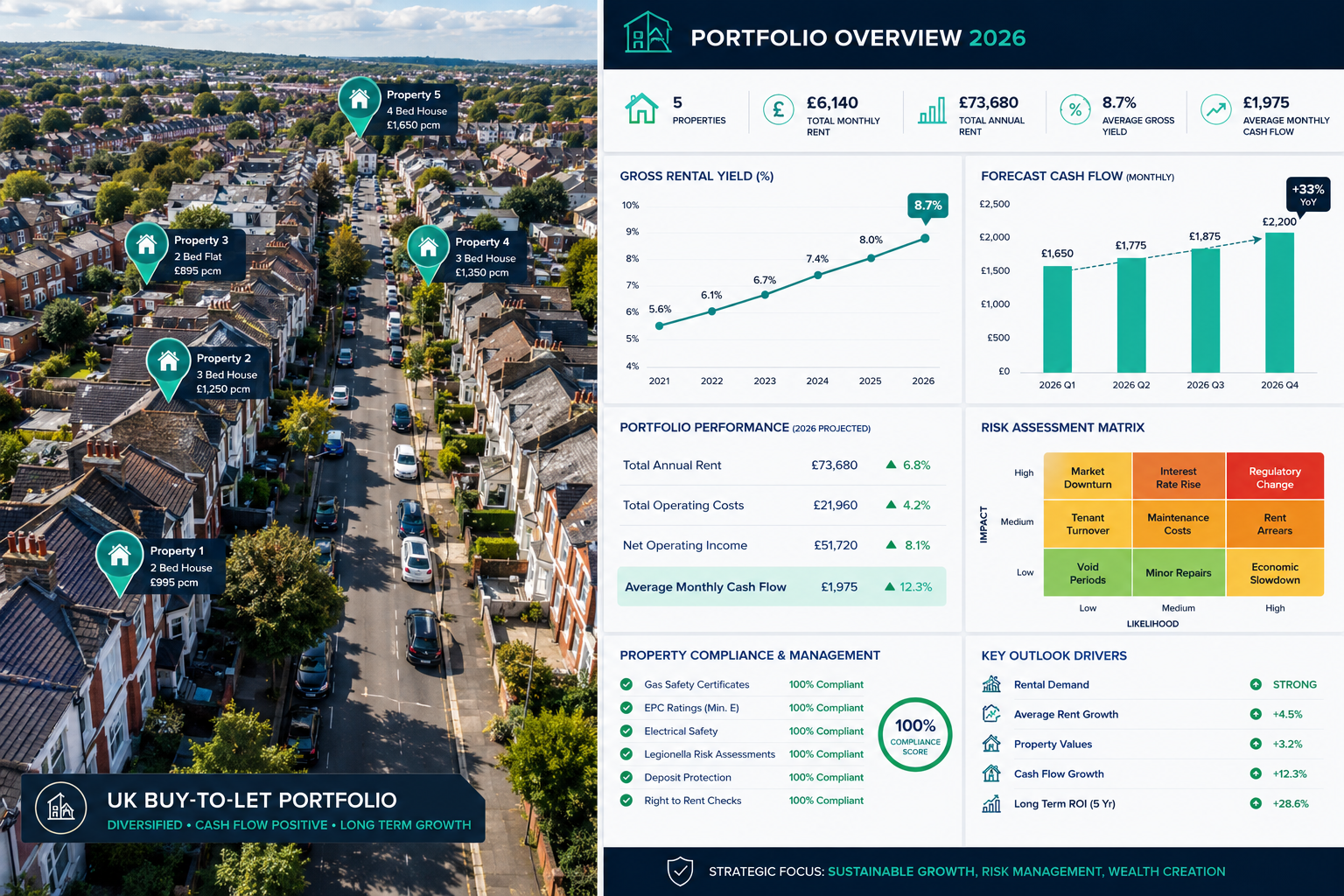
Understanding market sentiment is one thing. Translating it into accurate, defensible buy-to-let valuations requires a structured approach to surveys, comparable analysis, and risk adjustment.
Step 1: Match Survey Depth to Asset Risk Profile
Not every buy-to-let property requires the same level of survey investment. A framework for matching survey type to asset risk:
🟢 Lower Risk (post-2000 new build, single flat, standard construction)
- RICS Level 2 HomeBuyer Survey or RICS Home Survey
- Basic drainage check
- EPC and compliance review
🟡 Medium Risk (1960s–1990s terrace or semi, standard construction, good condition)
- RICS Level 3 Building Survey — see the complete guide to Level 3 building surveys
- CCTV drainage survey
- Roof inspection
🔴 Higher Risk (pre-1960 stock, converted flats, HMOs, non-standard construction)
- Full RICS Level 3 Building Survey
- Drone survey for roof and external fabric
- Full CCTV drainage survey
- Asbestos management survey
- Subsidence survey if movement indicators present
- Structural engineer report if major concerns identified
This tiered approach allows institutional investors to allocate due diligence budget proportionally — concentrating resource where physical risk is highest.
Step 2: Build Survey Findings Into the Valuation Model
Survey findings should feed directly into the financial model, not sit in a separate document. A practical approach:
- Identify all defects with estimated remediation costs from the survey report
- Categorise by urgency: immediate (Year 1), medium-term (Years 2–5), long-term (Years 5+)
- Discount from gross yield to arrive at net yield after capex
- Stress-test against vacancy periods during major works
- Compare to comparable sold prices for fully refurbished equivalents
💬 "Prioritising cash-flow growth over cap rate compression is the dominant strategy in the current real estate cycle." — Morgan Stanley Real Estate 2026 Outlook [9]
This methodology aligns with Morgan Stanley's emphasis on cash flow quality. A property with a 7% gross yield but £40,000 of immediate remediation work has a very different investment case than one with a 6% gross yield and a clean survey.
Step 3: Use Red Book Valuations for Institutional Reporting
For institutional investors, informal valuations are not sufficient for fund reporting, lending, or regulatory compliance. A Red Book valuation — conducted in accordance with RICS Valuation – Global Standards — provides the formal, auditable assessment required by:
- Pension funds and insurance companies with regulated reporting obligations
- Lenders requiring independent valuation for loan security
- Fund managers reporting NAV to investors
- Tax authorities for capital gains or inheritance tax purposes
Red Book valuations incorporate survey findings, comparable transaction evidence, rental market data, and explicit assumptions about market conditions — producing a defensible figure that withstands scrutiny.
Step 4: Leverage Technology for Portfolio Efficiency
Institutional investors acquiring multiple buy-to-let units simultaneously face a practical challenge: how to conduct thorough due diligence at scale without creating transaction bottlenecks.
Drone surveys have become an increasingly valuable tool in this context. They enable rapid, high-resolution inspection of roof structures, external fabric, and site boundaries — often completing in a fraction of the time required for traditional scaffold-based access. For a portfolio of 20 or 30 units, the time and cost savings are significant.
Combined with monitoring surveys for assets with known structural concerns, technology-enabled survey approaches allow institutional teams to maintain rigorous standards without sacrificing transaction speed.
Case Study Snapshot: Bullish Multifamily Acquisition 🏢
Consider a scenario consistent with current market conditions:
An institutional fund targets a portfolio of 15 converted flats in a commuter belt location. Gross yield appears attractive at 6.8%. A layered survey programme — Level 3 building surveys, CCTV drainage, and drone roof inspection — identifies:
- Drainage defects requiring £28,000 of remediation across three units
- Roof covering at end of serviceable life (£45,000 estimated replacement)
- Minor damp issues in two ground-floor flats (£12,000)
Total identified capex: £85,000
Adjusted net yield after Year 1 capex: approximately 6.1% — still attractive in the current environment, but materially different from the headline figure. The fund uses survey findings to negotiate a £75,000 price reduction, preserving target returns and protecting against downside.
This is precisely the kind of disciplined underwriting that CBRE's survey data identifies as characteristic of the current institutional buyer cohort — bullish on fundamentals, but unwilling to loosen financial models. [5]
Conclusion: Actionable Next Steps for BTL Investors in 2026
Valuing buy-to-let properties in 2026: surveys for institutional investors amid market rebound is ultimately about combining market confidence with physical rigour. The data is clear — capital is returning, sentiment is improving, and the structural case for UK residential income assets is compelling. But the investors who will generate the strongest risk-adjusted returns are those who treat surveys not as a cost, but as a competitive advantage.
Actionable Next Steps ✅
- Assess your survey framework — does your current due diligence process match survey depth to asset risk profile? If not, revisit your approach before the next acquisition.
- Commission Red Book valuations for any assets entering institutional fund structures, lending arrangements, or regulatory reporting cycles.
- Integrate survey findings into financial models at the line-item level — not as a footnote, but as a direct input to net yield and capex forecasting.
- Explore drone and technology-enabled surveys for portfolio acquisitions where speed and scale are priorities.
- Work with RICS-accredited surveyors who understand institutional requirements and can produce reports that meet fund-grade documentation standards.
- Monitor cap rate trends in your target submarkets — the compression expected through 2026 [4] means windows for attractive entry pricing may be shorter than they appear.
The market rebound is real. The opportunity is genuine. The investors who act with both conviction and rigour — backed by comprehensive surveys and disciplined valuation methodology — are best positioned to capture it.
References
[1] Investors Set To Deploy More Capital In 2026 As Us Commercial Real Estate Market Stabilizes – https://www.cbre.com/press-releases/investors-set-to-deploy-more-capital-in-2026-as-us-commercial-real-estate-market-stabilizes?utm_source=openai
[2] Renewed Momentum Across Europes Living Sector – https://www.cushmanwakefield.com/en/germany/news/2026/04/renewed-momentum-across-europes-living-sector?utm_source=openai
[3] Cre Valuations Hold Steady Capital Markets Head 2026 Debt Equity – https://www.situsamc.com/resources-insights/articles/cre-valuations-hold-steady-capital-markets-head-2026-debt-equity?utm_source=openai
[4] Senior Living Investors Bet On Tighter Cap Rates As Recovery Deepens – https://www.globest.com/2026/02/09/senior-living-investors-bet-on-tighter-cap-rates-as-recovery-deepens/?utm_source=openai
[5] Core Multifamily Buyers Turn More Bullish But Dont Loosen Their Models – https://www.globest.com/2026/03/04/core-multifamily-buyers-turn-more-bullish-but-dont-loosen-their-models/?utm_source=openai
[6] Article Real Estate The Brightening Case For Gp Focused Solutions In 2026 – https://www.nb.com/ja/insights/article-real-estate-the-brightening-case-for-gp-focused-solutions-in-2026?utm_source=openai
[7] Core Capital Returns – https://www.knightfrank.com/research/article/2026/1/core-capital-returns?utm_source=openai
[8] 2026 North American Investor Intentions Survey – https://www.cbre.com/insights/reports/2026-north-american-investor-intentions-survey?utm_source=openai
[9] Real Estate 2026 Outlook – https://www.morganstanley.com/im/en-sg/institutional-investor/insights/articles/real-estate-2026-outlook.html?utm_source=openai
