
Basement waterproofing failures in shared properties have surged by 34% across water-vulnerable UK regions during the 2026 retrofit boom, with membrane defects and high water table complications triggering unprecedented disputes between adjoining owners. As thousands of homeowners pursue basement conversions in flood-prone areas, the intersection of party wall legislation and groundwater management has become a critical battleground requiring specialist surveyor intervention.
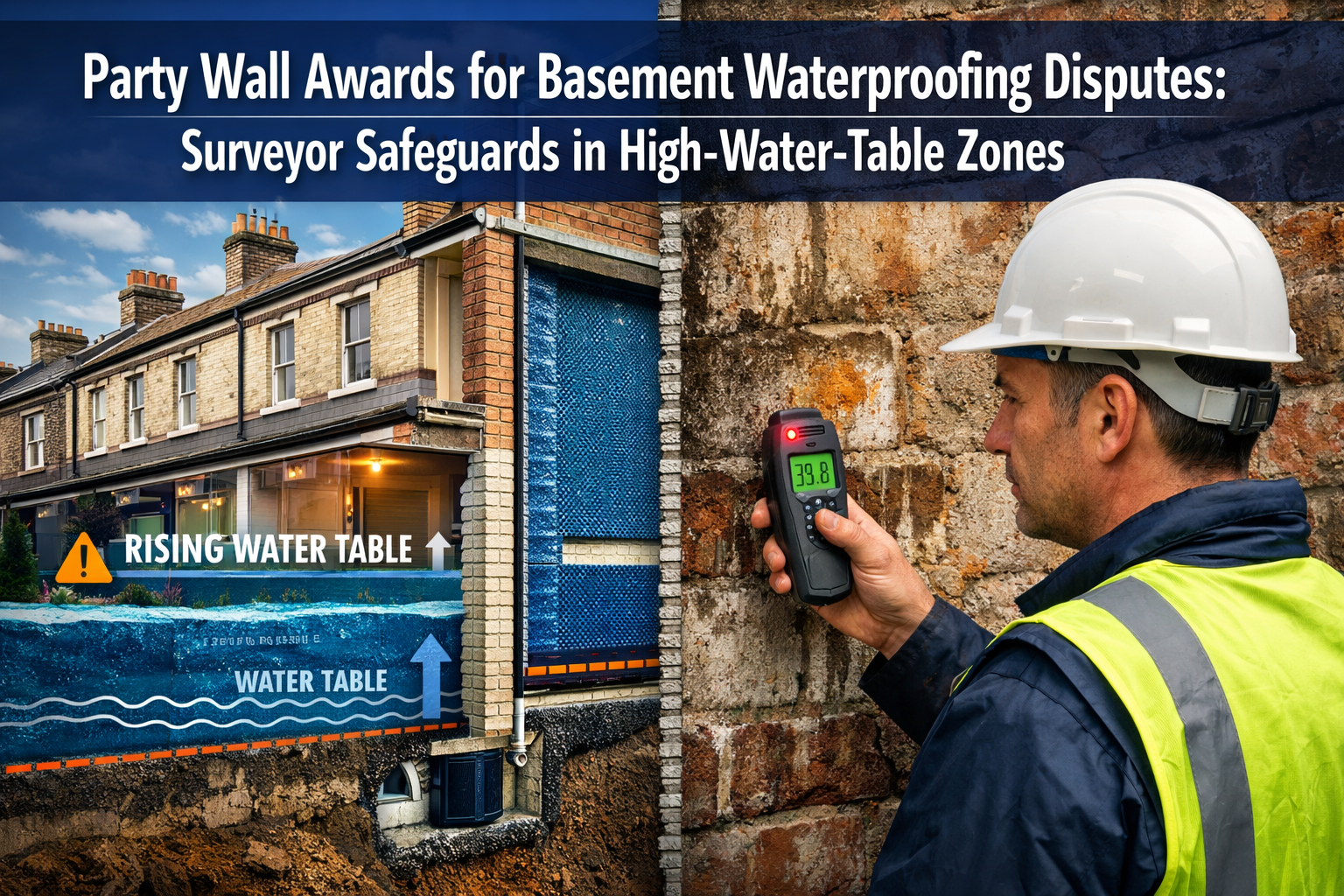
Understanding Party Wall Awards for Basement Waterproofing Disputes: Surveyor Safeguards in High-Water-Table Zones has become essential for property owners undertaking basement work in areas with elevated groundwater levels. These specialized awards provide legal frameworks for resolving conflicts when waterproofing systems fail, affecting both the building owner's property and their neighbor's basement or foundations.
Key Takeaways
- 🏗️ Party wall awards establish formal dispute resolution mechanisms when basement waterproofing failures affect adjoining properties in high-water-table zones
- 💧 Surveyor safeguards include moisture mapping, thermal imaging, and proportional cost allocation rather than automatic 50/50 splits in shared wall damp disputes
- 📋 Award templates must address groundwater management systems, membrane specifications, and maintenance responsibilities specific to water-vulnerable locations
- ⏱️ Resolution timelines typically span 4-8 weeks from initial notice to final award, with expedited procedures available for active water ingress emergencies
- 🔍 Expert assessment determines liability through maintenance records, construction quality analysis, and water table fluctuation monitoring
Understanding Party Wall Awards in Basement Waterproofing Contexts
The Party Wall etc. Act 1996 provides the legal foundation for resolving disputes when basement work affects shared structures. However, waterproofing complications in high-water-table zones introduce unique challenges that standard party wall procedures weren't originally designed to address.
What Makes Waterproofing Disputes Different
Traditional party wall matters typically involve structural alterations, excavations, or building work that directly impacts the shared wall. Basement waterproofing disputes differ significantly because:
- Hidden defects may not become apparent until months or years after work completion
- Water migration follows unpredictable paths through soil and masonry
- Liability attribution becomes complex when multiple properties share drainage systems
- Groundwater fluctuations create seasonal variations in water table levels
The Party Wall etc. Act 1996 establishes procedures for disputes involving shared walls, including provisions for surveyor appointment and a test of "reasonableness" based on use, benefit, and maintenance records[2]. This reasonableness test becomes particularly important when determining whether a building owner took adequate precautions against known high-water-table risks.
The Role of Party Wall Awards
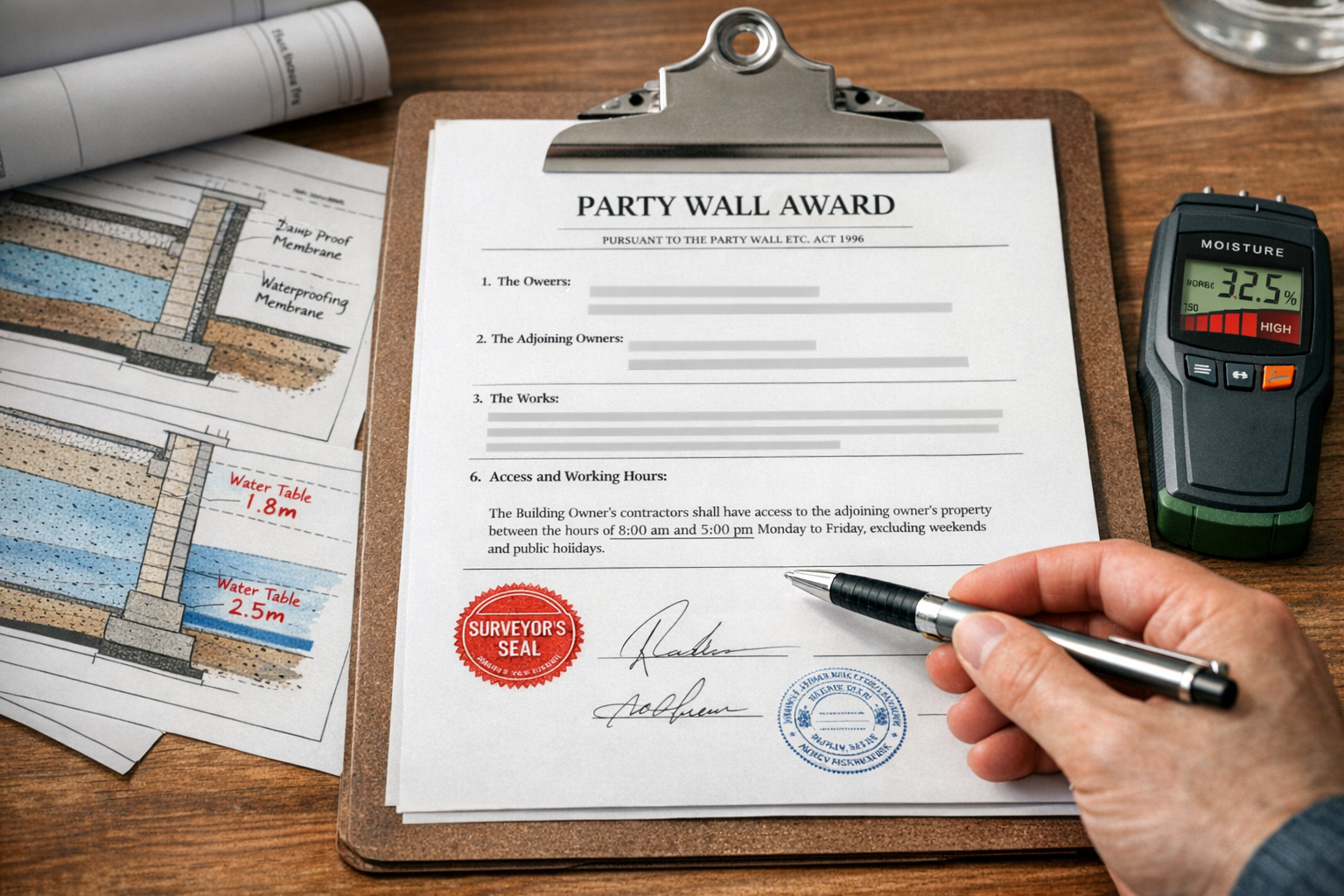
A party wall award serves as a legally binding document that:
✅ Defines the scope of permitted basement waterproofing work
✅ Establishes safeguards to protect adjoining owners from water damage
✅ Allocates costs for remedial work if waterproofing systems fail
✅ Sets monitoring requirements for water table levels and membrane integrity
✅ Creates dispute resolution procedures for future waterproofing failures
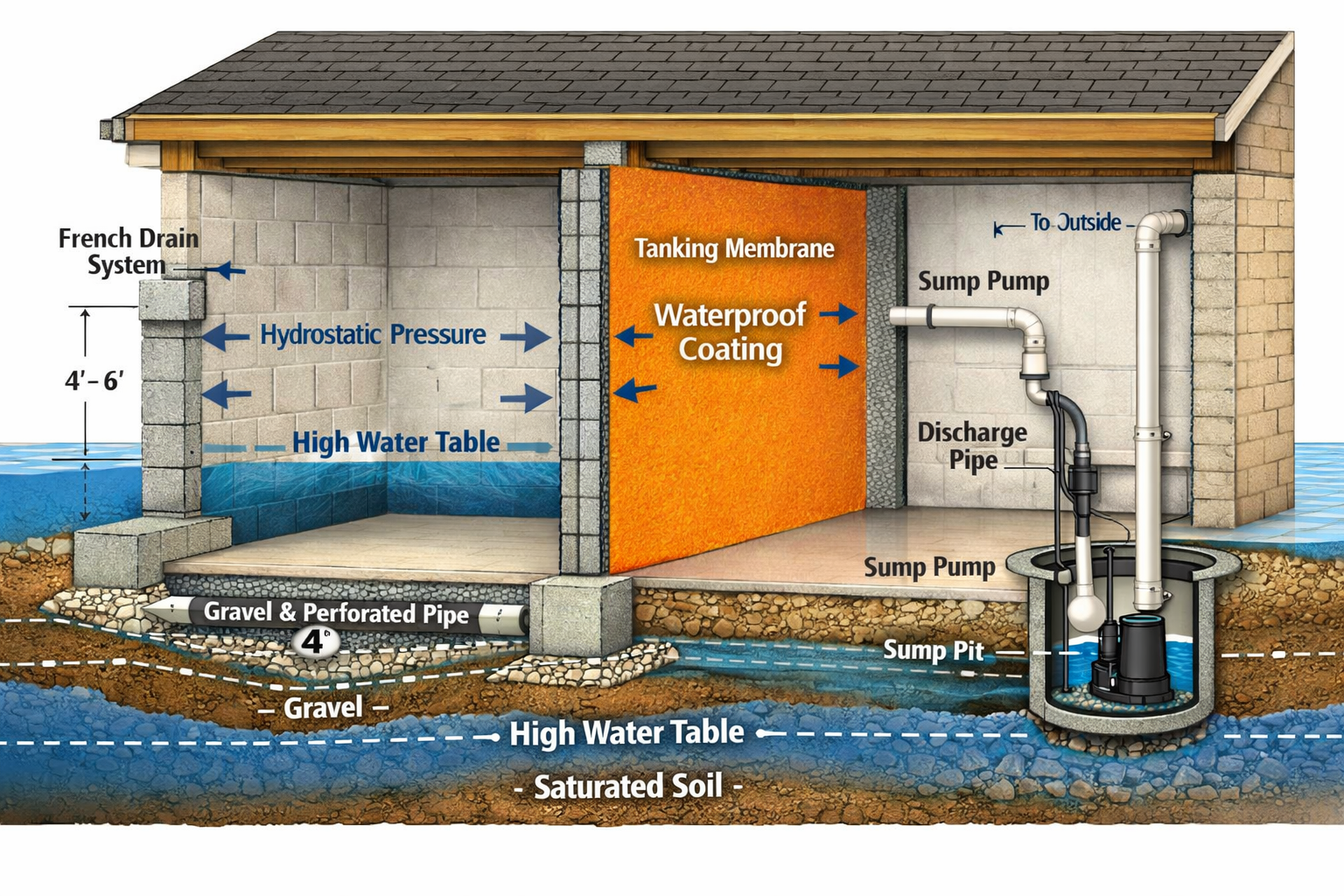
In high-water-table zones, awards must specifically address groundwater management. This includes specifying tanking systems, drainage solutions, and sump pump installations that prevent water from migrating through party walls to neighboring properties.
When Party Wall Awards Become Necessary
Property owners must serve party wall notices before undertaking basement waterproofing work that:
- Excavates within three meters of a neighbor's structure
- Installs new foundations deeper than existing adjoining foundations
- Cuts into or alters a party wall to install damp-proof membranes
- Creates new drainage systems that might affect neighboring properties
If the adjoining owner dissents or fails to respond within 14 days, the matter proceeds to a party wall award. Surveyors appointed under the Act then assess the proposed waterproofing work and establish protective conditions.
High-Water-Table Challenges in Basement Waterproofing
High water tables present distinct engineering challenges that directly impact party wall considerations. Understanding these complications helps surveyors craft awards with appropriate safeguards.
True vs. False Water Tables
Not all basement water problems stem from genuine high water tables. False water tables occur when poor drainage around foundations creates localized water accumulation that mimics true groundwater conditions[1]. This distinction matters significantly for party wall awards because:
| True High Water Table | False Water Table |
|---|---|
| Regional groundwater level naturally high | Poor surface drainage creating localized pooling |
| Affects entire neighborhood uniformly | May only impact specific properties |
| Requires permanent dewatering systems | Can be resolved through improved drainage |
| Seasonal fluctuation patterns predictable | Varies with rainfall and drainage maintenance |
| Liability often shared between neighbors | Typically attributable to specific property maintenance |
Surveyors must determine which condition exists before drafting awards. False water tables caused by one property's inadequate drainage may shift liability entirely to that building owner, while true high water tables typically require shared solutions[1].
Common Waterproofing System Failures
In high-water-table zones, waterproofing systems fail through several mechanisms that can affect adjoining properties:
🔴 Membrane breaches – Physical damage to tanking systems during or after installation
🔴 Hydrostatic pressure overload – Water table rises exceeding design specifications
🔴 Joint failures – Separation at wall-floor junctions where party walls meet basement slabs
🔴 Sump pump failures – Mechanical breakdown or inadequate capacity during peak water table periods
🔴 French drain blockages – Sediment accumulation reducing drainage system effectiveness
When these failures occur in properties with shared party walls, water often migrates horizontally through the wall structure, causing damage to the adjoining owner's basement. This creates disputes about who bears responsibility for remediation costs.
Surveyor Assessment Methodologies
Professional surveyors use sophisticated techniques to trace water sources and assign responsibility. These methodologies form the evidence base for party wall awards in waterproofing disputes.
Moisture mapping involves systematic measurement of water content throughout wall structures using calibrated meters. Surveyors create detailed maps showing moisture gradients that reveal whether water originates from one property or affects both equally[2].
Thermal imaging cameras detect temperature variations associated with water infiltration. Cold spots indicate active water ingress, while thermal patterns show historical moisture paths through masonry[2].
Maintenance record analysis examines both properties' histories of gutter cleaning, drainage maintenance, and previous waterproofing work. This evidence helps determine whether negligence contributed to the current problem[2].
Surveyors combine these assessment techniques to establish proportional responsibility rather than applying automatic 50/50 cost splits[2]. This evidence-based approach ensures fairness when one property's maintenance failures predominantly caused the shared wall dampness.
Surveyor Safeguards in Party Wall Awards for Basement Waterproofing Disputes
Effective party wall awards for basement waterproofing in high-water-table zones must incorporate specific safeguards that protect all parties while enabling necessary remedial work.
Pre-Work Condition Surveys
Before any basement waterproofing work begins, surveyors should mandate comprehensive condition surveys documenting:
- Existing moisture levels in party walls and adjoining basements
- Current water table depth measured through test boreholes
- Drainage system functionality for both properties
- Structural integrity of party walls and foundations
- Photographic evidence of all relevant areas
This baseline documentation becomes crucial if disputes arise later about whether damage resulted from new waterproofing work or pre-existed the project. Party wall surveyors typically recommend professional photography and detailed written descriptions of all party wall conditions.
Waterproofing System Specifications
Awards should specify minimum standards for waterproofing systems in high-water-table zones:
Tanking membrane specifications:
- Minimum membrane thickness (typically 2mm for high-water-table applications)
- Required overlap distances at joints (usually 150mm minimum)
- Party wall junction detailing with flexible sealants
- Certification requirements for installers
Drainage system requirements:
- French drain sizing based on calculated groundwater flow rates
- Sump pump capacity with redundancy (dual pump systems recommended)
- Battery backup systems for power failure scenarios
- Discharge routing that doesn't impact neighboring properties
Monitoring provisions:
- Water level sensors in sumps with alarm systems
- Annual inspection requirements by qualified professionals
- Maintenance schedules for pumps and drainage systems
- Reporting obligations to adjoining owners
Cost Allocation Frameworks
Party wall awards must establish clear cost allocation principles for initial waterproofing work and potential future remediation. Surveyors typically consider:
Proportional benefit analysis – If one property gains 80% of the benefit from improved waterproofing (e.g., creating habitable basement space) while the neighbor gains only 20% benefit (protection from water migration), costs might be allocated accordingly.
Causation assessment – When maintenance failures or construction defects in one property caused the water problem, that owner may bear greater responsibility. Surveyors use moisture mapping and maintenance records to establish causation[2].
Shared infrastructure costs – Drainage improvements that benefit both properties equally typically warrant 50/50 cost splits, even when one property initiated the work.
The cost responsibilities for party wall surveyors themselves follow separate rules, with the building owner typically paying all reasonable surveyor fees.
Dispute Resolution Timelines
Party Wall Awards for Basement Waterproofing Disputes: Surveyor Safeguards in High-Water-Table Zones must include realistic timelines that balance urgency with thorough assessment:
| Stage | Standard Timeline | Expedited (Active Flooding) |
|---|---|---|
| Initial notice period | 14 days | 48 hours |
| Surveyor appointment | 10 days | 24 hours |
| Condition survey completion | 7-14 days | 2-3 days |
| Technical assessment | 14-21 days | 5-7 days |
| Draft award circulation | 7 days | 2 days |
| Final award issuance | 14 days from draft | 3 days from draft |
| Total process | 6-10 weeks | 2-3 weeks |
Expedited procedures apply when active water ingress threatens structural integrity or creates health hazards. Awards should specify triggers for expedited processes and emergency work authorizations.
Ongoing Monitoring Requirements
Unlike structural party wall work that concludes once construction finishes, basement waterproofing in high-water-table zones requires perpetual vigilance. Awards should mandate:
📊 Annual inspections by qualified surveyors examining membrane integrity, drainage function, and water table levels
📊 Seasonal monitoring during known high-water-table periods (typically late winter/early spring)
📊 Maintenance logs documenting pump servicing, drain cleaning, and system testing
📊 Notification protocols requiring building owners to inform neighbors of system malfunctions within 24 hours
📊 Access rights allowing adjoining owners' surveyors to inspect shared waterproofing systems
These ongoing safeguards prevent small problems from escalating into major disputes. When building owners neglect maintenance, awards should specify remedies including the adjoining owner's right to undertake necessary maintenance and recover costs.
Award Templates and Practical Implementation
Drafting effective party wall awards for basement waterproofing disputes requires balancing legal precision with practical engineering considerations.
Essential Award Clauses for High-Water-Table Scenarios
Clause 1: Scope of Permitted Work
Detailed descriptions of waterproofing systems, excavation depths, and drainage installations. Should reference specific British Standards for tanking and drainage design.
Clause 2: Pre-Commencement Requirements
Condition surveys, water table testing, and photographic documentation before work begins. Establishes baseline for future dispute resolution.
Clause 3: Construction Safeguards
Temporary dewatering procedures, shoring requirements, and monitoring of adjoining property during excavation. Specifies notification requirements if unexpected groundwater encountered.
Clause 4: System Specifications
Technical requirements for membranes, drainage, and pumping systems. Should exceed minimum standards in high-water-table zones to provide safety margins.
Clause 5: Testing and Commissioning
Post-installation testing protocols including hydrostatic pressure tests, drainage flow rate verification, and pump capacity confirmation.
Clause 6: Maintenance Obligations
Perpetual maintenance requirements with specific schedules. Establishes building owner's duty to maintain systems protecting both properties.
Clause 7: Monitoring and Reporting
Inspection frequencies, reporting formats, and notification triggers. Creates transparency that prevents disputes from festering undetected.
Clause 8: Remediation Procedures
Protocols if waterproofing fails, including emergency work authorizations, cost allocation for repairs, and dispute resolution mechanisms.
Clause 9: Cost Allocation
Detailed breakdown of initial work costs and principles for future remediation cost sharing. Should reference the proportional responsibility analysis.
Clause 10: Access Rights
Ongoing access for inspections, maintenance, and emergency repairs. Balances adjoining owner's protection rights with building owner's privacy.
Case Study: Terraced House Basement Conversion Dispute
A 2025 case in South London illustrates how Party Wall Awards for Basement Waterproofing Disputes: Surveyor Safeguards in High-Water-Table Zones function in practice:
Scenario: Building owner excavated basement in Victorian terraced house located in area with water table 1.5 meters below ground level. Initial waterproofing used standard tanking membrane without enhanced drainage systems.
Problem: Six months after completion, adjoining owner's basement developed dampness along shared party wall. Moisture mapping revealed water migrating horizontally through party wall from building owner's property.
Investigation: Surveyors discovered building owner's sump pump undersized for actual groundwater inflow during winter high-water-table period. Pump ran continuously but couldn't keep pace, causing hydrostatic pressure buildup that forced water through party wall joints.
Award Resolution:
- Building owner required to install dual sump pump system with 50% greater capacity
- Enhanced membrane applied to party wall with improved joint sealing
- Building owner bore 85% of costs based on causation analysis (inadequate initial system design)
- Adjoining owner contributed 15% reflecting benefit from improved party wall waterproofing
- Quarterly monitoring mandated for two years, then annual inspections thereafter
Outcome: Remedial work cost £18,500. Building owner paid £15,725, adjoining owner paid £2,775. System has functioned successfully through two subsequent winter high-water-table periods.
This case demonstrates how proportional cost allocation based on causation produces fairer outcomes than automatic 50/50 splits[2].
Common Pitfalls and How to Avoid Them
❌ Insufficient water table assessment – Awards based on summer water table measurements may fail during winter peaks. Solution: Require year-round water table data or conservative design assumptions.
❌ Vague maintenance obligations – General requirements like "maintain in good condition" create ambiguity. Solution: Specify exact maintenance tasks with frequencies (e.g., "pump servicing every six months by qualified engineer").
❌ Inadequate drainage capacity – Designing for average conditions rather than peak flows. Solution: Mandate drainage systems sized for 1-in-10-year groundwater events minimum.
❌ No emergency procedures – Awards that don't address system failures create chaos during crises. Solution: Include emergency work authorization procedures with cost recovery mechanisms.
❌ Ignoring false water table possibilities – Assuming all basement water comes from true groundwater. Solution: Require drainage assessment of both properties to identify false water table conditions[1].
Integration with Building Control and Planning
Party wall awards don't operate in isolation. Surveyors must ensure waterproofing specifications align with:
Building Regulations Approved Document C – Resistance to moisture requirements
Structural engineer specifications – Foundation loading and excavation support
Planning conditions – Any specific requirements for basement conversions
Environmental permits – Groundwater discharge consents if dewatering required
Coordination between party wall surveyors, building control officers, and structural engineers prevents conflicting requirements that could compromise waterproofing effectiveness.
Professional Surveyor Selection and Qualifications
Choosing appropriately qualified surveyors is critical for effective awards in complex waterproofing disputes.
Required Expertise
Party wall surveyors handling basement waterproofing disputes in high-water-table zones should possess:
🎓 RICS qualification (Royal Institution of Chartered Surveyors)
🎓 Building surveying specialism with structural knowledge
🎓 Waterproofing technology understanding including modern membrane systems
🎓 Hydrogeology basics to assess groundwater conditions
🎓 Dispute resolution experience in similar cases
The complete guide to party wall surveyors emphasizes that specialist knowledge matters significantly in technical disputes. General surveyors without waterproofing expertise may draft awards with inadequate safeguards.
The Agreed Surveyor Option
Property owners can appoint a single "agreed surveyor" to represent both parties rather than each appointing separate surveyors. This approach:
✅ Reduces overall costs
✅ Speeds up the award process
✅ Works well when relationships are cooperative
However, in contentious waterproofing disputes where significant costs are at stake, separate surveyors often better protect each party's interests. The cost implications of party wall agreements should be weighed against the dispute's complexity and financial exposure.
Third Surveyor Appointments
When appointed surveyors disagree on technical matters, they may jointly appoint a "third surveyor" to resolve specific issues. In waterproofing disputes, third surveyors often bring specialized hydrogeology or waterproofing engineering expertise that party wall surveyors may lack.
Third surveyor determinations on technical matters like drainage system sizing or membrane specifications become binding parts of the final award.
Regional Considerations for High-Water-Table Zones
Water table levels vary dramatically across the UK, requiring location-specific approaches to party wall awards.
High-Risk Areas
Certain regions face particularly challenging groundwater conditions:
Thames Valley and London – Extensive areas with water tables 1-3 meters below ground level, complicated by underground rivers and historic drainage modifications.
Fenlands (Cambridgeshire, Lincolnshire) – Naturally high water tables in low-lying areas with seasonal fluctuations of 1-2 meters.
Coastal zones – Tidal influences create complex groundwater patterns with daily fluctuations.
River valleys nationwide – Floodplains and areas near watercourses with elevated groundwater.
Property owners in these regions should expect more stringent waterproofing requirements in party wall awards. Local surveyors with regional experience understand area-specific challenges and typical water table behaviors.
Seasonal Variations
Awards must account for seasonal water table fluctuations. Winter levels typically peak 1-2 meters higher than summer lows in many UK regions. Waterproofing systems designed based on summer conditions fail catastrophically during winter peaks.
Surveyors should require:
- Design specifications based on historical maximum water table levels
- Safety margins of at least 0.5 meters above recorded maximums
- Monitoring protocols during known high-water-table seasons
- Contingency plans for extreme events exceeding design parameters
Climate Change Considerations
The 2026 retrofit boom occurs against increasing climate uncertainty. Party wall awards for basement waterproofing should incorporate climate resilience:
🌍 Future-proofing – Design for water table levels 0.5-1.0 meters higher than current maximums
🌍 Extreme event capacity – Systems that handle 1-in-50-year groundwater events
🌍 Adaptive management – Monitoring protocols that detect changing groundwater patterns
🌍 Upgrade provisions – Award clauses allowing system enhancements if conditions worsen
These forward-looking provisions protect both property owners from obsolescence as climate patterns shift.
Legal Remedies When Awards Are Breached
Even well-drafted awards fail if building owners don't comply with their obligations.
Enforcement Mechanisms
Adjoining owners have several remedies when building owners breach party wall award requirements:
County Court enforcement – Awards are legally binding documents enforceable through court orders. Judges can compel compliance and award damages for losses caused by breaches.
Injunctive relief – Courts can issue injunctions preventing building owners from proceeding with work that violates award specifications or requiring immediate remedial action.
Self-help remedies – In emergencies (active flooding threatening property), adjoining owners may undertake necessary work themselves and recover costs from the building owner. Awards should specify when self-help is permitted.
Professional negligence claims – If surveyors drafted inadequate awards that failed to prevent foreseeable damage, affected parties may have claims against the surveyors.
Dispute Resolution Without Litigation
Court proceedings are expensive and time-consuming. Awards should include alternative dispute resolution mechanisms:
Surveyor mediation – Original surveyors attempt to resolve disagreements about award interpretation or compliance.
Expert determination – Technical disputes about whether work complies with specifications can be resolved by independent experts rather than judges.
Structured negotiation – Awards can mandate good-faith negotiation periods before litigation, with costs consequences for parties who refuse reasonable settlements.
These mechanisms resolve most disputes faster and cheaper than court proceedings.
Future Trends in Party Wall Waterproofing Awards
The intersection of party wall law and basement waterproofing continues evolving as construction techniques advance and climate patterns shift.
Technology Integration
Modern waterproofing systems increasingly incorporate smart monitoring:
IoT sensors continuously monitor water table levels, membrane integrity, and pump function
Automated alerts notify property owners and surveyors of system anomalies
Remote diagnostics allow experts to assess problems without site visits
Performance data creates evidence trails for future disputes
Party wall awards should specify data sharing requirements, ensuring adjoining owners receive relevant monitoring information about systems protecting their properties.
Standardization Efforts
Industry bodies are developing standardized award templates for common scenarios including basement waterproofing in high-water-table zones. Standardization offers:
✅ Reduced surveyor fees through template efficiency
✅ More consistent outcomes across similar cases
✅ Clearer expectations for property owners
✅ Faster dispute resolution
However, templates must allow customization for site-specific conditions. Rigid standardization that ignores local water table variations or property-specific factors could create inadequate protections.
Insurance Developments
Specialist insurance products are emerging to cover party wall waterproofing risks:
Waterproofing system insurance – Covers remediation costs if systems fail within warranty periods
Party wall dispute insurance – Reimburses legal and surveyor costs in contentious cases
Latent defect insurance – Protects against hidden waterproofing failures discovered years after construction
Awards should address insurance requirements, potentially mandating building owners maintain coverage that protects adjoining owners from waterproofing failures.
Conclusion
Party Wall Awards for Basement Waterproofing Disputes: Surveyor Safeguards in High-Water-Table Zones have become essential tools for managing the complex intersection of property rights, construction technology, and groundwater management in the 2026 retrofit boom. As basement conversions proliferate in water-vulnerable UK regions, the quality of party wall awards directly determines whether these projects protect or damage neighboring properties.
Effective awards require surveyors with specialized expertise in both party wall procedures and waterproofing technology. They must incorporate comprehensive safeguards including detailed condition surveys, robust waterproofing system specifications, proportional cost allocation based on causation analysis, realistic dispute resolution timelines, and perpetual monitoring requirements.
Property owners undertaking basement work in high-water-table zones should prioritize professional party wall surveyor selection and invest in waterproofing systems that exceed minimum standards. The relatively modest additional cost of enhanced drainage and redundant pumping capacity pales compared to remediation expenses and neighbor disputes when inadequate systems fail.
Adjoining owners should actively engage with the party wall process rather than passively accepting notices. Appointing qualified surveyors who understand waterproofing technology ensures awards include meaningful protections rather than boilerplate clauses that prove worthless when problems arise.
Actionable Next Steps
For building owners planning basement waterproofing:
- Obtain professional water table assessment before designing systems
- Serve proper party wall notices early in the planning process
- Appoint RICS surveyors with waterproofing expertise
- Design systems for worst-case water table scenarios, not average conditions
- Budget for ongoing monitoring and maintenance, not just initial installation
For adjoining owners receiving notices:
- Respond within the 14-day notice period to preserve your rights
- Appoint your own surveyor rather than relying on the building owner's surveyor
- Request comprehensive pre-work condition surveys
- Ensure awards include specific waterproofing system specifications, not vague requirements
- Insist on monitoring provisions that give you visibility into system performance
For surveyors drafting awards:
- Conduct thorough water table assessments including seasonal variation analysis
- Distinguish between true high water tables and false water tables caused by drainage problems[1]
- Use evidence-based proportional cost allocation rather than automatic 50/50 splits[2]
- Include detailed maintenance obligations with specific frequencies and standards
- Establish clear emergency procedures for system failures
The 2026 surge in basement conversions will generate waterproofing disputes for years to come as systems age and climate patterns evolve. Well-crafted party wall awards with robust surveyor safeguards provide the legal and technical framework for managing these challenges fairly and effectively, protecting property values and neighbor relationships in high-water-table zones across the UK.
References
[1] High Water Table Basement It Could Be A False Water Table – https://drycretewp.com/high-water-table-basement-it-could-be-a-false-water-table/
[2] Shared Wall Damp Disputes Who Pays When Its Both Properties Legal Costs – https://www.sussexdampexperts.com/shared-wall-damp-disputes-who-pays-when-its-both-properties-legal-costs/
