
London's construction boom has triggered a 340% increase in right of light disputes since 2020, with property owners increasingly challenging developments that cast shadows across their windows. As urban density intensifies in 2026, expert witnesses have become essential arbiters in these complex cases, providing photometric analysis and valuation evidence that can determine whether multi-million-pound developments proceed or stall.
The landscape of Expert Witness Roles in Right of Light Litigation: RICS Evidence Standards Post-2026 Daylight Rights Reforms has evolved significantly, requiring surveyors to master both technical measurement protocols and courtroom presentation skills. With recent reforms to daylight rights legislation and updated RICS professional standards, expert witnesses now navigate a more rigorous framework for presenting evidence in these high-stakes disputes.
Key Takeaways
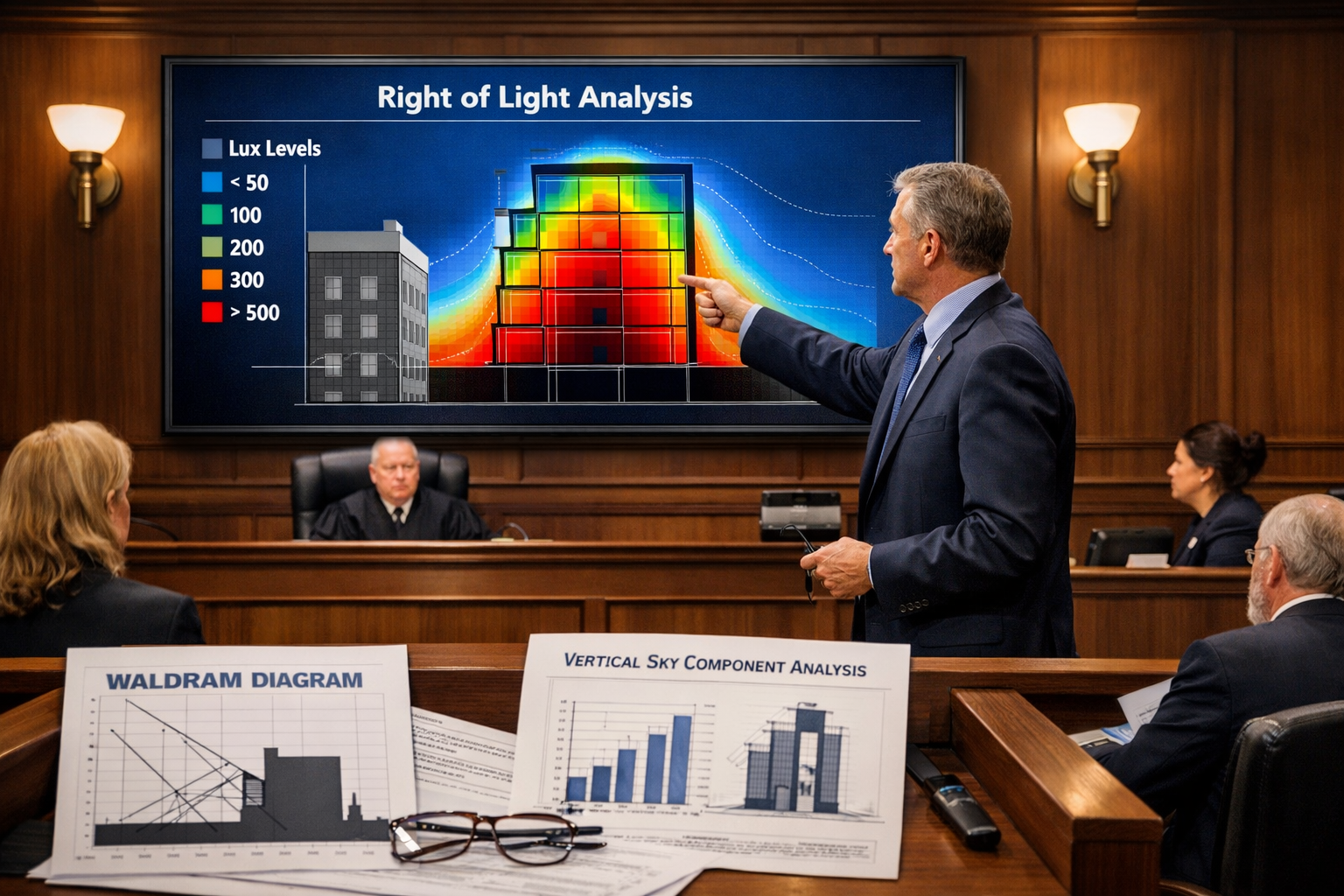
- 🏛️ Expert witnesses in right of light cases must provide photometric analysis using standardized methods like Waldram diagrams and Vertical Sky Component measurements
- 📊 RICS evidence standards require comprehensive documentation linking light obstruction to quantifiable property value impacts
- ⚖️ Courtroom strategies in 2026 increasingly integrate Land Registry data with technical light measurements to establish historical rights
- 📈 Post-reform requirements demand enhanced transparency in methodology and stricter adherence to professional conduct standards
- 💼 Valuation expertise must demonstrate direct correlation between light loss percentages and diminution in property market value
Understanding Right of Light Litigation in 2026
Right of light is an ancient legal principle that protects property owners' access to natural daylight through their windows. This easement can be acquired through 20 years of uninterrupted light access or explicit grant. In 2026's densely packed urban environments, particularly in London and major UK cities, these rights frequently clash with development ambitions.
The Legal Framework
The Prescription Act 1832 remains the foundation of right of light law, but recent reforms have clarified measurement standards and compensation frameworks. Property owners can seek injunctive relief to halt construction or claim damages for light obstruction. Courts now require more rigorous evidence to support claims, making expert witness testimony crucial.
Why Expert Witnesses Are Essential
Unlike standard property surveyors, expert witnesses in right of light cases must provide objective, scientifically defensible evidence that withstands cross-examination. They bridge the gap between technical photometric measurements and legal standards, translating complex data into accessible courtroom presentations.
The role demands expertise in:
- Photometric analysis using specialized equipment
- Property valuation methodologies
- Legal procedures and evidence presentation
- Historical research using Land Registry records
- Technical report writing meeting court standards
Core Responsibilities of Expert Witnesses in Right of Light Cases
Expert witnesses in right of light litigation carry distinct responsibilities that extend beyond standard surveying practice. According to RICS guidance, their primary duty is to the court rather than the instructing party—a principle that fundamentally shapes their approach [1].
Technical Assessment and Measurement
The foundation of expert witness work involves precise photometric measurements to quantify light obstruction. Key methodologies include:
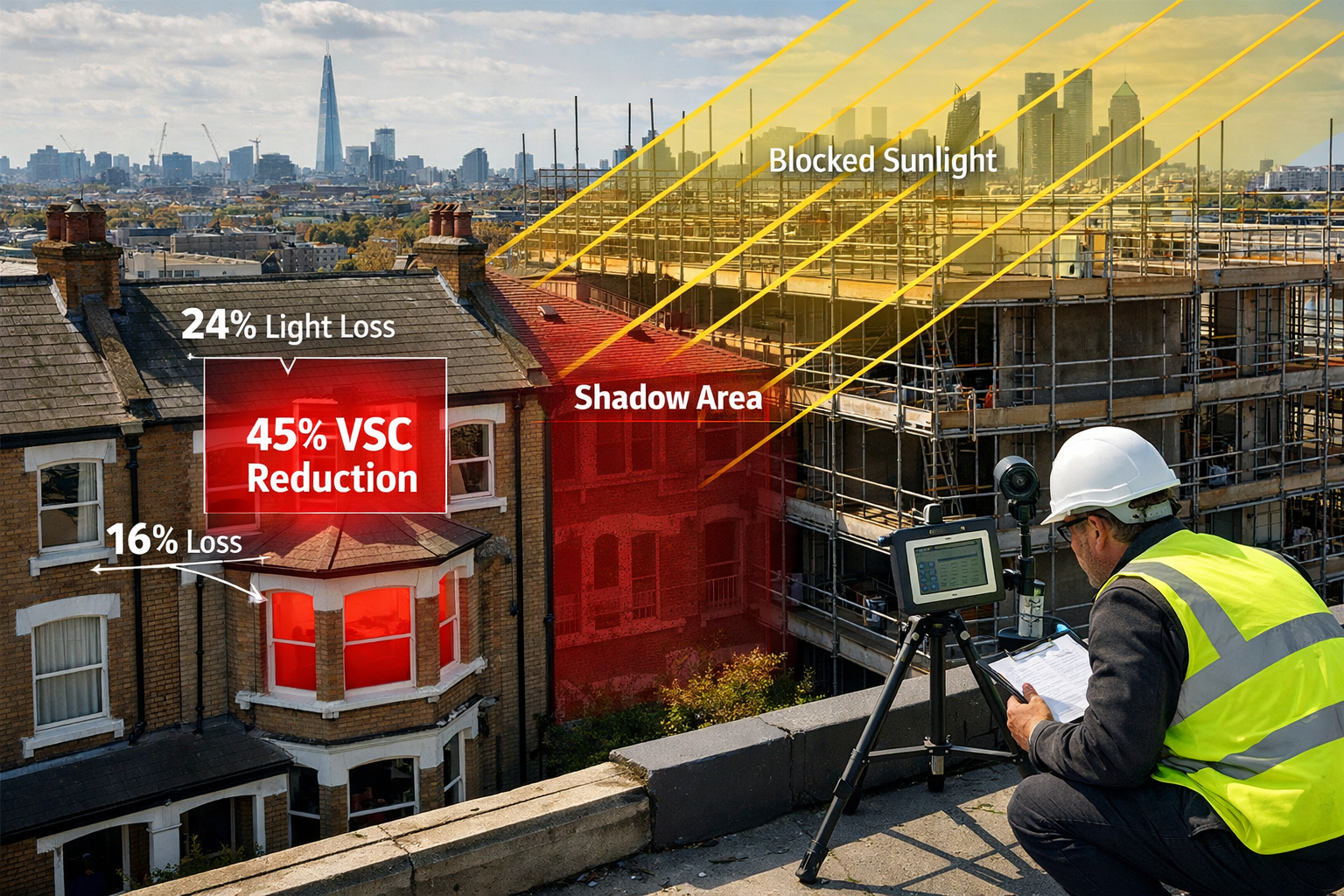
Vertical Sky Component (VSC): Measures the proportion of sky visible from a reference point on the exterior of a window. A reduction below 27% VSC or a loss of more than 20% of the original value typically indicates actionable interference.
Waldram Diagrams: Graphical representations showing the distribution of light across a room's working plane, accounting for window size, room dimensions, and obstructions.
Average Daylight Factor (ADF): Calculates the ratio of internal illuminance to external illuminance, expressed as a percentage.
Expert witnesses must conduct these assessments using calibrated equipment and follow standardized protocols to ensure reproducibility [2].
Valuation Impact Analysis
Beyond measuring light loss, expert witnesses must quantify the financial impact on property value. This requires:
- Comparative market analysis of similar properties with varying light conditions
- Assessment of room functionality changes (e.g., a previously bright living room becoming unsuitable)
- Consideration of psychological impacts on property desirability
- Integration with broader valuation factors affecting property worth
The 2026 reforms have emphasized the need for transparent methodologies linking specific light loss percentages to documented value diminution, typically ranging from 5-15% for significant obstructions.
Historical Rights Documentation
Expert witnesses must establish the legal basis for right of light claims through:
- Land Registry searches confirming property boundaries and easements
- Historical photographs and planning records showing window positions
- Evidence of continuous 20-year light enjoyment periods
- Analysis of previous planning permissions affecting light access
This documentary evidence forms the foundation upon which technical measurements build the case.
RICS Evidence Standards for Expert Witnesses Post-2026 Reforms
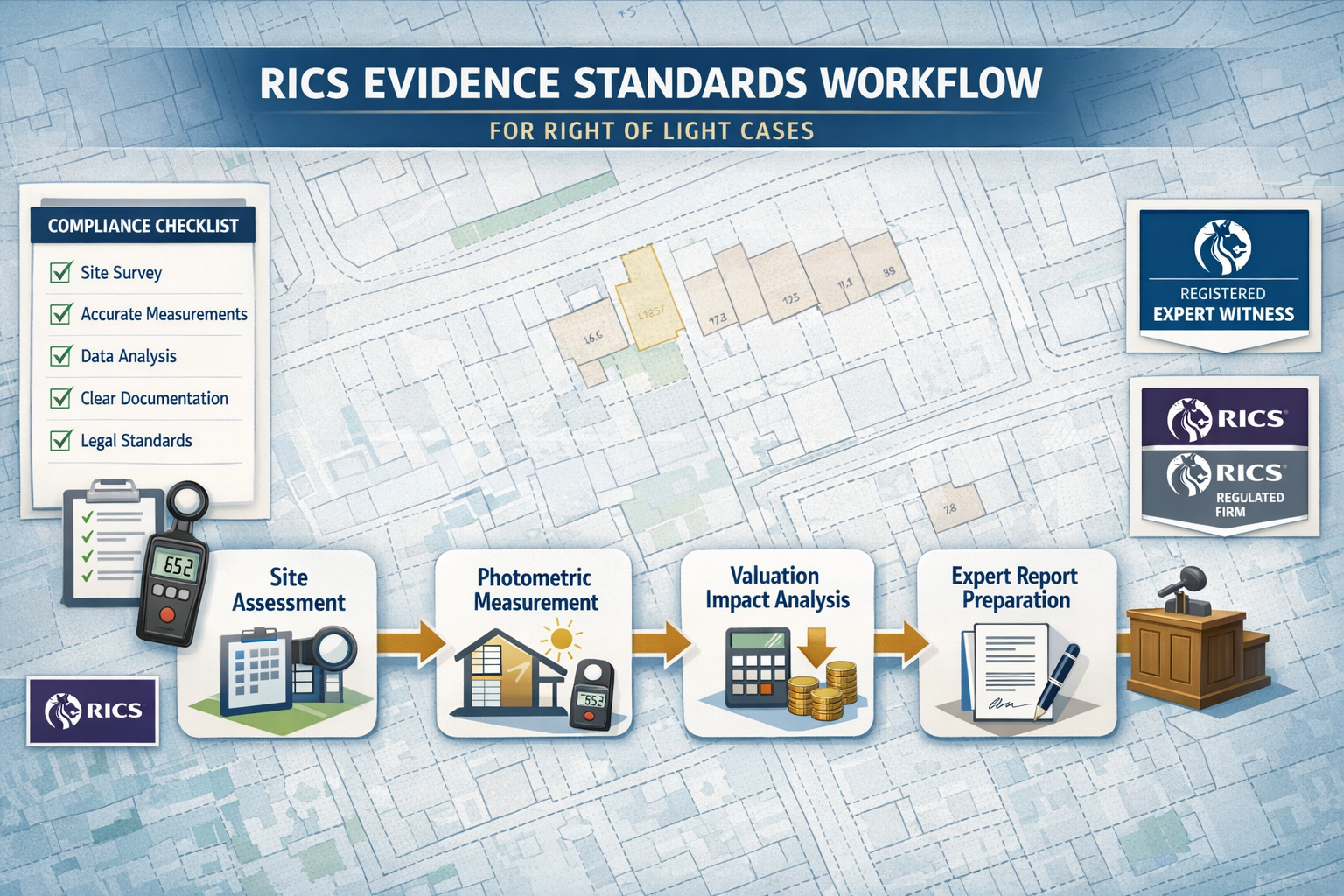
The Royal Institution of Chartered Surveyors has significantly updated its professional standards for expert witnesses, particularly following consultation processes completed in late 2025. These reforms directly impact how chartered surveyors approach Expert Witness Roles in Right of Light Litigation: RICS Evidence Standards Post-2026 Daylight Rights Reforms.
Updated Professional Conduct Requirements
The revised RICS guidance emphasizes several critical principles that expert witnesses must follow [2]:
Overriding Duty to the Court: Expert witnesses must provide independent, unbiased opinions regardless of which party instructs them. This duty supersedes any obligation to the client paying their fees [1].
Transparency in Methodology: All technical assessments must include detailed explanations of:
- Equipment specifications and calibration records
- Measurement protocols followed
- Assumptions made in calculations
- Limitations of the analysis
- Alternative methodologies considered
Competence and Specialization: RICS now requires expert witnesses to demonstrate specific competence in right of light assessment, not merely general surveying qualifications. This has led to increased uptake of specialized training programs [6].
Report Writing Standards
Expert witness reports in 2026 must meet stringent formatting and content requirements:
✅ Executive Summary: Clear statement of instructions, methodology, and conclusions
✅ Qualifications Section: Detailed CV demonstrating relevant experience and training
✅ Site Description: Comprehensive documentation of both affected and obstructing properties
✅ Technical Analysis: Photometric measurements with supporting diagrams and calculations
✅ Valuation Assessment: Evidence-based quantification of financial impacts
✅ Declaration of Truth: Formal statement acknowledging duties to the court
The reforms have introduced standardized templates that many practitioners now use to ensure compliance [3].
Continuing Professional Development
RICS mandates ongoing CPD specifically related to expert witness work. This includes:
- Annual updates on case law developments
- Technical training in new measurement technologies
- Courtroom skills workshops
- Ethics and professional conduct refreshers
The Expert Witness Certificate program has become increasingly popular among surveyors seeking to demonstrate competence in this specialized field [6].
Integration with Land Registry Data
A significant 2026 reform requires expert witnesses to systematically cross-reference their assessments with Land Registry records. This ensures:
- Accurate property boundary identification
- Verification of easement registrations
- Historical ownership and development tracking
- Coordination with planning authority records
This data integration has become a standard expectation in court proceedings, with judges frequently questioning experts about their Land Registry research during testimony.
Courtroom Strategies and Evidence Presentation
The effectiveness of expert witness testimony in right of light litigation depends not only on technical accuracy but also on clear, persuasive presentation. In 2026's increasingly complex cases, successful expert witnesses employ sophisticated courtroom strategies.
Preparing for Cross-Examination
Cross-examination represents the most challenging aspect of expert witness work. Opposing counsel will scrutinize methodology, challenge assumptions, and attempt to undermine credibility. Preparation strategies include:
Anticipating Challenges: Reviewing reports with a critical eye to identify potential weaknesses before they're exposed in court.
Documentation Rigor: Maintaining comprehensive records of all measurements, calculations, and site visits to support testimony [4].
Scenario Modeling: Preparing responses to "what if" questions about alternative measurement approaches or different assumptions.
Consistency Checks: Ensuring all figures, dates, and technical details align across reports, exhibits, and oral testimony.
The RICS guidance emphasizes that expert witnesses should acknowledge limitations in their analysis rather than overstate certainty [1].
Visual Evidence and Technology
Modern right of light cases increasingly rely on sophisticated visual presentations:
3D Modeling: Computer-generated models showing light distribution before and after development, allowing judges to visualize impacts intuitively.
Photographic Evidence: Time-stamped photographs documenting light conditions at different times of day and seasons.
Comparative Overlays: Side-by-side presentations showing existing conditions versus proposed development impacts.
Interactive Demonstrations: Tablet-based presentations allowing real-time manipulation of variables during testimony.
These technological tools must be introduced carefully, with clear explanations of their underlying assumptions and limitations [5].
Addressing Valuation Disputes
Property value impacts often become contentious in right of light cases. Expert witnesses must present compelling evidence linking light loss to diminution in value:
| Light Loss (VSC Reduction) | Typical Value Impact | Supporting Evidence Required |
|---|---|---|
| 10-20% | 2-5% value reduction | Comparable sales analysis |
| 20-30% | 5-10% value reduction | Market research + functionality assessment |
| 30-40% | 10-15% value reduction | Multiple valuation methods + expert consensus |
| 40%+ | 15-20%+ value reduction | Comprehensive market analysis + habitability concerns |
Effective testimony connects specific photometric measurements to documented market reactions, often citing recent comparable transactions where light conditions influenced sale prices.
Professional Conduct Under Pressure
The adversarial nature of litigation can create pressure to advocate for the instructing party's position. RICS standards explicitly prohibit this, requiring expert witnesses to maintain objectivity even when their opinions disadvantage their client [2].
Best practices include:
- Declining unsuitable instructions when conflicts of interest exist
- Correcting errors promptly if discovered after report submission
- Resisting pressure to modify conclusions to support settlement negotiations
- Maintaining independence in all communications with instructing parties
The 2026 reforms have strengthened disciplinary procedures for expert witnesses who violate these principles, including potential removal from RICS expert witness registers [3].
Integration with Related Property Disputes
Right of light litigation rarely exists in isolation. Expert witnesses must understand how these cases intersect with other property law areas:
Party Wall Matters
Development projects triggering right of light disputes often simultaneously involve party wall agreements. Expert witnesses may need to coordinate with party wall surveyors to ensure comprehensive assessment of development impacts.
The Party Wall etc. Act 1996 provides a separate framework for addressing building works, but right of light claims can proceed independently understanding the Party Wall Act.
Dilapidations and Lease Disputes
Commercial property cases may involve right of light issues within broader dilapidations surveys, particularly when lease terms include covenants about maintaining light access or when tenant alterations affect neighboring properties.
Planning and Development Disputes
Expert witness evidence in right of light cases often influences planning decisions. Local authorities increasingly request photometric assessments as part of planning applications for significant developments, creating a preventive role for expert analysis before disputes arise.
Practical Considerations for Property Owners and Developers
Understanding Expert Witness Roles in Right of Light Litigation: RICS Evidence Standards Post-2026 Daylight Rights Reforms benefits both property owners protecting their rights and developers planning projects.
When to Instruct an Expert Witness
Property owners should consider engaging an expert witness when:
- 📍 A neighboring development significantly reduces natural light
- 📍 Informal negotiations with developers have stalled
- 📍 The light loss affects property value or usability
- 📍 Legal action is being contemplated or threatened
- 📍 Pre-action protocols require expert evidence
Early instruction allows experts to document existing conditions before construction commences, strengthening the evidentiary foundation.
Cost Considerations
Expert witness fees in right of light cases typically range from £3,000-£15,000+ depending on:
- Complexity of photometric analysis required
- Number of affected windows and rooms
- Extent of valuation work needed
- Court appearance requirements
- Report preparation and revision cycles
While substantial, these costs must be weighed against potential property value losses or compensation awards, which can reach hundreds of thousands of pounds in significant cases.
Selecting the Right Expert
Not all surveyors possess the specialized knowledge required for right of light litigation. Selection criteria should include:
✓ RICS membership with relevant specialization
✓ Demonstrated experience in right of light cases specifically
✓ Expert witness training and certification [6]
✓ Technical competence in photometric measurement
✓ Valuation expertise relevant to the property type
✓ Court testimony experience and communication skills
✓ Professional indemnity insurance adequate for the case value
Reviewing previous expert reports and seeking recommendations from property litigation solicitors helps identify suitable experts.
Alternative Dispute Resolution
The 2026 reforms encourage resolution of right of light disputes through mediation and expert determination before court proceedings. Expert witnesses play crucial roles in these processes by:
- Providing joint expert reports with opposing party's expert
- Participating in without-prejudice settlement discussions
- Offering expert determination as neutral arbitrators
- Facilitating technical understanding between parties
These approaches can achieve faster, more cost-effective outcomes while maintaining the rigor of expert analysis [5].
Future Developments in Right of Light Litigation
The field of Expert Witness Roles in Right of Light Litigation: RICS Evidence Standards Post-2026 Daylight Rights Reforms continues to evolve. Several trends are shaping future practice:
Technological Advancements
Emerging technologies promise to enhance expert witness capabilities:
AI-Powered Analysis: Machine learning algorithms can now process thousands of comparable transactions to identify light-related value impacts with greater precision.
Drone Photogrammetry: Unmanned aerial vehicles capture comprehensive site data, creating detailed 3D models for light analysis without requiring access to neighboring properties.
Real-Time Monitoring: IoT light sensors can document actual illuminance levels over extended periods, providing empirical data superior to theoretical calculations.
Regulatory Evolution
Further reforms are anticipated as urban density pressures intensify:
- Standardization of compensation calculation methodologies
- Clearer thresholds for actionable light obstruction
- Integration with environmental and sustainability regulations
- Enhanced pre-planning consultation requirements
Expert witnesses must stay current with these developments through ongoing professional development.
Sustainability Considerations
The intersection of right of light law with environmental sustainability creates new complexities. Developments incorporating green technologies or addressing climate change objectives may receive different treatment, requiring expert witnesses to balance competing policy objectives in their assessments.
Conclusion
The role of expert witnesses in right of light litigation has become increasingly sophisticated and essential in 2026's dense urban landscape. Expert Witness Roles in Right of Light Litigation: RICS Evidence Standards Post-2026 Daylight Rights Reforms represent a critical evolution in professional practice, demanding technical excellence, rigorous methodology, and unwavering professional integrity.
Successful expert witnesses combine photometric measurement expertise with valuation skills, historical research capabilities, and effective courtroom communication. The updated RICS standards ensure that evidence presented in these high-stakes disputes meets the highest professional benchmarks, protecting both property rights and development interests through objective, scientifically defensible analysis.
Actionable Next Steps
For Property Owners: If you're concerned about a development affecting your light access, document current conditions through photographs and consider instructing a qualified expert witness early in the process to assess potential impacts and preserve evidence.
For Developers: Conduct photometric assessments during planning stages to identify potential right of light issues before committing to designs. Early expert analysis can prevent costly litigation and project delays.
For Surveyors: If you're interested in this specialized field, pursue the RICS Expert Witness Certificate and seek mentorship from experienced practitioners to develop the unique skill set required for courtroom work.
For Legal Professionals: Engage expert witnesses early in right of light disputes to ensure comprehensive evidence gathering and strengthen negotiating positions before formal proceedings commence.
The intersection of ancient property rights and modern urban development will continue to generate complex disputes requiring expert analysis. By understanding the evolving standards and methodologies that govern expert witness practice in 2026, all parties can navigate these challenges more effectively and achieve fair outcomes that balance competing interests in our increasingly dense urban environments.
References
[1] Ever Changing Role Duties Expert Witness – https://www.rics.org/dispute-resolution-service/drs-information-hub/ever-changing-role-duties-expert-witness
[2] Surveyors Acting As Expert Witnesses – https://www.rics.org/profession-standards/rics-standards-and-guidance/sector-standards/dispute-resolution-standards/surveyors-acting-as-expert-witnesses
[3] New Expert Witness Guidance For Rics Members – https://www.nmrk.com/en-gb/perspectives/new-expert-witness-guidance-for-rics-members
[4] Role Responsibilities Expert Witnesses Built Environment – https://www.rics.org/news-insights/role-responsibilities-expert-witnesses-built-environment
[5] How Expert Witness Surveyors Help Resolve Construction Disputes – https://novusresolve.com/knowledge-base/how-expert-witness-surveyors-help-resolve-construction-disputes
[6] Expert Witness Certificate – https://www.rics.org/training-events/training-courses/expert-witness-certificate
