
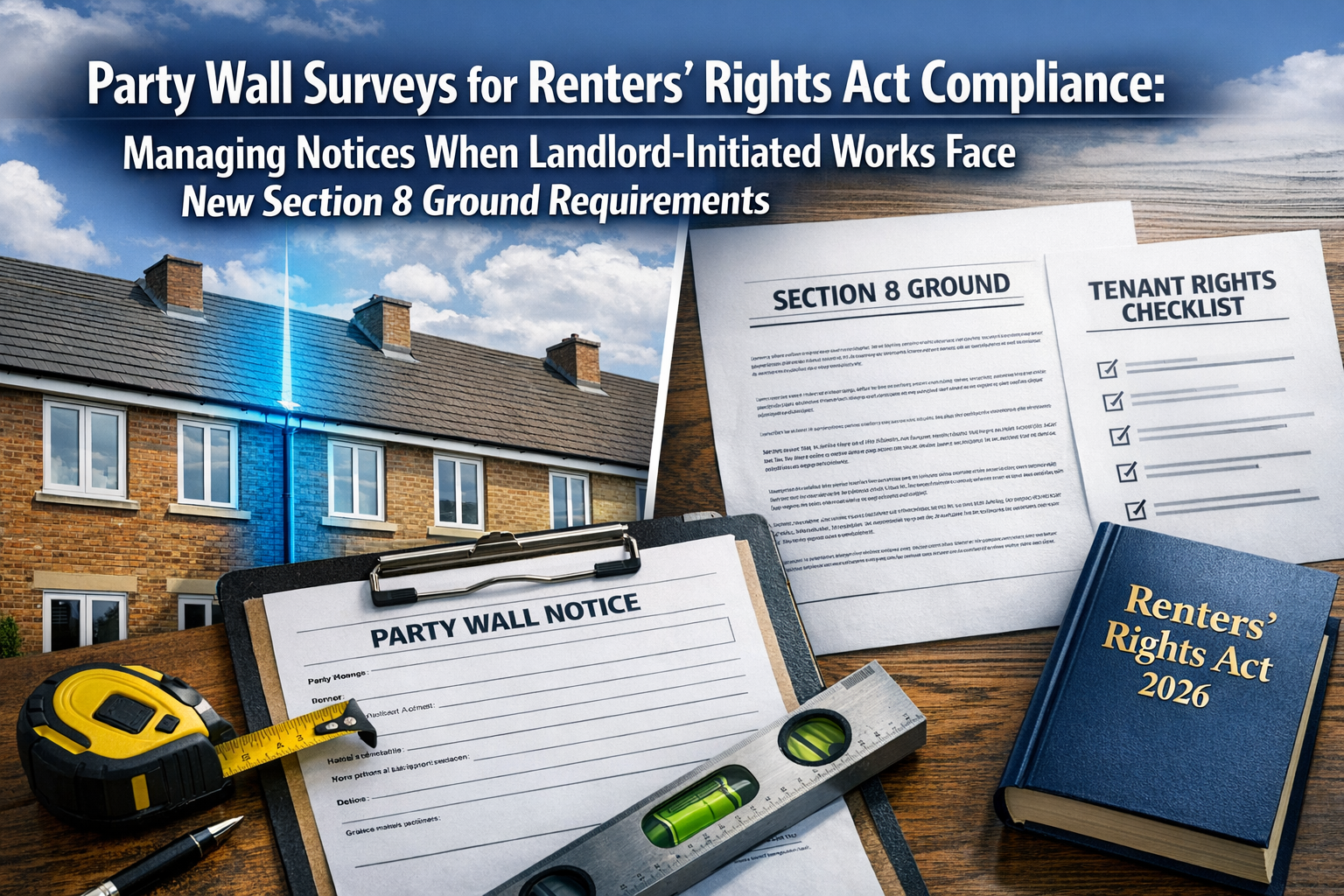
The abolition of Section 21 "no-fault" evictions under the Renters' Rights Act 2026 has fundamentally altered how landlords approach property improvements—particularly when those works trigger party wall procedures. With landlords now required to justify evictions through specific Section 8 grounds, party wall surveys have evolved from purely technical assessments into complex compliance exercises that must balance structural requirements with enhanced tenant protections and the oversight of the new Private Rented Sector Ombudsman.
Party Wall Surveys for Renters' Rights Act Compliance: Managing Notices When Landlord-Initiated Works Face New Section 8 Ground Requirements represents a critical intersection of property law, tenant rights, and construction practice. Surveyors must now navigate not only the technical requirements of the Party Wall etc. Act 1996 but also ensure that landlord-initiated works comply with the new legislative framework that places tenant consent and justification at the center of every notice.
Key Takeaways
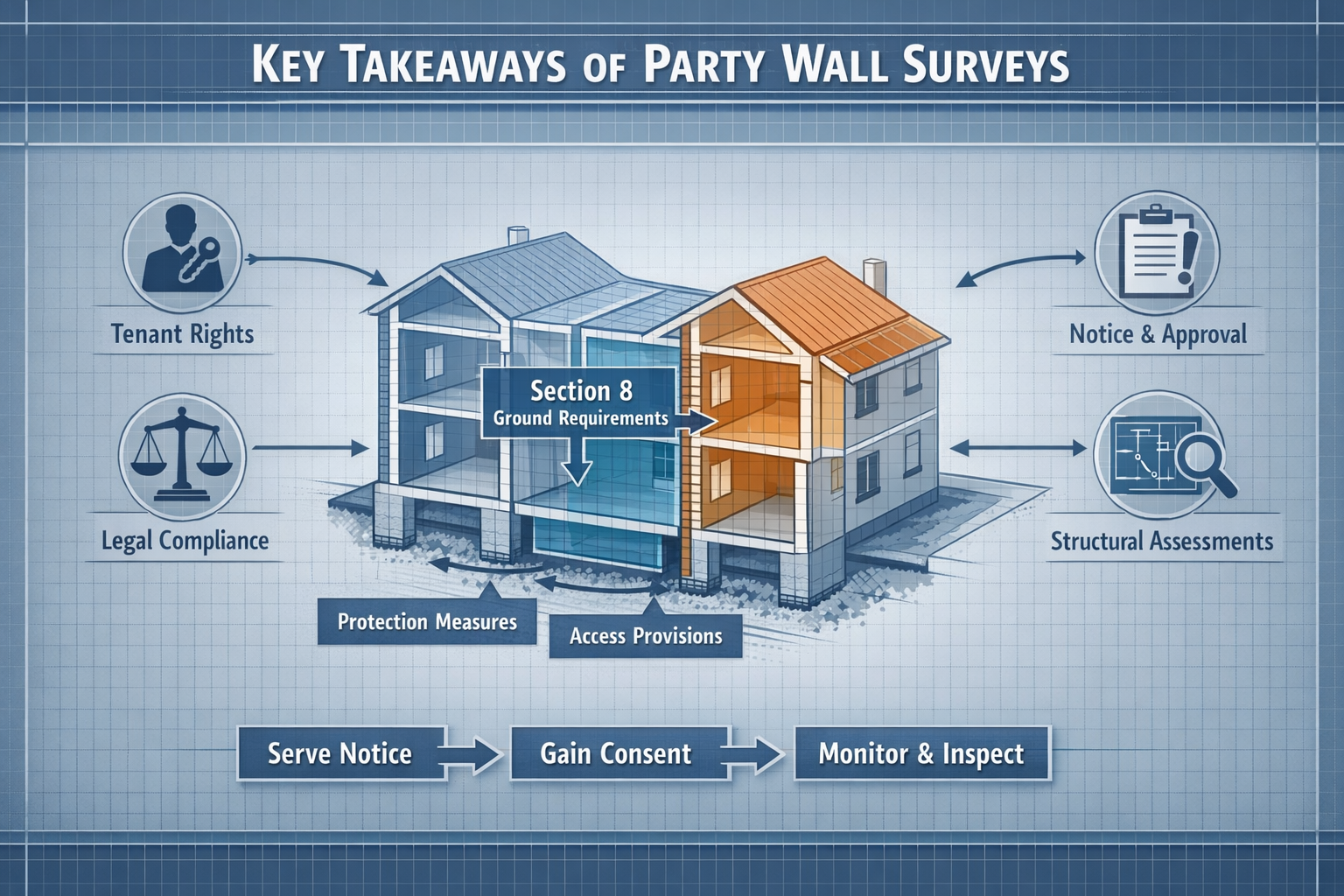
- 🏛️ Section 21 abolition requires landlords to justify party wall works through specific Section 8 grounds, eliminating the ability to use structural improvements as pretexts for tenant removal
- 📋 Enhanced notice procedures demand that party wall surveys include tenant impact assessments, consent documentation, and clear justifications for why works cannot be postponed
- ⚖️ RICS 8th edition guidance (consultation launched April 2026) emphasizes surveyor independence and proper jurisdiction, particularly relevant when tenant disputes arise[2]
- 👥 Private Rented Sector Ombudsman oversight creates new accountability mechanisms for party wall procedures in rental properties
- 📊 Documentation requirements have expanded significantly—surveyors must maintain comprehensive records demonstrating compliance with both party wall legislation and tenant protection frameworks
Understanding the Legislative Shift: How the Renters' Rights Act 2026 Transforms Party Wall Procedures
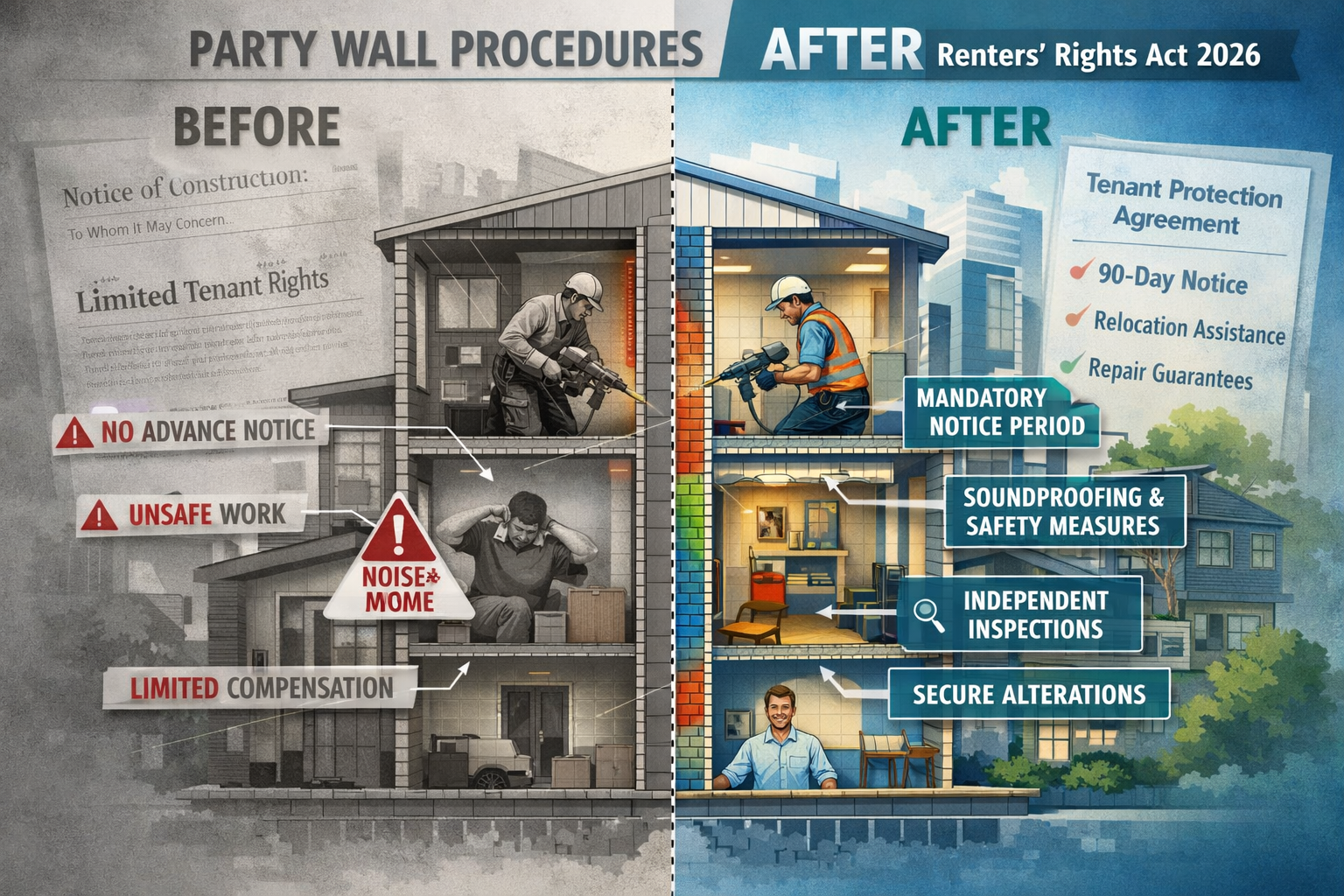
The Renters' Rights Act 2026 has fundamentally recalibrated the relationship between landlords, tenants, and party wall procedures. Previously, landlords could serve Section 21 notices to regain possession without providing reasons—a mechanism sometimes used when tenants objected to disruptive party wall works. This option no longer exists.
The End of Section 21 and Its Impact on Party Wall Works
Under the new framework, landlords must rely exclusively on Section 8 grounds to regain possession. These grounds require specific justifications such as rent arrears, antisocial behavior, or—critically for party wall contexts—the need to carry out substantial works that cannot be completed with the tenant in situ (Ground 6).
This legislative change means that Party Wall Surveys for Renters' Rights Act Compliance: Managing Notices When Landlord-Initiated Works Face New Section 8 Ground Requirements must address several new considerations:
- Justification burden: Landlords must demonstrate why party wall works genuinely necessitate vacant possession
- Alternative arrangements: Evidence that works cannot be phased or scheduled to minimize tenant disruption
- Proportionality assessment: Whether the proposed works justify the significant impact on tenant security
- Ombudsman scrutiny: All decisions are now subject to review by the Private Rented Sector Ombudsman
The 2026 legislative changes have repositioned tenant rights as central to all party wall notices and procedures for institutional buy-to-let expansions and landlord-initiated works[1]. This represents a complete recalibration of notice procedures, placing tenant rights at the center of every notice issued in landlord improvement contexts[3].
Key Section 8 Grounds Relevant to Party Wall Works
When landlord-initiated party wall works affect rental properties, several Section 8 grounds become particularly relevant:
| Ground | Description | Party Wall Relevance |
|---|---|---|
| Ground 6 | Landlord intends to demolish, reconstruct, or carry out substantial works | Most directly applicable to major party wall works requiring vacant possession |
| Ground 1 | Landlord requires property as residence for self or family | May apply if works are part of property reconfiguration for personal use |
| Ground 4 | Suitable alternative accommodation available | Required if Ground 6 is pursued—landlord must offer comparable housing during works |
For surveyors, understanding these grounds is essential because party wall notices must now align with Section 8 justifications. A notice proposing extensive structural works that would render the property uninhabitable must be accompanied by evidence supporting a potential Ground 6 claim if the landlord anticipates needing vacant possession.
Party Wall Surveys for Renters' Rights Act Compliance: Integrating Tenant Rights into Technical Assessments
The technical requirements of understanding the Party Wall etc. Act 1996 remain unchanged, but the procedural framework surrounding those requirements has expanded significantly to accommodate tenant protections.
Enhanced Notice Requirements for Rental Properties
When landlords initiate party wall works in rental properties, surveyors must ensure notices include:
✅ Clear tenant identification: Notices must be served on both the adjoining owner AND any tenants occupying affected properties
✅ Impact assessment: Detailed explanation of how works will affect tenant enjoyment, including noise levels, access restrictions, and duration
✅ Consent documentation: Evidence that the landlord has consulted with tenants and considered their objections or concerns
✅ Alternative scheduling: Demonstration that work timing has been optimized to minimize tenant disruption where possible
✅ Section 8 ground justification: If works may require vacant possession, preliminary documentation supporting the relevant ground
The RICS consultation launched on April 8, 2026, emphasizes surveyor independence and statutory duty, with particular concern about awards being challenged when surveyors lack proper jurisdiction or when no genuine dispute exists between parties[2]. This is especially relevant in rental contexts where tenants may dispute the necessity or timing of works.
The Surveyor's Expanded Role in Tenant Protection
Surveyors appointed under the Party Wall etc. Act 1996 have always operated independently of their appointing party. However, the Renters' Rights Act 2026 has expanded this independence to include specific considerations for tenant welfare:
🔍 Tenant Impact Analysis: Surveyors must assess whether proposed works are proportionate given their impact on tenant security and enjoyment. This goes beyond structural concerns to include habitability assessments.
📅 Scheduling Recommendations: Awards should include recommendations for work phasing that minimizes tenant disruption, even if this extends the overall project timeline.
🛡️ Protection Measures: Detailed specification of dust barriers, noise mitigation, and access provisions that protect tenant living conditions during works.
📝 Documentation Standards: Comprehensive record-keeping that demonstrates compliance with both party wall legislation and tenant protection requirements—essential if disputes reach the Private Rented Sector Ombudsman.
For guidance on when party wall agreements are legally required, surveyors should reference updated RICS guidance that incorporates these new tenant-focused considerations.
Managing Tenant Objections and Disputes
The new legislative framework creates additional complexity when tenants object to party wall works. Previously, landlords could potentially circumvent tenant objections through Section 21 notices. Now, tenant objections carry greater weight and must be addressed through proper dispute resolution channels.
When tenants object to party wall works, surveyors should:
- Document the objection thoroughly: Record specific concerns, whether related to timing, methodology, or necessity of works
- Facilitate communication: Arrange meetings between landlord, tenant, and technical experts to address concerns
- Explore alternatives: Consider modified approaches that address tenant concerns while achieving structural objectives
- Engage the Third Surveyor: If disputes cannot be resolved, the Third Surveyor mechanism provides independent resolution
- Ombudsman awareness: Recognize that unresolved disputes may escalate to the Private Rented Sector Ombudsman
The updated RICS guidance includes enhanced sections on use of the Third Surveyor and service of notices[2], providing clearer frameworks for managing these complex disputes. For comprehensive guidance on resolving party wall disputes, surveyors should reference both traditional dispute resolution mechanisms and the new Ombudsman pathway.
Practical Implementation: Managing Party Wall Notices Under New Section 8 Ground Requirements
Implementing Party Wall Surveys for Renters' Rights Act Compliance: Managing Notices When Landlord-Initiated Works Face New Section 8 Ground Requirements requires systematic approaches that integrate technical assessments with regulatory compliance.
Pre-Notice Phase: Assessment and Planning
Before serving party wall notices in rental properties, landlords and surveyors should complete a comprehensive assessment:
Step 1: Tenant Status Verification 📋
- Confirm current tenancy agreements and tenant rights
- Identify any protected tenancies or special circumstances
- Review tenancy history and any previous disputes
Step 2: Works Necessity Analysis 🔨
- Document structural justification for proposed works
- Assess whether works can be deferred or phased
- Evaluate alternatives that might reduce tenant impact
Step 3: Section 8 Ground Evaluation ⚖️
- Determine if works may require vacant possession
- Prepare preliminary justification for relevant grounds
- Identify alternative accommodation options if needed
Step 4: Consultation Planning 💬
- Schedule pre-notice discussions with tenants
- Prepare clear explanations of works and their necessity
- Document tenant concerns and potential accommodations
This pre-notice phase is critical for avoiding challenges later in the process. The draft 8th edition of RICS guidance clarifies that a party wall surveyor's appointment is personal and statutory, independent of client instruction[2], meaning surveyors must ensure proper groundwork is completed before accepting appointments.
Notice Service and Documentation
When serving party wall notices in rental properties, enhanced documentation standards apply:
Notice Content Requirements:
✅ Standard party wall information: Type of works, location, timing, and technical details as required by the Party Wall etc. Act 1996
✅ Tenant impact statement: Clear explanation of how works will affect tenant enjoyment, including expected noise levels, access restrictions, and duration
✅ Mitigation measures: Proposed steps to minimize disruption, such as restricted working hours, dust control measures, and communication protocols
✅ Consent invitation: Explicit invitation for tenant feedback and concerns, with clear timelines for response
✅ Section 8 ground disclosure: If works may necessitate vacant possession, transparent disclosure of this possibility with preliminary justification
✅ Ombudsman information: Details of the Private Rented Sector Ombudsman and how to escalate concerns if needed
For landlords uncertain about when party wall agreements are needed, the enhanced documentation requirements under the Renters' Rights Act 2026 make professional surveyor involvement even more critical.
Award Preparation with Tenant Protections
Party wall awards in rental contexts must now incorporate specific tenant protection provisions:
🏗️ Work Methodology: Detailed specification of construction methods that minimize noise, dust, and disruption to occupied properties
⏰ Scheduling Provisions: Restricted working hours that respect tenant quiet enjoyment, with flexibility for tenant-requested modifications
🚪 Access Arrangements: Clear protocols for any necessary access to rental properties, respecting tenant privacy rights and providing adequate notice
📊 Monitoring Requirements: Regular inspections and reporting to ensure compliance with tenant protection measures, with copies provided to tenants
💰 Compensation Provisions: Clear frameworks for compensating tenants for any disruption beyond normal party wall works, particularly if habitability is affected
📞 Communication Protocols: Designated contact persons for tenant concerns, with guaranteed response timeframes
The strengthened RICS guidance on regulatory conduct and Third Surveyor procedures[2] provides enhanced frameworks for ensuring awards properly balance structural requirements with tenant protections.
Managing Works Execution with Tenant Oversight
Once works commence, ongoing compliance with tenant protection requirements is essential:
Weekly Communication: Regular updates to tenants on progress, upcoming activities, and any schedule changes
Disruption Monitoring: Active tracking of noise levels, dust control effectiveness, and access impacts, with responsive adjustments as needed
Complaint Resolution: Immediate response mechanisms for tenant concerns, with escalation pathways if issues aren't resolved promptly
Documentation Maintenance: Comprehensive records of all tenant communications, complaints, resolutions, and compliance measures—essential if disputes reach the Ombudsman
Flexibility and Accommodation: Willingness to adjust work schedules or methods if tenant circumstances change (illness, work-from-home requirements, etc.)
For landlords managing party wall insulation projects or other improvement works, maintaining positive tenant relationships throughout the process reduces the risk of disputes and potential Ombudsman involvement.
The Private Rented Sector Ombudsman's Role in Party Wall Disputes
The establishment of the Private Rented Sector Ombudsman creates a new oversight layer for party wall works in rental properties. While the Ombudsman doesn't replace the Party Wall etc. Act 1996's dispute resolution mechanisms, it provides tenants with an additional avenue for addressing concerns about landlord conduct during party wall procedures.
When Tenants Can Escalate to the Ombudsman
Tenants may bring complaints to the Ombudsman regarding:
- Inadequate notice or consultation about party wall works
- Excessive disruption beyond what was disclosed in notices
- Failure to implement promised mitigation measures
- Retaliatory behavior by landlords following tenant objections to works
- Improper use of Section 8 grounds to circumvent tenant rights during party wall procedures
The Ombudsman's involvement doesn't invalidate party wall awards but can result in recommendations for compensation, changes to work practices, or—in serious cases—referrals to local authorities for enforcement action.
Surveyor Responsibilities in the Ombudsman Era
Surveyors must recognize that their awards and recommendations may be scrutinized by the Ombudsman if tenant complaints arise. This creates additional responsibilities:
📝 Transparent Documentation: All decisions, recommendations, and communications must be clearly documented with rationales that demonstrate consideration of tenant welfare
⚖️ Balanced Assessments: Awards must demonstrably balance structural necessities with tenant protections, avoiding any appearance of bias toward landlord interests
🔍 Compliance Verification: Surveyors should verify that landlords have fulfilled consultation and notice requirements before proceeding with awards
📞 Accessibility: Surveyors should be available to explain technical decisions to tenants who may not have construction expertise
For guidance on understanding the party wall process in this new regulatory environment, surveyors should reference updated RICS materials that incorporate Ombudsman considerations.
Cost Implications and Responsibilities Under the New Framework
The enhanced procedural requirements of Party Wall Surveys for Renters' Rights Act Compliance: Managing Notices When Landlord-Initiated Works Face New Section 8 Ground Requirements inevitably affect costs. Understanding who bears these expenses is critical for all parties.
Traditional Party Wall Cost Allocation
Under the Party Wall etc. Act 1996, the building owner (typically the landlord initiating works) bears responsibility for:
- Their own surveyor's fees
- The adjoining owner's surveyor's fees (if a surveyor is appointed)
- The Third Surveyor's fees (if required)
- Costs of preparing and serving notices
- Reasonable costs of the adjoining owner in reviewing and responding to notices
For detailed information on party wall surveyor costs, traditional allocation principles remain unchanged under the Renters' Rights Act 2026.
Additional Costs Under Enhanced Compliance Requirements
The new regulatory framework introduces additional cost considerations:
Tenant Consultation Expenses: Additional time and professional fees for enhanced tenant engagement and documentation
Extended Assessment Periods: More comprehensive pre-notice assessments increase surveyor time and associated costs
Enhanced Monitoring: Ongoing compliance verification and tenant communication protocols add to project management expenses
Dispute Resolution: Potential Ombudsman proceedings or extended Third Surveyor involvement if tenant disputes arise
Mitigation Measures: Additional construction costs for enhanced dust control, noise barriers, or restricted working hours
Landlords should budget for 15-25% higher professional fees compared to traditional party wall procedures when works affect rental properties, reflecting the enhanced compliance requirements. For a comprehensive breakdown of party wall agreement costs, updated 2026 figures should incorporate these additional compliance elements.
Common Pitfalls and How to Avoid Them
Navigating Party Wall Surveys for Renters' Rights Act Compliance: Managing Notices When Landlord-Initiated Works Face New Section 8 Ground Requirements presents several common challenges:
❌ Pitfall 1: Treating Tenants as Secondary Parties
The Problem: Serving notices only on the adjoining owner while treating tenants as mere occupants without independent rights.
The Solution: Recognize that tenants have independent rights under the Renters' Rights Act 2026. Serve comprehensive notices on tenants, engage them in consultation, and document their concerns as carefully as those of property owners.
❌ Pitfall 2: Inadequate Section 8 Ground Preparation
The Problem: Proceeding with party wall works without considering whether Section 8 grounds can be satisfied if vacant possession becomes necessary.
The Solution: Complete Section 8 ground assessments during the pre-notice phase. If works may require vacant possession, prepare justification documentation and identify alternative accommodation options before serving party wall notices.
❌ Pitfall 3: Insufficient Documentation
The Problem: Relying on verbal communications or minimal documentation, creating vulnerability if disputes reach the Ombudsman.
The Solution: Maintain comprehensive written records of all tenant consultations, objections, accommodations, and compliance measures. Treat documentation as essential protection against future challenges.
❌ Pitfall 4: Ignoring Tenant Objections
The Problem: Proceeding with works despite tenant objections, assuming party wall awards override tenant rights.
The Solution: Take tenant objections seriously and explore accommodations. Party wall awards don't eliminate tenant protections under the Renters' Rights Act 2026—both frameworks must be satisfied.
❌ Pitfall 5: Inadequate Surveyor Selection
The Problem: Appointing surveyors unfamiliar with the intersection of party wall law and tenant rights legislation.
The Solution: Engage surveyors with specific expertise in rental property contexts who understand both technical party wall requirements and the Renters' Rights Act 2026 framework. For guidance on finding reliable party wall surveyors, prioritize those with demonstrated experience in rental property contexts.
Future Developments and Ongoing Compliance
The regulatory landscape surrounding party wall procedures in rental properties continues to evolve. Surveyors and landlords should monitor several ongoing developments:
RICS 8th Edition Guidance Finalization
The RICS consultation on the draft 8th edition guidance, launched in April 2026, will likely conclude by mid-2026[2]. The finalized guidance will provide authoritative frameworks for managing party wall procedures under the new legislative environment. Key areas to watch include:
- Enhanced clarity on surveyor duties regarding tenant welfare
- Updated template notices incorporating tenant protection provisions
- Revised award templates with tenant-focused conditions
- Clarified Third Surveyor procedures for tenant-related disputes
Ombudsman Precedent Development
As the Private Rented Sector Ombudsman begins handling cases involving party wall works, precedents will emerge regarding:
- What constitutes adequate tenant consultation
- Acceptable levels of disruption for various work types
- Appropriate compensation for tenant inconvenience
- Standards for landlord communication during works
Surveyors should monitor published Ombudsman decisions to ensure their practices align with emerging standards.
Legislative Refinements
The Renters' Rights Act 2026 may be refined through regulations or amendments as implementation challenges emerge. Areas potentially subject to clarification include:
- Specific timelines for tenant consultation before party wall notices
- Standardized tenant impact assessment frameworks
- Clearer definitions of when Section 8 Ground 6 applies to party wall contexts
- Enhanced guidance on alternative accommodation requirements during works
Staying informed about these developments is essential for maintaining compliance. Professional organizations, RICS updates, and specialist legal guidance provide valuable resources for tracking changes.
Conclusion
Party Wall Surveys for Renters' Rights Act Compliance: Managing Notices When Landlord-Initiated Works Face New Section 8 Ground Requirements represents a fundamental evolution in how party wall procedures must be conducted in rental properties. The abolition of Section 21 evictions has eliminated landlords' ability to circumvent tenant objections to disruptive works, requiring instead that party wall procedures integrate robust tenant protections and clear justifications for any works that may affect tenant security.
Surveyors must now balance traditional technical assessments under the Party Wall etc. Act 1996 with enhanced responsibilities for tenant welfare, comprehensive documentation, and awareness of Private Rented Sector Ombudsman oversight. The RICS 8th edition guidance, currently under consultation, will provide updated frameworks that reflect these expanded responsibilities[2].
For landlords, the new framework demands earlier planning, more comprehensive consultation, and realistic budgeting for enhanced compliance requirements. The inability to rely on Section 21 notices means that party wall works must be justified on their merits and executed with genuine consideration for tenant rights—a shift that ultimately strengthens the rental sector's professionalism and fairness.
Actionable Next Steps
For Landlords Planning Party Wall Works:
- ✅ Engage surveyors with specific expertise in rental property contexts early in planning
- ✅ Complete comprehensive tenant consultations before serving party wall notices
- ✅ Assess Section 8 ground requirements if works may necessitate vacant possession
- ✅ Budget for 15-25% higher professional fees to account for enhanced compliance requirements
- ✅ Establish clear communication protocols with tenants before works commence
For Surveyors:
- ✅ Update appointment procedures to include tenant rights assessments
- ✅ Develop enhanced notice templates incorporating tenant impact statements
- ✅ Implement comprehensive documentation systems for tenant consultations and objections
- ✅ Monitor RICS 8th edition guidance finalization and Ombudsman precedents
- ✅ Consider specialized training on the intersection of party wall law and tenant rights
For Tenants:
- ✅ Review any party wall notices carefully and seek clarification on unclear points
- ✅ Document all concerns about proposed works in writing
- ✅ Engage constructively with landlords and surveyors to explore accommodations
- ✅ Understand your rights to escalate concerns to the Private Rented Sector Ombudsman
- ✅ Seek independent advice if works may significantly affect your tenancy security
The integration of party wall procedures with enhanced tenant protections reflects a broader shift toward more balanced and professional rental sector practices. By embracing these changes and implementing robust compliance frameworks, surveyors and landlords can navigate party wall works successfully while respecting the legitimate rights of all parties involved.
For comprehensive support with party wall procedures in rental properties, professional surveyor guidance ensures technical excellence and regulatory compliance throughout the process.
References
[1] Party Wall Surveys For Institutional Buy To Let Expansions Managing Notices Under 2026 Renters Rights Act Compliance – https://nottinghillsurveyors.com/blog/party-wall-surveys-for-institutional-buy-to-let-expansions-managing-notices-under-2026-renters-rights-act-compliance
[2] Rics Launches Consultation On Updated Party Wall Practice Guidance – https://www.rics.org/news-insights/rics-launches-consultation-on-updated-party-wall-practice-guidance
[3] Party Wall Surveys Under Renters Rights Act 2026 Protocols For Landlord Improvements Without Section 21 Evictions – https://nottinghillsurveyors.com/blog/party-wall-surveys-under-renters-rights-act-2026-protocols-for-landlord-improvements-without-section-21-evictions
