
The abolition of Section 21 no-fault evictions under the Renters' Rights Act 2026 has fundamentally altered how landlords approach property improvements involving party walls. With an estimated 4.4 million rental properties in England requiring structural upgrades to meet new Decent Homes Standards, landlords can no longer use eviction threats to bypass tenant concerns during renovation works [3]. This legislative shift demands a complete recalibration of party wall survey protocols, placing tenant rights at the center of every notice, award, and construction phase.
Party Wall Surveys Under Renters' Rights Act 2026: Protocols for Landlord Improvements Without Section 21 Evictions represent a critical intersection of property law, surveying practice, and tenant protection. Landlords planning extensions, loft conversions, or structural repairs affecting shared walls must now navigate enhanced consultation requirements, extended notice periods, and mandatory tenant impact assessments—all while maintaining compliance with both the Party Wall etc. Act 1996 and the new rental regulations.

Key Takeaways
✅ Section 21 abolition prevents landlords from using no-fault evictions to circumvent tenant objections during party wall works, requiring genuine consultation and accommodation.
✅ Enhanced notice protocols under the 2026 Act mandate detailed tenant impact assessments, alternative accommodation provisions, and extended response periods for rental properties.
✅ Surveyor responsibilities now include verifying landlord compliance with Decent Homes Standards and documenting tenant protection measures within party wall awards.
✅ Dispute resolution has shifted toward mediation-first approaches, with surveyors acting as impartial facilitators between landlords and protected tenants.
✅ Documentation requirements have expanded significantly, with awards needing explicit tenant rights acknowledgments and works scheduling that minimizes disruption.
Understanding Party Wall Surveys Under Renters' Rights Act 2026: The New Legislative Framework
The Renters' Rights Act 2026, which received Royal Assent in January and came into force in April 2026, represents the most significant overhaul of private rental legislation in a generation [1][3]. At its core, the Act abolishes Section 21 "no-fault" evictions, transforming the power dynamic between landlords and tenants during property improvement works.
The Intersection of Party Wall Law and Tenant Protection
The Party Wall etc. Act 1996 remains the governing legislation for works affecting shared structures, boundaries, and excavations near neighboring properties. However, the 2026 reforms introduce critical overlays that surveyors must incorporate into their practice:
🏗️ Mandatory Tenant Consultation Requirements
Before serving party wall notices on rental properties, landlords must now demonstrate that they have:
- Provided tenants with detailed information about proposed works in plain language
- Offered reasonable alternative accommodation if works render the property uninhabitable
- Conducted a tenant impact assessment addressing noise, access disruption, and health considerations
- Documented tenant feedback and incorporated reasonable modifications to work schedules
These requirements go beyond the traditional party wall notice process, which focuses primarily on the adjoining owner's rights [1].
📋 Enhanced Notice Periods for Occupied Rental Properties
While the Party Wall Act specifies minimum notice periods (typically two months for Line of Junction notices and one month for Party Structure notices), the Renters' Rights Act 2026 extends these timelines for occupied rental properties:
| Work Type | Standard Notice | Rental Property Notice |
|---|---|---|
| Party Structure Notice | 1 month | 2 months minimum |
| Line of Junction Notice | 2 months | 3 months minimum |
| Adjacent Excavation Notice | 1 month | 2 months minimum |
This extension allows tenants adequate time to understand the implications, seek advice, and participate meaningfully in the process [3].
For comprehensive background on party wall procedures, review our complete guide to party wall surveys.
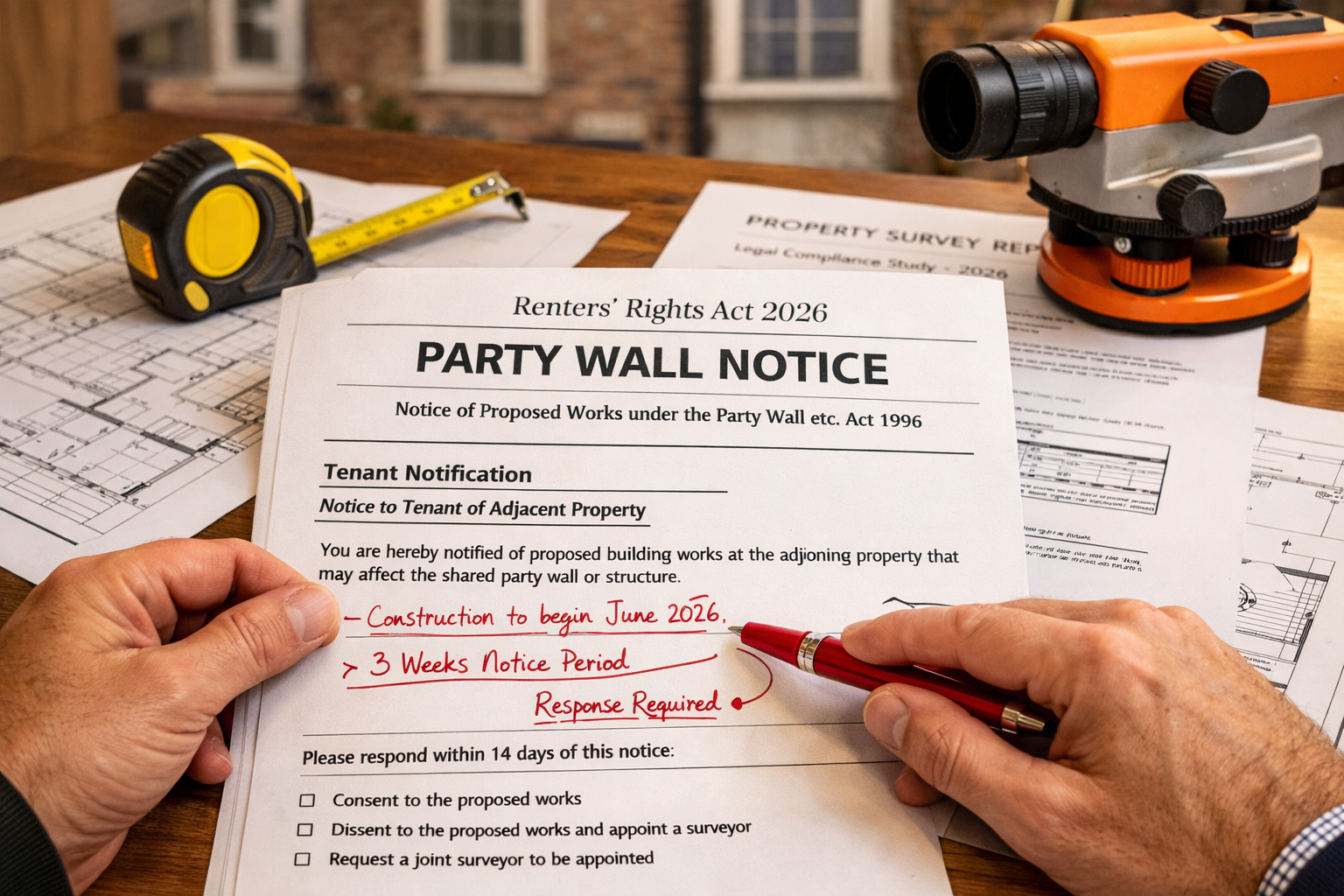
Surveyor Obligations Under the Dual Regulatory Framework
Chartered surveyors appointed under Section 10 of the Party Wall Act now carry expanded responsibilities when rental properties are involved. The Royal Institution of Chartered Surveyors (RICS) has issued updated guidance emphasizing that party wall surveyors must:
- Verify landlord compliance with Decent Homes Standards before approving works that could affect habitability
- Document tenant protection measures explicitly within party wall awards
- Assess alternative accommodation arrangements when works require temporary relocation
- Include dispute resolution pathways that acknowledge tenants' enhanced rights
These obligations reflect the Act's fundamental principle: property improvements cannot come at the expense of tenant security or wellbeing [1][3].
Understanding when a party wall agreement is legally required becomes even more critical in this new regulatory environment.
Protocols for Landlord Improvements Without Section 21 Evictions: Practical Implementation
The removal of Section 21 as a landlord tool fundamentally changes how improvement works are planned and executed. Previously, landlords could serve no-fault eviction notices before major renovations, allowing vacant possession during construction. This option no longer exists, requiring sophisticated project management that respects tenant occupation rights.
Pre-Works Planning and Tenant Engagement
Step 1: Preliminary Tenant Consultation (Minimum 4 Weeks Before Party Wall Notice)
Landlords must initiate dialogue with tenants well before formal party wall procedures begin. This consultation should include:
- Detailed project descriptions with visual aids (drawings, 3D renderings) showing the scope of works
- Timeline projections indicating start dates, daily working hours, and estimated completion
- Disruption assessments covering noise levels, access restrictions, utility interruptions, and dust/debris management
- Health and safety protocols particularly relevant for vulnerable tenants or those with medical conditions
Documentation of this consultation phase is now mandatory evidence that surveyors may request when preparing party wall awards [1].
Step 2: Tenant Impact Assessment
Building surveyors working with landlords must conduct formal impact assessments that evaluate:
- Whether the property remains habitable during works
- Noise exposure levels and compliance with local authority environmental health standards
- Access requirements for construction personnel and equipment
- Temporary facility provisions (kitchen, bathroom access) if primary facilities are affected
- Security measures during construction phases
This assessment directly informs the party wall surveyor's conditions and schedules within the award document.
Step 3: Alternative Accommodation Provisions
When works render a rental property uninhabitable—even temporarily—landlords must provide suitable alternative accommodation at no additional cost to the tenant. The 2026 Act defines "suitable" as:
✓ Comparable location (within reasonable commuting distance of tenant's workplace/school)
✓ Equivalent or better condition and amenities
✓ Similar rent level (landlord absorbs any differential)
✓ Available for the entire disruption period plus reasonable buffer time
Party wall surveyors must verify these arrangements before issuing awards for extensive works [3].
For landlords navigating these requirements, consulting our guide on party wall surveyors' roles and legal requirements provides essential context.
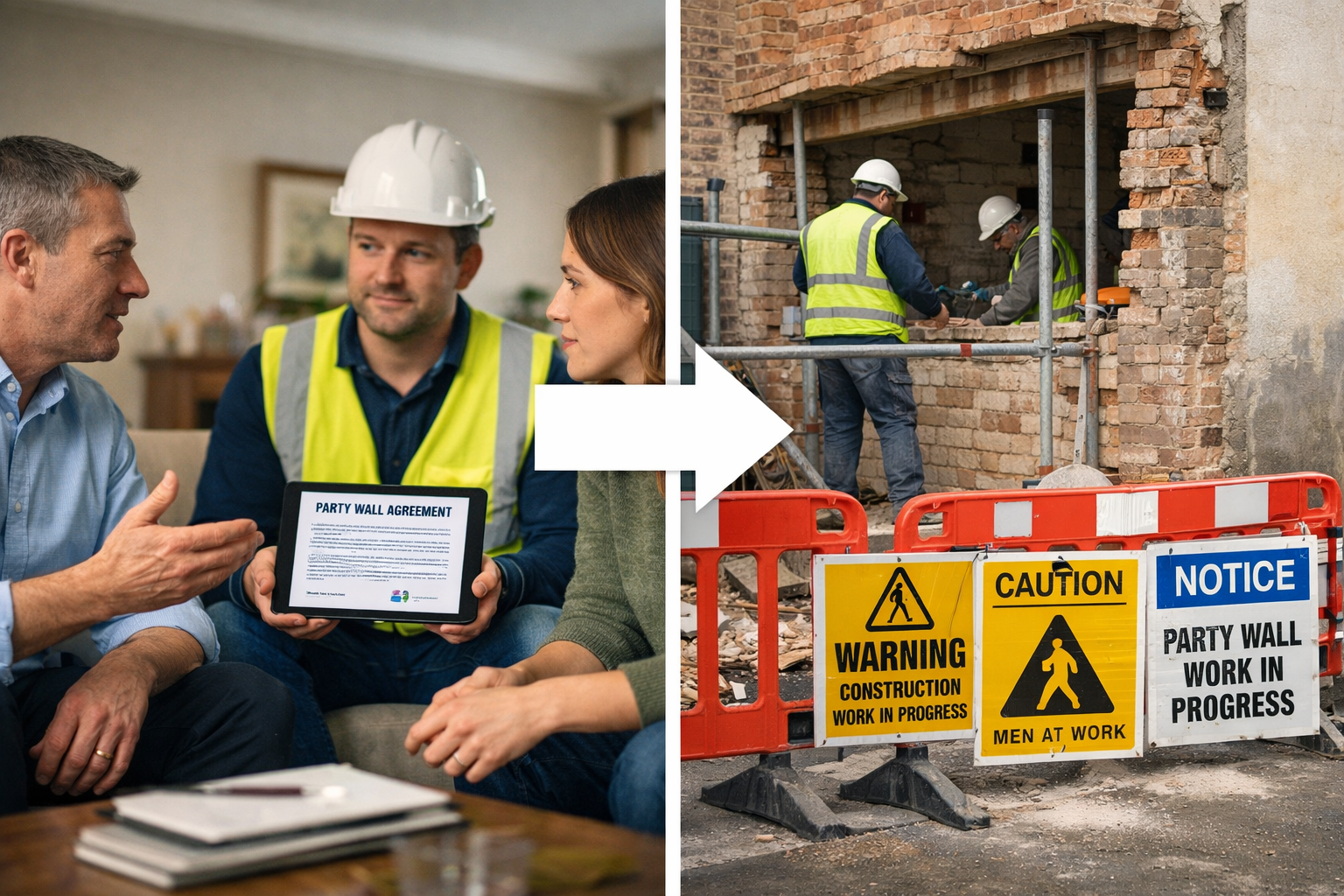
Party Wall Notice Service in Rental Properties
Serving party wall notices on rental properties now requires careful attention to both the building owner's obligations and the tenant's statutory rights.
🔔 Dual Notice Requirements
When the building owner is a landlord conducting works on a rental property, notices must be served on:
- Adjoining owners (as required by the Party Wall Act 1996)
- The tenant in occupation (as required by the Renters' Rights Act 2026)
The notice to the tenant must include additional information beyond standard party wall notices:
- Explicit statement of tenant's right to remain in occupation
- Contact information for independent tenant advice services
- Explanation of the landlord's obligations regarding habitability and alternative accommodation
- Details of how to raise concerns or objections through proper channels
📝 Notice Content Enhancements
Standard party wall notices must be supplemented with tenant-specific information. Our guide on how to write a party wall letter provides templates, but for rental properties, add:
- Disruption Schedule: Day-by-day breakdown of anticipated disturbances
- Tenant Rights Statement: Clear explanation that the notice does not constitute grounds for eviction
- Complaint Procedures: How tenants can report excessive noise, safety concerns, or non-compliance
- Compensation Framework: Rent reduction provisions for periods of significant disruption
Surveyor Appointment and Award Preparation
When disputes arise—or when landlords and tenants agree to appoint a single agreed surveyor—the 2026 protocols introduce new considerations.
Agreed Surveyor Selection in Rental Contexts
While party wall agreements without a surveyor remain possible when all parties consent, rental properties often benefit from professional surveyor involvement due to the complexity of balancing interests.
When appointing an agreed surveyor for works involving rental properties:
- The surveyor must demonstrate impartiality between landlord and tenant interests
- Fees are typically borne by the building owner (landlord) but must not be passed to tenants through rent increases
- The surveyor must have current knowledge of both Party Wall Act procedures and Renters' Rights Act requirements
Award Content Requirements
Party wall awards for rental property improvements must now include specific sections addressing:
-
Tenant Protection Clauses
- Maximum permissible noise levels and working hours
- Required notice periods for any schedule changes
- Protocols for emergency access to tenant accommodation
- Dust suppression and air quality maintenance measures
-
Habitability Certifications
- Surveyor's assessment that works allow continued safe occupation, OR
- Verification of alternative accommodation arrangements meeting statutory standards
-
Dispute Resolution Mechanisms
- Escalation procedures for tenant complaints during works
- Surveyor's role in mediating disputes between landlord and tenant
- Timelines for addressing urgent safety or habitability concerns
-
Compliance Monitoring
- Schedule of surveyor inspections during works
- Tenant reporting channels for non-compliance
- Consequences for breaching award conditions
These enhanced requirements reflect the surveyor's expanded role as guardian of both structural integrity and tenant welfare [1][3].
For complex disputes, understanding party wall dispute resolution procedures becomes essential.
Compliance Challenges and Best Practices for Party Wall Surveys Under Renters' Rights Act 2026
Navigating the intersection of party wall procedures and enhanced tenant protections presents practical challenges for landlords, surveyors, and tenants alike. Understanding common pitfalls and implementing best practices ensures legally compliant, efficient project delivery.
Common Compliance Pitfalls
❌ Inadequate Tenant Communication
The most frequent compliance failure involves treating tenant notification as a formality rather than genuine consultation. Landlords who simply serve statutory notices without meaningful engagement risk:
- Tenant objections that delay projects by months
- Enforcement action from local housing authorities
- Reputational damage affecting future lettings
- Increased surveyor fees due to extended dispute resolution
❌ Insufficient Disruption Planning
Underestimating the impact of works on tenant occupation leads to mid-project crises. Common failures include:
- Failing to provide temporary kitchen facilities during kitchen extension works
- Inadequate noise mitigation during intensive demolition phases
- Poor coordination causing repeated access disruptions
- Insufficient dust control affecting tenant health
❌ Incomplete Documentation
Party wall surveyors increasingly encounter awards challenged due to missing tenant protection documentation. Awards that fail to explicitly address tenant rights may be:
- Subject to legal challenge and potential nullification
- Insufficient to demonstrate compliance with the 2026 Act
- Unable to provide clear guidance when disputes arise during works
Best Practice Protocols
✅ Early Surveyor Engagement
Appointing a party wall surveyor during the project planning phase—before serving notices—allows:
- Preliminary assessment of tenant impact and mitigation requirements
- Identification of potential objections and proactive solutions
- Accurate timeline and cost projections incorporating tenant accommodation measures
- Coordinated notice service that meets both Party Wall Act and Renters' Rights Act requirements
Finding the right professional through our guide to finding a reliable party wall surveyor near you ensures expertise in the updated regulatory framework.
✅ Comprehensive Project Documentation
Maintain detailed records throughout the process:
- Pre-works photography of both properties (building owner's and adjoining owner's)
- Tenant consultation logs documenting all communications, concerns raised, and responses provided
- Condition schedules prepared by the appointed surveyor before works commence
- Daily works logs noting activities, disruptions, and any tenant complaints
- Post-completion inspections verifying no damage to adjoining properties and restoration of tenant amenities
✅ Flexible Scheduling and Phasing
Design work schedules that accommodate tenant occupation:
- Phased approaches that maintain habitable space throughout the project
- Restricted working hours that minimize disruption during evenings and weekends
- Advanced notice protocols giving tenants 48-72 hours warning before particularly disruptive activities
- Buffer periods between phases allowing tenants respite from continuous construction
✅ Transparent Communication Channels
Establish clear, accessible communication pathways:
- Named contact person (often the project manager or surveyor) available to tenants
- Regular updates (weekly minimum) on progress and upcoming activities
- Emergency contact procedures for urgent issues arising outside normal working hours
- Feedback mechanisms allowing tenants to raise concerns without fear of retaliation
Surveyor's Role in Ongoing Compliance Monitoring
Unlike traditional party wall surveys focused primarily on structural issues, the 2026 framework requires active surveyor involvement throughout the construction phase.
Periodic Inspections
Party wall surveyors should conduct:
- Pre-commencement inspection: Verify all notice requirements met and tenant protections in place
- Regular progress inspections: Monthly minimum, or more frequently for intensive works
- Disruption assessments: Evaluate whether actual impacts align with award conditions
- Completion inspection: Confirm works completed as specified and no damage to adjoining properties
Tenant Liaison Functions
Surveyors increasingly serve as neutral intermediaries between landlords and tenants:
- Receiving and investigating tenant complaints about works
- Mediating disputes over noise levels, access, or schedule changes
- Recommending award modifications when circumstances change
- Certifying compliance with tenant protection measures
This expanded role requires surveyors to balance technical expertise with interpersonal skills and thorough knowledge of tenant rights legislation [1][3].
Financial Considerations and Cost Management
The enhanced requirements under the Renters' Rights Act 2026 inevitably increase project costs. Landlords should budget for:
| Cost Category | Traditional Approach | 2026 Enhanced Approach |
|---|---|---|
| Surveyor fees | £700-£1,200 | £1,200-£2,000 |
| Notice period delays | 1-2 months | 2-3 months |
| Tenant accommodation | Often avoided via S21 | £1,500-£4,000/month if required |
| Enhanced mitigation | Basic dust sheets | Professional containment systems |
| Compliance monitoring | Minimal | Regular surveyor inspections |
However, these costs must be weighed against the benefits of maintaining tenancy continuity, avoiding void periods, and ensuring full legal compliance that protects against future challenges [3].
Understanding broader surveying contexts through resources like understanding the Party Wall Act helps landlords appreciate the value of proper procedures.
When Tenants Object: Navigating Disputes Under the New Framework
The abolition of Section 21 gives tenants greater confidence to raise legitimate objections to proposed works. Understanding how to address these objections constructively is crucial.
Legitimate Tenant Concerns
Tenants have valid grounds to object when proposed works:
- Pose health and safety risks (particularly for vulnerable individuals)
- Render the property uninhabitable without adequate alternative accommodation
- Occur during unreasonable hours or extend for excessive periods
- Fail to include appropriate dust, noise, or vibration mitigation
- Lack proper insurance and liability coverage
Resolution Pathways
When tenants raise objections:
- Direct negotiation: Landlord and tenant discuss concerns with surveyor facilitation
- Award modifications: Surveyor adjusts conditions to address legitimate concerns
- Mediation services: Independent mediators help parties reach compromise
- Formal dispute resolution: Party wall surveyor's award provides binding determination
- Appeals process: Either party can appeal to the County Court (though rare)
The key principle: tenant objections must be addressed on their merits, not dismissed or circumvented through eviction threats [1].
Our resource on whether a neighbor can legally refuse a party wall agreement provides relevant context, though tenant protections extend beyond adjoining owner rights.
Technology and Documentation Tools
Modern surveying practice increasingly relies on technology to manage the enhanced documentation requirements:
📱 Digital Communication Platforms
- Dedicated project portals where tenants access updates, documents, and contact forms
- Automated notification systems for schedule changes or upcoming disruptive activities
- Photo and video documentation apps for condition surveys and progress monitoring
- Digital signature systems for consent forms and acknowledgments
📊 Compliance Tracking Software
- Checklist systems ensuring all statutory requirements met before works commence
- Inspection scheduling and reporting tools for surveyors
- Complaint logging and resolution tracking
- Audit trails demonstrating full compliance with both Party Wall Act and Renters' Rights Act
These tools not only improve efficiency but provide robust evidence of compliance if disputes arise or regulatory investigations occur.
Conclusion
Party Wall Surveys Under Renters' Rights Act 2026: Protocols for Landlord Improvements Without Section 21 Evictions represent a fundamental evolution in how property improvements are conducted in the rental sector. The abolition of no-fault evictions has rightfully shifted the balance toward tenant protection, requiring landlords and surveyors to adopt more consultative, transparent, and tenant-centered approaches.
Key principles for success include:
🔑 Early engagement with both tenants and professional surveyors before serving formal notices
🔑 Comprehensive impact assessments that honestly evaluate disruption and plan appropriate mitigation
🔑 Enhanced documentation demonstrating compliance with both party wall and tenant protection requirements
🔑 Flexible project management that accommodates tenant occupation throughout works
🔑 Transparent communication maintaining trust and addressing concerns promptly
For landlords, these requirements may initially seem burdensome. However, they ultimately promote better project outcomes, reduced disputes, maintained tenancy relationships, and full legal compliance that protects long-term property investments.
For tenants, the new framework provides meaningful protections against displacement during necessary property improvements, ensuring that rental security extends even when significant construction works are required.
For surveyors, the expanded role demands updated knowledge, enhanced interpersonal skills, and commitment to balancing multiple stakeholder interests while maintaining professional impartiality.
Next Steps
For Landlords Planning Improvements:
- Consult a qualified party wall surveyor familiar with the 2026 Act requirements at the earliest planning stage
- Initiate tenant consultation well before formal notice periods
- Commission comprehensive tenant impact assessments
- Budget appropriately for enhanced compliance measures
- Establish clear communication protocols before works commence
For Tenants Facing Proposed Works:
- Review all notices and documentation carefully, seeking independent advice if needed
- Raise legitimate concerns promptly and in writing
- Engage constructively with landlords and surveyors
- Document all communications and any disruptions experienced
- Know your rights under both the Party Wall Act and Renters' Rights Act 2026
For Surveyors:
- Update practice procedures to incorporate tenant protection requirements
- Develop template award clauses addressing habitability and tenant welfare
- Establish protocols for ongoing compliance monitoring during works
- Maintain current knowledge of evolving guidance from RICS and housing authorities
- Consider specialized training in tenant rights legislation
The integration of party wall procedures with enhanced tenant protections marks a maturation of the UK rental sector, prioritizing both property improvement and occupant security. By embracing these protocols rather than resisting them, all stakeholders can contribute to a more professional, equitable, and sustainable rental market.
For additional guidance on specific aspects of party wall procedures, explore our comprehensive resources on party wall awards and what to do if no party wall notice was served.
References
[1] Valuation Adjustments For Renters Rights Act 2026 How Building Surveyors Must Assess Landlord Tenant Compliance – https://nottinghillsurveyors.com/blog/valuation-adjustments-for-renters-rights-act-2026-how-building-surveyors-must-assess-landlord-tenant-compliance
[2] 2026 Alta Survey Standards Updates Potential Impacts On Real Estate Transactions – https://www.mondaq.com/unitedstates/real-estate/1766334/2026-alta-survey-standards-updates-potential-impacts-on-real-estate-transactions
[3] Renters Rights Act 2026 Impact On Building Surveys Surveyor Roles In Decent Homes Standard Compliance For Landlords – https://nottinghillsurveyors.com/blog/renters-rights-act-2026-impact-on-building-surveys-surveyor-roles-in-decent-homes-standard-compliance-for-landlords
