
The Renters' Rights Act 2026, effective from 1 May 2026, has triggered the most significant recalibration of UK rental property valuations in a generation. With Section 21 "no-fault" evictions abolished and fixed-term Assured Shorthold Tenancies (ASTs) replaced by periodic agreements, building surveyors now face unprecedented challenges in determining accurate property values. The shift isn't merely legislative—it fundamentally alters investment risk profiles, income assumptions, and comparable evidence reliability. For professionals conducting Valuation Adjustments for Renters' Rights Act 2026: How Building Surveyors Must Assess Landlord-Tenant Compliance, understanding these changes is no longer optional; it's essential to professional competency and client protection.
The Act introduces rent increase restrictions (no increases for 12 months, then only annual adjustments), enhanced tenant protections, and stringent compliance requirements that directly impact property valuations [1]. Building surveyors must now integrate regulatory compliance assessments into every valuation, recognising that non-compliance can trigger penalties up to £7,000 and cause multi-month possession delays [3][6].
Key Takeaways
- 🏛️ Section 21 abolition eliminates landlords' ability to evict without cause, increasing possession risk and reducing property values by an estimated 5-15% in some market segments
- 📊 Periodic tenancy defaults replace fixed-term ASTs, creating valuation uncertainty as historic comparable evidence may no longer provide accurate benchmarks
- ✅ Mandatory compliance documentation (Decent Homes Standards, EPC certificates, Gas Safety records) now directly affects property valuations and investment viability
- ⚖️ RICS competency requirements mandate that surveyors demonstrate specialist knowledge when valuing properties affected by the Act, with particular emphasis on professional judgment
- 📅 31 May 2026 deadline for landlords to provide Information Sheets to tenants, with significant financial penalties for non-compliance affecting property marketability
Understanding the Legislative Framework Behind Valuation Adjustments for Renters' Rights Act 2026
The Renters' Rights Act 2026 represents Parliament's most comprehensive overhaul of private rental sector regulations since the introduction of ASTs in 1988. At its core, the legislation aims to rebalance power dynamics between landlords and tenants by eliminating what campaigners termed "exploitative practices" while maintaining a viable rental market.
Core Provisions Affecting Property Valuations
Abolition of Section 21 Evictions stands as the Act's most consequential provision for property valuations. Previously, landlords could regain possession of their properties with just two months' notice and no stated reason. This mechanism provided landlords with significant control and flexibility, factors that historically supported higher property valuations [3].
Under the new framework, landlords must rely exclusively on statutory grounds for possession, requiring:
- Documented evidence of tenant breach (rent arrears, property damage, antisocial behaviour)
- Watertight compliance with all regulatory requirements (deposit protection, safety certificates, licensing)
- Extended notice periods and potential court proceedings that can stretch for months
- Professional legal representation to navigate complex possession procedures
The transition to periodic tenancies eliminates fixed-term contracts entirely. All new tenancies default to open-ended agreements, with existing fixed-term ASTs converting to periodic arrangements upon expiry. This structural change creates several valuation challenges:
| Aspect | Old AST System | New Periodic System | Valuation Impact |
|---|---|---|---|
| Contract Duration | Fixed 6-12 months | Open-ended | ⚠️ Income certainty reduced |
| Rent Increases | At renewal | Once annually after 12 months | ⚠️ Revenue growth constrained |
| Possession Process | Section 21 (2 months) | Statutory grounds only (3-6+ months) | ⚠️ Risk premium increased |
| Comparable Evidence | Extensive historic data | Limited new data | ⚠️ Valuation uncertainty |
Rent control mechanisms now restrict increases to once per year (after an initial 12-month freeze), with adjustments subject to market value assessments. This provision fundamentally alters revenue projections that underpin investment valuations [1].
Compliance Requirements That Impact Property Values
The Act introduces enhanced due diligence obligations that directly affect property marketability and value. Landlords must demonstrate compliance with:
✅ Decent Homes Standards – Properties must meet minimum quality thresholds for heating, insulation, and repair standards
✅ Deposit Protection Scheme – All deposits must be protected within 30 days with prescribed information provided to tenants
✅ Safety Certification – Current Gas Safety, Electrical Installation Condition Reports (EICRs), and Energy Performance Certificates (EPCs)
✅ Licensing Compliance – Where applicable, properties must hold valid selective or mandatory licensing
✅ Information Sheet Provision – By 31 May 2026, all landlords must provide standardised information to tenants [6]
For building surveyors conducting valuations, these compliance requirements create additional assessment layers. A property that fails to meet Decent Homes Standards or lacks current safety certificates carries both immediate remediation costs and possession risk—factors that must be reflected in valuation adjustments.
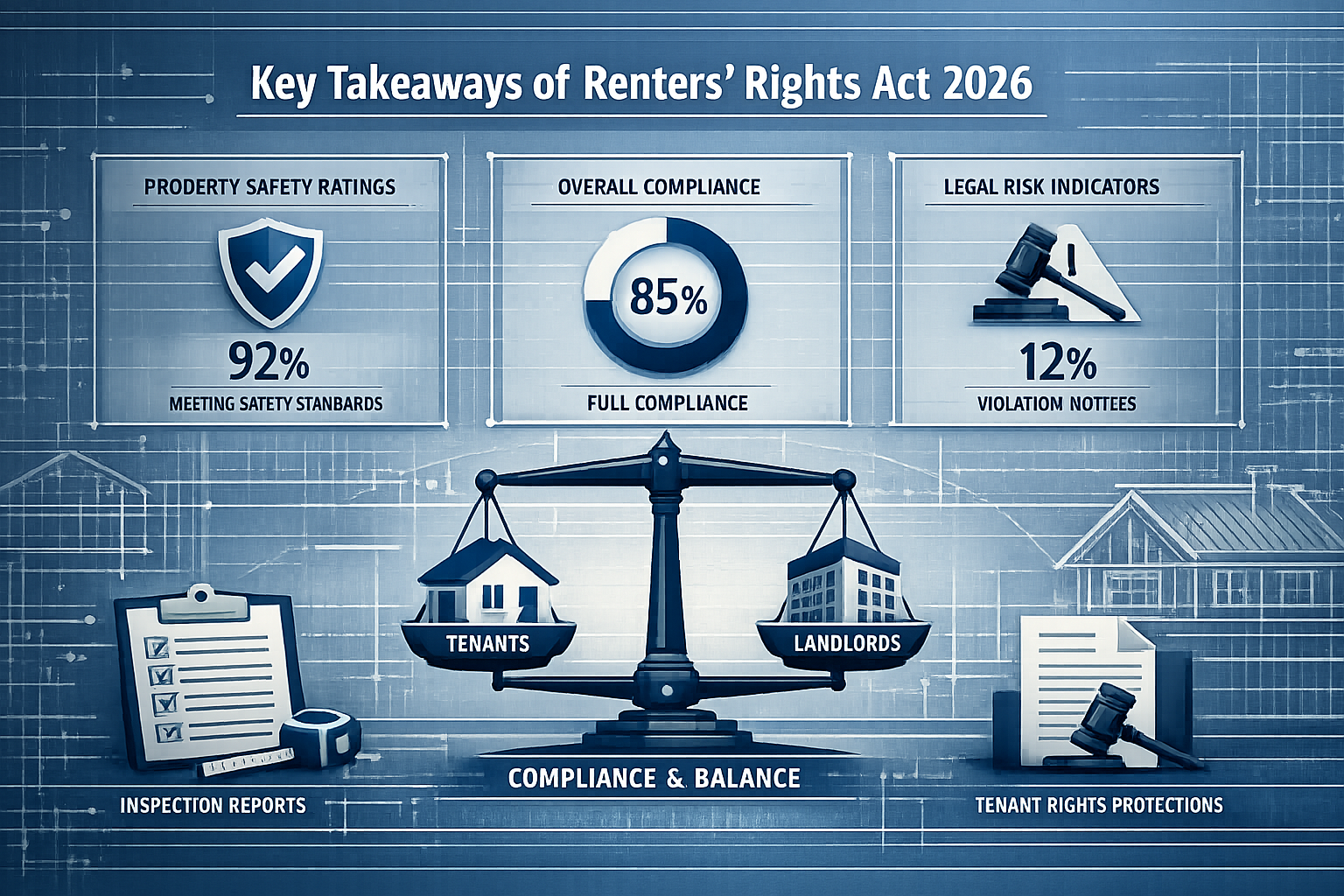
How Building Surveyors Must Assess Landlord-Tenant Compliance in Property Valuations
Professional competency in assessing compliance has shifted from peripheral consideration to core valuation skill. The Royal Institution of Chartered Surveyors (RICS) now emphasises that all members practising as valuers must demonstrate appropriate experience, skill, and judgment when valuing properties affected by the Act [1].
Compliance Assessment Framework for Surveyors
Building surveyors must adopt a systematic approach to evaluating compliance status and its valuation implications. The assessment framework should include:
1. Documentation Verification
Surveyors should request and verify:
- Current Gas Safety Certificate (annual requirement)
- Electrical Installation Condition Report (5-year validity)
- Energy Performance Certificate (10-year validity, minimum Band E from 2025)
- Deposit protection scheme compliance documentation
- Licensing certificates (where applicable)
- Tenancy agreement conforming to Act requirements
- Information Sheet provision evidence (deadline: 31 May 2026)
2. Physical Property Standards Assessment
A comprehensive building survey should evaluate:
- 🏠 Structural integrity – Free from serious disrepair affecting health and safety
- 🔥 Heating systems – Effective heating in all habitable rooms
- 💧 Damp and mould – Absence of significant damp, condensation, or mould growth
- 🪟 Windows and doors – Secure, weatherproof, and in reasonable repair
- ⚡ Electrical safety – Compliant wiring, functioning smoke and carbon monoxide alarms
- 🚰 Kitchen and bathroom facilities – Adequate, modern, and in good working order
Properties failing to meet Decent Homes Standards require immediate remediation, with costs directly impacting valuation adjustments.
3. Possession Risk Analysis
The abolition of Section 21 creates a possession risk premium that must be quantified in valuations. Surveyors should assess:
- Compliance gaps that could prevent successful possession proceedings
- Documentation deficiencies that would delay court processes
- Tenant payment history and potential arrears risk
- Property condition issues that could trigger tenant complaints or rent withholding
"Even minor documentation failures—missing certificates, incorrectly served notices, or compliance errors—can delay possession proceedings by months, making professional property management essential risk mitigation rather than optional service." [3]
Valuation Methodology Adjustments
Traditional valuation approaches require significant modification to account for the Act's provisions. The Royal Institution of Chartered Surveyors highlights that historic comparable evidence may become unreliable as sales data collected under the old AST system may no longer provide accurate comparisons [4].
Investment Method Adjustments
When using the investment method (capitalising rental income), surveyors must:
- Reduce gross yield assumptions by 0.5-1.5% to reflect increased possession risk
- Apply rental growth constraints reflecting the 12-month freeze and annual-only increases
- Incorporate compliance cost provisions for ongoing certification and standards maintenance
- Adjust void period assumptions upward to reflect longer possession timelines
Comparable Method Modifications
When relying on comparable sales evidence:
- Prioritise post-May 2026 transactions where both parties understood Act implications
- Apply adjustment factors to pre-Act comparables (typically 5-15% depending on property type and location)
- Distinguish between compliant and non-compliant properties in comparable selection
- Consider tenant-in-situ versus vacant possession scenarios with greater care
Residual Method Considerations
For development or refurbishment valuations:
- Incorporate Decent Homes Standards costs into development budgets
- Adjust projected rental values for post-Act market conditions
- Extend development timelines to account for compliance certification processes
- Reassess exit strategy assumptions given changed investment landscape
Professional Judgment and Expert Witness Requirements
The complexity of Valuation Adjustments for Renters' Rights Act 2026: How Building Surveyors Must Assess Landlord-Tenant Compliance increasingly requires expert witness testimony to quantify how tenant protections affect investment returns [7]. Building surveyors must be prepared to:
- Defend valuation assumptions regarding compliance impact on property values
- Provide evidence-based analysis of possession risk premiums
- Demonstrate competency in interpreting Act provisions and their valuation implications
- Exercise professional judgment regarding vacant possession assumptions
RICS guidance emphasises that surveyors must exercise particular care when making vacant possession assumptions, as the difficulty of obtaining possession has materially increased under the new legislative framework [1].

Practical Implementation: Integrating Compliance Assessments Into Valuation Practice
The transition from theory to practice requires building surveyors to fundamentally restructure their valuation workflows. The market remains in a period of active recalibration, with lenders monitoring the Act's impact but not yet changing lending criteria significantly [4]. This transitional environment creates both challenges and opportunities for surveyors who can demonstrate competency in compliance assessment.
Establishing a Compliance-Integrated Valuation Workflow
Pre-Instruction Phase
Before accepting a valuation instruction, surveyors should:
- Clarify instruction scope – Confirm whether the valuation requires compliance assessment or assumes compliance
- Identify property type – Residential rental properties require full Act consideration; owner-occupied properties do not
- Determine valuation purpose – Lending, sale, insurance, or litigation valuations have different compliance emphasis
- Assess competency requirements – Ensure appropriate knowledge and experience for Act-related valuations
Inspection Phase Enhancements
During property inspection, surveyors must expand their assessment to include:
📋 Compliance Documentation Review
- Request all safety certificates and licensing documentation
- Verify deposit protection scheme compliance
- Review tenancy agreements for Act conformity
- Confirm Information Sheet provision (post-31 May 2026)
🔍 Enhanced Physical Inspection
- Conduct detailed Level 2 or Level 3 survey depending on property age and condition
- Assess Decent Homes Standards compliance across all criteria
- Identify remediation requirements and estimate costs
- Photograph compliance-related features (heating systems, safety devices, condition issues)
💬 Stakeholder Interviews
- Discuss compliance status with landlords or managing agents
- Understand any ongoing tenant issues or possession considerations
- Clarify planned remediation or upgrade works
- Identify any regulatory enforcement history
Quantifying Valuation Adjustments
The most challenging aspect of Valuation Adjustments for Renters' Rights Act 2026: How Building Surveyors Must Assess Landlord-Tenant Compliance involves quantifying the financial impact of compliance gaps and regulatory changes. While the market continues to establish new norms, surveyors can apply the following framework:
Compliance Deficit Adjustments
| Compliance Issue | Typical Adjustment Range | Rationale |
|---|---|---|
| Missing Gas Safety Certificate | £500-£1,500 | Immediate remediation required; possession proceedings blocked |
| Expired EICR | £300-£800 | Testing and remediation costs; regulatory breach |
| EPC below Band E | £2,000-£15,000+ | Significant upgrade works required; rental prohibition risk |
| Decent Homes Standards failures | £5,000-£50,000+ | Varies by severity; may require extensive refurbishment |
| Deposit protection non-compliance | £1,000-£3,000 | Penalty exposure (1-3x deposit value) |
| Missing Information Sheet | £7,000 | Maximum penalty under Act provisions |
Structural Valuation Adjustments
Beyond specific compliance costs, surveyors must apply broader adjustments reflecting the changed investment landscape:
- Yield compression: 0.5-1.5% reduction in gross yields for fully compliant properties
- Possession risk premium: Additional 2-5% value reduction for properties with tenant-in-situ
- Liquidity discount: 3-7% reduction reflecting reduced investor appetite in transitional market
- Management intensity premium: Ongoing compliance costs of £500-£1,500 annually per property
Regional and Property Type Variations
The impact of the Act varies significantly by location and property characteristics. Building surveyors must consider:
London and South East Markets
Higher property values and competitive rental markets mean:
- Compliance costs represent smaller percentage of property value
- Strong tenant demand maintains rental income stability
- Investor appetite remains relatively robust despite regulatory changes
- Chartered surveyors in London report more modest valuation adjustments (5-10%)
Regional Markets
Lower property values and tighter rental yields create greater sensitivity:
- Compliance costs represent larger percentage impact
- Weaker tenant demand increases void period risk
- Some landlords exiting market, reducing comparable evidence
- Valuation adjustments may reach 10-15% in some locations
Property Type Considerations
- Houses in Multiple Occupation (HMOs): Higher compliance burden; significant licensing requirements; greater valuation impact
- Purpose-built flats: Generally better compliance; lower remediation costs; modest valuation adjustments
- Period properties: Higher risk of Decent Homes Standards failures; significant remediation costs; greater valuation uncertainty
- New-build properties: Typically compliant; minimal immediate remediation; lower adjustment requirements
Documentation and Reporting Best Practices
Professional valuation reports must now include comprehensive compliance commentary. Best practice reporting should incorporate:
Compliance Status Section
- Summary of documentation reviewed and verification status
- Identification of compliance gaps and remediation requirements
- Cost estimates for achieving full compliance
- Timeline considerations for compliance achievement
Valuation Assumptions Disclosure
- Clear statement of compliance assumptions underpinning the valuation
- Explicit disclosure of any unverified compliance matters
- Caveats regarding valuation accuracy if compliance documentation incomplete
- Sensitivity analysis showing valuation range based on compliance scenarios
Professional Limitations Statement
- Clarification that compliance assessment does not constitute legal advice
- Recommendation for specialist legal review where complex issues identified
- Acknowledgment of market uncertainty during transitional period
- Reference to RICS guidance and professional standards applied
For complex cases involving lease extensions or dilapidation assessments, additional specialist input may be required to fully assess compliance implications.
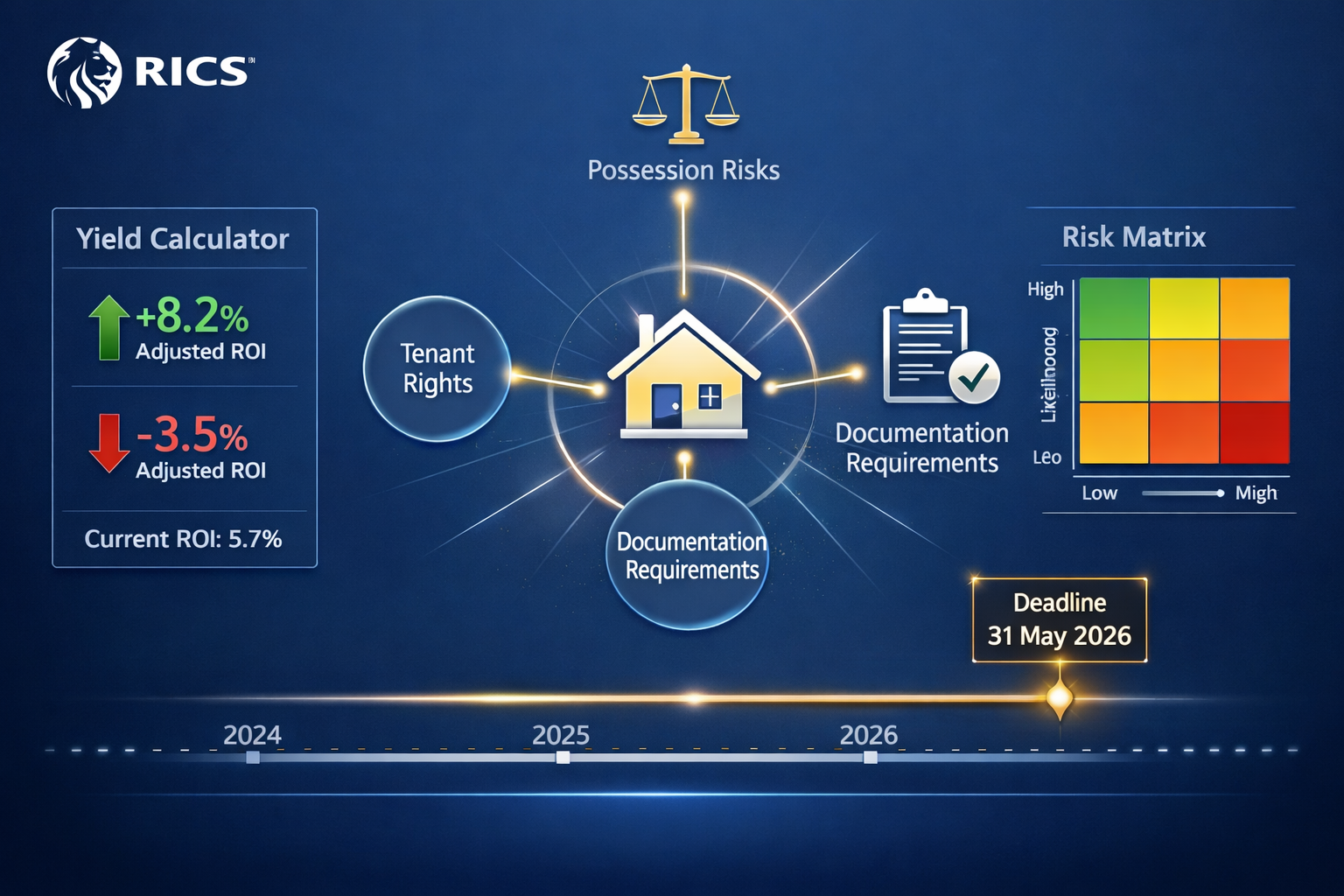
Market Adaptation and Future Outlook for Rental Property Valuations
The UK rental property market is experiencing a fundamental recalibration as stakeholders adapt to the Renters' Rights Act 2026. Lenders, investors, landlords, and professional advisors are all reassessing their approaches, creating a dynamic environment for building surveyors conducting valuations.
Emerging Market Trends
Investor Behaviour Shifts
Early evidence suggests divergent responses from different investor segments:
- Portfolio landlords are professionalising operations, investing in compliance systems, and accepting lower net yields
- Accidental landlords are increasingly exiting the market, unable to justify compliance costs against returns
- Institutional investors are viewing the Act as a competitive advantage, as compliance costs favour scale operations
- Build-to-rent developers are accelerating development, seeing opportunity in reduced private landlord competition
Rental Value Trajectories
The Act's rent control mechanisms create a complex pricing dynamic:
- Initial rent setting becomes more critical, as subsequent increases are constrained
- Market rent assessments will require greater rigour to justify annual increase applications
- Regional variations are emerging, with strong demand areas maintaining growth while weaker markets stagnate
- Quality premium expansion as compliant, well-maintained properties command higher rents
Professional Development Requirements for Surveyors
Building surveyors must invest in continuous professional development to maintain competency in this evolving landscape. Essential knowledge areas include:
🎓 Legislative Understanding
- Detailed knowledge of Renters' Rights Act provisions and implementation timeline
- Familiarity with related regulations (Decent Homes Standards, licensing schemes, safety requirements)
- Understanding of possession grounds and procedural requirements
- Awareness of enforcement mechanisms and penalty structures
📊 Market Intelligence
- Access to post-Act transaction data and rental evidence
- Understanding of regional market variations and investor sentiment
- Knowledge of lender attitudes and lending criteria evolution
- Awareness of emerging case law and regulatory guidance
🔧 Technical Competencies
- Enhanced building pathology knowledge for Decent Homes Standards assessment
- Understanding of energy efficiency requirements and upgrade options
- Familiarity with safety certification requirements and testing procedures
- Capability to estimate remediation costs accurately
⚖️ Professional Standards
- Application of RICS Valuation – Global Standards (Red Book)
- Understanding of professional indemnity implications
- Competency in expert witness procedures where required
- Ethical considerations in compliance reporting
Technology and Data Solutions
Forward-thinking surveying practices are leveraging technology to enhance compliance assessment capabilities:
- Digital inspection tools enabling systematic compliance checklist completion during site visits
- Compliance databases tracking certification expiry dates and renewal requirements
- Valuation software incorporating Act-specific adjustment algorithms and sensitivity analysis
- Market data platforms providing post-Act comparable evidence and yield benchmarks
Collaboration with Related Professionals
Effective Valuation Adjustments for Renters' Rights Act 2026: How Building Surveyors Must Assess Landlord-Tenant Compliance often requires collaboration with:
- Property lawyers for complex possession risk assessment and tenancy agreement review
- Letting agents for market rent evidence and tenant management insights
- Energy assessors for EPC upgrade pathways and cost estimates
- Electrical and gas engineers for safety certification and remediation specifications
- Mortgage brokers for lender attitude intelligence and lending criteria updates
Building surveyors who develop strong professional networks and collaborative working relationships will be best positioned to deliver comprehensive, accurate valuations in this new regulatory environment.
Long-Term Market Equilibrium
While the immediate post-Act period creates uncertainty, market equilibrium will eventually establish new norms. Surveyors should anticipate:
📈 Yield stabilisation as investors recalibrate return expectations and price in compliance costs
📉 Transaction volume recovery once valuation methodologies mature and lender confidence returns
🏗️ Quality improvement across the rental stock as non-compliant properties are upgraded or exit the market
💼 Professionalisation of landlord practices, with amateur operators replaced by professional management
The surveyors who successfully navigate this transition will be those who embrace the complexity, invest in specialist knowledge, and maintain rigorous professional standards while the market adapts.
Conclusion
The Renters' Rights Act 2026 represents a watershed moment for UK rental property valuations, fundamentally altering the risk-return profile of residential investment property. Building surveyors conducting Valuation Adjustments for Renters' Rights Act 2026: How Building Surveyors Must Assess Landlord-Tenant Compliance must master a complex intersection of legislative knowledge, technical assessment capability, and professional judgment.
The abolition of Section 21 evictions, transition to periodic tenancies, and enhanced compliance requirements create material valuation impacts ranging from 5-15% depending on property characteristics, location, and compliance status. Historic comparable evidence may no longer provide reliable guidance, requiring surveyors to exercise heightened professional judgment and develop new valuation methodologies appropriate to the changed regulatory landscape.
Actionable Next Steps for Building Surveyors
✅ Enhance professional knowledge through targeted CPD on Renters' Rights Act provisions and compliance requirements
✅ Develop compliance assessment protocols integrating documentation verification and physical inspection checklists
✅ Establish valuation adjustment frameworks quantifying compliance gaps and regulatory risk premiums
✅ Build professional networks with property lawyers, letting agents, and specialist contractors
✅ Invest in technology solutions enabling systematic compliance tracking and market data analysis
✅ Review professional indemnity coverage ensuring adequate protection for Act-related valuation work
✅ Monitor market developments tracking post-Act transaction data and emerging case law
The surveyors who approach these changes as professional development opportunities rather than regulatory burdens will establish themselves as trusted advisors in a transformed market. By combining technical excellence with specialist compliance knowledge, building surveyors can deliver the accurate, defensible valuations that clients, lenders, and courts increasingly require.
The deadline of 31 May 2026 for Information Sheet provision represents an immediate compliance checkpoint that will affect property marketability and valuations [6]. Building surveyors should proactively verify compliance status in all rental property valuations conducted from now forward, ensuring clients understand both immediate remediation requirements and longer-term regulatory implications.
For property owners, investors, and lenders navigating this new landscape, engaging experienced building surveyors with demonstrated competency in Act-related compliance assessment is no longer optional—it's essential to making informed decisions in a fundamentally changed market.
References
[1] Consideration Of Implications Of Renters Rights Act On Valuation – https://www.rics.org/news-insights/consideration-of-implications-of-renters-rights-act-on-valuation
[3] The Renters Rights Act What Every Landlord Needs To Know In 2026 – https://www.rokmarsh.com/blog/the-renters-rights-act-what-every-landlord-needs-to-know-in-2026
[4] Renters Rights Bill Future Of Valuations – https://www.terracottaproperty.com/blog/renters-rights-bill-future-of-valuations
[6] The Renters Rights Act Information Sheet 2026 What You Need To Know – https://www.mondaq.com/unitedstates/landlord-tenant-leases/1766818/the-renters-rights-act-information-sheet-2026-what-you-need-to-know
[7] Expert Witness Strategies For 2026 Rental Regulation Disputes Navigating Stricter Tenant Protections – https://nottinghillsurveyors.com/blog/expert-witness-strategies-for-2026-rental-regulation-disputes-navigating-stricter-tenant-protections
