
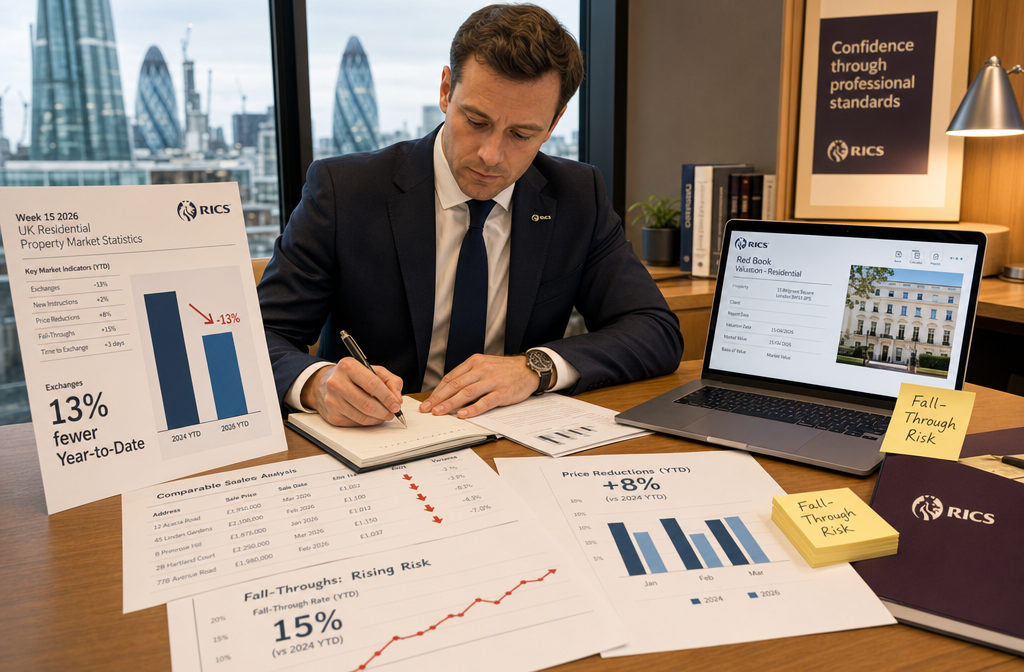
Year-to-date data through April 2026 confirms what many chartered surveyors already suspected: exchange volumes are down 13% compared to the same period in 2025, and net sales lags are widening week by week. For Week 15 specifically, those numbers are not just statistics — they are a direct instruction to revisit how comparables are selected, weighted, and adjusted.
Valuation Adjustments for Week 15 2026 Market Stats: Surveyor Strategies Amid Falling Exchanges and Rising Fall-Through Risks is no longer a niche conversation happening only in RICS CPD sessions. It is the defining challenge of the current market cycle. When fewer transactions complete and fall-through rates climb, every comparable sale carries greater uncertainty — and every valuation report carries greater professional responsibility.
Key Takeaways 📌
- Exchange volumes are 13% lower YTD (April 2026), creating thinner comparable evidence pools for valuers.
- Fall-through rates are rising, meaning agreed sales that never complete are distorting apparent market activity.
- RICS Level 2 and Level 3 surveys play a critical role in identifying the defects that trigger fall-throughs and price renegotiations.
- Downward valuation adjustments are increasingly justified when comparables come from a more active 2025 market.
- Buyer caution protocols — including pre-offer surveys and detailed condition reports — are becoming standard practice in cautious 2026 conditions.
Understanding the Week 15 2026 Market Landscape
What the April 2026 Data Actually Shows
The numbers behind Valuation Adjustments for Week 15 2026 Market Stats: Surveyor Strategies Amid Falling Exchanges and Rising Fall-Through Risks tell a story of a market under structural pressure. Three converging forces are reshaping how valuers must approach their work:
| Market Indicator | 2025 Baseline | Week 15 2026 | Change |
|---|---|---|---|
| Exchange volumes (YTD) | Baseline | -13% | ⬇️ Significant decline |
| Net sales lag (weeks) | ~8 weeks | ~11 weeks | ⬆️ Lengthening |
| Fall-through rate | ~25% | ~31–33% | ⬆️ Rising sharply |
| Agreed-to-completed ratio | Higher | Lower | ⬇️ Deteriorating |
💬 Pull Quote: "When only 67–69% of agreed sales actually complete, the 'sold' price on a portal is not evidence of market value — it is evidence of market aspiration."
This distinction matters enormously for RICS-compliant valuations. A comparable sale that was agreed in late 2025 and completed in early 2026 may reflect buyer confidence levels that no longer exist. Adjusting for this temporal gap is not optional — it is a professional obligation under RICS Red Book Global Standards.
Why Fall-Through Rates Are the Hidden Distortion
Fall-throughs are not evenly distributed. They cluster around:
- Properties with structural or condition issues identified during the survey phase 🏚️
- Transactions where buyers overextended on price and used survey findings to renegotiate
- Chains involving multiple parties, where one weak link collapses the entire sequence
- Properties with ambiguous title or lease issues that surface during conveyancing
For valuers, this clustering effect means that the properties most likely to have completed in the current market are those in the best condition, with the cleanest legal profiles, and at prices that buyers felt confident about even after survey. This creates a survivorship bias in available comparables — the sales that exist in the evidence pool are not a representative sample of the wider market.
Understanding the different valuation types and methodologies available to RICS surveyors is essential context for navigating this kind of distorted evidence environment.
How Surveyors Should Adjust Comparables in a Falling Exchange Market
The Core Problem: Thin Evidence Pools
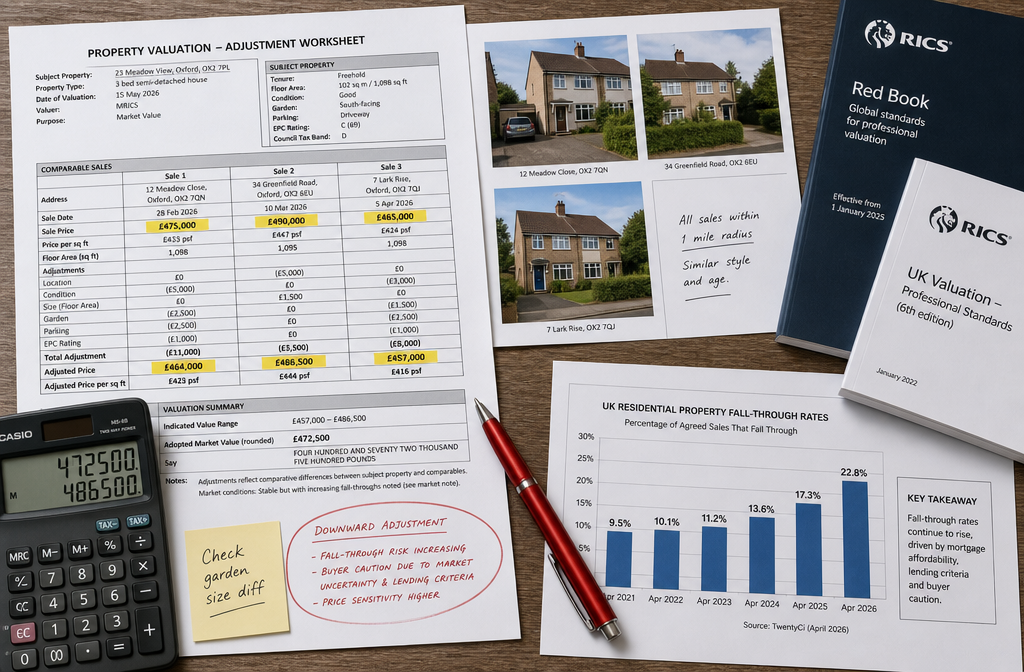
When exchange volumes drop by 13%, the number of truly comparable sales available within a reasonable search radius and time window shrinks dramatically. A valuer who might normally draw on 8–10 strong comparables in a healthy market may find only 3–4 in Week 15 2026 conditions. This forces a choice between:
- Widening the geographic search (and accepting less comparable properties)
- Extending the time window (and accepting older, potentially stale evidence)
- Applying explicit adjustments to explain why older or less comparable evidence has been used
Option 3 is almost always the most defensible approach under RICS guidance. Explicit adjustments, clearly reasoned and documented, are far more robust than silent reliance on questionable comparables.
Applying Temporal Adjustments
When using comparables from late 2025 — a period of higher exchange volumes and arguably stronger buyer sentiment — surveyors should consider applying a negative temporal adjustment. The rationale is straightforward:
- Market conditions have deteriorated since those sales agreed
- Buyer pool is smaller and more cautious
- Lenders are applying more conservative mortgage criteria
- The risk premium for illiquidity has increased
The size of this adjustment will depend on property type, location, and price band. However, in the context of Week 15 2026 market stats, adjustments in the range of 1.5% to 3.5% from late-2025 comparables are broadly supportable in many UK regional markets, particularly for properties above £500,000 where buyer pools are thinner.
💬 Pull Quote: "A comparable is only as good as the market conditions that produced it. Using 2025 evidence in a 2026 market without adjustment is not neutral — it is optimistic."
Condition Adjustments and the Survey Connection
One of the most important — and often underused — adjustment categories is physical condition. In a market where fall-throughs are rising, condition has become a primary driver of whether a sale actually completes. Properties with known defects are not just harder to sell; they are actively being used as renegotiation leverage.
This is where the RICS Level 3 building survey becomes a valuation tool, not just a buyer protection tool. A Level 3 survey that identifies:
- Structural movement 🧱
- Roof covering deterioration
- Damp ingress or drainage issues
- Outdated electrical or heating systems
…provides the quantified basis for a downward condition adjustment that is both defensible and transparent. Surveyors who understand what a Level 3 home survey covers are better positioned to translate physical findings into credible valuation adjustments.
A Practical Adjustment Framework for Week 15 2026
Here is a structured approach to comparable adjustment in current conditions:
Step 1 — Screen for survivorship bias
Ask whether each comparable is likely to represent the full market or only the "easy" transactions that completed despite market headwinds.
Step 2 — Apply temporal adjustment
For comparables agreed before October 2025, consider a negative adjustment reflecting deteriorating sentiment.
Step 3 — Apply condition weighting
Weight comparables in similar physical condition more heavily. Discount comparables where condition data is unavailable.
Step 4 — Document the fall-through risk premium
In your valuation narrative, explicitly acknowledge that the subject property's marketability is constrained by current fall-through rates. This is not pessimism — it is accuracy.
Step 5 — Cross-reference with asking price evidence
In thin markets, current asking prices (not just completed sales) provide useful directional evidence, provided they are used carefully and not treated as equivalent to transaction evidence.
Understanding the key valuation factors that influence RICS assessments provides a strong foundation for applying this framework consistently.
Buyer Caution Protocols and the Role of Level 2/3 Surveys
Why Buyers Need More Protection in 2026
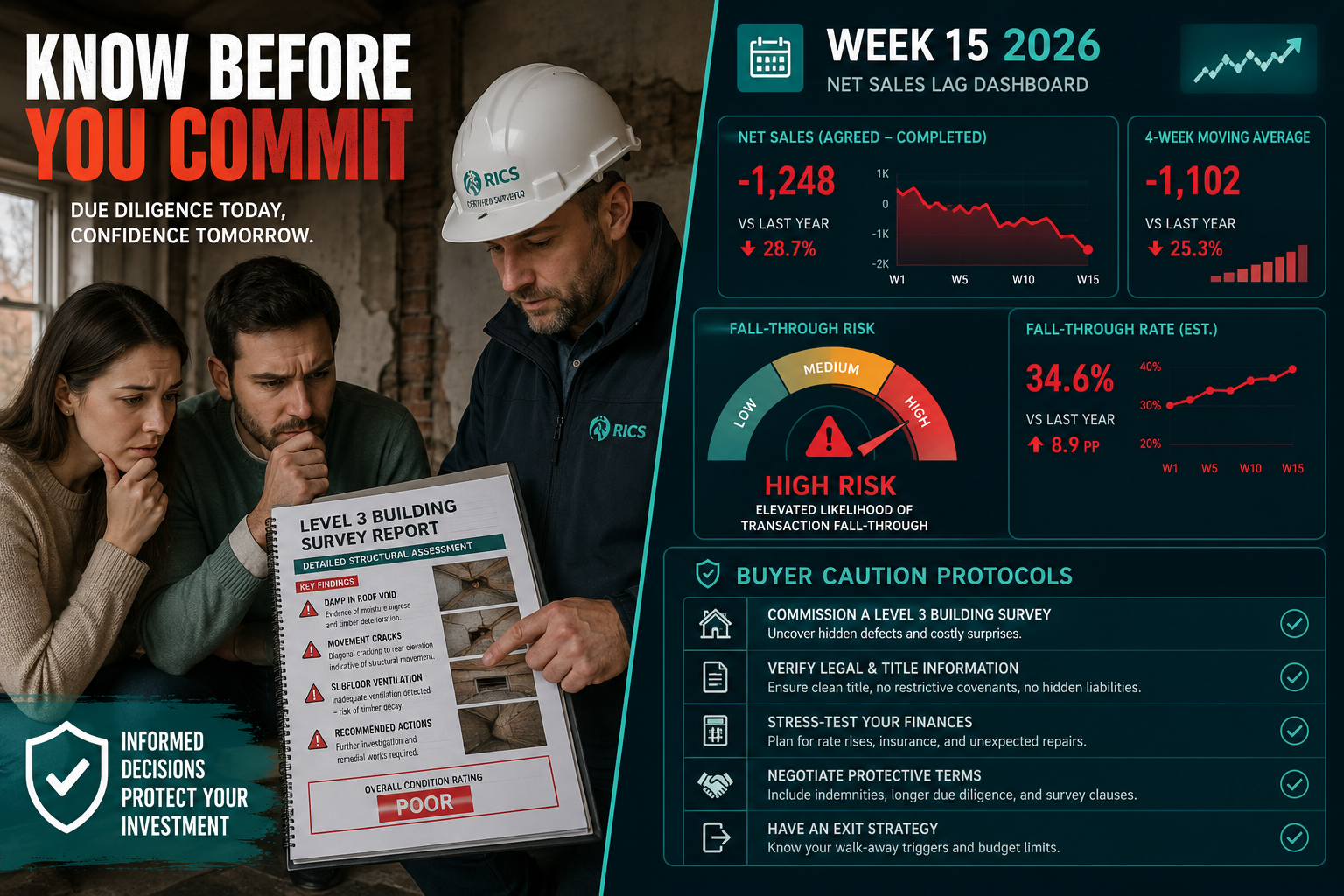
Rising fall-through rates are not just a problem for sellers and estate agents. They represent a significant financial risk for buyers who have already committed to legal fees, survey costs, and mortgage arrangement fees — only to see the transaction collapse. In a market where 1 in 3 agreed sales may not complete, buyers need better information earlier.
The most effective single intervention is commissioning a survey before or immediately after offer acceptance, rather than waiting for the mortgage valuation to flag issues. This approach:
- ✅ Identifies deal-breaking defects before significant costs accumulate
- ✅ Provides a basis for price renegotiation rather than withdrawal
- ✅ Reduces the emotional and financial cost of late-stage fall-throughs
- ✅ Gives buyers a clearer picture of ongoing maintenance costs
The ultimate house survey checklist is a practical starting point for buyers trying to understand what a thorough inspection should cover.
Choosing the Right Survey Level in a Cautious Market
In Week 15 2026 conditions, the default choice of a Level 2 HomeBuyer Report is increasingly insufficient for many property types. The difference between Level 2 and Level 3 surveys matters enormously when:
- The property is over 15–20 years old
- There is any visible evidence of movement, damp, or roof wear
- The property has been extended or significantly altered
- The buyer is purchasing with a smaller deposit and cannot absorb unexpected repair costs
A Level 3 building survey provides the depth of investigation that allows buyers to make genuinely informed decisions — and gives valuers the condition data they need to support defensible adjustments.
When to upgrade to a Level 3 survey in 2026: 🔍
| Property Type | Recommended Survey Level |
|---|---|
| New build (under 10 years) | Level 2 or snagging survey |
| Standard post-war semi/terrace | Level 2 minimum |
| Pre-1950s property | Level 3 strongly recommended |
| Any property with visible defects | Level 3 essential |
| Listed building or unusual construction | Level 3 + specialist reports |
| Property over £600,000 | Level 3 for due diligence |
The Surveyor's Role in Managing Fall-Through Risk
Valuation Adjustments for Week 15 2026 Market Stats: Surveyor Strategies Amid Falling Exchanges and Rising Fall-Through Risks ultimately comes down to the surveyor's professional judgment in translating market conditions into actionable guidance. That means:
- Being explicit about market conditions in valuation narratives, not just citing comparables
- Flagging fall-through risk as a material factor where property condition or market liquidity warrants it
- Recommending specialist investigations proactively rather than waiting for buyers to ask
- Advising on structural survey considerations where movement or subsidence is suspected
Surveyors working in London and the South East — areas where the 13% exchange volume decline is most acutely felt in absolute terms — should pay particular attention to the interaction between price sensitivity and condition. A property that might have sold at asking price in 2025 with a Level 2 survey may now require a Level 3 survey, a price adjustment, and a longer marketing period to achieve a successful exchange.
For buyers and sellers in specific areas, working with chartered surveyors in South West London who understand local micro-market dynamics can make a significant difference to outcomes in the current environment.
Valuation Types That Matter Most Right Now
In a market characterised by falling exchanges and rising fall-through risk, certain valuation types are seeing increased demand:
- Red Book valuations — for mortgage and lending purposes, where lenders are applying greater scrutiny
- Capital gains tax valuations — as more transactions are restructured or delayed into the new tax year
- Matrimonial valuations — where relationship breakdowns are accelerating property sales in a difficult market
Each of these requires the same rigorous approach to comparable adjustment and market condition analysis described above.
Practical Checklist: Surveyor Strategies for Week 15 2026 Conditions
Before finalising any valuation or survey report in the current market, work through this checklist:
- Have all comparables been screened for survivorship bias and temporal relevance?
- Has a temporal adjustment been applied to pre-October 2025 comparables?
- Is the fall-through rate explicitly acknowledged in the valuation narrative?
- Has physical condition been assessed and weighted appropriately?
- Has the appropriate survey level been recommended or commissioned?
- Are specialist investigations recommended where condition evidence is ambiguous?
- Is the marketability assessment realistic given current exchange volumes?
- Has the client been advised on buyer caution protocols relevant to their transaction?
Conclusion: Precision Over Optimism in a Challenging Market
The Week 15 2026 data is unambiguous. Fewer exchanges, longer sales lags, and rising fall-through rates are not temporary noise — they represent a structural shift in market conditions that demands a corresponding shift in how valuations are prepared and presented.
Actionable next steps for surveyors and buyers in 2026:
- Audit your comparable selection methodology against the temporal and condition adjustment framework outlined above.
- Default to Level 3 surveys for any property where condition uncertainty could drive a fall-through.
- Build fall-through risk language into valuation narratives as standard practice, not an exception.
- Engage with local market data at the micro-level — national averages mask significant regional variation in how the 13% exchange decline is distributed.
- Communicate proactively with clients about realistic timescales and the factors that increase or reduce fall-through risk for their specific transaction.
The surveyors who navigate 2026 most successfully will be those who treat market statistics not as background context, but as active inputs into every valuation decision they make. In a market this cautious, precision is not just a professional virtue — it is a commercial differentiator.
For expert guidance on valuations, surveys, and buyer protection strategies tailored to current market conditions, contact the Notting Hill Surveyors team to discuss your specific requirements.
