
Last updated: May 21, 2026
Quick Answer: The Commonhold and Leasehold Reform Bill — confirmed in the King's Speech on 13 May 2026 — proposes the most significant shake-up to English flat ownership in decades. For owners and buyers of prime leasehold flats in Notting Hill and central west London, the proposals could reduce lease extension costs, cap ground rents, and gradually shift the tenure landscape toward commonhold. Against a backdrop of softer prime London values (broadly down around 2.4%), understanding how leasehold commonhold reform 2026 prime London flat valuations interact is now a practical necessity before buying or selling. Note: all timelines and proposals discussed here are subject to parliamentary passage and may change before enactment.
Table of Contents
- What Exactly Does Leasehold Reform Mean for London Flat Owners?
- Key Differences Between the Current and Proposed Leasehold Systems
- How Do the 2026 Reforms Impact Prime Central London Property Valuations?
- Who Benefits Most from the New Leasehold Commonhold Rules?
- Will Lease Extension Costs Drop — and By How Much?
- Am I Eligible for a Lease Extension Under the New Regulations?
- Which Types of London Flats Are Most Affected?
- How Do International Property Investors View These Reforms?
- Mistakes to Avoid When Acting During the Reform Window
- The Role of a RICS Valuation and Building Survey Before You Buy
- FAQ
- References
What Exactly Does Leasehold Reform Mean for London Flat Owners? {#what-it-means}
The proposed reforms would replace the current leasehold system — where flat owners pay ground rent to a freeholder and hold a time-limited interest — with commonhold as the default tenure for new flats. For existing leaseholders, the changes propose capping ground rents, abolishing forfeiture, and making it easier to convert buildings to commonhold.
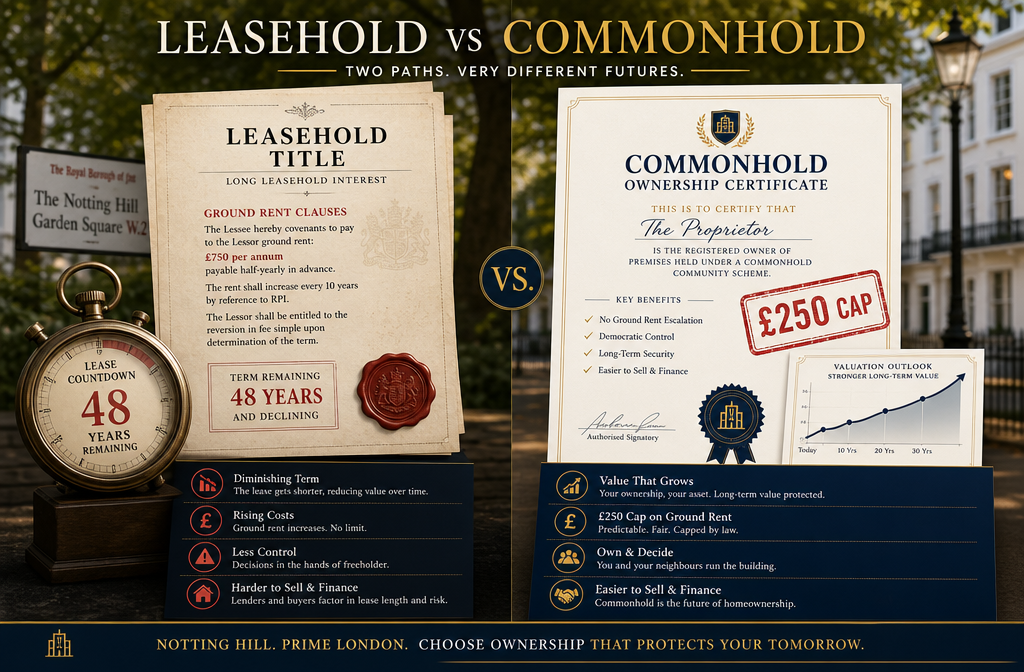
Here is what the draft Bill (published 27 January 2026) proposes in plain terms:
- Ban on new leasehold flats: Most new residential flats would be sold as commonhold rather than leasehold, possibly from 2029 (indicative, not confirmed).
- Ground rent cap: Existing ground rents would be capped at £250 per year. Rents above this threshold — common in many prime London buildings — would be reduced by law. An indicative timeline suggests this could take effect by late 2028.
- Abolition of forfeiture: The current rule allowing freeholders to repossess a flat over unpaid charges (even minor ones) would be scrapped, replaced with stronger leaseholder protections.
- Easier commonhold conversion: The threshold for a building to convert from leasehold to commonhold would drop from unanimous leaseholder agreement to approximately 50%.
⚠️ Important: All of the above are proposals in a draft Bill. Parliament must pass the legislation, and details may change significantly before enactment. This article is factual commentary, not legal or financial advice.
Key Differences Between the Current and Proposed Leasehold Systems {#key-differences}
The current system gives freeholders ongoing income rights and significant legal leverage over leaseholders. The proposed system shifts power toward flat owners in several concrete ways.
| Feature | Current Leasehold System | Proposed Commonhold/Reformed System |
|---|---|---|
| Flat ownership | Time-limited lease (e.g., 99–999 years) | Freehold title via commonhold unit |
| Ground rent | Can be market rate; some exceed £1,000/year | Capped at £250/year for existing leases |
| New flat sales | Leasehold permitted | Commonhold to become default (proposed ~2029) |
| Forfeiture | Freeholder can repossess for unpaid charges | Abolished under proposals |
| Commonhold conversion | Requires unanimous leaseholder consent | Proposed threshold: ~50% approval |
| Lease extension | Statutory right after 2 years' ownership | Reforms aim to reduce premium calculations |
Common mistake: Assuming the reforms are already law. As of May 2026, the Bill has been confirmed in the King's Speech but has not yet received Royal Assent. Acting as though the rules have changed — for example, deferring a lease extension on the assumption costs will fall — carries real financial risk.
How Do the 2026 Reforms Impact Prime Central London Property Valuations? {#valuation-impact}
Leasehold commonhold reform 2026 prime London flat valuations are being shaped by two forces pulling in different directions: reform proposals that could increase leaseholder value, and a softer prime market that has already reduced prices by approximately 2.4% across London (Savills, 2025 prime London data). The net effect on any individual flat depends heavily on its lease length, ground rent level, and building type.
Ground rent and value: A flat paying £2,500/year in ground rent is worth less than an otherwise identical flat paying £250/year, because the ground rent is a cost that buyers factor into their offers. If the £250 cap is enacted, flats with high ground rents could see a valuation uplift — but buyers are already pricing in reform uncertainty, so the market hasn't fully moved yet.
Lease length and value: Short leases (below 80 years) attract a "marriage value" premium in extension calculations, making extensions expensive. Flats with leases below 80 years in Notting Hill typically trade at a meaningful discount to equivalent long-lease properties. Reform proposals aim to reduce this cost, but until legislation passes, the current statutory formula still applies.
Softer market context: With prime London values broadly softer, sellers of short-lease or high-ground-rent flats face a double headwind: market-wide price pressure and buyer caution about leasehold risk. A professional RICS valuation in Notting Hill is the most reliable way to establish where a specific flat sits in this shifting landscape.
Who Benefits Most from the New Leasehold Commonhold Rules? {#who-benefits}
Existing leaseholders with high ground rents and those holding short leases stand to gain the most if the reforms pass in their current form. Freeholders and ground-rent investors face the greatest financial impact.
Biggest potential beneficiaries:
- Owners of flats with ground rents above £250/year — the proposed cap would reduce their ongoing liability and improve saleability.
- Leaseholders in buildings where 50%+ want to convert — the lower conversion threshold could unlock commonhold for buildings where unanimous consent was previously impossible.
- Buyers of new-build flats post-reform — purchasing a commonhold unit rather than a leasehold flat means no ground rent, no lease countdown, and collective ownership of the building.
- Leaseholders seeking extensions — if the premium calculation is reformed to remove or reduce marriage value, extension costs could fall materially.
Who benefits less or not at all:
- Leaseholders with very long leases (900+ years, peppercorn rent) — they already have minimal leasehold risk and little to gain from reform.
- Owners in buildings where fewer than 50% want to convert — they may remain in leasehold tenure indefinitely.
Will Lease Extension Costs Drop — and By How Much? {#lease-extension-costs}
The draft Bill proposes changes to the premium calculation formula that could reduce the cost of extending a lease, primarily by reforming or removing "marriage value" — the additional premium payable when a lease falls below 80 years. No confirmed figures have been published, and the final calculation methodology will depend on the enacted legislation.
Current position (as of May 2026): The Leasehold Reform (Ground Rent) Act 2022 already banned ground rents on new leases. The draft 2026 Bill goes further, but the statutory lease extension formula under the Leasehold Reform, Housing and Urban Development Act 1993 still applies to existing leases until new legislation takes effect.
For a Notting Hill flat with, say, 72 years remaining and a ground rent of £500/year, the current extension premium could run to tens of thousands of pounds. If marriage value is removed from the formula, that premium could fall significantly — but "significantly" is not a number that can responsibly be quoted until the Bill is enacted and RICS guidance is updated.
For a current estimate of what an extension would cost under existing law, a lease extension valuation from a RICS-registered surveyor provides a defensible starting point. For a breakdown of the cost components involved, see this guide to the cost of a lease extension.
Am I Eligible for a Lease Extension Under the New Regulations? {#eligibility}
Under current law, a leaseholder is eligible to extend their lease if they have owned the flat for at least two years and hold a long lease (originally granted for more than 21 years). The draft 2026 Bill proposes removing the two-year ownership requirement, meaning buyers could serve notice immediately after completion.
Key eligibility points under current law:
- Must have owned the flat for at least two years
- Original lease must have been granted for more than 21 years
- The flat must be a residential dwelling
Proposed change: Removing the two-year qualifying period would benefit buyers who purchase a short-lease flat as an investment or primary residence and want to extend without waiting.
Edge case: If a building is in the process of converting to commonhold, lease extension rights may interact with that process in ways that require specialist advice. The FAQ on lease extensions covers many of the common eligibility questions in more detail.
Which Types of London Flats Are Most Affected by These Changes? {#most-affected}
Not all prime London leasehold flats face the same exposure to reform. The characteristics that create the greatest valuation sensitivity are high ground rents, short lease terms, and buildings where conversion to commonhold is feasible.
Most affected:
- Flats with ground rents above £250/year — particularly those in older mansion blocks or buildings sold by institutional freeholders where rents were set at commercial rates.
- Short-lease flats (below 80 years) — the marriage value issue makes these expensive to extend under current law, and reform could meaningfully change their value.
- Flats in buildings with majority leaseholder support for conversion — these could transition to commonhold if the 50% threshold is enacted.
Less affected:
- Flats on 999-year leases with peppercorn (£0) ground rents — already effectively freehold in practice.
- New-build flats sold after the Leasehold Reform (Ground Rent) Act 2022 — ground rents are already banned on these.
Prime Notting Hill stock includes a significant proportion of Victorian and Edwardian conversions, many held on leases of 80–150 years with variable ground rent structures. Buyers in this market should treat lease terms as a core part of due diligence, not an afterthought.
How Do International Property Investors View These Leasehold Reforms? {#investor-view}
International buyers — a significant segment of the prime Notting Hill market — have historically viewed English leasehold tenure with some confusion or concern. The proposed reforms are broadly seen as a positive structural change, but uncertainty about timing and final form is creating a wait-and-see attitude among some overseas purchasers.
Key investor concerns:
- Tenure clarity: Commonhold is closer to the condominium or co-ownership models familiar in the US, Europe, and Asia. A shift to commonhold default for new flats may make London more legible to international buyers.
- Ground rent income: Investors who purchased ground rent portfolios as income assets face significant value impairment if the £250 cap is enacted. This is already reflected in the secondary market for ground rent investments.
- Reform uncertainty: Until the Bill receives Royal Assent, investors cannot price the reforms with certainty. Some are deferring purchases of short-lease or high-ground-rent flats until the legislative picture is clearer.
For international buyers considering a prime west London flat, a RICS Red Book valuation provides a credible, internationally recognised basis for assessing market value under current law — useful for financing, tax, and negotiation purposes.
Mistakes to Avoid When Acting During the Reform Window {#mistakes}
Several common errors are emerging among buyers and owners who are reacting to reform headlines without fully understanding the current legal position.

Mistake 1: Deferring a lease extension because "costs will fall soon."
The reforms are not yet law. If a lease drops below 80 years while an owner waits, marriage value kicks in and the extension cost increases under current law. The risk of waiting can outweigh the potential saving.
Mistake 2: Assuming a ground rent cap is already in force.
The £250 cap is a proposal. Ground rents above that level remain legally payable until legislation changes.
Mistake 3: Skipping a building survey because the flat "looks fine."
Leasehold flats in Victorian and Edwardian conversions carry structural and maintenance risks that affect value independently of tenure reform. A Level 2 or Level 3 building survey identifies issues that could affect the price negotiation or reveal unexpected service charge liabilities.
Mistake 4: Relying on an estate agent's valuation for a complex leasehold flat.
Where ground rent, lease length, and reform uncertainty all interact, a RICS valuation from a registered valuer provides a defensible, methodology-backed opinion of value — not a marketing estimate.
Mistake 5: Ignoring collective enfranchisement as an alternative.
If 50%+ of leaseholders in a building want to buy the freehold collectively, collective enfranchisement may be a more immediate route to security than waiting for commonhold conversion rules to change.
The Role of a RICS Valuation and Building Survey Before Buying a Prime Leasehold Flat {#rics-role}
Before purchasing any prime leasehold flat in Notting Hill or central west London in 2026, two professional reports are worth commissioning: a RICS Red Book valuation and a building survey. Together, they address the two main risks in the current market — paying the wrong price and inheriting hidden defects.
RICS valuation: A registered valuer will account for lease length, ground rent level, and the current market in their opinion of value. This is particularly important where a flat has a lease below 90 years or a ground rent above £250/year, because standard automated valuations often fail to capture these adjustments accurately. See the RICS valuations service for more on what this involves.
Building survey: A Level 2 HomeBuyer Report or Level 3 Building Survey assesses the physical condition of the property. For converted Victorian flats — the dominant stock type in Notting Hill — issues such as damp, roof condition, and structural movement are common findings that directly affect value and future service charge costs. A comprehensive building survey is especially important where the service charge history is unclear or the building has deferred maintenance.
Why both matter together: A flat may be correctly priced for its lease length but have £30,000 of deferred roof repairs that will land as a service charge demand within two years. Neither the valuation nor the survey alone captures the full picture — both are needed.
For buyers working with chartered surveyors in west London, commissioning both services from the same firm can improve consistency and reduce the risk of gaps between the two reports.
Conclusion
Leasehold commonhold reform 2026 prime London flat valuations sit at the intersection of significant legislative change and a softer prime market — a combination that rewards careful due diligence and penalises assumptions.
The draft Commonhold and Leasehold Reform Bill proposes real and meaningful changes: a £250/year ground rent cap, abolition of forfeiture, commonhold as the default for new flats, and a lower conversion threshold. But these are proposals, not law. The indicative timelines — ground-rent cap possibly by late 2028, commonhold for new flat sales possibly from 2029 — may shift, and the final legislation may differ from the draft.
Actionable next steps for Notting Hill flat owners and buyers:
- Check your lease length now. If it is approaching or below 80 years, the cost of waiting for reform may exceed the potential saving. Get a current lease extension valuation.
- Review your ground rent. If it exceeds £250/year, model the valuation impact of the proposed cap — but do not assume it is already in force.
- Commission a RICS valuation before buying or selling any flat where lease length, ground rent, or building condition creates complexity.
- Get a building survey. Physical condition affects value and future costs independently of tenure reform.
- Monitor the Bill's progress. The King's Speech confirmed it on 13 May 2026; Royal Assent could follow within 12–24 months, but parliamentary timetables are unpredictable.
- Take specialist advice. Nothing in this article constitutes legal or financial advice. Consult a solicitor and a RICS-registered valuer for guidance specific to your property.
FAQ {#faq}
Q: Is the leasehold reform Bill already law in 2026?
No. The Commonhold and Leasehold Reform Bill was confirmed in the King's Speech on 13 May 2026 and a draft was published on 27 January 2026, but it has not yet received Royal Assent. Current leasehold law still applies.
Q: Will the ground rent cap apply to my existing lease?
The draft Bill proposes capping ground rents on existing leases at £250/year. If enacted, this would apply retrospectively to existing leases — but the indicative timeline for this is late 2028 at the earliest, and the final rules may differ.
Q: Does a short lease always reduce a flat's value?
Yes, in practice. Leases below 80 years attract marriage value in extension calculations, making extensions more expensive and deterring some buyers. Below 70 years, mortgage lenders often refuse to lend, which further suppresses value.
Q: What is commonhold and how is it different from leasehold?
Commonhold gives each flat owner a freehold title to their unit, with shared ownership of common parts through a Commonhold Association. There is no lease countdown, no ground rent, and no freeholder. It is closer to the condominium model used in most other countries.
Q: Should I extend my lease now or wait for reform?
This depends on your lease length and personal circumstances. If your lease is approaching 80 years, waiting carries a real cost risk under current law. A RICS lease extension valuation will show what extension costs today versus the risk of delay. This is not financial advice — consult a specialist.
Q: How does the softer prime London market affect leasehold flat values specifically?
A broadly softer market (approximately -2.4% across prime London) compounds the discount already applied to short-lease or high-ground-rent flats. Buyers have more negotiating power, and sellers of problematic leasehold flats face pressure from both directions.
Q: Can I convert my building to commonhold before the new law passes?
Under current law, conversion requires unanimous consent from all leaseholders, which is rarely achievable in practice. The proposed 50% threshold is not yet in force. Collective enfranchisement (buying the freehold collectively) is currently the more practical route for most buildings.
References {#references}
- UK Government, Leasehold and Freehold Reform Act 2024, legislation.gov.uk, 2024
- UK Government, Draft Commonhold and Leasehold Reform Bill, GOV.UK, published 27 January 2026, gov.uk
- UK Parliament, King's Speech 2026, Hansard, 13 May 2026
- Leasehold Reform (Ground Rent) Act 2022, legislation.gov.uk, 2022
- Leasehold Reform, Housing and Urban Development Act 1993, legislation.gov.uk, 1993
- Savills, Prime London Residential Market Update, Savills Research, 2025
- RICS, RICS Valuation — Global Standards (Red Book), Royal Institution of Chartered Surveyors, 2022
This article is for informational purposes only and does not constitute legal, financial, or surveying advice. All legislative proposals referenced are subject to parliamentary passage and may change before enactment. Readers should consult qualified professionals for advice specific to their property.
