
Over 100,000 boundary and property disputes reach formal legal proceedings in England and Wales every year — yet the majority of property owners have no idea that a specialist surveyor, not just a solicitor, can be the most decisive voice in the room. Understanding Expert Witness Surveyors in Property Disputes: When and How to Instruct One in the UK is essential knowledge for any homeowner, landlord, developer, or commercial property holder who faces a contested claim that cannot be resolved informally.
This guide demystifies the role of the surveying expert witness — covering when their involvement is warranted, how to instruct one correctly, what CPR Part 35 and RICS standards demand of them, and how their evidence shapes outcomes in mediation, tribunal, and court.
Key Takeaways
- 🏛️ An expert witness surveyor's primary duty is to the court, not to the party who instructs them — this is a legal obligation under CPR Part 35.
- 📋 RICS members acting as expert witnesses must comply with both CPR rules and the RICS Practice Statement on Expert Witnesses.
- ⚖️ Three main dispute types call for expert surveying evidence: boundary disputes, property valuation disagreements, and construction/defect claims.
- 📝 A well-drafted Letter of Instruction is critical — vague instructions produce weak reports that courts may disregard.
- 🤝 Expert evidence is used across multiple forums: mediation, RICS adjudication, First-tier Tribunal (Property Chamber), and the County Court or High Court.
What Is an Expert Witness Surveyor and Why Do They Matter?
An expert witness surveyor is a qualified surveying professional — typically a Chartered Surveyor (MRICS or FRICS) — who provides independent, impartial technical evidence to assist a court, tribunal, or dispute resolution body in understanding complex property matters that fall outside the knowledge of a layperson judge or arbitrator.
Their role is fundamentally different from that of an advocate surveyor, who argues a client's case. The expert witness must, above all else, assist the court. This duty overrides any obligation to the instructing party. In England and Wales, this is codified in Civil Procedure Rules (CPR) Part 35, which governs the use of expert evidence in civil proceedings.
💬 "It is the duty of an expert to help the court on the matters within their expertise. This duty overrides any obligation to the person from whom the expert has received instructions."
— CPR Part 35.3
The RICS Dimension
The Royal Institution of Chartered Surveyors publishes a Practice Statement: Surveyors Acting as Expert Witnesses, which all RICS members must follow when providing expert evidence. This document sets out obligations around independence, conflicts of interest, report structure, and conduct in proceedings. Failure to comply can result in disciplinary action and — critically — a report being rejected by the court.
Understanding the different types of surveyors and their specialisations helps clarify which professional is best suited to a given dispute.
When Do You Need an Expert Witness Surveyor in a Property Dispute?
Not every property disagreement requires formal expert evidence. However, several categories of dispute almost always benefit — or legally require — independent surveying testimony.
1. 🏠 Boundary Disputes
Boundary disputes are among the most common and most bitterly contested property conflicts in the UK. They arise when neighbouring owners disagree about the precise location of a boundary, ownership of a strip of land, or rights over a shared structure.
An expert witness surveyor in a boundary dispute will:
- Analyse historical title deeds, OS maps, and Land Registry plans
- Conduct a boundary survey and prepare a measured survey plan
- Interpret conveyancing documents and apply legal presumptions
- Provide an independent opinion on the most probable boundary line
These cases frequently reach the First-tier Tribunal (Property Chamber) or the County Court, both of which expect CPR-compliant expert reports.
2. 💷 Valuation Disputes
Valuation disagreements arise in a wide range of contexts:
| Dispute Type | Typical Forum |
|---|---|
| Matrimonial asset division | Family Court |
| Probate and inheritance disputes | Chancery Division |
| Leasehold enfranchisement | First-tier Tribunal |
| Capital gains tax challenges | Tax Tribunal |
| Compulsory purchase compensation | Upper Tribunal (Lands Chamber) |
| Dilapidations claims | County Court / arbitration |
In each case, a Chartered Valuation Surveyor provides an independent Red Book (RICS Valuation – Global Standards) compliant valuation opinion, which the tribunal uses to determine a fair figure.
3. 🔨 Construction Defects and Building Disputes
When a contractor, developer, or neighbour causes alleged damage — whether through poor workmanship, a party wall breach, or structural interference — a building surveyor acting as an expert witness can:
- Assess the nature, cause, and extent of defects
- Attribute causation (e.g., distinguishing pre-existing issues from new damage)
- Quantify the cost of remediation
- Comment on whether industry standards were met
For disputes involving neighbouring construction works, a thorough understanding of resolving party wall disputes is often the essential starting point before formal expert evidence becomes necessary.
How to Instruct an Expert Witness Surveyor: A Step-by-Step Guide
Instructing an expert witness surveyor correctly is not simply a matter of calling a surveyor and asking for a report. The process has formal requirements that, if ignored, can undermine the entire case.
Step 1: Confirm the Need for Expert Evidence
Before instructing anyone, confirm with your solicitor that:
- The dispute genuinely requires independent technical evidence
- The court or tribunal has given permission for expert evidence (required under CPR 35.4 in most civil proceedings)
- Single joint expert (SJE) appointment is not being ordered instead of party-appointed experts
Step 2: Select the Right Surveyor
The expert must have:
- ✅ Relevant RICS membership and specialisation
- ✅ Demonstrable experience in the specific dispute type
- ✅ No conflict of interest with either party
- ✅ Familiarity with CPR Part 35 and RICS Practice Statement obligations
- ✅ Experience of giving evidence in the relevant forum (court, tribunal, arbitration)
Step 3: Draft a Clear Letter of Instruction
The Letter of Instruction (LOI) is the document that defines the expert's scope of work. Courts may request to see it, so it must be carefully drafted. A strong LOI will include:
- A factual summary of the dispute
- The specific questions the expert is asked to address
- Copies of all relevant documents (title plans, surveys, correspondence)
- The relevant legal test or standard to be applied
- Deadlines for the draft and final report
- Confirmation that the expert understands their duty to the court
⚠️ Common mistake: Instructing parties sometimes draft LOIs that subtly push the expert toward a favourable conclusion. Courts are alert to this, and a biased report will damage credibility far more than having no expert at all.
Step 4: The Site Inspection and Investigation
The expert will typically:
- Carry out a physical inspection of the property or site
- Review all documentary evidence provided
- Conduct independent research (historical maps, planning records, comparable evidence)
- Prepare a draft report for review by the instructing solicitor
Note: The solicitor may comment on factual accuracy and clarity but must not ask the expert to change their professional opinion.
Step 5: The Expert Witness Report
Under CPR Part 35 and Practice Direction 35, the report must contain specific declarations, including:
- A statement that the expert understands their duty to the court
- Confirmation the report is their own independent opinion
- A statement of truth
- Details of their qualifications and the substance of their instructions
- A summary of conclusions
For complex building disputes, a comprehensive condition survey report may form part of the evidential foundation upon which the expert report is built.
CPR Part 35 and RICS Standards: What the Expert Must Comply With
Understanding the regulatory framework helps both instructing parties and their legal teams hold experts to the right standard.
CPR Part 35 Key Requirements
| Requirement | Detail |
|---|---|
| Duty to court | Overrides duty to instructing party |
| Single joint experts | Courts often prefer one shared expert in lower-value claims |
| Written questions | Opposing party may submit written questions to the expert |
| Discussions between experts | Courts may order experts to meet and produce a joint statement |
| Overriding objective | Expert evidence must be proportionate to the value of the claim |
RICS Practice Statement Obligations
RICS members acting as expert witnesses must:
- Declare any conflict of interest before accepting instruction
- Maintain independence throughout
- Not enter into contingency fee arrangements
- Comply with the RICS Conflicts of Interest Professional Statement
- Keep a clear audit trail of all communications
When experts from both sides are appointed, the court will often order an experts' meeting to narrow the issues in dispute. The resulting Joint Statement of Experts is one of the most influential documents in any property litigation — it tells the judge exactly where the experts agree and disagree, focusing the trial on genuine points of contention.
How Expert Evidence Is Used Across Different Forums
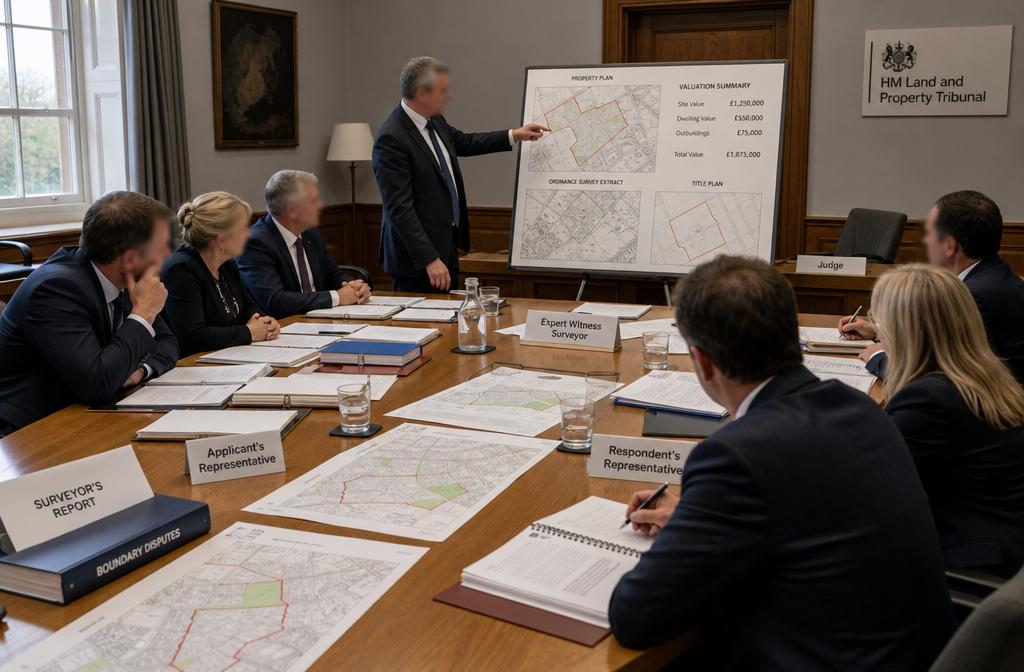
The forum in which a dispute is heard significantly affects how expert evidence is presented and weighted.
🤝 Mediation
In mediation, expert evidence is used informally to inform negotiation. A well-prepared expert report — even one not yet tested in court — can shift the balance of power dramatically. Parties who understand the strength of independent evidence against them are far more likely to settle.
⚖️ RICS Adjudication and Arbitration
For disputes referred to RICS-appointed adjudicators or arbitrators, the expert's report is submitted as written evidence. The adjudicator may ask written questions. This is a faster, more cost-effective route than litigation for many commercial and leasehold disputes.
🏛️ First-tier Tribunal (Property Chamber)
The Property Chamber handles leasehold disputes, service charge disagreements, and some boundary matters. It is relatively informal compared to the High Court but still expects CPR-compliant expert reports. Surveyors frequently appear as expert witnesses here, particularly in dilapidations surveys and leasehold valuation cases.
🏦 County Court and High Court
In full civil litigation, the expert may be required to:
- Attend a pre-trial experts' meeting
- Submit a joint statement of agreed and disputed issues
- Give oral evidence and be cross-examined by opposing counsel
The ability to withstand cross-examination while maintaining a calm, independent stance is what separates a truly effective expert witness from a technically competent surveyor who is not suited to the role.
For party wall-related disputes that escalate to court, the RICS party wall surveyors guidance provides important context on how surveyor evidence is framed in those specific proceedings.
Costs, Proportionality, and Practical Considerations
Expert witness fees vary considerably depending on the complexity of the dispute, the seniority of the expert, and the volume of documentation to review. As a general guide in 2026:
| Service | Approximate Cost Range |
|---|---|
| Initial review and advice | £500 – £1,500 |
| Full expert report (boundary) | £2,000 – £6,000 |
| Full expert report (valuation) | £1,500 – £5,000 |
| Court attendance (per day) | £1,500 – £4,000+ |
| Experts' meeting and joint statement | £500 – £2,000 |
Proportionality is critical. In small claims or low-value disputes, courts are unlikely to grant permission for expensive expert evidence. The cost of the expert must be justified against the value of the claim and the likely benefit to the court.
💡 Practical tip: In lower-value disputes, consider whether a Single Joint Expert (SJE) — appointed jointly by both parties — might achieve the same outcome at lower cost and with greater weight given to their independence.
For commercial property disputes, working with experienced commercial property surveyors who understand both the technical and procedural dimensions of expert evidence is especially valuable.
Common Pitfalls to Avoid
Even experienced legal teams make avoidable mistakes when using expert witness surveyors. The most frequent errors include:
- ❌ Instructing too late — Expert reports take time; last-minute instructions produce rushed, weaker evidence
- ❌ Choosing an advocate, not an expert — A surveyor who argues your case rather than assists the court will be undermined in cross-examination
- ❌ Providing incomplete documentation — Missing title deeds or historic plans can fatally weaken a boundary report
- ❌ Ignoring the joint statement process — Failing to engage constructively with the opposing expert's views looks obstructive to the court
- ❌ Conflating roles — The expert witness and the party's own surveying advisor should ideally be different people to preserve independence
Conclusion: Taking the Right Steps in 2026
Property disputes are stressful, expensive, and — without the right expert guidance — unpredictable. The role of expert witness surveyors in property disputes is not merely procedural; it is often the difference between winning and losing a case.
Here are the actionable next steps for anyone facing a property dispute in 2026:
- Consult a solicitor early to determine whether expert evidence is appropriate and whether court permission is needed.
- Identify the right type of surveyor for your dispute — boundary, valuation, or building defects each require different specialisms.
- Draft a precise Letter of Instruction with your solicitor, covering all relevant questions and providing complete documentation.
- Choose a RICS-qualified expert with demonstrable experience in the relevant forum and no conflicts of interest.
- Budget realistically — factor in not just the report but potential court attendance, joint meetings, and written questions.
- Engage early with the opposing expert's report — a proactive response to a joint statement process demonstrates good faith and often accelerates settlement.
Whether a dispute involves a contested fence line, a disputed lease renewal valuation, or structural damage caused by a neighbour's extension, the right expert witness surveyor — instructed correctly and given clear, fair instructions — is one of the most powerful tools available in UK property litigation.
