
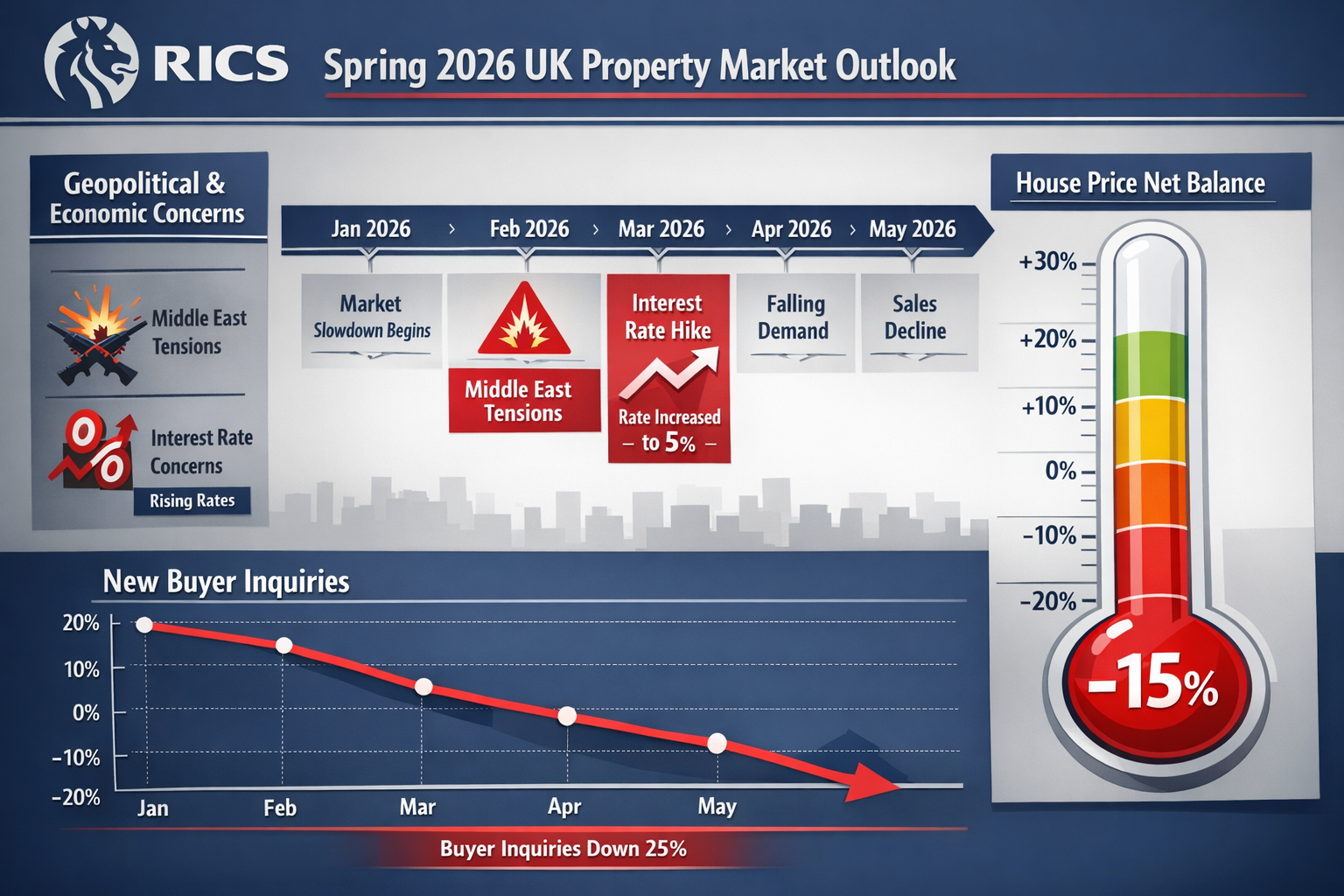
The March 2026 RICS Residential Market Survey delivered a sobering verdict: house price net balances plummeted to -15%, marking one of the sharpest declines in recent quarters[4]. As geopolitical tensions and interest rate concerns dampen buyer sentiment across the UK property market, the limitations of automated valuation models (AVMs) have never been more apparent. In this volatile environment, Navigating Uncertainty in Spring 2026 Valuations: How RICS Real-Time Surveyor Data Outperforms Automated Valuation Models has become a critical conversation for property professionals, lenders, and investors seeking accuracy when market conditions shift rapidly.
The spring 2026 property landscape presents unique challenges that expose fundamental differences between human surveyor expertise and algorithm-driven valuations. While AVMs rely on historical data and statistical models, RICS-qualified surveyors integrate real-time market intelligence, physical property inspection, and professional judgment to deliver valuations that reflect current market realities rather than outdated trends.
Key Takeaways
- 📉 March 2026 market data shows house prices declining with net balances at -15%, creating challenges for backward-looking automated valuation models
- 🎯 RICS surveyors provide real-time market insights that capture current buyer sentiment, geopolitical impacts, and local market nuances missed by AVMs
- ⚖️ New AI standards effective March 9, 2026 require RICS members to maintain governance, transparency, and accountability when using AI tools in surveying services
- 🔍 Human expertise remains essential for complex valuations, non-standard properties, and uncertain market conditions where algorithmic models struggle
- 📊 Data quality and freshness determine valuation accuracy, with surveyor-gathered intelligence outperforming lag-prone AVM datasets during market transitions
Understanding the Spring 2026 Market Context
The first quarter of 2026 has challenged property valuers with unprecedented complexity. Beyond the headline -15% house price net balance, new buyer inquiries have declined significantly, signaling weakening demand across residential markets[4]. This softening reflects multiple converging pressures:
Geopolitical volatility stemming from ongoing Middle East conflicts has created economic uncertainty, affecting consumer confidence and mortgage availability. Interest rate concerns continue to dominate buyer psychology, with households cautious about committing to major property purchases amid potential rate adjustments.
For valuation professionals, these conditions create a critical problem: AVMs trained on historical data struggle to adjust quickly to rapid sentiment shifts. Traditional automated models typically incorporate transaction data with a 3-6 month lag, meaning their valuations in spring 2026 may still reflect the more optimistic market conditions of late 2025.
Why Timing Matters in Valuation Accuracy
Property values don't move in smooth, predictable patterns—they respond to market psychology, policy changes, and external shocks. When the RICS survey captures declining buyer inquiries and falling price expectations in March 2026, this intelligence represents real-time market sentiment that won't appear in Land Registry transaction data until months later.
RICS chartered surveyors access this intelligence immediately through:
- Direct conversations with estate agents and property professionals
- Observation of viewing activity and offer patterns
- Understanding of local market dynamics and buyer behavior
- Professional networks sharing market intelligence across regions
This real-time information flow creates a fundamental advantage over AVMs, which must wait for completed transactions to update their models. During periods of rapid market change, this lag can produce valuation errors of 5-10% or more.
Navigating Uncertainty in Spring 2026 Valuations: The RICS Surveyor Advantage
The question facing property professionals in 2026 is not whether technology has a role in valuations—it clearly does—but rather when human expertise becomes indispensable. The answer increasingly points to periods of market uncertainty, where Navigating Uncertainty in Spring 2026 Valuations: How RICS Real-Time Surveyor Data Outperforms Automated Valuation Models becomes most evident.
Real-Time Market Intelligence vs Historical Data
RICS surveyors operate at the frontline of market activity. When conducting property valuations, they synthesize multiple information sources that AVMs cannot access:
Local market knowledge 🏘️ includes understanding neighborhood dynamics, planned developments, infrastructure changes, and community factors that affect property desirability. A surveyor working in North London or Surrey develops intimate knowledge of micro-markets that algorithms cannot replicate.
Physical property inspection 🔍 reveals condition factors, structural concerns, and quality variations that significantly impact value but may not appear in property databases. Our guide on what surveyors check details the comprehensive assessment process that informs accurate valuations.
Professional judgment ⚖️ allows surveyors to weigh competing factors, adjust for unusual circumstances, and apply experience-based insights that rigid algorithms cannot accommodate. This becomes particularly valuable for non-standard properties, commercial valuations, or specialized assignments like shared ownership valuations.
The AVM Limitation Problem
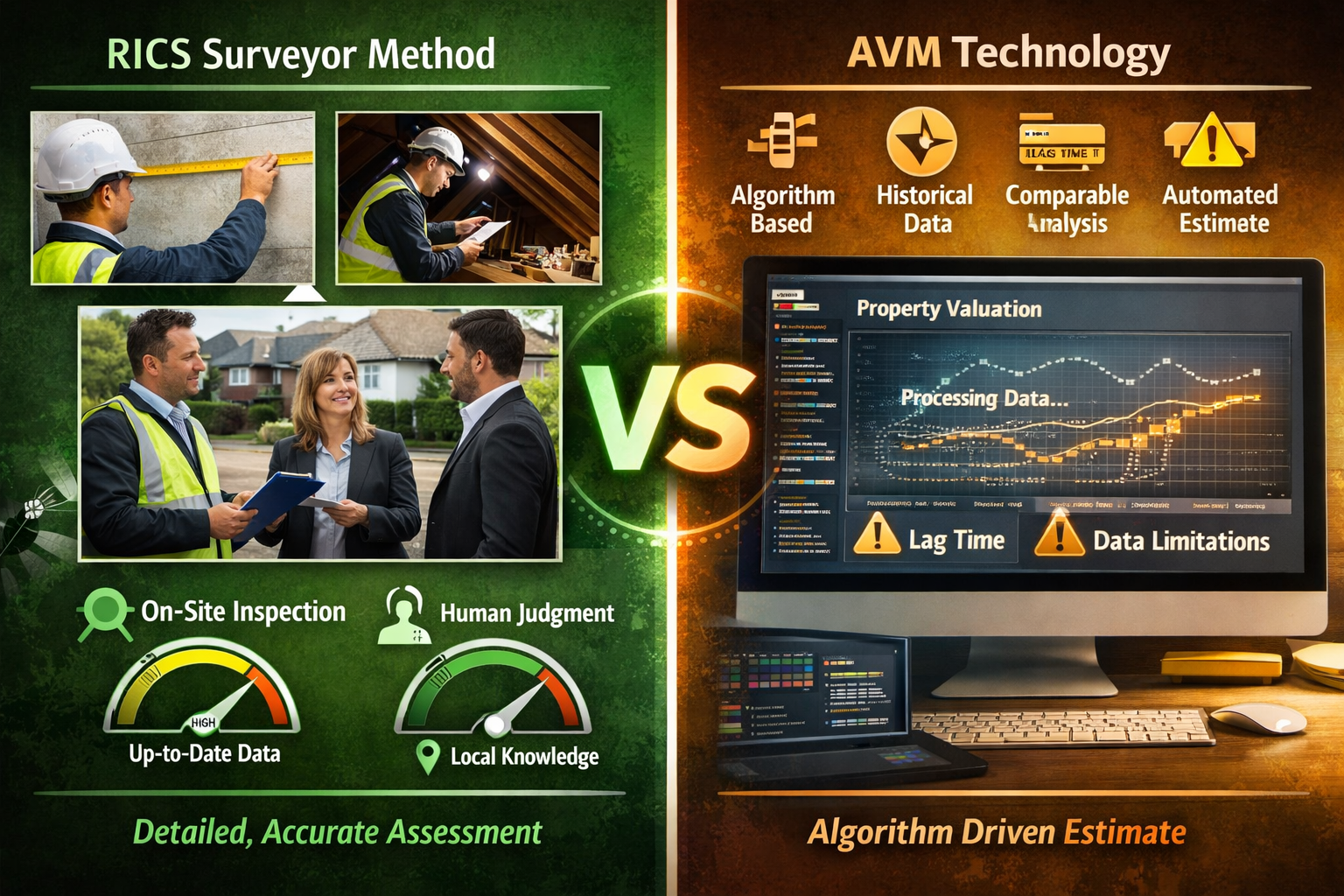
Automated Valuation Models excel in stable markets with abundant comparable data. They process large datasets efficiently and provide instant valuations at scale[7]. However, their limitations become critical during market transitions:
| AVM Weakness | Impact in Spring 2026 | RICS Surveyor Solution |
|---|---|---|
| Data lag (3-6 months) | Values reflect Q4 2025 conditions, not current -15% decline | Real-time market intelligence from current activity |
| Limited property inspection | Cannot assess condition, quality variations | Physical inspection reveals true property state |
| Algorithm rigidity | Struggles with non-standard properties | Professional judgment adapts to unique circumstances |
| Lack of local context | Misses neighborhood changes, planned developments | Deep local market knowledge |
| Sentiment blindness | Cannot capture buyer psychology shifts | Direct engagement with market participants |
The March 2026 market conditions perfectly illustrate these limitations. As buyer inquiries decline and price expectations soften, AVMs continue reporting values based on completed transactions from months earlier, creating a dangerous disconnect between reported valuations and actual market conditions.
How RICS Real-Time Surveyor Data Outperforms Automated Valuation Models
The performance gap between RICS surveyor valuations and AVMs widens during market uncertainty. Understanding Navigating Uncertainty in Spring 2026 Valuations: How RICS Real-Time Surveyor Data Outperforms Automated Valuation Models requires examining specific mechanisms that create this advantage.
Data Freshness and Market Responsiveness
Transaction data lag represents the most significant AVM vulnerability. When market conditions shift rapidly—as they have in spring 2026—this lag creates systematic valuation errors. Consider the timeline:
- January 2026: Market begins softening as geopolitical concerns intensify
- February 2026: Buyer inquiries decline, but transactions from Q4 2025 continue completing
- March 2026: RICS survey captures -15% price net balance, but Land Registry data still reflects earlier optimism
- April-May 2026: AVMs gradually incorporate March data, but remain 2-3 months behind current conditions
RICS surveyors, by contrast, adjust their valuations immediately based on current market intelligence. When conducting a Red Book valuation, they incorporate:
- Today's buyer sentiment from estate agent conversations
- Current viewing activity and offer patterns
- Latest comparable evidence including agreed sales not yet completed
- Market direction indicators from professional networks
This real-time responsiveness means RICS valuations in spring 2026 accurately reflect the -15% price decline captured in the March survey, while AVMs may still be reporting values 5-10% higher based on outdated transaction data.
Complexity and Non-Standard Property Handling
AVMs perform reasonably well for standard properties in data-rich markets. They struggle significantly with:
Period properties with unique architectural features, listed building status, or conservation area restrictions require nuanced valuation approaches that algorithms cannot replicate. A Level 3 Building Survey often reveals condition factors that dramatically affect value but don't appear in property databases.
Commercial properties involve lease structures, tenant quality, yield calculations, and market positioning that demand specialized expertise. Our commercial property surveyors apply professional judgment that AVMs cannot match.
Properties with defects require assessment of remediation costs, impact on marketability, and adjustment of comparable evidence. When structural surveys reveal significant issues, RICS surveyors quantify the value impact through professional analysis rather than algorithmic approximation.
Specialized valuations for purposes like Capital Gains Tax, Charities Act compliance, or Right to Buy require regulatory knowledge and methodological expertise beyond AVM capabilities.
Quality Assurance and Professional Accountability
RICS membership carries significant professional obligations that create quality assurance mechanisms absent from automated systems:
✅ Professional indemnity insurance protects clients against valuation errors
✅ Regulatory oversight by RICS ensures standards compliance
✅ Continuing professional development requirements maintain surveyor expertise
✅ Ethical standards govern professional conduct and client service
✅ Complaints and disciplinary procedures provide accountability mechanisms
When a RICS surveyor signs a valuation report, they accept personal professional liability for the accuracy and methodology. This accountability incentivizes thorough analysis and conservative judgment—particularly important during uncertain market conditions like spring 2026.
The New RICS AI Standards: Balancing Technology and Human Expertise
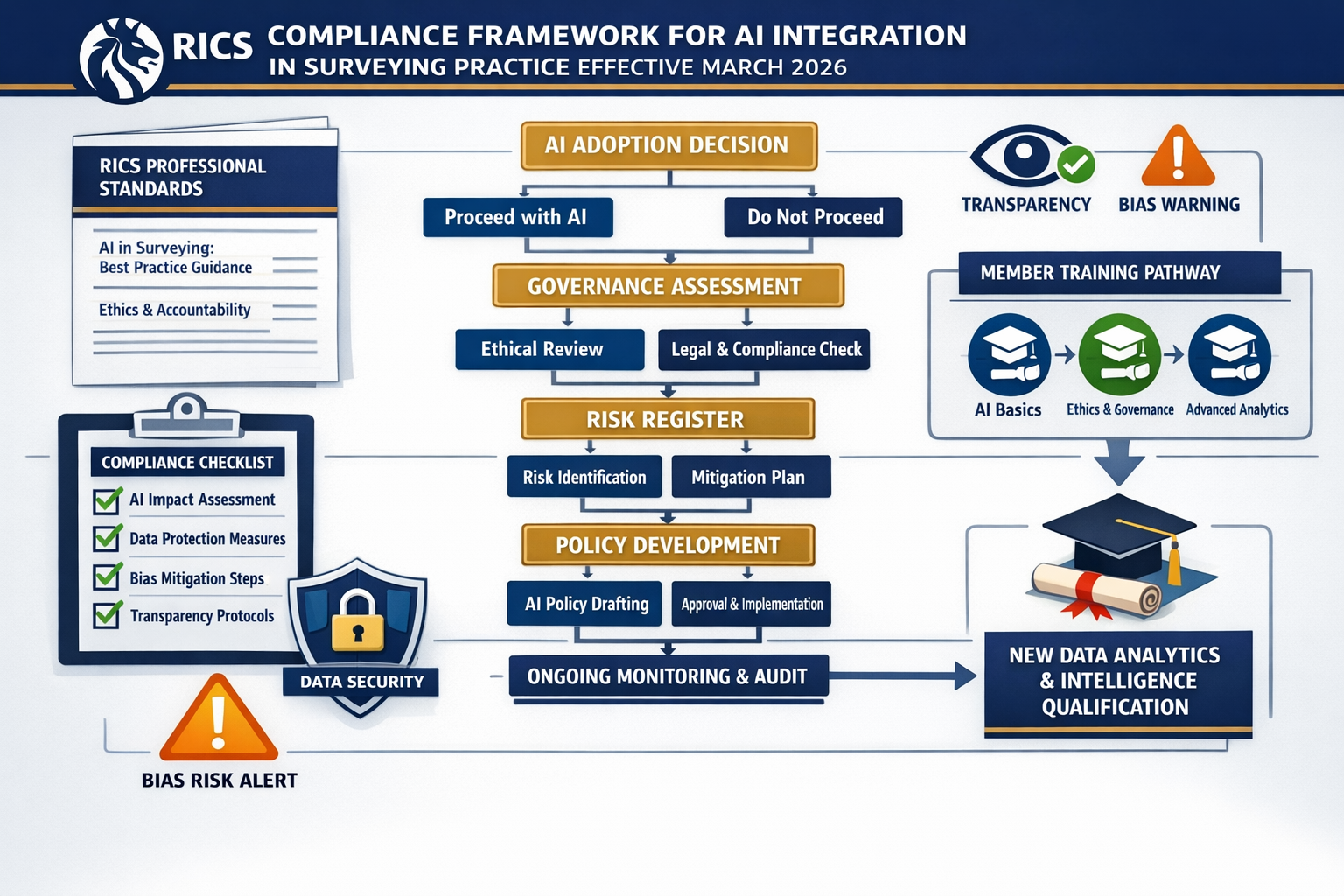
Recognizing both the opportunities and risks of artificial intelligence in property valuation, RICS implemented comprehensive AI standards effective March 9, 2026[2]. These requirements establish a framework for Navigating Uncertainty in Spring 2026 Valuations: How RICS Real-Time Surveyor Data Outperforms Automated Valuation Models while allowing appropriate technology integration.
Key Requirements for RICS Members Using AI
The new professional standard mandates that RICS members and regulated firms must[2]:
Understand AI fundamentals 🧠 including different AI types, their limitations, failure modes, potential biases, and data usage risks. This ensures surveyors can critically evaluate AI tools rather than blindly accepting algorithmic outputs.
Conduct governance assessments 📋 before implementing AI systems in surveying services. This includes evaluating data quality, algorithm transparency, validation methodologies, and potential bias sources.
Document AI usage 📝 when AI has material impact on surveying services. This creates transparency and allows clients to understand the role of automated tools in their valuations.
Develop responsible AI policies 📜 informed by risk registers that identify potential issues with AI implementation. Firms must establish clear protocols for AI use, human oversight, and quality control.
Maintain human oversight 👤 ensuring that professional judgment remains central to valuation conclusions, with AI serving as a tool rather than a replacement for surveyor expertise.
These requirements reflect RICS' recognition that while AI can enhance surveying efficiency—particularly for tasks like lease abstraction, rent roll analysis, and comparable evidence collation[5]—human expertise remains essential for accurate valuations during market uncertainty.
The Data, Analytics and Intelligence Pathway
Further emphasizing the importance of data literacy, RICS launched a pilot Data, Analytics and Intelligence pathway for chartered surveyors in 2026[1][3]. This new qualification pathway focuses on:
- Data understanding and interpretation
- Analytics methodologies and applications
- Data management and governance
- Cyber security considerations
- Digital ethics and responsible data use
This initiative recognizes that modern surveyors must combine traditional expertise with data literacy to effectively navigate uncertainty in spring 2026 valuations. Surveyors who understand both human judgment and data analytics can critically evaluate AVM outputs, identify algorithmic limitations, and integrate technology appropriately into their valuation practice.
Practical Applications: When to Choose RICS Surveyors Over AVMs
Understanding the theoretical advantages of RICS surveyor data helps, but property professionals need practical guidance on when to prioritize human expertise over automated models.
High-Stakes Transactions
Mortgage lending decisions in spring 2026's uncertain market require accurate valuations to manage risk. Lenders increasingly recognize that AVM over-valuations based on outdated data could create portfolio vulnerabilities. RICS valuations provide the accuracy and defensibility needed for significant lending decisions.
Commercial property acquisitions involve substantial capital commitments where valuation accuracy directly impacts investment returns. The complexity of commercial building surveys and specialized commercial valuations demands surveyor expertise.
Portfolio valuations for institutional investors require consistent methodology, market knowledge, and professional judgment across multiple properties. The accountability and quality assurance of RICS valuations justifies the additional cost for high-value portfolios.
Market Transition Periods
The spring 2026 market exemplifies conditions where RICS surveyor advantages become most pronounced:
- Rapidly changing sentiment requires real-time market intelligence
- Diverging regional performance demands local market expertise
- Policy uncertainty needs professional judgment to assess impact
- Geopolitical factors require contextual analysis beyond algorithmic capability
During stable market conditions, AVMs may provide adequate accuracy for routine transactions. When markets transition—as they clearly are in spring 2026—the value of real-time surveyor data increases dramatically.
Complex or Non-Standard Properties
Certain property types simply exceed AVM capabilities:
🏛️ Listed buildings and conservation area properties
🏗️ Properties with structural issues requiring structural engineer reports
🏚️ Non-standard construction properties detailed in our non-standard construction guide
🏢 Mixed-use developments combining residential and commercial elements
🏡 Properties with significant land requiring development potential assessment
For these properties, attempting to rely on AVMs creates false precision—algorithmic outputs may appear authoritative but lack the accuracy needed for important decisions.
Integrating Technology Responsibly: Best Practices for 2026
The goal is not to reject technology but to integrate it responsibly within a framework of professional expertise. Navigating Uncertainty in Spring 2026 Valuations: How RICS Real-Time Surveyor Data Outperforms Automated Valuation Models doesn't mean abandoning automation—it means understanding when and how to use each approach.
The Hybrid Approach
Leading valuation practices in 2026 combine technological efficiency with human expertise:
Initial screening 🖥️ uses AVMs to identify properties requiring detailed attention, flagging outliers or unusual characteristics for surveyor review.
Data gathering 📊 leverages AI tools for efficient comparable evidence collation, lease abstraction, and initial analysis[5], saving surveyor time for higher-value analytical work.
Professional analysis 🎓 applies RICS surveyor expertise to interpret data, adjust for market conditions, assess property-specific factors, and reach valuation conclusions.
Quality assurance ✅ maintains human oversight and professional accountability for final valuations, ensuring compliance with RICS standards and client requirements.
This hybrid model maximizes efficiency while preserving the accuracy and accountability that professional valuations require—particularly during uncertain market conditions.
Transparency and Client Communication
The new RICS AI standards emphasize transparency when technology contributes to surveying services[2]. Best practices include:
- Clear disclosure of AI tool usage in valuation reports
- Explanation of methodology including how technology and human judgment combine
- Limitation acknowledgment regarding data sources, comparable evidence, and market conditions
- Professional certification that surveyors have reviewed and validated algorithmic outputs
This transparency builds client confidence and ensures appropriate understanding of valuation methodology—essential for homebuyer surveys and specialized assignments.
Continuing Professional Development
As technology evolves, RICS surveyors must maintain current knowledge through:
- Training on AI fundamentals and limitations
- Understanding of data analytics methodologies
- Awareness of market data sources and quality issues
- Skills in critically evaluating algorithmic outputs
- Knowledge of regulatory requirements for AI use
The new Data, Analytics and Intelligence pathway[1][3] provides structured development for surveyors seeking to enhance their data literacy while maintaining professional expertise.
Case Study: Spring 2026 Valuation Scenarios
Consider three hypothetical valuation scenarios from spring 2026 that illustrate the RICS surveyor advantage:
Scenario 1: Standard Semi-Detached Home in Declining Market
Property: Three-bedroom semi-detached house in Hounslow
AVM Output: £485,000 (based on Q4 2025 comparables)
RICS Surveyor Valuation: £455,000
Difference: £30,000 (6.2%)
Explanation: The RICS surveyor incorporated March 2026 market intelligence showing declining buyer inquiries and softening prices in the local area. While the AVM relied on completed transactions from late 2025, the surveyor adjusted for current market conditions based on conversations with local estate agents and observation of properties remaining on market longer with price reductions.
Scenario 2: Period Property with Structural Concerns
Property: Victorian terrace in Fulham with suspected subsidence
AVM Output: £875,000 (unable to assess structural issues)
RICS Surveyor Valuation: £725,000
Difference: £150,000 (17.1%)
Explanation: The structural survey revealed significant subsidence requiring underpinning estimated at £80,000-£100,000. The RICS surveyor also adjusted for reduced marketability due to structural concerns and potential mortgage difficulties. The AVM could not incorporate this property-specific information, producing a dangerously inflated valuation.
Scenario 3: Commercial Property with Lease Complications
Property: Retail unit in Buckinghamshire with upcoming lease expiry
AVM Output: Not applicable (AVMs generally unsuitable for commercial property)
RICS Surveyor Valuation: £320,000
Explanation: The commercial valuation required analysis of lease terms, tenant covenant strength, rental market conditions, and investment yield expectations. This complexity exceeded AVM capabilities, demonstrating why professional surveyor expertise remains essential for commercial property.
Future Outlook: The Evolving Role of Surveyors in a Technology-Enabled Market
As 2026 progresses, the relationship between human expertise and technological tools continues evolving. Several trends will shape how Navigating Uncertainty in Spring 2026 Valuations: How RICS Real-Time Surveyor Data Outperforms Automated Valuation Models develops:
Enhanced Data Integration
RICS surveyors will increasingly access real-time market data feeds, sentiment indicators, and analytics tools that enhance their market intelligence. The key differentiator remains the professional judgment to interpret and apply this data appropriately.
Regulatory Evolution
The March 2026 AI standards[2] represent the beginning of ongoing regulatory development. Expect further guidance on AI transparency, algorithmic accountability, and quality assurance requirements as technology capabilities expand.
Client Education
Property professionals, lenders, and consumers will develop more sophisticated understanding of when AVMs provide adequate accuracy versus when RICS surveyor expertise becomes essential. This education process will help appropriately allocate resources based on transaction complexity and market conditions.
Professional Differentiation
Surveyors who combine traditional expertise with data literacy and technology proficiency will command premium positioning. The new Data, Analytics and Intelligence pathway[1][3] provides structured development for this professional evolution.
Conclusion: Prioritizing Accuracy During Market Uncertainty
The spring 2026 property market presents challenges that expose fundamental differences between automated valuation models and RICS surveyor expertise. With house price net balances at -15% and buyer inquiries declining[4], the limitations of backward-looking AVMs create significant accuracy risks for property transactions.
Navigating Uncertainty in Spring 2026 Valuations: How RICS Real-Time Surveyor Data Outperforms Automated Valuation Models is not about rejecting technology—it's about understanding when human expertise becomes indispensable. RICS surveyors provide:
✅ Real-time market intelligence that captures current conditions rather than outdated transaction data
✅ Physical property inspection revealing condition factors that algorithms cannot assess
✅ Professional judgment adapting to complex circumstances and non-standard properties
✅ Accountability and quality assurance through professional standards and regulatory oversight
✅ Transparent AI integration following the March 2026 RICS standards for responsible technology use
Actionable Next Steps
For property professionals navigating the spring 2026 market:
-
Assess transaction complexity: Use AVMs for initial screening but engage RICS surveyors for high-stakes transactions, complex properties, or uncertain market conditions
-
Verify data freshness: Question valuation sources and ensure they incorporate current market intelligence rather than outdated transaction data
-
Prioritize transparency: Work with surveyors who clearly explain their methodology, data sources, and how they integrate technology appropriately
-
Invest in expertise: For significant property decisions, the cost of RICS surveyor engagement provides valuable insurance against valuation errors that could cost far more
-
Stay informed: Monitor RICS market surveys and professional guidance to understand evolving market conditions and valuation best practices
The property market will eventually stabilize, and AVM accuracy will improve as transaction data catches up to current conditions. Until then, the real-time market intelligence and professional judgment of RICS surveyors provides the accuracy that spring 2026's uncertain market demands.
For expert valuation services that combine professional expertise with responsible technology integration, contact our chartered surveyors to discuss your specific requirements.
References
[1] Rics Calls For Expressions Of Interest In New Data Analytics And Intelligence Pathway – https://www.rics.org/news-insights/rics-calls-for-expressions-of-interest-in-new-data-analytics-and-intelligence-pathway
[2] Ai Responsible Use Standard – https://ww3.rics.org/uk/en/journals/construction-journal/ai-responsible-use-standard.html
[3] Rics Calls For Expressions Of Interest In New Data Analytics And Intelligence Pathway – https://construction-update.co.uk/2026/03/06/rics-calls-for-expressions-of-interest-in-new-data-analytics-and-intelligence-pathway/
[4] Valuation Adjustments For March 2026 Rics Survey Navigating Softer House Prices And Middle East Conflict Impacts – https://nottinghillsurveyors.com/blog/valuation-adjustments-for-march-2026-rics-survey-navigating-softer-house-prices-and-middle-east-conflict-impacts
[5] Modus By Rics January 2026 – https://www.rics.org/content/dam/ricsglobal/documents/to-be-sorted/MODUS-by-RICS-January-2026.pdf
[6] Home Survey Standard 2nd Edition April 2026 Update – https://www.rics.org/news-insights/home-survey-standard-2nd-edition-april-2026-update
[7] ekonomiaisrodowisko.pl – https://ekonomiaisrodowisko.pl/journal/article/view/974
