
Falls on stairs and in bathrooms account for over half of all fatal home accidents in the UK — yet the legal machinery governing how landlords can safely retrofit shared walls to address these hazards remains poorly understood by many property professionals. As Party Wall Implications for Stair and Bath Fall Hazard Retrofits: Awaab's Law 2026 Survey Protocols move to the centre of housing compliance conversations in 2026, landlords, surveyors, and managing agents must understand exactly where housing law and party wall legislation intersect.
Awaab's Law came into force on 27 October 2025, initially targeting damp and mould hazards in social housing [2]. In 2026, the regulations are set to extend to additional hazards that present a significant risk of harm to tenants [3] — a development that raises urgent questions about whether fall hazards from stairs and bathrooms will fall within scope, and how structural retrofits on or near party walls must be managed to stay compliant.
Key Takeaways 🔑
- Awaab's Law 2026 is expanding beyond damp and mould — fall hazards from stairs and bathrooms may soon trigger the same strict investigation and repair timeframes.
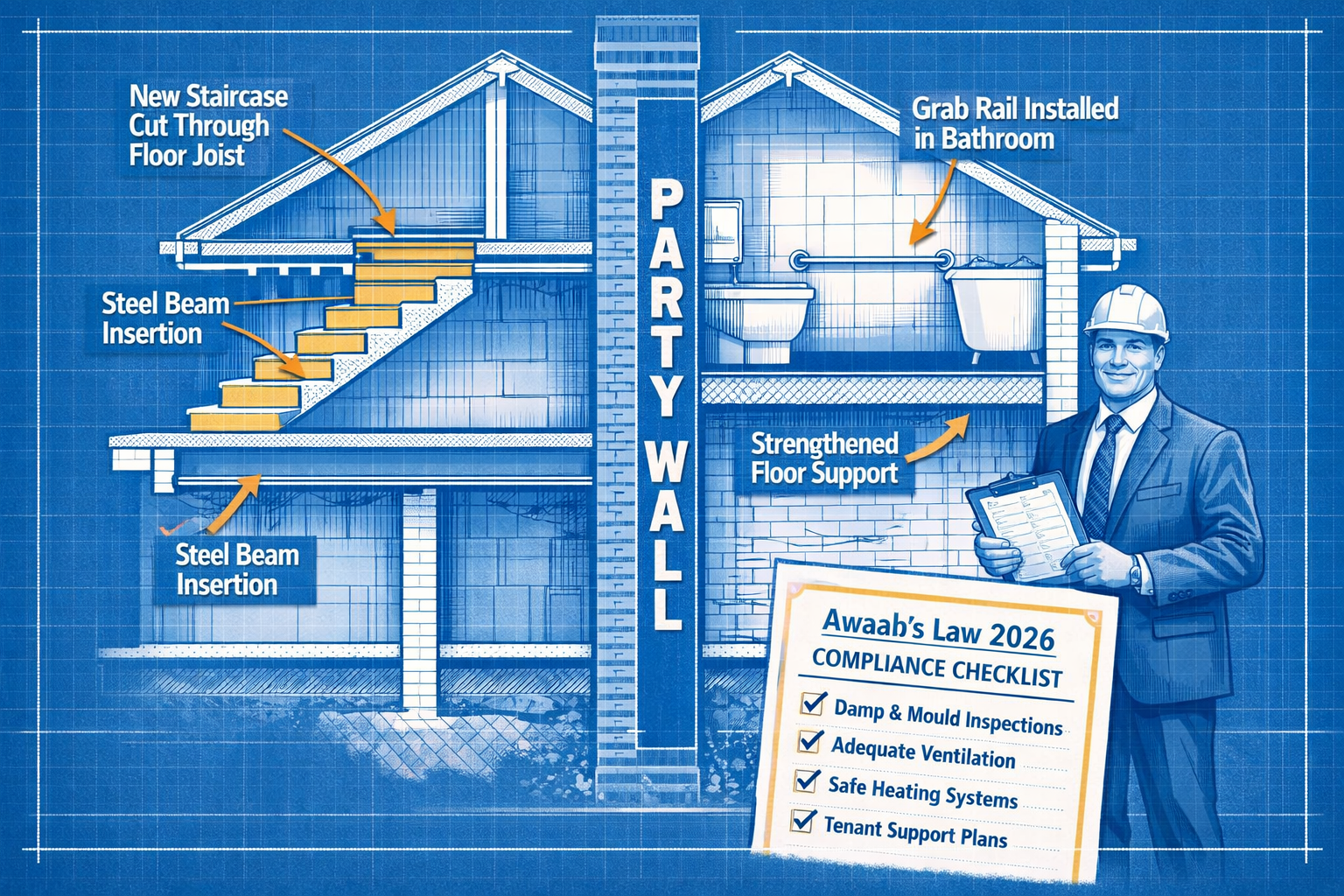
- Any structural modification to a party wall (such as fixing grab rails, widening doorways, or reinforcing stair structures) requires formal notice under the Party Wall etc. Act 1996.
- Social landlords face fines and enforcement action for non-compliance with Awaab's Law repair timelines [2].
- A party wall award can protect both the building owner and the adjoining owner during retrofit works.
- Early engagement with a qualified party wall surveyor is the single most effective way to avoid delays, disputes, and legal liability.
Understanding Awaab's Law and Its 2026 Expansion
What Awaab's Law Actually Requires
Awaab's Law was born from a tragic case: the death of two-year-old Awaab Ishak in 2020, caused by prolonged exposure to mould in a social housing flat. The legislation that bears his name imposes strict timelines on social landlords when tenants report hazardous conditions [3].
The core obligations are:
| Trigger | Requirement |
|---|---|
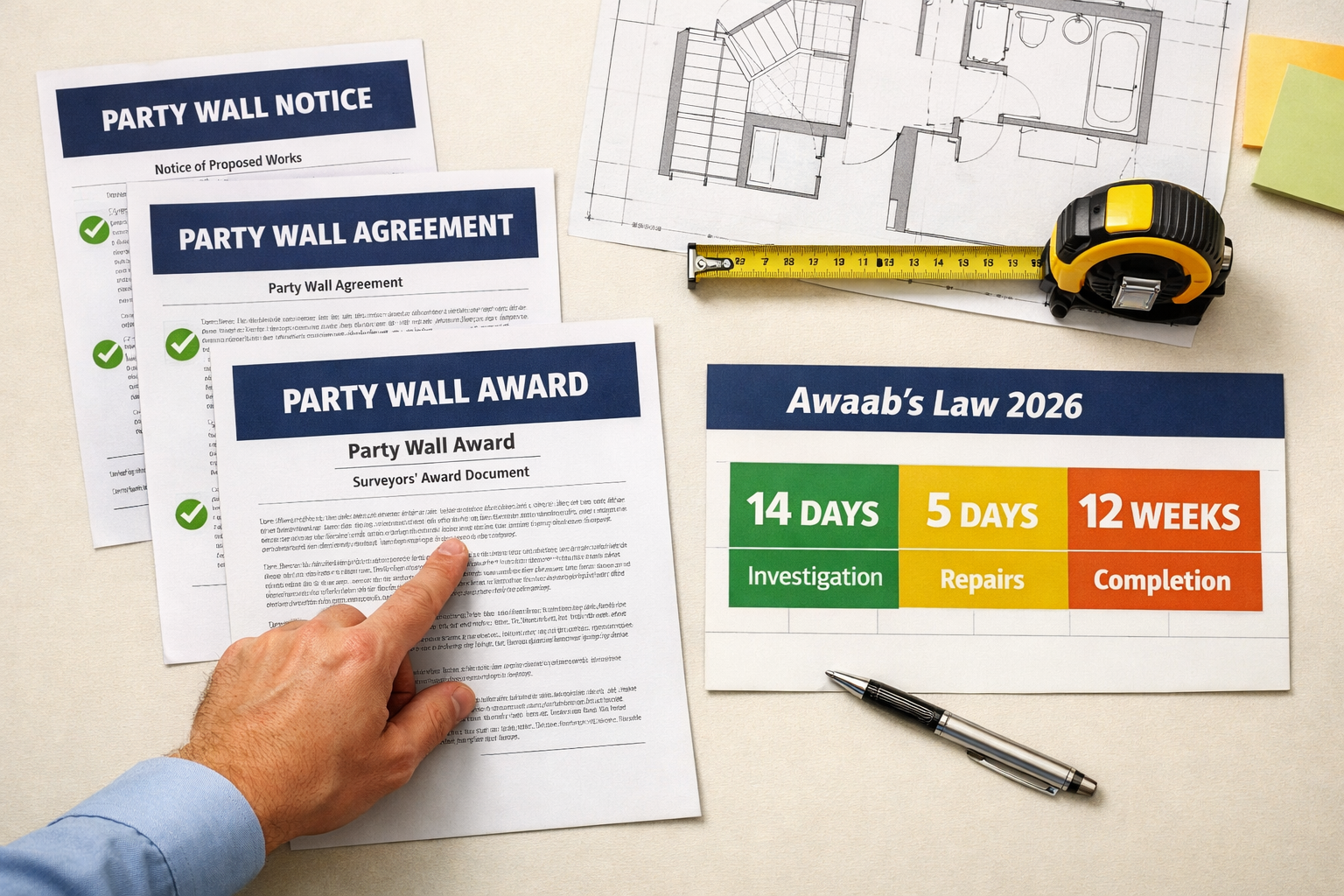
| Tenant reports a hazard | Landlord must investigate within 14 calendar days [2] |
| Investigation concludes hazard exists | Safety work must begin within 5 working days [3] |
| Work cannot be completed immediately | Preventative measures within 5 working days; full completion within 12 weeks [3] |
| Non-compliance | Fines and enforcement action [2] |
These timelines are non-negotiable. They apply regardless of whether the repair requires work on a party wall — a complication that many landlords have not yet factored into their compliance planning.
The 2026 Hazard Expansion: What It Means
The government's guidance confirms that in 2026, Awaab's Law will extend to additional hazards beyond damp and mould, where those hazards present a significant risk of harm [3]. While the specific hazards have not been exhaustively listed in current published guidance, the direction of travel is clear: the Housing Health and Safety Rating System (HHSRS) already identifies falls on stairs and falls on level surfaces (including wet bathroom floors) as Category 1 hazards.
💡 Pull Quote: "Landlords who assume Awaab's Law only covers mould are building their compliance strategy on a foundation that is already crumbling."
This means social landlords should be preparing now for the possibility that stair and bathroom fall hazards will trigger the same 14-day investigation and 5-working-day repair obligations that currently apply to damp [4]. The consequences of being caught unprepared — particularly when retrofit works touch a party wall — could be severe.
How Party Wall Law Intersects With Fall Hazard Retrofits
When Does a Retrofit Trigger the Party Wall etc. Act 1996?
The Party Wall etc. Act 1996 governs works to walls shared between neighbouring properties. Not every safety improvement will engage the Act — but many common fall hazard retrofits will. Understanding the party wall process step by step is essential before any works begin.
Retrofits that are likely to trigger the Act include:
- ✅ Installing structural grab rails or handrails anchored into a party wall
- ✅ Widening a stairwell or bathroom doorway that sits within or adjacent to a party wall
- ✅ Reinforcing floor joists near a party wall to support new stair structures
- ✅ Cutting into a party wall to install wet room drainage or level-access shower trays
- ✅ Any excavation within 3 metres of a neighbouring property's foundations (relevant for ground-floor bathroom conversions)
Retrofits unlikely to trigger the Act:
- ❌ Surface-mounted grab rails fixed only to internal walls
- ❌ Anti-slip flooring applied to existing surfaces
- ❌ Stair gate installation
- ❌ Lighting improvements
The distinction matters enormously. A landlord racing to meet a 5-working-day repair deadline under Awaab's Law cannot simply begin drilling into a party wall without first serving the correct notices.
The Notice Obligation: Timing Is Everything
Under the Party Wall etc. Act 1996, a party wall notice must be served on adjoining owners before works begin. The standard notice period is two months for party wall works, or one month for line of junction works. This creates an immediate tension with Awaab's Law's tight repair windows.
For landlords managing Party Wall Implications for Stair and Bath Fall Hazard Retrofits: Awaab's Law 2026 Survey Protocols, the practical solution lies in proactive planning:
- Audit the property before a hazard is formally reported — identify which retrofits would touch party walls.
- Pre-serve notices where works are anticipated, rather than waiting for a complaint.
- Seek adjoining owner consent promptly — if consent is given in writing, works can begin immediately without waiting for the notice period to expire.
For a detailed overview of party wall notice requirements and how to respond, landlords should consult qualified professionals early.
Drafting the Notice: Key Elements for Fall Hazard Works
A party wall notice for fall hazard retrofits should clearly describe:
- The nature of the hazard being addressed (e.g., HHSRS Category 1 fall risk)
- The specific works proposed (e.g., structural fixing of grab rail brackets into party wall at bathroom, first floor)
- The method of fixing and any load calculations
- The start date and estimated duration
- Reference to any Awaab's Law compliance obligation driving the urgency
Including the regulatory context in the notice can help adjoining owners understand why speed is necessary — and may encourage faster consent. Understanding what a party wall surveyor does in this context is vital for landlords who have not previously navigated the Act.
Survey Protocols for Party Wall Implications in Stair and Bath Fall Hazard Retrofits: Awaab's Law 2026 Compliance
The Schedule of Condition: Your First Line of Defence
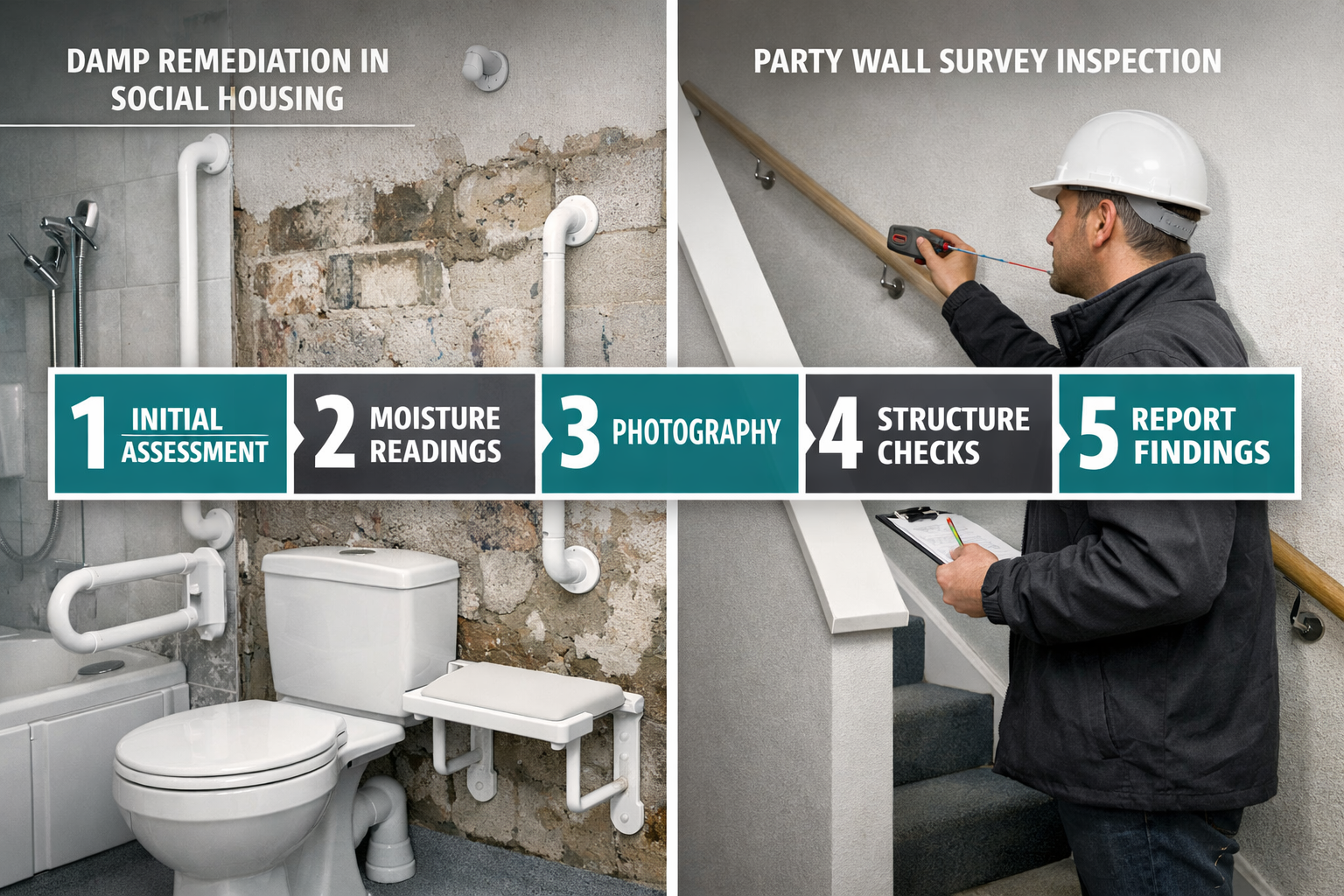
Before any fall hazard retrofit begins on or near a party wall, a Schedule of Condition should be prepared. This document records the existing state of the adjoining property — cracks, finishes, structural elements — so that any damage caused by the works can be clearly attributed and fairly resolved.
For bathroom and stair retrofits, the schedule should specifically capture:
- The condition of tiled surfaces on both sides of the party wall
- Any pre-existing cracking in plasterwork or masonry
- The state of stair strings, newel posts, and balustrading near the shared wall
- Existing dampness readings (particularly relevant given the damp/mould focus of Awaab's Law Phase 1)
A schedule of condition prepared by a qualified surveyor provides independent, dated evidence that protects both the building owner and the neighbour.
The Party Wall Award: Formalising the Agreement
Where an adjoining owner does not consent to proposed works — or where the works are complex — a Party Wall Award is the formal mechanism for resolving the position. The award sets out:
- Exactly what works are permitted
- The method and sequence of construction
- Hours of working
- How disputes about damage will be resolved
- Any security for expenses
For party wall award guidance specific to retrofit scenarios, engaging a surveyor with experience in both residential compliance and housing law is strongly recommended.
Structural Considerations Unique to Fall Hazard Retrofits
Fall hazard retrofits present specific structural challenges at party walls:
Stair retrofits:
- Reinforcing a staircase that runs parallel to a party wall may require new timber or steel elements to be fixed into the wall
- Load transfer calculations must confirm that new handrail fixings will not cause cracking or movement in the adjoining property
- Beam calculations may be needed where structural members span across or near the party wall
Bathroom retrofits:
- Installing a level-access shower or wet room often requires lowering the floor — which can affect the party wall's foundation depth
- Grab rail fixings into a party wall must be assessed for their impact on both sides of the wall
- Waterproofing membranes applied to a party wall surface can trap moisture and create new damp risks — directly counterproductive under Awaab's Law
Coordinating Awaab's Law Timelines With Party Wall Procedures
The most significant practical challenge in Party Wall Implications for Stair and Bath Fall Hazard Retrofits: Awaab's Law 2026 Survey Protocols is aligning two sets of legal timelines that were not designed with each other in mind.
Here is a practical coordination framework:
| Stage | Awaab's Law Timeline | Party Wall Action Required |
|---|---|---|
| Hazard reported by tenant | Day 0 | Begin property audit; identify party wall implications |
| Investigation period | Days 1–14 | Prepare draft party wall notice; contact adjoining owner informally |
| Investigation concludes | Day 14 | Serve formal party wall notice (or seek immediate consent) |
| Repair must begin | Day 14 + 5 working days | If consent given: works can begin. If not: appoint surveyor, begin award process |
| Full completion deadline | 12 weeks from investigation | Party wall award should be in place; works proceeding under award |
⚠️ Important: Where works cannot begin within 5 working days due to party wall notice periods, landlords should document their compliance efforts thoroughly. Demonstrating that notice was served promptly and that all reasonable steps were taken may be relevant to any enforcement assessment [2].
Choosing the Right Surveyor
Not all surveyors are equally equipped to handle the intersection of housing compliance law and party wall procedure. When selecting a professional for these cases, look for:
- RICS membership and experience with the Party Wall etc. Act 1996
- Familiarity with HHSRS hazard assessments
- Experience with social housing compliance frameworks
- Knowledge of structural engineering principles relevant to stair and bathroom retrofits
For those seeking qualified party wall surveyors with the right expertise, verifying credentials through RICS is a reliable starting point.
Practical Steps for Landlords and Managing Agents in 2026
The convergence of Awaab's Law's expanding scope and party wall obligations creates a compliance landscape that rewards preparation. Here are the most important actions to take now:
🏠 Before a Hazard Is Reported
- Commission a proactive HHSRS survey of all properties — identify stair and bathroom fall risks before they become formal complaints.
- Map party wall implications for each potential retrofit — know in advance which works will require notices.
- Build relationships with adjoining owners — a cooperative neighbour can give consent quickly when urgency arises.
- Prepare template party wall notices for common retrofit types (grab rails, wet rooms, stair reinforcement).
📋 When a Hazard Is Reported
- Begin the 14-day investigation clock immediately — do not delay acknowledgement.
- Simultaneously assess whether proposed remediation will affect a party wall.
- Serve party wall notices at the earliest possible opportunity.
- Commission a Schedule of Condition before any works begin.
🔧 During Works
- Ensure all works proceed strictly in accordance with the party wall award or written consent.
- Keep photographic records of all work affecting the party wall.
- Maintain communication with the adjoining owner throughout.
📁 After Works
- Obtain written confirmation from the adjoining owner that no damage has resulted.
- Update property records with details of the retrofit and party wall documentation.
- Review whether the completed works fully address the HHSRS hazard — partial remediation will not satisfy Awaab's Law [3].
Conclusion: Acting Before the Deadline Arrives
The expansion of Awaab's Law in 2026 is not a distant regulatory threat — it is an immediate compliance imperative for every social landlord with properties that share walls with neighbours. The intersection of housing hazard law and party wall procedure is complex, but it is navigable with the right professional support and early planning.
The key message is simple: waiting for a tenant to report a fall hazard before thinking about party wall implications is a strategy that will fail. The timelines imposed by Awaab's Law [3] leave no room for the two-month notice periods that party wall law typically requires — unless landlords have already done the groundwork.
Actionable Next Steps ✅
- Audit all properties now for HHSRS Category 1 fall hazards on stairs and in bathrooms.
- Identify which potential retrofits touch party walls and prepare notices in advance.
- Engage a qualified party wall surveyor with housing compliance experience — not after a hazard is reported, but today.
- Review your internal repair workflows to ensure Awaab's Law timelines are built into your maintenance management system.
- Consult the government's published guidance on Awaab's Law timeframes [3] and ensure your team understands the enforcement consequences of non-compliance [2].
For landlords and surveyors navigating this evolving landscape, understanding the full scope of party wall surveyor responsibilities — and how they apply to housing safety retrofits — is no longer optional. It is the foundation of responsible property management in 2026.
References
[1] Party Wall Notice Requirements For Prs Database Compliance Works Surveyor Tactics Post Renters Rights Act Registration In 2026 – https://nottinghillsurveyors.com/blog/party-wall-notice-requirements-for-prs-database-compliance-works-surveyor-tactics-post-renters-rights-act-registration-in-2026
[2] Awaabs Law Technical Compliance Hvac Ventilation – https://www.arm-environments.com/resources/awaabs-law-technical-compliance-hvac-ventilation
[3] Awaabs Law Guidance For Social Landlords Timeframes For Repairs In The Social Rented Sector – https://www.gov.uk/government/publications/awaabs-law-guidance-for-social-landlords/awaabs-law-guidance-for-social-landlords-timeframes-for-repairs-in-the-social-rented-sector
[4] Awaabs Law A Guide For Social And Private Landlords – https://cydinnovation.com/knowledge_hub/awaabs-law-a-guide-for-social-and-private-landlords/
