
Boundary disputes and party wall disagreements account for over 40% of all neighbour-related litigation in England and Wales, yet most never reach court. The difference between costly litigation and successful mediation often hinges on one critical factor: properly prepared expert witness valuations that comply with Civil Procedure Rules Part 35. When disputes over property boundaries, encroachments, or construction damage escalate to mediation, Expert Witness Valuations in Neighbour Dispute Settlements: Mediation Evidence and CPR Part 35 Compliance become the cornerstone of defensible settlement negotiations.
Understanding how to prepare and present valuation evidence that meets legal standards can save thousands in legal fees while achieving fair outcomes for all parties involved.
Key Takeaways
- 🏛️ Expert witnesses owe their primary duty to the court, not to the instructing party, ensuring independence and objectivity in all valuations
- 📋 CPR Part 35 compliance requires specific report elements including qualifications, methodology, evidence summary, and formal independence declarations
- ⚖️ Mediation evidence must be proportionate to the dispute value, with courts favoring single joint experts for smaller claims
- 🔍 Transparent methodology and unbiased language are essential for valuation reports to be admissible in settlement negotiations
- 💼 Written reports are the default format for expert evidence, with oral testimony requiring specific court direction
Understanding Expert Witness Valuations in Neighbour Dispute Settlements
What Makes an Expert Witness Different from a Regular Surveyor?
The distinction between a standard property surveyor and an expert witness is fundamental. While both may hold identical qualifications and technical expertise, an expert witness operates under a completely different set of obligations when providing evidence for dispute resolution.
The Overriding Duty to the Court 🏛️
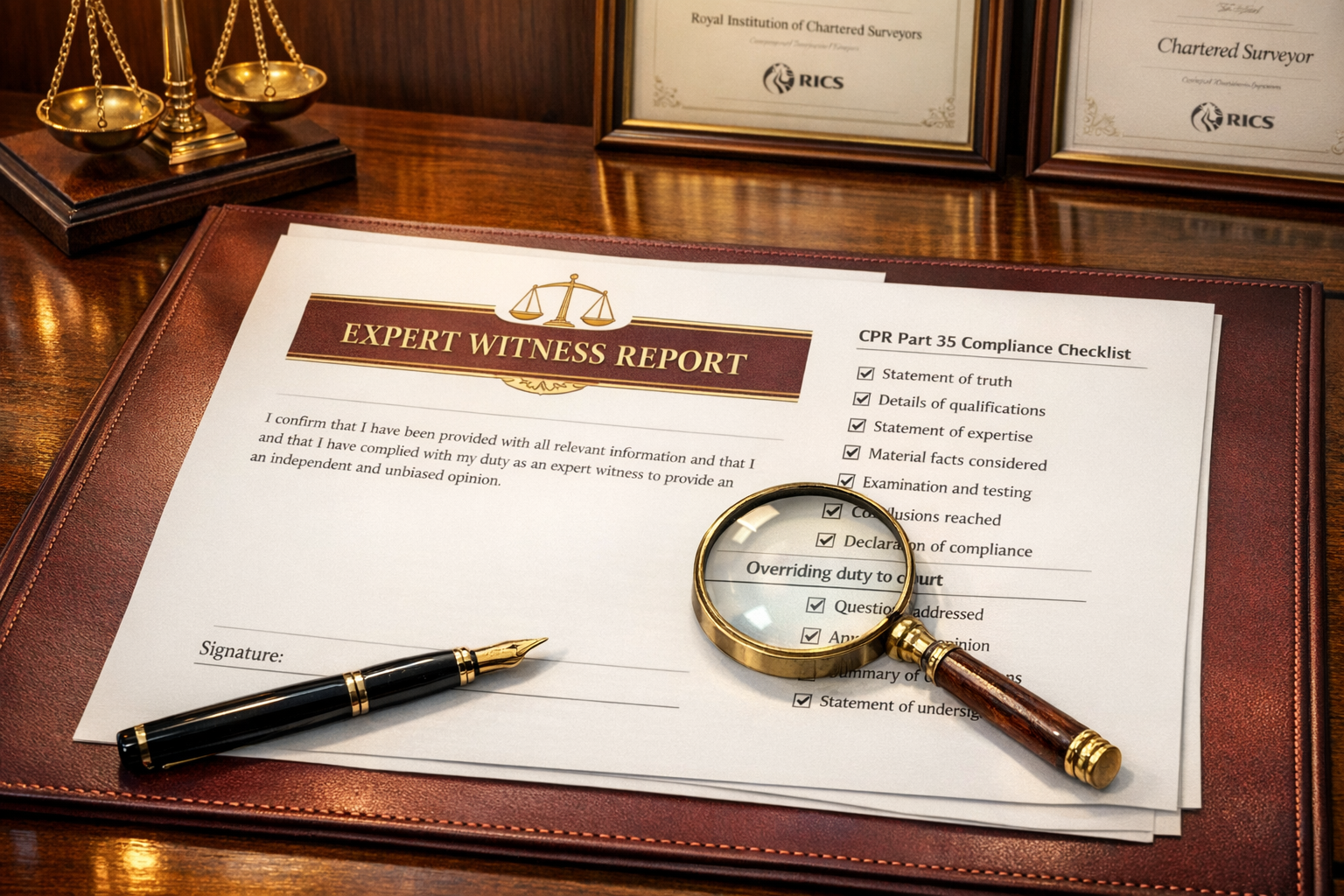
Under CPR 35.3, an expert witness's primary duty is to the court and this obligation overrides any duty to the instructing party or the person paying their fees [8]. This means that even if a neighbour instructs and pays for the valuation, the expert must remain completely independent and objective in their findings.
This independence requirement distinguishes expert witness work from standard RICS valuations where the surveyor acts primarily as an advisor to their client.
Key Characteristics of Expert Witness Valuations:
- Independence: Evidence must be uninfluenced by litigation pressures [3]
- Transparency: Full disclosure of methodology and assumptions
- Objectivity: Unbiased presentation regardless of which party benefits
- Competence: Evidence must fall within the expert's area of expertise [1]
Common Neighbour Disputes Requiring Expert Valuations
Expert witness valuations become necessary when neighbours cannot agree on the financial impact of various property-related issues:
| Dispute Type | Valuation Purpose | Typical Issues |
|---|---|---|
| Boundary Encroachment | Diminution in value | Land loss, access restriction, development potential impact |
| Party Wall Damage | Cost of repairs + consequential loss | Structural damage, decoration damage, temporary accommodation costs |
| Tree Root Damage | Property devaluation + remediation | Foundation damage, subsidence, ongoing monitoring costs |
| Right of Light | Loss of amenity value | Development blocking light, impact on property value |
| Noise/Nuisance | Diminution in value | Impact on marketability and sale price |
For disputes involving party wall works, expert valuations often focus on whether damage was caused by the works and the appropriate compensation.
The Role of Valuations in Mediation vs. Litigation
Mediation Context 🤝
In mediation, expert witness valuations serve as the factual foundation for settlement negotiations. Unlike court proceedings, mediation allows for more flexible presentation of evidence, but the underlying valuation must still meet CPR Part 35 standards to carry weight.
Benefits of compliant valuations in mediation:
- Provides neutral baseline for negotiations
- Reduces positional bargaining
- Enables parties to assess settlement offers objectively
- Can be used later in court if mediation fails
Litigation Context ⚖️
If mediation fails and the dispute proceeds to court, the same valuation evidence will face much stricter scrutiny. Courts have the power to exclude expert evidence that fails to comply with CPR Part 35 requirements [3].
CPR Part 35 Compliance Requirements for Expert Witness Valuations in Neighbour Dispute Settlements

Essential Elements of a Part 35 Compliant Report
The Civil Procedure Rules establish specific requirements that every expert witness report must contain. Failure to include these elements can result in the evidence being rejected or given reduced weight [1].
1. Statement of Truth and Independence Declaration ✍️
Every compliant report must include a formal declaration that:
- The expert understands their duty to the court
- They have complied with that duty
- The report contains their true and complete professional opinion [8]
The declaration typically reads: "I confirm that I have made clear which facts and matters referred to in this report are within my own knowledge and which are not. Those that are within my own knowledge I confirm to be true. The opinions I have expressed represent my true and complete professional opinions on the matters to which they refer."
2. Qualifications and Experience 🎓
The report must clearly state:
- Professional qualifications (e.g., MRICS, FRICS)
- Relevant experience in the specific type of valuation
- Number of similar cases previously handled
- Any specialist training or accreditation
For party wall disputes, demonstrating experience with the Party Wall Act 1996 adds credibility.
3. Instructions and Background 📋
The report must identify:
- Who instructed the expert
- The questions or issues to be addressed
- Factual background of the dispute
- Documents reviewed and site inspections conducted
4. Methodology and Assumptions 🔬
Transparency is critical. The report must explain:
- Valuation methodology employed (e.g., comparable sales, cost approach, income approach)
- Assumptions made and their justification
- Limitations or caveats
- Alternative approaches considered
5. Evidence Summary and Analysis 📊
Present all evidence in plain, unbiased language:
- Factual findings from inspections
- Market data and comparables
- Calculations with full workings shown
- Range of possible values where appropriate
6. Conclusions and Opinion 💡
The expert's professional opinion must:
- Address each question in the instructions
- Be clearly distinguished from factual statements
- Acknowledge any uncertainty or alternative interpretations
- Avoid advocacy for either party
What Courts Reject: Common Compliance Failures
Understanding what makes evidence inadmissible helps ensure your valuation meets standards:
❌ Advocacy Instead of Independence
Reports that read like arguments for one party rather than objective analysis will be rejected. The language must remain neutral throughout [3].
❌ Incomplete Methodology Disclosure
Failing to explain how values were calculated or which comparables were selected undermines credibility and transparency.
❌ Exceeding Expertise Boundaries
Experts must only opine on matters within their professional competence. A valuation surveyor should not, for example, offer structural engineering opinions without appropriate qualifications.
❌ Missing Independence Declaration
Without the formal statement of truth and duty to the court, the report fails basic compliance requirements [1].
Single Joint Expert vs. Party-Appointed Experts
The court considers proportionality when deciding whether parties should share a single joint expert or each appoint their own [7].
Single Joint Expert (SJE) 👥
Advantages:
- Cost-effective for smaller disputes
- Reduces adversarial positioning
- Faster resolution
- Court's preferred approach for straightforward valuations
Typically appointed when:
- Dispute value is under £25,000
- Technical issues are straightforward
- Parties agree on the expert's identity
Separate Party-Appointed Experts 🔀
Permitted when:
- Dispute value justifies additional cost
- Complex technical issues require different perspectives
- Significant sums at stake warrant independent review
- Parties fundamentally disagree on valuation approach
For complex party wall damage claims, courts may allow separate experts if the potential liability exceeds £50,000.
Preparing Defensible Valuation Evidence for Mediation in Neighbour Dispute Settlements
Valuation Methodologies for Different Dispute Types
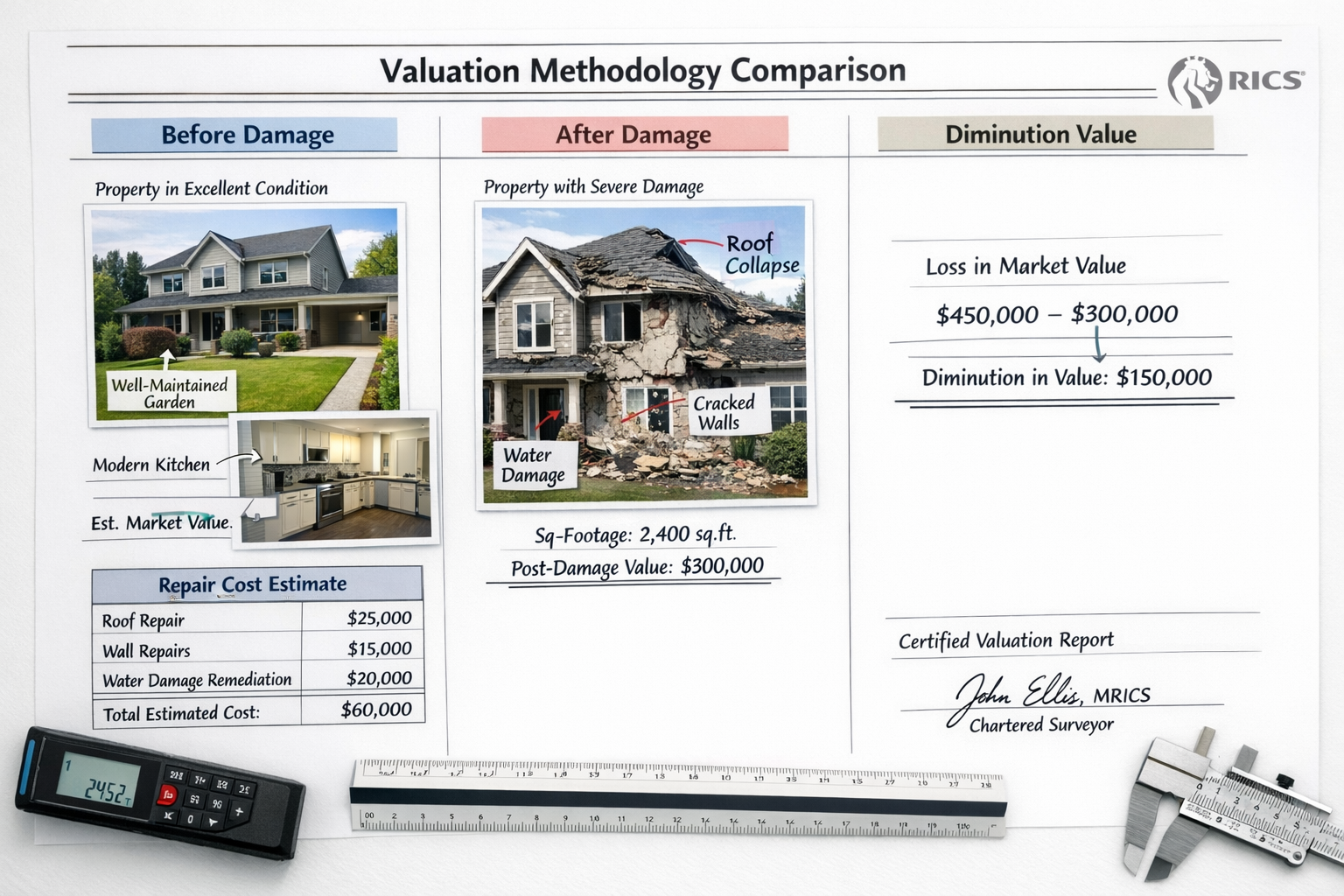
Selecting the appropriate valuation methodology is crucial for producing defensible evidence. Different dispute scenarios require different approaches.
Diminution in Value Approach 📉
Used when: Property has been devalued by neighbour's actions (encroachment, loss of light, etc.)
Method:
- Value property in its current diminished state
- Value property as it would be without the defect
- Calculate difference = diminution in value
Before and After Example:
- Property value without encroachment: £750,000
- Property value with 2-meter boundary encroachment: £720,000
- Diminution in value: £30,000
This approach requires robust comparable evidence for both scenarios, which can be challenging when the defect is unique.
Cost of Cure Approach 🔧
Used when: Physical damage has occurred requiring remediation
Method:
- Obtain detailed specifications for repair works
- Get competitive quotations from qualified contractors
- Add professional fees (surveyors, engineers)
- Include consequential losses (temporary accommodation, storage)
Typical Cost Breakdown:
- Structural repairs: £15,000
- Redecoration and finishes: £8,000
- Professional fees (15%): £3,450
- Temporary accommodation (3 months): £6,000
- Total claim: £32,450
For party wall damage, this approach often provides the most straightforward evidence.
Comparable Sales Analysis 🏘️
Used when: Assessing market value impact
Requirements:
- Minimum 3-5 comparable properties
- Sales within past 12 months
- Similar location, size, and condition
- Adjustments clearly explained and justified
Adjustment Factors:
- Size differential: ±£X per square meter
- Condition: ±5-15% depending on state
- Location: ±10-20% for micro-location differences
- Time: Indexed to current market conditions
Documentation and Evidence Gathering
The strength of your valuation depends entirely on the quality of underlying evidence. Thorough documentation is essential.
Site Inspection Records 📸
- Comprehensive photographs with measurements
- Detailed notes of observations
- Sketch plans showing damage locations
- Environmental factors affecting value
- Date and time of inspection clearly recorded
Market Evidence 📈
- Land Registry data for comparable sales
- Estate agent particulars and marketing materials
- Asking prices vs. achieved prices
- Days on market for comparables
- Market trends analysis for the specific area
Technical Reports 🔍
- Structural engineer reports (if structural damage involved)
- Building control records
- Planning permissions and building regulations
erts - Previous survey reports
- Party wall awards and schedules of condition
Financial Records 💰
- Actual repair quotations (not estimates)
- Invoices for completed works
- Rental loss calculations with tenancy agreements
- Alternative accommodation costs with receipts
Presenting Evidence in Plain Language
CPR Part 35 requires that expert reports use language that can be understood by non-specialists [1]. This doesn't mean "dumbing down" technical content, but rather explaining it clearly.
Before (Too Technical):
"The heave-induced differential settlement has manifested in Category 3 damage per BRE Digest 251, with progressive crack propagation indicating ongoing foundation movement attributable to desiccation of the clay substrate following vegetation removal."
After (Plain Language):
"The property has suffered serious cracking (Category 3 – requiring structural repairs) caused by ground movement. The clay soil beneath the foundations has swollen after the neighbour removed large trees, causing the building to lift unevenly. The damage is ongoing and requires foundation stabilization."
Tips for Clear Communication:
✅ Define technical terms on first use
✅ Use bullet points and tables for complex information
✅ Include photographs with clear annotations
✅ Explain "why" as well as "what"
✅ Summarize key findings at the beginning and end
✅ Use appendices for detailed technical data
Addressing Uncertainty and Alternative Scenarios
Professional integrity requires acknowledging uncertainty rather than presenting false precision [10].
Expressing Uncertainty Appropriately:
Instead of: "The diminution in value is £47,350"
Better: "Based on available comparable evidence, the diminution in value is estimated at £45,000-£50,000, with a mid-point figure of £47,500 representing the most likely value."
Scenario Analysis 🎯
For complex disputes, presenting multiple scenarios strengthens credibility:
| Scenario | Assumptions | Valuation |
|---|---|---|
| Best Case | Damage fully repairable, no lasting impact | £12,000 |
| Most Likely | Repairs effective but minor residual concerns | £18,500 |
| Worst Case | Ongoing monitoring required, marketability affected | £28,000 |
This approach gives mediators and parties a realistic range for settlement negotiations.
The Mediation Process and Expert Evidence
How Expert Valuations Facilitate Settlement
In mediation, the expert's role extends beyond simply providing a number. The valuation becomes a tool for breaking deadlock and finding common ground.
Pre-Mediation Preparation 📝
- Exchange expert reports at least 14 days before mediation
- Identify areas of agreement and disagreement
- Prepare questions for the opposing expert
- Brief the mediator on technical issues
During Mediation 🤝
Experts may be asked to:
- Present their findings to both parties jointly
- Explain technical concepts in accessible terms
- Engage in "without prejudice" discussions with the opposing expert
- Narrow the range of dispute through professional dialogue
Expert Conferencing (Hot-Tubbing) 💬
This process involves both experts meeting to:
- Identify common ground
- Clarify differences in methodology or assumptions
- Agree on facts versus opinions
- Potentially produce a joint statement
Research shows that expert conferencing reduces the range of dispute by an average of 40-60% in property valuation cases [4].
Proportionality and Cost Management
The cost of expert evidence must be proportionate to the dispute value. Courts and mediators increasingly scrutinize excessive expert costs [7].
Proportionality Guidelines:
| Dispute Value | Reasonable Expert Costs |
|---|---|
| Under £10,000 | £1,500-£3,000 |
| £10,000-£25,000 | £3,000-£6,000 |
| £25,000-£100,000 | £6,000-£15,000 |
| Over £100,000 | £15,000-£30,000+ |
These figures include report preparation, site visits, and attendance at mediation. Excessive costs may not be recoverable even if a party succeeds.
Cost-Saving Strategies:
💰 Agree on a Single Joint Expert – Splits costs and avoids duplication
💰 Limit the Scope – Focus on key valuation issues only
💰 Use Written Questions – Instead of requiring attendance at mediation
💰 Sequential Appointments – Second expert only if first report disputed
For straightforward party wall matters, a single joint expert approach typically provides sufficient evidence at reasonable cost.
Written Reports vs. Oral Evidence
The Default Position: Written Reports
CPR 35.5 establishes that expert evidence should be given by written report unless the court directs otherwise [8]. This reflects the practical reality that written reports:
- Allow parties time to consider and respond to evidence
- Create a permanent record of the expert's opinion
- Are more cost-effective than oral testimony
- Enable easier comparison between competing experts
Essential Written Report Structure:
- Executive Summary (1-2 pages)
- Instructions and Background (2-3 pages)
- Qualifications and Experience (1 page)
- Methodology (2-4 pages)
- Evidence and Analysis (5-10 pages)
- Conclusions and Opinion (2-3 pages)
- Appendices (supporting documents, photographs, calculations)
- Declaration and Statement of Truth (1 page)
A typical expert witness valuation report for a neighbour dispute ranges from 15-30 pages depending on complexity.
When Oral Evidence May Be Required
Courts may direct oral expert testimony when:
🎤 Complex Technical Issues require explanation beyond written words
🎤 Significant Dispute Value justifies the additional cost
🎤 Cross-Examination Necessary to test the expert's methodology
🎤 Credibility Questions arise regarding the written evidence
Preparing for Oral Testimony:
- Review your report thoroughly before attending
- Anticipate challenges to methodology and assumptions
- Prepare visual aids (charts, photographs, diagrams)
- Practice explaining technical concepts in plain language
- Remain calm and professional under cross-examination
- Never deviate from your written report without good reason
For most neighbour disputes resolved through mediation, oral testimony is unnecessary if the written report is comprehensive and clear.
Practical Steps for Instructing an Expert Witness
Selecting the Right Expert
Not all qualified surveyors make effective expert witnesses. Look for:
✅ Relevant Qualifications – MRICS or FRICS with valuation specialism
✅ Expert Witness Training – Formal CPR Part 35 training completed
✅ Relevant Experience – Previous expert witness appointments in similar disputes
✅ Independence – No prior relationship with either party
✅ Availability – Can meet mediation/court timescales
✅ Communication Skills – Able to explain technical matters clearly
Check credentials through the RICS directory and request CVs and examples of previous expert reports.
Letter of Instruction
Clear instructions are essential for obtaining useful evidence. Your letter should specify:
Essential Elements:
📄 Parties and Property – Full details of both properties and owners
📄 Dispute Background – Chronology of events leading to dispute
📄 Specific Questions – Precise valuation issues to address
📄 Documents Provided – List all materials supplied
📄 Access Arrangements – Inspection dates and contact details
📄 Timescales – Report deadline and mediation date
📄 Budget – Fee estimate and payment terms
Sample Instruction Questions:
- What was the market value of [Property A] immediately before [incident date]?
- What is the current market value of [Property A] given [the defect]?
- What is the diminution in value caused by [the defect]?
- What is the reasonable cost of remedying [the damage]?
- What consequential losses have been incurred?
For party wall disputes, instructions should reference the relevant sections of the Party Wall Act 1996 and any existing party wall awards.
Understanding Expert Fees and Billing
Expert witness fees typically comprise:
| Fee Component | Typical Rate | Notes |
|---|---|---|
| Initial Review | £200-£400 | Conflict check and preliminary advice |
| Site Inspection | £500-£1,000 | Including travel and photography |
| Report Preparation | £150-£300/hour | 10-20 hours typical |
| Report Review/Amendments | £150-£300/hour | 2-4 hours typical |
| Mediation Attendance | £1,500-£3,000/day | Full day rate |
| Court Attendance | £2,000-£5,000/day | Includes preparation |
Most experts require:
- Initial retainer (typically 50% of estimated fees)
- Balance on delivery of report
- Additional fees for attendance agreed in advance
Ensure fee agreements are in writing and understand what is included before instructing.
Common Pitfalls and How to Avoid Them
Pitfall 1: Instructing Too Late ⏰
The Problem: Many parties only instruct an expert weeks before mediation or trial, leaving insufficient time for proper investigation.
The Solution: Instruct experts early in the dispute process. Ideally:
- Initial expert consultation: Within 1 month of dispute arising
- Formal instruction: 3-4 months before mediation
- Report delivery: 6-8 weeks before mediation
Early instruction allows time for thorough investigation and potential settlement before formal proceedings.
Pitfall 2: Providing Incomplete Information 📋
The Problem: Experts can only opine on the information provided. Missing documents or restricted access undermines the valuation.
The Solution: Provide comprehensive documentation including:
- Title deeds and Land Registry plans
- Previous surveys and valuations
- Planning permissions and building control records
- Correspondence between parties
- Photographs and contemporaneous notes
- Any existing party wall awards
Pitfall 3: Seeking Advocacy Rather Than Objectivity ⚖️
The Problem: Instructing parties sometimes pressure experts to support their position rather than provide independent opinion.
The Solution: Understand that expert witnesses serve the court, not the paying party. An expert who provides biased evidence:
- Violates professional standards
- Risks having evidence excluded
- May face disciplinary action from RICS
- Damages your case more than helps it
Choose experts who demonstrate independence and resist any pressure to slant findings.
Pitfall 4: Ignoring Proportionality 💷
The Problem: Spending £15,000 on expert evidence for a £20,000 claim is disproportionate and may not be recoverable.
The Solution:
- Consider a single joint expert for smaller disputes
- Agree limited scope instructions
- Use written questions rather than requiring attendance
- Assess cost-benefit before instructing
Courts increasingly penalize parties who incur disproportionate expert costs, even if they win the substantive dispute [7].
Pitfall 5: Poor Communication with Your Expert 📞
The Problem: Failing to keep experts updated on developments or restricting their access to information.
The Solution:
- Maintain regular contact throughout the process
- Provide updates on new evidence or changed circumstances
- Respond promptly to expert queries
- Allow reasonable access to properties for inspection
- Brief experts fully before mediation or court attendance
Integration with Party Wall Procedures
Many neighbour disputes involve party wall matters where specific statutory procedures apply alongside general dispute resolution.
When Party Wall Act Meets CPR Part 35
The Party Wall Act 1996 creates its own dispute resolution mechanism through party wall surveyors. However, when disputes escalate beyond the Act's scope or involve claims for damages, CPR Part 35 expert evidence becomes necessary.
Overlapping Scenarios:
🏗️ Damage Claims – Party wall surveyor determines whether damage occurred; valuation expert quantifies compensation
🏗️ Award Challenges – Expert evidence may be needed to challenge a party wall award in court
🏗️ Consequential Loss – Beyond the party wall surveyor's remit, requiring separate valuation
🏗️ Negligence Claims – Against building owners or their surveyors
For more details on party wall procedures, see our guide on what party wall surveyors do.
Using Party Wall Awards as Evidence
Existing party wall awards can provide valuable evidence for expert witnesses:
- Schedule of Condition – Baseline for damage assessment
- Agreed Works – Scope of what was authorized
- Previous Valuations – Historical property values
- Surveyor Correspondence – Timeline of events and concerns raised
However, party wall awards are not binding in subsequent court proceedings and can be challenged with proper expert evidence.
Regional Considerations and Local Expertise
Why Local Knowledge Matters
Property valuation is inherently location-specific. An expert with local market knowledge provides more credible evidence than one unfamiliar with the area.
Local Factors Affecting Valuations:
🏘️ Micro-Market Variations – Values can vary 20%+ within a single postcode
🏘️ Development Trends – Regeneration or decline affecting future values
🏘️ Transport Links – Impact of new infrastructure on desirability
🏘️ School Catchments – Significant value driver in family areas
🏘️ Conservation Areas – Restrictions affecting development potential
For London disputes, consider local chartered surveyors with specific neighborhood expertise.
Geographic Scope of Expertise
Expert witnesses should clearly define their geographic competence:
✅ Primary Area – Where they have extensive transaction experience
✅ Secondary Area – Where they have good market knowledge
❌ Outside Competence – Where they lack sufficient comparable evidence
An expert should decline instructions outside their geographic expertise or clearly caveat their opinion accordingly [10].
Future Trends in Expert Witness Valuations
Technology and Digital Evidence
The landscape of expert witness evidence is evolving with technology:
Emerging Tools:
📱 Digital Site Documentation – 360° photography and drone surveys
📱 Automated Valuation Models (AVMs) – Supporting (not replacing) expert opinion
📱 Virtual Inspections – Video calls for initial assessments
📱 Blockchain Property Records – Immutable transaction history
📱 AI-Assisted Comparable Selection – Faster market analysis
However, CPR Part 35 requirements remain unchanged – technology must support, not replace, expert professional judgment [10].
Increased Scrutiny of Expert Evidence
Courts are applying stricter scrutiny to expert evidence:
- Daubert-Style Challenges – Testing reliability of methodology
- Cost Budgeting – Limiting recoverable expert fees
- Expert Witness Immunity – Recent cases limiting protection from negligence claims
- Professional Conduct – RICS increasing disciplinary actions for non-compliance
Experts must maintain higher standards of professionalism and compliance than ever before.
Conclusion
Expert Witness Valuations in Neighbour Dispute Settlements: Mediation Evidence and CPR Part 35 Compliance represent a specialized intersection of property valuation, legal procedure, and dispute resolution. Success in mediation and litigation depends on understanding and implementing the rigorous standards that govern expert evidence.
Key Success Factors
✅ Independence First – Remember the overriding duty to the court supersedes all other obligations
✅ Transparent Methodology – Fully disclose how valuations were calculated and what assumptions were made
✅ Proportionate Approach – Match the scope and cost of expert evidence to the dispute value
✅ Clear Communication – Present technical evidence in language accessible to non-specialists
✅ Comprehensive Documentation – Support every opinion with robust underlying evidence
✅ Professional Integrity – Acknowledge uncertainty and alternative interpretations honestly
Actionable Next Steps
If you're involved in a neighbour dispute requiring expert valuation evidence:
- Assess Proportionality – Determine whether the dispute value justifies expert costs
- Instruct Early – Allow 3-4 months before mediation for proper investigation
- Choose Wisely – Select an expert with relevant qualifications, experience, and local knowledge
- Provide Complete Information – Supply all relevant documents and ensure property access
- Understand CPR Part 35 – Familiarize yourself with compliance requirements
- Consider Single Joint Expert – For disputes under £25,000, this is usually most cost-effective
- Maintain Communication – Keep your expert updated throughout the process
Professional Support
For neighbour disputes involving property valuations, party wall matters, or boundary issues, engaging qualified professionals early can prevent disputes escalating to costly litigation. Whether you need a party wall surveyor, RICS valuation, or expert witness services, ensure they have demonstrable CPR Part 35 compliance experience.
The investment in properly prepared expert evidence typically pays for itself through faster settlement, reduced legal costs, and more favorable outcomes. In 2026, with courts increasingly focused on proportionality and efficiency, the quality of expert evidence has never been more important to successful dispute resolution.
References
[1] Part 35 Compliant Expert Witness Report – https://prohort.co.uk/part-35-compliant-expert-witness-report/
[2] Construction Expert Witness – https://arbicon.co.uk/services/construction-expert-witness
[3] What Is An Expert Witnesses Part 35 – https://www.jonathanlea.net/blog/what-is-an-expert-witnesses-part-35/
[4] Expert Evidence – https://www.brownejacobson.com/insights/expert-evidence
[5] The Responsibilities Of An Expert Witness Under Civil Procedure Rules Part 35 – https://paramedic-expert.com/the-responsibilities-of-an-expert-witness-under-civil-procedure-rules-part-35/
[6] Valuation Reports For Uk Restructuring Plans Must Comply With Formal Requirements – https://www.kirkland.com/publications/kirkland-alert/2024/11/valuation-reports-for-uk-restructuring-plans-must-comply-with-formal-requirements
[7] Pd Part35 – https://www.justice.gov.uk/courts/procedure-rules/civil/rules/part35/pd_part35
[8] Part35 – https://www.justice.gov.uk/courts/procedure-rules/civil/rules/part35
[9] Residential Buildings – https://www.jspubs.com/expert-witness/si/r/residential-buildings/
[10] Surveyors%20acting%20as%20expert%20witnesses Feb2023amend – https://www.rics.org/content/dam/ricsglobal/documents/standards/Surveyors%20acting%20as%20expert%20witnesses_Feb2023amend.pdf
