
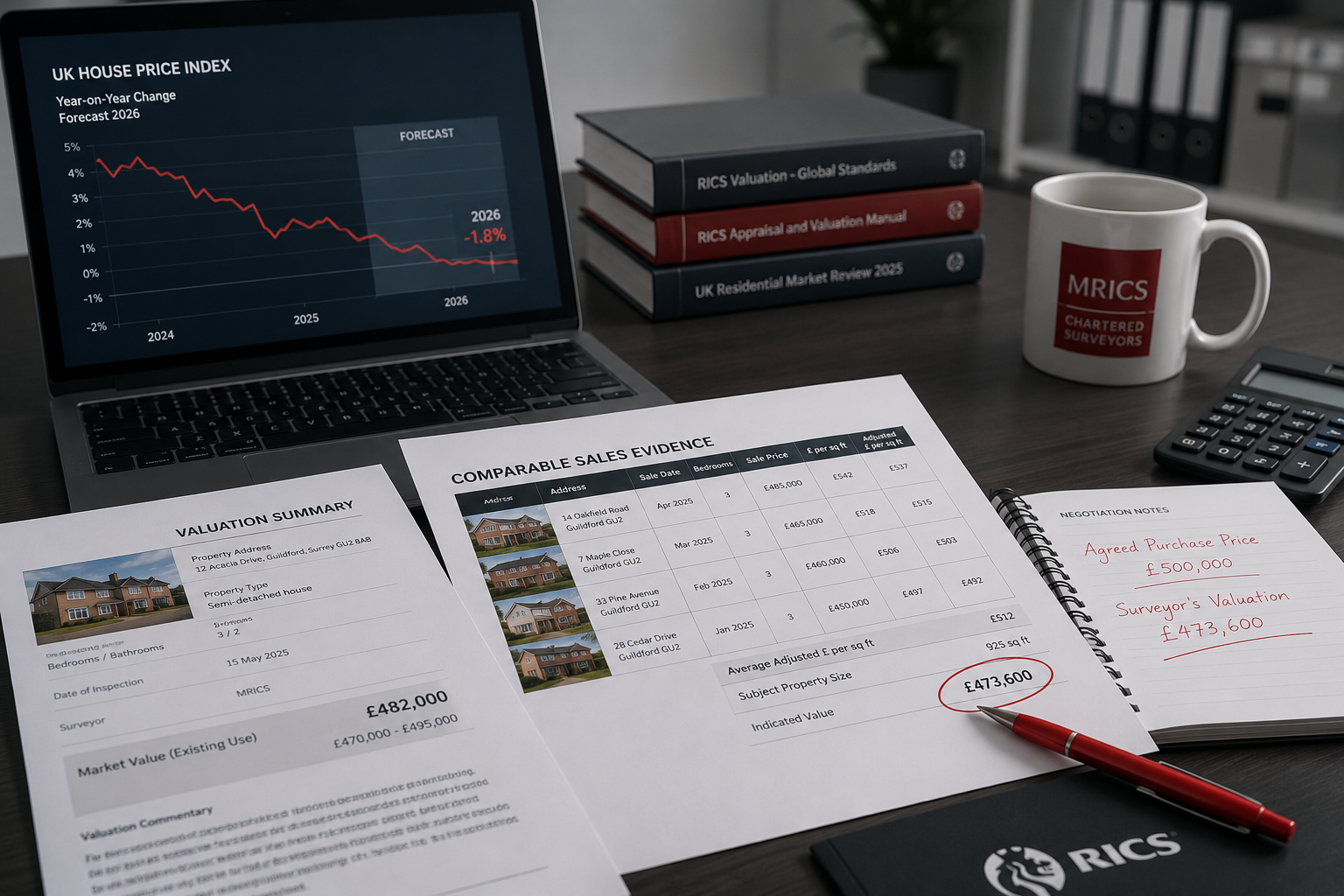
Roughly one in five mortgage valuations in the UK currently comes in below the agreed purchase price — a figure that has remained stubbornly elevated even as interest rates have begun to ease from their 2023 peak. For buyers who believed they had secured their dream home, a down-valuation can feel like the ground shifting beneath them. For lenders, it is a risk-management mechanism. For surveyors, it is a professional judgement call made under significant market pressure.
Understanding Down-Valuations and Mortgage Offers: How Surveyors Navigate Price Uncertainty in the 2026 Recovery is essential for anyone active in the UK property market right now. This article examines why valuers conclude a property is worth less than the agreed price, how the cautious 2026 market environment shapes those decisions, and what borrowers, agents, and lenders can realistically do when a down-valuation occurs.
Key Takeaways
- Down-valuations occur when a mortgage surveyor's assessed value falls below the agreed purchase price, reducing the loan a lender will offer.
- In 2026, surveyors remain cautious despite easing rates, relying on completed sales data rather than current market sentiment, which often produces conservative figures.
- Buyer demand weakened in February 2026, with RICS reporting a net balance of -26%, compounding the scarcity of comparable sales data that surveyors need.
- Borrowers have several practical options when a down-valuation occurs: renegotiate the price, challenge the valuation with evidence, increase the deposit, or walk away.
- Automated Valuation Models (AVMs) are proving less reliable in the volatile 2026 market, making RICS-qualified surveyors' real-time intelligence more valuable than ever.
What Is a Down-Valuation and Why Does It Matter in 2026
A down-valuation happens when the surveyor appointed by a mortgage lender assesses a property at a figure lower than the price the buyer and seller have agreed. The lender then bases its loan offer on the surveyor's figure, not the agreed price. If a buyer has agreed to pay £400,000 but the surveyor values the property at £375,000, the lender will typically offer a mortgage calculated on £375,000. The buyer must either find the £25,000 shortfall from savings, renegotiate the price downward, or abandon the purchase.
This matters enormously in the 2026 recovery because the gap between asking prices and surveyor valuations has widened. Sellers, encouraged by the post-2021 price surge, often hold firm on ambitious prices. Surveyors, shaped by the volatility of 2023 and 2024, are applying a protective discount that reflects their mandate: to value a property at the price it would achieve in an open market between a willing buyer and a willing seller — not the price one motivated buyer is prepared to pay today [1].
Key distinction: A surveyor is not assessing what a property is worth to you. They are assessing what it would sell for if the lender had to repossess and sell it within a reasonable timeframe.
Why Surveyors Are Still Cautious Despite Easing Mortgage Rates
The expectation in late 2025 was that falling mortgage rates would unlock demand and push valuations upward. The reality in 2026 has been more complicated.
The Data Lag Problem
Surveyors rely on completed sales data — transactions that have exchanged contracts and been registered with the Land Registry. This data typically lags the market by three to six months. When the market is moving quickly upward, this lag causes surveyors to undervalue. When the market is recovering tentatively, as in 2026, the lag means surveyors are anchoring to prices from a period of greater uncertainty. The result is conservative valuations even when current sentiment is improving [1].
Downside Risk Protection
Lenders instruct surveyors to consider not just what a property is worth today, but what it might be worth if the borrower defaults and the lender needs to sell quickly. This downside risk weighting became more pronounced after the rate shocks of 2022-2023, and surveyors have not abandoned it simply because the Bank of England has trimmed its base rate [1].
Mortgage Rates Climbing Back Above 5%
By March 2026, many fixed-rate mortgage products had crept back above 5%, reversing some of the relief buyers had anticipated. Higher rates reduce affordability, which in turn reduces the pool of buyers who could purchase a property at any given price. Surveyors factor in this reduced buyer pool when assessing sustainable market value [3].
"Surveyors increasingly differentiate between a property's current market appeal and its sustainable value — considering factors like potential resale challenges under different market conditions." [1]
This distinction between saleability and value is at the heart of why a property that attracts multiple viewings can still receive a down-valuation. Strong interest from buyers does not guarantee that those buyers could secure mortgages at the agreed price.
The Market Data Behind Down-Valuations and Mortgage Offers: How Surveyors Navigate Price Uncertainty in the 2026 Recovery
Understanding the data environment surveyors are working in helps explain their caution.
RICS February 2026 Sentiment Data
RICS's February 2026 survey painted a sobering picture. Buyer demand weakened significantly, with surveyors reporting a net balance of -26%, down from -15% in January. Agreed sales also slipped, moving from -9% to -12% [2]. These figures indicate that while sellers may be holding firm on price, buyers are pulling back — a divergence that creates exactly the conditions in which down-valuations flourish.
London's Cooling Prime Market
The London market has experienced particularly sharp adjustments. Prime transactions fell approximately 30% year-on-year, with over half of properties seeing price reductions [5]. In areas where comparable sales are sparse and price movements are uneven, surveyors have even less data to support higher valuations. Buyers considering flats in London's cooling market should be especially prepared for the possibility of a down-valuation.
For buyers in specific London areas, working with local chartered surveyors in West London or chartered surveyors in Chelsea who understand hyperlocal price movements can provide a more nuanced valuation picture.
Regional Price Divergence
One of the defining features of the 2026 market is that it is not behaving uniformly. Some regional markets are recovering faster than others. Surveyors operating in areas with limited transaction volumes face the hardest task: they must value properties using comparables from neighbouring areas or older transactions, both of which introduce inaccuracy [7]. This regional divergence means a down-valuation in one postcode may reflect genuine market softness, while in another it may reflect a data gap rather than a true price ceiling.
| Market Condition | Surveyor Response | Risk of Down-Valuation |
|---|---|---|
| Strong comparable sales data | Valuation closer to agreed price | Lower |
| Limited recent transactions | Conservative default valuation | Higher |
| Regional price divergence | Reliance on wider area data | Moderate to High |
| High buyer demand but low completions | Demand discounted; completions weighted | Higher |
| Stabilising prices with clear trend | Graduated adjustment applied | Moderate |
How Surveyors Actually Arrive at a Valuation Figure
The methodology behind a mortgage valuation is more structured than many buyers realise. RICS-qualified surveyors follow a defined process that includes:
1. Comparable evidence analysis — identifying recent sales of similar properties in the same area. The closer the comparable in terms of size, condition, location, and sale date, the more weight it carries.
2. Adjustment for differences — if the best comparable is a three-bedroom house that sold for £350,000 but the subject property has a larger garden or a loft conversion, the surveyor applies a reasoned adjustment. These adjustments must be defensible [7].
3. Market conditions weighting — current RICS guidance requires surveyors to note whether the market is rising, falling, or stable, and to reflect this in their valuation. In an uncertain recovery, surveyors tend to apply a cautious weighting [7].
4. Condition and defect assessment — a mortgage valuation is not the same as a full building survey, but surveyors do note significant defects that could affect value or saleability. For a thorough understanding of what surveyors look for in a house survey, buyers should review the relevant guidance before their valuation takes place.
5. Automated Valuation Model cross-check — many lenders run an AVM alongside the physical valuation. However, in the volatile spring 2026 market, AVMs have shown significant limitations due to their reliance on historical data. RICS-qualified surveyors' real-time market intelligence consistently outperforms algorithmic models in fast-moving or data-sparse markets [4].
What Borrowers, Agents, and Lenders Can Do When a Down-Valuation Occurs
A down-valuation is not necessarily the end of a transaction. There are several realistic options, each with trade-offs.
Option 1: Renegotiate the Purchase Price
The most straightforward response is to use the surveyor's figure as leverage to renegotiate. If the seller is motivated and the down-valuation is supported by clear comparable evidence, many sellers will accept a reduced price rather than lose the sale and restart the process. Estate agents often facilitate this conversation.
Practical tip: Present the down-valuation report to the seller's agent in writing. Verbal renegotiations are harder to pin down.
Option 2: Challenge the Valuation
Buyers have the right to challenge a down-valuation by providing additional comparable evidence. This might include recent sales that the surveyor did not use, or evidence of unique features that justify a premium. The challenge must go through the lender, who will refer it back to the surveyor or commission a second opinion.
A successful challenge requires:
- Comparable sales within the last three months
- Properties that closely match in size, type, and location
- Evidence of any improvements that add measurable value
Option 3: Increase the Deposit
If the buyer has access to additional funds, they can bridge the gap between the surveyor's figure and the agreed price from savings. This maintains the purchase at the agreed price but requires the buyer to accept that they are paying above the lender's assessed value — a risk worth considering carefully.
Option 4: Commission an Independent Survey
An independent RICS home survey or a Level 3 building survey can provide a more detailed assessment of the property's condition and value. While this does not override the lender's mortgage valuation, it gives the buyer independent evidence to support a challenge or to make an informed decision about whether the agreed price is genuinely justified.
For buyers unsure which level of survey is appropriate, a comparison of Level 2 vs Level 3 surveys can help clarify the right choice.
Option 5: Walk Away
If the seller will not renegotiate, the buyer cannot bridge the gap, and the challenge fails, walking away may be the most financially prudent decision. Paying significantly above a lender's assessed value means starting with negative equity — a position that can take years to recover from, particularly in a market where prices are not rising sharply.
The Role of Surveyors in Managing Lending Risk During the 2026 Recovery
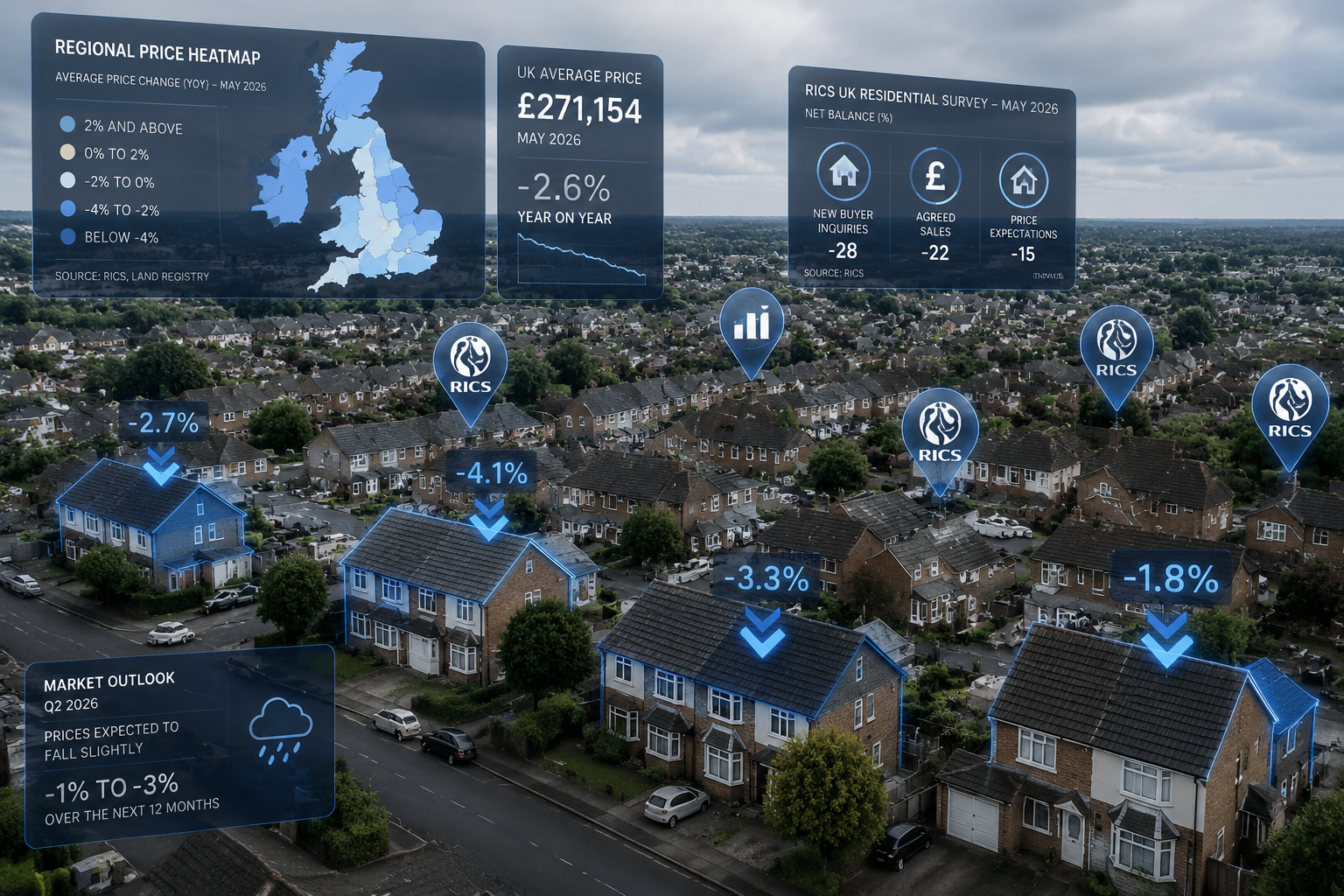
The relationship between surveyors and lenders is often misunderstood by buyers. The surveyor appointed for a mortgage valuation works for the lender, not the buyer. Their primary function is to protect the lender's security interest in the property [6].
This does not mean surveyors are adversarial toward buyers. It means their mandate is specifically calibrated to identify downside risk. In the cautious 2026 housing market, surveyors' insights are crucial for lenders to manage risk, as they provide real-time, ground-level property market intelligence that automated models may miss [6].
For buyers who want independent advice that serves their interests rather than the lender's, commissioning a separate homebuyer survey is strongly recommended. A homebuyer survey provides a condition assessment and an independent market valuation that can either support or challenge the lender's figure.
The Surveyor's Dilemma
Surveyors face a genuine professional tension in a recovering market. Valuing too conservatively risks killing transactions unnecessarily and suppressing market recovery. Valuing too generously risks exposing lenders to losses if prices correct again. RICS guidance attempts to navigate this tension by requiring surveyors to reflect actual market evidence rather than sentiment — but in a market with limited comparable data, professional judgement inevitably plays a larger role [7].
Down-Valuations and Mortgage Offers: How Surveyors Navigate Price Uncertainty in the 2026 Recovery — Regional Considerations
Geography matters significantly when assessing down-valuation risk. The 2026 market is characterised by sharp regional divergence, and buyers in different areas face very different environments.
-
London prime and super-prime markets: High risk of down-valuation given the 30% drop in prime transactions and widespread price reductions [5]. Buyers should budget for potential shortfalls and commission independent surveys.
-
Commuter belt and South East: Mixed picture. Areas with strong employment demand and good transport links are holding value better, but isolated properties or those with unusual characteristics remain vulnerable.
-
Regional cities: Markets such as Manchester, Birmingham, and Leeds have shown more resilience, with stronger transaction volumes providing surveyors with better comparable data.
-
Rural and low-transaction areas: Highest risk of conservative valuations due to sparse comparables. Surveyors in these areas have less data to work with and default to caution.
Buyers working with chartered surveyors in Weybridge or chartered surveyors in Kingston benefit from local expertise in markets where commuter demand and London spillover pricing create their own valuation complexities.
Conclusion
Down-valuations are not arbitrary obstacles. They are the product of a structured professional process applied in a market environment that remains genuinely uncertain. In 2026, surveyors are navigating a recovery that is uneven, data-sparse in some regions, and complicated by mortgage rates that have not fallen as far or as fast as many buyers hoped.
For borrowers, the most important action is preparation. Commission an independent survey before the lender's valuation takes place. Understand the comparable sales in your target area. Know your financial ceiling — including how much of a gap you could bridge from savings if needed. If a down-valuation does occur, treat it as information rather than a verdict. Challenge it with evidence if you have it, renegotiate if the seller is flexible, or walk away if the numbers do not work.
For agents and sellers, the clearest path to avoiding a down-valuation derailing a sale is pricing realistically from the outset. Properties priced in line with recent comparable sales are far less likely to trigger a conservative mortgage valuation.
For lenders, the 2026 environment reinforces the value of RICS-qualified surveyors over algorithmic models. Real-time, ground-level market intelligence is the most reliable tool available when market data is thin and regional divergence is wide.
The property market in 2026 is recovering, but it is doing so cautiously. Understanding Down-Valuations and Mortgage Offers: How Surveyors Navigate Price Uncertainty in the 2026 Recovery is not just useful knowledge — it is practical protection for one of the largest financial decisions most people will ever make.
References
[1] Mortgage Valuations In 2026 Why Surveyors Are Still Cautious Even As Rates Ease – https://www.willowprivatefinance.co.uk/mortgage-valuations-in-2026-why-surveyors-are-still-cautious-even-as-rates-ease
[2] Buyer Demand Slips Amid Doubts For A Housing Market Recovery Rics – https://www.mortgagesolutions.co.uk/mortgage-news/2026/03/12/buyer-demand-slips-amid-doubts-for-a-housing-market-recovery-rics/
[3] Navigating Rics February 2026 Market Volatility Building Survey Demand Strategies When Buyer Enquiries Drop 26 And Regional Price Divergence Widens – https://www.canterburysurveyors.com/blog/navigating-rics-february-2026-market-volatility-building-survey-demand-strategies-when-buyer-enquiries-drop-26-and-regional-price-divergence-widens/
[4] Navigating Uncertainty In Spring 2026 Valuations How Rics Real Time Surveyor Data Outperforms Automated Valuation Models – https://nottinghillsurveyors.com/blog/navigating-uncertainty-in-spring-2026-valuations-how-rics-real-time-surveyor-data-outperforms-automated-valuation-models
[5] Valuing Flats In Londons Cooling 2026 Market Level 3 Surveys For Stagnant Prices And Buyer Caution – https://kingstonsurveyors.com/valuing-flats-in-londons-cooling-2026-market-level-3-surveys-for-stagnant-prices-and-buyer-caution/
[6] Navigating A Cautious Uk Housing Market In 2026 And Why Surveying Insight Matters More Than Ever Ison – https://www.mortgagesolutions.co.uk/better-business/business-skills/2026/04/15/navigating-a-cautious-uk-housing-market-in-2026-and-why-surveying-insight-matters-more-than-ever-ison/
[7] Valuation Adjustments For Stabilising Prices Rics Techniques For Accurate Appraisals In Early 2026 Recovery – https://kingstonsurveyors.com/valuation-adjustments-for-stabilising-prices-rics-techniques-for-accurate-appraisals-in-early-2026-recovery/
