
.
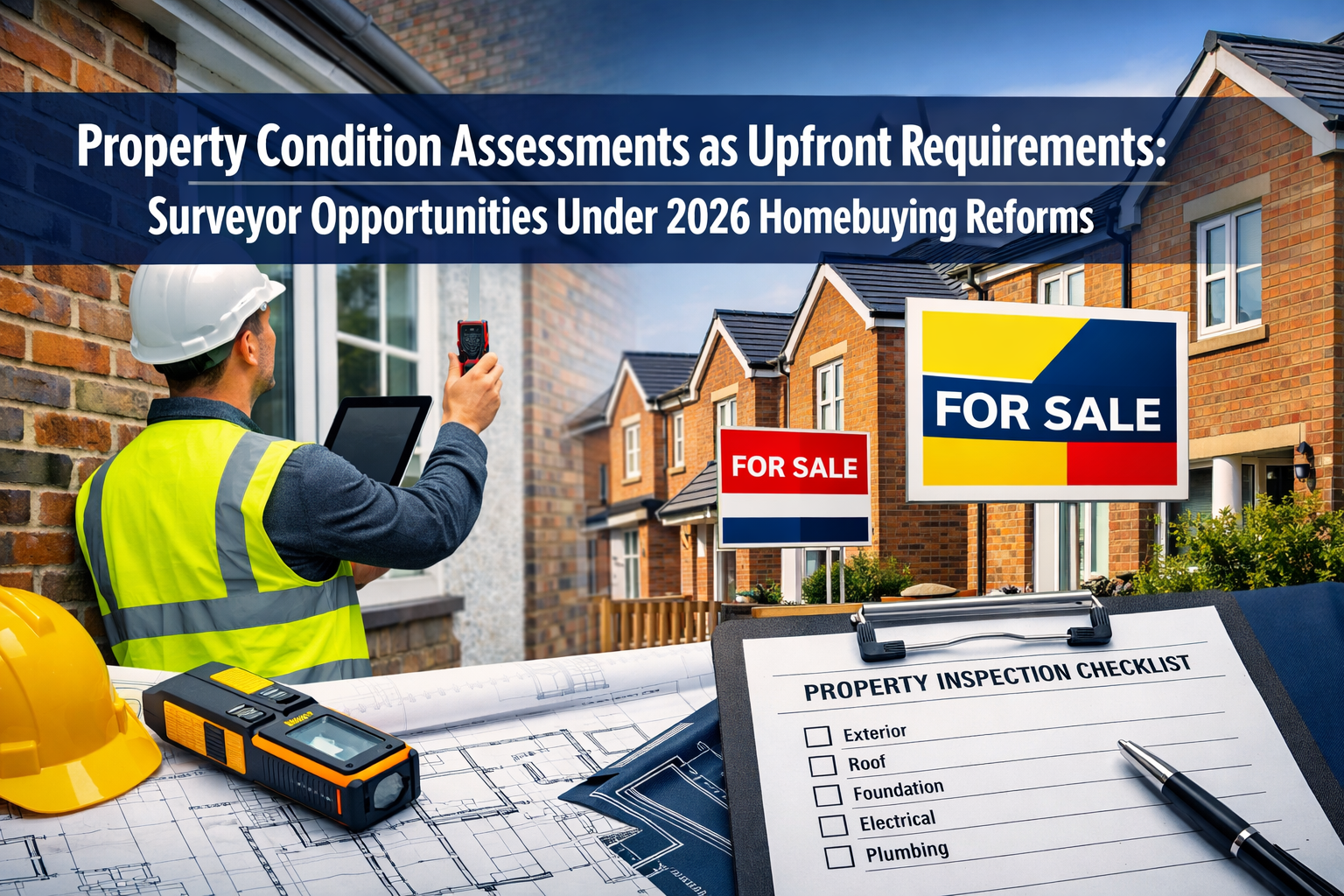
The UK government's consultation on mandatory upfront property condition assessments represents the most significant potential shift in residential property transactions in decades, with industry analysts projecting survey demand could increase by 40-60% if reforms are implemented.[1] This transformative policy under consideration would fundamentally restructure when and how surveyors engage in the homebuying process, moving property condition assessments from optional mid-transaction evaluations to mandatory upfront requirements before properties even reach the market.
Property Condition Assessments as Upfront Requirements: Surveyor Opportunities Under 2026 Homebuying Reforms are creating unprecedented discussion within the surveying profession. The proposed changes would require sellers to commission comprehensive property surveys before listing, providing prospective buyers with detailed condition reports from the outset. This shift promises to reduce transaction failures, accelerate completion timelines, and create substantial new opportunities for qualified surveyors across the UK.
Key Takeaways
- Mandatory upfront assessments could fundamentally change surveyor workflows, moving property condition evaluations to the pre-listing stage rather than post-offer acceptance
- Survey demand is projected to increase significantly with lenders forecasting strong growth through 2026 as reforms potentially take effect[1]
- Technology integration will be essential for surveyors to efficiently handle increased volumes while maintaining quality standards
- New revenue streams will emerge for surveying practices that position themselves strategically ahead of regulatory changes
- Professional development in digital survey methodologies and rapid reporting will become competitive advantages
Understanding the Proposed Property Condition Assessment Reforms
What Are Upfront Property Condition Assessments?
Upfront property condition assessments represent a paradigm shift in how residential property surveys are commissioned and utilized. Under the proposed reforms being consulted upon by the UK government, sellers would be required to obtain a professional property survey before marketing their property.[1] This assessment would provide a comprehensive evaluation of the property's structural integrity, defects, and overall condition, making this information available to all prospective buyers from the first viewing.
The concept mirrors successful models implemented in other European countries, where mandatory seller surveys have reduced transaction failures and increased market transparency. For UK surveyors, this represents a fundamental change in client relationships and service delivery timing.
Key components of proposed upfront assessments include:
- Comprehensive structural evaluation covering all major building elements
- Defect identification and severity grading using standardized reporting frameworks
- Estimated repair costs for identified issues to inform pricing negotiations
- Validity periods during which the assessment remains current (typically 6-12 months)
- Professional indemnity coverage protecting both sellers and buyers
Understanding what a property surveyor does becomes even more critical as their role shifts from buyer-commissioned evaluator to market-enabling professional whose work underpins the entire transaction process.
The Government Consultation Framework
The UK government's exploration of mandatory property condition assessments forms part of broader efforts to modernize and streamline residential property transactions. The consultation process seeks input from industry stakeholders—including surveyors, estate agents, conveyancers, and consumer groups—on implementation mechanisms, timing requirements, and quality standards.[1]
Core consultation questions being explored include:
| Consultation Area | Key Questions |
|---|---|
| Timing | At what point should assessments be commissioned? Before listing or after initial interest? |
| Scope | Should all properties require full surveys, or should there be tiered requirements based on age/value? |
| Qualifications | What professional credentials should be mandatory for conducting upfront assessments? |
| Liability | How should responsibility be allocated between sellers, surveyors, and buyers? |
| Costs | Should there be price caps or standardized fee structures? |
The consultation also addresses how upfront assessments would integrate with existing survey products like RICS Home Surveys, which currently serve buyer needs. The proposed reforms don't eliminate buyer choice for additional surveys but aim to establish a baseline of information transparency.
Parallel developments in housing policy, including aspects of broader housing reform legislation, demonstrate government commitment to addressing transaction efficiency and market transparency.[2][3] While much of the recent legislative focus in the US has centered on affordability and supply, the UK consultation specifically targets transaction process improvements.
Timeline and Implementation Expectations
While the consultation process continues through 2026, industry observers anticipate a phased implementation approach if reforms proceed. The surveying sector is already preparing for potential changes, with comprehensive condition survey reports being refined to meet anticipated regulatory requirements.[1]
Projected implementation timeline:
📅 Q2-Q3 2026: Consultation period concludes with government analysis of stakeholder feedback
📅 Q4 2026-Q1 2027: Draft legislation and regulatory framework development
📅 2027: Pilot programs in select regions testing implementation models
📅 2028: Potential nationwide rollout with transition periods for market adaptation
This timeline allows surveying practices to invest in necessary technology, training, and capacity expansion. Early adopters who develop specialized expertise in upfront assessment methodologies will likely capture significant market share as reforms take effect.
Surveyor Opportunities Created by Property Condition Assessments as Upfront Requirements
Increased Demand Volume and Market Expansion
The most immediate opportunity presented by Property Condition Assessments as Upfront Requirements: Surveyor Opportunities Under 2026 Homebuying Reforms is the substantial increase in survey volumes. Currently, approximately 30-40% of property transactions involve professional surveys, with many buyers opting out due to cost concerns or perceived low risk. Mandatory upfront assessments would push this figure toward 100% of listed properties.[1]
Volume projections for surveying practices:
- Residential survey demand could increase by 40-60% within the first two years of implementation
- Repeat business opportunities emerge as properties require updated assessments if unsold after validity periods expire
- Portfolio work from estate agents and property developers seeking preferred surveyor partnerships
- Buy-to-let sector continuing strong investment with institutional landlords valuing proper due diligence[1]
Lenders are already forecasting increased volumes in both lending and surveys, with expectations of a strong start to 2026 and sustained growth through the year.[1] This optimistic outlook reflects confidence that reforms will proceed and that the market can absorb the structural changes.
For surveyors considering whether a homebuyers survey is worth it, the answer becomes clearer: upfront assessments create guaranteed demand regardless of individual buyer decisions, fundamentally changing the business model from optional service to market requirement.
New Service Lines and Revenue Streams
Beyond increased volume in traditional survey work, upfront assessment mandates create opportunities for entirely new service offerings. Forward-thinking surveying practices are already developing specialized products to capture these emerging revenue streams.
Emerging service opportunities include:
🏠 Pre-listing consultation services – Advising sellers on remediation priorities before commissioning formal assessments
📊 Assessment update services – Providing expedited re-evaluations when properties remain unsold beyond validity periods
🤝 Estate agent partnerships – Developing preferred provider relationships with volume commitments
💻 Digital report platforms – Creating buyer-accessible portals for assessment reports with enhanced data visualization
🔍 Defect monitoring services – Offering follow-up inspections to verify reported issues haven't deteriorated
📈 Market analysis integration – Combining condition assessments with valuation services for comprehensive property intelligence
The distinction between different survey levels becomes more nuanced under upfront assessment frameworks. Understanding level 2 vs level 3 survey differences helps surveyors position appropriate service tiers for different property types and price points.
Technology-Enabled Efficiency Gains
Technology is helping surveyors work smarter and more efficiently to handle the anticipated increased demand from Property Condition Assessments as Upfront Requirements: Surveyor Opportunities Under 2026 Homebuying Reforms.[1] Practices investing in digital tools and workflow automation will maintain quality standards while scaling capacity.
Key technology investments for competitive advantage:
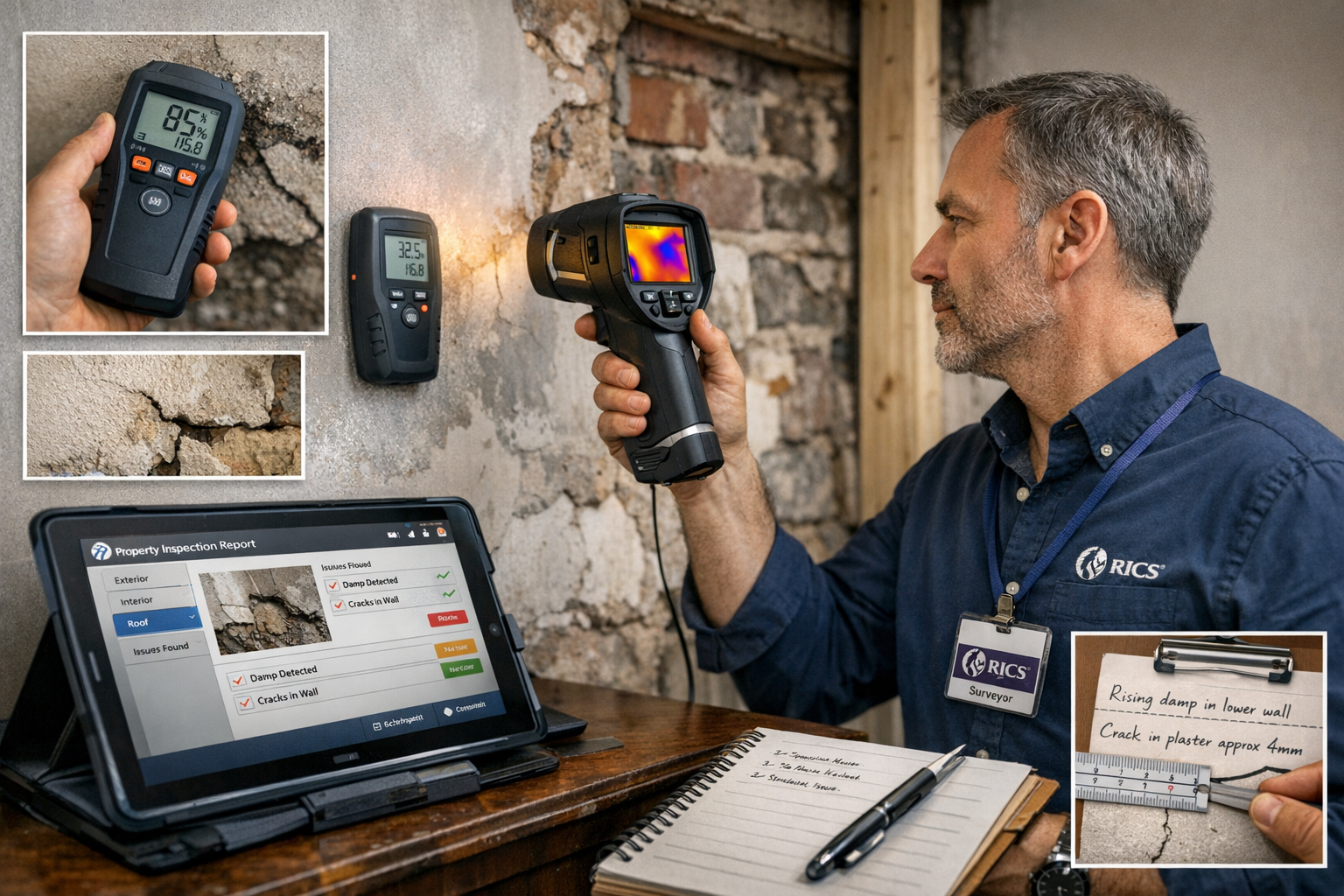
- Digital inspection tools including thermal imaging, moisture meters, and laser measurement devices with cloud connectivity
- Mobile reporting applications enabling on-site report drafting and instant photo integration
- AI-assisted defect identification using image recognition to flag common issues
- Automated report generation with template systems that maintain consistency while reducing drafting time
- Client portals providing transparent access to assessment progress and findings
- Scheduling optimization software maximizing surveyor productivity across geographic territories
These technological capabilities allow surveyors to potentially double their daily inspection capacity while maintaining the thoroughness required for professional standards. The investment costs are offset by increased volume and the ability to serve more clients without proportional staff expansion.
Strategic Positioning for Surveying Practices Under 2026 Homebuying Reforms
Building Capacity and Professional Development
Successfully capitalizing on Property Condition Assessments as Upfront Requirements: Surveyor Opportunities Under 2026 Homebuying Reforms requires strategic capacity building well before reforms take full effect. Surveying practices should begin preparation immediately to avoid being overwhelmed when demand surges.
Capacity building priorities:
✅ Recruitment and training – Expanding surveyor teams with qualified professionals who understand upfront assessment requirements
✅ Professional credentials – Ensuring all surveyors maintain current RICS accreditation and specialized certifications
✅ Quality management systems – Implementing robust review processes to maintain standards despite increased volumes
✅ Insurance coverage – Reviewing and potentially expanding professional indemnity policies to cover new liability scenarios
✅ Continuing education – Investing in training on emerging defect types, modern construction methods, and regulatory compliance
The question of what surveyors check during inspections becomes standardized under upfront assessment frameworks, with regulatory guidance likely specifying minimum inspection standards and reporting requirements.
Practices should also consider geographic expansion strategies. Understanding local market dynamics through resources like guides to chartered surveyors in Central London or chartered surveyors in North London helps identify underserved markets where capacity expansion offers competitive advantages.
Marketing and Client Acquisition Strategies

As upfront assessments become mandatory, the client acquisition model shifts dramatically. Instead of marketing primarily to buyers, surveyors must develop relationships with sellers, estate agents, and property developers who will commission assessments before listing properties.
Effective marketing strategies for the reformed market:
🎯 Estate agent partnerships – Developing preferred provider agreements with agencies handling high volumes of listings
🎯 Seller education campaigns – Creating content explaining assessment benefits and process to property owners
🎯 Developer relationships – Establishing contracts with residential developers for new-build assessment programs
🎯 Digital presence optimization – Ensuring website and booking systems accommodate the seller-focused model
🎯 Competitive pricing structures – Developing transparent fee schedules that demonstrate value while remaining competitive
🎯 Rapid turnaround guarantees – Marketing speed of service as differentiator, with commitments to complete assessments within specified timeframes
For sellers wondering do I need a home survey when buying a home, the answer under reformed regulations becomes clear: surveys are mandatory before listing, shifting the question from "whether" to "which surveyor to choose."
Content marketing becomes particularly valuable, with educational resources positioning practices as trusted advisors. Topics like what surveyors look for in a house survey help demystify the process for sellers unfamiliar with survey requirements.
Quality Standards and Professional Excellence
As survey volumes increase under mandatory upfront assessment frameworks, maintaining quality standards becomes both a competitive differentiator and a professional obligation. Practices that compromise thoroughness for speed will face reputational damage and potential liability issues.
Quality assurance best practices:
- Standardized inspection protocols ensuring consistent coverage across all property types
- Peer review systems with senior surveyors reviewing reports before release
- Client feedback mechanisms capturing satisfaction data and identifying improvement opportunities
- Continuous improvement processes analyzing common defects and refining detection methodologies
- Professional development tracking ensuring all surveyors maintain current knowledge of building pathology
The value proposition of Level 3 building surveys and comprehensive assessments becomes clearer when these reports serve as the foundation for entire transactions. Buyers, sellers, and lenders all rely on the accuracy and completeness of upfront assessments, elevating the importance of professional excellence.
Valuation Methodology and Transaction Workflow Implications
Integration with Property Valuation Processes
Property Condition Assessments as Upfront Requirements: Surveyor Opportunities Under 2026 Homebuying Reforms create important intersections between condition assessment and property valuation. While these remain distinct professional services, upfront condition reports will inevitably influence valuation methodologies and pricing strategies.[4]
Key valuation implications:
💷 Transparent defect disclosure allows more accurate pricing from initial listing, reducing negotiation friction
💷 Repair cost quantification provides objective basis for price adjustments rather than subjective buyer concerns
💷 Market comparison accuracy improves as condition differences between properties become standardized and documented
💷 Lender confidence increases with comprehensive condition data supporting valuation figures
💷 Transaction velocity accelerates as pricing reflects known condition from outset rather than requiring renegotiation after buyer surveys
Surveyors offering combined services—condition assessment plus valuation—may find significant competitive advantages in this reformed market. The synergies between understanding property condition and determining market value create natural service bundling opportunities.
Workflow Timing and Transaction Acceleration
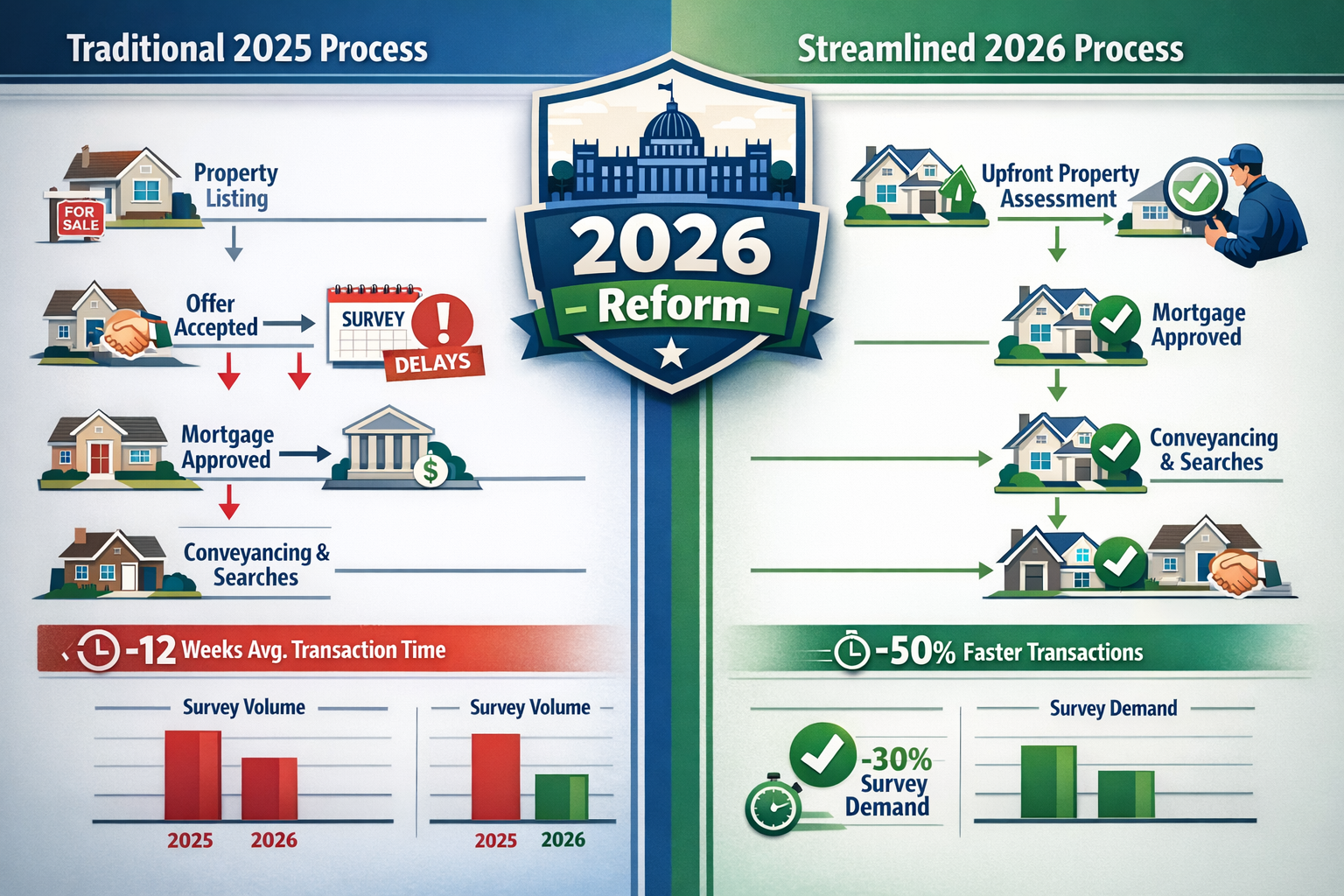
One of the primary government objectives driving the consultation on upfront assessments is reducing transaction timelines and failure rates. Current UK property transactions average 12-16 weeks from offer acceptance to completion, with approximately 30% of transactions falling through—often due to issues discovered during buyer surveys conducted mid-process.
Reformed workflow timeline:
| Transaction Stage | Traditional Process | Reformed Process with Upfront Assessments |
|---|---|---|
| Pre-listing | No survey required | Seller commissions mandatory condition assessment |
| Marketing | Limited condition disclosure | Comprehensive assessment available to all viewers |
| Offer stage | Buyers commission surveys post-offer | Buyers review existing assessment, may commission additional specialist surveys only |
| Negotiation | Frequent price renegotiation based on survey findings | Pricing already reflects known condition; minimal renegotiation |
| Completion | 12-16 weeks average | Projected 8-10 weeks average |
This acceleration benefits all market participants: sellers achieve faster sales, buyers gain certainty earlier, and estate agents improve conversion rates. For surveyors, the workflow change means earlier engagement but potentially shorter client relationship duration per transaction.
Understanding how long a Level 2 survey takes becomes critical for managing seller expectations about listing timelines under reformed processes.
Risk Allocation and Liability Considerations
Upfront assessment mandates create new questions about professional liability and risk allocation. When surveys serve multiple parties—sellers, buyers, lenders—rather than a single client, liability frameworks become more complex.
Emerging liability considerations:
⚖️ Multi-party reliance – Reports commissioned by sellers but relied upon by buyers and lenders create broader duty-of-care questions
⚖️ Validity period limitations – Surveyors must clearly define assessment validity timeframes and update requirements
⚖️ Scope limitations – Distinguishing between comprehensive assessments and additional specialist investigations (e.g., specialist surveys for specific defects)
⚖️ Disclosure standards – Establishing clear protocols for reporting defects of varying severity
⚖️ Professional indemnity insurance – Ensuring coverage adequately addresses multi-party scenarios and increased claim potential
Professional bodies like RICS will likely develop specific guidance for upfront assessment scenarios, establishing standards that protect both surveyors and clients. Practices should engage actively with these developing standards to ensure compliance and minimize liability exposure.
Broader Housing Reform Context and Market Dynamics
Parallel Regulatory Developments
While the UK consultation on upfront property condition assessments proceeds, parallel housing reforms in other jurisdictions provide instructive context. The 21st Century ROAD to Housing Act, which passed both House and Senate votes by March 2026, includes provisions affecting property assessment and valuation processes.[2][3]
Key provisions relevant to property assessment:
- Appraisal licensing and workforce reforms enhancing standards for approved appraisers and authorizing grants to support workforce development[3]
- HUD inspection process improvements reducing delays by allowing units financed through certain federal programs to automatically meet inspection requirements if recently inspected[3]
- NEPA review streamlining for housing activities, potentially accelerating property transactions through reduced regulatory delays[3]
While these US-focused reforms don't directly impact UK surveyors, they demonstrate broader international momentum toward professionalizing property assessment and integrating condition evaluation more systematically into transaction processes.
Market Adaptation and Stakeholder Responses
The surveying sector's response to proposed upfront assessment requirements has been largely positive, recognizing the transformative potential for the profession.[1] However, other market stakeholders have varied perspectives that will influence final reform implementation.
Stakeholder perspectives:
👥 Estate agents – Generally supportive, anticipating reduced transaction failures and faster sales cycles
👥 Sellers – Mixed reactions, with concerns about upfront costs balanced against potential for faster sales and reduced fall-through rates
👥 Buyers – Supportive of increased transparency but concerned about reduced negotiation leverage
👥 Lenders – Strongly supportive, forecasting increased lending volumes and reduced default risk from better-informed transactions[1]
👥 Conveyancers – Cautiously optimistic, anticipating workflow changes but recognizing efficiency potential
Understanding these diverse perspectives helps surveyors position their services effectively, addressing concerns while emphasizing benefits across all stakeholder groups.
Technology and Innovation Driving Sector Evolution
Beyond regulatory reforms, technological innovation is fundamentally reshaping how surveyors operate. The convergence of mandatory upfront assessments with advancing survey technology creates unprecedented opportunities for practices that embrace digital transformation.[1]
Transformative technologies:
🔧 Drone-based roof and exterior inspections – Providing comprehensive visual documentation without scaffolding requirements
🔧 Thermal imaging and moisture detection – Identifying hidden defects invisible to visual inspection
🔧 3D scanning and digital twin creation – Creating comprehensive property models for detailed analysis
🔧 AI-powered defect recognition – Accelerating identification of common issues from photographic evidence
🔧 Blockchain-based report verification – Creating tamper-proof records of assessment findings
🔧 Predictive maintenance modeling – Using condition data to forecast future repair requirements
Practices investing in these technologies position themselves as industry leaders, capable of delivering superior service quality while handling increased volumes efficiently. The question of whether a Level 3 survey is worth it becomes easier to answer when technology enables comprehensive assessment without proportional cost increases.
Preparing for Implementation: Practical Steps for Surveying Practices
Immediate Action Items for 2026
Even as consultation processes continue and final regulatory frameworks remain under development, surveying practices should begin preparation immediately. The lead time required for capacity building, technology implementation, and market positioning means early movers will capture disproportionate benefits.
Priority actions for 2026:
✓ Conduct capacity assessment – Evaluate current surveyor availability against projected demand increases
✓ Invest in technology infrastructure – Implement digital inspection tools and reporting platforms
✓ Develop estate agent relationships – Initiate partnership discussions with high-volume agencies
✓ Refine service offerings – Create upfront assessment products with clear scope, pricing, and turnaround commitments
✓ Enhance quality systems – Implement review processes ensuring consistent standards across increased volumes
✓ Expand professional development – Invest in training on emerging construction methods and defect types
✓ Review insurance coverage – Ensure professional indemnity policies adequately address upfront assessment scenarios
✓ Optimize digital presence – Update websites and marketing materials to address seller-focused positioning
Long-Term Strategic Planning
Beyond immediate preparation, surveying practices should develop comprehensive strategic plans addressing the fundamentally transformed market landscape that upfront assessment mandates will create.
Strategic planning considerations:
📋 Market positioning – Define target client segments (residential sellers, developers, estate agents) and value propositions for each
📋 Geographic expansion – Identify underserved markets where capacity gaps create growth opportunities
📋 Service diversification – Develop complementary offerings (valuations, project management, specialist surveys) that create comprehensive solutions
📋 Partnership strategies – Establish formal relationships with estate agents, conveyancers, and lenders for integrated service delivery
📋 Technology roadmap – Plan multi-year investments in digital capabilities that maintain competitive advantages
📋 Talent acquisition – Develop recruitment and retention strategies attracting qualified surveyors in competitive market
📋 Financial planning – Model revenue projections, investment requirements, and profitability scenarios under various reform implementation timelines
Practices that approach Property Condition Assessments as Upfront Requirements: Surveyor Opportunities Under 2026 Homebuying Reforms strategically—rather than reactively—will emerge as market leaders in the transformed landscape.
Conclusion
Property Condition Assessments as Upfront Requirements: Surveyor Opportunities Under 2026 Homebuying Reforms represent a watershed moment for the surveying profession. The UK government's consultation on mandatory upfront assessments promises to fundamentally restructure residential property transactions, moving professional surveys from optional buyer-commissioned evaluations to mandatory seller-provided market information. This transformation creates unprecedented opportunities for surveying practices positioned to capitalize on increased demand, new service lines, and technology-enabled efficiency gains.
The projected 40-60% increase in survey volumes, combined with lenders' optimistic forecasts for 2026 and beyond, signals strong market confidence in both reform implementation and sector growth potential.[1] Surveyors who invest now in capacity building, technology infrastructure, and strategic partnerships will capture disproportionate market share as reforms take effect.
Key success factors include:
- Early adoption of digital inspection tools and reporting platforms that enable efficient scaling
- Strategic positioning with estate agents and property developers as preferred assessment providers
- Quality maintenance through robust review systems despite increased volumes
- Service innovation developing new offerings that address emerging client needs in reformed market
- Professional development ensuring all surveyors maintain current expertise in modern construction methods and defect identification
The transformation extends beyond simple volume increases to fundamental business model changes. Surveyors must shift from reactive service providers responding to buyer requests to proactive market enablers whose work underpins entire transaction processes. This elevated role brings both opportunities and responsibilities, requiring unwavering commitment to professional excellence and ethical practice.
For practices ready to embrace change, Property Condition Assessments as Upfront Requirements: Surveyor Opportunities Under 2026 Homebuying Reforms offer a clear path to growth, profitability, and enhanced professional standing. The question is not whether to prepare, but how quickly and comprehensively to position for success in the reformed market landscape.
Next Steps
For surveying practices: Begin capacity assessment and technology investment planning immediately. Engage with estate agents to discuss partnership opportunities. Review professional indemnity insurance coverage and quality management systems.
For individual surveyors: Invest in continuing professional development, particularly in digital inspection methodologies and rapid reporting techniques. Consider specialization in property types or defect categories that will be in high demand.
For market stakeholders: Engage actively in consultation processes to shape reform implementation. Collaborate across the transaction ecosystem to ensure reforms achieve intended benefits of reduced failures and accelerated timelines.
The future of residential property surveying is being written in 2026. Those who act decisively today will define industry standards tomorrow.
References
[1] Surveying In 2026 Reform Recovery And Renewed Demand – https://www.lrg.co.uk/news-and-insights/surveying-in-2026-reform-recovery-and-renewed-demand/
[2] Housing For The 21st Century Act – https://themortgagereports.com/127655/housing-for-the-21st-century-act
[3] Whats In The 21st Century Road To Housing Act – https://bipartisanpolicy.org/explainer/whats-in-the-21st-century-road-to-housing-act/
[4] Valuation Impacts Of Government Homebuying Reforms Upfront Condition Survey Mandates And Their Effect On 2026 Transaction Workflows – https://nottinghillsurveyors.com/blog/valuation-impacts-of-government-homebuying-reforms-upfront-condition-survey-mandates-and-their-effect-on-2026-transaction-workflows
