
The UK property market in 2026 is telling two very different stories. While Scotland and Northern Ireland celebrate robust price growth and rising buyer confidence, London and the South East continue to grapple with affordability pressures and stagnant valuations. This Regional Valuation Divergences in 2026 Recovery: RICS Tactics for North-South Price Shifts in Building Surveys creates unprecedented challenges for chartered surveyors who must navigate these contrasting market conditions with precision and expertise.
Recent RICS data reveals that the national house price net balance has improved to -10% in early 2026, up from -19% in October 2025[1]. Yet this headline figure masks significant regional variations that demand tailored valuation approaches. For property professionals conducting RICS building surveys Level 3, understanding these geographic price shifts isn't just helpful—it's essential for delivering accurate, defensible valuations in today's fractured market.
Key Takeaways
✅ Northern regions lead recovery: Scotland, Northern Ireland, and the North of England show strong upward price trajectories, requiring more optimistic valuation assumptions and growth projections.
✅ Southern markets lag significantly: London, the South East, South West, and East Anglia continue experiencing affordability pressures, demanding conservative pricing strategies and realistic market-adjusted valuations.
✅ Long-term optimism vs. short-term caution: While +43% of surveyors expect higher prices over the next year, near-term three-month expectations remain flat at -4%, creating a complex valuation landscape[1].
✅ Tactical adjustments required: Surveyors must employ differentiated strategies based on regional performance, property type, and time-on-market factors to deliver accurate assessments.
✅ Rental market impacts: Constrained supply and rising tenant demand affect investment property valuations differently across regions, requiring specialized approaches for buy-to-let assessments.
Understanding the 2026 Regional Property Market Divide
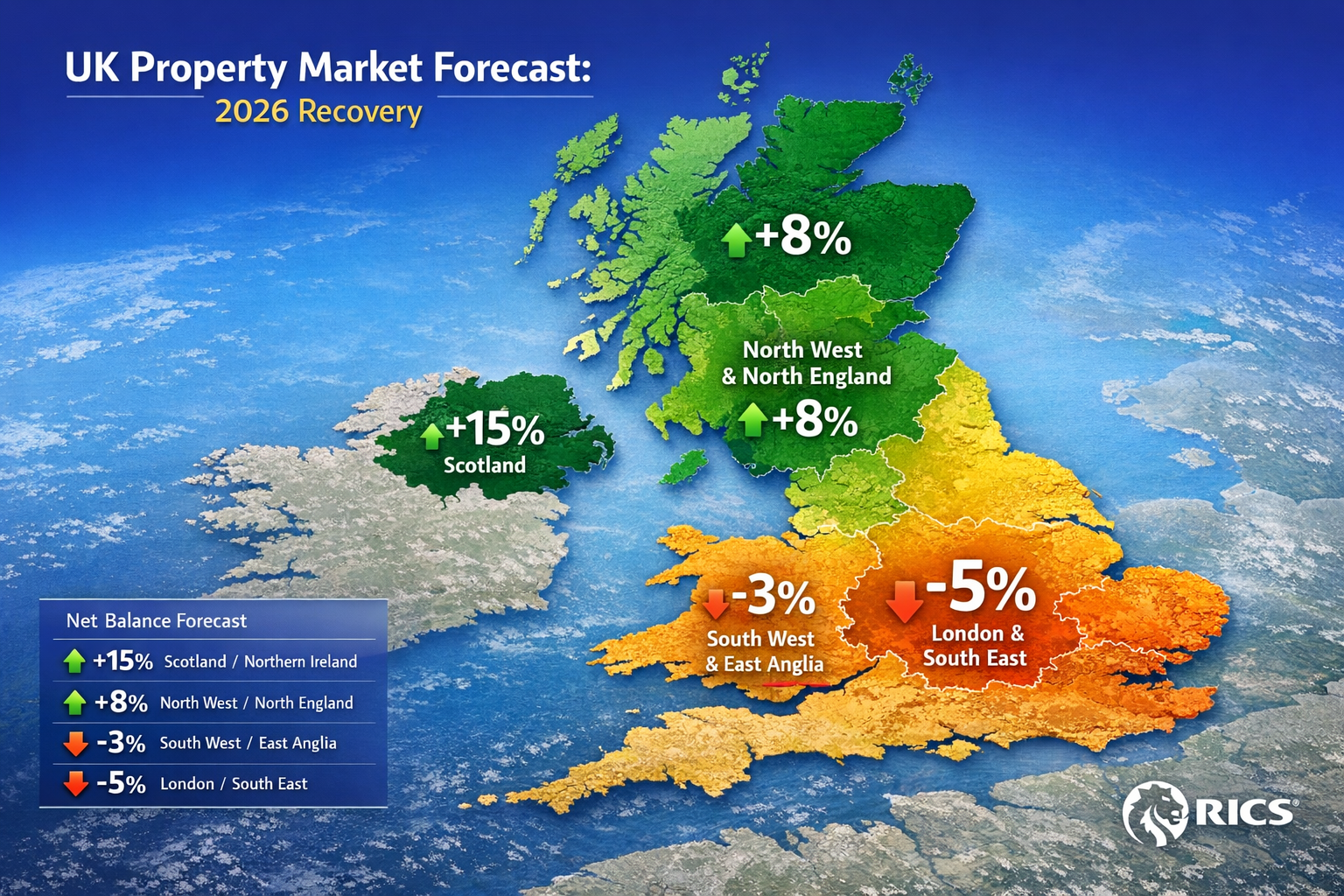
The North-South Price Performance Gap
The geographical split in UK property performance has widened considerably throughout the 2026 recovery period. Scotland and Northern Ireland continue to demonstrate the strongest price growth trajectories, with the North West and North of England reporting consistent upward price movements[1][2]. These regions benefit from relative affordability, strong local employment markets, and continued demand from buyers priced out of southern markets.
In stark contrast, London, the South East, the South West, and East Anglia maintain net balances more negative than the national average[1]. While conditions have improved modestly compared to late 2025, these areas face persistent affordability challenges that suppress buyer demand and limit price growth potential.
| Region | Price Trend Direction | Key Market Characteristics |
|---|---|---|
| Scotland | ⬆️ Strong upward | Affordability advantage, steady demand |
| Northern Ireland | ⬆️ Strong upward | Value positioning, buyer confidence |
| North West/North England | ⬆️ Moderate upward | Mid-market strength, family housing demand |
| London | ➡️ Flat to slight decline | Affordability pressures, price adjustments |
| South East | ➡️ Flat to slight decline | High entry costs, cautious buyers |
| South West/East Anglia | ➡️ Flat to slight decline | Premium pricing challenges |
This divergence creates significant implications for professionals conducting building surveys across different regions. A property in Manchester requires fundamentally different valuation considerations than a comparable property in Surrey, even when structural condition and specifications are similar.
Market Sentiment Indicators Across Regions
Buyer demand recovery shows encouraging signs nationally, with new buyer enquiries improving to a net balance of -15% in January 2026, up from -21% in December and -29% in November[1]. However, this recovery manifests differently across regions.
Northern markets experience stronger enquiry levels and faster conversion rates from viewings to agreed sales. Southern markets see more cautious buyer behavior, with extended decision-making periods and greater price sensitivity. Agreed sales recorded their least negative reading since June 2025 at -9%, but this masks regional variation where northern properties achieve sales agreements more quickly than southern equivalents[1].
For surveyors preparing valuation factors analyses, these sentiment indicators provide crucial context for market positioning recommendations.
The Time Horizon Paradox in Valuation Expectations
One of the most striking features of the 2026 market is the divergence between near-term and medium-term price expectations. Short-term price expectations over the coming three months stand at just -4%, indicating a relatively flat outlook for the immediate quarter[2]. Yet long-term price optimism tells a different story, with a net balance of +43% of survey respondents anticipating higher prices over the year ahead—the most positive outlook since February 2025[1].
This creates a valuation paradox: properties may experience minimal price movement in the next 90 days while facing stronger appreciation potential over the next 12 months. For chartered surveyors conducting Level 3 building surveys, this requires careful communication with clients about realistic timescales for value realization.
"The widening divergence across regions means surveyors must employ differentiated valuation strategies—northern regions warrant more optimistic assumptions, while southern markets require continued emphasis on affordability pressures and realistic market-adjusted pricing."[2]
Regional Valuation Divergences in 2026 Recovery: RICS-Compliant Adjustment Strategies
Northern Market Valuation Approaches
When conducting valuations in Scotland, Northern Ireland, and northern English regions, chartered surveyors should incorporate several tactical adjustments to reflect stronger market fundamentals:
1. Comparable Selection Criteria 📊
Select comparables from the most recent 3-6 month period rather than extending to 12 months, as price appreciation in these markets means older comparables undervalue current market positioning. Properties in similar condition achieving sales in the past quarter provide more accurate benchmarks.
2. Market Conditions Adjustments
Apply positive market conditions adjustments of +5% to +12% depending on specific locality and property type when recent comparables show consistent upward pricing trends. Mid-market family houses in the £200,000-£350,000 range demonstrate particularly strong performance.
3. Time-on-Market Expectations
Reflect shorter marketing periods in valuation reports, typically 6-10 weeks for well-presented properties in desirable northern locations, compared to the historical average of 12-16 weeks. This affects liquidity assessments and market value conclusions.
4. Buyer Motivation Analysis
Northern markets benefit from genuine end-user demand rather than speculative investment, creating more stable valuation foundations. Highlight this in reports when discussing market sustainability and risk factors.
For professionals conducting surveys in areas like North London or North West London, these principles apply with appropriate local market calibration.
Southern Market Valuation Tactics
Valuations in London, the South East, South West, and East Anglia require more conservative approaches that acknowledge persistent affordability challenges:
1. Realistic Pricing Emphasis 💷
Stock that remained unsold during 2025's weaker market now attracts renewed interest as asking prices adjust downward to more realistic levels[2]. When valuing properties with extended market exposure, apply negative adjustments of -5% to -15% to reflect necessary price corrections for achieving sales.
2. Affordability-Adjusted Comparables
Prioritize comparables that represent realistic transaction prices rather than optimistic asking prices. Properties achieving sales after price reductions provide more accurate market evidence than initial listing prices.
3. Property Type Differentiation
Lower-priced flats and mid-market family houses in southern regions attract renewed interest as prices adjust[2]. Distinguish between:
- High-value properties (£800k+): Continue facing significant headwinds, requiring conservative valuations
- Mid-market properties (£400k-£800k): Showing signs of stabilization with realistic pricing
- Entry-level properties (under £400k): Experiencing relatively stronger demand from first-time buyers
4. Extended Marketing Period Assumptions
Reflect longer time-on-market expectations of 12-20 weeks for southern properties, particularly in premium segments. This affects forced sale scenarios and market value conclusions in RICS registered valuers reports.
Cross-Regional Consistency in RICS Standards
Despite regional variations, all valuations must maintain consistency with RICS Valuation Global Standards (Red Book). Key principles include:
✅ Market value definition consistency: Apply the same fundamental market value definition regardless of regional market strength
✅ Transparent assumptions: Clearly state regional market condition assumptions and their impact on value conclusions
✅ Comparable adjustment documentation: Provide detailed justification for all regional adjustments applied to comparable evidence
✅ Special assumptions disclosure: Identify any special assumptions related to regional market recovery trajectories
Professionals conducting specific defect surveys must ensure regional market considerations don't overshadow structural and condition-based valuation factors.
Building Survey Tactics for Regional Valuation Divergences in 2026 Recovery
Integrating Market Intelligence into Survey Reports
Modern building surveys must go beyond structural assessment to provide comprehensive market context. When preparing reports in 2026's divergent market, include:
Regional Market Commentary Sections
Dedicate a section of survey reports to regional market performance, drawing on current RICS data[1][4] to contextualize the property within its specific geographic market. This helps clients understand how location affects both current value and future appreciation potential.
Comparative Regional Analysis
For clients relocating between regions, provide comparative analysis showing how similar properties perform in different markets. A £400,000 property in Leeds offers vastly different value proposition than a £400,000 property in Brighton.
Repair Cost Impact by Region
Regional variations in labor costs and material availability affect repair cost estimates. Northern regions often benefit from more competitive contractor pricing, while southern markets face premium labor rates. Adjust reinstatement cost valuations accordingly.
Property-Type Specific Regional Considerations
Different property types respond differently to regional market conditions:
Period Properties 🏛️
Victorian and Edwardian properties in northern cities demonstrate strong value retention and appreciation potential, particularly when well-maintained. In southern markets, period properties face greater price sensitivity due to higher absolute values and maintenance costs.
When conducting surveys on period properties, emphasize:
- Energy efficiency upgrade potential and costs
- Maintenance reserve requirements
- Regional demand for character properties
- Comparable sales analysis for similar period stock
New Build Properties 🏗️
Construction activity remained broadly flat in late 2025, though forward-looking indicators point to modest recovery in 2026[1]. This affects new build survey valuations differently by region:
- Northern markets: New builds compete effectively with period stock on price
- Southern markets: New builds face premium pricing challenges and slower sales rates
Flats and Apartments
Lower-priced flats in southern regions show signs of renewed interest as prices adjust to realistic levels[2]. Survey reports should address:
- Service charge sustainability and trends
- Building management quality
- Lease length implications (particularly relevant for lease extension valuations)
- Regional rental yield potential
Rental Investment Property Considerations
The lettings market presents unique regional dynamics affecting investment valuations. Tenant demand edged higher in the three months to January 2026, but landlord instructions remain firmly negative, resulting in expected continued rental price increases[1].
Northern Rental Markets
- Stronger yields (typically 5-7% gross)
- Growing tenant demand from relocating professionals
- More favorable landlord-tenant supply dynamics
- Lower entry costs attracting new investors
Southern Rental Markets
- Compressed yields (typically 3-5% gross)
- Constrained supply driving rental growth
- Higher regulatory compliance costs
- Capital appreciation potential remains primary investment driver
For surveyors preparing investment property reports, incorporate regional rental market data to support yield calculations and investment return projections.
Addressing Properties with Extended Market Exposure
Properties that failed to sell during 2025's weaker market require special consideration in 2026 valuations. When surveying such properties:
1. Investigate Previous Marketing History
Request details of previous asking prices, price reductions, and marketing duration. This provides evidence of necessary pricing adjustments to achieve sales.
2. Assess Presentation and Condition
Properties with extended market exposure often suffer from deferred maintenance or poor presentation. Quantify improvement costs that could enhance marketability.
3. Realistic Pricing Recommendations
Based on current regional market conditions, provide clear guidance on pricing levels likely to generate buyer interest within reasonable timeframes (90-120 days).
4. Stigma Considerations
Long market exposure can create perception issues. Address this in valuation reports and recommend strategies to overcome buyer concerns (fresh marketing approach, price positioning, property improvements).
Tactical Implementation: Regional Survey Methodologies

Northern Region Survey Protocols
When conducting building surveys in stronger northern markets, employ these tactical approaches:
Enhanced Opportunity Identification 🔍
Given stronger market fundamentals, identify value-enhancement opportunities that clients can capitalize on:
- Extension and conversion potential (subject to planning)
- Energy efficiency upgrades that enhance marketability
- Cosmetic improvements with strong return on investment
- Garden and outdoor space optimization
Accelerated Reporting Timelines
Faster-moving northern markets require quicker survey turnaround. Aim for 5-7 working day report delivery rather than standard 10-14 days, enabling clients to make competitive offers in active markets.
Market Positioning Confidence
Provide confident market positioning advice based on strong regional fundamentals. Clients purchasing in northern markets benefit from clear guidance on fair pricing and negotiation strategies.
Future-Proofing Recommendations
With stronger appreciation potential, emphasize improvements and maintenance that protect long-term value:
- Roof and structural element condition
- Damp-proofing and drainage systems
- Heating system efficiency and longevity
- External decoration and weather protection
Southern Region Survey Protocols
Southern market surveys require heightened attention to value protection and realistic pricing:
Rigorous Defect Documentation 📋
In price-sensitive southern markets, comprehensive defect documentation supports price negotiation:
- Detailed repair cost estimates for all identified defects
- Prioritization of repairs (urgent, essential, desirable)
- Impact assessment on market value and marketability
- Photographic evidence of significant defects
Conservative Valuation Approaches
Apply conservative assumptions when providing market value guidance:
- Use lower-end comparable evidence
- Apply appropriate adjustments for condition and presentation
- Reflect realistic marketing period expectations
- Acknowledge affordability constraints in local market
Negotiation Support
Provide detailed evidence supporting price negotiations:
- Itemized repair schedules with cost estimates
- Comparable sales showing realistic pricing levels
- Market condition commentary supporting buyer position
- Priority action recommendations
Alternative Value Scenarios
Consider providing multiple value scenarios:
- As-is value: Current condition and market
- Improved value: After essential repairs and presentation upgrades
- Optimized value: After strategic improvements and optimal market timing
This approach helps clients understand value enhancement potential despite challenging market conditions.
Cross-Regional Best Practices
Regardless of region, maintain these professional standards:
1. Independence and Objectivity
Remain independent of market pressures. Strong northern markets shouldn't inflate valuations beyond evidence; weak southern markets shouldn't suppress values below fair market levels.
2. Evidence-Based Conclusions
Support all valuation conclusions with robust comparable evidence, market data, and transparent adjustment rationale. Reference current RICS market survey data[1][4] to contextualize regional performance.
3. Clear Communication
Explain regional market dynamics in accessible language. Clients need to understand why location significantly affects value and appreciation potential.
4. Professional Skepticism
Question assumptions and verify market intelligence. Regional trends reported in aggregate data may not apply to specific micro-markets or property types.
5. Continuing Professional Development
Stay current with regional market developments through RICS publications, local market intelligence, and professional networks. The 2026 recovery evolves rapidly, requiring ongoing knowledge updates.
Advanced Considerations for Regional Valuation Divergences
Micro-Market Analysis Within Regions
Regional classifications (North, South, London) provide useful frameworks but mask significant micro-market variations:
London Sub-Markets 🏙️
London itself contains multiple distinct markets:
- Prime Central London: Ultra-high-value, international buyer focus, unique dynamics
- Inner London: Gentrified areas with strong fundamentals but affordability challenges
- Outer London: More affordable, family-oriented, varying performance by borough
- Regeneration zones: Development-driven appreciation potential
Surveyors working in Central London or East London must understand these sub-market nuances.
Regional City Centers vs. Commuter Towns
Northern regional cities (Manchester, Leeds, Newcastle) demonstrate different dynamics than surrounding commuter towns. City centers attract younger buyers and investors; commuter towns appeal to families seeking space and schools.
Coastal vs. Inland Markets
Coastal locations in both northern and southern regions face unique considerations:
- Seasonal demand variations
- Second-home and retirement buyer segments
- Maintenance challenges (salt exposure, weather)
- Tourism and rental income potential
Economic and Policy Factors Affecting Regional Divergence
Understanding the drivers behind regional divergence enhances valuation accuracy:
Employment and Income Patterns
Northern regions benefit from growing employment in technology, professional services, and advanced manufacturing sectors. Southern regions face pressure from high living costs relative to income growth, particularly affecting first-time buyers.
Infrastructure Investment
Transport infrastructure improvements affect regional market performance:
- Northern Powerhouse investments supporting northern city growth
- HS2 developments (where proceeding) affecting corridor markets
- Local transport improvements enhancing commuter town appeal
Housing Supply Dynamics
Regional planning and development patterns influence supply-demand balance:
- Northern regions: More responsive supply, preventing excessive price inflation
- Southern regions: Constrained supply (green belt, planning restrictions) supporting long-term values despite current weakness
Sustainability and ESG Considerations
RICS has published updated global standards for ESG and sustainability in commercial property valuation[3], with principles increasingly relevant to residential valuations:
Energy Performance Certificates (EPCs)
Regional markets respond differently to energy efficiency:
- Northern markets: EPC improvements offer strong value enhancement due to heating cost concerns
- Southern markets: EPC ratings increasingly important for marketability, particularly for flats
Climate Risk Assessment
Regional climate risks affect long-term value:
- Flood risk (river, coastal, surface water)
- Subsidence risk (particularly relevant for subsidence surveys)
- Overheating risk (increasingly relevant in southern regions)
Future-Proofing Valuation Advice
Consider regulatory trajectory when advising on property improvements:
- Minimum EPC requirements for rental properties
- Potential future standards for owner-occupied properties
- Heat pump and renewable energy installation potential
- Retrofit costs and value impact
Practical Case Studies: Regional Valuation in Action
Case Study 1: Victorian Terrace – Manchester vs. Brighton
Property Specification: 3-bedroom Victorian mid-terrace, 1,200 sq ft, period features, requires modernization
Manchester (Northern Market)
- Market Context: Strong buyer demand, 8-week average time-on-market
- Comparable Evidence: Recent sales £285k-£310k
- Valuation Approach: Mid-range comparable (£295k), positive market adjustment (+3%), condition adjustment (-5%)
- Market Value Conclusion: £290,000
- Rental Yield: 5.8% gross (£1,400 pcm achievable)
- Survey Recommendations: Prioritize energy efficiency upgrades; strong appreciation potential supports investment in improvements
Brighton (Southern Market)
- Market Context: Price-sensitive buyers, 16-week average time-on-market
- Comparable Evidence: Recent sales £485k-£535k (following price reductions from £550k+ asking prices)
- Valuation Approach: Lower-end comparable (£490k), negative market adjustment (-4%), condition adjustment (-6%)
- Market Value Conclusion: £465,000
- Rental Yield: 4.2% gross (£1,625 pcm achievable)
- Survey Recommendations: Essential repairs only; defer discretionary improvements until market strengthens
Case Study 2: Modern Flat – Edinburgh vs. London
Property Specification: 2-bedroom apartment, 750 sq ft, 10 years old, good condition, 95-year lease
Edinburgh (Northern Market)
- Market Context: Strong flat market, particularly for well-located modern units
- Comparable Evidence: Recent sales £245k-£265k
- Service Charge: £1,800 per annum (reasonable)
- Valuation Approach: Upper-range comparable (£262k), positive market adjustment (+4%)
- Market Value Conclusion: £272,000
- Investment Potential: Strong rental demand, capital appreciation expected
- Survey Focus: Service charge sustainability, building management quality
London Zone 3 (Southern Market)
- Market Context: Flat market showing signs of stabilization after price corrections
- Comparable Evidence: Recent sales £425k-£465k (reduced from £480k+ asking prices)
- Service Charge: £2,400 per annum (requires monitoring)
- Valuation Approach: Mid-range comparable (£440k), flat market adjustment (0%), lease adjustment (-2%)
- Market Value Conclusion: £431,000
- Investment Potential: Rental demand strong but yields compressed; capital appreciation uncertain near-term
- Survey Focus: Lease length implications, service charge trends, building reserve fund adequacy
Future Outlook: Evolving Regional Dynamics
2026 Second Half Expectations
RICS data suggests the recovery will continue evolving through 2026:
Sales Expectations Trajectory
Three-month sales expectations recorded a net balance of +4%, reflecting ongoing caution about the immediate outlook. However, twelve-month expectations surged to +35%—the strongest reading since December 2024[1]. This suggests:
- Gradual strengthening rather than sharp near-term gains
- Regional divergence likely to persist through mid-2026
- Potential convergence in late 2026 as southern markets stabilize
- Continued outperformance by northern regions through year-end
Interest Rate and Affordability Impacts
Mortgage affordability remains the critical factor affecting regional divergence. Northern markets benefit from lower absolute prices, making mortgage payments manageable despite elevated interest rates. Southern markets require significant income levels, limiting buyer pools.
Strategic Positioning for Surveyors
To navigate evolving regional dynamics effectively:
1. Develop Regional Expertise
Specialize in specific regions or develop robust networks providing local market intelligence. Generic national market knowledge proves insufficient in divergent markets.
2. Enhance Data Analytics Capabilities
Invest in comparable sales databases, market analytics tools, and RICS market survey access[4]. Data-driven valuations provide defensibility in uncertain markets.
3. Communicate Uncertainty Transparently
Acknowledge market uncertainty in reports while providing evidence-based conclusions. Clients value honesty about market dynamics over false precision.
4. Adapt Service Offerings
Consider developing region-specific service packages:
- Northern market packages emphasizing opportunity identification
- Southern market packages focusing on negotiation support and value protection
- Investment property packages incorporating regional rental market analysis
Conclusion
The Regional Valuation Divergences in 2026 Recovery: RICS Tactics for North-South Price Shifts in Building Surveys represent one of the most significant challenges facing chartered surveyors in recent years. The stark contrast between strong northern market performance and persistent southern market weakness demands sophisticated, region-specific valuation approaches that maintain RICS professional standards while acknowledging market realities.
Key strategic imperatives for surveyors navigating 2026's fractured market include:
✅ Apply differentiated regional strategies: Northern markets warrant optimistic assumptions based on strong fundamentals; southern markets require conservative approaches reflecting affordability constraints
✅ Maintain evidence-based rigor: Support all valuation conclusions with robust comparable evidence and transparent adjustment rationale, regardless of regional market strength
✅ Communicate market context clearly: Help clients understand how regional dynamics affect both current value and future appreciation potential through accessible, comprehensive reporting
✅ Stay current with market evolution: Monitor RICS market surveys and local intelligence as regional dynamics continue evolving through 2026
✅ Balance near and medium-term perspectives: Acknowledge flat near-term expectations while recognizing stronger medium-term outlook, particularly in northern markets
Actionable Next Steps
For property professionals seeking to excel in 2026's divergent market:
1. Conduct Regional Market Audits
Review your current comparable databases and market intelligence for each region you serve. Identify gaps and develop strategies to enhance regional expertise.
2. Update Valuation Methodologies
Revise standard valuation approaches to incorporate region-specific adjustments reflecting current market dynamics. Document rationale for all regional variations.
3. Enhance Client Communication
Develop region-specific market commentary templates for survey reports. Ensure clients understand location's impact on value and investment potential.
4. Invest in Professional Development
Engage with RICS continuing professional development resources focused on valuation in uncertain markets and regional market analysis.
5. Build Professional Networks
Develop relationships with surveyors in other regions to share market intelligence and enhance understanding of regional divergence drivers.
The 2026 recovery presents both challenges and opportunities. Surveyors who adapt their approaches to reflect regional realities while maintaining professional standards will deliver superior value to clients and strengthen their competitive positioning in an evolving market.
For comprehensive property assessment services tailored to current market conditions, explore our RICS building surveys Level 3 and building survey offerings, delivered by experienced chartered surveyors who understand regional market nuances.
References
[1] Uk Resi Survey Jan 2026 Report Shows Early Signs Market Recovery Despite Caution – https://www.rics.org/news-insights/uk-resi-survey-jan-2026-report-shows-early-signs-market-recovery-despite-caution
[2] Uk Residential Market Survey January 2026 – https://www.rics.org/content/dam/ricsglobal/documents/market-surveys/uk-residential-market-survey/UK-Residential-Market-Survey_January-2026.pdf
[3] Rics Publishes Updated Global Standard Esg Sustainability Commercial Property Valuation – https://www.rics.org/news-insights/rics-publishes-updated-global-standard-esg-sustainability-commercial-property-valuation
[4] Market Surveys – https://www.rics.org/news-insights/market-surveys
