
As of May 1, 2026, any Section 21 notice served by a landlord in England is legally invalid — and local authorities can now impose civil penalties of up to £7,000 per breach [2]. This single legislative change, enacted through the Renters' Rights Act 2026, has fundamentally altered the risk profile of every buy-to-let (BTL) asset in the private rented sector (PRS). For surveyors, valuers, and property investors, the question is no longer whether valuation adjustments for private rented sector properties are necessary — it is how large those adjustments should be.
This article examines the mechanics of the Renters' Rights Act 2026 Section 21 abolition, its direct impact on BTL yields, and the valuation methodology adjustments that RICS-registered surveyors must now apply when assessing investment property.
Key Takeaways 📌
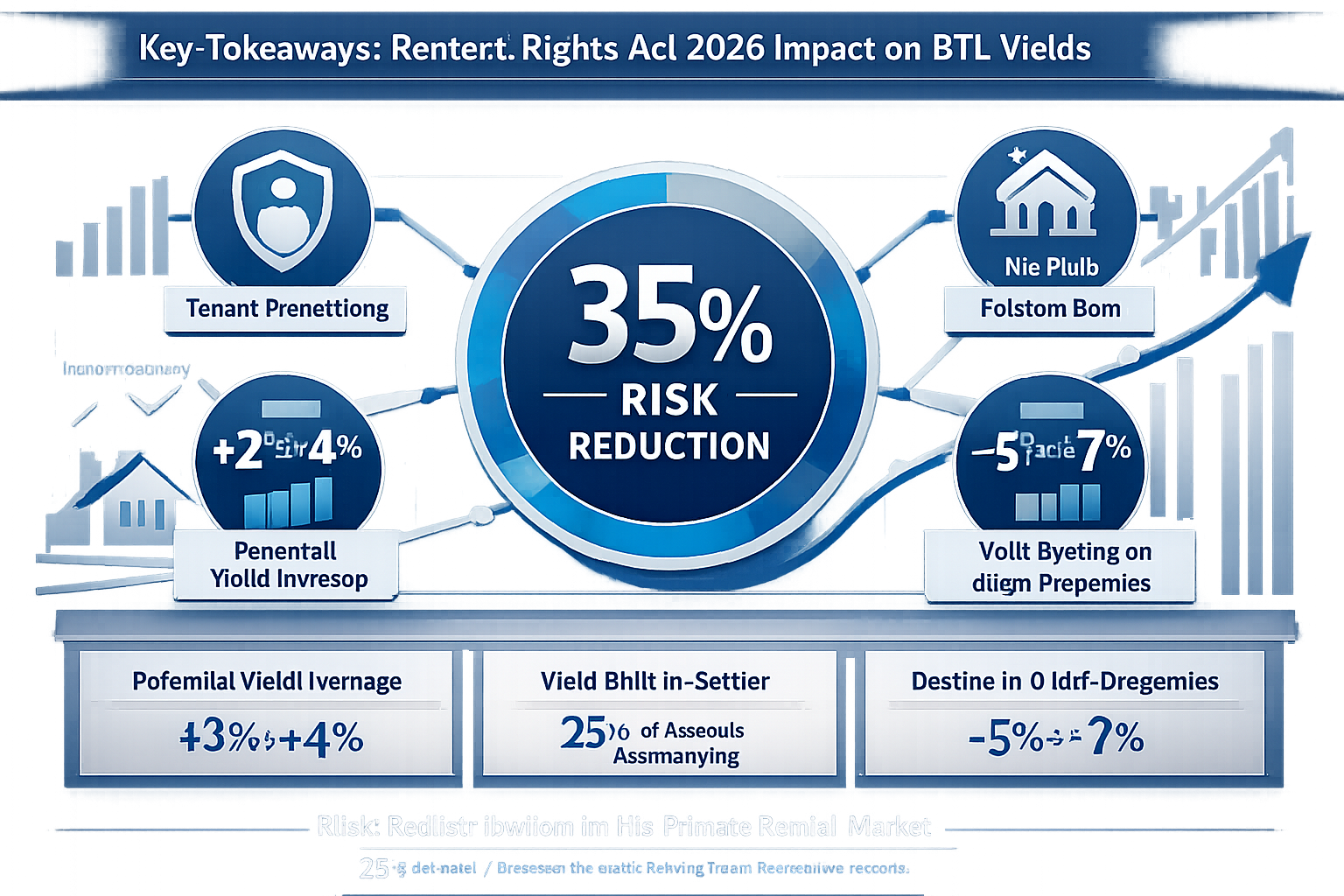
- Section 21 no-fault evictions are abolished from May 1, 2026, replacing the no-fault eviction route with mandatory Section 8 grounds-based possession claims.
- Vacant possession is now significantly harder to obtain, extending timelines for property sales and affecting exit values for BTL investors.
- Valuers must apply risk-adjusted yield premiums to reflect increased tenant security, longer notice periods, and court-dependent possession timelines.
- Rent increase flexibility is restricted to once per year under periodic tenancies, limiting landlords' ability to grow income in line with market conditions.
- RICS Red Book valuations for BTL assets must now account for the new legislative landscape, including void risk, arrears accumulation periods, and ombudsman dispute resolution costs.
Understanding the Legislative Shift: What the Renters' Rights Act 2026 Actually Changes
The End of Section 21 and the New Possession Framework
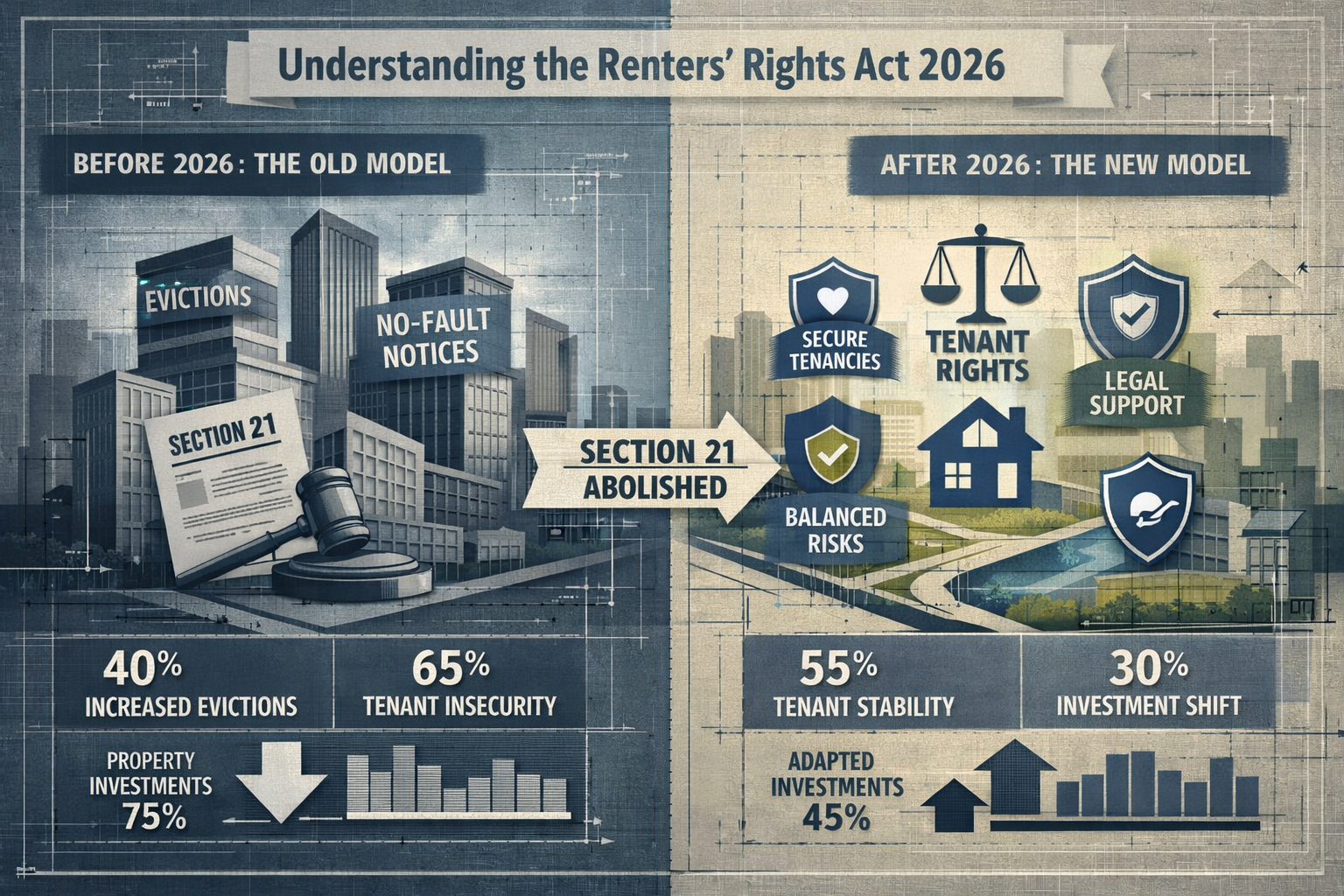
Before May 1, 2026, landlords could recover possession of a property without giving any reason, provided they served a valid Section 21 notice and followed the correct procedure. This "no-fault" route gave BTL investors a reliable exit mechanism — particularly useful when selling a property with vacant possession or when a tenancy was no longer commercially viable.
That mechanism no longer exists [2].
All possession claims must now rely on Section 8 of the Housing Act 1988, citing specific statutory grounds. The most commonly used grounds for BTL investors include:
| Ground | Reason | Notice Period Required |
|---|---|---|
| Ground 1A | Landlord intends to sell the property | 4 months |
| Ground 8 | Rent arrears of 4+ months | 4 weeks |
| Ground 14 | Antisocial behaviour | Immediate (court discretion) |
| Ground 1 | Landlord or close family intends to occupy | 4 months |
💡 Key shift: Under the old regime, Ground 1A's equivalent was a 2-month Section 21 notice. The doubling of the notice period to 4 months directly delays vacant possession sales and extends holding periods [2].
Fixed-Term Tenancies Are Gone: The Periodic Tenancy Default
All assured shorthold tenancies (ASTs) — including existing ones — have now transitioned to periodic (rolling) tenancies [5]. This is not merely procedural. It changes the entire commercial logic of BTL investment:
- No guaranteed end date means no built-in opportunity to sell with vacant possession at lease expiry.
- Exit strategies must now be planned around court timelines, not contractual dates.
- Holding period assumptions used in investment appraisals must be revised upward.
For valuers, this means that the "tenanted value" and "vacant possession value" gap — already a standard consideration in investment valuations — has widened materially [3].
How Valuation Adjustments for Private Rented Sector Properties Must Reflect the New Risk Landscape
Recalibrating Yield Premiums for Increased Possession Risk
The core principle of investment property valuation is that yield reflects risk. Higher risk demands a higher yield, which — all else being equal — means a lower capital value. The Renters' Rights Act 2026 has introduced several new risk layers that valuers must price into BTL assessments.
A RICS Red Book valuation for a BTL property in 2026 should now explicitly consider:
1. Void Risk Premium
The inability to serve a Section 21 notice means landlords cannot easily remove non-paying or problematic tenants without court proceedings. This increases the probability and duration of voids. Valuers should model extended void periods — particularly in areas with high court backlogs.
2. Arrears Accumulation Risk
Under the new rules, tenants must accumulate 4 months of rent arrears before a mandatory Ground 8 possession order can be sought [2]. Combined with typical court processing times, a landlord could face 6–9 months without rental income before recovering possession. This materially affects net yield calculations.
3. Notice Period Extension Discount
Ground 1A (sale) now requires 4 months' notice rather than 2 [2]. For a property valued at £350,000 with a monthly rent of £1,500, that additional 2-month notice period represents £3,000 in additional carrying costs — a direct deduction from net sale proceeds.
4. Ombudsman and Dispute Resolution Costs
The Renters' Rights Act 2026 introduces a mandatory Private Rented Sector Ombudsman scheme. Landlords must be registered, and tenants can bring disputes without going to court. Valuation models should factor in an annual allowance for potential dispute resolution costs.
Practical Yield Adjustment Methodology
When conducting RICS valuations for BTL assets, the following framework provides a structured approach to yield adjustment:
Step 1: Establish the Gross Initial Yield (GIY)
Calculate the passing rent as a percentage of the purchase price or current market value.
Step 2: Apply Void and Arrears Deductions
Model a realistic void scenario based on the new possession timeline. For a standard rent arrears case:
- 4 months to qualify for Ground 8 [2]
- 2–4 months court processing (variable by region)
- Total exposure: 6–8 months' rent
Step 3: Apply a Legislative Risk Premium
Add 50–100 basis points to the required yield to reflect:
- Reduced landlord control over tenancy termination
- Restricted rent increase frequency (once per year maximum) [5]
- Increased compliance costs (ombudsman registration, new notice requirements)
Step 4: Reconcile Against Market Evidence
Benchmark against comparable BTL transactions post-May 2026. Early market data suggests a 5–8% discount on tenanted BTL values versus vacant possession equivalents in high-demand urban markets [3].
📊 Pull Quote: "The gap between tenanted value and vacant possession value for BTL properties has widened materially since May 2026 — valuers who ignore this shift risk producing misleading assessments."
Practical Implications for Landlords, Investors, and Surveyors
Impact on BTL Investment Appraisals and Exit Strategies
The abolition of Section 21 does not just affect ongoing management — it fundamentally changes how BTL investments should be appraised at the point of acquisition and how exit strategies are structured.
Acquisition Appraisals
Investors purchasing tenanted BTL properties must now build in:
- A longer assumed holding period (to allow for potential possession proceedings before sale)
- A higher discount rate to reflect legislative risk
- A realistic allowance for legal costs if possession is contested
Understanding the cost of valuation for a BTL asset has become more complex — a simple desktop assessment is no longer sufficient for investment-grade decisions.
Exit Strategies
Selling a tenanted property with a sitting tenant has always attracted a discount versus vacant possession. That discount has grown [3]. Landlords who wish to sell to owner-occupiers must now:
- Serve a Ground 1A notice (4 months) [2]
- Wait for the notice period to expire
- Apply to court if the tenant does not vacate
- Await a court hearing and enforcement
In practice, this can extend the timeline from decision-to-sell to vacant possession by 6–12 months in contested cases — a significant drag on investor returns.
Portfolio Refinancing
Lenders are also adjusting. Several BTL mortgage providers have begun factoring the new possession timeline into their stress-testing models. A property that previously qualified for a 75% LTV mortgage based on rental coverage ratios may now require a higher yield or lower LTV to satisfy lender requirements. Surveyors providing RICS valuations for mortgage purposes must ensure their reports reflect the current legislative environment.
The Dilapidations and Condition Dimension
With tenants now enjoying greater security of tenure, the condition of a property at the end of a tenancy becomes an even more critical issue. Landlords can no longer rely on a swift Section 21 exit to address deteriorating properties. Instead, they must manage condition proactively throughout the tenancy.
This makes pre-tenancy schedule of condition documentation essential. A well-prepared schedule of condition:
- Establishes a clear baseline for dilapidations claims
- Supports any Section 8 possession claim based on property damage
- Protects landlords in ombudsman dispute proceedings
Similarly, dilapidations surveys at the end of tenancy are now more commercially significant — they form the evidential basis for any financial claim against a departing tenant.
Capital Gains Tax Valuation Considerations
For landlords disposing of BTL assets — whether tenanted or with vacant possession — accurate capital gains tax valuation is essential. The new legislative environment means that:
- Tenanted disposal values may be lower than pre-2026 comparables, potentially reducing CGT liability
- Vacant possession premiums are harder to achieve, affecting the base cost calculation for CGT purposes
- Delayed sales (due to extended notice periods) may push disposal into a different tax year, with planning implications
Landlords considering disposal should seek a formal RICS valuation to establish a defensible market value for HMRC purposes.
Regional Variations in Valuation Impact
The impact of the Renters' Rights Act 2026 is not uniform across England. Valuers should apply regional judgment when calibrating yield adjustments:
| Region | Court Backlog Risk | Typical Void Exposure | Suggested Yield Premium |
|---|---|---|---|
| London (inner) | High | 8–12 months | +75–100 bps |
| London (outer) | Medium-High | 6–10 months | +50–75 bps |
| South East | Medium | 5–8 months | +50 bps |
| North West / North East | Lower | 4–7 months | +25–50 bps |
Note: These are indicative ranges based on current court processing data and should be reviewed as case law and enforcement patterns develop through 2026.
Adapting Valuation Practice: What Surveyors Must Do Now
Updating Valuation Reports for the Post-Section 21 Era
RICS-registered valuers have a professional obligation to ensure their reports reflect the current market and legislative context. In 2026, this means every Red Book valuation for a PRS property should include:
✅ Explicit reference to the Renters' Rights Act 2026 and its impact on possession rights
✅ A tenanted value and a vacant possession value with a clear explanation of the gap
✅ A yield analysis that incorporates the legislative risk premium
✅ Commentary on the specific tenancy terms — notice periods served, arrears status, and any ombudsman proceedings
✅ A sensitivity analysis showing how value changes under different possession timeline scenarios
The Role of Building Surveys in BTL Risk Assessment
Beyond yield and valuation, the physical condition of a BTL property now carries greater financial weight. With possession harder to obtain, a landlord cannot simply serve notice and refurbish. Structural issues, damp, or significant disrepair must be managed with a sitting tenant in place — or addressed proactively between tenancies.
A Level 3 building survey before acquiring a BTL property in 2026 is no longer optional for prudent investors. It provides:
- A full assessment of repair liability before a tenancy begins
- Evidence to support any future Section 8 possession claim based on tenant-caused damage
- A baseline for dilapidations assessment at tenancy end
For investors managing larger portfolios, a stock condition survey across multiple units provides a cost-effective way to prioritise capital expenditure and manage compliance risk under the new legislative framework [1].

Conclusion: Actionable Next Steps for Landlords and Valuers
The valuation adjustments for private rented sector properties required in the wake of the Renters' Rights Act 2026 Section 21 abolition are not cosmetic. They reflect a genuine and permanent shift in the risk profile of BTL investment. Surveyors who fail to update their methodology risk producing valuations that misrepresent market value — with serious consequences for lenders, investors, and HMRC.
Here are the immediate steps every stakeholder should take:
🏠 Landlords: Commission a current RICS Red Book valuation for each BTL asset to understand the post-Section 21 market value. Review exit strategies and adjust holding period assumptions accordingly.
📋 Surveyors and Valuers: Update standard BTL valuation templates to include explicit legislative risk commentary, dual tenanted/vacant possession values, and yield premium justification. Ensure all reports reference the Renters' Rights Act 2026.
🔍 Investors Acquiring BTL Assets: Instruct a Level 3 building survey and a schedule of condition before completing any tenanted purchase. Factor extended possession timelines into acquisition yield calculations.
💰 Landlords Disposing of Assets: Obtain a formal capital gains tax valuation to establish a defensible disposal value in the new legislative environment.
📊 Portfolio Managers: Commission a stock condition survey to identify properties with the highest repair liability and manage compliance risk proactively.
The Renters' Rights Act 2026 is not the end of BTL investment — but it is the end of BTL investment as it was previously understood. Those who adapt their valuation practice and investment strategy to the new reality will be best positioned to navigate the years ahead.
References
[1] Navigating The 2026 Renters Rights Act A Survival Guide For St Helens Landlords – https://www.belvoir.co.uk/guides/st-helens/navigating-the-2026-renters-rights-act-a-survival-guide-for-st-helens-landlords/
[2] Section 21 Abolition – https://theindependentlandlord.com/section-21-abolition/
[3] Selling A Rental Property In 2026 How The New Renters Rights Bill Affects You – https://www.gorvinsresidential.com/selling-a-rental-property-in-2026-how-the-new-renters-rights-bill-affects-you/
[4] Existing Tenancies Renters Rights Act – https://www.nrla.org.uk/resources/renters-rights/existing-tenancies-renters-rights-act
[5] Renters Rights Bill A Letting Agents Guide – https://blog.goodlord.co/renters-rights-bill-a-letting-agents-guide
