
Over 50,000 electrical fires break out in UK homes every year — yet until 2026, no single piece of housing legislation formally required landlords to respond to electrical and fire hazards within legally binding timeframes. That changed with the Phase 2 rollout of Awaab's Law, which directly reshapes how electrical hazards and fire risk assessment in building surveys must be conducted, documented, and acted upon across the private and social rented sectors.
This article examines what Awaab's Law 2026 extensions mean for surveyors, landlords, and tenants — covering the new hazard categories, strict response timelines, documentation requirements, and the professional indemnity implications that now sit at the heart of surveyor liability.
Key Takeaways 📋
- Phase 2 of Awaab's Law (2026) extends legally binding hazard response timelines to fire and electrical hazards for the first time, moving beyond Phase 1's focus on damp and mould.
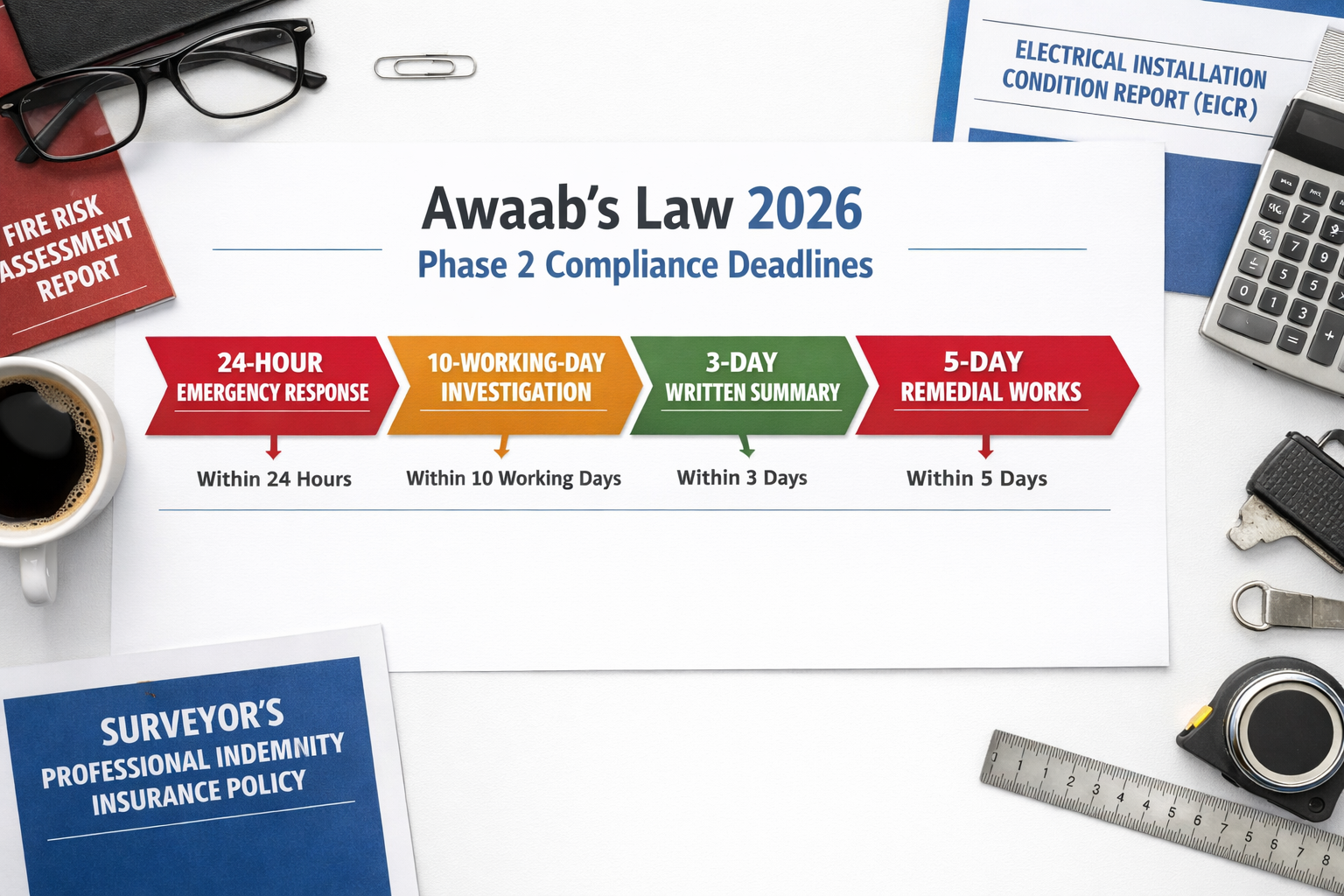
- Emergency electrical and fire hazards must be investigated and remediated within 24 hours; significant hazards require investigation within 10 working days.
- Surveyors face increased liability for missing, misclassifying, or inadequately documenting fire and electrical defects in building survey reports.
- Landlords cannot delegate compliance to third-party contractors — ultimate responsibility remains with the property owner.
- Phase 3 (2027) will extend Awaab's Law to all remaining HHSRS hazards, making early adoption of robust survey protocols essential now.
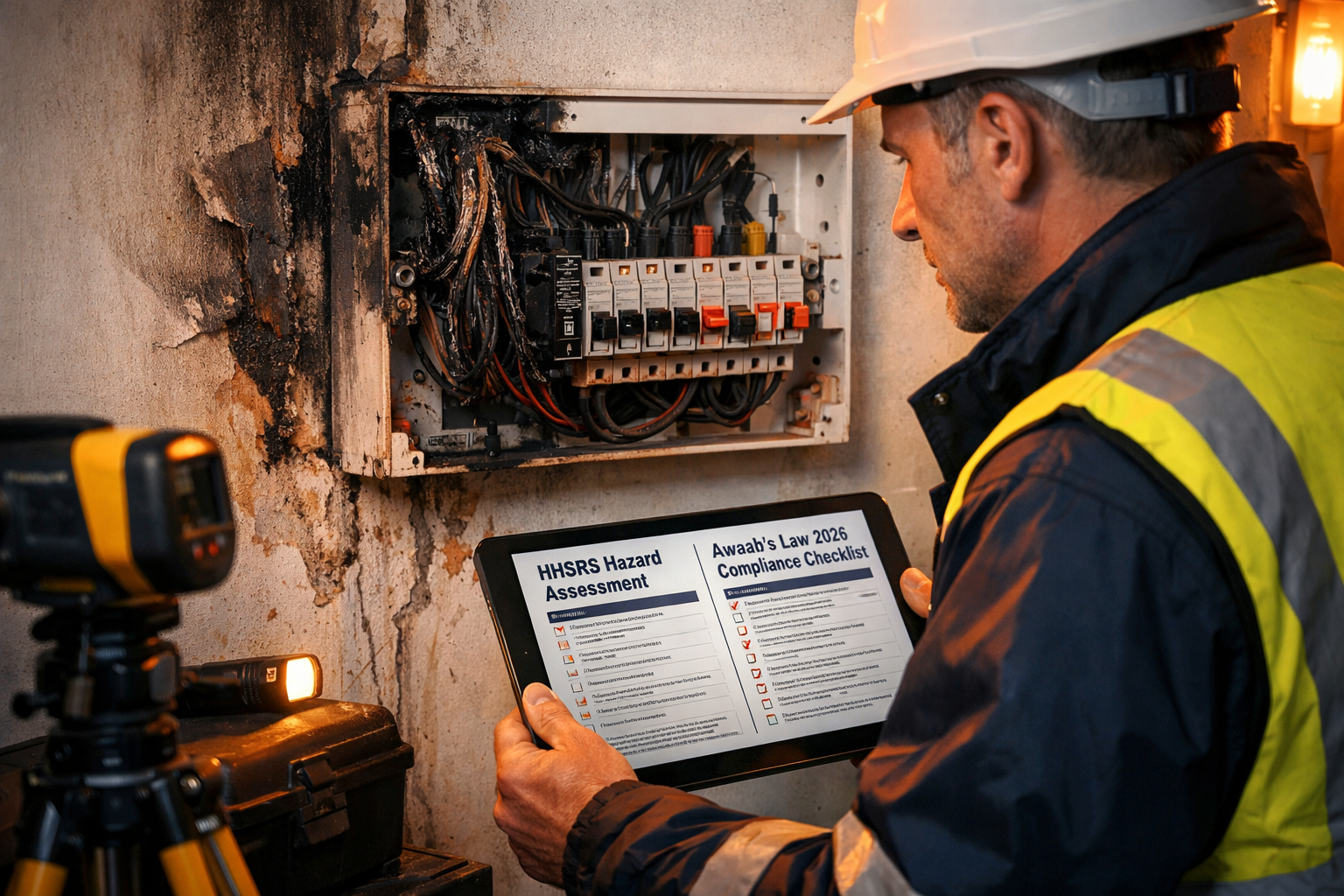
Understanding Awaab's Law 2026: Phase 2 Extensions Explained
Awaab's Law takes its name from Awaab Ishak, a two-year-old boy who died in 2020 as a direct result of prolonged exposure to severe mould in a Rochdale social housing property. The legislation, embedded within the Social Housing (Regulation) Act 2023, created enforceable timelines for landlords to investigate and remedy housing hazards.
Phase 1, which came into force on 27 October 2025, applied exclusively to damp and mould. Phase 2, implemented in 2026, significantly expands the scope to include:
- 🔥 Fire hazards
- ⚡ Electrical hazards
- 🌡️ Excess cold and excess heat
- 🚿 Domestic hygiene hazards
- 🪜 Falls associated with baths and stairs
- 🏗️ Structural collapse risks
- 💥 Explosion hazards [4]
This expansion represents a fundamental shift in how housing hazards are governed. For surveyors, it means that electrical hazards and fire risk assessment in building surveys are no longer simply best-practice items — they are legally prescribed obligations with enforceable consequences for non-compliance [2].
What Counts as a "Significant" vs "Emergency" Hazard?
The legislation draws a critical distinction between hazard severity levels:
| Hazard Classification | Investigation Deadline | Remediation Start |
|---|---|---|
| Emergency (immediate risk to life) | 24 hours | 24 hours |
| Significant (serious but not immediate) | 10 working days | 5 working days after investigation |
| Complex significant (major works required) | 10 working days | Commence within 12 weeks |
A landlord who becomes aware of exposed live wiring, a faulty consumer unit, or evidence of electrical arcing faces a 24-hour clock to investigate and begin remediation [1]. For significant electrical defects — such as an outdated fuse board or inadequate earthing — the investigation must conclude within 10 working days, with a written summary provided to the tenant within 3 working days of that investigation completing [3].
💬 "The 10-working-day investigation window is not a grace period — it is a hard legal deadline from the moment a landlord is made aware of a hazard." — Surventrix, Awaab's Law Compliance Guide
Surveyor Responsibilities: Fire and Electrical Hazard Assessment in Building Surveys
For chartered surveyors, the 2026 extensions create a more demanding inspection and reporting environment. A comprehensive building survey must now address fire and electrical hazards with the same rigour previously reserved for structural defects.
What Surveyors Must Assess
When conducting a Level 3 RICS building survey, surveyors are expected to identify and document:
Electrical hazards:
- Condition of consumer units and distribution boards
- Visible signs of overloading, scorching, or arcing
- Presence of outdated wiring systems (e.g., rubber-insulated cables)
- Absence of RCD (Residual Current Device) protection
- Non-compliant socket outlets in bathrooms or kitchens
- Evidence of DIY or non-Part P electrical work
Fire hazards:
- Compromised fire compartmentation (e.g., unsealed penetrations)
- Missing or inoperative smoke and heat detectors
- Blocked or inadequate means of escape
- Combustible materials in proximity to heat sources
- Absence of fire doors in HMOs or multi-occupancy buildings
Surveyors are not expected to replace an Electrical Installation Condition Report (EICR) — that remains the domain of a qualified electrician. However, they are expected to flag visible indicators of electrical risk and recommend specialist investigation where warranted [2].
Documentation Standards Post-Awaab's Law 2026
The new regulatory environment demands more precise survey reporting. Key documentation requirements include:
- Clear hazard classification — distinguishing between emergency and significant hazards using HHSRS categories
- Photographic evidence of all identified electrical and fire defects
- Explicit remediation recommendations with urgency ratings
- Cross-referencing with current Building Regulations Part B (Fire Safety) and BS 7671 (Wiring Regulations)
- Tenant-accessible language in any written summaries provided under landlord obligations
For landlords managing large residential portfolios, a stock condition survey provides the systematic baseline needed to identify which properties carry the highest fire and electrical hazard risk — allowing prioritised compliance planning before enforcement action arises.
Surveyor Liability Under Awaab's Law 2026: Professional Indemnity Implications
The extension of Awaab's Law to electrical hazards and fire risk assessment in building surveys creates a sharper professional liability landscape for surveyors. Three liability vectors now demand attention.
1. Negligent Omission of Hazards
If a surveyor conducts a building survey and fails to identify or report a fire or electrical hazard that subsequently causes injury, death, or property loss, the professional indemnity exposure is significant. Courts will assess whether the surveyor met the standard of a reasonably competent chartered surveyor at the time of inspection.
Post-2026, that standard explicitly includes awareness of Awaab's Law Phase 2 hazard categories. Surveyors who rely on outdated inspection protocols — or who fail to recommend specialist electrical investigation where visible defects are present — face negligence claims from both landlords and tenants [4].
2. Misclassification of Hazard Severity
Classifying an emergency hazard as a significant one — or downgrading a significant hazard to a minor defect — carries direct legal consequences. If a landlord acts on a surveyor's misclassification and fails to meet the 24-hour emergency response window, both parties may face enforcement proceedings.
A specific defect survey can provide the focused, expert-level assessment needed when a particular electrical or fire defect requires detailed investigation beyond the scope of a standard survey report.
3. Contractor and FM Arrangement Liability
A critical point clarified by legal commentary on Awaab's Law is that landlords cannot transfer compliance responsibility to third-party contractors [4]. Even where a facilities management company or maintenance contractor is engaged, the landlord remains the legally accountable party.
For surveyors advising landlords on maintenance contracts, this means:
- Building contracts and refurbishment agreements must be explicitly updated to cover Awaab's Law fire and electrical hazard obligations [4]
- Contractors must be required to rectify defects constituting HHSRS hazards during the defects liability period
- FM contracts should include step-in rights allowing landlords to take direct action if a contractor fails to meet Awaab's Law timelines
💬 "Awaab's Law compliance cannot be outsourced. The landlord is the responsible person — full stop."
Non-Compliance Penalties
The consequences of failing to meet fire and electrical hazard response obligations are severe:
- Unlimited fines issued by the Housing Ombudsman or local authority
- Enforcement orders requiring immediate remediation
- Rent repayment orders if a property becomes uninhabitable due to an unaddressed hazard
- Tenant compensation claims for injury, distress, or financial loss [4]
Tenants now have a direct enforcement avenue — they can formally request action and pursue compensation if landlords breach the prescribed response timelines [3]. This tenant empowerment mechanism makes proactive survey and assessment work more valuable than ever.
Practical Compliance: What Landlords and Surveyors Should Do Now in 2026
For Landlords
Immediate actions:
✅ Commission a comprehensive condition survey report across all tenanted properties to establish a baseline hazard register
✅ Ensure all properties have a current EICR (no older than 5 years for private rentals, or on change of tenancy)
✅ Update maintenance and FM contracts to include explicit Awaab's Law compliance clauses
✅ Establish an internal triage system to classify reported hazards as emergency or significant within hours of notification
✅ Train property management staff to recognise fire and electrical hazard indicators
For portfolio landlords, understanding what surveyors look for in a house survey helps set expectations for the depth of assessment now required under Phase 2 protocols.
For Surveyors
Survey report upgrades:
✅ Integrate explicit HHSRS hazard category references into fire and electrical defect descriptions
✅ Use clear severity classifications aligned with Awaab's Law emergency/significant thresholds
✅ Include recommended specialist referrals (electricians, fire engineers) with urgency ratings
✅ Ensure professional indemnity insurance covers Awaab's Law-related claims — review policy wording with insurers
✅ Stay current with BS 7671:2018 (Amendment 2) and Building Regulations Part B updates
For commercial properties, the obligations differ but the principle of proactive hazard assessment remains paramount. A RICS commercial building survey should similarly incorporate fire and electrical risk documentation as standard practice.
The Road to Phase 3 (2027)
Phase 2 is not the final destination. Phase 3, expected in 2027, will extend Awaab's Law to all remaining HHSRS hazards, including:
- Asbestos
- Biocides
- Carbon monoxide
- Noise
- Crowding and space hazards [3]
Surveyors and landlords who establish robust compliance frameworks now — covering electrical hazards and fire risk assessment in building surveys — will be significantly better positioned when Phase 3 obligations arrive.
Conclusion: Acting Before the Clock Starts
Awaab's Law 2026 has transformed fire and electrical hazard management from a best-practice aspiration into a legally enforced obligation. The 24-hour emergency response window and 10-working-day investigation deadline leave no room for administrative delay or ambiguity.
For surveyors, the message is clear: survey reports must now meet a higher standard of hazard identification, classification, and documentation. Professional indemnity exposure is real, and the reputational consequences of missing a prescribed hazard are significant.
For landlords, the law removes any comfort in delegation — compliance responsibility cannot be passed to contractors or managing agents.
Actionable Next Steps 🎯
- Commission a full building survey that explicitly addresses HHSRS Phase 2 hazard categories — including fire and electrical risks
- Review all existing EICRs and fire risk assessments for currency and completeness
- Update maintenance contracts to include Awaab's Law compliance obligations on contractors
- Brief property management teams on the 24-hour emergency and 10-working-day significant hazard timelines
- Consult a chartered surveyor experienced in post-Awaab's Law protocols before your next tenancy begins or renews
The clock on compliance started in 2026. Properties that have not been assessed against the new fire and electrical hazard standards are already carrying unquantified legal risk. The cost of a thorough building survey is a fraction of the cost of an enforcement order, a compensation claim, or — most critically — a preventable tragedy.
References
[1] Awaabs Law – https://www.ecosafegroup.co.uk/post/awaabs-law
[2] Building Surveys For Excess Cold And Fire Hazards In Prs Post Awaabs Law 2026 Protocols For Private Landlord Compliance – https://nottinghillsurveyors.com/blog/building-surveys-for-excess-cold-and-fire-hazards-in-prs-post-awaabs-law-2026-protocols-for-private-landlord-compliance
[3] Awaabs Law Is Here The Surveyors Guide For Compliance – https://www.surventrix.com/blog/awaabs-law-is-here-the-surveyors-guide-for-compliance
[4] Awaabs Law Comes Into Force What Does It Mean For Construction – https://www.trowers.com/insights/2025/november/awaabs-law-comes-into-force-what-does-it-mean-for-construction
