
Landlords who cannot produce a professional defect report when challenged under the Renters' Rights Act 2026 face a stark reality: courts will not simply take their word for it. With the abolition of Section 21 "no-fault" evictions, every possession claim must now be argued on documented grounds — and building survey defect documentation under the new Renters' Rights Act 2026 has become the cornerstone of landlord compliance evidence for Section 8 eviction grounds.
This shift is not merely procedural. The Act has fundamentally changed the evidentiary burden on landlords. Whether a landlord is defending against a tenant's disrepair claim, demonstrating proactive maintenance, or pursuing a Section 8 possession order based on property condition, the quality and timing of defect documentation will determine the outcome.
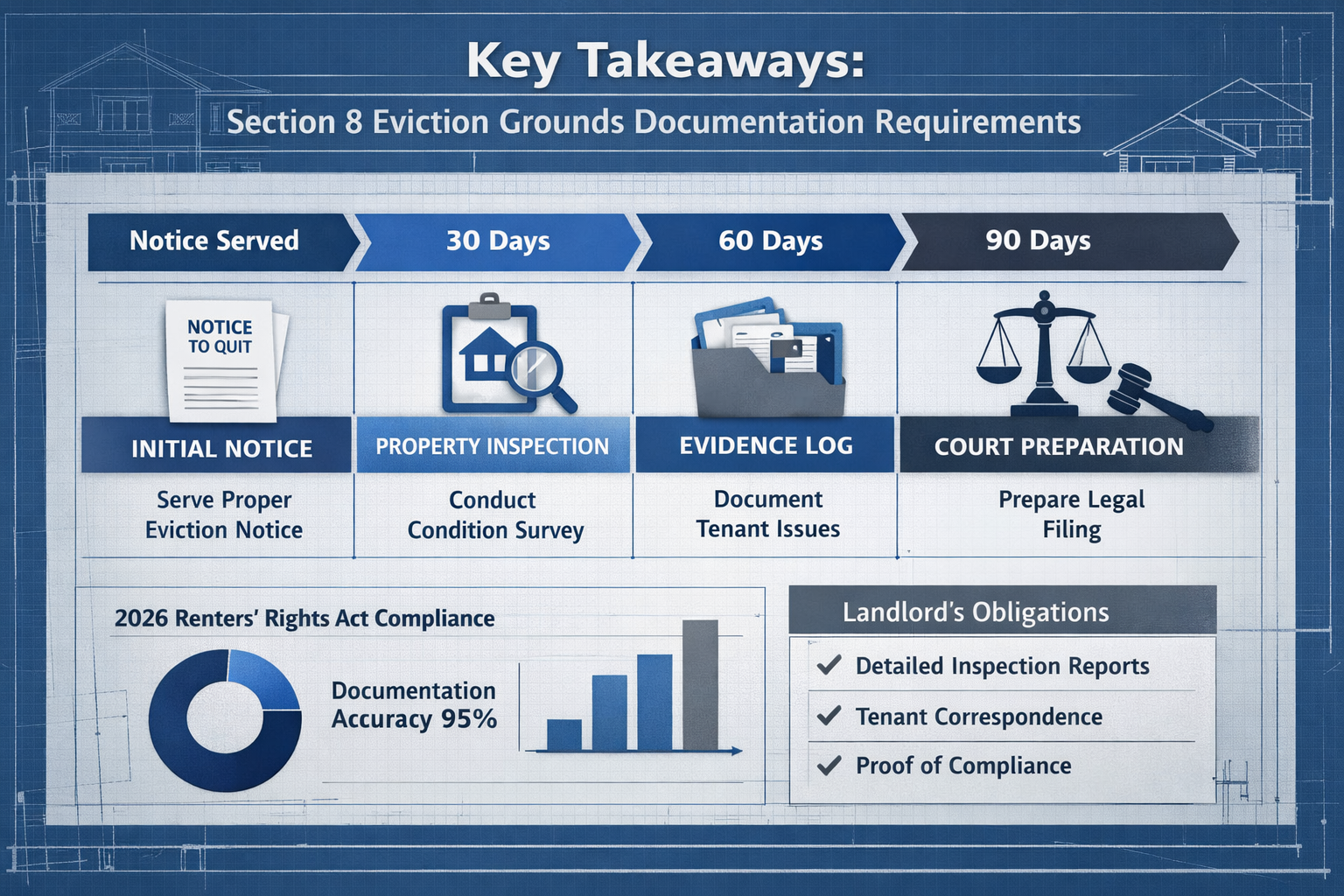
Key Takeaways 📋
- Section 21 is gone — all evictions now require Section 8 grounds, making documented evidence of property condition and landlord compliance non-negotiable.
- The Decent Homes Standard now applies legally to private rentals; properties with serious damp or mould are statutorily "non-decent." [1]
- Strict timelines apply: 14 days to investigate, 7 days to begin repairs, and 24 hours for imminent health risks — all requiring timestamped documentation. [1]
- Professional building survey reports serve as admissible compliance evidence in possession proceedings and disrepair disputes.
- Blaming tenants for damp or mould will not succeed unless landlords can prove adequate ventilation and insulation through technical documentation. [1]
Why Section 21 Abolition Makes Defect Documentation Critical
The Renters' Rights Act 2026 removes the landlord's ability to end a tenancy without providing a legal reason. Every possession claim must now succeed or fail on one of the specified Section 8 grounds. This creates an immediate and practical problem: if a landlord has failed to document the property's condition, maintenance history, and defect responses, they have no evidence base from which to argue.
"A landlord without documented evidence is a landlord without a case."
Section 8 grounds relevant to property condition include situations where tenants have caused damage, where the property requires significant works, or where the tenancy has broken down due to disputes about disrepair. In each scenario, the landlord must present objective, credible evidence — and courts increasingly expect that evidence to come from qualified professionals rather than landlord-prepared notes. [4]
This is why building survey defect documentation under the new Renters' Rights Act 2026 is no longer optional. It is the evidentiary foundation on which landlord compliance evidence for Section 8 eviction grounds is built.
For landlords seeking to understand the full scope of what a professional survey involves, the comprehensive guide to building surveyors in London provides an excellent starting point.
The Decent Homes Standard: A New Legal Benchmark for Private Landlords
What the Standard Now Requires
Previously, the Decent Homes Standard applied only to social housing. The Renters' Rights Act 2026 extends it to the private rented sector as statutory law, not guidance. [1] This is a fundamental shift. A property that fails the standard is not merely substandard — it is legally non-compliant.
Under this framework, a property is deemed non-decent if it:
- Contains a Category 1 hazard under the Housing Health and Safety Rating System (HHSRS)
- Is in a serious state of disrepair
- Lacks reasonably modern facilities
- Has inadequate thermal comfort
Damp and mould are explicitly classified as making a property non-decent. [1] This means landlords cannot treat visible mould as a cosmetic issue or attribute it to tenant lifestyle without robust technical evidence to support that position.
The Building Performance Standard
One of the most significant provisions is the building performance test. A property is considered defective if it cannot handle "normal day-to-day living" — including breathing, cooking, and drying towels — without developing mould. [1]
This shifts the burden decisively. Landlords cannot simply blame tenants for condensation mould unless they can demonstrate through technical documentation that:
| Requirement | Documentation Needed |
|---|---|
| Adequate mechanical ventilation | Humidistat-controlled fan specifications and installation records |
| Sufficient insulation | U-value calculations or energy performance data |
| Structural integrity | Building survey confirming no penetrating or rising damp |
| Adequate heating | Boiler service records and heat loss calculations |
Without this documentation, a landlord's claim that mould resulted from tenant behaviour will likely fail in tribunal. [1]
Compliance Timelines: The Documentation Windows Landlords Cannot Miss
The Act establishes three critical response windows, each requiring a documented audit trail. [1]
⏱️ The 14-Day Investigation Window
When a tenant reports a defect — in writing, by text, or verbally — the clock starts. Landlords have 14 days to complete a thorough investigation. Crucially, "investigation" means identifying the root cause, not a visual check. [1]
This is where a professional building survey becomes essential. A chartered surveyor can:
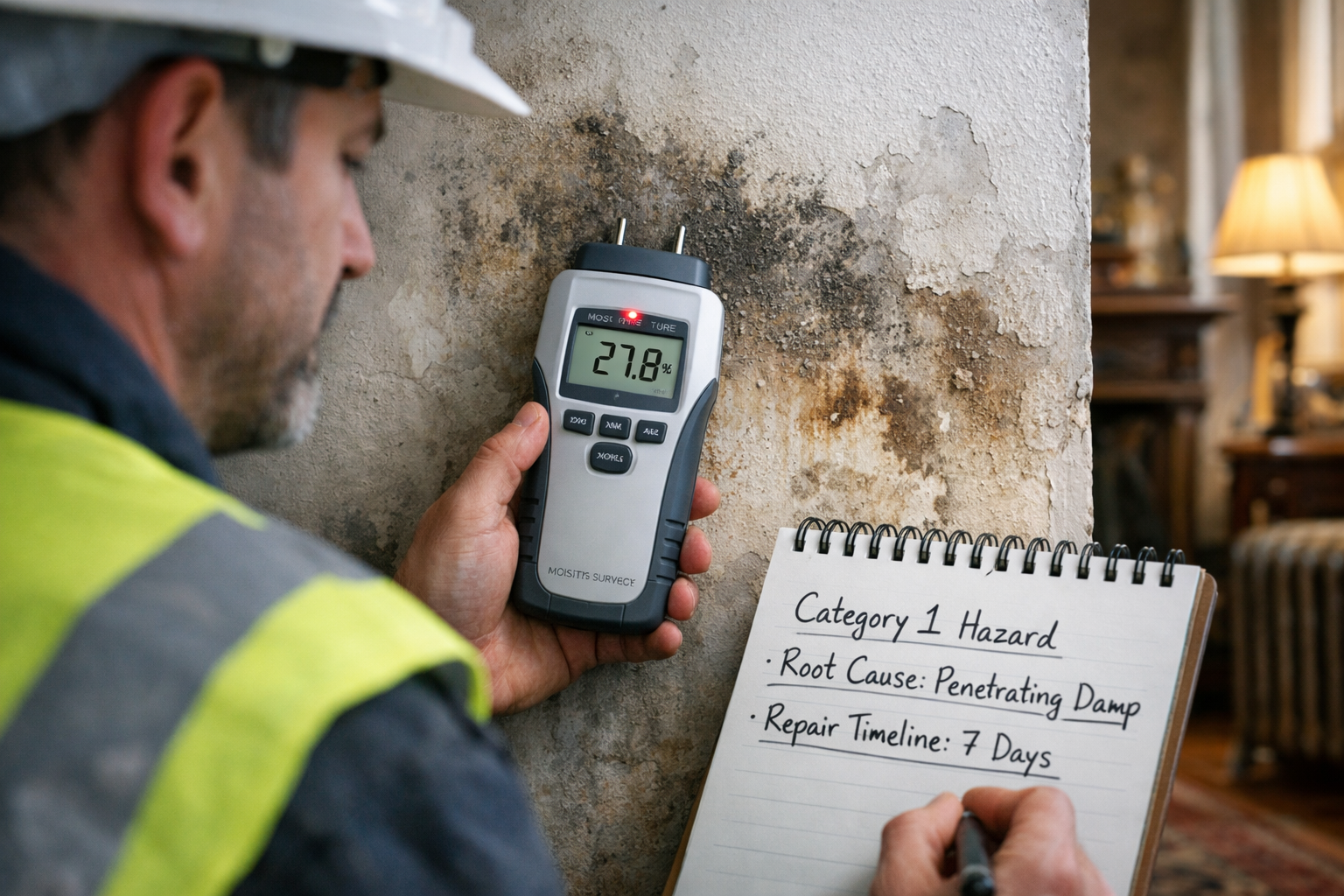
- Identify whether damp is condensation, penetrating, or rising
- Use moisture meters and thermal imaging to locate hidden defects
- Produce a timestamped report that proves investigation occurred within the legal window
For landlords managing properties with complex structural issues, a Level 3 building survey provides the most thorough defect analysis available.
🔧 The 7-Day Repair Commencement Window
Once a hazard is identified, landlords must begin repairs within seven days. [1] The Act is explicit: "starting repairs" means addressing the root cause. Painting over mould or applying surface sealant does not satisfy this requirement.
Where the root cause is structural — such as failed pointing, a defective roof, or bridged cavity walls — landlords need a documented plan of action within this window. [1] A specific defect report from a qualified surveyor provides exactly this: a professional diagnosis with recommended remediation steps and a timeline.
🚨 The 24-Hour Emergency Protocol
Where a defect poses an imminent risk to health — such as extensive mould in an infant's bedroom or a structural collapse risk — investigation and action must occur within 24 hours. [1]
This requires landlords to have rapid-response surveying arrangements in place. Documentary evidence of same-day or next-day professional inspection will be critical in any subsequent tribunal proceedings.
How Building Survey Defect Documentation Supports Section 8 Grounds
Building Survey Defect Documentation Under the New Renters' Rights Act 2026 as a Compliance Shield
Professional survey reports serve a dual function under the 2026 framework. [1] For tenants, they provide evidence of defects. For landlords, they demonstrate that qualified experts were engaged promptly and that issues were addressed systematically rather than ignored.
This dual-purpose nature makes building survey documentation one of the most powerful tools available to landlords in Section 8 proceedings. A well-structured survey report can:
✅ Prove that a reported defect was investigated within the 14-day window
✅ Establish that the root cause — not just the symptom — was identified
✅ Document that repair works commenced within seven days of hazard identification
✅ Demonstrate that the property meets the Decent Homes Standard
✅ Counter tenant allegations of neglect or retaliatory eviction
For landlords dealing with end-of-tenancy disputes, a schedule of dilapidations provides a formal record of property condition that distinguishes fair wear and tear from tenant-caused damage — directly relevant to Section 8 damage grounds.
What a Compliant Defect Documentation Package Looks Like
A robust compliance evidence file for Section 8 proceedings should contain:
- Tenant notification record — date, method, and content of defect report
- Investigation report — professional survey with root cause analysis, dated within 14 days
- Hazard classification — HHSRS category assessment (Category 1 or 2)
- Remediation plan — documented plan of action with start date within 7 days
- Contractor records — quotes, instructions, and completion certificates
- Post-repair survey — confirmation that the root cause has been resolved
- Ongoing monitoring records — evidence of regular property inspections
Roof Defects and Structural Issues: Special Considerations
Roof defects are a common source of penetrating damp in older rental stock. A professional roof survey provides the technical documentation needed to demonstrate that a landlord has properly investigated and addressed the source of water ingress — a requirement that cannot be met by a general visual inspection.
Similarly, where structural issues are suspected, a structural engineer report may be required alongside a building survey to fully document the defect and its remediation requirements.
Practical Steps for Landlords: Building a Compliance Evidence System
Step 1: Commission Pre-Tenancy and Periodic Surveys
The strongest compliance position begins before a tenancy starts. A pre-tenancy building condition survey establishes a baseline against which any future claims can be measured. Periodic surveys — ideally annual — maintain the documentary record. [3]
For landlords with properties in London, chartered surveyors in Central London and across the wider region are well-positioned to provide this ongoing service.
Step 2: Respond to Defect Reports in Writing
Every tenant communication about a defect should be acknowledged in writing, with a clear statement of the investigation timeline. This creates the audit trail that compliance requires.
Step 3: Use Qualified Professionals, Not DIY Assessments
Under the Act, landlord-prepared condition reports carry significantly less weight than professional surveys from RICS-qualified chartered surveyors. [1] Courts and tribunals will scrutinise the credibility of evidence, and a report from a qualified professional is far harder to challenge.
To understand the qualifications to look for, the guide on what a chartered surveyor does explains the professional standards and responsibilities involved.
Step 4: Document the Full Remediation Chain
Evidence of investigation is necessary but not sufficient. The compliance file must show the complete chain: defect reported → investigated → root cause identified → repair commenced → repair completed → post-repair verification. Any gap in this chain weakens the landlord's position.
Step 5: Understand the Limits of Tenant Behaviour Arguments
As noted above, attributing damp and mould to tenant lifestyle requires technical evidence of adequate building performance. [1] Before making this argument, landlords need documented proof of ventilation specifications, insulation standards, and heating adequacy. Without this, the argument will likely fail — and may be seen as evidence of bad faith.
Common Defects and Their Documentation Requirements
| Defect Type | Survey Required | Key Evidence Points |
|---|---|---|
| Condensation mould | Condition survey + ventilation assessment | Ventilation specs, insulation data, humidity readings |
| Penetrating damp | Level 3 building survey | Source identification, structural assessment |
| Rising damp | Specialist damp survey | DPC condition, ground levels, wall moisture profiles |
| Roof leaks | Roof survey | Defect location, water ingress path, repair specification |
| Structural movement | Structural engineer report | Crack mapping, movement monitoring, cause analysis |
| Heating failure | Boiler service + heat loss calculation | System capacity, maintenance history |
Conclusion: Actionable Next Steps for Landlords in 2026
The Renters' Rights Act 2026 has permanently altered the landlord-tenant legal landscape. Building survey defect documentation under the new Renters' Rights Act 2026 is no longer a best practice — it is a legal necessity for any landlord seeking to maintain compliance and preserve their ability to use Section 8 eviction grounds when needed.
The landlords who will navigate this environment successfully are those who treat documentation as an ongoing system, not a reactive measure. The compliance timelines are strict, the evidentiary standards are high, and the consequences of inadequate documentation — failed possession claims, disrepair liability, and civil penalties — are significant.
Immediate action steps:
- 📋 Audit your existing documentation — identify gaps in condition records for each property
- 🔍 Commission a professional building survey for any property where defects have been reported or are suspected
- ⏱️ Establish a defect response protocol that meets the 14-day, 7-day, and 24-hour windows
- 📁 Build a compliance evidence file for each tenancy, updated with every defect report and response
- 🏛️ Engage RICS-qualified surveyors to ensure professional reports meet the evidentiary standard courts expect
The Act has raised the bar. Professional building survey documentation is how landlords clear it.
References
[1] The Renters Rights Bill Is Your Rental Property Compliant With The New Damp Rules – https://mouldremovalspecialists.com/the-renters-rights-bill-is-your-rental-property-compliant-with-the-new-damp-rules/
[2] Valuation Impacts Of New Pet Friendly Rules In Renters Rights Act 2026 Surveyor Adjustments For Landlord Risk Assessments – https://nottinghillsurveyors.com/blog/valuation-impacts-of-new-pet-friendly-rules-in-renters-rights-act-2026-surveyor-adjustments-for-landlord-risk-assessments
[3] Building Surveys For Excess Cold And Fire Hazards In Prs Post Awaabs Law 2026 Protocols For Private Landlord Compliance – https://nottinghillsurveyors.com/blog/building-surveys-for-excess-cold-and-fire-hazards-in-prs-post-awaabs-law-2026-protocols-for-private-landlord-compliance
[4] Renters Rights Act Implementation – https://www.jdsupra.com/legalnews/renters-rights-act-implementation-6365569/
