
{"cover":"Professional landscape format (1536×1024) hero image featuring bold text overlay 'RICS Residential Market Survey Q1 2026: Building Survey Implications for Northern England Price Surges' in extra large 70pt white sans-serif font with dark shadow effect, positioned in upper third. Background shows aerial view of Northern England terraced housing and modern developments with upward trending price graph overlay in vibrant blue and green. Foreground includes RICS surveyor with clipboard examining property exterior, professional equipment visible. Color scheme: deep navy blue, emerald green, white accents. High contrast, magazine cover quality, editorial style with subtle UK property market aesthetic, professional photography composition","content":["Detailed landscape format (1536×1024) infographic showing RICS Q1 2026 regional price performance comparison chart with Northern England highlighted in bright green showing upward trajectory at +3-5%, contrasting with London and South East in muted red showing decline. Bar graphs display net balance percentages for buyer enquiries (-15%), agreed sales (-9%), and 12-month price expectations (+43%). Background features semi-transparent map of UK with Northern regions emphasized, modern data visualization style, clean professional aesthetic with RICS branding colors, statistical overlays, percentage annotations","Detailed landscape format (1536×1024) scene showing professional RICS chartered surveyor conducting Level 3 building survey inspection in Northern England Victorian terraced property. Surveyor examining structural elements with moisture meter and thermal imaging camera, checklist visible on tablet device. Split-screen composition showing hidden defects: damp penetration, roof issues, foundation concerns on left side, and value uplift opportunities on right side including period features and extension potential. Warm interior lighting, professional survey equipment prominent, detailed architectural elements, documentary photography style","Detailed landscape format (1536×1024) visualization of Northern England property investment strategy dashboard showing rental market data with tenant demand at +13% net balance, rental price expectations at +28%, and constrained landlord supply at +1%. Background features modern Northern city skyline (Manchester/Liverpool aesthetic) with residential properties. Foreground displays professional surveyor's valuation report with adjustment techniques, comparable sales data, and risk assessment matrices. Color-coded heat map overlay showing high-demand postcodes, clean financial infographic style, professional business aesthetic with charts and data points"]

The UK housing market is showing early signs of recovery in 2026, but the story isn't uniform across all regions. While London and the South East continue to struggle, Northern England is experiencing a remarkable price surge that's catching the attention of property investors, homebuyers, and building surveyors alike. The latest RICS Residential Market Survey Q1 2026: Building Survey Implications for Northern England Price Surges reveals a fascinating regional divergence that demands strategic responses from property professionals.
For chartered surveyors and prospective buyers, understanding these regional dynamics isn't just about tracking statistics—it's about identifying genuine value opportunities while avoiding costly mistakes in rapidly appreciating markets. This comprehensive analysis examines what the RICS data means for building survey practices and how professionals can adapt their methodologies to serve clients in Northern England's evolving property landscape.
Key Takeaways
- Northern England and Scotland are leading price recovery, with surveyors reporting upward price trajectories while southern regions continue to decline, creating significant regional arbitrage opportunities[1]
- Buyer enquiries improved to -15% net balance in January 2026, the strongest reading in months, signaling renewed market confidence that requires enhanced due diligence[2]
- Building surveys must adapt to rapid price appreciation, with Northern England properties expected to see 3-5% price growth during 2026, necessitating careful valuation adjustments[3]
- Rental market pressures are intensifying, with tenant demand rising to +13% and rental price expectations reaching +28%, creating investment opportunities that require thorough property assessments[1]
- 12-month price expectations reached +43%, the highest level since February 2025, indicating strengthened medium-term sentiment that demands proactive survey strategies[2]
Understanding the RICS Q1 2026 Regional Price Divergence 📊
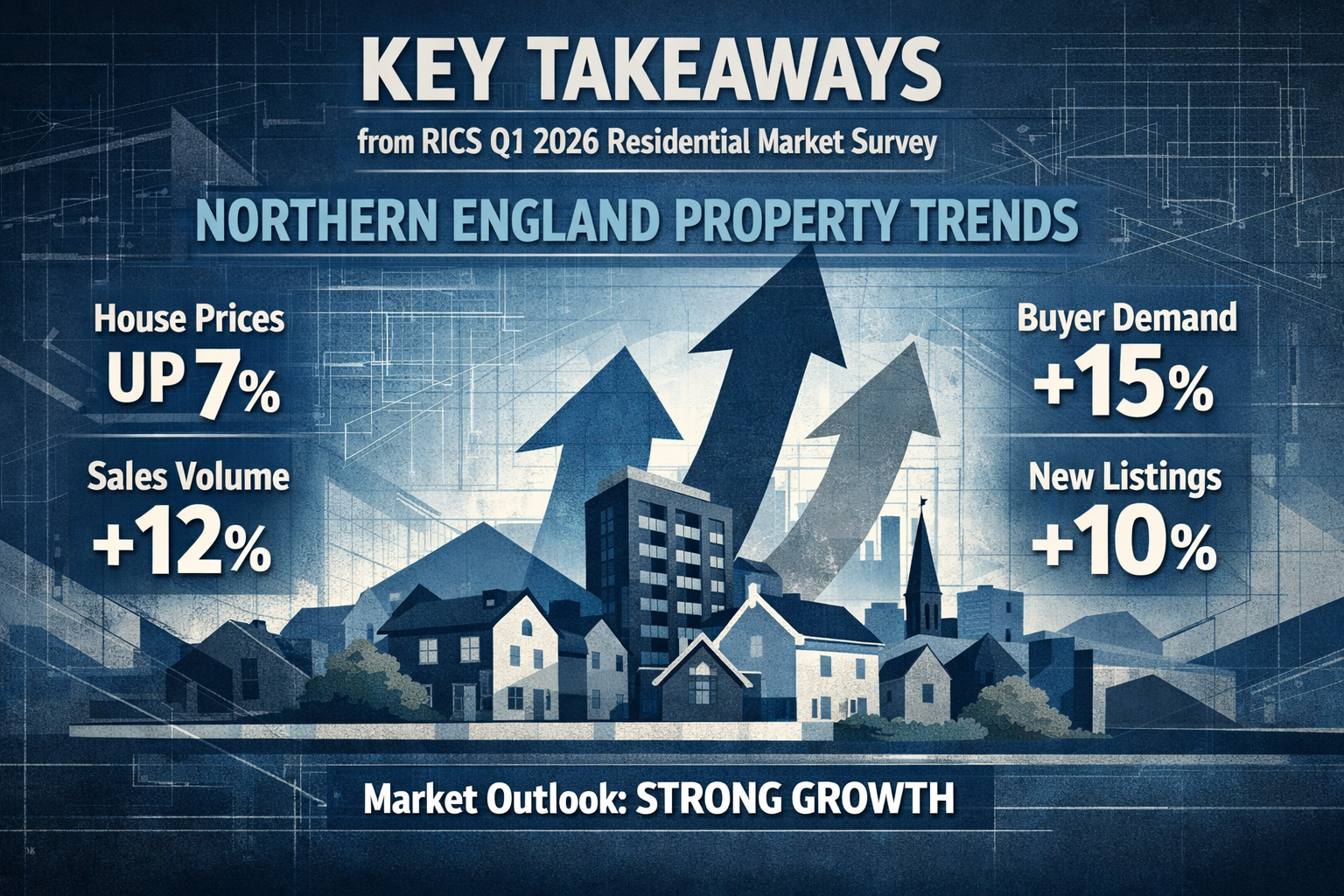
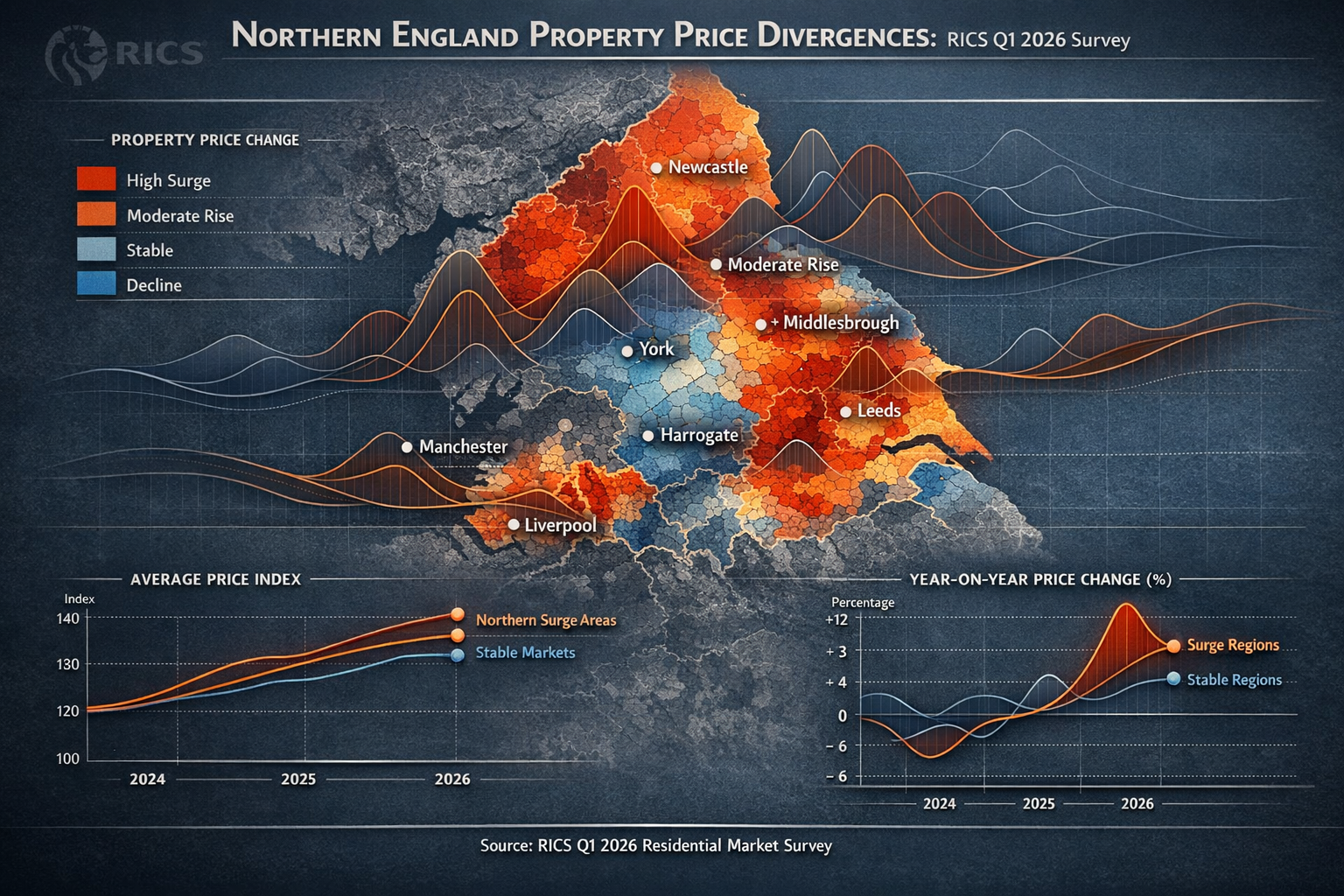
The RICS Residential Market Survey Q1 2026: Building Survey Implications for Northern England Price Surges highlights a remarkable geographic split in the UK property market. While the national picture shows stabilization with a net balance of -10% for prices over the past three months—up from -19% in October 2025—the regional variations tell a more complex story[2].
Northern England's Upward Trajectory
Northern England has emerged as a standout performer in Q1 2026, with respondents consistently reporting prices moving higher across the region. This contrasts sharply with weaker performance in traditional property hotspots like London, the South East, and South West[1]. The shift represents a fundamental rebalancing of the UK property market, driven by several factors:
Economic drivers include:
- Improved regional employment prospects
- Infrastructure investment in Northern cities
- Relative affordability compared to southern markets
- Remote working flexibility enabling lifestyle migration
- Strong rental yields attracting buy-to-let investors
Scotland and Northern Ireland are showing similarly strong price growth, positioning themselves alongside Northern England as the most resilient regional markets in early 2026[2]. This geographic clustering suggests structural rather than temporary market shifts.
National Market Indicators Show Cautious Optimism
Beyond regional variations, several national indicators from the RICS survey demonstrate improving sentiment:
| Metric | January 2026 | Previous Month | Trend |
|---|---|---|---|
| New Buyer Enquiries | -15% | -21% (Dec) | ⬆️ Improving |
| Agreed Sales | -9% | -16% (Dec) | ⬆️ Improving |
| House Prices (3-month) | -10% | -12% (Dec) | ⬆️ Stabilizing |
| 12-Month Price Expectations | +43% | +38% (Dec) | ⬆️ Strengthening |
| 12-Month Sales Expectations | +35% | +30% (Dec) | ⬆️ Optimistic |
The improvement in agreed sales to -9%—the least negative reading in seven months and the best performance since June 2025—indicates that transaction activity is genuinely recovering[2]. For building surveyors, this translates to increased workload and the need for efficient survey processes that maintain quality while meeting demand.
What This Means for Building Survey Professionals
The regional divergence identified in the RICS Residential Market Survey Q1 2026: Building Survey Implications for Northern England Price Surges creates both opportunities and challenges for chartered surveyors. Professionals conducting RICS building surveys in Northern England must recalibrate their approaches to account for:
✅ Faster-moving markets requiring quicker turnaround times
✅ Price appreciation necessitating careful comparable analysis
✅ Increased buyer competition demanding comprehensive defect identification
✅ Investment-driven purchases requiring detailed rental potential assessments
✅ Older housing stock in Northern cities needing thorough structural evaluation
Understanding these dynamics enables surveyors to provide more valuable, contextually relevant advice to clients navigating Northern England's property surge.
Building Survey Implications for Northern England Price Surges: Identifying Value and Risk 🏠
As Northern England experiences upward price momentum, the role of comprehensive building surveys becomes increasingly critical. Buyers entering competitive markets often face pressure to move quickly, but thorough due diligence remains essential—particularly when properties are appreciating rapidly.
Tailored Survey Approaches for Northern England Properties
The RICS Residential Market Survey Q1 2026: Building Survey Implications for Northern England Price Surges suggests that surveyors working in the region should adopt specialized methodologies that address local property characteristics:
Victorian and Edwardian Terraced Housing
Northern cities feature extensive Victorian and Edwardian terraced housing stock. These properties present specific survey considerations:
Critical inspection areas:
- Solid wall construction without cavity insulation, creating potential damp issues
- Original slate roofing that may require replacement or extensive repair
- Shared party walls requiring careful assessment for structural movement
- Original timber floors susceptible to rot, beetle infestation, and deflection
- Period features that add value but may need specialist restoration
- Rear extensions of varying quality and compliance standards
A thorough Level 3 building survey is particularly valuable for these properties, as it provides the detailed analysis needed to identify both hidden defects and value-enhancement opportunities.
Post-War and Modern Developments
Northern England also features significant post-war housing estates and modern developments:
Key survey focus points:
- Concrete construction in 1960s-70s builds requiring carbonation testing
- Cavity wall tie corrosion in properties from the 1970s-80s
- UPVC window and door replacements affecting building regulation compliance
- Flat roof extensions prone to water ingress
- Modern insulation standards and energy efficiency ratings
- New-build snagging issues in recent developments
Value Uplift Opportunities in Appreciating Markets
When conducting surveys in markets experiencing the price surges identified in the RICS Q1 2026 data, professional surveyors should help clients identify value uplift opportunities alongside defects. This balanced approach provides genuine strategic value:
Potential value enhancers to highlight:
🏗️ Extension and conversion potential – Loft conversions, rear extensions, and basement developments that could significantly increase property value
🎨 Period feature restoration – Original fireplaces, cornicing, and architectural details that add premium value when properly restored
⚡ Energy efficiency improvements – Opportunities for insulation, heating system upgrades, and renewable energy installations that improve EPC ratings
🏡 Garden and outdoor space development – Landscaping, outbuildings, and garden offices increasingly valued in post-pandemic market
🚗 Parking and access improvements – Off-street parking creation in urban areas with high parking demand
By identifying these opportunities within survey reports, professionals provide clients with a comprehensive understanding of both immediate condition and future potential—essential intelligence when making purchase decisions in competitive markets.
Pre-Purchase Survey Checklist for Northern England Buyers
For buyers navigating the Northern England property surge, this comprehensive checklist ensures thorough due diligence:
Structural Assessment
- Foundation condition and evidence of settlement or subsidence
- External wall construction type and condition
- Roof structure, covering, and remaining lifespan
- Chimney stack stability and condition
- Window and door frames (original timber vs. replacement)
- Internal wall cracking patterns and severity
- Floor level variations and structural movement
- Timber condition in floors, joists, and roof timbers
Damp and Water Ingress
- Rising damp in solid wall construction
- Penetrating damp from defective pointing or rendering
- Condensation issues and ventilation adequacy
- Roof water ingress and gutter/downpipe condition
- Basement or cellar dampness
- Bathroom and kitchen waterproofing
- Evidence of previous flood damage
Services and Systems
- Electrical installation age and compliance
- Heating system type, age, and efficiency
- Plumbing condition and material type
- Drainage system functionality
- Water pressure and supply adequacy
- Gas safety and appliance condition
Environmental and External Factors
- Boundary definitions and ownership
- Shared access rights and restrictions
- Japanese knotweed or invasive species
- Trees proximity and root damage risk
- Flood risk assessment
- Mining and ground stability (particularly relevant in Northern England)
- Radon gas risk levels
Professional surveyors can use this framework when conducting what surveyors look for in a house survey to ensure comprehensive coverage of all critical aspects.
Valuation Adjustments in Rapidly Appreciating Markets
The RICS data showing Northern England surveyors anticipating 3-5% price appreciation during 2026[3] creates specific challenges for accurate property valuation. Chartered surveyors must carefully adjust their comparable analysis to account for:
Time-based adjustments: Recent sales may not reflect current market conditions if appreciation is rapid. Surveyors should weight more recent comparables more heavily and apply appropriate time adjustments.
Location micro-variations: Even within Northern England's generally strong market, specific postcodes and streets may perform differently based on school catchments, transport links, and local amenities.
Property condition premiums: In competitive markets, well-maintained properties command significant premiums over those requiring work, even when the underlying structure is similar.
Investment yield considerations: With rental prices expected to rise by +28% according to surveyor expectations[1], investment buyers may pay premiums for properties with strong rental potential.
Understanding these nuances enables surveyors to provide accurate valuations that reflect genuine market conditions rather than outdated comparable data.
Strategic Implications for Buyers, Investors, and Surveyors 💼
The RICS Residential Market Survey Q1 2026: Building Survey Implications for Northern England Price Surges creates strategic opportunities for different market participants. Understanding how to leverage this data can mean the difference between profitable investments and costly mistakes.
For Property Buyers: Navigating Competitive Northern Markets
The improved buyer enquiry figures (-15% net balance, up from -21%)[2] indicate that competition is increasing in Northern England's property market. Buyers should:
Act decisively but diligently: While markets are moving faster, comprehensive surveys remain essential. Consider booking residential surveyor services in advance to minimize delays once an offer is accepted.
Budget for survey costs appropriately: A thorough Level 3 survey typically costs £800-1,500 but can identify defects worth tens of thousands of pounds in repair costs. This represents exceptional value in markets where prices are rising 3-5% annually.
Use survey findings strategically: In competitive markets, survey results can provide negotiating leverage even when multiple buyers are interested. Significant defects identified in professional reports create legitimate grounds for price renegotiation.
Consider future value trajectories: With 12-month price expectations at +43%[2], properties requiring cosmetic work may offer better value than turnkey homes if the underlying structure is sound.
For Property Investors: Capitalizing on Rental Market Dynamics
The RICS survey reveals particularly strong rental market indicators that create investment opportunities:
Rental market metrics:
- Tenant demand: +13% net balance (up from negative readings in previous quarters)[2]
- Rental price expectations: +28% (up from +16%)[1]
- New landlord instructions: +1% (virtually unchanged, indicating constrained supply)[1]
These figures suggest a rental market with strengthening fundamentals—rising demand, limited supply, and upward price pressure. For investors, this creates opportunities, but thorough property assessment remains critical:
Investment-focused survey priorities:
- Rental yield potential based on property configuration and local rental comparables
- Maintenance cost projections to accurately forecast net returns
- Tenant appeal factors including energy efficiency, parking, and amenity access
- Regulatory compliance with current landlord safety and licensing requirements
- Long-term capital appreciation potential based on area development plans
Investors should commission comprehensive surveys that address these specific concerns rather than relying on basic homebuyer reports designed for owner-occupiers.
For Chartered Surveyors: Adapting Practice to Regional Dynamics
Professional surveyors working in Northern England must adapt their practices to serve clients effectively in the evolving market conditions identified in the RICS Residential Market Survey Q1 2026: Building Survey Implications for Northern England Price Surges.
Enhanced Regional Market Knowledge
Surveyors should develop deep understanding of:
✅ Local price trends at postcode level, not just regional averages
✅ Development pipeline affecting future supply and demand
✅ Transport infrastructure improvements influencing area desirability
✅ Employment centers driving residential demand
✅ School performance data affecting family buyer preferences
✅ Rental market dynamics in specific neighborhoods
This granular market intelligence enables surveyors to provide contextual advice that goes beyond basic property condition assessment.
Technology Integration for Efficiency
With transaction volumes expected to increase (12-month sales expectations at +35%)[1], surveyors should leverage technology to maintain quality while improving efficiency:
Recommended technology tools:
- Thermal imaging cameras for rapid damp and insulation assessment
- Moisture meters with data logging for evidence-based reporting
- Drone surveys for roof and chimney inspection without scaffolding
- Digital reporting platforms enabling faster report delivery
- Comparable sales databases with real-time market data integration
- Client portals providing transparent communication throughout the survey process
These tools enable surveyors to deliver comprehensive RICS home survey services with faster turnaround times—a competitive advantage in busy markets.
Specialized Service Offerings
The regional price surge creates demand for specialized survey services:
Emerging service opportunities:
- Investment property assessments combining structural surveys with rental yield analysis
- Renovation potential reports identifying value-add opportunities in period properties
- Energy efficiency audits assessing improvement potential and grant eligibility
- Pre-purchase snagging surveys for new-build properties in Northern development schemes
- Portfolio surveys for investors acquiring multiple properties simultaneously
By developing these specialized offerings, surveyors can differentiate their practices and capture premium fees for higher-value services.
Risk Management in Appreciating Markets
While the RICS data shows positive trends, prudent surveyors should help clients understand potential risks:
⚠️ Market correction risk: Rapid appreciation may not be sustainable if economic conditions deteriorate
⚠️ Interest rate sensitivity: The recovery is occurring against a backdrop of elevated mortgage rates that could change
⚠️ Regional economic dependency: Northern England's performance is partly tied to specific industries and employment centers
⚠️ Property-specific defects: Individual properties may have issues that override positive market trends
⚠️ Regulatory changes: Landlord taxation, energy efficiency requirements, and planning rules continue to evolve
Professional surveyors should incorporate these broader risk factors into their advice, ensuring clients make informed decisions based on comprehensive analysis rather than market momentum alone.
Conclusion: Leveraging RICS Q1 2026 Insights for Informed Property Decisions
The RICS Residential Market Survey Q1 2026: Building Survey Implications for Northern England Price Surges reveals a UK property market in transition, with Northern England emerging as a clear outperformer while southern regions continue to struggle. For property buyers, investors, and chartered surveyors, understanding these regional dynamics is essential for making informed decisions in 2026.
The data shows genuine grounds for optimism—buyer enquiries improving to -15%, agreed sales reaching their best level in seven months at -9%, and 12-month price expectations climbing to +43%[2]. Northern England's upward price trajectory, with anticipated 3-5% appreciation during 2026[3], creates opportunities for those who approach the market strategically.
However, opportunity demands diligence. The same competitive pressures that drive price appreciation also increase the risk of overlooking critical property defects or overpaying relative to true value. This is where comprehensive building surveys become invaluable—not as obstacles to quick transactions, but as essential tools for informed decision-making.
Actionable Next Steps
For property buyers in Northern England:
- Commission a thorough Level 3 building survey for any property built before 2000, particularly Victorian and Edwardian terraced housing
- Request rental market analysis if considering future letting potential
- Use survey findings strategically in negotiations, even in competitive markets
- Budget appropriately for both survey costs and any remedial work identified
- Consider future value trajectories when evaluating properties requiring renovation
For property investors:
- Focus on areas with strong rental demand fundamentals (+13% tenant demand)[2]
- Model rental yields conservatively despite positive price expectations
- Commission investment-focused surveys that assess rental potential alongside condition
- Evaluate maintenance cost projections carefully to forecast accurate net returns
- Monitor regulatory developments affecting landlord obligations and taxation
For chartered surveyors:
- Develop deep regional market knowledge at postcode level
- Invest in technology to improve efficiency without compromising quality
- Create specialized service offerings for investment properties and renovation potential
- Maintain rigorous professional standards even as transaction volumes increase
- Provide contextual market advice that goes beyond basic condition assessment
The Northern England property surge identified in the RICS Q1 2026 survey represents a significant market opportunity, but success requires combining market awareness with thorough due diligence. Whether buying a family home, building an investment portfolio, or providing professional survey services, the principles remain constant: understand the market, assess properties rigorously, and make decisions based on comprehensive information rather than momentum alone.
As the UK property market continues to evolve through 2026, those who leverage professional survey insights alongside market data will be best positioned to capitalize on opportunities while avoiding costly mistakes. The regional divergence between Northern England's strength and southern weakness may persist, making location-specific expertise increasingly valuable in the months ahead.
