
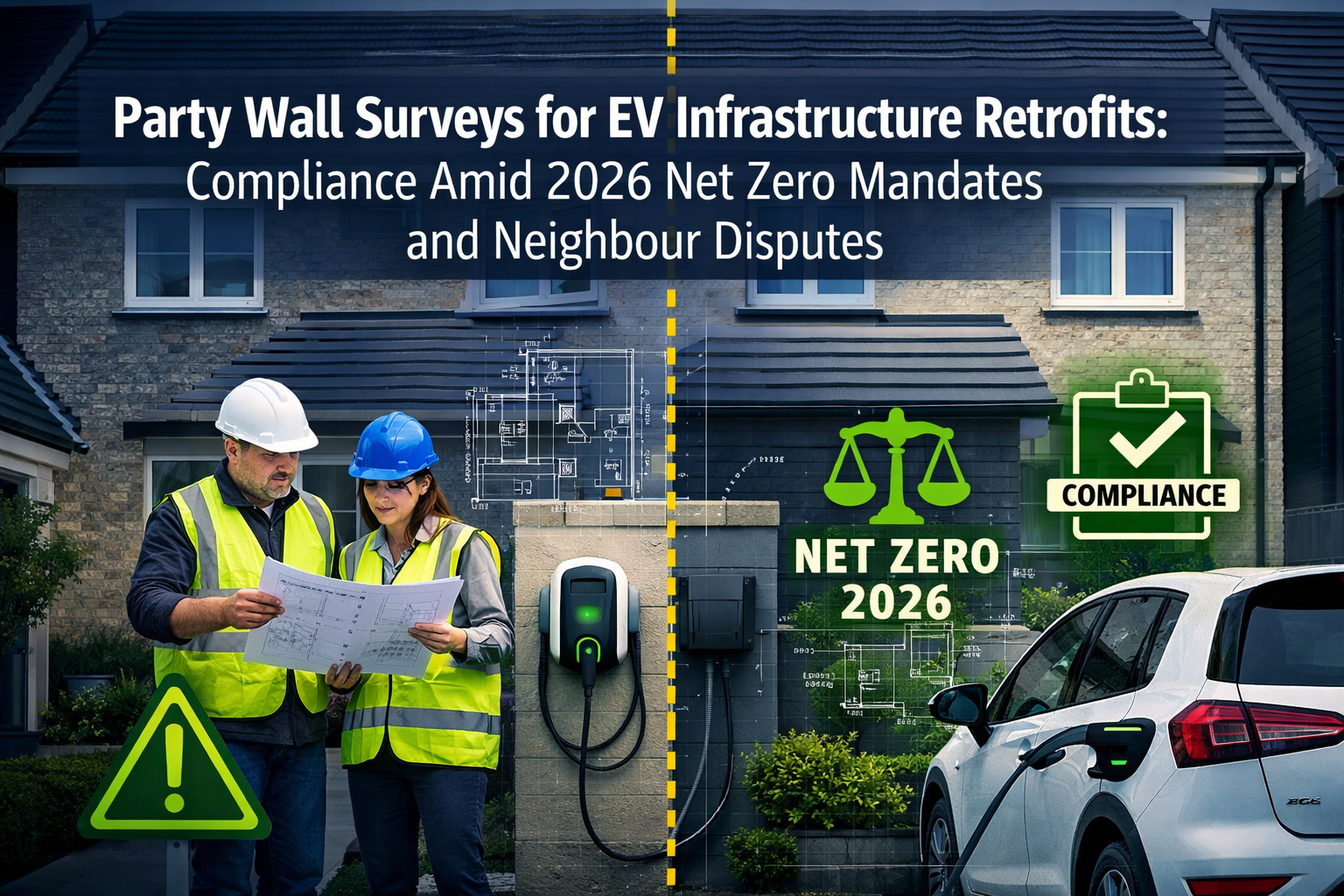
As the United Kingdom accelerates toward ambitious net zero targets in 2026, property owners face unprecedented challenges installing electric vehicle (EV) charging infrastructure on shared boundaries. Party Wall Surveys for EV Infrastructure Retrofits: Compliance Amid 2026 Net Zero Mandates and Neighbour Disputes has emerged as a critical concern for homeowners, landlords, and commercial property managers navigating the complex intersection of environmental regulations and property law. With retrofit activity surging and neighbour disputes escalating, understanding the Party Wall etc. Act 1996 framework has never been more essential. ⚡
The installation of EV charging points on party walls—shared boundaries between semi-detached or terraced properties—requires careful legal navigation, technical expertise, and diplomatic neighbour relations. As government mandates push for widespread EV adoption, the frequency of party wall conflicts related to charging infrastructure has increased dramatically, creating new challenges for surveyors and property owners alike.
Key Takeaways
- Legal compliance is mandatory: Installing EV charging infrastructure on or near party walls requires formal party wall notices under the Party Wall etc. Act 1996, with potential disputes requiring appointed surveyors
- 2026 net zero mandates are driving retrofit activity: Government regulations and funding programmes are accelerating EV infrastructure installations, particularly in multifamily and commercial properties, increasing party wall survey demands
- Technical specifications matter: OCPP compliance, cybersecurity standards, and proper conduit installation through shared walls require expert surveying to prevent structural damage and legal conflicts[1]
- Award templates reduce disputes: Well-drafted party wall awards with specific provisions for EV installations, access rights, and maintenance schedules can prevent costly neighbour disputes
- Early engagement prevents delays: Initiating the party wall process 2-3 months before planned EV charger installation ensures compliance and minimizes project disruption
Understanding the Party Wall Act Framework for EV Charging Infrastructure
The Party Wall etc. Act 1996 governs building work on shared boundaries between properties in England and Wales. When property owners plan to install EV charging infrastructure that affects party walls, party structures, or excavations near neighbouring properties, they must follow specific legal procedures to protect both parties' interests.
What Constitutes Party Wall Work for EV Installations?
EV charging infrastructure can trigger party wall requirements in several scenarios:
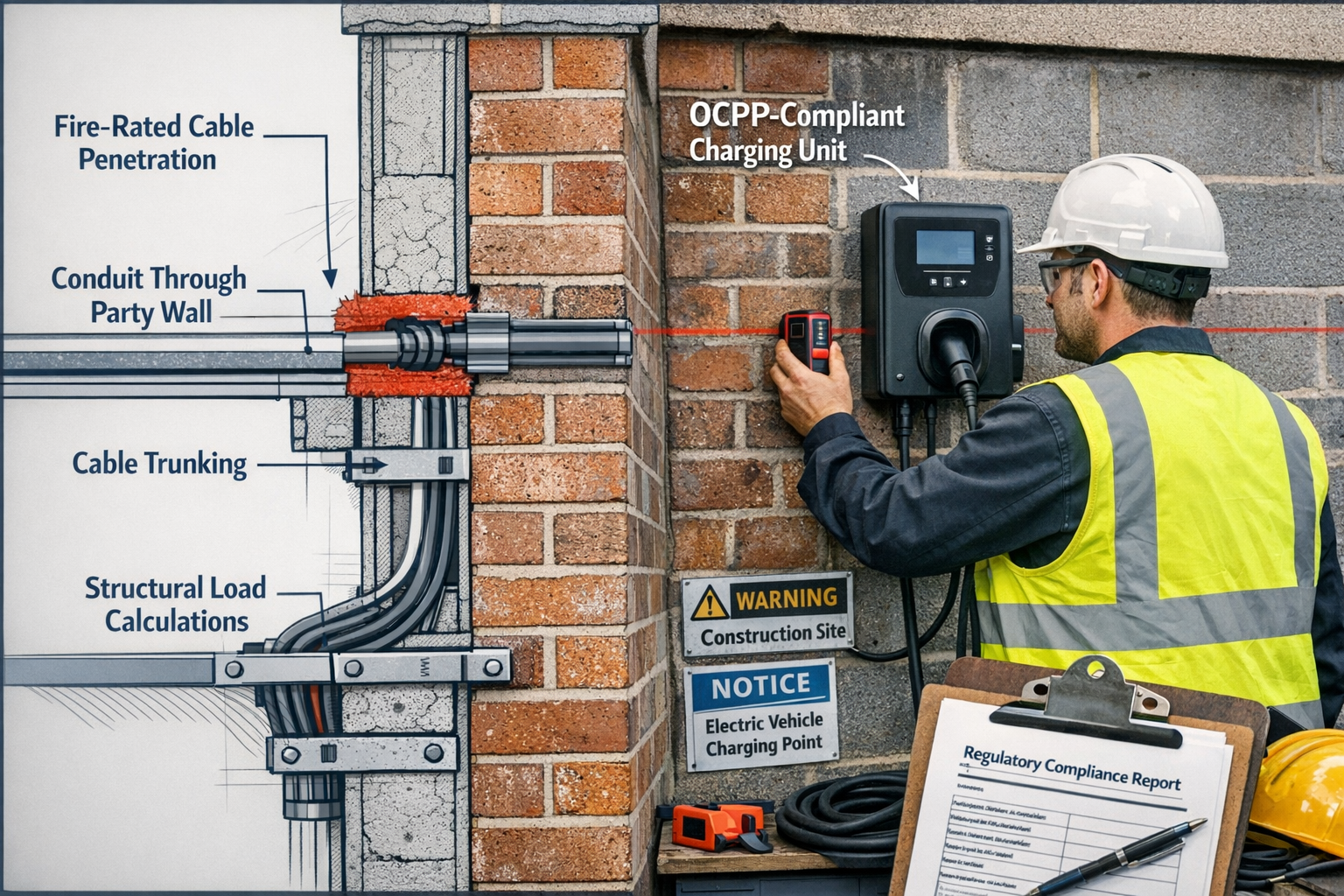
- Mounting charging units directly on party walls: Drilling, fixing brackets, or installing conduit through shared masonry structures
- Running electrical cables through party walls: Creating penetrations or chases in shared structures for power supply routing
- Excavating near boundaries: Digging trenches within three metres of neighbouring properties for underground cable runs
- Structural modifications: Altering load-bearing capacity or weatherproofing of party walls to accommodate charging equipment
According to the Party Wall etc. Act 1996, property owners must serve formal notice to adjoining owners at least two months before commencing work. This notification period allows neighbours to consent or dissent, triggering the appointment of party wall surveyors if disputes arise.
The Rising Complexity of EV Retrofit Projects
Commercial properties preparing for 2026 compliance face particularly complex challenges. As noted in recent industry analysis, proper conduit infrastructure, code compliance, and permitting considerations require extensive planning[3]. Multifamily residential properties must navigate even more intricate scenarios, with multiple adjoining owners and shared infrastructure systems.
Key compliance considerations include:
| Compliance Area | Requirements | Party Wall Implications |
|---|---|---|
| Electrical Safety | BS 7671 wiring regulations, dedicated circuits | Cable routing through party walls requires structural assessment |
| Fire Safety | Fire-rated cable penetrations, compartmentation | Maintaining fire resistance of party walls during installation |
| Structural Integrity | Load calculations for wall-mounted units | Surveyor verification of structural adequacy |
| OCPP Standards | Open Charge Point Protocol compliance[1] | Smart charging infrastructure may require additional cabling |
| Cybersecurity | Network security for connected charging systems[1] | Data cable routing considerations through shared structures |
Understanding when you need a party wall agreement is crucial for EV infrastructure projects. Even seemingly minor installations can trigger legal requirements if they affect shared structures.
Party Wall Surveys for EV Infrastructure Retrofits: Navigating 2026 Net Zero Mandates
The convergence of environmental policy and property law has created unprecedented demand for specialized party wall surveying services. In 2026, multiple regulatory drivers are accelerating EV infrastructure retrofits, particularly in existing buildings where party wall considerations are unavoidable.
Government Mandates Driving Retrofit Activity
Several policy initiatives are pushing property owners toward EV charging installations:
Federal and State Programmes: The National Electric Vehicle Infrastructure (NEVI) Formula Program has expanded significantly, with states like Pennsylvania launching community charging funding rounds in February 2026[4]. These programmes incentivize property owners to install charging infrastructure, often on properties with shared boundaries.
Multifamily Requirements: California's 2025 CALGreen Code has increased EV-ready parking requirements to 100% in some multifamily cases[2], setting a precedent that other jurisdictions are following. UK regulations are similarly tightening, requiring new residential developments to include charging infrastructure and pushing retrofit activity in existing buildings.
Commercial Property Obligations: Building regulations increasingly mandate EV charging provision in commercial car parks, creating pressure for rapid installation that sometimes overlooks proper party wall procedures.
Market Recovery and Retrofit Surge
The EV charging infrastructure market is experiencing robust growth in 2026. Industry forecasts indicate substantial expansion in both residential and commercial charging installations[7][8], with retrofit projects representing a significant portion of new installations. This surge has created bottlenecks in the party wall surveying sector, as property owners rush to comply with mandates while managing neighbour relations.
Common Dispute Scenarios in EV Retrofits
Party Wall Surveys for EV Infrastructure Retrofits: Compliance Amid 2026 Net Zero Mandates and Neighbour Disputes frequently arise in these situations:
- Noise and vibration concerns: Neighbours worry about drilling through party walls and ongoing charging equipment noise
- Aesthetic objections: Visible charging units, conduit runs, or cable management systems on shared external walls
- Access disputes: Installation requiring temporary access to neighbouring property for scaffolding or cable routing
- Structural damage fears: Concerns about weakening party walls through penetrations or mounting heavy equipment
- Future maintenance access: Disagreements over ongoing rights to access party walls for charger maintenance
A qualified party wall surveyor can navigate these disputes by preparing comprehensive awards that address all parties' concerns while enabling net zero compliance.
Technical Specifications and Surveyor Responsibilities
Party wall surveyors handling EV infrastructure projects must understand technical requirements beyond traditional building work. OCPP compliance standards ensure interoperability between charging equipment and network management systems[1], while cybersecurity requirements protect connected charging infrastructure from digital threats.
Surveyor checklists should include:
- ✅ Structural capacity assessment for wall-mounted charging units (typical weight: 15-30kg)
- ✅ Fire safety verification for cable penetrations through party walls
- ✅ Electrical load calculations and circuit capacity verification
- ✅ Weatherproofing and damp-proofing considerations for external installations
- ✅ Vibration isolation specifications for wall-mounted equipment
- ✅ Access provisions for installation and future maintenance
- ✅ Photographic condition surveys before and after installation
- ✅ Compliance verification with BS 7671 and building regulations
For comprehensive guidance on party wall procedures, property owners should consult resources on understanding the party wall process.
Drafting Effective Party Wall Awards for High-Dispute EV Installation Scenarios
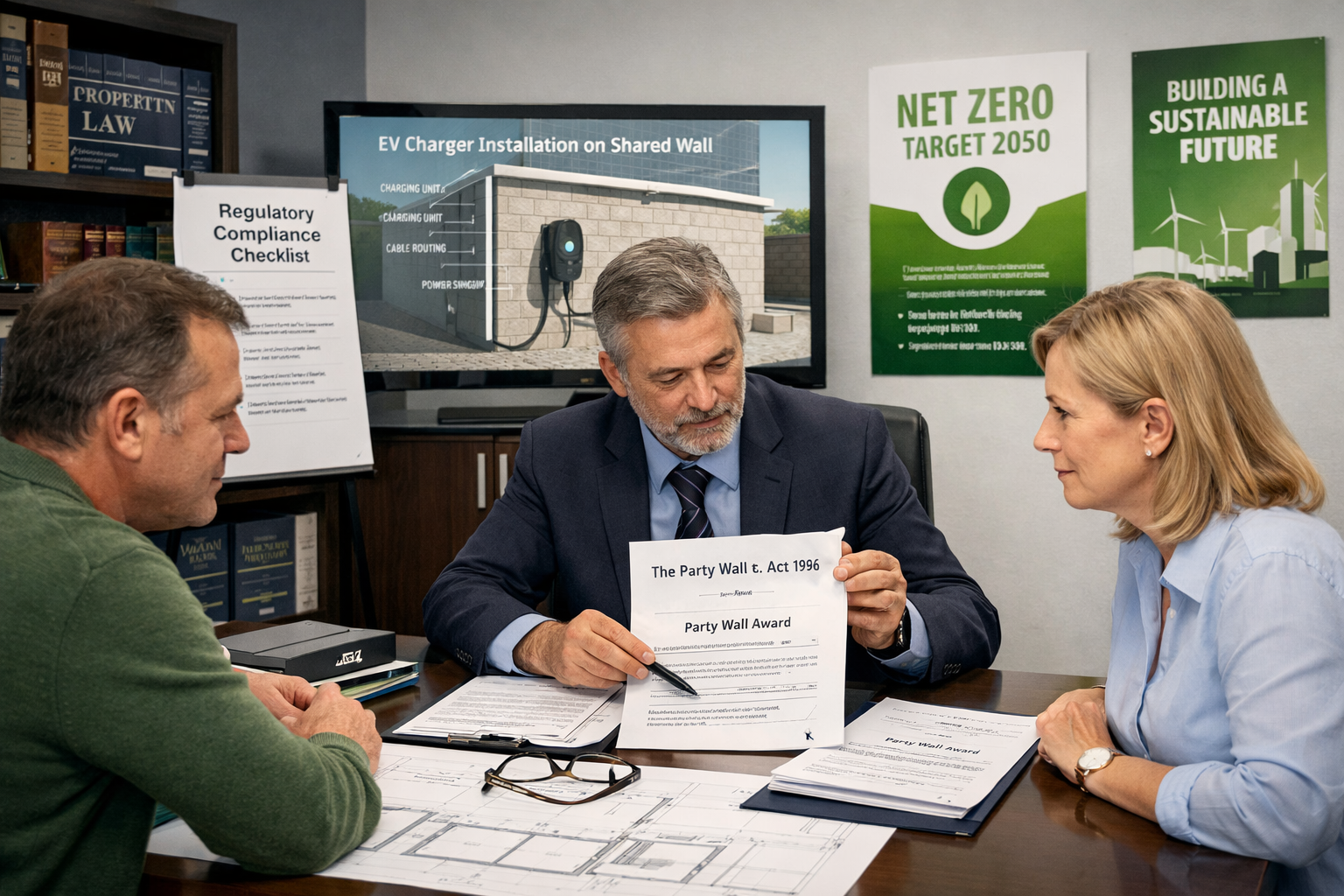
When neighbours dissent to party wall notices for EV charging installations, appointed surveyors must prepare detailed party wall awards that balance competing interests while enabling net zero compliance. Well-drafted awards prevent future disputes and provide clear frameworks for installation, maintenance, and dispute resolution.
Essential Components of EV Infrastructure Party Wall Awards
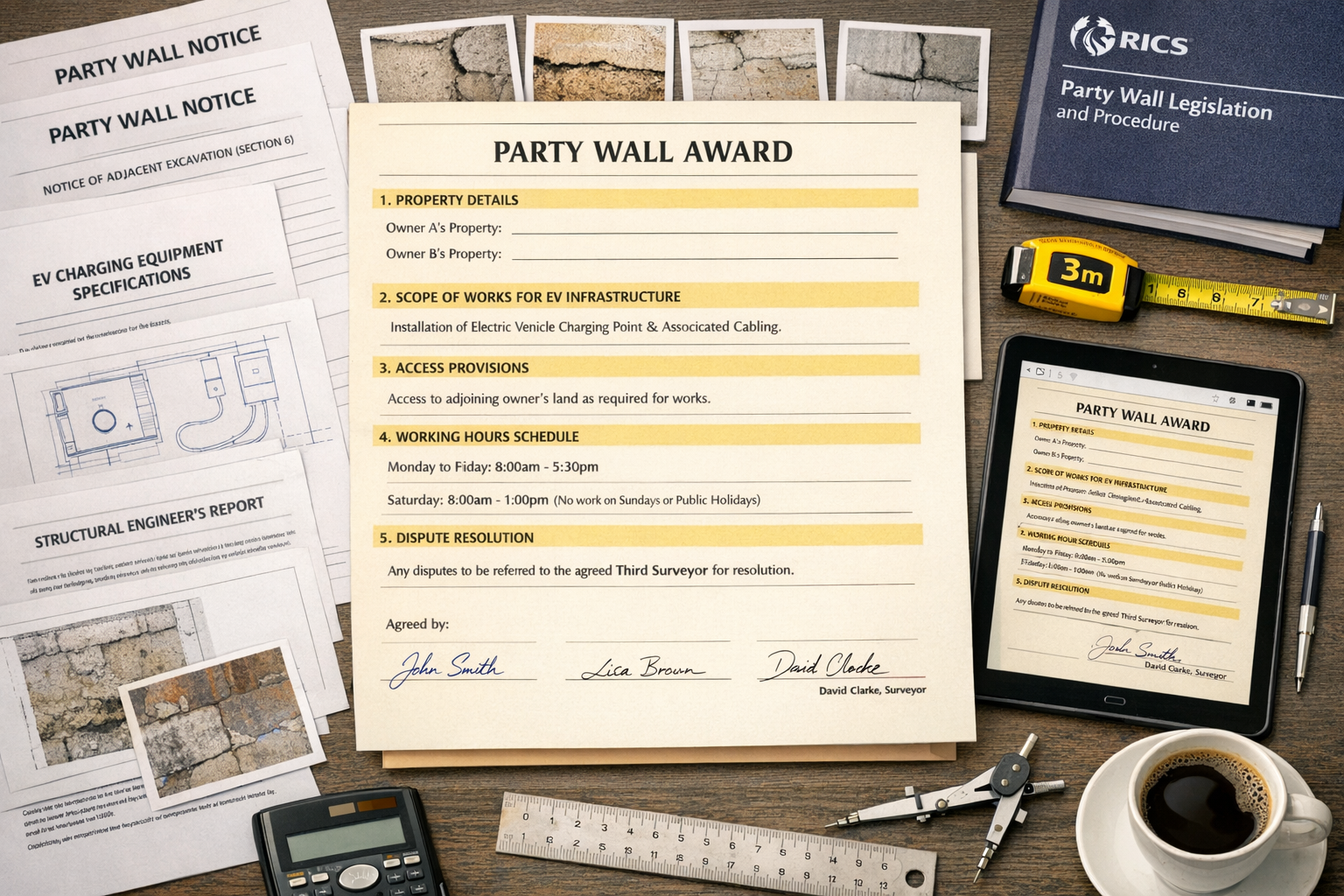
A comprehensive party wall award for EV charging installations should include these key sections:
1. Detailed Description of Works
Specify exactly what work will be undertaken, including:
- Precise location of charging unit mounting points on party wall
- Dimensions and depths of all penetrations through shared structures
- Cable routing paths and conduit specifications
- Excavation details if underground cable runs are required
- Temporary works such as scaffolding or access equipment
Example clause: "The Building Owner shall install one wall-mounted EV charging unit (Model: [specify], Weight: 22kg) at coordinates [specify] on the party wall, requiring four M10 masonry anchor points penetrating 80mm into the wall structure. Electrical conduit (25mm diameter) shall run vertically from the charging unit through the party wall at [location], with fire-rated sealing compound applied to all penetrations."
2. Access Provisions
Clearly define when and how the building owner may access neighbouring property:
- Specific dates and times for access (typically working hours: 8am-6pm, Monday-Friday)
- Duration of access requirements
- Notice period for access (minimum 7 days recommended)
- Restrictions on access during sensitive times (holidays, weekends)
3. Protective Measures and Condition Surveys
Establish baseline conditions and protection requirements:
- Comprehensive photographic condition survey of party wall and adjoining property
- Protective measures during installation (dust sheets, floor protection, scaffolding guards)
- Structural monitoring if significant load or vibration concerns exist
- Schedule of condition for neighbouring property interiors
4. Technical Specifications and Compliance
Reference applicable standards and regulations:
- BS 7671 electrical installation requirements
- Building Regulations Part P (Electrical Safety) compliance
- Fire safety requirements for party wall penetrations (typically 60-minute fire resistance)
- OCPP compliance for smart charging functionality[1]
- Cybersecurity standards for networked charging systems[1]
5. Dispute Resolution Procedures
Outline mechanisms for resolving disagreements during or after installation:
- Named surveyors for both parties with contact details
- Procedure for raising concerns or complaints
- Timeline for surveyor responses (typically 7-14 days)
- Third surveyor appointment process if agreement cannot be reached
- Cost allocation for additional surveyor involvement
6. Maintenance and Future Access
Address ongoing obligations after installation:
- Annual inspection rights for adjoining owner
- Maintenance access provisions for building owner
- Responsibility for repairs to party wall if damage occurs
- Decommissioning procedures if charging unit is removed
- Restoration obligations to return party wall to original condition
7. Cost Allocation and Payment Terms
Clearly specify financial responsibilities:
- Building owner's obligation to bear all reasonable costs
- Payment schedule for adjoining owner's surveyor fees
- Compensation provisions if damage occurs
- Insurance requirements (minimum £5 million public liability recommended)
- Security deposit considerations for high-value properties
Template Award Clauses for Common Dispute Scenarios
Noise and Vibration Concerns:
"The Building Owner shall ensure that all EV charging equipment operates within noise limits of 40dB(A) when measured from the adjoining owner's property boundary. Installation works shall not exceed 75dB(A) during permitted working hours. Vibration monitoring shall be conducted if ground-borne vibration from installation exceeds 0.3mm/s PPV."
Aesthetic Objections:
"All external conduit runs on the party wall shall be finished in [colour specification] to match existing wall finish. Cable management systems shall be installed flush to the wall surface with maximum projection of 25mm. The Building Owner shall submit finish samples to the adjoining owner for approval prior to installation."
Structural Damage Prevention:
"Prior to any penetrations of the party wall, the Building Owner shall commission a structural engineer's assessment confirming adequate wall capacity for the proposed installation. Any cracks exceeding 0.5mm width appearing in the adjoining owner's property during or within 12 months of installation shall be investigated and repaired at the Building Owner's expense."
For guidance on preparing formal notifications, review our resource on how to write a party wall letter.
What If a Neighbour Refuses to Cooperate?
A common question is whether a neighbour can legally refuse a party wall agreement. While neighbours can dissent to proposed works, they cannot ultimately prevent lawful work from proceeding. Dissent triggers the appointment of surveyors who prepare an award that both parties must follow.
Key points about neighbour refusal:
- 🚫 Neighbours cannot block legitimate party wall work indefinitely
- ⚖️ Dissent leads to surveyor appointment, not work prohibition
- 📋 Awards are legally binding once issued, even without neighbour consent
- 💷 Unreasonable refusal may result in cost consequences for the dissenting party
- ⏱️ The process adds 4-8 weeks to project timelines but ensures legal compliance
For complex disputes, professional assistance from experienced party wall surveyors is essential. Learn more about resolving party wall disputes through proper procedures.
Multifamily and Commercial Property Considerations
Party Wall Surveys for EV Infrastructure Retrofits: Compliance Amid 2026 Net Zero Mandates and Neighbour Disputes become exponentially more complex in multifamily residential buildings and commercial properties where multiple adjoining owners exist.
Multifamily EV Charging Challenges
Apartment buildings and converted houses face unique obstacles:
Multiple Adjoining Owners: A single EV charging installation may affect multiple parties, requiring separate notices and potentially multiple surveyors. Coordination becomes critical when different owners have conflicting priorities.
Shared Infrastructure: Existing electrical systems may lack capacity for multiple charging points, requiring substantial upgrades that affect common areas and party walls throughout the building.
Access Complications: Installation may require access through multiple units or common areas, necessitating complex access agreements and scheduling.
According to multifamily EV charging guidance, properties should consider centralized charging solutions with load management systems to distribute electrical capacity efficiently[5]. These systems often require extensive cable routing through party walls and common structures.
Commercial Property Retrofit Strategies
Commercial properties preparing for 2026 compliance face different challenges:
Tenant Coordination: Occupied commercial buildings require careful scheduling to minimize business disruption while maintaining party wall compliance with adjacent properties.
Scalability Planning: Commercial installations typically involve multiple charging points, requiring comprehensive electrical infrastructure that may affect party walls at multiple locations.
Future-Proofing: Conduit infrastructure should accommodate future charging capacity increases, requiring larger penetrations through party walls than current needs dictate[3].
Permitting Complexity: Commercial installations face more rigorous permitting requirements, with party wall awards needing to align with broader building permits and planning permissions.
Cost Considerations for Complex Projects
Party wall surveyor costs for EV infrastructure projects vary based on complexity:
| Project Type | Typical Surveyor Fees | Timeline |
|---|---|---|
| Simple residential (single charging point, one adjoining owner) | £700-£1,200 | 4-6 weeks |
| Complex residential (multiple penetrations, two+ adjoining owners) | £1,500-£3,000 | 6-10 weeks |
| Multifamily building (shared infrastructure, multiple units affected) | £3,000-£7,000 | 8-12 weeks |
| Commercial property (multiple charging points, complex routing) | £5,000-£15,000+ | 10-16 weeks |
For detailed cost breakdowns, consult our guide on party wall surveyor costs.
Practical Steps for Property Owners Planning EV Infrastructure
Property owners can take proactive steps to ensure smooth EV charging installations while maintaining party wall compliance:
Step 1: Early Assessment (3-4 Months Before Installation)
- Identify party wall implications: Determine whether proposed charging point location affects party walls or requires excavation near boundaries
- Review property deeds: Confirm boundary locations and any existing easements or restrictions
- Consult qualified electrician: Obtain preliminary electrical assessment for charging infrastructure requirements
- Engage party wall surveyor: Seek professional advice on party wall requirements before finalizing installation plans
Step 2: Design and Planning (2-3 Months Before Installation)
- Finalize charging point location: Choose location that minimizes party wall impacts while meeting electrical and practical requirements
- Obtain detailed technical specifications: Secure manufacturer specifications for charging equipment, including weight, dimensions, and electrical requirements
- Prepare party wall notices: Draft formal notices with surveyor assistance, including detailed descriptions of proposed works
- Initiate neighbour communication: Informally discuss plans with neighbours before serving formal notices to build goodwill
Step 3: Formal Party Wall Process (6-10 Weeks)
- Serve party wall notices: Deliver formal notices to all adjoining owners at least two months before planned work commencement
- Await neighbour response: Allow 14-day response period for neighbours to consent or dissent
- Appoint surveyors if needed: If neighbours dissent or fail to respond, appoint party wall surveyors to prepare award
- Conduct condition surveys: Complete comprehensive photographic surveys of party walls and adjoining properties
- Finalize party wall award: Ensure award addresses all technical, access, and dispute resolution provisions
Step 4: Installation and Compliance (During Works)
- Adhere to award conditions: Follow all specifications, working hours, and protective measures outlined in party wall award
- Maintain communication: Keep neighbours informed of progress and any unexpected issues
- Document installation: Photograph all stages of work, particularly party wall penetrations and protective measures
- Address concerns promptly: Respond quickly to any neighbour complaints or surveyor inquiries
Step 5: Post-Installation (After Completion)
- Conduct final condition survey: Document party wall condition after installation completion
- Address any damage: Promptly repair any damage to party walls or adjoining properties
- Provide documentation: Supply neighbours and surveyors with completion certificates and compliance documentation
- Establish maintenance schedule: Plan for ongoing maintenance access and inspection requirements
For additional guidance on the overall process, review our comprehensive resource on understanding party wall awards.
Finding Qualified Party Wall Surveyors for EV Projects
Not all party wall surveyors have experience with EV charging infrastructure projects. Property owners should seek specialists who understand both party wall law and the technical requirements of EV installations.
Essential Qualifications and Experience
Look for surveyors with:
- RICS membership: Royal Institution of Chartered Surveyors accreditation ensures professional standards and insurance
- Party wall specialization: Specific experience with Party Wall etc. Act 1996 procedures, not just general surveying
- EV infrastructure knowledge: Understanding of OCPP standards, electrical requirements, and charging equipment specifications[1]
- Local experience: Familiarity with local building control requirements and planning authorities
- Dispute resolution skills: Proven track record of mediating neighbour conflicts and preparing effective awards
For tips on selecting the right professional, see our guide on how to find a reliable party wall surveyor near you.
Questions to Ask Potential Surveyors
When interviewing party wall surveyors for EV infrastructure projects, ask:
- How many EV charging party wall cases have you handled? (Look for at least 5-10 similar projects)
- What technical standards do you consider for EV installations? (Should mention OCPP, BS 7671, fire safety)
- What is your typical timeline for awards? (6-8 weeks is reasonable for straightforward cases)
- How do you handle high-dispute scenarios? (Should describe mediation approaches and award drafting strategies)
- What are your fee structures? (Should provide clear, itemized fee schedules)
- Do you provide ongoing support during installation? (Important for addressing unexpected issues)
Red Flags to Avoid
Be cautious of surveyors who:
- ❌ Lack specific EV infrastructure experience
- ❌ Cannot provide references from recent party wall cases
- ❌ Offer unusually low fees (may indicate inexperience or hidden costs)
- ❌ Suggest avoiding formal party wall procedures to "save time"
- ❌ Show poor communication or responsiveness during initial consultations
- ❌ Are not RICS-registered or professionally insured
Future Trends: Party Wall Considerations Beyond 2026
As EV adoption accelerates and net zero mandates tighten, party wall considerations for charging infrastructure will continue evolving:
Emerging Technologies
Bidirectional charging (V2G): Vehicle-to-grid technology allows EVs to supply power back to buildings or the grid, requiring more sophisticated electrical infrastructure and potentially more extensive party wall work[7].
Wireless charging: Inductive charging systems may reduce visible infrastructure but require substantial underground installation, triggering different party wall considerations for excavation near boundaries.
Ultra-rapid charging: Higher-power charging systems (150kW+) require substantial electrical infrastructure and cooling systems, potentially increasing party wall impacts through larger cable runs and ventilation requirements.
Regulatory Evolution
Expect continued tightening of EV infrastructure requirements:
- Mandatory retrofit provisions: Older buildings may face requirements to install charging infrastructure during major renovations
- Shared charging obligations: Multifamily properties may be required to provide charging access to all residents, not just property owners
- Grid integration requirements: Smart charging and load management may become mandatory, affecting infrastructure complexity
Best Practices for Future-Proofing
Property owners planning EV infrastructure should consider:
- Oversized conduit: Install larger conduit than currently needed to accommodate future cable upgrades without additional party wall work
- Modular design: Choose charging systems that allow capacity upgrades without structural modifications
- Comprehensive awards: Include provisions for future technology upgrades in party wall awards to avoid repeated notice procedures
- Collaborative approaches: Work with neighbours to plan coordinated charging infrastructure that benefits multiple properties
For insights into broader net zero compliance and party wall considerations, see our article on party wall essentials for 2026 net zero compliance projects.
Conclusion
Party Wall Surveys for EV Infrastructure Retrofits: Compliance Amid 2026 Net Zero Mandates and Neighbour Disputes represents a critical intersection of environmental policy, property law, and neighbour relations. As government mandates accelerate EV charging installations and retrofit activity surges, property owners must navigate complex party wall procedures to ensure legal compliance while maintaining positive relationships with adjoining owners.
The key to success lies in early planning, professional surveyor engagement, and comprehensive party wall awards that address technical specifications, access provisions, and dispute resolution mechanisms. While the process adds time and cost to EV infrastructure projects, proper party wall compliance protects all parties' interests and prevents costly disputes that can derail net zero compliance efforts.
Actionable Next Steps
Property owners planning EV charging installations should:
- Assess party wall implications immediately: Don't wait until installation is imminent to determine whether party wall procedures are required
- Engage qualified surveyors early: Seek RICS-registered party wall surveyors with specific EV infrastructure experience at least 3-4 months before planned installation
- Communicate proactively with neighbours: Build goodwill through informal discussions before serving formal party wall notices
- Invest in comprehensive awards: Ensure party wall awards address all technical, access, maintenance, and dispute resolution provisions specific to EV charging equipment
- Document everything: Maintain detailed photographic records of party wall conditions before, during, and after installation
- Plan for the future: Design EV infrastructure with future capacity upgrades in mind to minimize repeated party wall procedures
The convergence of net zero mandates and party wall law will only intensify as 2026 progresses. Property owners who approach EV infrastructure retrofits with proper legal compliance, technical expertise, and neighbour consideration will successfully navigate this challenging landscape while contributing to the UK's environmental goals.
For professional assistance with party wall surveys for EV infrastructure projects, consult experienced RICS-registered surveyors who understand both the legal framework and the technical requirements of modern charging systems. The investment in proper party wall compliance pays dividends through smoother installations, preserved neighbour relationships, and legal protection for all parties involved.
References
[1] Ev Charging Infrastructure 2026 Trends – https://www.versinetic.com/news-blog/ev-charging-infrastructure-2026-trends/
[2] Sorting Through Requirements For Ev Charging In Multi Family Construction – https://www.3c-ren.org/sorting-through-requirements-for-ev-charging-in-multi-family-construction/
[3] Planning Ev Charger Installations For 2026 What Commercial Properties Should Prepare Now – https://amtekconstruction.com/planning-ev-charger-installations-for-2026-what-commercial-properties-should-prepare-now/
[4] National Electric Vehicle Infrastructure Nevi Formula Program – https://www.pa.gov/agencies/penndot/research-planning-and-innovation/electric-vehicles-and-alternative-fuels/national-electric-vehicle-infrastructure-nevi-formula-program
[5] Multifamily Ev Charging Solutions Guide – https://www.ampup.io/blog/multifamily-ev-charging-solutions-guide
[6] Party Wall Essentials For 2026 Net Zero Compliance Projects Surveyor Checklists For Epc Retrofit Disputes – https://nottinghillsurveyors.com/blog/party-wall-essentials-for-2026-net-zero-compliance-projects-surveyor-checklists-for-epc-retrofit-disputes
[7] Ev Forecast Infrastructure Report – https://www.eei.org/-/media/Project/EEI/Documents/Issues-and-Policy/Electric-Transportation/EV-Forecast-Infrastructure-Report.pdf
[8] Electric Vehicle Charging Market Growth – https://www.pwc.com/us/en/industries/industrial-products/library/electric-vehicle-charging-market-growth.html
