
{"cover":"Professional landscape format (1536×1024) hero image with bold text overlay: 'Building Surveyor Demand: 30+ Years Pathology Lessons for 2026 Homebuyers' in extra large 72pt white bold sans-serif font with dark semi-transparent overlay box, centered upper-third composition. Background shows a chartered building surveyor in high-visibility vest and hard hat inspecting a Victorian terraced property facade with a clipboard, dramatic natural light, warm brick tones contrasted with cool sky. Color palette: deep navy, white, amber accents. Magazine cover aesthetic, editorial quality, high contrast, photorealistic.","content":["Wide-angle editorial photograph of a senior building surveyor examining damp patches and structural cracks on an interior wall of a period property, using a moisture meter and torch, detailed defect annotations visible on a clipboard, warm interior lighting, peeling plaster and exposed brickwork visible, professional documentary style, 1536×1024 landscape format, muted earth tones with clinical white highlights, building pathology diagnostic theme","Infographic-style editorial illustration showing a timeline spanning 30 years (1994 to 2026) of building defect patterns in UK residential properties, with icons representing rising damp, subsidence, roof failure, and structural movement plotted along the timeline, clean modern design with navy and amber color scheme, data visualization aesthetic, 1536×1024 landscape format, professional financial-report quality, homebuyer survey context","Close-up aerial drone-perspective photograph of a row of mixed-age UK residential properties including Victorian terraces and 1970s semis, a building surveyor visible on a rooftop with inspection equipment, 2026 urban residential landscape, golden hour lighting, overlaid with subtle RICS logo watermark and survey checklist graphic elements, 1536×1024 landscape format, editorial real estate photography style, deep blue sky contrast with warm brick tones"}

Nearly one-third of UK construction firms now describe their surveying capacity shortfall as "critical" — a statistic that carries serious consequences for anyone buying a home in 2026. [1] The growing Building Surveyor Demand from Freetec-Style Firms: 30+ Years Pathology Lessons for 2026 Homebuyers conversation is no longer just an industry talking point. It is a practical warning that shapes how, when, and from whom buyers commission property inspections. Specialist independent practices — operating in the tradition of defect-diagnosis-led firms like Freetec — are emerging as essential partners for buyers navigating a market where older housing stock, post-pandemic renovation backlogs, and tightening mortgage requirements all converge.
Key Takeaways 📋
- Surveying capacity is under strain in 2026, making early booking and independent specialist firms more important than ever.
- Freetec-style firms — those built on deep building pathology expertise — offer diagnostic depth that volume-led survey providers often cannot match.
- 30+ years of defect data reveal recurring patterns in UK homes: damp, subsidence, roof failure, and structural movement remain the top four risk categories.
- Level 3 Building Surveys are increasingly the recommended standard for pre-1980 properties, particularly in competitive urban markets.
- RICS recovery signals in 2026 indicate growing residential transaction volumes, meaning demand for qualified surveyors will intensify further before it eases.
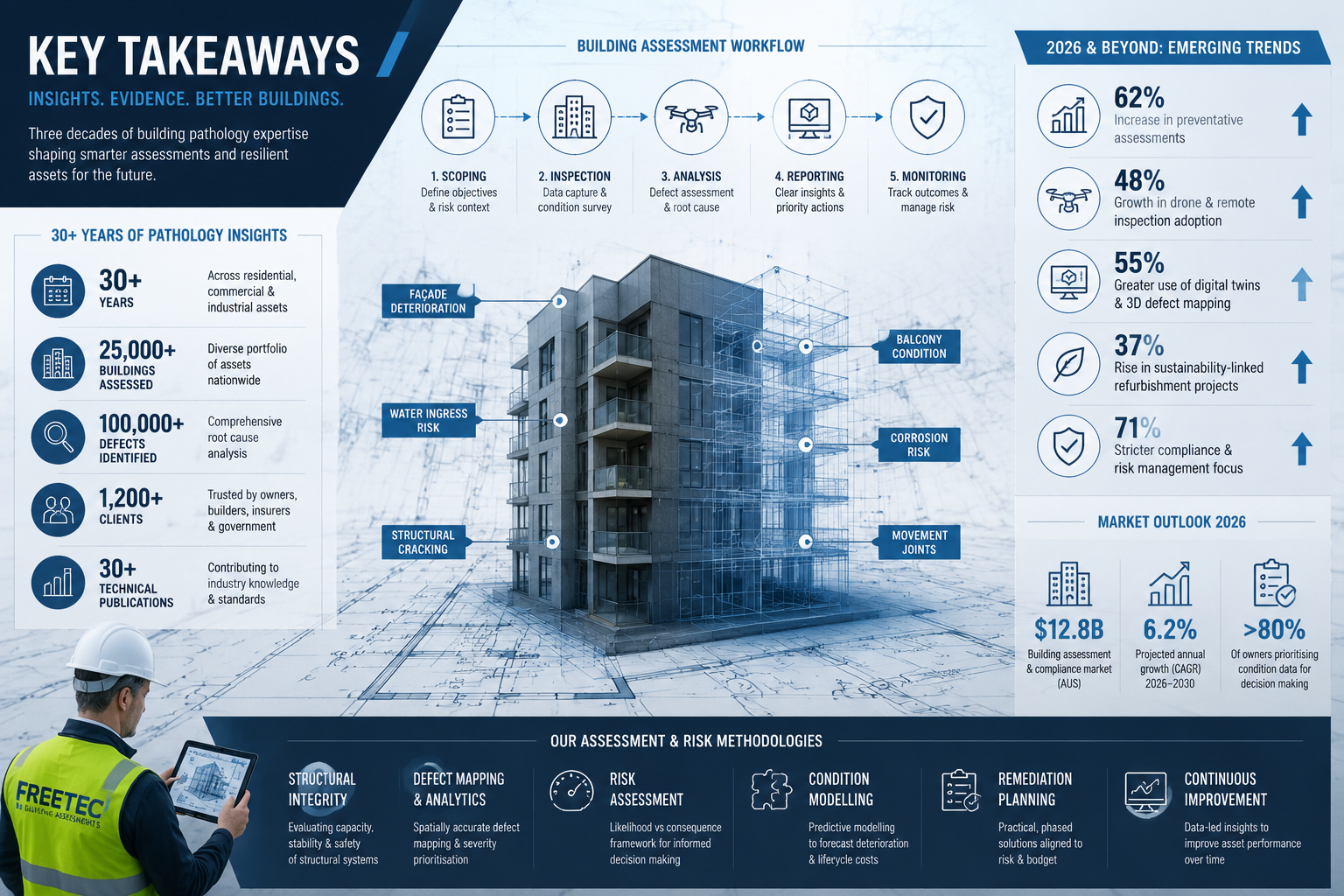
What "Freetec-Style" Expertise Actually Means for Homebuyers
The term "Freetec-style" refers to a philosophy of practice rather than a single brand. It describes independent building surveying firms whose identity is rooted in building pathology — the systematic study of why structures fail, how defects develop over time, and what remediation is genuinely necessary versus cosmetically alarming. This approach stands in contrast to high-volume survey factories that process dozens of instructions per week with standardised, template-heavy reports.
💬 "A building pathologist does not just note a crack — they trace its origin, assess its trajectory, and tell you whether it matters."
For 2026 homebuyers, this distinction is financially significant. A homebuyer survey from a volume provider might flag a condition rating without explaining causation. A Freetec-style surveyor will tell you whether that crack is historic settlement or active subsidence — a difference that could mean £40,000 in remediation costs or nothing at all.
The Pathology-First Model: Core Principles
| Principle | Volume Provider | Freetec-Style Specialist |
|---|---|---|
| Defect identification | Tick-box condition ratings | Root-cause diagnosis |
| Report depth | Standardised templates | Bespoke narrative analysis |
| Remediation advice | Generic recommendations | Costed, prioritised action plans |
| Follow-up support | Rarely included | Often available |
| Expertise focus | Broad property types | Specialist in older/complex stock |
This model matters most when buying pre-1960 properties, converted buildings, or homes with visible signs of movement, moisture, or non-standard construction. Understanding what a surveyor looks for in a house survey is the first step to appreciating why pathology depth changes outcomes.
30+ Years of Building Pathology: The Defect Patterns That Keep Returning

Three decades of residential survey data from UK practices paint a remarkably consistent picture. The Building Surveyor Demand from Freetec-Style Firms: 30+ Years Pathology Lessons for 2026 Homebuyers discussion gains its urgency from this consistency: the same defect categories recur generation after generation, yet buyers continue to be surprised by them.
🏠 The Top Four Recurring Defect Categories
1. Rising and Penetrating Damp
Damp remains the single most misdiagnosed defect in UK residential surveys. Over-reliance on electronic moisture meters — without contextual interpretation — leads to both false positives (causing buyers to walk away from sound properties) and false negatives (missing genuine moisture ingress behind dry-lined walls). Freetec-style surveyors apply hygrothermal analysis: understanding how a building breathes, where condensation forms, and whether a damp reading reflects the wall's material properties or an active water pathway.
2. Subsidence and Ground Movement
Clay-heavy soils across London, the South East, and parts of the Midlands make subsidence a persistent risk. The pattern over 30+ years shows that tree-related subsidence claims spike during drought years, and 2022–2024 saw elevated activity following the exceptional heat events of those summers. Buyers in 2026 should treat any property within 7 metres of a mature tree on shrinkable clay as requiring specialist assessment.
3. Roof Structure and Covering Failure
Flat roofs installed between 1960 and 1985 are now reaching or exceeding their design life. Traditional pitched roofs with original clay or slate coverings frequently show nail-sickness (corroded fixings) that is invisible from ground level. A roof survey conducted by a specialist adds meaningful protection against post-completion surprises.
4. Structural Movement in Party Walls and Lintels
In terraced and semi-detached properties — which make up the majority of UK housing stock — lintel failure and party wall movement are consistently underreported in standard surveys. The Level 3 Building Survey is specifically designed to investigate these elements in accessible voids, roof spaces, and subfloor areas.
Why These Patterns Matter in 2026 Specifically
The UK housing stock is ageing. The average age of a UK home is now over 60 years. Deferred maintenance during the 2020–2023 cost-of-living squeeze means many properties entering the 2026 market carry a backlog of unaddressed defects. RICS residential market indicators for early 2026 point to recovering transaction volumes — which means more buyers competing for the same stock, with less time to conduct due diligence. [1]
This is precisely the environment in which Freetec-style pathology expertise earns its fee many times over.
Building Surveyor Demand from Freetec-Style Firms: What 2026 Homebuyers Must Do Differently

The Building Surveyor Demand from Freetec-Style Firms: 30+ Years Pathology Lessons for 2026 Homebuyers challenge is not just about finding a good surveyor — it is about understanding which survey type matches the property and acting quickly enough to secure a qualified professional before exchange pressure mounts.
Choosing the Right Survey Level
The RICS Home Survey Standard defines three levels of service. Matching the level to the property is the most consequential decision a buyer makes before instruction:
| Survey Level | Best For | What It Covers |
|---|---|---|
| Level 1 (Condition Report) | New builds, recently renovated homes | Basic condition ratings only |
| Level 2 (HomeBuyer Report) | Conventional post-1950 properties in reasonable condition | Condition ratings + market valuation option |
| Level 3 (Building Survey) | Pre-1960, altered, extended, or complex properties | Full structural inspection + defect diagnosis |
For most buyers in 2026 — particularly those purchasing Victorian, Edwardian, or interwar properties — a Level 3 Building Survey is not a luxury. It is the appropriate tool for the asset class. If in doubt, use the survey comparison tool to assess which level suits a specific property type.
⏱️ Timing: Book Early, Book Specifically
With surveying capacity under strain [1], the practical advice for 2026 buyers is:
- ✅ Instruct a surveyor at the same time as instructing a solicitor — not after receiving a mortgage offer.
- ✅ Specify the property type and age when requesting a quote — this allows the surveyor to allocate appropriate time.
- ✅ Ask about the surveyor's specific experience with the construction type (e.g., solid wall construction, timber frame, concrete panel systems).
- ✅ Confirm turnaround time in writing — in a competitive market, a 10-day report turnaround can affect exchange timelines.
Understanding how long a home buyers survey takes helps buyers build realistic transaction timelines and avoid the pressure of rushing a decision based on an incomplete report.
The Independent Specialist Advantage
Large panel management companies — which route survey instructions to the cheapest available surveyor in a postcode — have grown significantly since 2015. The model prioritises cost and speed. It does not prioritise the assignment of the most experienced surveyor to the most complex property.
Independent Freetec-style practices operate differently:
- The surveyor who inspects the property writes the report personally
- Instructions are accepted based on genuine capacity, not volume targets
- Specialist knowledge of local geology, construction eras, and common defects in a specific area informs the inspection
For buyers in London and the South East, chartered surveyors in North West London, Central London, and Hertfordshire offer locally-grounded expertise that panel surveyors — potentially travelling from outside the area — simply cannot replicate.
🔍 Questions to Ask Before Instructing a Surveyor
- How many years have you been surveying properties of this type and age?
- Will you personally conduct the inspection and write the report?
- Does your report include a prioritised remediation schedule with indicative costs?
- Are you available for a follow-up call after I receive the report?
- Do you have professional indemnity insurance specific to residential building surveys?
These questions separate pathology-led practitioners from template-report providers. A surveyor who hesitates on question 3 is unlikely to deliver the diagnostic depth that a complex property demands.
The RICS Recovery Signal and What It Means for Survey Demand
RICS residential market data for 2026 shows improving buyer enquiries and a modest but consistent rise in agreed sales volumes following the interest rate adjustments of late 2025. [1] This recovery creates a double pressure on surveying capacity:
- More transactions mean more survey instructions competing for the same pool of qualified surveyors.
- Rising property values increase the financial stakes of every inspection — making under-surveying more costly than ever.
The construction sector more broadly is experiencing significant skills pressure. Construction roles grew 30% since late 2022, with demand accelerating across multiple specialisms. [2] Building surveyors — whose qualification pathway through RICS takes a minimum of five to six years — cannot be rapidly scaled to meet demand spikes. This structural constraint makes early engagement with specialist independent firms a practical necessity, not merely a quality preference.
💬 "In a recovering market, the buyers who move fastest are not always the ones who win — the ones who prepare most thoroughly are."
Buyers who want to understand the full scope of professional surveying services — from what a chartered surveyor does through to the specific outputs of a RICS Building Survey — will be better positioned to instruct the right professional at the right time.
Practical Checklist: Applying 30+ Years of Pathology Lessons Before Exchange
Before exchanging contracts on any property, a pathology-informed buyer should verify the following:
🏗️ Structural Elements
- Roof structure inspected in accessible loft space
- Chimney stacks assessed for stability and pointing condition
- Lintels above windows and doors checked for deflection
- Party walls assessed for movement or previous underpinning
💧 Moisture and Drainage
- Damp-proof course condition assessed (or absence noted for pre-DPC properties)
- Gutters, downpipes, and gullies checked for blockage or damage
- Drainage survey commissioned for properties with suspected drainage issues
- Subfloor ventilation assessed in suspended timber floor properties
⚡ Services and Fabric
- Electrical installation age and condition noted
- Heating system age and last service date confirmed
- Window and door frames assessed for rot or air infiltration
- External render and pointing checked for failure
This checklist reflects the accumulated intelligence of three decades of residential building surveys. The ultimate house survey checklist expands on each of these categories with specific guidance for buyers.
Conclusion: Act on the Pathology Lessons Before the Market Moves Faster
The Building Surveyor Demand from Freetec-Style Firms: 30+ Years Pathology Lessons for 2026 Homebuyers conversation ultimately comes down to a simple proposition: the defects that have cost UK homebuyers money for three decades are still present in the housing stock today, and the professionals best equipped to find them are under more demand pressure than at any point in recent memory.
Actionable Next Steps for 2026 Homebuyers 🎯
- Determine the correct survey level for the property type using the survey comparison guide before making an offer.
- Identify and contact a Freetec-style independent specialist in the property's local area — do not default to a panel management company.
- Book the surveyor early — at solicitor instruction stage, not mortgage offer stage.
- Ask the five diagnostic questions listed above before confirming the instruction.
- Read the report actively — call the surveyor after receipt to clarify any condition ratings before negotiating on price or requesting remediation.
- Use the pathology checklist above as a pre-inspection briefing tool to direct the surveyor's attention to specific concerns.
The 30+ years of lessons embedded in building pathology practice exist precisely so that each new generation of homebuyers does not have to learn them the expensive way. In 2026, with a recovering market, ageing housing stock, and constrained surveying capacity, those lessons have never been more relevant — or more actionable.
References
[1] Quantity Surveyor Shortage Crisis 2026 How Building Surveyors Can Adapt Service Delivery And Protect Project Margins – https://nottinghillsurveyors.com/blog/quantity-surveyor-shortage-crisis-2026-how-building-surveyors-can-adapt-service-delivery-and-protect-project-margins
[2] Skilled Trade Demand Randstand Report Electricans Technicans Construction Workers Six Figure Salaries Data Center Boom – https://fortune.com/2026/03/20/skilled-trade-demand-randstand-report-electricans-technicans-construction-workers-six-figure-salaries-data-center-boom/
