
Nearly one in three party wall disputes that reach formal adjudication could have been avoided if the building owner had served a correctly completed notice in the first place. That single administrative step — getting the paperwork right — separates a smooth renovation from months of legal wrangling and neighbourly tension.
This guide covers everything needed to navigate Free Party Wall Notice Templates and DIY Serving Rules for 2026: When to Call in Surveyors, from choosing the right notice type and downloading compliant templates, to understanding the critical moments when professional help stops being optional and starts being essential.
Key Takeaways
- 🏠 Three notice types exist under the Party Wall etc. Act 1996 — choosing the wrong one invalidates the process entirely.
- ⏱️ Two months' written notice is mandatory for party wall/structure works; one month applies to excavation notices.
- 📬 Neighbours have just 14 days to respond — silence legally counts as dissent, triggering the surveyor appointment process.
- 📄 Free, compliant templates are available from reputable sources, but users carry full legal responsibility for correct completion.
- ⚠️ A professional Schedule of Condition is the single most effective tool for preventing post-works damage disputes — and DIY versions rarely hold up.
Understanding the Party Wall etc. Act 1996: The Foundation
Before downloading any template, it is worth understanding what the legislation actually requires. The Party Wall etc. Act 1996 creates a statutory framework that governs construction works affecting shared walls, boundary structures, and excavations near neighbouring buildings.
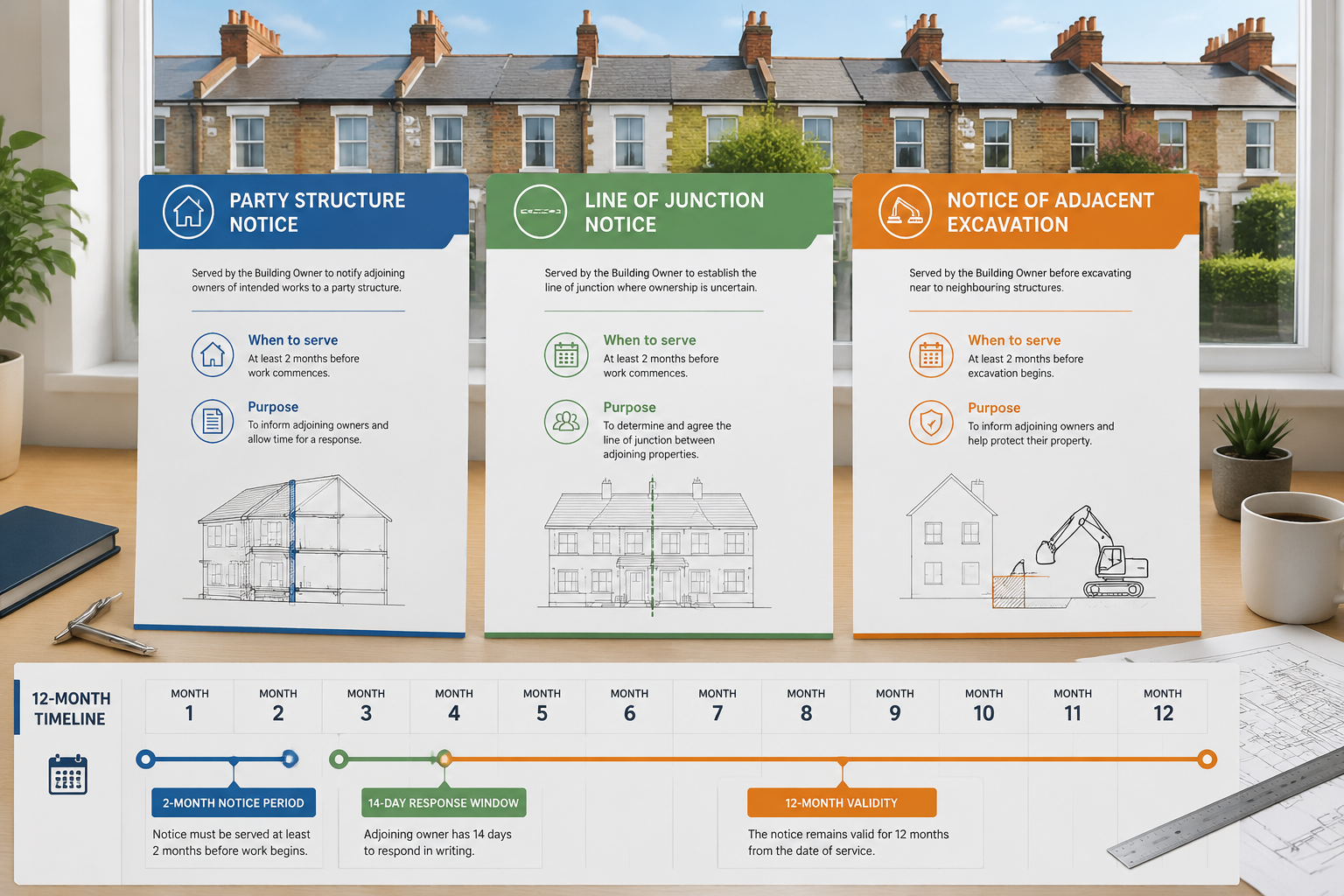
The Act applies in England and Wales and covers three distinct scenarios, each requiring a different notice type [1][2]:
| Notice Type | Trigger | Advance Notice Required |
|---|---|---|
| Party Structure Notice | Works to an existing party wall or structure | 2 months |
| Line of Junction Notice | Building a new wall at or astride the boundary | 1 month |
| Notice of Adjacent Excavation | Excavating within 3m or 6m of a neighbour's building | 1 month |
💡 Pull Quote: "Many projects — such as a loft conversion involving a shared chimney stack — require more than one notice type served simultaneously." [2]
It is also worth noting that planning permission is not a prerequisite for serving notices. Homeowners can — and often should — serve notices well ahead of receiving planning approval to satisfy the advance notice requirement [3].
Free Party Wall Notice Templates and DIY Serving Rules for 2026: What Every Notice Must Include
The Seven Mandatory Elements
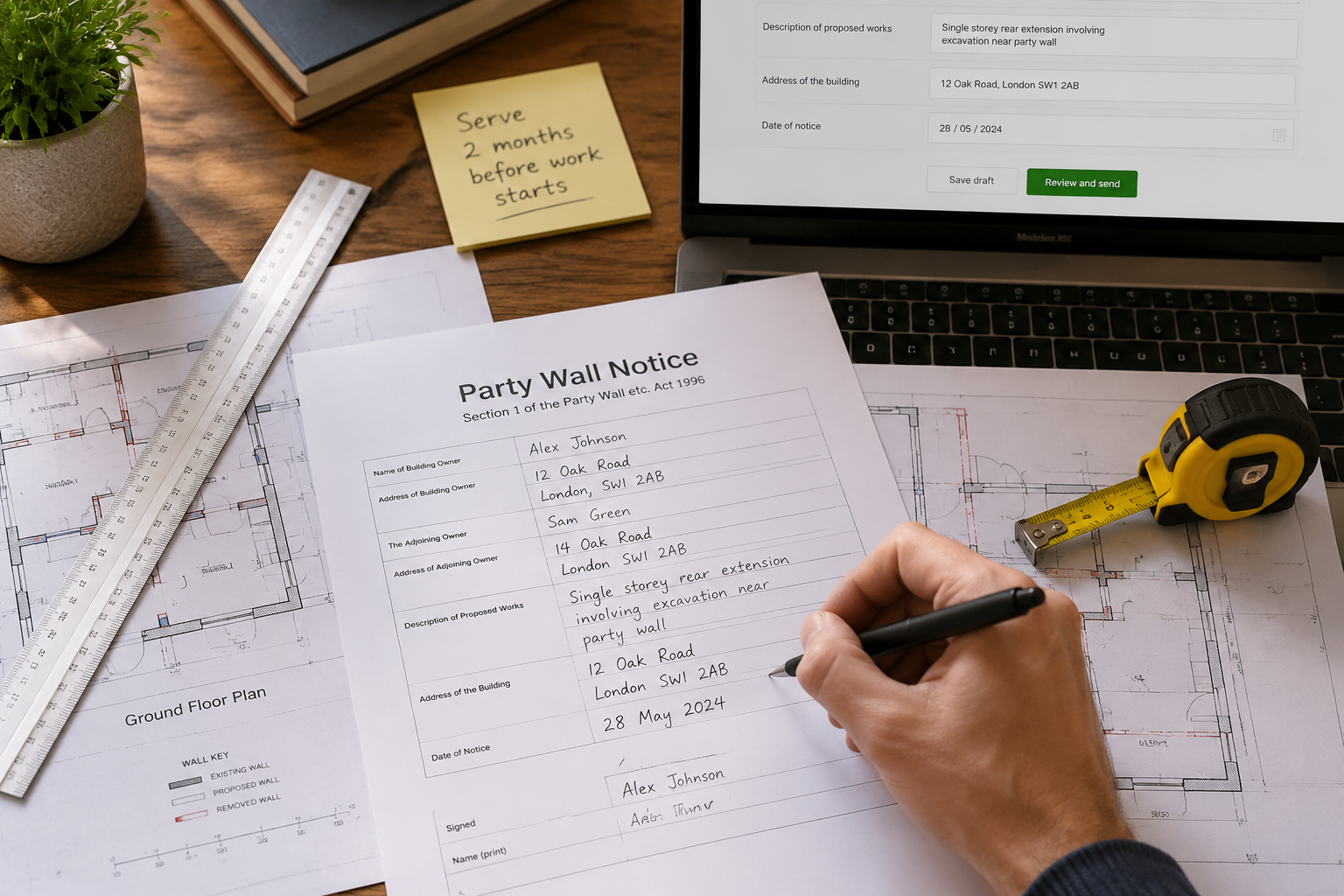
Every valid party wall notice, regardless of type, must contain seven core pieces of information [1]:
- Full name and address of the building owner (the person doing the works)
- Address of the property where works will take place
- Detailed description of the proposed works
- Planned start date for construction
- Date of service of the notice
- Signature of the building owner or their authorised agent
- For Section 6 excavation notices: drawings and sections showing the depth and proximity of excavation to the neighbouring structure
⚠️ Critical reminder: Verbal communication carries zero legal standing under the Act. Everything must be in writing [1].
Who Must Be Notified?
Notices must be served on all adjoining owners with a qualifying interest, which includes:
- Freeholders of the neighbouring property
- Leaseholders with more than one year remaining on their lease [1]
If a property is rented out, both the landlord and a long-term tenant may need to receive separate notices. Missing even one qualifying owner can render the entire process invalid.
How to Serve the Notice Legally in 2026
Three service methods are recognised as legally compliant [1]:
- ✅ Hand delivery — with a signed acknowledgement of receipt retained as proof
- ✅ Recorded post or tracked courier — retaining the postal receipt as evidence
- ✅ Email — only if the recipient has explicitly pre-agreed to electronic service in writing
Standard email without prior consent does not satisfy the service requirements. Always keep comprehensive evidence of service — this becomes critical if a dispute arises later.
The 12-Month Validity Window
A party wall notice is valid for 12 months from the date of service [1]. If construction does not begin within that window — or is not prosecuted with due diligence — the notice lapses and a fresh one must be served. Factor this into project planning timelines, particularly for larger renovations where delays are common.
Where to Find Free Party Wall Notice Templates in 2026
Reputable Sources for Downloadable Templates
Several professional organisations provide free, downloadable templates that comply with the Act's requirements:
- HomeOwners Alliance (HOA) — Offers plain-English guidance alongside downloadable notice templates [3]
- Collier Stevens Chartered Surveyors — Provides customisable templates with clear instructions [4]
- Houricanassociates — Offers online fillable generators that walk users through each required field [2]
- Template.net — Hosts editable party wall notice formats suitable for standard scenarios [5]
📌 Important disclaimer from template providers: Users are solely responsible for ensuring templates are correctly completed and served in accordance with the Act. Templates must not be used commercially or sold on [4].
What to Look for in a Compliant Template
When evaluating any free template, check that it:
- ✔️ References the correct section of the Party Wall etc. Act 1996
- ✔️ Includes space for all seven mandatory elements listed above
- ✔️ Differentiates between notice types (do not use a Party Structure Notice template for an excavation scenario)
- ✔️ Includes an acknowledgement/consent slip for the adjoining owner to sign and return
For a deeper understanding of how notices interact with the broader legal process, the Party Wall Act notices guide provides a comprehensive breakdown of what happens after service.
The 14-Day Response Window: What Happens Next
Once a notice is served, the adjoining owner has 14 days to respond [1]. There are three possible outcomes:
| Response | What It Means | Next Step |
|---|---|---|
| Written consent | Works can proceed as described | No surveyor required (though a Schedule of Condition is still advisable) |
| Written dissent | Neighbour disagrees — dispute resolution begins | Surveyor(s) must be appointed |
| No response (silence) | Legally treated as dissent under the Act | Surveyor(s) must be appointed |
The silent dissent rule catches many building owners off guard. A neighbour who simply does not reply — even if they have no objection — triggers the formal dispute resolution process by default [1].
When dissent occurs, a Party Wall Award (a legally binding document) must be prepared by appointed surveyors before works commence. For guidance on what this document contains and how it protects both parties, see this complete guide to Party Wall Awards.
DIY vs Professional: The Notifiability Test
Is Your Project Notifiable? A Quick Self-Assessment
Not every building project triggers the Act. Use this checklist to assess notifiability:
Your project IS likely notifiable if it involves:
- 🔨 Cutting into a party wall (e.g., for a steel beam)
- 🏗️ Raising or lowering a party wall
- 🧱 Demolishing and rebuilding a party wall
- 🪟 Underpinning a party wall or its foundations
- 🏠 A loft conversion touching a shared wall or chimney (see party wall considerations for loft conversions)
- ⛏️ Excavating within 3 metres of a neighbour's structure to a depth below their foundations (the 3-metre rule explained)
Your project is likely NOT notifiable if it involves:
- Internal decorating with no structural changes
- Fitting shelves or plugs into a party wall
- Replacing like-for-like fixtures with no structural impact
The DIY Serving Decision: Honest Risk Assessment
Serving a notice without professional help is entirely legal and, for straightforward projects with cooperative neighbours, often perfectly adequate. However, the risks escalate quickly in certain scenarios:
DIY is generally reasonable when:
- The works are simple and clearly defined
- The neighbour is known to be cooperative
- No excavation or structural underpinning is involved
- The building owner has time to manage the process carefully
Professional involvement becomes strongly advisable when:
- The neighbour dissents or fails to respond (surveyors become legally required)
- The project involves complex structural works
- There is an existing neighbourly dispute
- The property is a leasehold with multiple qualifying owners
- The building owner is uncertain which notice type applies
For a full breakdown of surveyor roles in this process, the guide to party wall surveyor roles and responsibilities is essential reading.
Free Party Wall Notice Templates and DIY Serving Rules for 2026: The Schedule of Condition Problem

Why This Is the Biggest DIY Risk of All
The Schedule of Condition is a photographic and written record of the neighbouring property's condition before works begin. It is arguably the most important document in the entire party wall process — and the one most frequently skipped or poorly executed in DIY scenarios.
⚠️ Pull Quote: "A poorly prepared Schedule of Condition is almost worthless in a dispute. Photographs without timestamps, missing areas, or vague written descriptions give neither party a reliable baseline."
What a Professional Schedule of Condition Includes
A surveyor-prepared Schedule of Condition typically contains:
- 📸 Timestamped, geotagged photographs of every potentially affected area
- 📝 Written descriptions of existing cracks, settlement, or defects
- 📐 Crack gauge measurements for existing structural movement
- 🗂️ Room-by-room systematic coverage so nothing is missed
- ✍️ Signed agreement from both parties that the record is accurate
A DIY version — even a thorough one — rarely includes crack gauges, rarely covers loft spaces and cellars, and almost never carries the evidential weight of a professionally prepared document if the matter reaches a court or tribunal.
If damage occurs during works, the Schedule of Condition is the primary document used to establish liability. Without a robust one, the building owner may face claims for pre-existing damage they did not cause. For information on how damage claims are handled, see the party wall property damage guide.
When to Call in Surveyors: A Decision Framework
Mandatory Surveyor Involvement
Surveyors must be appointed in the following situations:
- The adjoining owner dissents to the notice
- The adjoining owner fails to respond within 14 days (deemed dissent)
- Both parties cannot agree on a single agreed surveyor
- Works are particularly complex or high-risk
In these cases, a Party Wall Award must be prepared before any notifiable works commence. Proceeding without one exposes the building owner to injunctions and potential liability for all resulting costs [6].
Voluntary but Strongly Recommended
Even when a neighbour consents in writing, professional involvement adds significant value:
- A surveyor can prepare a proper Schedule of Condition (see above)
- They can advise on whether the correct notice type was served
- They can flag issues with the notice before it is served, avoiding costly re-serving delays
- They can help negotiate practical working arrangements
For projects where costs are a concern, understanding how much a party wall agreement costs helps with budgeting — surveyor fees are often recoverable from the building owner under the Act.
Common DIY Mistakes and How to Avoid Them
| Mistake | Consequence | Prevention |
|---|---|---|
| Serving the wrong notice type | Notice is invalid; works cannot proceed | Check the Act or consult a surveyor before serving |
| Missing a qualifying owner | Entire process invalidated | Search Land Registry for all freeholders and long leaseholders |
| Serving by standard email without consent | Notice not legally served | Use recorded post or obtain written email consent first |
| Starting works before the notice period expires | Injunction risk; neighbour can seek court order | Serve early; track the notice expiry date |
| No Schedule of Condition | Liability for pre-existing damage | Commission a professional survey before works begin |
| Allowing notice to lapse | Must re-serve; delays project | Monitor the 12-month validity window actively |
Conclusion: Actionable Next Steps for 2026
Getting the party wall process right in 2026 is not about choosing between DIY and professional help as an either/or decision — it is about knowing precisely where the line falls.
Here is a practical action plan:
- ✅ Run the notifiability test — confirm whether your project triggers the Act before serving anything
- ✅ Identify all qualifying adjoining owners via Land Registry searches
- ✅ Download the correct template from HOA, Collier Stevens, or Houricanassociates — and match it to the right notice type
- ✅ Serve with proper evidence — recorded post or hand delivery with signed receipt
- ✅ Track the 14-day response window — do not assume silence means consent
- ✅ Commission a professional Schedule of Condition regardless of whether the neighbour consents — this protects both parties
- ✅ Appoint a surveyor immediately if dissent occurs — do not attempt to manage a formal dispute without professional guidance
The templates are free. The legal framework is clear. But the cost of getting it wrong — in legal fees, project delays, and damaged neighbourly relationships — is anything but. For complex projects or any situation involving dissent, a qualified party wall surveyor is not an optional extra; it is the most cost-effective decision a building owner can make.
References
[1] How To Serve A Party Wall Notice – https://onlinearchitecturalservices.com/how-to-serve-a-party-wall-notice/
[2] Free Party Wall Acknowledgement Template – https://www.houricanassociates.com/free-party-wall-acknowledgement-template/
[3] Party Wall Agreement – https://hoa.org.uk/advice/guides-for-homeowners/i-am-improving/party-wall-agreement/
[4] Party Wall Notice Templates – https://collier-stevens.co.uk/resources/party-wall-notice-templates/
[5] Party Wall Notice – https://www.template.net/edit-online/312800/party-wall-notice
[6] Party Wall Contract Guide And Party Wall Award Template – https://nottinghillsurveyors.com/blog/party-wall-contract-guide-and-party-wall-award-template
