
Electrical hazards now sit at the centre of a compliance storm in UK social housing. From October 2026, Phase 2 of Awaab's Law formally classifies electrical hazards as prescribed hazards, giving tenants enforceable statutory rights and exposing landlords to serious legal liability when they fail to act within tight response windows. For legal practitioners, housing managers, and surveyors, Expert Witness Reports for Electrical Hazards in Awaab's Law Disputes: Building Evidence Standards and Quantum Assessments Post-2026 Expansion have become an urgent and specialist discipline — one that demands rigorous methodology, clear liability analysis, and defensible quantum assessments.
This article sets out what those reports must contain, how evidence should be built, and how quantum assessments work in practice for disputes arising under the expanded regime.
Key Takeaways 📋
- Phase 2 of Awaab's Law (October 2026) formally adds electrical hazards to the list of prescribed hazards, triggering mandatory investigation and remediation timelines.
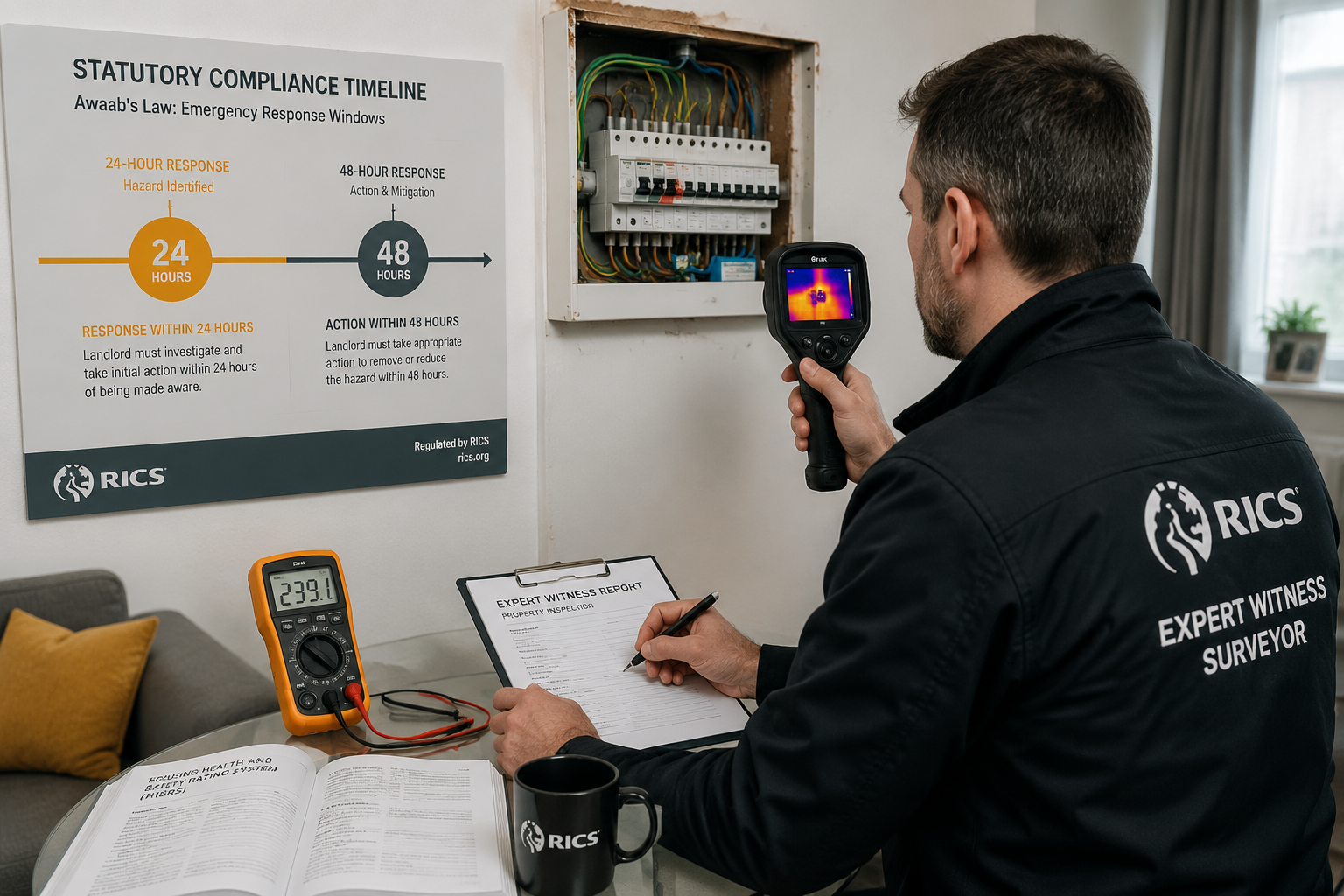
- Emergency electrical hazards (e.g., exposed wiring) require investigation within 24 hours and remediation within a further 24 hours.
- Expert witnesses must meet a "competent investigator" standard under Regulation 6(2) — professional qualification is not optional.
- Written investigation summaries must be provided to tenants within 3 working days of investigation completion.
- Quantum assessments in Awaab's Law disputes cover remediation costs, rent abatement, personal injury damages, and consequential losses — all requiring structured RICS-aligned methodology.
The Post-2026 Legal Landscape: What Awaab's Law Now Demands for Electrical Hazards
Phase 2 Expansion and the Prescribed Hazards Framework
Awaab's Law — enacted through the Social Housing (Regulation) Act 2023 and operationalised through secondary legislation — entered its critical second phase in October 2026. Phase 1 addressed damp, mould, and excess cold. Phase 2 dramatically widens the scope, bringing fire hazards, electrical hazards, structural collapse risks, domestic hygiene hazards, and excess heat within the same statutory framework [1][2].
The governing instrument is the Hazards in Social Housing (Prescribed Requirements) (England) Regulations 2025, which sets out the categories of hazard, the response timescales, and the qualification requirements for those carrying out investigations [2].
For electrical hazards specifically, the law distinguishes between:
| Hazard Type | Investigation Deadline | Remediation Deadline |
|---|---|---|
| Emergency hazard (e.g., exposed electrics) | Within 24 hours | Within a further 24 hours |
| Urgent hazard (significant but not immediate risk) | Within 14 days | Within a further 14 days |
| Standard prescribed hazard | Within 14 days | Within a reasonable period |
💡 Pull Quote: "Exposed electrics are explicitly identified as emergency-level hazards — particularly where vulnerable occupants, children under five, or elderly tenants are present." [5]
What Qualifies as a Prescribed Electrical Hazard?
Not every electrical fault triggers Awaab's Law. Three conditions must be met [2]:
- The hazard must arise from defect, disrepair, or lack of maintenance — not from tenant misuse or breach of tenancy agreement.
- The hazard must be within the landlord's control to remedy.
- The hazard must present a risk to the health and safety of the tenant.
This scoping rule is critical for expert witnesses. A report that fails to establish these three conditions will not support a successful claim. Equally, cladding-related hazards fall outside Awaab's Law because separate legislation governs them — a distinction that can affect how a building defect case is scoped and pleaded [2].
From 2026, landlords must also shift from reactive repair to proactive, multi-hazard monitoring — encompassing electrical hazards alongside fire, biohazards, heating failures, vermin, refuse, and structural compromise [5]. This creates a broader audit trail obligation that expert witnesses can interrogate.
Building Evidence Standards: What Expert Witness Reports for Electrical Hazards in Awaab's Law Disputes Must Contain
The Competent Investigator Standard
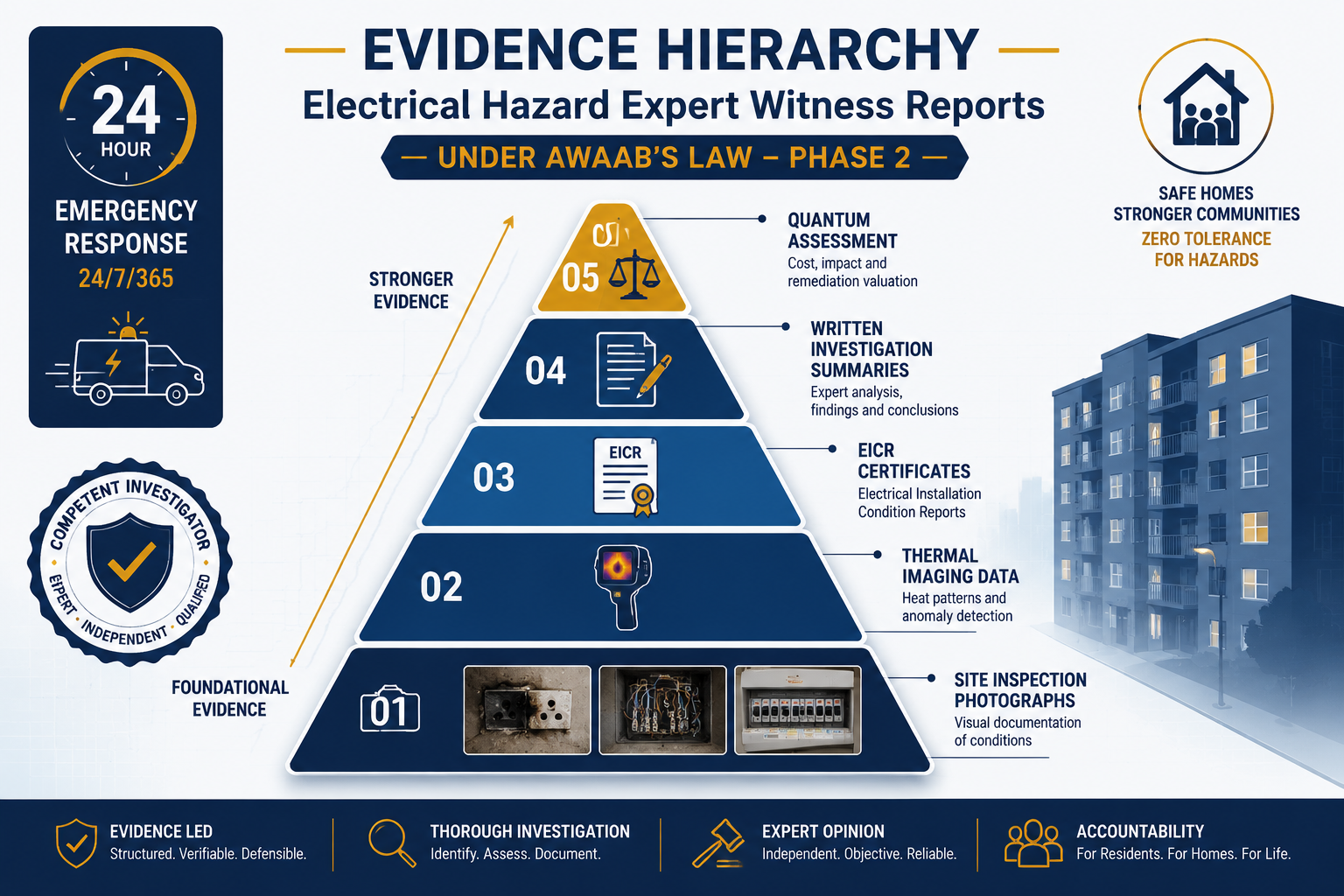
Regulation 6(2) of the 2025 Regulations requires that any investigation of a prescribed hazard — including electrical hazards — must be completed by a "competent investigator" possessing the skills and experience necessary "in the reasonable opinion of the lessor" [6]. In practice, this means:
- Electrical Installation Condition Reports (EICRs) must be produced by a qualified electrician (typically Part P registered or equivalent).
- Expert witness reports for litigation purposes should be prepared by a RICS-qualified building surveyor or chartered engineer with demonstrable electrical hazard experience.
- Where thermal imaging or specialist diagnostics are used, the operator must hold relevant certification (e.g., ITC Level 1 thermography).
Agents and landlords must ensure appropriately qualified specialists are engaged, with statutory timeframes communicated clearly to contractors and potential liabilities for default understood from the outset [2]. In disputes, the claimant's legal team will scrutinise whether the landlord's investigator genuinely met the competent investigator threshold — and the expert witness report must address this directly.
A structural engineer report may also be required where electrical hazards are linked to structural defects, such as water ingress compromising wiring routes or damaged consumer unit housings.
Core Components of a Compliant Expert Witness Report
A well-constructed expert witness report for an Awaab's Law electrical hazard dispute should include the following sections:
1. 🔍 Instructions and Scope
- Confirm the expert's qualifications and independence (CPR Part 35 compliance in England and Wales).
- Define the precise hazard(s) under investigation and the relevant prescribed hazard category.
2. 📸 Site Inspection Evidence
- Photographic documentation of all electrical defects observed.
- Thermal imaging data where relevant (overheating circuits, failing connections).
- Details of any EICR findings, including C1 (danger present), C2 (potentially dangerous), and FI (further investigation required) codes.
3. 📅 Chronological Hazard Timeline
- Date hazard first reported by tenant.
- Date(s) of any landlord inspection or investigation.
- Date(s) of any remediation works.
- Comparison against statutory response windows.
4. ⚖️ Liability Analysis
- Was the hazard caused by defect, disrepair, or lack of maintenance?
- Was it within the landlord's control?
- Did the landlord engage a competent investigator?
- Was the written investigation summary provided within 3 working days? [3]
5. 📊 Quantum Assessment (detailed in the next section)
6. 📝 Expert's Opinion and Declaration
⚠️ Important: Under CPR Part 35, the expert's duty is to the court — not to the instructing party. Any report that reads as advocacy rather than independent analysis will be challenged and may be excluded.
Written Investigation Summaries as Evidence
One of the most powerful — and frequently overlooked — evidential tools in Awaab's Law disputes is the written investigation summary. Following investigation of a prescribed hazard, landlords must provide tenants with a written summary of findings within 3 working days of investigation conclusion, unless works are completed and the hazard is made safe [3].
In practice, many landlords are failing to produce these summaries. The absence of a written summary is itself evidence of non-compliance and should be highlighted in the expert witness report. Where summaries do exist, they form part of the documentary audit trail and must be cross-referenced against the physical evidence found on site.
For properties with complex construction histories, a RICS specific defect survey can provide the granular defect-level analysis needed to establish the root cause of electrical hazards — particularly in older or non-standard construction properties where wiring routes and consumer unit locations may be non-compliant or inaccessible.
Quantum Assessments Post-2026: Valuing Electrical Hazard Claims in Awaab's Law Disputes
What Does Quantum Cover in These Disputes?
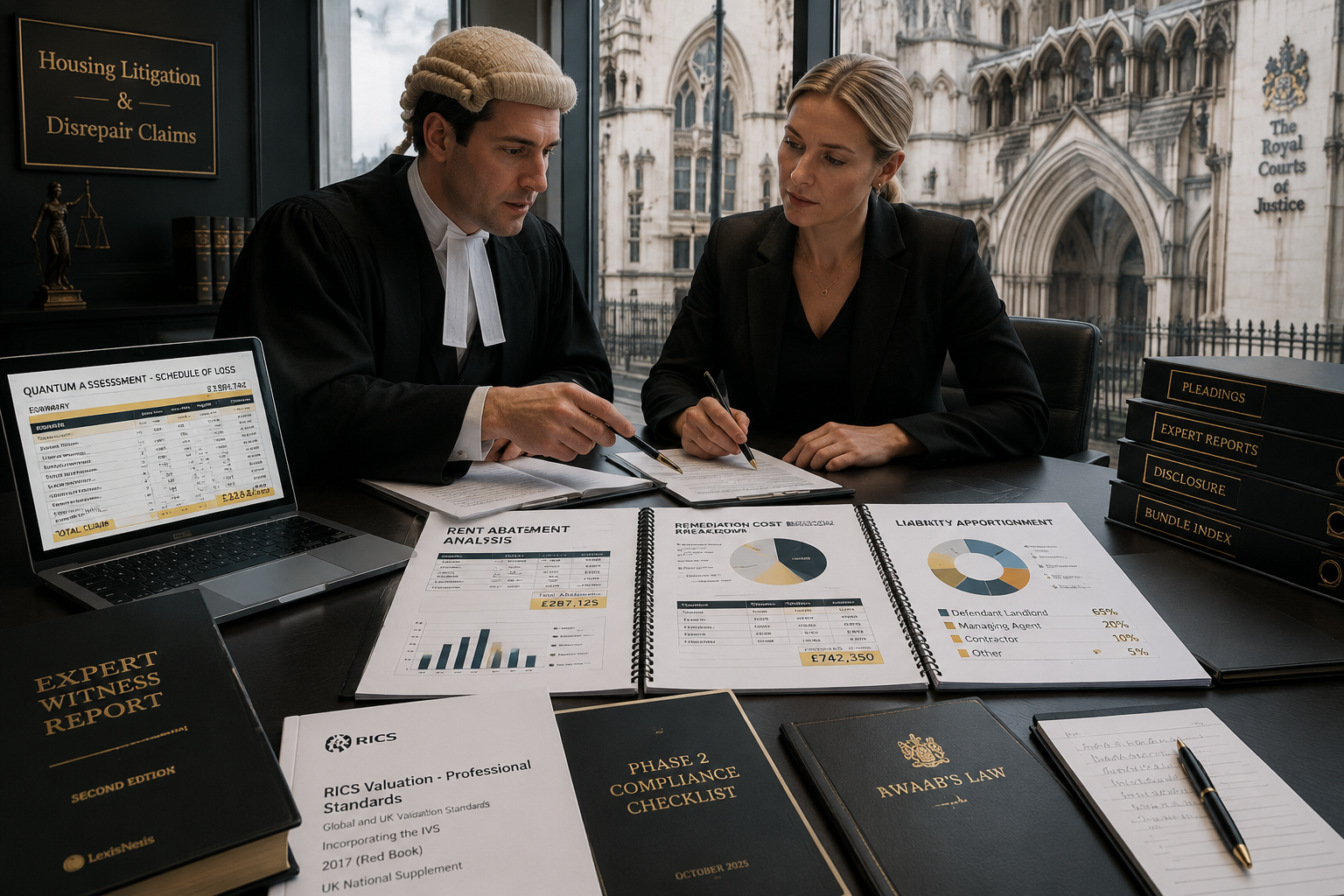
Quantum — the financial value of a claim — in Awaab's Law electrical hazard disputes typically falls across four heads of loss:
| Head of Loss | Description | Methodology |
|---|---|---|
| Remediation costs | Cost to bring electrical installation to compliant standard | Schedule of works + contractor quotes |
| Rent abatement | Reduction in rental value during period of hazard | RICS comparable evidence / % diminution |
| Personal injury damages | Compensation for injury or illness caused by hazard | Medical evidence + Judicial College Guidelines |
| Consequential losses | Damaged belongings, temporary accommodation, distress | Itemised schedule + receipts |
Rent Abatement Methodology
Rent abatement is the most contested quantum head in Awaab's Law disputes. The expert witness must determine:
- The open market rental value of the property in its hazard-free condition.
- The diminution in rental value attributable to the electrical hazard during the period of non-compliance.
- The duration of the non-compliant period — from the date the hazard was (or should have been) identified to the date of effective remediation.
RICS methodology requires the expert to use comparable rental evidence from similar properties in the same area, adjusted for the specific impact of the hazard. For severe electrical hazards — particularly those classified as emergency hazards — a diminution of 20% to 50% of rental value is not uncommon, depending on the severity and duration.
A rent review specialist or RICS valuer with residential expertise should ideally collaborate with the building surveyor on this element. Where the property is shared ownership, the shared ownership valuation framework adds further complexity, as the landlord's liability may be proportional to the equity share retained.
Remediation Cost Schedules
The remediation cost schedule must be:
- Itemised — broken down by trade, material, and labour.
- Independently verified — ideally by a second contractor quote or a quantity surveyor's assessment.
- Proportionate — only costs directly attributable to bringing the installation to the required standard should be included.
Where the electrical hazard is linked to broader building defects (e.g., water ingress causing cable degradation), the expert witness must carefully apportion liability between the electrical remediation and the underlying structural or waterproofing works. A schedule of dilapidations approach can be useful here, particularly in cases involving multiple overlapping defects.
Liability Apportionment in Multi-Defect Cases
Awaab's Law disputes rarely involve a single isolated hazard. More commonly, electrical hazards coexist with damp, mould, structural defects, or fire safety failures. The expert witness must [1][5]:
- Identify each prescribed hazard separately and assess whether it independently meets the prescribed hazard threshold.
- Attribute causation — is the electrical hazard a standalone defect, or is it consequential on another failure (e.g., roof leak causing cable damage)?
- Apportion remediation costs where works address multiple hazards simultaneously.
- Assess contributory negligence where tenant behaviour has exacerbated (but not caused) the hazard.
💡 Pull Quote: "Multi-hazard monitoring from 2026 means landlords face simultaneous compliance obligations across electrical, fire, structural, and hygiene hazards — and expert witnesses must be equipped to assess all of them within a single coherent report." [5]
The Role of Stock Condition Surveys in Quantum Evidence
Proactive landlords who have commissioned regular stock condition surveys are in a stronger defensive position. These surveys create a baseline record of the electrical installation's condition at a given date, which can be used to:
- Demonstrate that the hazard did not exist at a prior inspection.
- Establish the rate of deterioration and therefore the likely date of onset.
- Support the landlord's argument that the hazard arose from tenant interference rather than disrepair.
Conversely, where a stock condition survey reveals a pre-existing electrical deficiency that the landlord failed to act upon, it becomes powerful evidence for the claimant.
Practical Guidance for Instructing Expert Witnesses in 2026 Electrical Hazard Claims
Selecting the Right Expert
When selecting an expert witness for an Awaab's Law electrical hazard dispute, consider:
- ✅ RICS membership (Chartered Building Surveyor or Chartered Engineer)
- ✅ Demonstrable electrical hazard experience (EICR interpretation, thermal imaging)
- ✅ CPR Part 35 familiarity and court experience
- ✅ Knowledge of Awaab's Law Phase 2 prescribed hazards framework
- ✅ Independence — no prior relationship with either party
For verification of surveyor credentials, the guide on how to verify surveyor qualifications in the UK provides a useful checklist for solicitors and claimants.
Timing of Instruction
Early instruction is critical. The expert should ideally be engaged:
- Before proceedings are issued — to assess the strength of the claim and identify any gaps in evidence.
- Before remediation is completed — so that the hazard can be inspected in situ.
- As soon as a written investigation summary is received — to assess whether the landlord's findings are accurate and complete.
Common Pitfalls to Avoid
| ❌ Pitfall | ✅ Best Practice |
|---|---|
| Instructing an electrician without CPR Part 35 experience | Instruct a RICS surveyor with electrical hazard expertise |
| Failing to document the hazard before remediation | Arrange urgent site inspection before works commence |
| Conflating cladding hazards with Awaab's Law claims | Confirm prescribed hazard scope before pleading |
| Omitting written investigation summary from evidence bundle | Request all written summaries under pre-action protocol |
| Producing a quantum schedule without comparable rental evidence | Commission RICS rental valuation alongside defect report |
Conclusion: Actionable Next Steps for Practitioners and Property Professionals
The expansion of Awaab's Law to cover electrical hazards from October 2026 has created a new and demanding frontier for expert witness surveyors, housing solicitors, and landlords alike. The statutory framework is precise, the timelines are tight, and the evidential standards required to succeed — or defend — a claim are high.
For claimants and their legal teams:
- Instruct a RICS-qualified expert witness with electrical hazard experience at the earliest opportunity — ideally before remediation begins.
- Secure all written investigation summaries and EICR documentation under pre-action protocol.
- Commission a separate RICS rental valuation to support the rent abatement quantum.
For landlords and housing associations:
- Implement proactive multi-hazard monitoring protocols now — stock condition surveys provide the best defensive evidence base.
- Ensure all investigators engaged under Regulation 6(2) genuinely meet the competent investigator standard.
- Issue written investigation summaries within 3 working days of every investigation — non-compliance is itself actionable.
For expert witnesses:
- Structure reports to address all three prescribed hazard conditions: defect/disrepair, landlord control, and health risk.
- Produce itemised, independently verifiable remediation cost schedules.
- Maintain strict CPR Part 35 independence throughout — the report's credibility depends on it.
The intersection of statutory housing law, electrical engineering standards, and RICS valuation methodology makes Expert Witness Reports for Electrical Hazards in Awaab's Law Disputes: Building Evidence Standards and Quantum Assessments Post-2026 Expansion one of the most technically demanding areas of property dispute work in 2026. Getting the evidence right from the outset is not just good practice — it is the difference between a successful claim and a failed one.
References
[1] Building Surveys For Damp And Mould Post Awaabs Law Expansion Protocols For Identifying Prescribed Hazards In 2026 – https://nottinghillsurveyors.com/blog/building-surveys-for-damp-and-mould-post-awaabs-law-expansion-protocols-for-identifying-prescribed-hazards-in-2026
[2] Awaabs Law A New Dawn For Tenant Safety – https://beale-law.com/article/awaabs-law-a-new-dawn-for-tenant-safety/
[3] How Does Awaabs Law Protect My Rights As A Social Housing Tenant – https://www.hja.net/expert-comments/opinion/housing-law/how-does-awaabs-law-protect-my-rights-as-a-social-housing-tenant/
[4] Electrically Hazardous Areas Expert Witness – https://www.seakexperts.com/keywords/electrically-hazardous-areas-expert-witness
[5] Awaabs Law Awareness Triage And Categorisation Of Hazards – https://www.sussexdampexperts.com/awaabs-law-awareness-triage-and-categorisation-of-hazards/
[6] Awaabs Law Oddities And Observations – https://thelegalposition.co.uk/2026/01/27/awaabs-law-oddities-and-observations/
[7] Preventing Damp And Mould In 2026 Under Awaab S Law – https://www.augustapp.com/blog/preventing-damp-and-mould-in-2026-under-awaab-s-law
