
Nearly one in five party wall disputes handled by UK surveyors in recent years involves work that has already been completed without the required statutory notice ever being served. That single procedural failure transforms what should be a straightforward building project into a complex legal minefield — one where the remedies available are far more costly, contentious, and uncertain than proper compliance would ever have been.
This guide examines how surveyors navigate retrospective party wall agreements: legal remedies and damage quantification when works proceed without proper notice — covering the statutory framework, the landmark case law that shapes current practice, how damages are calculated, and what both building owners and adjoining owners must do to protect their position in 2026.
Key Takeaways 📋
- A retrospective party wall award is not legally binding under the Party Wall etc. Act 1996 — it functions only as a binding contract between parties, not a statutory instrument.
- The landmark case Shah v Power [2022] confirmed that where no notice is served, the Act is not invoked at all, stripping any surveyor appointments of their statutory basis.
- The primary legal remedy for an adjoining owner is court injunction and/or common law damages — not a retrospective award.
- Damage quantification requires a professional surveyor assessment comparing pre- and post-works property condition, often supported by a Schedule of Condition.
- Building owners who ignore violations face indemnity-basis legal costs that can dwarf the original construction budget.
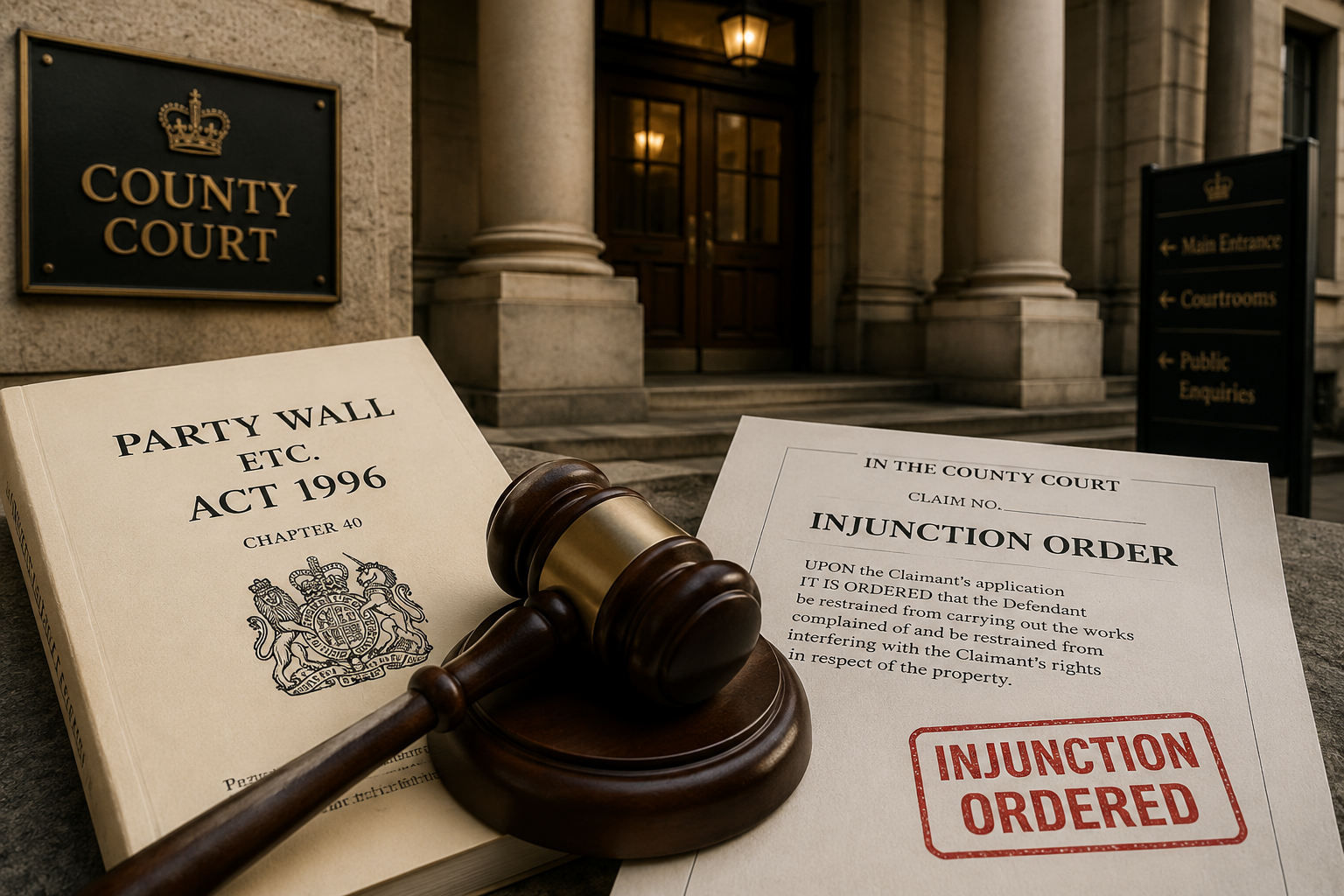
The Statutory Foundation: Why the Party Wall Act Cannot Work Backwards
The Party Wall etc. Act 1996 is, at its core, a preventive statute. It requires building owners to serve formal notice on adjoining owners before any notifiable works begin — whether that involves work to a shared wall, excavation near a neighbouring foundation, or construction of a new wall at the boundary line [5].
This notice requirement is not a technicality. It gives adjoining owners the opportunity to:
- Review the proposed works
- Appoint their own surveyor
- Agree or dissent to the works
- Secure a formal Party Wall Award that protects their interests
When that process is bypassed, the Act's entire protective machinery is never engaged. As confirmed in the High Court ruling in Shah v Power and another [2022] EWHC 209 (QB), where no notice is served before works commence, the Party Wall etc. Act 1996 is simply not invoked. Any surveyor appointments made after the fact and any awards produced have no statutory basis whatsoever [4].
💬 "A retrospective party wall award is no more than a binding contract and is not enforceable as an award under the Act's provisions." — Icon Surveyors [4]
This distinction is critical for surveyors operating in expert witness roles. For a deeper understanding of the Act's foundational requirements, see this comprehensive guide to the Party Wall etc. Act 1996.
What Counts as a Notifiable Work?
Not every building project triggers the Act. The following works typically require formal notice:
| Work Type | Notice Required | Notice Period |
|---|---|---|
| Work to a shared (party) wall | Party Structure Notice | 2 months |
| New wall at the boundary | Party Structure Notice | 2 months |
| Excavation within 3–6 metres of neighbour's foundation | Party Wall Excavation Notice | 1 month |
| Loft conversion affecting party wall | Party Structure Notice | 2 months |
Homeowners carrying out party wall works for loft conversions or excavation near boundaries are among those most commonly caught out by failing to serve notice in time.
Retrospective Party Wall Agreements: Legal Remedies and Damage Quantification When Works Proceed Without Proper Notice
When a building owner completes notifiable works without serving notice, the adjoining owner is left in a difficult position. The Act's normal dispute resolution pathway — appointing surveyors, producing an Award, appealing within 14 days — is unavailable because the Act was never triggered [2][3].
Instead, the adjoining owner must pursue remedies through common law and the civil courts.
🔴 Remedy 1: Court Injunction
An injunction is the most immediate and powerful tool available. Where works are still ongoing, an adjoining owner can apply to the court to halt construction immediately [4][2].
To obtain an injunction, the adjoining owner typically needs to demonstrate:
- That notifiable works were carried out without proper notice
- That there is a real risk of ongoing or further harm
- That damages alone would not be an adequate remedy
Injunctions can be expensive and time-sensitive. If works are already complete, the court may decline to grant one on the basis that the harm has already occurred and financial compensation is the more appropriate remedy.
🔴 Remedy 2: Common Law Damages
Where works are complete and damage has occurred, the adjoining owner's primary recourse is a common law damages claim. This is entirely separate from the Party Wall Act framework and is pursued through the civil courts [6].
Critically, if the building owner refuses to engage or rectify violations, the adjoining owner can pursue a claim that requires the defendant to pay legal costs on an indemnity basis — meaning all reasonable legal costs, not just the standard proportion. This can substantially increase total liability and "considerably bump up" the original project costs beyond what proper compliance would ever have cost [6].
🔴 Remedy 3: Negotiated Retrospective Agreement
While not a statutory remedy, the parties can agree to formalise a retrospective party wall agreement as a binding contract. This requires:
- Both parties' informed consent
- Appointment of an agreed (single joint) surveyor or two party wall surveyors
- A written agreement documenting the works completed, any damage caused, and agreed remediation
This agreement carries contractual enforceability but cannot be enforced as a Party Wall Award under the Act [5][1]. It is best understood as a negotiated settlement rather than a statutory resolution.
⚠️ Important: A retrospective agreement does not erase the original breach. It simply provides a framework for resolving the consequences. Legal advice should always be sought before entering into such an agreement.
For guidance on what happens when no party wall notice is served, the no party wall notice served resource provides a useful practical overview.
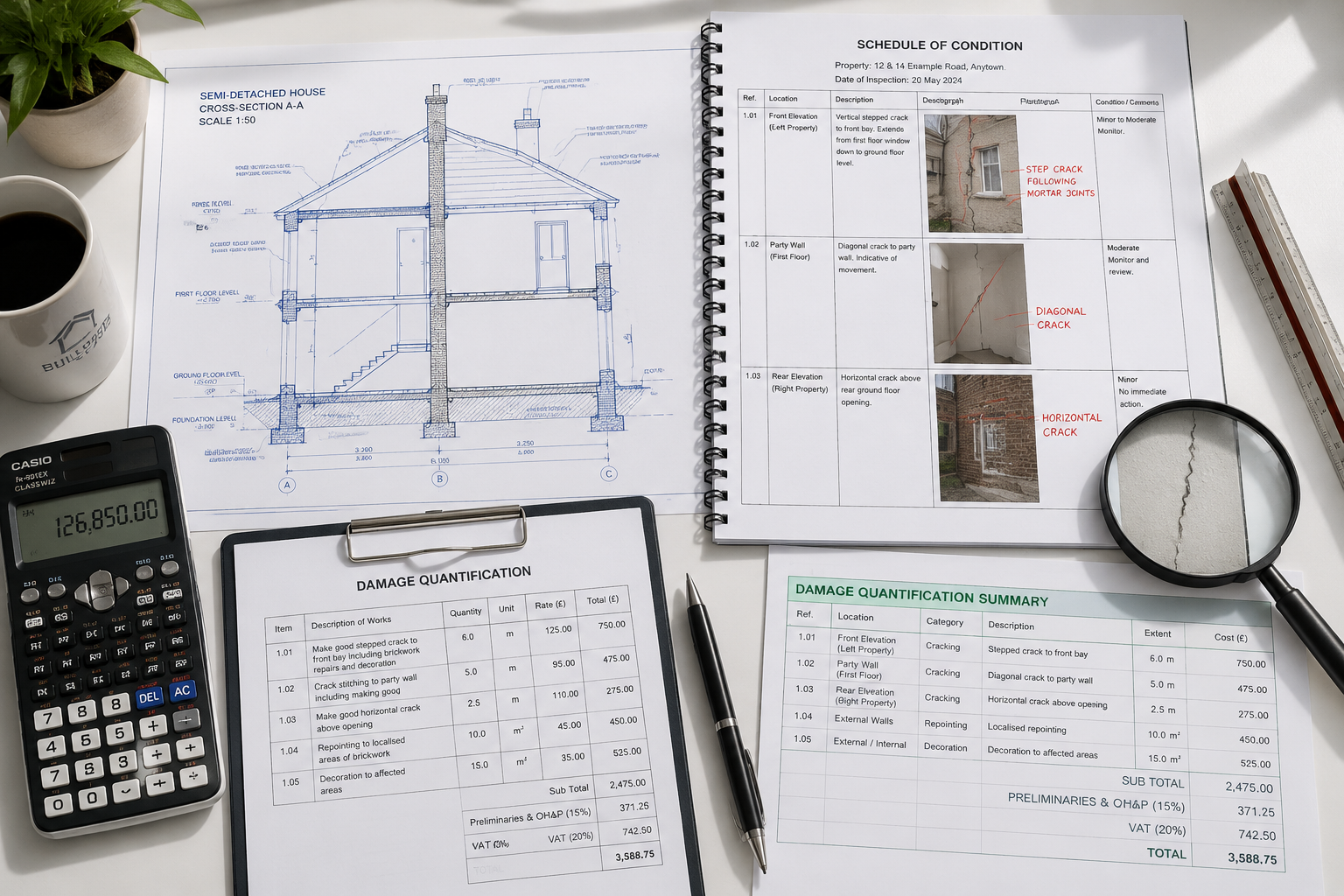
Damage Quantification: How Surveyors Assess and Value Harm
Quantifying damage in retrospective party wall disputes is one of the most technically demanding tasks a surveyor faces. Unlike prospective awards — where a Schedule of Condition is prepared before works begin — retrospective assessments must reconstruct what the property looked like prior to the works using whatever evidence is available [5].
The Schedule of Condition Problem
In a properly managed party wall process, a schedule of condition is prepared before works start. This document records the existing state of the adjoining property with photographs and written descriptions, creating a clear baseline for any future damage claims.
When works proceed without notice, no pre-works schedule exists. Surveyors must instead rely on:
- Photographs taken by the adjoining owner before or during works
- Estate agent or mortgage valuation photographs
- Google Street View historical imagery
- Witness statements from neighbours or contractors
- Structural engineering assessments of crack patterns and their likely age
This evidential gap significantly complicates damage quantification and underscores why prevention is always preferable to retrospective remedy.
Categories of Quantifiable Damage
When assessing harm in retrospective disputes, surveyors typically evaluate damage across several categories:
1. Direct Physical Damage
- Cracking to walls, ceilings, or plasterwork
- Damage to foundations or structural elements
- Water ingress resulting from compromised wall integrity
- Loss of lateral support
2. Consequential Losses
- Cost of temporary accommodation during repairs
- Loss of rental income
- Costs of engaging specialist contractors
3. Diminution in Value
- Where physical damage cannot be fully remediated, the property may suffer a permanent reduction in market value
- This is assessed by a qualified valuer comparing the property's open market value before and after the damage
4. Professional Fees
- Surveyor fees incurred in investigating and documenting the damage
- Legal costs of pursuing the claim
The Expert Witness Role 🔍
In contested cases, surveyors frequently act as expert witnesses providing independent technical evidence to the court. The expert's report must:
- Clearly identify the causal link between the works and the damage
- Provide a reasoned methodology for quantifying loss
- Distinguish between pre-existing defects and works-related damage
- Comply with Civil Procedure Rules Part 35 (Expert Evidence)
A well-prepared expert witness report is often the single most important factor in determining the outcome of a retrospective party wall damages claim. For complex structural cases, structural engineering input may also be required to support the surveyor's findings.
Retrospective Party Wall Agreements: Legal Remedies and Damage Quantification When Works Proceed Without Proper Notice — Practical Steps for Each Party
Understanding the legal landscape is only half the battle. Both building owners and adjoining owners need clear, practical guidance on what to do when works have already proceeded without notice.
For the Adjoining Owner: Immediate Action Steps ✅
- Document everything immediately — Photograph all visible damage, note dates, and gather any pre-works photographs you can find.
- Do not carry out repairs yet — Premature repairs can destroy evidence and weaken your claim.
- Engage a party wall surveyor — Instruct a qualified surveyor to inspect and prepare a damage assessment report. See the guide to resolving party wall disputes for an overview of the process.
- Write formally to the building owner — Put your concerns in writing, giving the building owner the opportunity to respond and engage.
- Seek legal advice — If the building owner is unresponsive, consult a solicitor about injunctive relief or a damages claim.
- Consider mediation — Before court proceedings, mediation can resolve disputes faster and more cheaply.
For the Building Owner: Damage Limitation Steps ✅
- Do not ignore the problem — Failing to engage will almost certainly result in indemnity-basis costs being awarded against you [6].
- Engage a party wall surveyor immediately — A surveyor can assess the damage objectively and help negotiate a resolution.
- Consider a retrospective agreement — Where both parties are willing, a formal retrospective agreement can provide a structured resolution pathway [5].
- Carry out remedial works promptly — Demonstrating good faith by addressing damage quickly can significantly reduce overall liability.
- Check your insurance — Some home insurance policies cover party wall disputes; notify your insurer as soon as possible.
💡 Pro Tip for Building Owners: The cost of proper party wall compliance — typically a few hundred to a few thousand pounds — is almost always a fraction of the legal costs, damages, and delays that arise from non-compliance. For a breakdown of typical costs, see the cost of party wall agreements guide.
The 14-Day Appeal Window: A Critical Deadline
Where a third surveyor's determination is eventually made in a retrospective context, any dissatisfied party has exactly 14 days to appeal to the County Court. This window is non-extendable and non-negotiable [2][3]. Missing it means the determination becomes final and binding with no further challenge available.
This tight deadline reinforces the importance of having a qualified surveyor monitoring the process from the outset.
Property Transaction Risks 🏠
One consequence of missing party wall agreements that is often overlooked is the impact on property sales. When a building owner later tries to sell their property, conveyancers and buyers' solicitors routinely flag the absence of party wall documentation as a risk [2].
This can:
- Delay or derail a sale
- Reduce the achievable sale price
- Require indemnity insurance (which may not cover all scenarios)
- Expose the seller to warranty claims post-completion
Addressing retrospective party wall issues proactively — rather than at the point of sale — is always the more commercially sensible approach.

How Surveyors Navigate Post-Completion Disputes in Practice
For party wall surveyors, retrospective disputes present a unique set of professional challenges. The normal statutory framework is unavailable, evidence is often incomplete, and emotions on both sides are frequently running high.
Experienced surveyors typically approach these cases by:
- Conducting a thorough joint inspection of both properties
- Reviewing all available photographic and documentary evidence
- Preparing a detailed condition report identifying damage and likely causation
- Producing a costed schedule of remedial works
- Advising both parties on realistic settlement ranges
- Where appropriate, preparing expert witness reports for court proceedings
When surveyor disagreement arises during any Award or agreement creation process, this can substantially delay resolution beyond the standard 4–6 week preparation period [2]. Selecting a surveyor with specific experience in retrospective and disputed cases is therefore essential.
For those seeking qualified professional support, RICS party wall surveyors offer the highest standard of expertise and are bound by professional conduct rules that protect both parties.
Conclusion: Prevention Beats Cure — But When Damage Is Done, Act Fast
Retrospective party wall agreements: legal remedies and damage quantification when works proceed without proper notice represent some of the most complex and costly situations in residential property law. The Shah v Power [2022] ruling has made clear that the Party Wall Act cannot be applied retrospectively — leaving court-based remedies as the primary recourse for adjoining owners who have suffered harm.
Actionable next steps for anyone facing this situation in 2026:
- ✅ Adjoining owners: Document damage immediately, instruct a qualified surveyor, and seek legal advice before carrying out any repairs.
- ✅ Building owners: Engage proactively, instruct a surveyor, and consider a formal retrospective agreement to limit escalating costs.
- ✅ Both parties: Be aware of the 14-day appeal deadline if a third surveyor determination is made.
- ✅ Anyone planning future works: Serve proper notice before works begin — the cost of compliance is always less than the cost of litigation.
- ✅ Surveyors in expert witness roles: Ensure damage reports are methodologically rigorous, causally clear, and CPR Part 35 compliant.
The party wall framework exists to protect everyone involved in shared-boundary construction. When it is bypassed, the consequences are invariably more expensive, more stressful, and more damaging to neighbourly relations than proper compliance would ever have been.
References
[1] Retrospective Party Wall Agreements – https://simmonstaylorhall.co.uk/retrospective-party-wall-agreements/
[2] Party Wall Dispute – https://onlinearchitecturalservices.com/party-wall-dispute/
[3] Party Wall Agreement – https://hoa.org.uk/advice/guides-for-homeowners/i-am-improving/party-wall-agreement/
[4] What Is A Retrospective Party Wall Award – https://iconsurveyors.co.uk/faqs/what-is-a-retrospective-party-wall-award/
[5] Can A Retrospective Party Wall Award Be Agreed Without Notices Being Served – https://www.tayross.com/blogs/can-a-retrospective-party-wall-award-be-agreed-without-notices-being-served
[6] Retrospective Party Wall Agreements – https://www.idealhome.co.uk/renovation/project-planning/retrospective-party-wall-agreements
[7] Understanding Party Wall Act What Homeowners Need Know Before Renovating – https://www.partywallslimited.com/blog/understanding-party-wall-act-what-homeowners-need-know-before-renovating
[8] Party Wall Agreements And Townhome Declarations Key Issues To Watch Out For When Drafting – https://ngazette.com/party-wall-agreements-and-townhome-declarations-key-issues-to-watch-out-for-when-drafting/
