
Basement excavations cause more party wall disputes than almost any other type of residential construction work in the UK — and the structural stakes are uniquely high. Unlike a loft conversion or rear extension, digging down beneath a shared boundary directly threatens the foundations of neighbouring properties, making Party Wall Surveys for Basement Excavations: Structural Risk Assessment and Neighbour Protection Under RICS 8th Edition one of the most technically demanding areas of surveying practice in 2026.
With RICS formally launching its consultation on the draft 8th edition of Party Wall Legislation and Procedure in April and May 2026 [1], the professional standards governing this work are being significantly refreshed. This guide explains what that means for building owners, adjoining neighbours, and the surveyors responsible for protecting both parties.
Key Takeaways 🏗️
- Section 6 of the Party Wall etc. Act 1996 requires a mandatory one-month notice period before basement excavation works begin, with a 14-day neighbour response window.
- The RICS 8th Edition introduces enhanced impartiality standards, updated competence requirements, and formal integration of technologies such as thermal imaging.
- A Schedule of Condition is the single most important document for protecting both neighbours and surveyors from disputed damage claims after excavation.
- Building owners bear all reasonable costs — including the adjoining owner's surveyor fees — under the Party Wall Act 1996.
- Complex basement projects routinely extend timelines by 8–12 weeks beyond the minimum statutory notice period due to Award preparation and structural assessment requirements.
Why Basement Excavations Present Unique Party Wall Challenges
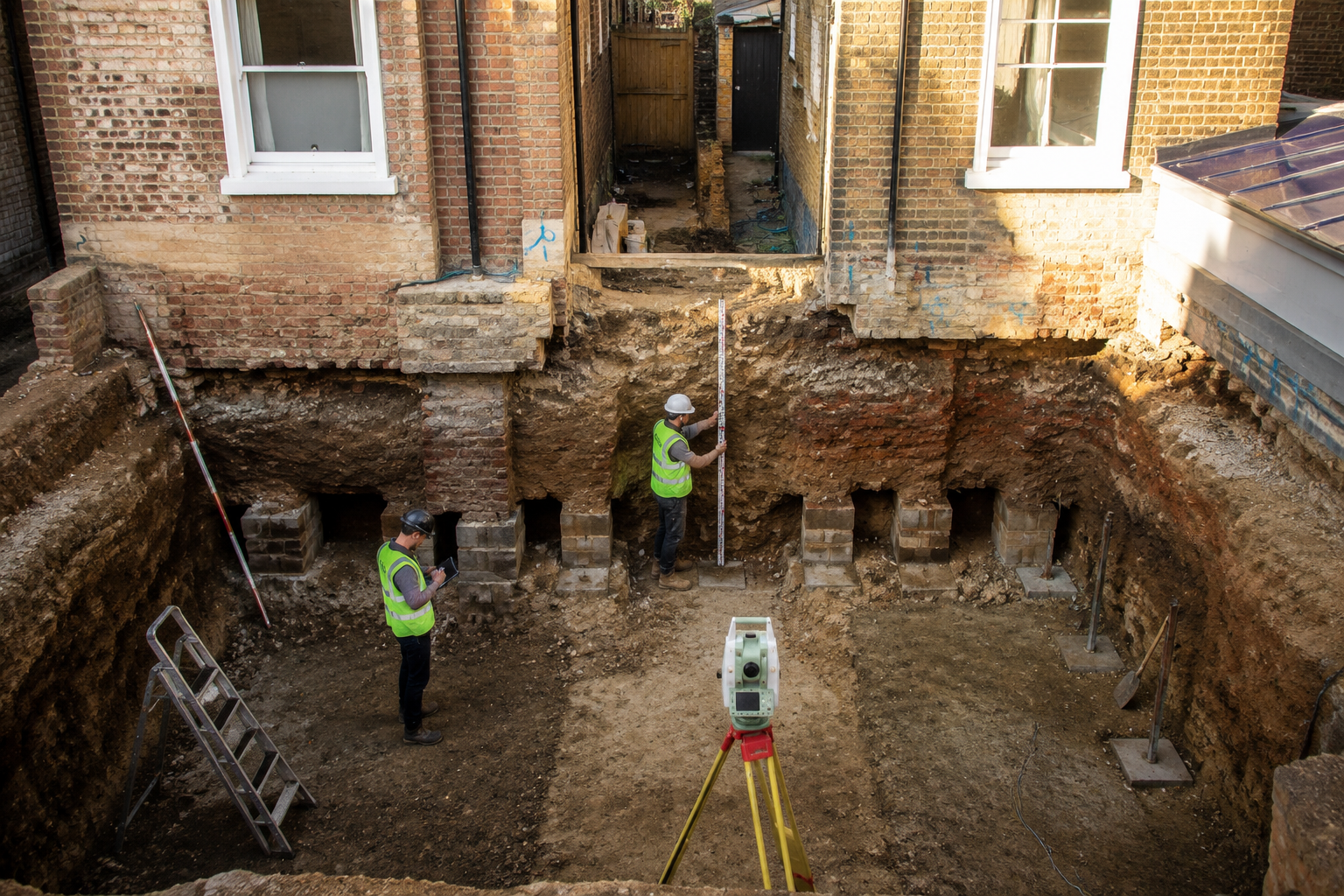
Most party wall matters involve works at or above ground level. Basement excavations are different: they disturb the soil that neighbouring foundations depend on. This creates risks that are invisible from the surface, difficult to predict, and potentially catastrophic if mismanaged.
The Soil Mechanics Problem
When soil is removed from one side of a boundary, the ground supporting adjacent foundations can shift. In London's predominantly clay subsoil, this risk is amplified. Clay shrinks and swells with moisture changes, and excavation-induced stress changes can trigger:
- Differential settlement — uneven sinking of the neighbour's structure
- Heave — upward movement of the base of an excavation
- Lateral movement — horizontal displacement of boundary walls
- Underpinning failure — if temporary works are inadequate
These are not theoretical concerns. They are documented failure modes that a competent party wall surveyor must assess before any Award is issued. Understanding the full scope of structural risk is therefore essential for both surveyors and building owners before work commences.
Section 6 Notices: The Legal Starting Point
Under Section 6 of the Party Wall etc. Act 1996, a building owner must serve notice when excavating within:
| Scenario | Distance Threshold | Notice Period |
|---|---|---|
| Excavation within 3 metres of neighbour's structure | At same or lower depth | 1 month |
| Excavation within 6 metres of neighbour's structure | Below 45° line from foundation | 1 month |
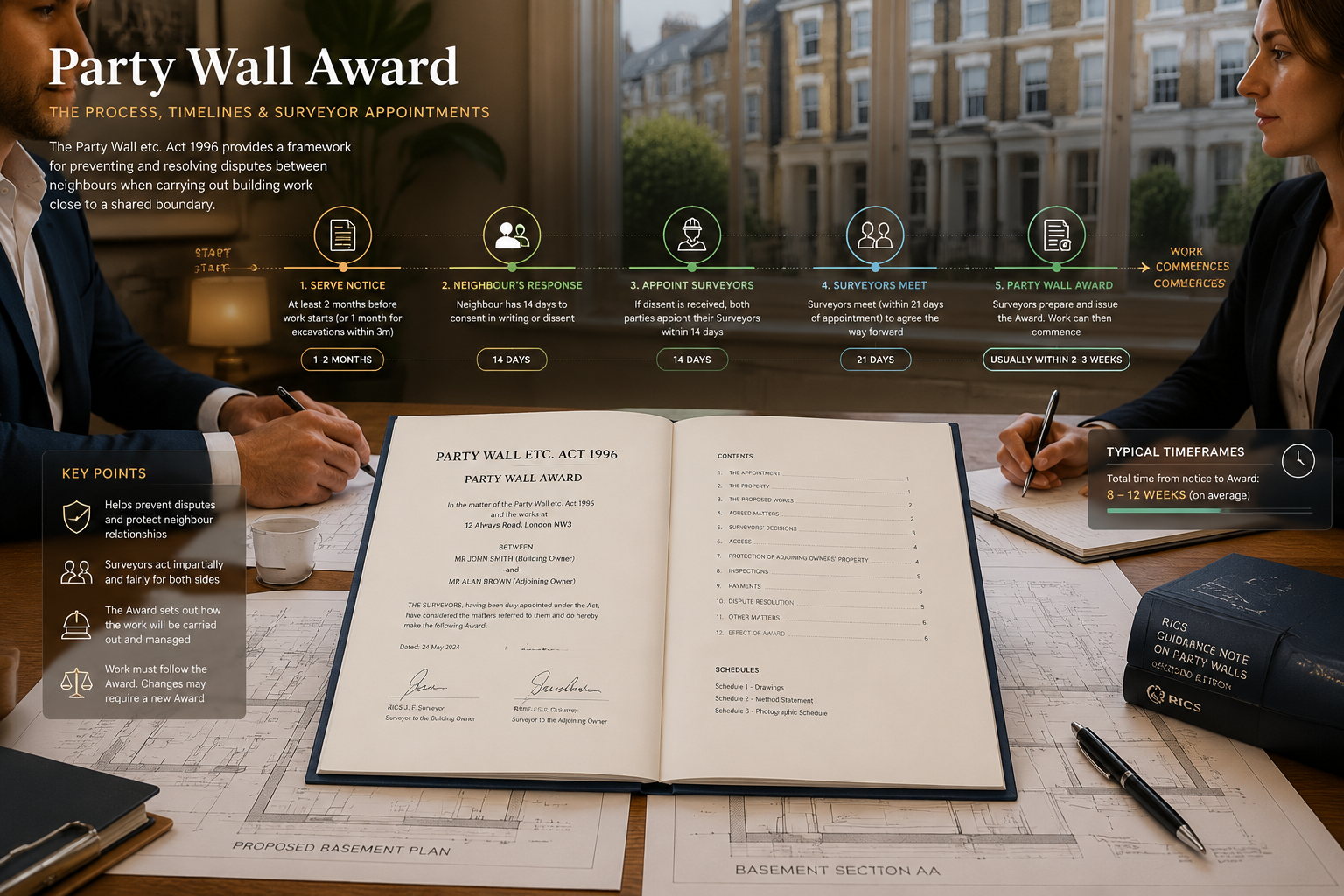
The adjoining owner then has 14 days to respond. If they consent, works can proceed. If they dissent — or fail to respond — the deemed dissent route is triggered, adding approximately two to three weeks before a surveyor can be formally appointed on their behalf [3].
💡 Pull Quote: "A Section 6 notice is not a formality — it is the legal foundation upon which the entire structural protection framework rests."
For a clear overview of the full process, the step-by-step guide to the party wall process provides an accessible walkthrough from notice to Award.
Structural Risk Assessment Under RICS 8th Edition Guidance
The draft RICS 8th edition represents a significant refresh of best-practice guidance for practitioners involved in party wall work [1]. For basement excavations specifically, the updated standards address three critical areas: competence, technology integration, and impartiality.
What the 8th Edition Changes
The 8th edition replaces the 7th edition with enhanced standards that explain when the Party Wall etc. Act 1996 is engaged, the procedures that follow, and the professional expectations on surveyors [1]. Key updates relevant to basement work include:
- Strengthened impartiality requirements for third surveyors, who must now make formal declarations of no conflict before accepting referral [3]
- Updated competence frameworks requiring surveyors to demonstrate technical understanding of excavation-related structural risks
- Integration of emerging survey technologies, including thermal imaging, into formal methodology [2]
Thermal Imaging: A 2026 Game-Changer 🔍
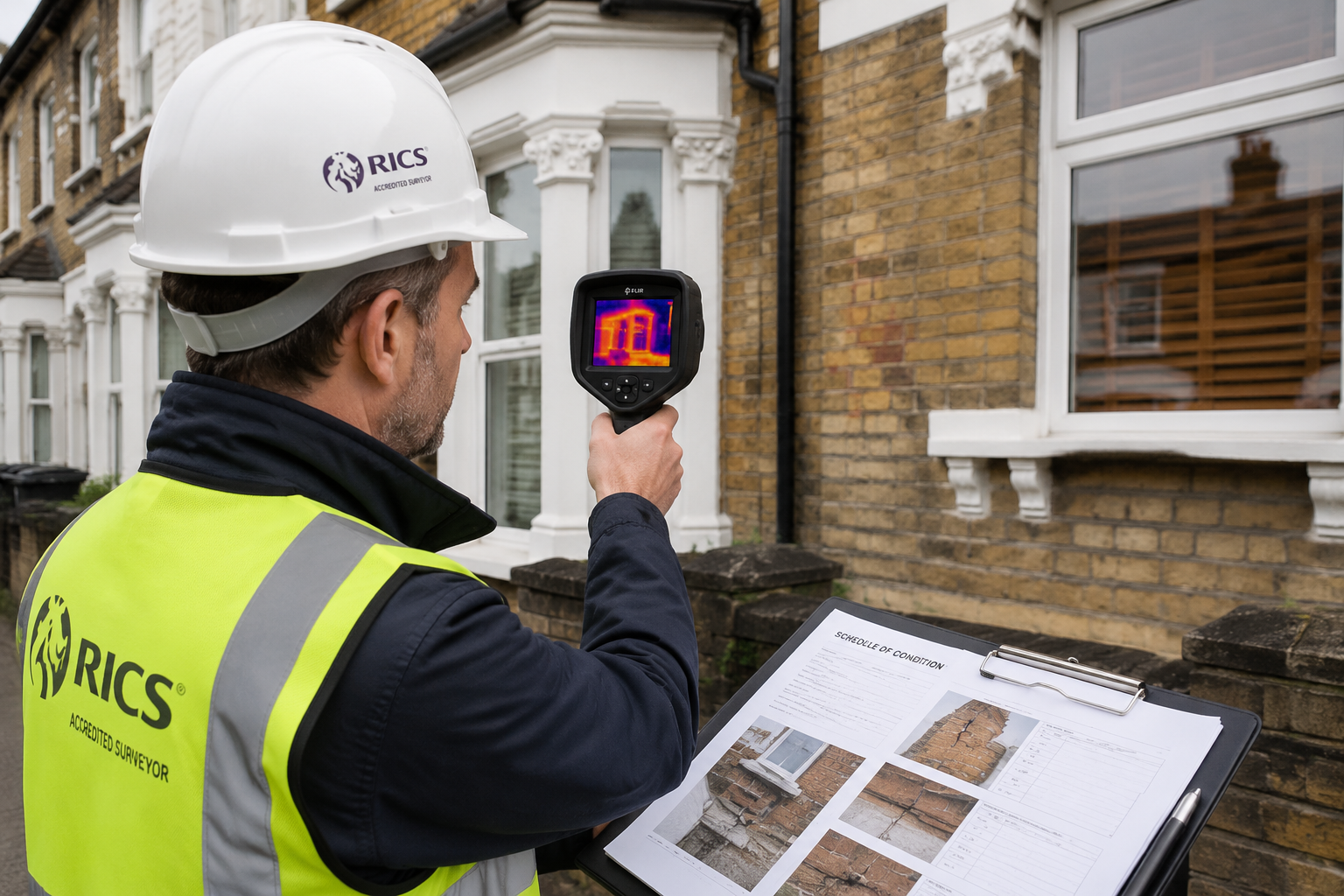
One of the most significant technical developments formalised under RICS 8th edition guidance is the use of thermal imaging in party wall surveys. As of 2026, thermal imaging is being formally integrated into party wall survey methodologies to detect hidden structural defects in adjacent properties before basement excavation works commence [2].
This matters enormously for basement projects because:
- Thermal cameras can reveal hidden moisture ingress behind plasterwork — a pre-existing defect that could later be falsely attributed to excavation
- Cold bridging patterns can indicate existing foundation weaknesses
- Anomalous heat signatures may reveal undisclosed drainage or service routes near the excavation zone
By capturing thermal evidence before work begins, surveyors protect both their own professional liability and the neighbour's ability to make legitimate damage claims.
The Schedule of Condition: Your Most Important Document
🔑 The Schedule of Condition is the legal bedrock of neighbour protection in basement excavation cases.
A detailed Schedule of Condition documents the existing state of the adjoining property before any excavation begins [3]. For basement projects, this must go well beyond a superficial visual check. A robust schedule should include:
Photography protocols:
- Minimum 200 high-resolution photographs per property
- Macro shots of all existing cracks (with scale reference)
- Wide-angle context shots for each room
- External elevations from multiple angles
- Cellar and subfloor spaces where accessible
Technical documentation:
- Crack width measurements using calibrated gauges
- Floor level readings using a digital level
- Thermal imaging scans of key walls and floors [2]
- Drainage inspection records where relevant
Written condition notes:
- Room-by-room descriptions of finishes and defects
- Specific notation of any pre-existing settlement or movement
- Date, time, and weather conditions recorded
Without this baseline, any crack or movement discovered after excavation becomes a disputed claim. With it, both parties have clear, objective evidence. For guidance on how damage claims are handled when things go wrong, see damage to property in party wall disputes.
Party Wall Awards, Timelines, and Cost Responsibilities for Basement Projects
Understanding the Party Wall Surveys for Basement Excavations: Structural Risk Assessment and Neighbour Protection Under RICS 8th Edition framework requires a clear grasp of how Awards are structured, how long they take, and who pays for what.
Realistic Timelines for Basement Excavation Projects
Many building owners underestimate how long the party wall process takes for basement work. Here is a realistic timeline:
| Stage | Minimum Duration |
|---|---|
| Section 6 notice period | 1 month |
| Neighbour response window | 14 days |
| Deemed dissent + surveyor appointment (if applicable) | 2–3 weeks |
| Structural risk assessment and Award preparation | 4–6 weeks |
| Total before works can legally begin | ~10–14 weeks |
Complex schemes involving significant excavation or multiple properties require four to six weeks beyond the original notice period for surveyor appointment and Party Wall Award creation [3]. The Party Wall Act does not impose strict deadlines for Award completion, though surveyors have a legal obligation to act expediently [3].
⚠️ Important: Any party dissatisfied with a third surveyor's determination has exactly 14 days to appeal to County Court. After this window, the determination is final and binding [3].
Who Pays? The Cost Responsibility Framework
Under the Party Wall Act 1996, the building owner bears responsibility for all reasonable costs [3], including:
- ✅ Their own surveyor's fees
- ✅ The adjoining owner's surveyor fees
- ✅ Party Wall Award preparation costs
- ✅ Third surveyor fees (if appointed)
- ✅ Schedule of Condition preparation
For basement excavation projects, surveyor fees typically range from £1,500 to £4,000 or more, with London specialists charging £200–£400 per hour for complex structural assessment work [3].
For a detailed breakdown of costs, the party wall surveyor cost guide provides current pricing benchmarks, and who pays for a party wall surveyor explains the legal cost allocation framework in full.
What a Party Wall Award Must Cover for Basement Works
A well-drafted Award for basement excavation should address:
- Method of excavation — hand-dig vs. mechanical, sequencing requirements
- Temporary works — shoring, underpinning specifications, and sign-off requirements
- Monitoring regime — crack monitor types, frequency of readings, trigger levels
- Working hours — restrictions to protect neighbours from vibration
- Drainage protection — measures to prevent groundwater disruption
- Reinstatement obligations — what happens if damage occurs
- Insurance requirements — confirmation of adequate contractor cover
For more on how Awards are structured and what they legally contain, the complete guide to party wall awards is an essential reference.
Protecting Neighbour Relations: Practical Guidance for Building Owners
The legal framework is only part of the picture. Basement excavations are stressful for neighbours even when everything goes smoothly. Building owners who manage the human side of the process well tend to avoid disputes that can delay projects by months.
Communication Best Practices 🤝
- Notify neighbours informally before serving formal notice — a conversation over the fence before a legal document lands on the doormat makes a significant difference
- Share the structural engineer's assessment — transparency about the technical safeguards in place reduces anxiety
- Provide a project timeline — neighbours want to know how long disruption will last
- Designate a single point of contact — confusion about who to call when something goes wrong escalates disputes
When Neighbours Refuse or Dispute
Neighbours cannot legally block a basement excavation that complies with the Party Wall Act, but they can slow it down significantly. For a clear explanation of the limits of neighbour refusal rights, can a neighbour legally refuse a party wall agreement sets out the legal position in plain terms.
If a genuine dispute arises about the scope of works or the adequacy of protective measures, the RICS party wall surveyors expert guidance resource explains how professional dispute resolution works in practice.
The Role of the Agreed Surveyor vs. Two Surveyors
For basement excavation projects, the agreed surveyor model (one surveyor acting for both parties) can work well when:
- The project is relatively straightforward
- Both parties have an existing cooperative relationship
- The structural risks are low-to-moderate
However, for complex basement schemes with significant underpinning requirements, separate surveyors for each party often produce better outcomes. Each surveyor can advocate robustly for their client's interests, and the resulting Award tends to be more thoroughly scrutinised.
Conclusion: Getting Basement Excavation Party Wall Surveys Right in 2026
Basement excavations sit at the intersection of complex soil mechanics, high structural risk, and sensitive neighbour relations. The Party Wall Surveys for Basement Excavations: Structural Risk Assessment and Neighbour Protection Under RICS 8th Edition framework exists precisely because the consequences of getting this wrong — cracked walls, subsidence, legal disputes, and damaged relationships — are severe and often irreversible.
Actionable Next Steps ✅
- Engage a RICS-accredited party wall surveyor early — ideally 3–4 months before planned excavation start, not after planning permission is granted
- Commission a structural engineer's assessment of ground conditions and foundation risks before serving notice
- Serve Section 6 notices promptly and correctly — errors in notice service reset the clock entirely
- Insist on a comprehensive Schedule of Condition with thermal imaging, calibrated crack measurements, and photographic records
- Budget realistically — factor in £1,500–£4,000+ in surveyor fees for complex basement projects [3]
- Stay informed on RICS 8th Edition developments — the consultation launched in April 2026 will shape professional standards for years to come [1]
- Maintain open communication with neighbours throughout the project, not just during the formal notice period
The RICS 8th edition consultation signals a profession taking its responsibilities seriously in an area where the risks to people's homes are real and significant. Building owners, surveyors, and neighbours alike benefit from a framework that prioritises competence, transparency, and rigorous structural assessment from the very first notice served.
References
[1] Rics Launches Consultation On Updated Party Wall Practice Guidance – https://www.rics.org/news-insights/rics-launches-consultation-on-updated-party-wall-practice-guidance
[2] Thermal Imaging In Party Wall Surveys Detecting Hidden Defects And Resolving Neighbour Disputes Under Rics 8th Edition – https://nottinghillsurveyors.com/blog/thermal-imaging-in-party-wall-surveys-detecting-hidden-defects-and-resolving-neighbour-disputes-under-rics-8th-edition
[3] Party Wall Dispute – https://onlinearchitecturalservices.com/party-wall-dispute/
