
Over 40% of party wall disputes in England and Wales involve damage claims where the defect was invisible to the naked eye at the time of the original schedule of condition — a gap that thermal imaging technology is now closing with remarkable precision. As RICS launches its formal consultation on the draft 8th edition of Party Wall Legislation and Procedure in 2026, the integration of building thermography into party wall practice is moving from optional enhancement to professional best practice [1][2].
Thermal Imaging in Party Wall Surveys: Detecting Hidden Defects and Resolving Neighbour Disputes Under RICS 8th Edition represents one of the most significant advances in how surveyors document pre-existing conditions, identify construction-related damage, and provide defensible expert evidence during neighbour disputes. This article explains exactly how it works, what it detects, and why it matters for property owners and surveyors alike in 2026.
Key Takeaways 🔑
- Thermal imaging is non-invasive and fast, making it ideal for party wall inspections in occupied homes and sensitive listed buildings [4].
- The RICS 8th edition consultation (2026) signals a drive toward greater competence and consistency in party wall professional work, creating the perfect framework for embedding thermography as standard [1].
- Hidden defects — including damp, cold bridging, insulation failures, and underfloor heating leaks — are reliably detected by thermal cameras before they escalate into costly disputes [4].
- Two types of thermographic inspection exist: qualitative (lower entry barrier) and quantitative (requiring formal temperature recording and higher competency) [4].
- Early thermal evidence strengthens party wall awards and can prevent litigation by providing objective, court-admissible documentation of a wall's condition before, during, and after works.
What Is Building Thermography and Why Does It Matter for Party Walls?
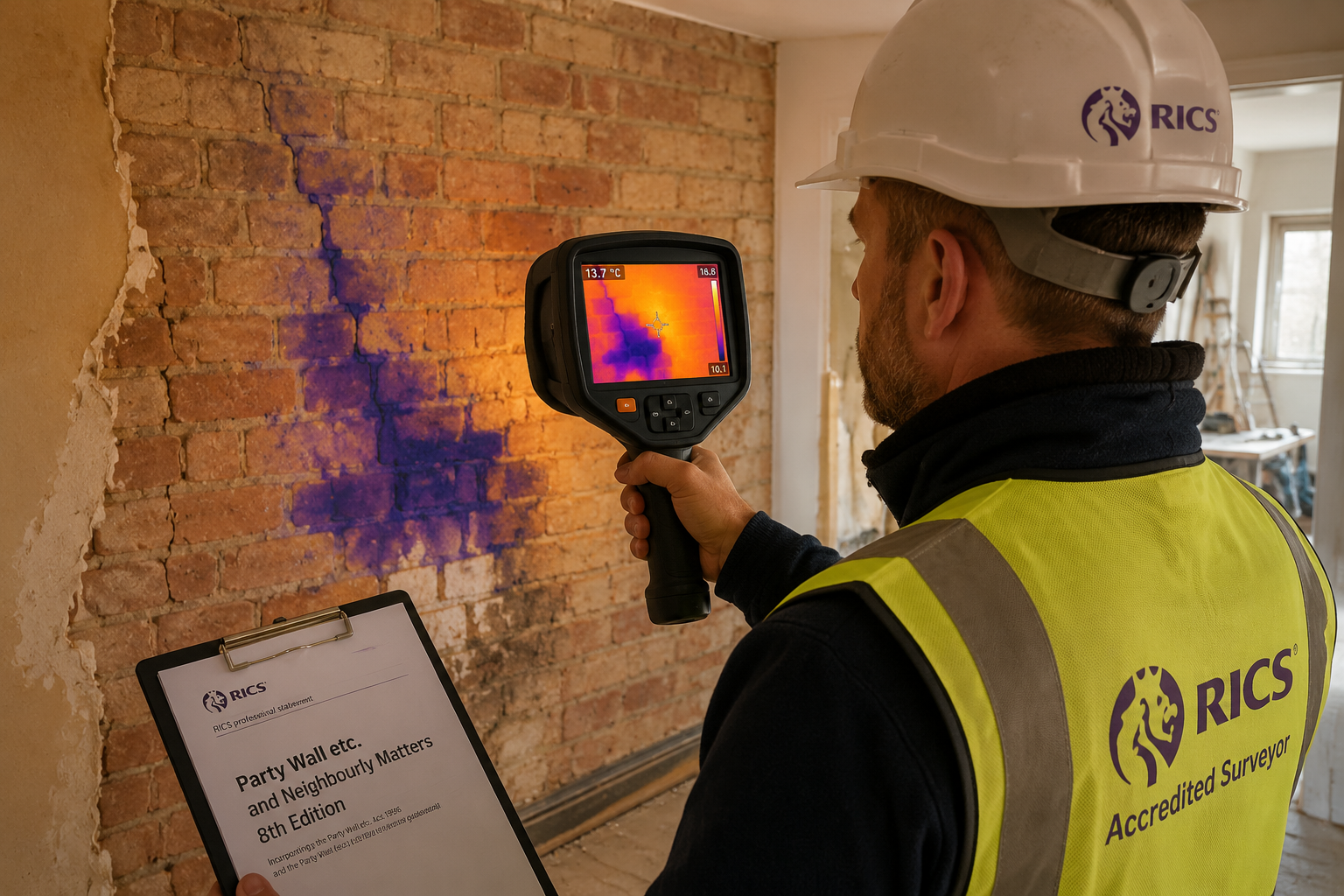
Building thermography uses infrared cameras to detect and visualise temperature differences across surfaces. Where conventional visual inspections can only report what is seen, a thermal camera reveals what is hidden — moisture behind plaster, missing insulation within a cavity, cold bridges that breed mould, or heat leaking through a compromised party wall structure [4].
For party wall surveyors, this is transformative. Under the Party Wall etc. Act 1996, a surveyor's primary duty is to act impartially and protect the interests of both the building owner and the adjoining owner. Producing an accurate, comprehensive schedule of condition before works begin is central to that duty. Yet traditional schedules rely on photography and written notes — methods that simply cannot document what lies beneath the surface.
💡 "A thermal image taken before excavation works begin can definitively show whether a damp patch existed prior to the works or was caused by them — removing the most common source of neighbour dispute at a stroke."
Thermography fills that evidential gap. It is completely non-invasive and comparatively quick, enabling surveyors to inspect difficult-to-access areas such as high ceilings, roof surfaces, and structural junctions without scaffolding or invasive probing [4]. For listed buildings and period properties — common in London and other urban areas where party wall disputes are most frequent — this non-destructive quality is especially valuable [4].
To understand the full scope of what a party wall surveyor is responsible for documenting, see this detailed overview of what a party wall surveyor does, their roles and legal requirements.
Defects Thermal Imaging Can Detect in Party Wall Contexts
The range of issues thermography can uncover in a party wall scenario is broad [4]:
| Defect Type | How Thermography Reveals It |
|---|---|
| 🌧️ Dampness & moisture ingress | Cold patches appear as blue/purple on thermal image |
| 🧱 Missing or incomplete insulation | Warm patches indicate uninsulated voids |
| ❄️ Cold bridging | Linear cold zones at structural junctions |
| 💧 Underfloor heating leaks | Hot streaks visible through floor finishes |
| 🔌 Electrical overheating | Hotspots at wiring or consumer units |
| 🪟 Failed double/triple glazing | Uniform cold zone across glazing unit |
| 🏗️ De-bonding render or cladding | Differential cooling patterns post-sunset |
| 🌫️ Condensation risk zones | Cold surfaces below dew point threshold |
Each of these defects can become a dispute flashpoint during party wall works. Excavations, underpinning, and structural alterations all create vibration, moisture redistribution, and thermal bridging changes. Without a pre-works thermographic baseline, it becomes almost impossible to prove whether a defect was pre-existing or construction-induced.
How Thermal Imaging Integrates With RICS 8th Edition Party Wall Practice
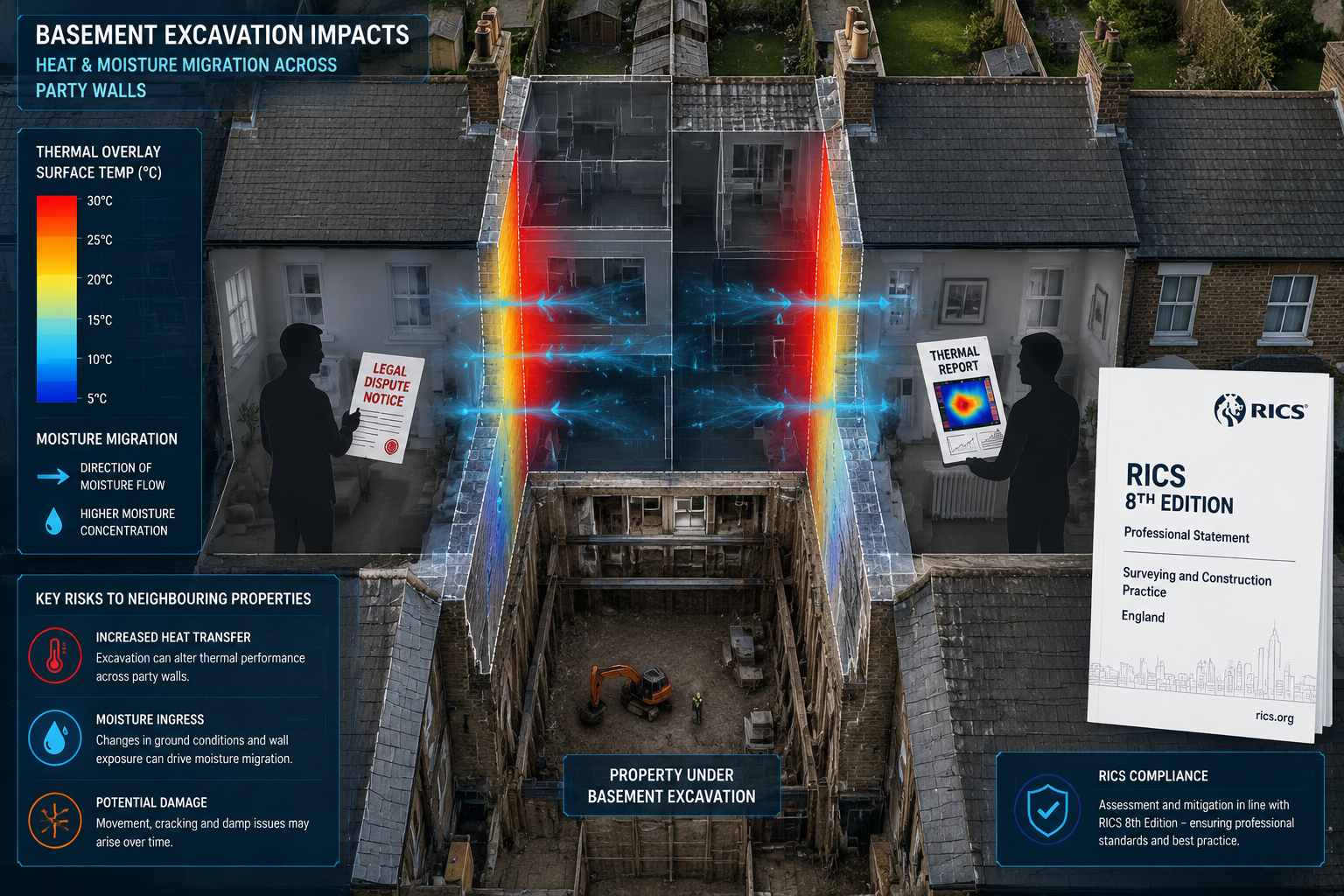
RICS launched a formal consultation on the draft 8th edition of Party Wall Legislation and Procedure during April–May 2026, inviting feedback from surveyors, legal professionals, dispute resolution practitioners, and stakeholders across England and Wales [1][3]. The 8th edition replaces the 7th edition and provides best-practice guidance for RICS members who accept instructions where the Party Wall etc. Act 1996 may apply [3].
The consultation is explicitly designed to support competence and consistency in party wall professional work [1]. This framing is significant: it signals that RICS expects surveyors to use the best available tools and methodologies — and thermal imaging is increasingly recognised as exactly that.
Two Types of Thermographic Inspection: Qualitative vs Quantitative
Not all thermal inspections are equal. RICS guidance distinguishes between two distinct types [4]:
1. Qualitative Inspections
- Do not involve formal temperature recording
- Lower competency threshold for surveyors
- Entry-level cameras cost approximately £650
- Suitable for identifying visible anomalies and documenting general condition
- Appropriate for most schedule of condition work
2. Quantitative Inspections
- Require formal temperature recording and calibrated equipment
- Significantly higher surveyor competency requirements
- Cameras capable of formal reporting cost over £2,000
- External inspections require a minimum IR resolution of 320 x 240 pixels and thermal sensitivity of 60 millikelvin [4]
- Required for expert witness reports and formal dispute proceedings
For most party wall schedules of condition, a qualitative inspection provides sufficient evidence. However, where a dispute has escalated — or where a surveyor anticipates litigation — a quantitative inspection with formal temperature recording produces court-admissible data that is far harder to challenge.
Embedding Thermography in the Schedule of Condition
The schedule of condition is the cornerstone document in any party wall process. It records the state of the adjoining owner's property before works begin, providing the baseline against which any post-works damage claim is assessed. For a complete guide to how party wall awards and schedules work, see this complete guide to party wall awards for property owners.
Integrating thermographic images into the schedule of condition adds a layer of objective evidence that written descriptions and standard photography cannot replicate. A thermal image showing no moisture anomaly in a wall cavity before works begin is definitive proof — if moisture appears after excavation, the thermal baseline establishes causation.
Best practice for thermographic schedules of condition:
- ✅ Conduct the inspection under appropriate temperature differential conditions (minimum 10°C difference between inside and outside)
- ✅ Inspect at night or in early morning for external surveys to avoid solar loading
- ✅ Document camera settings, ambient temperature, and weather conditions
- ✅ Annotate thermograms with location references matching the written schedule
- ✅ Retain raw image files alongside processed false-colour images
- ✅ Cross-reference thermal findings with any damp meter readings
With Awaab's Law expansion in 2026 placing greater regulatory emphasis on damp and mould hazard identification in building inspections [5], the use of thermal imaging in party wall surveys is further reinforced as both a professional and legal necessity.
Resolving Neighbour Disputes: Thermal Evidence in Practice
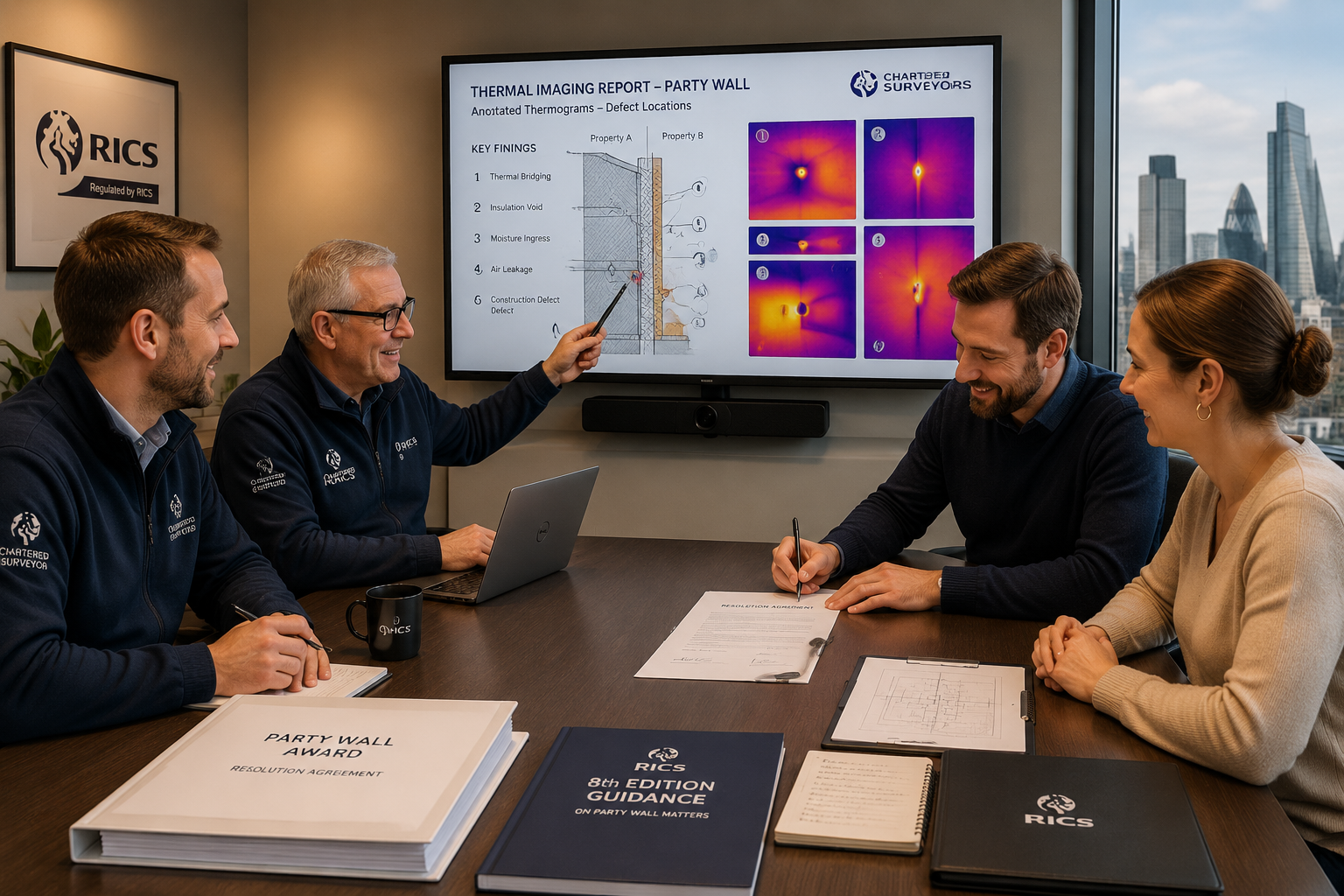
Thermal Imaging in Party Wall Surveys: Detecting Hidden Defects and Resolving Neighbour Disputes Under RICS 8th Edition is not just a technical upgrade — it is a dispute prevention and resolution tool of the first order. The following scenarios illustrate how thermography changes outcomes in real party wall situations.
Case Study 1: Basement Excavation in a London Terrace 🏘️
A homeowner in West London undertook a basement conversion beneath a Victorian terrace. The adjoining owner subsequently claimed that the works had caused damp penetration through the shared party wall, demanding £18,000 in remediation costs.
The party wall surveyor had conducted a pre-works thermographic schedule of condition. The thermal images clearly showed a pre-existing moisture anomaly in the precise location of the claimed damage — a cold patch consistent with long-standing damp ingress from a failed external gutter, entirely unrelated to the basement works.
Outcome: The claim was withdrawn within two weeks of the thermal evidence being presented. No litigation. No tribunal. Total resolution cost: the surveyor's fee.
Case Study 2: Loft Conversion and Cold Bridging Dispute 🏠
During a loft conversion on a semi-detached property, the adjoining owner reported new condensation and mould appearing on their bedroom ceiling adjacent to the party wall. They attributed this to insulation disturbance during the works.
Post-works thermographic inspection revealed cold bridging at a structural steel beam that had been inserted as part of the conversion. The thermal image showed a clear linear cold zone running across the party wall junction — a new defect directly attributable to the works.
Outcome: The building owner's surveyor accepted the thermal evidence. The party wall award was amended to require remedial insulation works at the building owner's cost. Dispute resolved without tribunal referral.
Why Thermal Evidence Is So Powerful in Dispute Resolution
- Objective and visual: Thermograms are immediately comprehensible to non-specialists, including county court judges and tribunal panels
- Timestamped and auditable: Digital thermal images carry metadata confirming when and under what conditions they were taken
- Comparative: Before-and-after thermal surveys provide direct causal evidence
- Non-destructive: Neither party can claim the inspection itself caused damage
For property owners wondering whether they need formal party wall protection before works begin, this complete guide to party wall agreements for homeowners is an essential starting point.
When to Commission a Thermographic Party Wall Survey
Not every party wall situation demands thermographic inspection. The following table helps identify when it adds the most value:
| Situation | Thermal Survey Recommended? |
|---|---|
| Basement excavation or underpinning | ✅ Strongly recommended |
| Loft conversion with structural steelwork | ✅ Strongly recommended |
| Simple rear extension, no excavation | ⚠️ Consider if damp history exists |
| Listed or period property | ✅ Strongly recommended |
| Active neighbour dispute already underway | ✅ Essential |
| New build party wall (no history) | ⚠️ Lower priority |
For complex structural works, a RICS Level 3 Building Survey or a specific defect report may be appropriate alongside thermographic party wall documentation, particularly where the adjoining property has known structural vulnerabilities.
Choosing the Right Surveyor: Competence in Thermography and Party Wall Law
The effectiveness of thermal imaging in party wall surveys depends entirely on the competence of the surveyor deploying it. A thermal camera in untrained hands produces images that are visually striking but evidentially worthless — or worse, misleading.
Key competencies to look for:
- 🎓 RICS membership with demonstrated party wall experience
- 📸 Formal thermography training (ITC Level 1 or equivalent minimum for qualitative work)
- 📋 Experience producing schedules of condition with integrated thermal documentation
- ⚖️ Understanding of the evidential requirements for party wall awards and dispute proceedings
- 🔧 Access to appropriately specified equipment (320×240 IR resolution minimum for external surveys) [4]
The RICS 8th edition consultation process in 2026 is expected to clarify competency expectations for surveyors using specialist technologies in party wall work [1]. Surveyors who invest in thermographic capability now will be well-positioned for the updated guidance framework.
For those navigating the party wall process for the first time, understanding how party wall notices work and how to respond is an important first step before commissioning any survey work. Understanding who pays for a party wall surveyor is equally important for budgeting purposes.
Conclusion: Thermal Imaging as the New Standard in Party Wall Practice
The convergence of advanced thermal imaging technology and the RICS 8th edition framework in 2026 creates a clear direction of travel for party wall practice in England and Wales. Thermal Imaging in Party Wall Surveys: Detecting Hidden Defects and Resolving Neighbour Disputes Under RICS 8th Edition is no longer a niche specialism — it is becoming the expected standard for competent, defensible party wall work.
The evidence is compelling:
- Hidden defects that cause the majority of neighbour disputes are reliably detectable by thermal cameras [4]
- Pre-works thermographic baselines transform the evidential quality of schedules of condition
- Dispute resolution is faster, cheaper, and less adversarial when objective thermal data is available
- RICS's 2026 consultation signals a regulatory environment that rewards surveyors who adopt best-practice technologies [1][3]
Actionable Next Steps for Property Owners and Surveyors
If you are a property owner planning works:
- Serve the correct party wall notices before works begin — see guidance on party wall notices and how to respond
- Ask your appointed surveyor whether thermographic inspection is included in the schedule of condition
- Retain all thermal reports as part of your party wall documentation
- If a dispute arises, commission a post-works thermographic survey immediately
If you are a surveyor:
- Invest in appropriate thermographic equipment (minimum 320×240 IR resolution for external work) [4]
- Obtain formal thermography training to meet the competency standards anticipated in the RICS 8th edition
- Develop a standard thermographic protocol for schedules of condition
- Engage with the RICS 8th edition consultation to shape best-practice guidance [1]
The party wall process exists to protect both building owners and their neighbours. Thermal imaging gives that protection genuine teeth — turning a paper-based procedural exercise into a robust, evidence-led safeguard for everyone involved.
References
[1] RICS Launches Consultation on Updated Party Wall Practice Guidance – https://www.rics.org/news-insights/rics-launches-consultation-on-updated-party-wall-practice-guidance
[2] MODUS by RICS January 2026 – https://www.rics.org/content/dam/ricsglobal/documents/to-be-sorted/MODUS-by-RICS-January-2026.pdf
[3] RICS Launches Consultation on Party Wall Guidance – https://thenegotiator.co.uk/news/regulation-law-news/rics-launches-consultation-on-party-wall-guidance/
[4] An Introduction to Building Thermography – https://ww3.rics.org/uk/en/journals/built-environment-journal/an-introduction-to-building-thermography.html
[5] Building Surveys for Damp and Mould Post Awaab's Law Expansion: Protocols for Identifying Prescribed Hazards in 2026 – https://nottinghillsurveyors.com/blog/building-surveys-for-damp-and-mould-post-awaabs-law-expansion-protocols-for-identifying-prescribed-hazards-in-2026
