
A mandatory injunction forcing a homeowner to demolish a newly built extension — that was the outcome in Ormiston Kilsby v Fattahi [2019], a landmark case that sent shockwaves through the UK construction and surveying world. The reason? Failure to serve the correct Party Wall Act notices before works began. [4] This case, and dozens like it, underline why Party Wall Expert Witness Reports: Lessons from Recent UK Litigation and RICS Best Practices are no longer a niche specialism — they are a critical line of defence for property owners, developers, and their legal teams alike.
As the 2026 construction boom drives unprecedented demand for loft conversions, basement excavations, and rear extensions across UK cities, the volume of party wall disputes is rising sharply. [6] When those disputes reach court, the quality of an expert witness report can determine who wins — and who faces a demolition order.
Key Takeaways 📋
- CPR Part 35 compliance is non-negotiable for expert witness reports submitted to courts in England and Wales — format errors can invalidate evidence entirely.
- Recent case law (including Ormiston Kilsby v Fattahi) demonstrates that courts will impose severe remedies for Party Wall Act non-compliance.
- Single Joint Experts (SJEs) are increasingly preferred by courts over competing party-appointed experts, reshaping how surveyors must present their reports.
- RICS best practice guidance sets a clear framework for independence, impartiality, and reasoned opinion in expert witness reporting.
- Scope limitations matter: party wall surveyors cannot determine property boundaries or act beyond their statutory powers — misunderstanding this has derailed multiple cases.
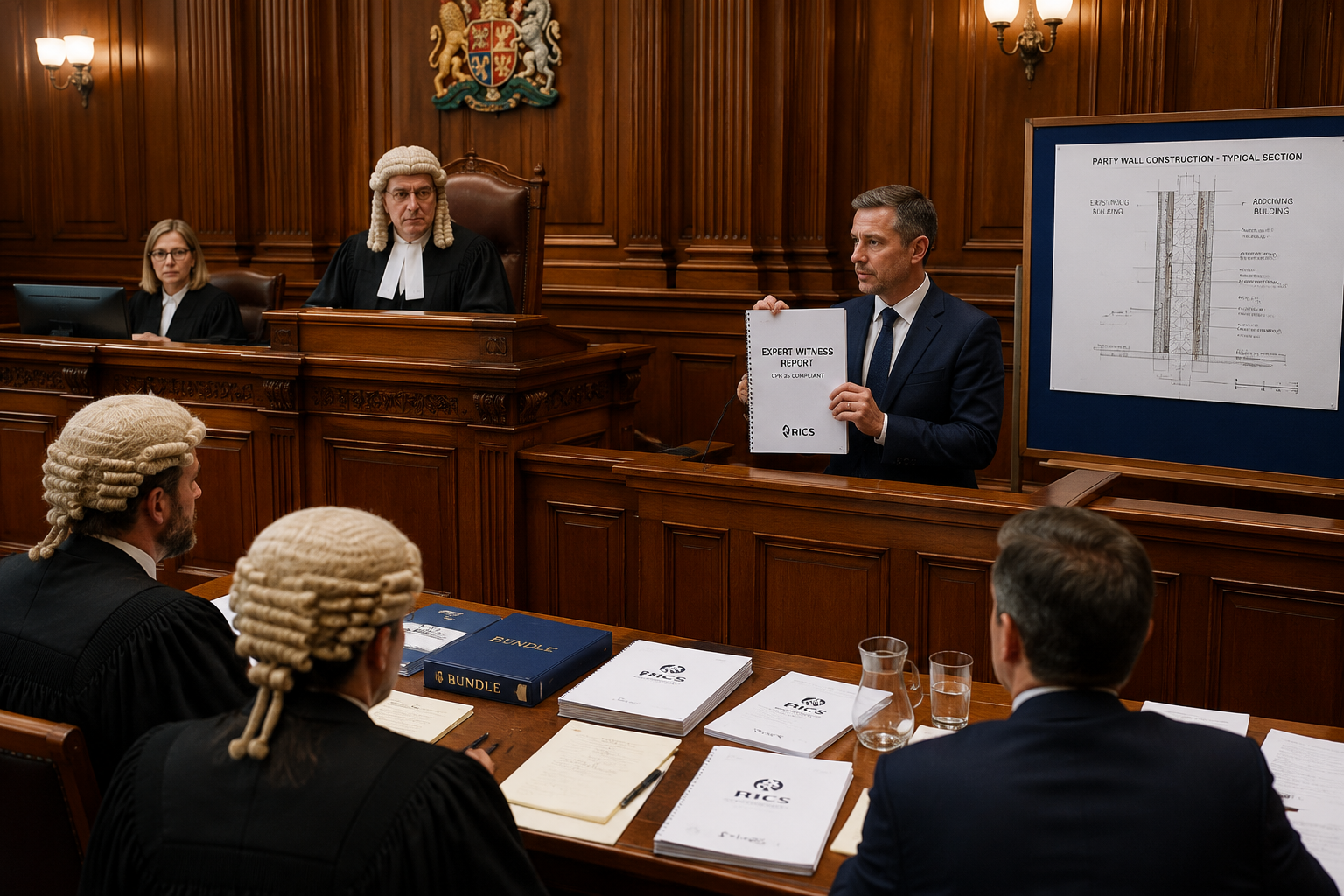
Why Party Wall Expert Witness Reports Matter More Than Ever in 2026
The UK housing market's relentless pressure on space has made party wall works — loft conversions, side extensions, basement digs — a daily reality in cities like London, Bristol, and Manchester. With more works comes more conflict. [6]
When a dispute cannot be resolved between appointed surveyors, it escalates to the County Court or, in complex cases, the Technology and Construction Court (TCC). At that point, the party wall expert witness report becomes the primary vehicle through which technical facts are communicated to a judge.
💬 "An expert witness report that fails to meet CPR35 requirements isn't just weak evidence — it may be inadmissible evidence."
Understanding what a party wall surveyor does is the first step. But when disputes escalate to litigation, the role transforms from statutory administrator to court-appointed technical authority — and the standards are far more demanding.
The Statutory Framework: Party Wall Act 1996 and Its Limits
The Party Wall etc. Act 1996 grants surveyors specific powers to resolve disputes between building owners and adjoining owners. However, recent case law has reinforced a critical principle: surveyors must act strictly intra vires — within the scope of those statutory powers. [4]
Key limitations courts have confirmed include:
| What Surveyors CAN Do | What Surveyors CANNOT Do |
|---|---|
| Issue a Party Wall Award | Determine property boundaries |
| Assess damage caused by notifiable works | Adjudicate on trespass claims |
| Specify working methods and hours | Act as arbitrators on non-party-wall matters |
| Appoint a third surveyor if parties disagree | Override planning or building regulations decisions |
Boundary determination is a particularly common trap. Courts have confirmed that party wall surveyors rely on assertions provided by building owners rather than making independent determinations. [4] An expert witness report that strays into boundary adjudication will be challenged — and likely discredited.
For a thorough grounding in the process, the complete guide to party wall surveys provides essential context before any expert engagement begins.
Landmark Cases: When Expert Witnesses Turned the Tide
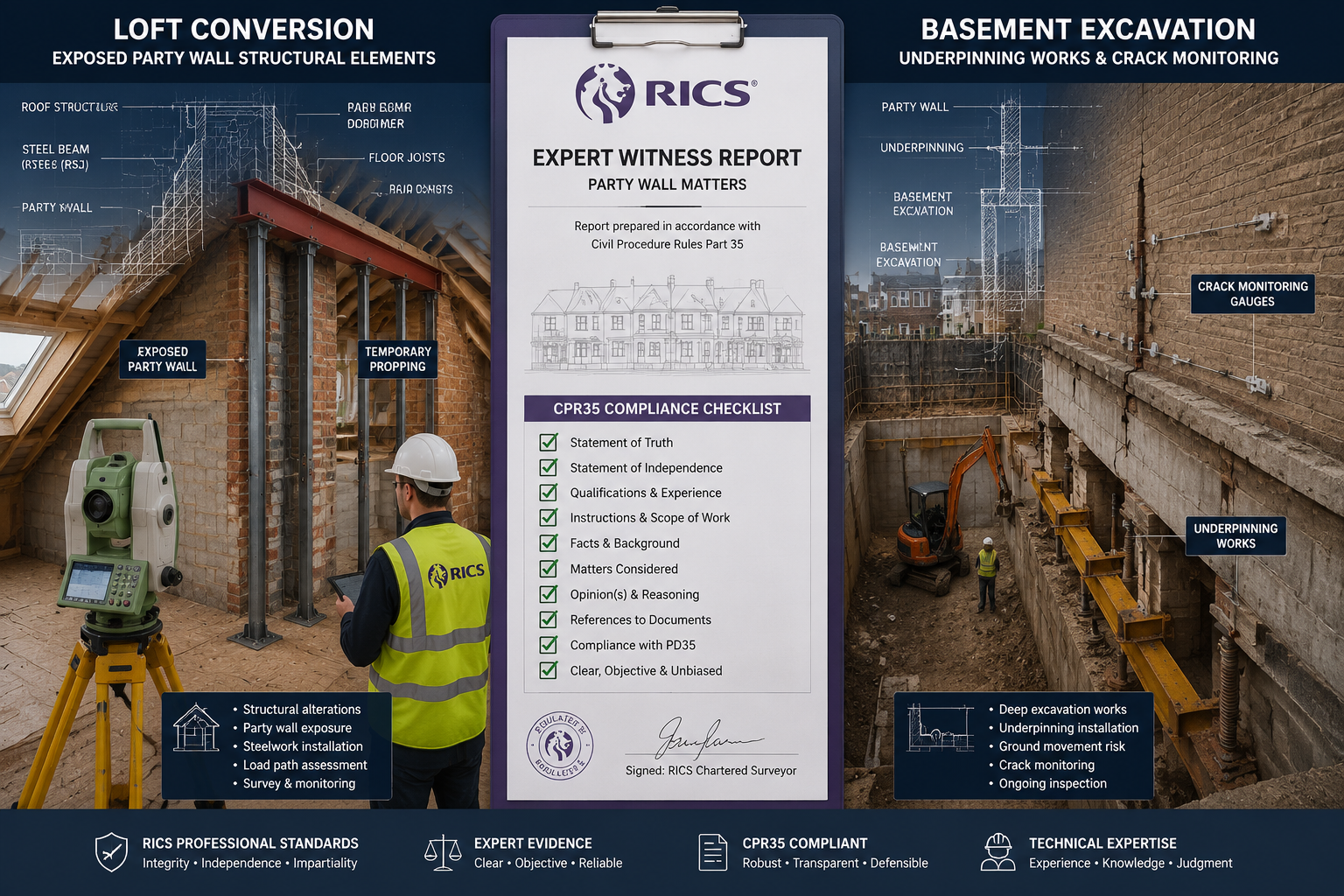
Ormiston Kilsby v Fattahi [2019]: The Demolition Precedent
This case is now required reading for anyone involved in party wall practice. The defendant carried out works — including building an extension — without serving the required notices under the Party Wall etc. Act 1996. The court granted a mandatory injunction requiring removal of the offending structure. [4]
The expert witness evidence in this case was pivotal. The claimant's surveyor produced a detailed CPR35-compliant report demonstrating:
- The precise nature of the notifiable works undertaken
- The absence of any valid notice or Award
- The structural impact on the adjoining property
- A reasoned professional opinion on the appropriate remedy
This is the gold standard: independent, reasoned, and scoped correctly. The report did not speculate beyond the surveyor's expertise, and it did not attempt to resolve boundary questions — it stayed firmly within party wall territory.
The Role of Expert Evidence in Schedule of Condition Disputes
A recurring battleground in party wall litigation involves schedules of condition — the pre-works record of an adjoining property's state. When a building owner claims no damage occurred and an adjoining owner claims otherwise, the expert witness report must:
- Compare pre- and post-works photographic evidence methodically
- Identify crack patterns consistent with specific construction activities (e.g., vibration from piling vs. differential settlement)
- Apply recognised building pathology standards to attribute causation
- Quantify remediation costs with reference to current market rates
Courts have repeatedly rejected expert reports that conflate correlation with causation — for example, assuming that cracks appearing during a neighbour's loft conversion were caused by that conversion without proper structural analysis. [7]
Parties dealing with damage to property in party wall situations will recognise how critical this distinction is in practice.
Single Joint Expert Cases: A Growing Trend
Under the Civil Procedure Rules, courts increasingly direct parties to appoint a Single Joint Expert (SJE) rather than each commissioning their own expert. [5] This trend has significant implications:
- The SJE must serve both parties' interests impartially — not advocate for either
- The report must anticipate questions from both sides and address them proactively
- Any perception of bias can result in the court appointing a replacement, wasting time and costs
💬 "The SJE model demands a higher standard of objectivity than party-appointed expert work — surveyors who approach it as advocacy will quickly find themselves cross-examined into difficulty."
For complex disputes involving multiple technical disciplines — structural engineering, dampness, fire separation — a multi-disciplinary expert team may be required, with each expert producing a CPR35-compliant report within their specific competence. [3] [7]
CPR35 Compliance and RICS Best Practices: A Practical Framework
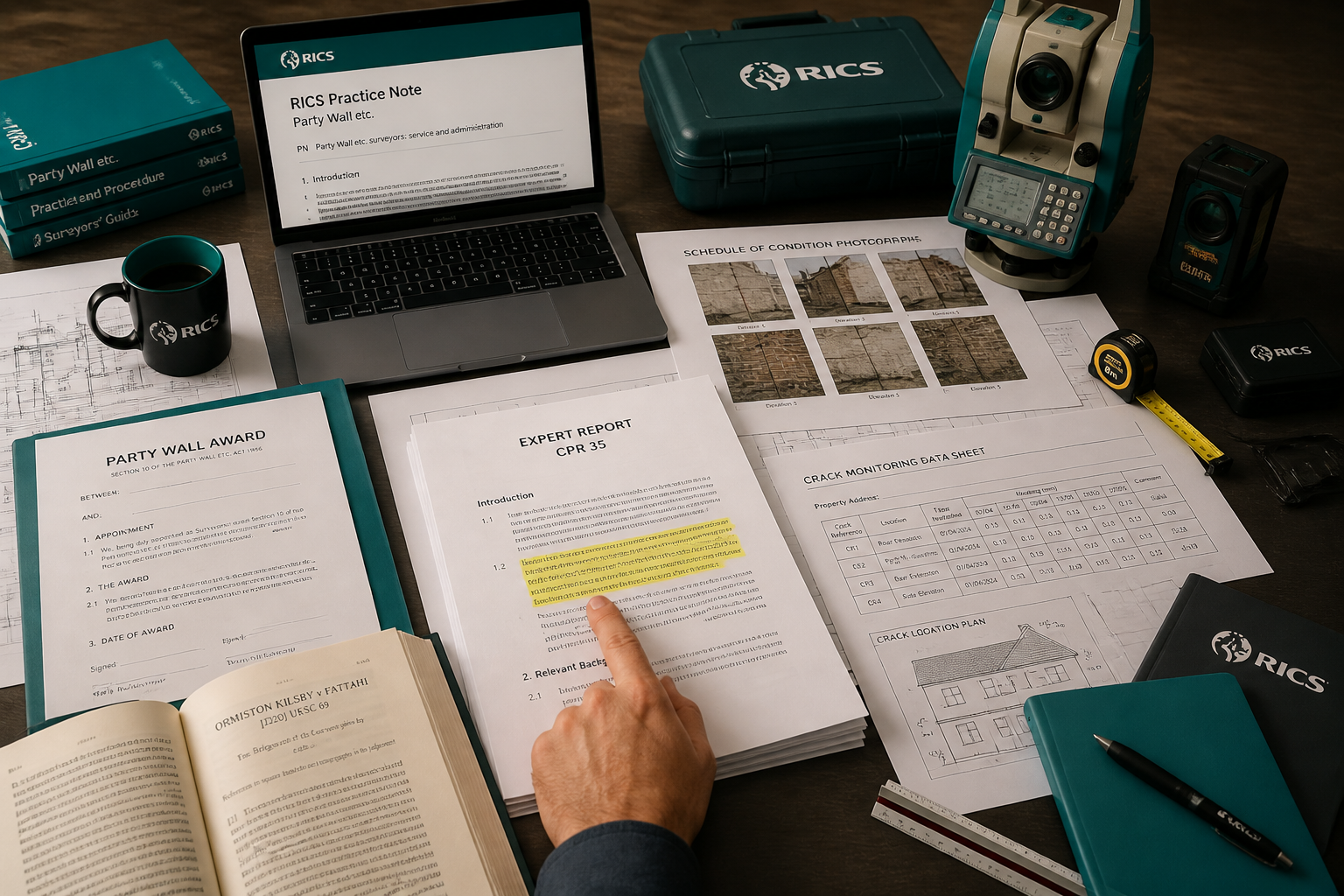
What CPR Part 35 Actually Requires
Civil Procedure Rule Part 35 sets out mandatory requirements for expert evidence in civil proceedings in England and Wales. [1] A compliant party wall expert witness report must include:
Mandatory structural elements:
- ✅ A statement of the expert's qualifications and relevant experience
- ✅ Details of the instructions received and the questions being addressed
- ✅ A summary of the facts and assumptions relied upon
- ✅ The expert's reasoned opinion on each issue
- ✅ A declaration that the expert understands their overriding duty to the court
- ✅ A statement of truth signed by the expert personally
The Expert's Declaration — often called the "Part 35 declaration" — is not a formality. Courts treat it seriously. An expert who signs the declaration and then produces a report that reads as advocacy rather than independent analysis risks professional sanctions and personal costs orders.
RICS Guidance: Independence and Impartiality
The Royal Institution of Chartered Surveyors (RICS) publishes practice notes and guidance on expert witness work that complement CPR35 requirements. Key RICS principles for party wall expert witness reports include:
- Independence: The expert's opinion must not be influenced by the client's desired outcome
- Transparency: All material facts — including those that do not support the client's case — must be disclosed
- Competence: Experts should only opine on matters within their professional expertise
- Proportionality: The level of detail in the report should be proportionate to the value and complexity of the dispute
The UK Register of Expert Witnesses maintains a vetted directory of practitioners with specific party wall expertise, providing a useful starting point when selecting a qualified expert. [2]
Verifying that a surveyor holds the appropriate credentials is essential — the guide to finding qualified party wall surveyors covers this in detail.
Template Structure for 2026 Works: Loft Conversions and Basements
The types of works generating the most expert witness instructions in 2026 are loft conversions (involving steel beam insertions and wall plate modifications) and basement excavations (involving underpinning and potential ground movement). Each requires a tailored report structure.
For Loft Conversion Disputes:
| Report Section | Key Content |
|---|---|
| Background & Instructions | Works description, notice history, Award details |
| Site Inspection Findings | Structural observations, photographic schedule |
| Technical Analysis | Steel beam bearing on party wall, vibration assessment |
| Causation Opinion | Attribution of any cracking or movement |
| Remediation Recommendations | Specification and cost estimate |
| CPR35 Declaration | Signed statement of independence |
For Basement/Underpinning Disputes:
| Report Section | Key Content |
|---|---|
| Background & Instructions | Scope of excavation, proximity to foundations |
| Pre-Works Condition Evidence | Schedule of condition review |
| Monitoring Data Analysis | Crack gauge readings, inclinometer data |
| Ground Movement Assessment | Settlement analysis, differential movement |
| Causation Opinion | Expert attribution with reasoning |
| CPR35 Declaration | Signed statement of independence |
For those navigating a live dispute, the comprehensive guide to party wall dispute resolution provides a clear roadmap of the process before expert witness engagement becomes necessary.
Common Pitfalls That Undermine Party Wall Expert Witness Reports
Even experienced surveyors make avoidable errors when producing expert witness reports. The most frequently cited failures in UK litigation include:
⚠️ 1. Advocacy Masquerading as Opinion
The single most common reason expert reports are challenged is that they read as a brief for one party rather than an independent analysis. Phrases like "it is clear that the defendant was negligent" are advocacy. Phrases like "on the balance of probabilities, the cracking pattern is consistent with vibration from the defendant's piling works, for the following reasons…" are expert opinion.
⚠️ 2. Exceeding Statutory Scope
As established in case law, party wall surveyors cannot adjudicate on matters outside the Act. [4] An expert report that ventures into trespass, nuisance, or boundary determination will be challenged on admissibility grounds — and rightly so.
⚠️ 3. Inadequate Factual Foundation
Courts require experts to clearly separate facts from assumptions. If an expert assumes that a schedule of condition was accurate but has not personally verified it, that assumption must be stated explicitly — and its impact on the opinion must be acknowledged.
⚠️ 4. Failure to Address the Opposing Expert's Points
In cases with two party-appointed experts, the court will often direct a joint statement identifying areas of agreement and disagreement. Experts who have not engaged seriously with the opposing report will struggle to produce a credible joint statement — and the judge will notice.
⚠️ 5. Missing the CPR35 Declaration
Surprisingly common: reports submitted without the mandatory declaration of independence. This is a technical defect that can result in the report being excluded from evidence entirely. [1]
Selecting the Right Expert: Credentials, Experience, and Scope
Not every party wall surveyor is equipped to act as an expert witness. The skills are related but distinct. When selecting an expert for litigation, the following criteria are essential:
- RICS membership (MRICS or FRICS) with active practising certificate
- Demonstrable court experience — ideally with references to previous cases
- Specific party wall expertise — not just general building surveying
- Familiarity with CPR35 and the RICS expert witness practice note
- Absence of conflicts of interest with either party
The expert witness services offered by specialist surveyors combine statutory party wall knowledge with litigation-ready reporting skills — a combination that is increasingly in demand as dispute volumes rise in 2026.
It is also worth noting that expert witnesses in party wall cases often need to understand the broader construction survey context. The complete guide to construction surveys provides useful background on the technical standards that underpin expert analysis.
Conclusion: Actionable Steps for 2026 Party Wall Disputes
Party Wall Expert Witness Reports: Lessons from Recent UK Litigation and RICS Best Practices point to a clear conclusion: the quality of expert evidence is often the decisive factor in party wall litigation. Cases like Ormiston Kilsby v Fattahi demonstrate that courts will impose serious remedies — including demolition — when the expert evidence is compelling and properly presented.
Actionable next steps for property owners, developers, and legal teams:
- Serve notices correctly and on time — the party wall notices guide explains exactly what is required under the Act.
- Commission a thorough schedule of condition before any notifiable works begin — this is the foundation of any future expert report.
- Appoint a qualified expert early if litigation appears likely — late instruction limits the expert's ability to gather contemporaneous evidence.
- Ensure CPR35 compliance from the first draft — retrofitting a non-compliant report is costly and time-consuming.
- Consider the SJE route where appropriate — it reduces costs and is increasingly favoured by courts.
- Keep the expert's scope tightly defined — reports that stray beyond party wall matters into boundary or trespass territory will be challenged.
The 2026 construction environment is generating more party wall disputes than ever before. Those who invest in rigorous, RICS-compliant expert witness reports will be far better positioned — whether defending against a claim or pursuing one.
References
[1] Expert Witness – https://collier-stevens.co.uk/services/expert-witness/
[2] Party Walls – https://www.jspubs.com/expert-witness/si/p/party-walls/
[3] Expert Witness Reports – https://www.briangalesurveyors.com/expert-witness-reports/
[4] How Has Party Wall Act Changed – https://www.localsurveyorsdirect.co.uk/how-has-party-wall-act-changed
[5] Expert Witness Report – https://www.david-cooper.co.uk/services/commercial/expert-witness-report/
[6] Party Wall Surveys Amid 2026 Construction Boom – https://nottinghillsurveyors.com/blog/party-wall-surveys-amid-2026-construction-boom-handling-disputes-in-high-demand-uk-housing-markets
[7] Expert Witness – https://www.surveyorexpert.co.uk/expert-witness
