
The UK property market is experiencing a remarkable revival in 2026, with construction activity surging across urban centres and buyer demand reaching levels not seen since before the pandemic. As homeowners and developers rush to capitalise on this momentum, party wall surveys have become critical gatekeepers in the renovation and development process. Understanding how to navigate Party Wall Surveys Amid 2026 Construction Boom: Handling Disputes in High-Demand UK Housing Markets has never been more essential for property owners, developers, and construction professionals seeking to avoid costly delays in this competitive landscape.
With transaction volumes climbing and urban regeneration projects accelerating across cities like London, Manchester, and Birmingham, the number of party wall notices served has increased dramatically. This surge brings heightened scrutiny to party wall agreements and awards, making robust documentation and professional surveying practices absolutely vital. The stakes are higher than ever—delays caused by poorly managed party wall procedures can derail projects in markets where timing is everything.
Key Takeaways
- 📈 Construction activity is rebounding strongly in 2026, with forecasts predicting growth rates of 2.6% and urban housing markets experiencing renewed vigour, driving unprecedented demand for party wall surveys [1][2]
- ⚖️ Party wall disputes are intensifying as neighbouring property owners face increased construction activity, requiring RICS-qualified surveyors to draft comprehensive awards that protect all parties
- 🏗️ Proactive surveying strategies including detailed pre-construction condition surveys and robust documentation are essential to mitigate delays in high-demand markets
- 💷 Transaction volumes are rising, creating time-sensitive pressures that make efficient party wall procedures critical for project success [3]
- 🎯 Professional expertise matters more than ever, with properly qualified surveyors serving as essential mediators in an increasingly complex regulatory environment
Understanding the 2026 UK Construction Landscape and Party Wall Implications
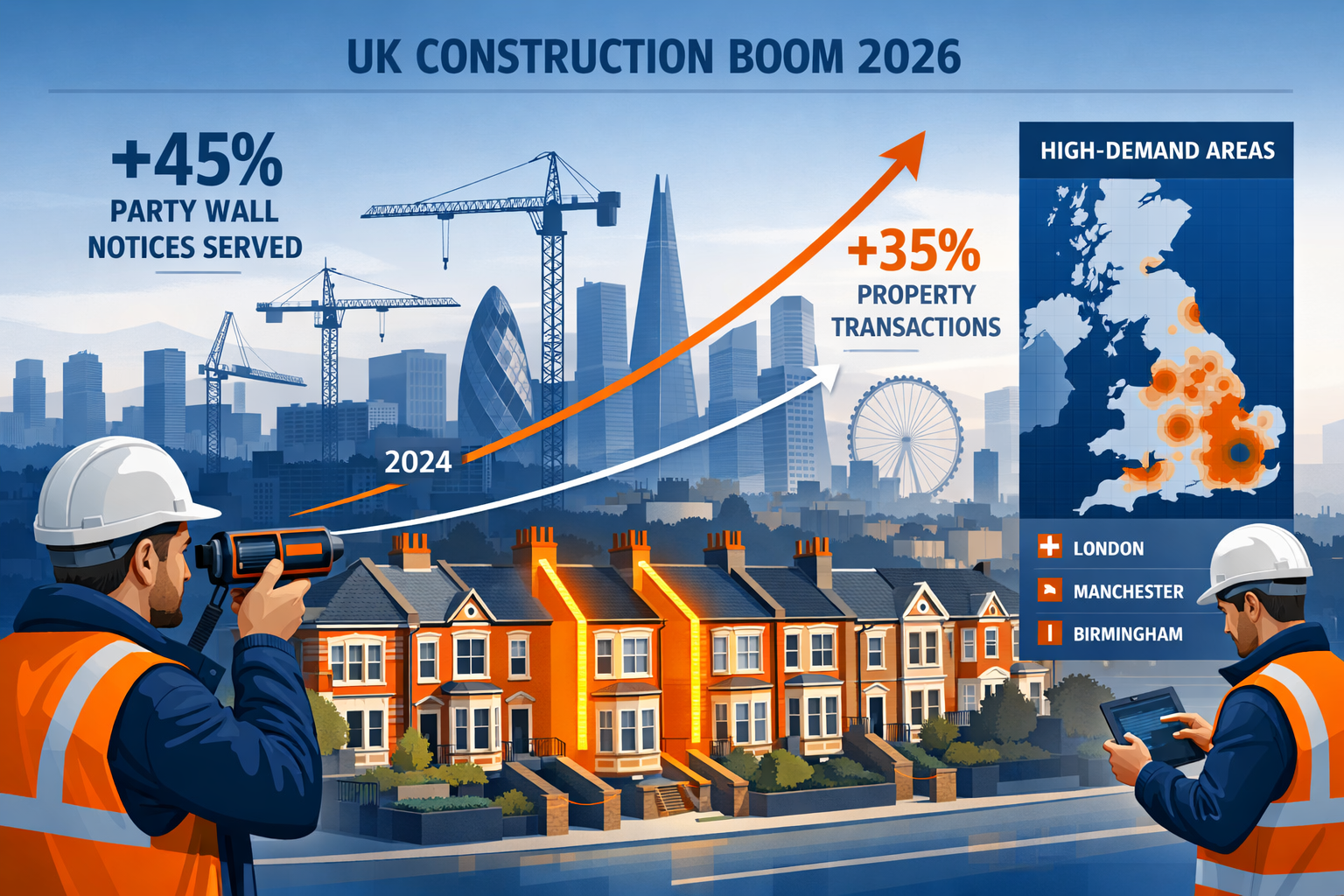
The Construction Boom Returns
The UK construction industry is experiencing a significant turnaround in 2026 after several challenging years. Industry forecasts predict construction output growth of 2.6% for the year, marking a return to expansion after periods of stagnation [1]. This recovery is being driven by multiple factors, including improved economic conditions, renewed investor confidence, and pent-up demand for housing and commercial development.
The residential sector is particularly buoyant, with housing transaction volumes showing sustained increases throughout early 2026 [3]. Urban markets are leading this charge, as buyers return to city centres and commuter towns that offer proximity to employment hubs. This urban revival is creating intense pressure on existing housing stock, with homeowners increasingly looking to extend, convert, and maximise their properties' potential.
Why Party Wall Surveys Matter More in 2026
In densely populated urban areas where terraced housing, semi-detached properties, and converted flats dominate, virtually any significant building work will trigger requirements under the Party Wall etc. Act 1996. The legislation governs work on shared walls, boundary structures, and excavations near neighbouring properties—precisely the types of projects that are proliferating in 2026's hot housing markets.
As construction activity intensifies, so too does the potential for party wall disputes. Neighbouring property owners who might once have been tolerant of occasional building work are now facing multiple projects on their streets simultaneously. This saturation is creating friction, with homeowners more likely to scrutinise party wall notices and raise objections.
The complete guide to party wall surveys explains the fundamental requirements, but in 2026's accelerated market, understanding the nuances of dispute resolution has become equally important.
High-Demand Markets Create Unique Pressures
In areas experiencing the strongest growth—including prime London boroughs, regeneration zones in Manchester and Birmingham, and affluent commuter towns—property values are climbing and development opportunities are at a premium [4]. These conditions create several challenges for party wall procedures:
- ⏰ Time sensitivity: Developers and homeowners face pressure to complete projects quickly to capitalise on market conditions
- 💰 Financial stakes: Higher property values mean greater financial exposure if disputes delay or derail projects
- 🏘️ Neighbour relations: In competitive markets, neighbouring property owners may be more protective of their own development potential
- 📋 Regulatory scrutiny: Planning authorities and building control are processing higher volumes of applications, increasing oversight
Understanding these dynamics is crucial for anyone involved in Party Wall Surveys Amid 2026 Construction Boom: Handling Disputes in High-Demand UK Housing Markets.
Common Party Wall Disputes in High-Activity Construction Markets
Excavation and Basement Extensions
One of the most contentious areas of party wall work involves excavation within three or six metres of a neighbouring building's foundations. As urban land values soar, basement conversions and extensions have become increasingly popular ways to add valuable living space without extending a property's footprint.
These projects require serving a Party Structure Notice or Notice of Adjacent Excavation under the Party Wall Act. However, they also carry the highest risk of causing damage to neighbouring properties through:
- Ground movement and subsidence
- Vibration from excavation equipment
- Undermining of existing foundations
- Water table disruption affecting neighbouring basements
In 2026's construction boom, surveyors are seeing a marked increase in objections to excavation projects. Neighbouring owners are rightfully concerned about potential damage to their properties, especially in areas where Victorian and Edwardian housing stock features shallow foundations vulnerable to nearby digging.
Loft Conversions and Roof Alterations
Loft conversions remain one of the most popular home improvement projects, particularly in urban terraced housing where extending upwards is often the only viable option. These projects typically require party wall procedures when they involve:
- Raising party walls to accommodate new roof structures
- Installing steel beams that rest on or are attached to party walls
- Creating openings in party walls for access
- Underpinning party walls to support additional loads
The surge in loft conversion activity during 2026 has led to increased disputes over noise, dust, access requirements, and concerns about structural integrity. Neighbours often worry about the impact of heavy construction work on shared structural elements, particularly in older properties where the condition of party walls may already be compromised.
Structural Alterations and Extensions
Side extensions, rear extensions, and internal structural alterations frequently involve party walls, especially in terraced and semi-detached properties. Common dispute triggers include:
- Cutting into party walls to insert steel beams or create openings
- Increasing loads on party walls through additional storeys or heavy materials
- Vibration and noise during construction affecting neighbouring occupants
- Access requirements for scaffolding or construction equipment on neighbouring land
In high-demand markets, these disputes can become particularly heated when neighbours perceive that development work will impact their own property values or future development potential. The comprehensive guide to resolving party wall disputes provides detailed strategies for addressing these conflicts.
Boundary Walls and Garden Structures
While often overlooked, boundary walls are also covered by the Party Wall Act when they straddle the boundary line between properties. Disputes over boundary walls have increased in 2026 as homeowners undertake garden improvements and outdoor living projects. Issues include:
- Disagreements over wall ownership and maintenance responsibilities
- Concerns about wall height and privacy impacts
- Structural stability of aging boundary walls
- Cost allocation for repairs or rebuilding
The Role of Pre-Existing Damage
A critical source of dispute in 2026's active construction environment involves pre-existing damage to neighbouring properties. When construction work begins, neighbours may claim that cracks, settlement, or other defects were caused by the building owner's work—even when these issues existed beforehand.
This is where comprehensive condition surveys become invaluable. Detailed photographic and written records of neighbouring properties' condition before work commences provide essential protection for building owners and clarity for all parties.
Party Wall Surveys Amid 2026 Construction Boom: Strategic Approaches for Dispute Prevention
The Critical Importance of Early Engagement
In 2026's fast-paced construction environment, early engagement with neighbours and party wall procedures is essential. The Party Wall Act requires specific notice periods—typically two months for most building works and one month for excavations—but savvy property owners are starting conversations even earlier.
Best practices for early engagement include:
- Informal preliminary discussions with neighbours about planned works before formal notices are served
- Sharing outline plans to address concerns and incorporate feedback where feasible
- Identifying potential objections early to allow time for resolution
- Appointing surveyors proactively rather than waiting for disputes to emerge
This approach is particularly valuable in high-demand markets where project timelines are tight and delays can be costly. By building goodwill and addressing concerns upfront, building owners can often avoid formal disputes entirely.
Appointing RICS-Qualified Party Wall Surveyors
The choice of surveyor can make or break a party wall process. In 2026's complex construction landscape, RICS-qualified party wall surveyors bring essential expertise and credibility to the process. These professionals understand:
- The technical requirements of the Party Wall etc. Act 1996
- Current construction methods and their implications for party structures
- Dispute resolution procedures and best practices
- Documentation standards that withstand scrutiny
The RICS party wall surveyors guide explains the qualifications and standards that professional surveyors must meet. In high-stakes projects, this expertise provides invaluable protection for all parties.
Comprehensive Condition Surveys: Your First Line of Defence
Detailed condition surveys of neighbouring properties before construction begins are the single most effective tool for preventing disputes. These surveys should include:
| Survey Component | Purpose | Best Practice |
|---|---|---|
| Photographic Record | Document existing cracks, defects, finishes | High-resolution images with date stamps, multiple angles |
| Written Descriptions | Provide detailed narrative of conditions | Room-by-room documentation with measurements |
| Structural Assessment | Identify pre-existing structural issues | Professional evaluation of foundations, walls, ceilings |
| Decorative Condition | Record finishes, fixtures, fittings | Detailed descriptions to establish baseline |
| External Elements | Document boundaries, drainage, external walls | Include garden features, paving, outbuildings |
In 2026's litigious environment, this documentation provides crucial evidence if disputes arise about alleged damage. It protects building owners from unfounded claims while giving neighbours confidence that their interests are safeguarded.
Drafting Robust Party Wall Awards
The party wall award is the legal document that sets out the rights and responsibilities of all parties during construction work. In high-demand markets where projects are complex and stakes are high, awards must be comprehensive and unambiguous.
Essential elements of robust party wall awards include:
✅ Clear description of proposed works with detailed specifications and drawings
✅ Comprehensive schedule of condition documenting neighbouring properties' existing state
✅ Specific working hours and access arrangements to minimise disruption
✅ Protection measures including scaffolding, dust sheets, vibration monitoring
✅ Dispute resolution procedures outlining steps if issues arise during work
✅ Insurance requirements ensuring adequate coverage for potential damage
✅ Monitoring protocols for structural movement, cracks, or other concerns
The understanding party wall awards guide provides detailed insights into award structures and requirements.
Managing Construction to Minimise Disputes
Even with perfect documentation and awards, disputes can still arise during construction if work is poorly managed. Best practices for dispute prevention during the build phase include:
🔧 Regular communication with neighbours about work schedules and any changes
🔧 Proactive monitoring for signs of movement, cracking, or other issues
🔧 Prompt response to neighbour concerns, however minor they may seem
🔧 Photographic documentation of work progress and any issues that arise
🔧 Professional contractors who understand party wall sensitivities and work respectfully
🔧 Compliance with award conditions regarding hours, access, protection measures
In 2026's active construction environment, contractors experienced in party wall work are invaluable. They understand that neighbour relations can make or break a project and take proactive steps to maintain goodwill.
When to Appoint an Agreed Surveyor vs. Separate Surveyors
The Party Wall Act allows for two approaches to surveyor appointment:
Agreed Surveyor: A single surveyor acts impartially for both building owner and adjoining owner, potentially streamlining the process and reducing costs.
Separate Surveyors: Each party appoints their own surveyor, who then work together (potentially appointing a third surveyor if they disagree) to produce the award.
In 2026's high-stakes markets, the choice between these approaches depends on several factors:
- Project complexity: More complex works often benefit from separate surveyors who can focus on their client's specific concerns
- Relationship between parties: Where trust exists, an agreed surveyor can work efficiently; where relations are strained, separate surveyors may be preferable
- Cost considerations: An agreed surveyor reduces overall costs, but building owners typically pay all surveyor fees regardless [5]
- Time pressures: Agreed surveyors can sometimes work faster, but separate surveyors provide more thorough protection
Understanding what party wall surveyors do helps in making this crucial decision.
Navigating Party Wall Disputes: Resolution Strategies for 2026 Markets
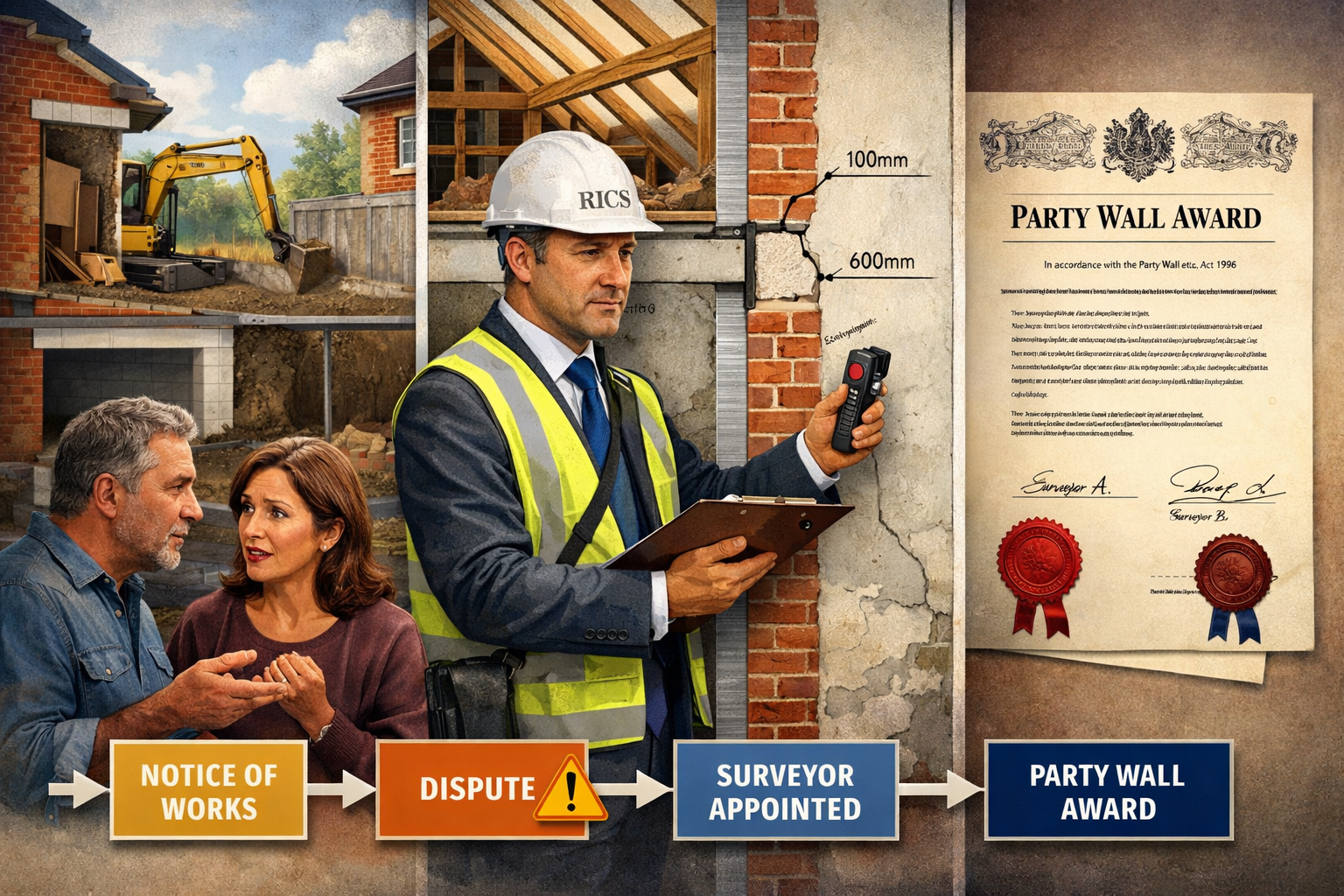
Understanding the Dispute Resolution Framework
When disputes arise despite best efforts at prevention, the Party Wall Act provides a structured resolution framework. Understanding this process is essential for Party Wall Surveys Amid 2026 Construction Boom: Handling Disputes in High-Demand UK Housing Markets.
The typical dispute escalation pathway follows these stages:
- Initial objection: Adjoining owner dissents to the party wall notice
- Surveyor appointment: Each party appoints a surveyor (or agrees on a single surveyor)
- Award preparation: Surveyors inspect properties, negotiate terms, and draft the award
- Award service: The formal award document is served on both parties
- Appeal period: Parties have 14 days to appeal to the County Court
- Implementation: Work proceeds according to award terms
In 2026's busy construction markets, this process must be managed efficiently to avoid project delays. The party wall disputes resolution guide provides comprehensive strategies for each stage.
Common Grounds for Dispute and How to Address Them
Concerns About Structural Damage
This is the most common source of party wall disputes. Adjoining owners worry that excavation, structural alterations, or heavy construction will damage their properties.
Resolution strategies:
- Commission independent structural engineering assessments
- Implement comprehensive monitoring programs (crack monitoring, vibration sensors)
- Provide detailed method statements showing how damage will be prevented
- Offer enhanced insurance coverage or financial guarantees
- Conduct regular inspections with the adjoining owner present
Disagreements Over Access Requirements
Many projects require access to neighbouring land for scaffolding, construction equipment, or building work itself.
Resolution strategies:
- Clearly define access requirements, timing, and duration in the award
- Offer compensation for inconvenience or loss of use
- Provide alternative arrangements where possible (e.g., scaffold design that minimises intrusion)
- Establish protocols for protecting neighbouring property during access
- Include restoration obligations for any areas affected
Disputes Over Working Hours and Disruption
In densely populated urban areas, construction noise and disruption can severely impact neighbours' quality of life.
Resolution strategies:
- Agree to restricted working hours that accommodate neighbours' schedules
- Provide advance notice of particularly noisy or disruptive operations
- Implement dust suppression and noise mitigation measures
- Offer temporary accommodation assistance during the most disruptive phases
- Establish direct communication channels for immediate concerns
Cost Allocation Disagreements
Questions about who pays for party wall surveyors, remedial works, or protective measures can become contentious.
Resolution strategies:
- Clearly understand the legal framework: building owners typically pay all surveyor fees and costs arising from their work
- Obtain multiple quotes for disputed works to establish fair costs
- Include detailed cost breakdowns in the award
- Establish escrow arrangements for disputed amounts
- Seek mediation before resorting to legal action
The guide to party wall surveyor costs clarifies the financial responsibilities.
Mediation and Alternative Dispute Resolution
While the Party Wall Act provides a formal framework, alternative dispute resolution (ADR) methods can often resolve conflicts more quickly and cost-effectively than formal procedures or court appeals.
Effective ADR approaches in 2026 party wall disputes include:
Direct Negotiation: Facilitated discussions between building owner and adjoining owner, often with surveyors present, to find mutually acceptable solutions.
Mediation: A neutral third-party mediator helps parties explore options and reach agreement, particularly valuable for relationship-based disputes.
Expert Determination: An independent expert (often a senior surveyor or construction professional) provides binding decisions on technical disputes.
Structured Settlement Discussions: Formal negotiation sessions with clear agendas and decision-making frameworks.
In high-demand markets where time is money, these approaches can save weeks or months compared to court proceedings while preserving neighbour relationships that may be important for future projects.
When Disputes Escalate: The Appeal Process
If parties cannot agree on the award terms, the Party Wall Act allows appeals to the County Court within 14 days of the award being served. However, court appeals should be a last resort, as they are:
- Time-consuming: Court proceedings can delay projects by months
- Expensive: Legal costs often far exceed the value in dispute
- Uncertain: Courts generally defer to qualified surveyors' professional judgment
- Relationship-damaging: Litigation typically destroys any remaining goodwill
In 2026's fast-moving markets, the cost of delay often exceeds the cost of compromise. Experienced surveyors counsel their clients to seek negotiated solutions wherever possible, reserving appeals for truly irreconcilable differences or cases involving significant legal principles.
Learning from 2026 Dispute Trends
As the construction boom continues through 2026, certain dispute patterns are emerging:
📊 Increased objections to excavation works as neighbours become more aware of subsidence risks
📊 Greater scrutiny of contractor qualifications and insurance coverage
📊 More detailed condition surveys being demanded by adjoining owners
📊 Higher expectations for communication and project transparency
📊 Growing use of technology including vibration monitoring apps and digital condition documentation
Surveyors and building owners who recognise these trends and adapt their approaches accordingly are experiencing smoother party wall processes and fewer disputes.
Practical Guidance: Party Wall Best Practices for 2026's Construction Boom
For Building Owners and Developers
If you're planning construction work that will trigger party wall procedures in 2026's active market, follow these strategic steps:
Step 1: Plan Ahead ⏰
- Start party wall procedures at least 3-4 months before your planned construction start date
- Factor party wall timelines into project schedules and financing arrangements
- Identify all potentially affected neighbours early
Step 2: Engage Professional Expertise 👷
- Appoint a qualified party wall surveyor with RICS accreditation
- Select contractors experienced in party wall work
- Consider engaging a structural engineer for complex projects
Step 3: Communicate Proactively 💬
- Speak with neighbours informally before serving formal notices
- Share plans and address concerns openly
- Maintain regular communication throughout the process
Step 4: Document Thoroughly 📸
- Commission comprehensive condition surveys of all affected properties
- Maintain detailed photographic records
- Keep written logs of all communications and site activities
Step 5: Comply Fully ✅
- Serve all required notices with correct timing and content
- Follow award conditions precisely
- Address any issues or concerns promptly
Step 6: Budget Appropriately 💷
- Include party wall costs in project budgets (typically £1,000-£5,000 for straightforward cases, more for complex disputes)
- Maintain contingency funds for unexpected issues
- Understand that you'll pay all surveyor fees regardless of outcome
The party wall process guide provides detailed procedural information.
For Adjoining Owners
If you've received a party wall notice from a neighbour in 2026, protect your interests by:
Understanding Your Rights 📋
- You have the right to appoint your own surveyor at the building owner's expense
- You can request detailed condition surveys of your property
- You're entitled to compensation for any damage caused by the works
Responding Appropriately ✍️
- Respond to party wall notices within 14 days to preserve your rights
- Don't ignore notices—silence can be treated as dissent
- Seek professional advice if you have concerns
Appointing a Surveyor 🔍
- Choose an experienced, RICS-qualified party wall surveyor
- Ensure they understand your specific concerns and priorities
- Maintain regular contact throughout the process
Documenting Conditions 📷
- Take your own photographs and notes of your property's current condition
- Identify and document any existing defects or concerns
- Keep records of all communications
Being Reasonable 🤝
- Recognise that party wall procedures exist to protect both parties
- Focus on legitimate concerns rather than blocking development unnecessarily
- Consider the long-term relationship with your neighbour
For Party Wall Surveyors
Professional surveyors navigating Party Wall Surveys Amid 2026 Construction Boom: Handling Disputes in High-Demand UK Housing Markets should adopt these enhanced practices:
Maintain Rigorous Standards 📐
- Follow RICS guidance and best practice protocols meticulously
- Stay current with case law and regulatory developments
- Invest in continuing professional development
Enhance Documentation 📑
- Use standardised templates that ensure comprehensive coverage
- Implement digital documentation systems for efficiency and accuracy
- Maintain detailed records of all site visits, communications, and decisions
Communicate Effectively 📞
- Keep all parties informed of progress and timelines
- Explain technical matters in accessible language
- Respond promptly to queries and concerns
Manage Expectations 💭
- Clearly explain the party wall process, timelines, and likely outcomes
- Help clients understand their rights and obligations
- Provide realistic assessments of costs and potential issues
Prioritise Dispute Prevention 🛡️
- Identify potential conflict points early and address them proactively
- Facilitate communication between building and adjoining owners
- Draft awards that anticipate and address likely concerns
Leverage Technology 💻
- Use digital tools for condition surveys and monitoring
- Implement project management systems for complex cases
- Adopt secure communication platforms for document sharing
The party wall surveyor responsibilities guide outlines professional standards and expectations.
Technology and Innovation in 2026 Party Wall Practice
The construction boom of 2026 has accelerated adoption of technology in party wall surveying:
Digital Condition Surveys 📱
- High-resolution photography with embedded GPS and timestamps
- 3D scanning of properties to create baseline models
- Drone surveys for roof and upper-level documentation
- Cloud-based storage for easy access and sharing
Monitoring Systems 📊
- Automated crack monitoring with millimetre-level precision
- Vibration sensors that alert when thresholds are exceeded
- Structural movement tracking using laser measurement
- Real-time reporting to all parties via mobile apps
Documentation Platforms 💾
- Secure portals for sharing notices, awards, and reports
- Digital signature systems for faster processing
- Automated compliance tracking and deadline management
- Integrated communication logs
Data Analytics 📈
- Trend analysis of dispute patterns and outcomes
- Risk assessment tools based on project characteristics
- Benchmarking of costs and timelines
- Predictive modelling for dispute likelihood
These innovations are making party wall procedures more efficient, transparent, and effective—critical advantages in 2026's fast-paced construction environment.
Regional Variations: Party Wall Surveys Across UK High-Demand Markets
London and the South East
London remains the epicentre of party wall activity in 2026, with the highest concentration of terraced and semi-detached properties, the most intense development pressure, and the highest property values. Specific characteristics include:
- Exceptionally high surveyor fees reflecting London's cost structure (often 50-100% above national averages)
- More complex projects including basement excavations, multi-storey extensions, and heritage property considerations
- Greater likelihood of disputes due to property values and neighbour sensitivities
- Sophisticated surveyors with extensive experience in complex cases
Areas experiencing particular activity include Notting Hill, Kensington, Chelsea, Islington, and Wandsworth, where property values make even modest extensions financially worthwhile despite significant party wall costs.
Manchester and the North West
Manchester's ongoing regeneration and the broader North West's housing growth are driving increased party wall activity in 2026. Characteristics include:
- Rapid urban regeneration creating clusters of simultaneous construction projects
- Victorian terraced housing stock requiring careful party wall management
- More collaborative approach with generally less adversarial relationships than London
- Growing professional expertise as local surveyor capacity expands
Birmingham and the Midlands
The Midlands' construction resurgence in 2026 brings party wall considerations to areas that historically saw less activity:
- Emerging development hotspots in Birmingham's suburbs and surrounding towns
- Mix of property types from Victorian terraces to post-war semi-detached homes
- Increasing awareness of party wall requirements among homeowners and builders
- Developing surveyor networks to meet growing demand
Regional Cities and Towns
Across the UK, regional cities experiencing 2026's construction boom—including Bristol, Leeds, Edinburgh, Cardiff, and others—are seeing increased party wall activity. Common features include:
- Local market dynamics influencing dispute patterns and resolution approaches
- Varying levels of professional expertise requiring careful surveyor selection
- Different cost structures generally lower than London but rising with demand
- Community-focused approaches with emphasis on maintaining neighbour relationships
Understanding these regional variations helps tailor party wall strategies to local conditions and expectations.
Cost Considerations in 2026's Party Wall Market
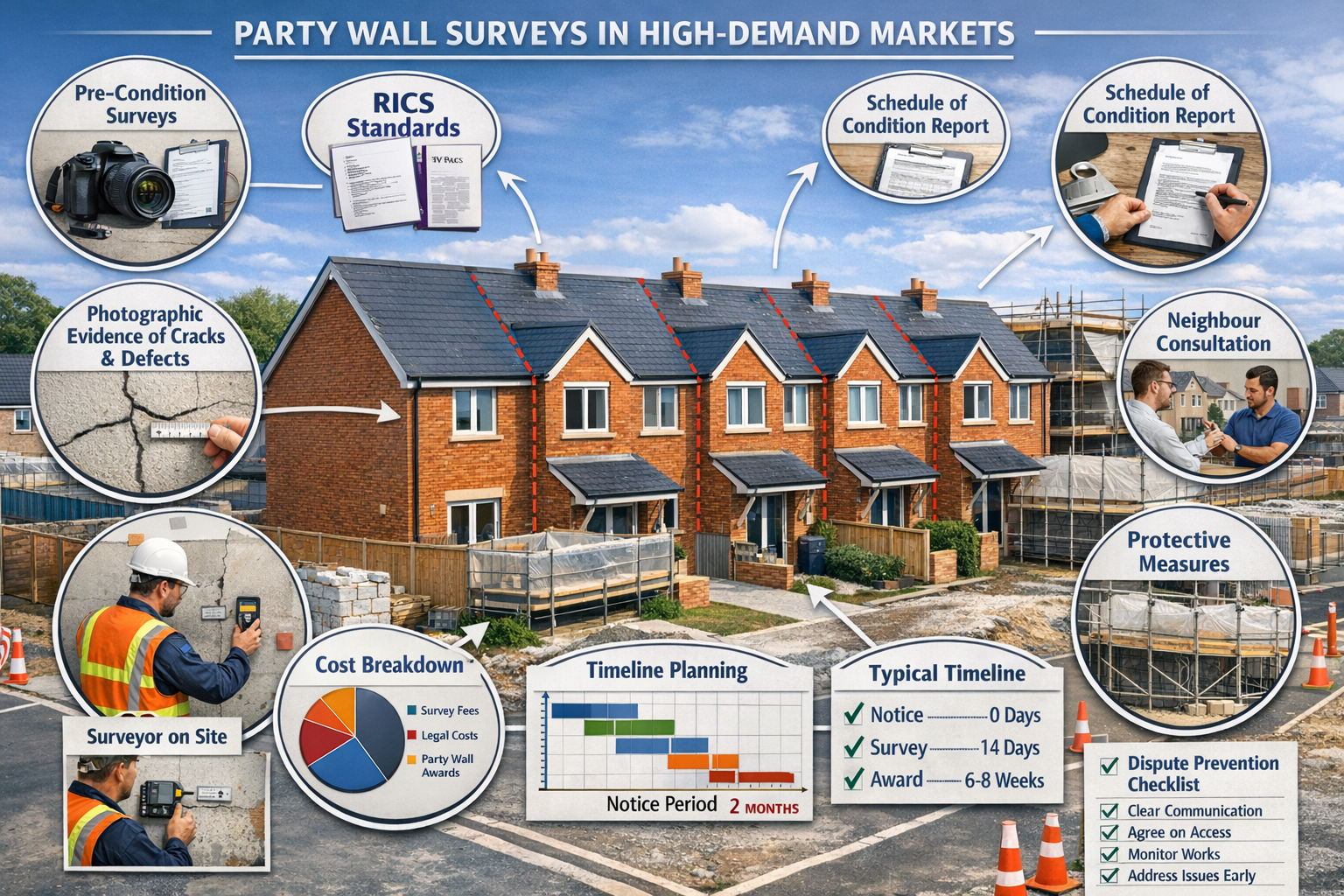
Typical Party Wall Survey Costs
Party wall costs vary significantly based on project complexity, location, and whether disputes arise. In 2026's market, typical ranges include:
| Project Type | Agreed Surveyor | Separate Surveyors | With Disputes |
|---|---|---|---|
| Simple extension | £700-£1,200 | £1,500-£2,500 | £3,000-£6,000 |
| Loft conversion | £800-£1,500 | £1,800-£3,000 | £3,500-£7,000 |
| Basement excavation | £1,500-£3,000 | £3,000-£6,000 | £6,000-£15,000+ |
| Complex multi-property | £2,500-£5,000 | £5,000-£10,000 | £10,000-£25,000+ |
London and South East costs typically run 50-100% higher than these national averages. The party wall agreement cost breakdown provides detailed pricing information.
Hidden Costs and Budget Contingencies
Beyond surveyor fees, building owners should budget for:
- Condition survey costs: £500-£2,000 per neighbouring property
- Monitoring systems: £500-£3,000 for vibration or movement monitoring
- Remedial works: Variable, potentially £5,000-£50,000+ if damage occurs
- Project delays: Lost time can cost thousands in extended financing, contractor standby time, and opportunity costs
- Legal fees: If disputes escalate to court, costs can reach £10,000-£50,000+
In 2026's high-demand markets, maintaining adequate contingency budgets (typically 10-20% of total party wall costs) is essential.
Value Proposition: Why Professional Party Wall Surveys Pay Off
While party wall costs may seem burdensome, professional surveying provides significant value:
✅ Risk mitigation: Comprehensive documentation protects against unfounded damage claims
✅ Dispute prevention: Professional mediation often prevents costly conflicts
✅ Project certainty: Clear awards provide roadmap for construction, avoiding delays
✅ Legal compliance: Proper procedures ensure work can proceed without injunctions
✅ Relationship preservation: Professional management maintains neighbour goodwill
✅ Property value protection: Proper procedures protect both properties' values
In 2026's competitive markets, the cost of not engaging professional party wall expertise—through project delays, disputes, or legal challenges—far exceeds the cost of doing it properly from the outset.
Future Outlook: Party Wall Considerations Beyond 2026
Sustained Construction Activity
Industry forecasts suggest that the construction recovery beginning in 2026 will continue into 2027 and beyond, with sustained growth in residential development [2]. This means party wall considerations will remain critical for the foreseeable future.
Factors supporting continued activity include:
- Housing undersupply: The UK's structural housing shortage continues to drive development
- Urban densification: Planning policies increasingly favour urban infill and intensification
- Property value growth: Rising values make extensions and improvements financially attractive
- Sustainability agenda: Retrofitting and upgrading existing stock requires party wall procedures
Evolving Regulatory Landscape
While the Party Wall etc. Act 1996 remains the core legislation, the regulatory environment continues to evolve:
- Building Safety Act implications: Enhanced safety requirements may intersect with party wall procedures
- Planning reform: Permitted development rights and planning changes affect what works require party wall procedures
- Professional standards: RICS and other bodies continually update guidance and best practices
- Case law development: Court decisions refine interpretation of party wall requirements
Staying current with these developments is essential for all parties involved in party wall work.
Technology Integration
The technology innovations emerging in 2026 will become standard practice in coming years:
- AI-assisted condition surveys identifying defects and changes automatically
- Blockchain-based documentation providing tamper-proof records
- Virtual reality property inspections enabling remote participation
- Predictive analytics assessing dispute risk and optimal resolution strategies
These tools will make party wall procedures more efficient, transparent, and effective.
Climate and Sustainability Considerations
As the UK pursues net-zero targets, party wall procedures will increasingly involve:
- Retrofit projects: Insulation, heat pumps, and other energy efficiency works
- Sustainable construction methods: New materials and techniques requiring party wall consideration
- Flood resilience: Adaptations to manage climate-related risks
- Green infrastructure: Living walls, green roofs, and similar features
Surveyors will need expertise in these emerging areas to serve clients effectively.
Conclusion: Navigating Party Wall Surveys in 2026's Dynamic Market
The construction boom of 2026 has created unprecedented opportunities for property owners and developers across the UK's high-demand housing markets. However, this surge in activity has also intensified the importance of professional party wall surveys and dispute resolution. Understanding Party Wall Surveys Amid 2026 Construction Boom: Handling Disputes in High-Demand UK Housing Markets is no longer optional—it's essential for project success.
The key lessons for navigating this environment successfully include:
🎯 Start early: Begin party wall procedures well before construction deadlines to allow time for proper process
🎯 Engage professionals: RICS-qualified surveyors provide invaluable expertise and dispute prevention
🎯 Document thoroughly: Comprehensive condition surveys protect all parties and prevent unfounded claims
🎯 Communicate proactively: Open dialogue with neighbours prevents many disputes before they arise
🎯 Budget realistically: Include adequate contingencies for party wall costs and potential delays
🎯 Comply fully: Following proper procedures protects against injunctions and legal challenges
🎯 Seek resolution: When disputes arise, prioritise negotiated solutions over adversarial escalation
Actionable Next Steps
For building owners planning construction work:
- Review your plans to identify all party wall requirements using this comprehensive guide
- Appoint a qualified party wall surveyor at least 3-4 months before your planned start date
- Commission condition surveys of all neighbouring properties
- Initiate informal discussions with neighbours about your plans
- Ensure your budget includes realistic party wall cost provisions
For adjoining owners who have received notices:
- Understand your rights under the Party Wall etc. Act 1996
- Appoint your own surveyor within 14 days to protect your interests
- Document your property's current condition thoroughly
- Communicate your concerns clearly but reasonably
- Focus on legitimate protection rather than obstruction
For property professionals:
- Stay current with RICS guidance and case law developments
- Invest in technology and systems that enhance service delivery
- Build networks with other professionals for complex cases
- Develop expertise in emerging areas like sustainability retrofits
- Prioritise client education and dispute prevention
The construction boom of 2026 presents remarkable opportunities, but success requires navigating party wall procedures with professionalism, expertise, and foresight. By following the strategies outlined in this guide and engaging qualified professionals, property owners can protect their interests, maintain good neighbour relations, and ensure their projects proceed smoothly in even the most competitive markets.
The future of UK construction looks bright, with sustained growth expected beyond 2026 [5]. Those who master the art and science of party wall management will be best positioned to capitalise on the opportunities ahead while minimising risks and disputes. Whether you're a building owner, adjoining owner, or surveying professional, investing in proper party wall procedures is an investment in project success and long-term property value.
References
[1] Full Steam Ahead Uk Construction To Return To Growth In 2026 – https://bdcmagazine.com/2025/11/full-steam-ahead-uk-construction-to-return-to-growth-in-2026/
[2] Why 2026 Better Days Uk Construction Industry – https://www.pinsentmasons.com/out-law/analysis/why-2026-better-days-uk-construction-industry
[3] Weekly Summary 16th January 2026 – https://builtplace.com/weekly-summary-16th-january-2026/
[4] Uk Real Estate Market Commentary January 2026 – https://www.schroders.com/en-us/us/institutional/insights/uk-real-estate-market-commentary—january-2026/
[5] Bcis Construction Industry Forecast – https://www.bcis.co.uk/news/bcis-construction-industry-forecast/
