
The courtroom falls silent as the expert witness approaches the stand, carrying meticulously prepared documentation that will determine the outcome of a £2.7 million cladding dispute. In 2026, the landscape of fire safety litigation has transformed dramatically since the Grenfell Tower tragedy, with regulatory updates demanding unprecedented precision in survey evidence and expert testimony. As only 35% of identified buildings with unsafe cladding have completed remediation works[1], the volume of high-stakes disputes continues to escalate, placing expert witness preparation at the forefront of building safety litigation.
Expert Witness Preparation for 2026 Fire Safety Disputes: Post-Grenfell Cladding Remediation Cases has become a specialized field requiring deep technical knowledge, RICS-compliant reporting standards, and the ability to translate complex building safety assessments into compelling courtroom evidence. With remediation costs estimated at £16.6 billion and thousands of buildings still awaiting safety improvements[2], the demand for qualified expert witnesses who can navigate the intricate intersection of building regulations, fire safety science, and legal proceedings has never been higher.
Key Takeaways
- Only 1,946 buildings (35%) have completed cladding remediation as of October 2025, creating a significant backlog of potential disputes requiring expert witness testimony[1]
- RICS-compliant documentation and EWS1 forms serve as critical evidence in fire safety litigation, demanding enhanced survey methodologies and precise technical reporting
- The Building Safety Act 2022 and updated Approved Document B have introduced new regulatory requirements, including mandatory two-staircase provisions for buildings over 18 metres from September 2026[9]
- Expert witnesses must demonstrate comprehensive knowledge of fire safety testing, material specifications, thermal imaging analysis, and remediation methodologies to withstand cross-examination
- Government remediation programmes are not on track to meet the 2035 completion deadline, suggesting continued litigation activity throughout the decade[2]
Understanding the Post-Grenfell Regulatory Landscape for Fire Safety Disputes
The regulatory environment governing fire safety disputes in 2026 represents a fundamental shift from pre-Grenfell standards. The Building Safety Act 2022, combined with amendments to Approved Document B, has created a complex framework that expert witnesses must navigate with precision. These changes affect how evidence is gathered, assessed, and presented in cladding remediation cases.
The Evolution of Fire Safety Standards
The Grenfell Tower tragedy in 2017 exposed catastrophic failures in building safety regulation and enforcement. Since then, the government has implemented sweeping reforms that directly impact how expert witnesses prepare for fire safety disputes. Understanding this evolution is essential for anyone involved in cladding litigation.
Key regulatory milestones include:
- 🏢 Introduction of the Building Safety Act 2022, establishing the Building Safety Regulator
- 📋 Enhanced EWS1 form requirements for external wall fire safety assessments
- 🔥 Updated fire testing standards for cladding materials and systems
- 👷 New competency requirements for building control professionals
- 📊 Mandatory building safety case reports for high-risk buildings
The government's remediation acceleration plan has identified between 9,000 and 12,000 buildings requiring safety improvements, yet only 4,771 buildings were enrolled in remediation programmes as of August 2024[2]. This significant gap between identified need and actual progress creates fertile ground for disputes involving property valuations, remediation costs, liability determinations, and regulatory compliance.
The Two-Staircase Requirement and Its Implications
One of the most significant regulatory changes affecting expert witness preparation is the amendment to Approved Document B requiring all new residential buildings over 18 metres to have two staircases, effective 30 September 2026[9]. This requirement has profound implications for ongoing disputes involving buildings in the design or construction phase.
Expert witnesses must now assess whether:
- Existing building designs comply with the new two-staircase mandate
- Remediation plans adequately address evacuation route requirements
- Alternative fire safety measures can compensate for single-staircase designs in existing buildings
- Cost estimates for compliance modifications are reasonable and justified
This regulatory change also affects how expert witnesses evaluate fire safety strategies in buildings undergoing cladding remediation. The interaction between external wall fire safety and internal evacuation provisions requires comprehensive analysis that extends beyond simple material replacement.
Building Safety Levy and Funding Disputes
The Building Safety Levy, expected to raise approximately £3.4 billion for remediation funding[2], has introduced new dimensions to fire safety disputes. Expert witnesses may be called upon to provide evidence regarding:
- Eligibility for government funding programmes and whether specific buildings qualify for remediation support
- Cost allocation between building owners, developers, and government funding sources
- Valuation impacts of buildings awaiting remediation versus those with completed safety improvements
- Timeline assessments for remediation completion and associated financial implications
With levy collection beginning in autumn 2025, disputes involving funding allocation and cost recovery are expected to increase throughout 2026 and beyond. Expert witnesses must understand the funding landscape to provide context for their technical assessments.
Essential Components of Expert Witness Preparation for 2026 Fire Safety Disputes
Preparing to serve as an expert witness in post-Grenfell cladding remediation cases requires meticulous attention to documentation, technical analysis, and presentation skills. The stakes are extraordinarily high, with individual cases involving millions of pounds and affecting the safety of hundreds or thousands of residents.
RICS-Compliant Survey Documentation
The foundation of credible expert witness testimony rests on comprehensive, professionally conducted surveys that adhere to Royal Institution of Chartered Surveyors (RICS) standards. In fire safety disputes, survey documentation must exceed typical property inspection requirements.
Critical survey elements include:
| Survey Component | Documentation Requirements | Evidentiary Value |
|---|---|---|
| Visual Inspection | High-resolution photographs with metadata, annotated elevation drawings | Establishes baseline conditions and material identification |
| Material Testing | Laboratory certificates, sample chain-of-custody records, fire test results | Proves material specifications and fire performance characteristics |
| Thermal Imaging | Infrared imagery showing thermal bridging and insulation defects | Demonstrates system performance and identifies hidden defects |
| Dimensional Analysis | Laser measurements, cavity inspections, fixing system assessments | Verifies installation compliance with manufacturer specifications |
| EWS1 Form Completion | Competent person certification, supporting calculations and assessments | Provides regulatory compliance evidence and valuation impact data |
Expert witnesses must be prepared to defend every aspect of their survey methodology under cross-examination. This includes explaining equipment calibration, inspection protocols, and how conclusions were reached based on observed conditions. For guidance on comprehensive property assessment methodologies, professionals can reference detailed building survey approaches that establish industry best practices.
Material Identification and Fire Performance Analysis
One of the most technically demanding aspects of expert witness preparation involves identifying cladding materials and assessing their fire performance characteristics. The complexity stems from the variety of materials used in construction, evolving product specifications, and the interaction between different building components.
Expert witnesses must be able to:
- Identify specific aluminium composite material (ACM) types, including polyethylene (PE) and fire-retardant (FR) core compositions
- Assess cavity barriers, fire stops, and compartmentation measures
- Evaluate insulation materials and their contribution to fire spread
- Analyze fixing systems and their impact on overall fire safety performance
- Review manufacturer specifications and installation guidance compliance
The landmark case involving £2.7 million in cladding claims demonstrated how Grenfell evidence has become central to litigation outcomes[5]. Expert witnesses who can draw clear connections between material specifications, fire testing data, and observed building conditions provide invaluable support to legal proceedings.
In many disputes, the critical question is not simply whether materials are combustible, but whether the entire external wall system complies with Building Regulations functional requirements for fire safety. This requires understanding of fire engineering principles, test methodologies like BS 8414, and classification systems such as BR 135.
Documentation of Remediation Progress and Compliance
With only 49% of identified buildings having started or completed remediation works[1], expert witnesses frequently encounter cases involving partially remediated buildings, disputed remediation scopes, or allegations of inadequate safety improvements.
Comprehensive documentation should track:
- Pre-remediation conditions – Complete photographic records, material samples, and fire safety assessments
- Remediation specifications – Detailed scope of works, material specifications, and compliance strategies
- Work progress monitoring – Staged inspections, quality control records, and deviation documentation
- Post-remediation verification – Final inspections, testing results, and compliance certifications
- Ongoing maintenance requirements – Inspection schedules, performance monitoring, and long-term safety management
The government's projection that remediation on all buildings over 11 metres will complete by 2035, despite the National Audit Office's assessment that current progress is insufficient to meet this deadline[2], suggests that disputes involving remediation timelines and completion standards will persist for years.
Expert witnesses must be prepared to assess whether remediation work meets current regulatory standards, follows manufacturer installation guidance, and achieves the intended fire safety performance. This often requires reviewing contractor qualifications, quality assurance procedures, and post-installation testing protocols. For professionals seeking to understand comprehensive survey methodologies, resources on condition survey reports provide valuable frameworks.
Preparing Technical Evidence for Court Presentation in Cladding Disputes
The transition from technical expert to effective courtroom witness requires careful preparation and the ability to communicate complex building science concepts to non-technical audiences. Judges, juries, and legal professionals rely on expert witnesses to translate technical evidence into understandable narratives that support decision-making.
Creating Clear Visual Evidence and Demonstrative Aids
Visual evidence forms the cornerstone of persuasive expert witness testimony in fire safety disputes. Well-prepared visual aids help courts understand complex building systems, material interactions, and fire safety principles that would otherwise remain abstract.
Effective visual evidence includes:
- 📸 Annotated photographs showing specific defects, material conditions, or installation errors with clear labeling and scale references
- 🏗️ Building elevation drawings highlighting cladding systems, cavity configurations, and fire safety features
- 🔥 Fire spread simulation graphics demonstrating potential fire behavior based on material properties and building geometry
- 📊 Comparative analysis charts showing tested versus installed materials, compliant versus non-compliant details
- 🎥 Video documentation of inspection processes, material testing, or site conditions
The key to effective visual evidence is clarity and simplicity. Complex technical drawings should be simplified for court presentation while maintaining accuracy. Color coding, progressive revelation of information, and consistent formatting across exhibits help judges and juries follow technical arguments.
Expert witnesses should prepare multiple versions of visual aids: detailed technical versions for expert review and simplified versions for court presentation. This dual approach ensures that technical rigor is maintained while accessibility is maximized.
Developing Comprehensive Expert Reports
The expert witness report serves as the primary written evidence in fire safety disputes. In 2026, courts expect reports that demonstrate not only technical competence but also awareness of current regulatory frameworks, industry standards, and relevant case precedents.
A comprehensive expert report should include:
- Executive Summary – Clear statement of opinions, conclusions, and basis for expert qualification
- Scope of Instructions – Precise definition of questions addressed and limitations of the assessment
- Methodology – Detailed explanation of inspection procedures, testing protocols, and analytical approaches
- Factual Findings – Objective observations, measurements, and material identifications without interpretation
- Technical Analysis – Application of fire safety principles, regulatory requirements, and industry standards to factual findings
- Opinions and Conclusions – Clear statements of expert opinion with supporting reasoning and evidence
- Appendices – Supporting documentation including photographs, test results, calculations, and reference materials
Reports must comply with Civil Procedure Rules Part 35, which governs expert evidence in civil proceedings. This includes the expert's duty to the court, requirements for independence, and obligations to identify matters outside the expert's expertise.
The quality of written reports directly impacts courtroom credibility. Reports riddled with technical jargon, unsupported assertions, or incomplete analysis undermine expert witness effectiveness. Conversely, well-structured reports that systematically build from observations to conclusions provide powerful support for legal arguments. Similar attention to detail is required in party wall dispute resolution, where comprehensive documentation proves essential.
Preparing for Cross-Examination
Cross-examination represents the most challenging aspect of expert witness testimony. Opposing counsel will scrutinize every aspect of the expert's methodology, qualifications, and conclusions, seeking to undermine credibility or create doubt about technical opinions.
Effective cross-examination preparation involves:
- Thorough knowledge of all case materials – Expert witnesses must be intimately familiar with their own reports, supporting documentation, and any statements made during the case
- Understanding opposing expert opinions – Anticipating challenges requires reviewing contrary expert reports and identifying areas of disagreement
- Practicing responses to difficult questions – Mock cross-examinations help experts develop concise, clear responses under pressure
- Maintaining composure and objectivity – Expert witnesses must remain calm, professional, and focused on technical facts regardless of aggressive questioning
- Knowing the limits of expertise – Acknowledging areas outside one's expertise demonstrates credibility rather than weakness
Common cross-examination tactics in fire safety disputes include challenging the expert's qualifications, questioning inspection thoroughness, highlighting alternative interpretations of evidence, and emphasizing uncertainties in technical analysis. Preparation should address each of these potential challenges.
Expert witnesses should avoid defensive or argumentative responses during cross-examination. The goal is to assist the court in understanding technical matters, not to "win" against opposing counsel. Measured, thoughtful responses that acknowledge legitimate questions while maintaining core opinions demonstrate expertise and credibility.
Navigating Specific Types of Fire Safety Disputes in 2026
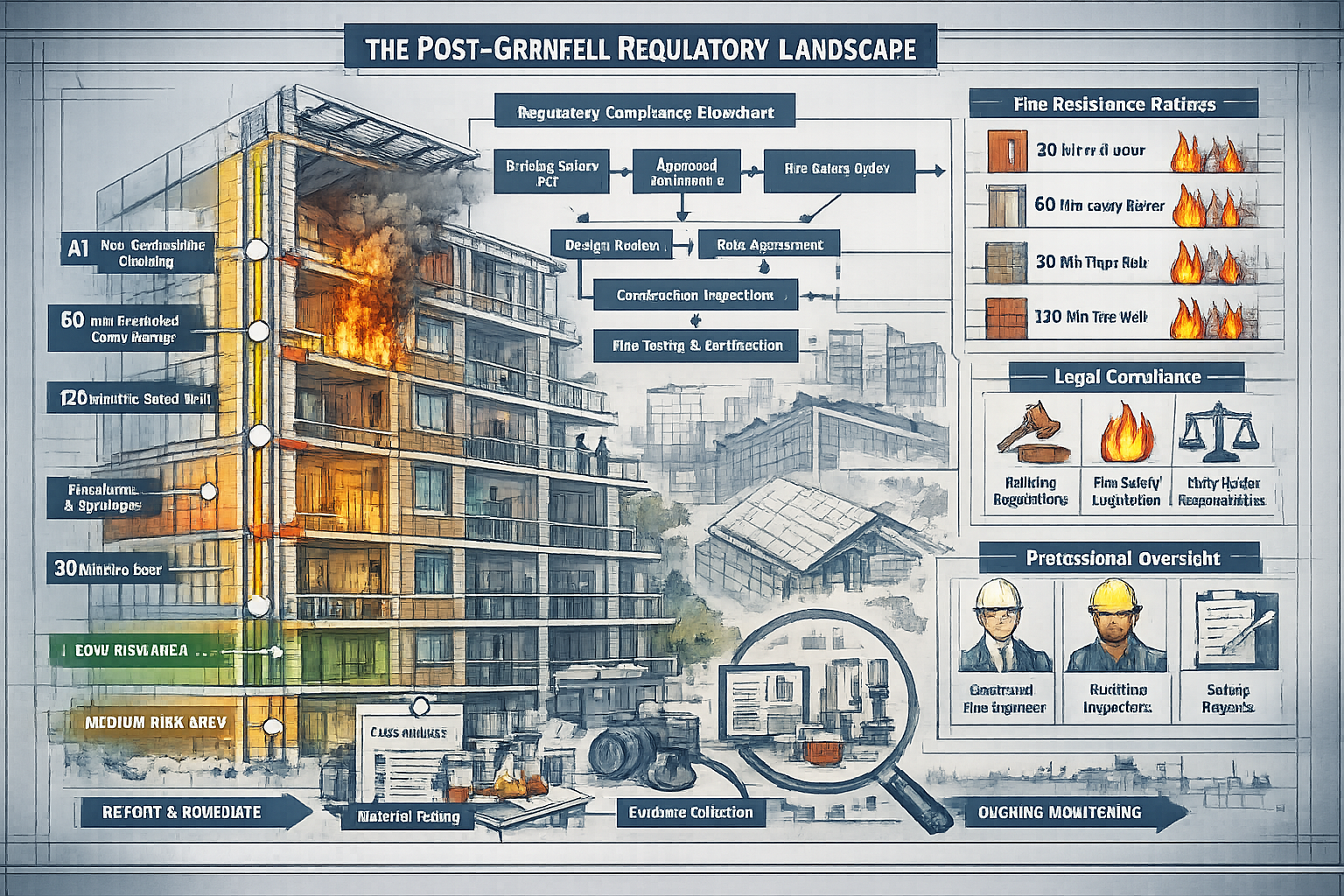
The landscape of fire safety litigation encompasses various dispute types, each requiring specialized knowledge and preparation approaches. Expert witnesses must tailor their evidence to the specific legal and technical questions at issue.
Liability Disputes: Developers, Contractors, and Material Suppliers
Liability disputes seek to determine responsibility for unsafe cladding installations and allocate remediation costs among various parties in the construction supply chain. These cases often involve multiple defendants, complex contractual relationships, and technical questions about design decisions, installation practices, and material specifications.
Expert witnesses in liability disputes must address:
- Whether original designs complied with Building Regulations in effect at the time of construction
- Whether contractors followed approved designs and manufacturer installation guidance
- Whether material suppliers provided accurate information about product fire performance
- Whether building control inspections identified or should have identified fire safety defects
- The contribution of various parties to the overall fire safety failure
The challenge in liability disputes is separating individual contributions from systemic failures. The Grenfell Tower Inquiry revealed failures across the entire construction ecosystem, from material manufacturers to building control authorities[3]. Expert witnesses must carefully analyze the specific facts of each case while understanding the broader context of industry practices.
Documentation of contemporaneous standards, guidance documents, and industry knowledge is critical. What was known or should have been known at the time of construction differs significantly from current understanding post-Grenfell. Expert witnesses must avoid hindsight bias while applying appropriate standards of professional competence.
Valuation Disputes and EWS1 Form Challenges
The introduction of EWS1 forms for external wall fire safety assessments has created a new category of disputes involving property valuations, mortgage lending, and transaction failures. Buildings requiring but lacking EWS1 forms often experience significant valuation impacts, leading to disputes between buyers, sellers, leaseholders, and freeholders.
Key issues in valuation disputes include:
- Whether an EWS1 form is required for a specific building based on height, construction type, and cladding materials
- The accuracy of fire safety assessments underlying EWS1 form conclusions
- The appropriate valuation discount for buildings with unsafe cladding or pending remediation
- Responsibility for obtaining EWS1 forms and funding any required remediation
- The impact of government funding programmes on property values
Expert witnesses may need to provide evidence on both building safety technical matters and valuation methodologies. This often requires collaboration between fire safety specialists and valuation experts to address the full scope of disputes. Understanding comprehensive valuation approaches helps experts provide context for safety-related value impacts.
The evolving nature of EWS1 requirements and lender policies creates additional complexity. Expert witnesses must stay current with guidance updates from RICS, UK Finance, and the Building Safety Regulator to provide accurate evidence about current market practices and requirements.
Remediation Scope and Cost Disputes
Disputes over appropriate remediation scope and reasonable costs represent a significant portion of fire safety litigation in 2026. With remediation costs estimated at £16.6 billion across the building stock[2], individual building disputes can involve millions of pounds.
Expert witnesses must evaluate:
- Whether proposed remediation work is necessary to achieve regulatory compliance
- Whether remediation specifications are appropriate for the specific building conditions
- Whether cost estimates are reasonable based on market rates and project complexity
- Whether alternative remediation approaches could achieve equivalent safety at lower cost
- Whether remediation work has been completed to appropriate quality standards
The government's identification gap—with only 39-54% of estimated buildings enrolled in remediation programmes as of August 2024[2]—suggests that many building owners are still determining appropriate remediation strategies. Expert witnesses play a crucial role in assessing whether "gold-plating" is occurring or whether comprehensive approaches are justified by safety considerations.
Cost disputes often hinge on technical questions about remediation necessity. For example, must an entire cladding system be replaced, or can targeted interventions achieve adequate safety? Expert witnesses must apply fire engineering principles, regulatory requirements, and industry guidance to support opinions about proportionate remediation approaches. For professionals managing complex building projects, understanding commercial property survey requirements provides valuable context for remediation assessments.
Insurance Claims and Coverage Disputes
Insurance disputes related to fire safety defects involve questions about policy coverage, causation, and damage quantification. These cases require expert witnesses who understand both building pathology and insurance policy interpretation.
Common insurance dispute issues include:
- Whether fire safety defects constitute "damage" triggering coverage under property policies
- Whether remediation costs are covered under professional indemnity policies for designers or contractors
- The timing of defect discovery and its impact on policy coverage periods
- The appropriate scope of remediation for insurance recovery purposes
- Whether building owners have mitigated damages through reasonable remediation approaches
Expert witnesses in insurance cases must carefully distinguish between pre-existing defects, progressive deterioration, and sudden damage events. Insurance policies typically cover fortuitous losses rather than design or construction defects, creating complex questions about causation and coverage triggers.
Documentation of when defects were discovered, how they manifested, and what damage resulted is critical for insurance claims. Expert witnesses should review inspection records, maintenance histories, and contemporaneous documentation to establish timelines and causation chains.
Best Practices for Expert Witness Preparation in 2026
As fire safety disputes continue to evolve with regulatory changes and remediation progress, expert witnesses must adopt best practices that ensure credibility, effectiveness, and professional compliance.
Maintaining Independence and Objectivity
The fundamental duty of expert witnesses is to the court, not to the party instructing them. This principle, enshrined in Civil Procedure Rules Part 35, requires experts to provide objective, unbiased opinions regardless of which party engaged their services.
Maintaining independence requires:
- 🎯 Forming opinions based solely on evidence and technical analysis, not on desired litigation outcomes
- 📋 Disclosing limitations and uncertainties in technical assessments rather than overstating confidence
- 🤝 Acknowledging valid points made by opposing experts when evidence supports alternative interpretations
- 💼 Avoiding financial arrangements that create incentives for particular conclusions
- 📚 Basing opinions on established science and industry standards rather than novel or untested theories
Expert witnesses who develop reputations for advocacy rather than objectivity find their effectiveness diminished. Courts value experts who acknowledge complexities, explain technical uncertainties, and provide balanced assessments even when those assessments may not fully support the instructing party's position.
Independence does not mean neutrality about technical conclusions. Expert witnesses should form clear opinions based on evidence and defend those opinions vigorously. However, the path to those opinions must be transparent, logical, and grounded in accepted methodologies.
Continuing Professional Development and Regulatory Updates
The fire safety regulatory landscape continues to evolve rapidly in 2026, with new guidance documents, updated testing standards, and emerging case law shaping expert witness requirements. Maintaining technical competence requires ongoing professional development.
Essential CPD activities include:
- Attending fire safety conferences and technical seminars on cladding remediation
- Reviewing Building Safety Regulator guidance and consultation documents
- Studying recent court decisions in fire safety and building defect cases
- Participating in RICS expert witness training and accreditation programmes
- Engaging with technical committees developing fire safety standards
- Conducting mock expert witness exercises and peer review sessions
The pace of regulatory change post-Grenfell means that knowledge from even two or three years ago may be outdated. Expert witnesses must demonstrate current awareness of regulatory requirements, industry standards, and technical developments when providing evidence.
Professional accreditation through organizations like RICS, the Institution of Fire Engineers, or the Chartered Institute of Building provides credibility and demonstrates commitment to professional standards. Many instructing solicitors now require expert witnesses to hold relevant professional qualifications and maintain CPD records. Resources for finding qualified surveyors can help parties identify appropriately credentialed experts.
Collaborative Working with Legal Teams
Effective expert witness preparation requires close collaboration with instructing solicitors and barristers. Understanding the legal strategy, key issues in dispute, and evidentiary requirements helps experts tailor their work to support litigation objectives.
Successful collaboration involves:
- Early engagement in case strategy development to identify critical technical issues
- Clear communication about technical limitations and evidentiary gaps
- Proactive identification of additional information or testing needed to support opinions
- Flexibility in report formatting and presentation to meet legal requirements
- Availability for conferences, witness preparation sessions, and trial testimony
- Understanding of litigation timelines and court procedural requirements
Expert witnesses should educate legal teams about technical complexities while learning from lawyers about effective evidence presentation. This mutual education creates stronger cases and more persuasive expert testimony.
However, collaboration must not compromise expert independence. Discussions about how to present evidence effectively differ from allowing legal teams to dictate technical conclusions. Expert witnesses should resist pressure to modify opinions to fit litigation strategy and should clearly communicate when evidence does not support desired conclusions.
Documentation and Record-Keeping Standards
Comprehensive documentation supports expert witness credibility and provides the foundation for detailed reports and testimony. In an era of electronic discovery and detailed disclosure requirements, expert witnesses must maintain meticulous records of all case-related activities.
Essential documentation includes:
- Detailed inspection notes with timestamps, locations, and observations
- Photographic logs with metadata, annotations, and cross-references to written notes
- Material sample chain-of-custody records and testing request documentation
- Calculation worksheets showing analytical processes and intermediate results
- Research notes documenting sources consulted and information reviewed
- Correspondence logs tracking instructions received and information provided
- Time records showing hours spent on various case activities
Documentation should be created contemporaneously with the activities being recorded. Reconstructing notes or creating documentation after the fact undermines credibility and may be revealed during cross-examination. For guidance on professional documentation standards, experts can reference schedule of condition methodologies that establish comprehensive recording practices.
Digital documentation tools, including cloud-based case management systems, photographic databases, and electronic note-taking platforms, enhance organization and accessibility. However, experts must ensure that digital systems maintain data integrity, provide audit trails, and comply with disclosure requirements.
The Future of Fire Safety Disputes: Trends and Predictions for 2026-2030
Looking beyond 2026, several trends will shape fire safety disputes and expert witness requirements in the coming years.
Increased Regulatory Scrutiny and Enforcement
The Building Safety Regulator, established under the Building Safety Act 2022, is expanding its enforcement activities and developing a more robust regulatory framework for high-risk buildings. This increased scrutiny will generate new categories of disputes involving:
- Compliance with building safety case requirements
- Mandatory occurrence reporting and incident investigation
- Accountable person and principal accountable person responsibilities
- Resident engagement and information provision obligations
- Building control approval processes for higher-risk buildings
Expert witnesses will need to understand not only building safety technical requirements but also the regulatory compliance framework and enforcement mechanisms. Disputes may increasingly involve regulatory penalties, enforcement notices, and compliance orders in addition to traditional civil litigation.
Technology-Enhanced Evidence Collection
Advances in building inspection technology will transform how expert witnesses collect and present evidence. Emerging tools include:
- 3D laser scanning and photogrammetry creating detailed building models for analysis and presentation
- Drone-based inspections enabling safe access to building exteriors and roofs
- Artificial intelligence image analysis identifying material types and defect patterns across large building portfolios
- Building information modeling (BIM) integration linking as-built conditions to design documentation
- Advanced thermal imaging detecting hidden defects and system performance issues
Expert witnesses who adopt these technologies early will gain competitive advantages in evidence quality and presentation effectiveness. However, technology adoption must be accompanied by validation of methodologies and demonstration of reliability for court acceptance.
Expansion of Dispute Types Beyond Cladding
While cladding remediation dominates current fire safety disputes, the scope of building safety litigation is expanding to include:
- Internal compartmentation and fire-stopping defects
- Fire door specifications and installation quality
- Smoke control system performance and maintenance
- Sprinkler system requirements and effectiveness
- Evacuation strategy disputes and stay-put policy challenges
Expert witnesses will need broader fire safety expertise beyond external wall systems to address this expanding dispute landscape. Specialization in particular building types (residential towers, hospitals, care homes) or fire safety systems (active fire protection, passive fire protection) may become increasingly valuable. Understanding comprehensive building survey approaches helps experts develop holistic assessment capabilities.
International Influence and Comparative Analysis
Fire safety regulations and remediation approaches in other jurisdictions will increasingly influence UK disputes. Expert witnesses may be called upon to provide evidence about:
- International fire testing standards and their equivalence to UK requirements
- Remediation approaches adopted in Australia, Canada, and other countries facing similar cladding crises
- Comparative regulatory frameworks and their effectiveness in preventing fire safety failures
- International product certifications and their acceptance in UK markets
The global nature of construction supply chains and the international reach of major developers and contractors means that cross-border evidence and comparative analysis will become more common in fire safety disputes.
Conclusion: Preparing for Excellence in Expert Witness Testimony

Expert Witness Preparation for 2026 Fire Safety Disputes: Post-Grenfell Cladding Remediation Cases demands a unique combination of technical expertise, regulatory knowledge, and communication skills. As the remediation crisis continues—with only 35% of identified buildings having completed safety improvements and government timelines at risk[1][2]—the need for qualified expert witnesses will persist throughout the decade.
The most effective expert witnesses in fire safety disputes demonstrate:
✅ Comprehensive technical knowledge of fire safety science, building construction, and material performance
✅ Current regulatory awareness of Building Safety Act requirements, Approved Document B amendments, and evolving guidance
✅ RICS-compliant documentation that provides robust evidentiary support for technical opinions
✅ Clear communication skills that translate complex building science into accessible courtroom testimony
✅ Professional independence that prioritizes objective analysis over advocacy for instructing parties
Actionable Next Steps for Professionals
For building surveyors, fire safety consultants, and other professionals seeking to serve as expert witnesses in fire safety disputes:
- Obtain relevant professional qualifications through RICS, Institution of Fire Engineers, or equivalent bodies
- Complete expert witness training covering CPR Part 35 requirements, report writing, and courtroom testimony
- Develop specialized expertise in cladding systems, fire testing standards, and remediation methodologies
- Build a portfolio of detailed inspection reports, technical analyses, and case studies demonstrating competence
- Establish professional networks with solicitors, barristers, and other experts in building safety litigation
- Maintain rigorous CPD tracking regulatory updates, technical developments, and case law evolution
- Invest in documentation systems that support comprehensive evidence collection and organization
For property owners, developers, and other parties facing fire safety disputes:
- Engage expert witnesses early in dispute resolution processes to identify technical issues and evidence needs
- Ensure experts have appropriate qualifications and demonstrable experience in fire safety assessments
- Provide comprehensive instructions clearly defining the questions experts should address
- Support thorough investigations by providing access to buildings, documentation, and relevant personnel
- Understand expert independence requirements and avoid pressuring experts to modify technical opinions
- Plan for long-term litigation given the scale of remediation challenges and complexity of technical issues
The post-Grenfell cladding remediation crisis represents one of the most significant building safety challenges in UK history. With an estimated £16.6 billion in remediation costs, thousands of buildings still requiring safety improvements, and regulatory frameworks continuing to evolve, fire safety disputes will remain a prominent feature of construction litigation for years to come[2][3].
Expert witnesses who prepare thoroughly, maintain professional standards, and communicate effectively will play essential roles in resolving these disputes, allocating responsibility fairly, and ultimately contributing to safer buildings for all residents. The stakes could not be higher—both in terms of financial implications and, most importantly, in protecting lives from fire safety failures.
As regulatory requirements continue to tighten and enforcement intensifies, the demand for expert witness services in fire safety disputes will only grow. Professionals who invest in developing the specialized knowledge, documentation practices, and communication skills required for effective expert witness testimony position themselves to make meaningful contributions to building safety while building rewarding professional practices.
The journey from technical expert to effective courtroom witness requires dedication, continuous learning, and unwavering commitment to professional standards. For those willing to meet these challenges, the opportunity to shape fire safety outcomes and contribute to a safer built environment makes expert witness work both professionally fulfilling and socially valuable.
References
[1] Progress Report Summary Update – https://www.gov.uk/government/publications/grenfell-tower-inquiry-government-progress-report/progress-report-summary-update
[2] Dangerous Cladding The Governments Remediation Portfolio – https://www.nao.org.uk/wp-content/uploads/2024/10/dangerous-cladding-the-governments-remediation-portfolio.pdf
[3] Grenfell Tower Inquiry Phase 2 Report Government Response Html – https://www.gov.uk/government/publications/grenfell-tower-inquiry-phase-2-report-government-response/grenfell-tower-inquiry-phase-2-report-government-response-html
[4] Remediation Acceleration Plan 2025 Update – https://gowlingwlg.com/en/insights-resources/articles/2025/remediation-acceleration-plan-2025-update
[5] Grenfell Evidence Cited In 2 7m Cladding Claim – https://www.thefpa.co.uk/news/grenfell-evidence-cited-in-2-7m-cladding-claim
[6] United Kingdom Cladding Crisis – https://en.wikipedia.org/wiki/United_Kingdom_cladding_crisis
[7] The Cladding Crisis – https://www.ube.ac.uk/whats-happening/articles/the-cladding-crisis/
[8] Cladding Remediation Are We Closer To Compliance – https://www.firesafetyevent.com/news/cladding-remediation-are-we-closer-to-compliance-
[9] Round Up Of Building Safety Caselaw In 2025 And What To Look Out For In 2026 – https://www.taylorwessing.com/en/insights-and-events/insights/2025/12/round-up-of-building-safety-caselaw-in-2025-and-what-to-look-out-for-in-2026
