
}

The UK housing market in 2026 presents a tale of two recoveries. While headline figures suggest stability—with average asking prices hovering around £368,019—the reality beneath reveals stark regional divides that demand sophisticated valuation approaches from property professionals.[1][2] As northern England and the devolved nations drive growth while London and the South East stagnate, surveyors face unprecedented Valuation Challenges in the 2026 UK Housing Recovery: How Surveyors Can Spot Hidden Opportunities Amid Regional Divides. Understanding these geographical disparities isn't just academic—it's essential for accurate property assessments and identifying lucrative opportunities in an evolving market landscape.
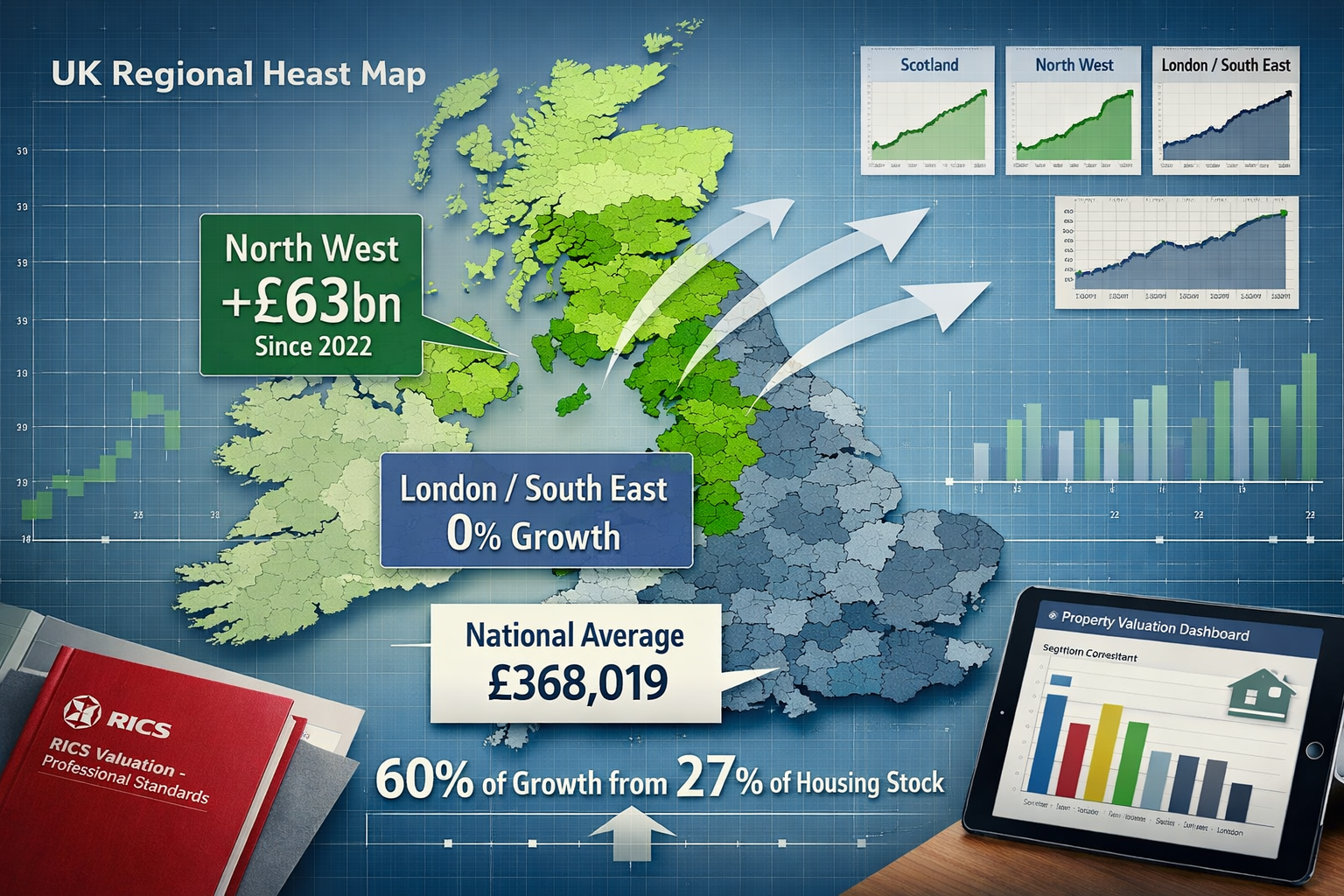
The numbers tell a compelling story: 2026 has recorded the strongest opening for asking prices since 2020, with values climbing 2.8% since December 2025.[1][2] Yet this recovery isn't uniform. The North of England and devolved nations—representing just 27% of UK home values—have contributed a remarkable 60% of total growth since 2022.[1] For surveyors, this geographical fragmentation creates both complexity and opportunity, requiring refined methodologies that account for local market dynamics rather than relying on national averages.
Key Takeaways
✅ Regional performance divergence: The North West alone added £63 billion in housing stock value since 2022, while London and the South East experienced virtually no growth—creating distinct valuation parameters across regions.[1]
✅ Improved buyer affordability: With wages up 17% over three years versus property prices rising just 1.5%, and mortgage rates dropping to 4.28%, market fundamentals have shifted significantly, affecting valuation assumptions.[1][2]
✅ Inventory surge: Newly listed properties are 11% higher than February 2024, with homes available for sale at their highest level in 11 years for this time of year—increasing comparable evidence but also competitive pressure.[1][2]
✅ Segment-specific trends: First-time buyer properties (£226,050) declined 0.4% year-on-year while second-stepper homes (£343,603) gained 0.8%, indicating differential demand across market segments.[2]
✅ Modest national outlook: Despite regional variations, surveyors should calibrate expectations around 2% national growth for 2026, adjusting valuations to reflect localized momentum rather than broad market optimism.
Understanding the 2026 UK Housing Market Landscape
The North-South Divide Deepens
The geographical split in the UK housing market has never been more pronounced. The North West emerged as the top-performing region, with its total housing stock value increasing by an impressive £63 billion since 2022.[1] This growth contrasts sharply with London and the South East, which have experienced an absence of price growth over the same period, contributing to the lowest three-year capital appreciation (£336 billion) since 2013.[1]
For property surveyors conducting RICS valuations, this divide necessitates fundamentally different approaches. A comparable evidence methodology that works effectively in Manchester or Leeds may produce misleading results when applied to Kensington or Surrey. Understanding these regional dynamics is crucial for chartered surveyors operating across multiple markets.
Market Activity and Inventory Levels
Transaction volume indicators suggest genuine recovery momentum. The number of newly listed properties is 11% higher than February 2024, while sales agreed are up 9%.[1] This increased activity provides surveyors with richer comparable evidence, but also introduces complexity as market conditions evolve rapidly.
Significantly, homes available for sale are at their highest level in 11 years for this time of year.[2] This inventory surge creates competitive conditions that can suppress prices in oversupplied markets while highlighting scarcity premiums in undersupplied areas. Surveyors must carefully assess local supply-demand dynamics rather than assuming national trends apply uniformly.
Affordability Improvements Reshaping Demand
A critical shift in market fundamentals has occurred: average wages are up 17% over three years while property prices are up only 1.5%.[1][2] This dramatic improvement in affordability ratios represents a fundamental recalibration of the relationship between earnings and housing costs.
Additionally, the average two-year mortgage rate stands at 4.28%, down from 4.96% year-on-year—the lowest since September 2022.[1][2] For surveyors assessing investment value or market value, these financing conditions significantly impact buyer capacity and should inform valuation assumptions, particularly for properties targeting first-time buyers and second-steppers.
| Market Segment | Average Price | Year-on-Year Change |
|---|---|---|
| First-time buyers (excluding inner London) | £226,050 | -0.4% ⬇️ |
| Second-steppers | £343,603 | +0.8% ⬆️ |
| Top of the ladder | £658,658 | -0.2% ⬇️ |
Source: Rightmove data, February 2026[2]
Valuation Challenges in the 2026 UK Housing Recovery: Adapting Methodologies for Regional Variations
The Comparable Evidence Dilemma
Traditional comparable evidence approaches assume relatively homogeneous market conditions. However, when the North West experiences substantial growth while London remains flat, surveyors face the challenge of identifying truly comparable properties. A three-bedroom semi-detached property in Bolton may have appreciated 8-10% over two years, while a superficially similar property in Bromley has remained static.
Best practice recommendations:
🔍 Narrow your geographical search radius: In fragmented markets, comparables from 5-10 miles away may reflect entirely different market dynamics. Prioritize hyper-local evidence over regional averages.
🔍 Time-adjust with regional indices: When using older comparables, apply regional rather than national house price indices to ensure adjustments reflect actual local market movements.
🔍 Weight recent transactions more heavily: In rapidly changing markets, transactions from 3-6 months ago provide more reliable guidance than those from 12+ months ago.
🔍 Consider segment-specific trends: A property targeting first-time buyers (-0.4% annually) requires different comparable weighting than one appealing to second-steppers (+0.8% annually).[2]
For surveyors conducting probate valuations or lease extension valuations, these regional adjustments become particularly critical, as statutory valuations require defensible evidence that reflects actual market conditions rather than outdated assumptions.
Adjusting for Inventory Levels and Market Velocity
With homes available for sale at 11-year highs for this time of year,[2] surveyors must assess how local inventory affects individual property values. High inventory typically exerts downward pressure on prices as buyer negotiating power increases, while low inventory creates competitive bidding scenarios.
Practical application:
When valuing a property in a high-inventory area, consider applying a modest discount (2-5%) to comparable evidence from lower-inventory periods. Conversely, in undersupplied micro-markets within otherwise balanced regions, a premium may be justified. This nuanced approach ensures valuations reflect current market realities rather than historical patterns.
The 9% increase in sales agreed[1] indicates improved market velocity, which generally supports values by reducing time-on-market risk. However, this metric varies significantly by region and price point, requiring surveyors to research local market statistics rather than relying on national figures.
Incorporating Affordability Metrics into Valuation Models
The dramatic shift in affordability—with wages up 17% versus prices up 1.5%[1][2]—fundamentally alters the relationship between property characteristics and value. Properties that offer strong value relative to local incomes may command premiums, while those priced at historical multiples of average earnings may struggle.
"Surveyors in 2026 must think like economists, understanding that value isn't just about bricks and mortar—it's about the relationship between property prices, local wages, and financing costs. A property that was fairly valued in 2022 may be undervalued today if local incomes have grown substantially while the property price has remained flat."
For valuation factors analysis, consider incorporating:
- Local wage growth data (available from ONS regional statistics)
- Employment sector composition (areas with growing high-wage sectors may outperform)
- Mortgage affordability calculations at current rates (4.28% average)[1][2]
- Rental yield comparisons (improving affordability may shift buy-versus-rent calculations)
Regional Growth Forecasting and Its Valuation Implications
While national growth projections hover around 2% for 2026, regional variations will likely persist. The North West's £63 billion growth trajectory[1] suggests continued outperformance, while London and the South East may experience modest growth or continued stagnation.
Strategic implications for surveyors:
📊 Northern England and devolved nations: Apply growth assumptions of 3-5% annually when assessing development viability or investment value, supported by recent performance data.
📊 London and South East: Use conservative growth assumptions of 0-2% annually, with higher growth potential in specific submarkets experiencing regeneration or infrastructure investment.
📊 Midlands and other regions: Apply moderate growth assumptions of 2-3%, adjusting for specific local factors such as employment growth, transport links, and housing supply constraints.
For chartered surveyors in West London or chartered surveyors in Hertfordshire, understanding these regional trajectories ensures valuations remain credible and defensible, particularly when challenged by clients or used in litigation contexts.
How Surveyors Can Spot Hidden Opportunities Amid Regional Divides
Identifying Undervalued Micro-Markets Within Stagnant Regions
While London and the South East have experienced minimal growth overall,[1] specific neighborhoods within these regions may offer compelling opportunities. Surveyors with deep local knowledge can identify areas where:
✨ Infrastructure investment is planned or underway (Crossrail extensions, station upgrades)
✨ Regeneration initiatives are transforming previously overlooked areas
✨ School performance improvements are attracting family buyers
✨ Demographic shifts are creating new demand patterns (remote workers relocating from expensive central areas)
Case study approach: When conducting a building survey or valuation in a historically stagnant area, research planning applications, local authority development plans, and recent sales velocities. Properties in areas showing transaction volume increases despite flat regional prices may be early indicators of micro-market recovery.
Capitalizing on the First-Time Buyer Segment Dynamics
With first-time buyer properties averaging £226,050 (down 0.4% year-on-year)[2] while affordability has improved dramatically, this segment presents interesting opportunities. The apparent price weakness contradicts improved affordability fundamentals, suggesting potential market inefficiency.
Opportunity identification strategies:
🏡 Properties priced just below stamp duty thresholds: These enjoy disproportionate demand from cost-conscious first-time buyers
🏡 Well-presented properties in commuter towns: Remote work flexibility has expanded first-time buyer search areas
🏡 Properties with low running costs: Energy-efficient homes command premiums as buyers factor ongoing costs into affordability calculations
🏡 Properties near good schools in affordable areas: Family-focused first-time buyers prioritize education access
For surveyors conducting home surveys, highlighting these value-adding characteristics helps clients understand why certain properties may appreciate faster than segment averages.
Leveraging the Second-Stepper Growth Premium
Second-stepper properties at £343,603 (up 0.8% year-on-year)[2] represent the only segment showing consistent growth. This reflects several dynamics:
- First-time buyers from 2020-2021 now have equity to trade up
- Improved affordability enables larger mortgage capacity
- Family formation drives demand for additional bedrooms
- Remote work increases demand for home office space
Valuation considerations:
Properties that appeal to second-steppers—typically three to four-bedroom semi-detached or terraced homes with gardens and parking—may warrant premiums over comparable evidence if they possess desirable characteristics like:
- Additional reception room (home office potential)
- Extended kitchen-dining space (family living)
- Garage or driveway (increasingly valued post-pandemic)
- Good-sized garden (outdoor space premium)
When conducting Level 2 or Level 3 surveys, explicitly noting these features and their market appeal provides valuable context for valuation purposes.
Recognizing Regional Investment Opportunities
The £63 billion growth in North West housing stock value since 2022[1] creates compelling investment opportunities for clients seeking capital appreciation. Surveyors can add value by:
🎯 Identifying emerging neighborhoods: Areas showing early signs of gentrification or regeneration before prices fully reflect future potential
🎯 Assessing rental yield opportunities: Northern markets often offer superior yields compared to southern equivalents, appealing to buy-to-let investors
🎯 Evaluating development potential: Properties with extension or conversion possibilities in growth markets offer enhanced returns
🎯 Analyzing infrastructure impacts: Properties near planned transport improvements may be undervalued relative to future accessibility benefits
For freehold valuations or investment property assessments, incorporating regional growth trajectories into discounted cash flow models ensures valuations reflect realistic appreciation assumptions rather than outdated national averages.
Understanding the Inventory Opportunity
With homes available for sale at 11-year highs,[2] buyers enjoy unprecedented choice. This creates opportunities for:
- Negotiation leverage: Surveyors identifying defects during inspections provide clients with stronger negotiating positions in a buyer-friendly market
- Portfolio acquisition: Investors can assemble multiple properties more easily when inventory is abundant
- Selective purchasing: Buyers can wait for properties meeting specific criteria rather than compromising due to scarcity
Surveyor value-add: When conducting specific defect reports or comprehensive surveys, clearly quantifying repair costs and their impact on value empowers clients to negotiate effectively. In high-inventory markets, even modest defects can justify 5-10% price reductions.
Practical Valuation Strategies for 2026 Market Conditions

Developing Regional Expertise and Local Market Intelligence
Generic valuation approaches fail in fragmented markets. Surveyors must develop deep expertise in their operating regions by:
📚 Monitoring local sales data weekly: Use Land Registry data, property portals, and local estate agent intelligence to track micro-market trends
📚 Building relationships with local agents: Estate agents provide invaluable insights into buyer sentiment, viewing-to-offer ratios, and negotiation patterns
📚 Attending local property auctions: Auction results reveal true market sentiment, particularly for distressed or unusual properties
📚 Analyzing planning applications: Understanding development pipeline helps predict future supply and demand dynamics
📚 Tracking employment and demographic data: ONS regional statistics reveal underlying economic drivers of housing demand
For chartered surveyors in London operating across multiple boroughs, maintaining distinct market intelligence for each area ensures valuations reflect hyper-local conditions rather than broad London averages.
Incorporating Multiple Valuation Methodologies
In uncertain markets, triangulating value through multiple approaches provides greater confidence. Consider combining:
Comparable evidence approach: Primary methodology for most residential valuations, adjusted for regional and temporal factors
Investment method: For rental properties, calculating value based on yield expectations (particularly relevant in high-yield northern markets)
Residual method: For properties with development potential, calculating value based on completed development value minus costs
Depreciated replacement cost: For unusual properties lacking comparables, particularly relevant in unique regional markets
Affordability-based approach: Calculating sustainable value based on local income multiples and mortgage capacity at current rates (4.28%)[1][2]
When valuations from different methodologies diverge significantly, this signals market uncertainty or unique property characteristics requiring additional investigation.
Adjusting for Market Sentiment and Momentum
The strongest opening for asking prices since 2020[1][2] reflects improved market sentiment, but sentiment varies regionally. Surveyors should assess:
🔄 Time on market trends: Properties selling quickly (under 4 weeks) indicate strong demand; those lingering (12+ weeks) suggest overpricing or weak demand
🔄 Offer-to-asking price ratios: Markets where properties achieve 98-100% of asking prices are stronger than those achieving 90-95%
🔄 Viewing-to-offer conversion: High conversion rates indicate competitive markets where buyers must act decisively
🔄 Chain progression rates: Markets where chains complete efficiently demonstrate confidence; high fall-through rates suggest uncertainty
Incorporating these sentiment indicators into valuation reports provides clients with valuable context beyond simple price figures.
Scenario Planning and Sensitivity Analysis
Given regional uncertainties and the modest 2% national growth projection, prudent surveyors should provide scenario-based valuations:
Base case scenario: Most likely outcome based on current trends (e.g., 2% national growth, 4% North West growth, 1% London growth)
Optimistic scenario: If affordability improvements and mortgage rate reductions stimulate stronger demand (e.g., 4% national growth)
Pessimistic scenario: If economic headwinds or mortgage rate increases dampen demand (e.g., 0% national growth or slight decline)
This approach proves particularly valuable for capital gains tax valuations, development appraisals, and investment decisions where clients need to understand value ranges rather than single-point estimates.
Leveraging Technology and Data Analytics
Modern surveyors should embrace technology to enhance valuation accuracy:
💻 Automated Valuation Models (AVMs): Use as a starting point or cross-check, but never as a substitute for professional judgment
💻 Geographic Information Systems (GIS): Map comparable evidence spatially to identify geographic value gradients
💻 Property price indices: Apply regional and local indices from Land Registry, ONS, and commercial providers to time-adjust comparables
💻 Demographic and economic databases: Access ONS, local authority, and commercial data to understand demand drivers
💻 Transaction velocity tracking: Monitor how quickly properties sell in specific price bands and locations
Technology enhances but doesn't replace professional expertise. The surveyor's role is interpreting data within local market context—something algorithms cannot replicate.
Navigating Specific Valuation Scenarios in the 2026 Recovery
Valuing Properties in High-Growth Northern Markets
When valuing properties in the North West (£63 billion growth since 2022)[1] or other high-performing regions:
✔️ Avoid over-reliance on historical data: Markets experiencing 4-6% annual growth require recent comparables (3-6 months maximum)
✔️ Consider momentum in valuation assumptions: Properties in rapidly appreciating areas may justify valuations toward the upper end of comparable ranges
✔️ Assess sustainability of growth: Distinguish between fundamental demand drivers (employment growth, infrastructure investment) and speculative momentum
✔️ Evaluate supply constraints: Growth markets with limited development capacity may sustain higher growth rates than those with abundant land supply
✔️ Consider investor demand: High-growth areas attract buy-to-let and institutional investors, potentially creating additional demand beyond owner-occupiers
For shared ownership valuations in these markets, growth assumptions significantly impact staircase pricing and future buy-out costs.
Valuing Properties in Stagnant Southern Markets
In London and the South East (minimal growth since 2022)[1]:
✔️ Emphasize property-specific characteristics: In flat markets, individual property features drive value more than market momentum
✔️ Identify micro-market variations: Even within stagnant regions, specific neighborhoods may outperform due to local factors
✔️ Consider long-term value retention: Established southern markets may offer lower growth but greater stability and liquidity
✔️ Assess rental yield opportunities: Flat capital growth may be offset by strong rental demand in employment centers
✔️ Evaluate quality and scarcity: Premium properties in desirable locations may maintain value better than average properties in average locations
When conducting ATED valuations in these markets, conservative growth assumptions ensure compliance with HMRC requirements while reflecting realistic market conditions.
First-Time Buyer Property Valuations
With first-time buyer properties at £226,050 (down 0.4% year-on-year)[2] despite improved affordability:
✔️ Emphasize affordability metrics: Calculate monthly mortgage payments at current rates (4.28%) relative to local incomes
✔️ Consider Help to Buy and government scheme eligibility: Properties qualifying for assistance schemes may command premiums
✔️ Assess stamp duty efficiency: Properties priced just below thresholds enjoy enhanced demand
✔️ Evaluate running costs: Energy efficiency, council tax bands, and maintenance requirements significantly impact first-time buyer decisions
✔️ Consider location relative to employment: First-time buyers prioritize affordability but need access to employment opportunities
Second-Stepper and Family Home Valuations
For second-stepper properties at £343,603 (up 0.8% year-on-year)[2]:
✔️ Prioritize family-friendly features: Gardens, parking, proximity to good schools, and additional reception rooms command premiums
✔️ Assess home office potential: Remote work flexibility makes dedicated office space increasingly valuable
✔️ Consider chain-free status: Chain-free properties appeal to second-steppers who often face complex chains
✔️ Evaluate extension and improvement potential: Second-steppers often seek properties they can adapt to growing family needs
✔️ Assess outdoor space quality: Not just quantity—usable, private, well-maintained gardens command premiums
Top-of-Ladder and Premium Property Valuations
With top-of-ladder properties at £658,658 (down 0.2%)[2]:
✔️ Recognize limited comparable evidence: Premium properties are inherently unique, requiring nuanced valuation approaches
✔️ Consider lifestyle and amenity value: Features like home gyms, wine cellars, and entertainment spaces appeal to this segment
✔️ Assess architectural and design quality: Premium buyers pay substantial premiums for exceptional design and craftsmanship
✔️ Evaluate privacy and exclusivity: Gated communities, large plots, and secluded locations command premiums
✔️ Consider international buyer demand: Premium London and southern properties attract international buyers, creating distinct demand dynamics
For reinstatement cost valuations on premium properties, accurate assessment of high-specification finishes and bespoke features is essential for adequate insurance coverage.
Professional Standards and Best Practices for 2026 Valuations
RICS Red Book Compliance in Fragmented Markets
The RICS Valuation – Global Standards (Red Book) provides the framework for professional valuations, but application requires judgment in fragmented markets. Key considerations:
📖 Basis of value selection: Market value, investment value, or fair value—each may produce different results in divergent regional markets
📖 Assumptions and special assumptions: Clearly state assumptions about market conditions, particularly regarding regional growth trajectories
📖 Comparable evidence disclosure: Transparently present comparable evidence, including adjustments for location, time, and property characteristics
📖 Uncertainty and material valuation uncertainty: Consider whether regional market fragmentation warrants material valuation uncertainty declarations
📖 Competence and local knowledge: Ensure valuers possess appropriate regional expertise—Red Book requires valuers to decline instructions outside their competence area
For detailed guidance on Red Book valuations, surveyors should regularly review RICS updates and practice statements addressing regional market variations.
Documentation and Report Quality
In markets characterized by regional divides, comprehensive documentation becomes critical:
✍️ Detailed comparable evidence schedules: Present at least 3-5 comparables with full details (address, date, price, size, condition, adjustments)
✍️ Regional market analysis: Include section discussing regional market trends, supported by credible data sources
✍️ Adjustment justifications: Explain all adjustments to comparable evidence (location, time, size, condition, features)
✍️ Photographs and property descriptions: Thorough documentation supports valuation conclusions and aids future reference
✍️ Market conditions commentary: Discuss relevant market factors (inventory levels, mortgage rates, affordability, sentiment)
High-quality documentation protects surveyors from professional liability claims and provides clients with transparent, defensible valuations.
Continuing Professional Development and Market Knowledge
The Valuation Challenges in the 2026 UK Housing Recovery: How Surveyors Can Spot Hidden Opportunities Amid Regional Divides require ongoing learning:
🎓 Regional market seminars: Attend events focused on specific regional markets to understand local dynamics
🎓 Economic and demographic analysis: Develop skills in interpreting economic data and its implications for property values
🎓 Technology and data analytics: Learn to use modern valuation tools, databases, and analytical software
🎓 Regulatory updates: Stay current with RICS standards, tax legislation, and lending requirements
🎓 Peer discussion and case studies: Engage with professional networks to discuss challenging valuation scenarios
Understanding what surveyors do in evolving markets requires commitment to continuous professional development.
Ethical Considerations and Independence
In markets offering "hidden opportunities," surveyors must maintain professional independence:
⚖️ Avoid conflicts of interest: Disclose any relationships with clients, properties, or parties that might compromise objectivity
⚖️ Resist pressure for predetermined values: Maintain independence even when clients seek specific valuation outcomes
⚖️ Provide objective advice: Recommend against transactions when valuations don't support asking prices
⚖️ Transparent fee structures: Ensure fees aren't contingent on valuation outcomes or transaction completion
⚖️ Professional skepticism: Question assumptions and verify information rather than accepting client representations uncritically
Professional integrity protects both surveyors and their clients from poor decisions based on biased valuations.
Future Outlook and Strategic Positioning for Surveyors

Anticipating Market Evolution Through 2026 and Beyond
While current data suggests 2% national growth with regional variations, several factors may alter this trajectory:
🔮 Interest rate movements: Further mortgage rate reductions could stimulate demand; increases could dampen it
🔮 Economic performance: Regional economic growth (or contraction) will drive employment and wage growth, affecting housing demand
🔮 Government policy: Planning reforms, tax changes, or housing initiatives could significantly impact supply and demand
🔮 Demographic shifts: Remote work patterns, migration trends, and household formation rates influence regional demand
🔮 Supply responses: Construction activity in high-growth regions may moderate price increases over time
Surveyors should monitor these factors and adjust valuation assumptions as conditions evolve.
Building Regional Specialization and Market Authority
In fragmented markets, generalist surveyors face disadvantages compared to regional specialists. Consider:
🏆 Developing deep expertise in 2-3 regions: Rather than operating nationally, focus on specific markets where you can build comprehensive knowledge
🏆 Creating regional market reports: Publish regular analyses of your specialist regions to demonstrate expertise
🏆 Building local professional networks: Develop relationships with local agents, solicitors, and developers
🏆 Investing in regional market data: Subscribe to local market intelligence services and maintain proprietary databases
🏆 Marketing regional expertise: Position yourself as the go-to expert for specific regions or property types
Regional specialization enhances valuation quality while creating competitive advantages in client acquisition.
Adapting Service Offerings to Market Opportunities
The Valuation Challenges in the 2026 UK Housing Recovery: How Surveyors Can Spot Hidden Opportunities Amid Regional Divides create service opportunities:
💼 Investment advisory services: Help clients identify high-growth regions and undervalued opportunities
💼 Portfolio valuation and optimization: Assist investors in managing multi-property portfolios across regions
💼 Development appraisal: Evaluate development opportunities in high-growth markets
💼 Strategic acquisition advice: Guide institutional buyers in regional expansion strategies
💼 Market research and feasibility studies: Provide detailed regional market analysis for developers and investors
Expanding beyond traditional valuation services positions surveyors as strategic advisors rather than commodity service providers.
Embracing Technology While Maintaining Professional Judgment
Technology will increasingly influence valuation practice:
🤖 AI-enhanced comparable selection: Algorithms can identify relevant comparables faster than manual searches
🤖 Automated adjustment calculations: Software can apply standardized adjustments for size, condition, and features
🤖 Predictive analytics: Machine learning models can forecast regional price movements based on economic indicators
🤖 Virtual inspection tools: Drones, 3D scanning, and virtual reality may supplement physical inspections
However, professional judgment remains irreplaceable. Technology provides tools; surveyors provide expertise, local knowledge, and nuanced interpretation that algorithms cannot replicate.
Positioning for Long-Term Market Cycles
The 2026 recovery represents one phase in ongoing market cycles. Successful surveyors:
📈 Maintain perspective across market cycles: Avoid recency bias by understanding long-term historical patterns
📈 Build financial resilience: Diversify client base and service offerings to weather market downturns
📈 Invest in professional development: Continuously enhance skills to remain relevant as markets evolve
📈 Cultivate client relationships: Long-term client relationships provide stability across market cycles
📈 Adapt methodologies: Remain flexible in approaches while maintaining professional standards
Understanding that current conditions are temporary encourages strategic thinking beyond immediate market circumstances.
Conclusion: Thriving Amid Complexity and Regional Divergence
The Valuation Challenges in the 2026 UK Housing Recovery: How Surveyors Can Spot Hidden Opportunities Amid Regional Divides demand sophisticated approaches that go beyond traditional methodologies. With the North West adding £63 billion in housing stock value while London and the South East stagnate,[1] surveyors must abandon one-size-fits-all approaches in favor of nuanced, regionally-informed valuations.
The market fundamentals are compelling: 2.8% growth since December 2025, the strongest opening since 2020,[1][2] improved affordability with wages up 17% versus prices up 1.5%,[1][2] and mortgage rates at 4.28%—the lowest since September 2022.[1][2] Yet these national figures mask profound regional variations that create both challenges and opportunities.
Successful surveyors in 2026 will distinguish themselves through:
✨ Deep regional expertise that enables accurate valuation in fragmented markets
✨ Sophisticated comparable evidence analysis that accounts for geographical and temporal variations
✨ Understanding of market fundamentals including affordability, inventory levels, and sentiment
✨ Ability to identify opportunities in undervalued micro-markets and emerging growth areas
✨ Professional standards adherence that ensures credible, defensible valuations
✨ Strategic advisory capabilities that position surveyors as valued partners rather than commodity service providers
Actionable Next Steps for Surveyors
To capitalize on the 2026 market recovery and navigate regional divides effectively:
1. Conduct a regional market audit: Systematically analyze your operating regions, identifying growth areas, stagnant markets, and micro-market variations. Use Land Registry data, ONS statistics, and local market intelligence to build comprehensive regional profiles.
2. Enhance your comparable evidence database: Develop systematic processes for capturing, categorizing, and analyzing comparable evidence. Implement regional and temporal adjustment protocols that reflect actual market movements rather than assumptions.
3. Invest in professional development: Attend regional market seminars, complete RICS CPD on valuation in uncertain markets, and develop skills in economic and demographic analysis. Consider specializing in high-growth regions or specific property types.
4. Upgrade your technology toolkit: Implement GIS mapping for comparable analysis, subscribe to comprehensive property databases, and explore AI-enhanced valuation tools while maintaining professional judgment as the ultimate arbiter.
5. Develop client advisory services: Move beyond transactional valuations to offer strategic advice on regional opportunities, portfolio optimization, and investment timing. Position yourself as a market expert rather than a commodity service provider.
6. Build regional professional networks: Cultivate relationships with estate agents, developers, solicitors, and other professionals in your specialist regions. Local intelligence often provides insights unavailable through data alone.
7. Publish regional market insights: Demonstrate expertise by producing regular market commentary, analysis pieces, or reports on your specialist regions. Thought leadership attracts clients and establishes professional credibility.
The 2026 UK housing recovery offers unprecedented opportunities for surveyors who embrace complexity, develop regional expertise, and maintain rigorous professional standards. While national headlines suggest modest 2% growth, the reality beneath reveals dynamic regional markets where informed professionals can identify substantial value for their clients.
By understanding the Valuation Challenges in the 2026 UK Housing Recovery: How Surveyors Can Spot Hidden Opportunities Amid Regional Divides, surveyors position themselves not merely to survive market fragmentation but to thrive within it—delivering exceptional value to clients while building sustainable, successful practices.
References
[1] February House Prices Fall Uk B2920773 – https://www.the-independent.com/news/uk/home-news/february-house-prices-fall-uk-b2920773.html
[2] Uk House Prices Hold Steady In February After Bumper Start To 2026 – https://www.morningstar.com/news/alliance-news/1771200097476297000/uk-house-prices-hold-steady-in-february-after-bumper-start-to-2026
