
As the UK property market shows signs of recovery in 2026, boundary disputes are becoming increasingly common. With transaction volumes rising and regional price shifts creating new tensions between neighbors, the role of expert witnesses in boundary litigation has never been more critical. Understanding the Expert Witness Essentials for 2026 Boundary Disputes: Strengthening Cases in a Recovering Property Market is vital for property owners, legal professionals, and surveyors navigating this complex landscape.
The Royal Institution of Chartered Surveyors (RICS) has emphasized the importance of robust home surveys and court-admissible evidence as sales activity improves across the country. This renewed focus comes at a crucial time when inadequate preparation and poorly qualified expert witnesses can result in losing entire cases[2]. As property values fluctuate and boundary lines become contested, having the right expert witness with proper qualifications, independence, and technical expertise can make the difference between winning and losing a boundary dispute.
Key Takeaways
✅ Expert qualifications are non-negotiable: Not every licensed land surveyor is qualified to serve as an expert witness in boundary disputes, and hiring inexperienced professionals can result in case failure[2].
✅ Independence is legally required: Expert witnesses must perform unbiased analysis independent of client wishes or attorney influence, maintaining professional objectivity throughout proceedings[3].
✅ Proper preparation prevents trial disasters: Many boundary disputes proceed to trial with inadequate investigation, with experts often retained too late in the process[3].
✅ The 2026 market recovery demands higher standards: Rising transaction volumes and regional price shifts require court-admissible evidence that meets RICS professional standards.
✅ Comprehensive documentation is essential: Expert witnesses must identify, authenticate, and explain the relevancy of all documents used to establish boundary positions[3].
Understanding the Role of Expert Witnesses in Boundary Disputes
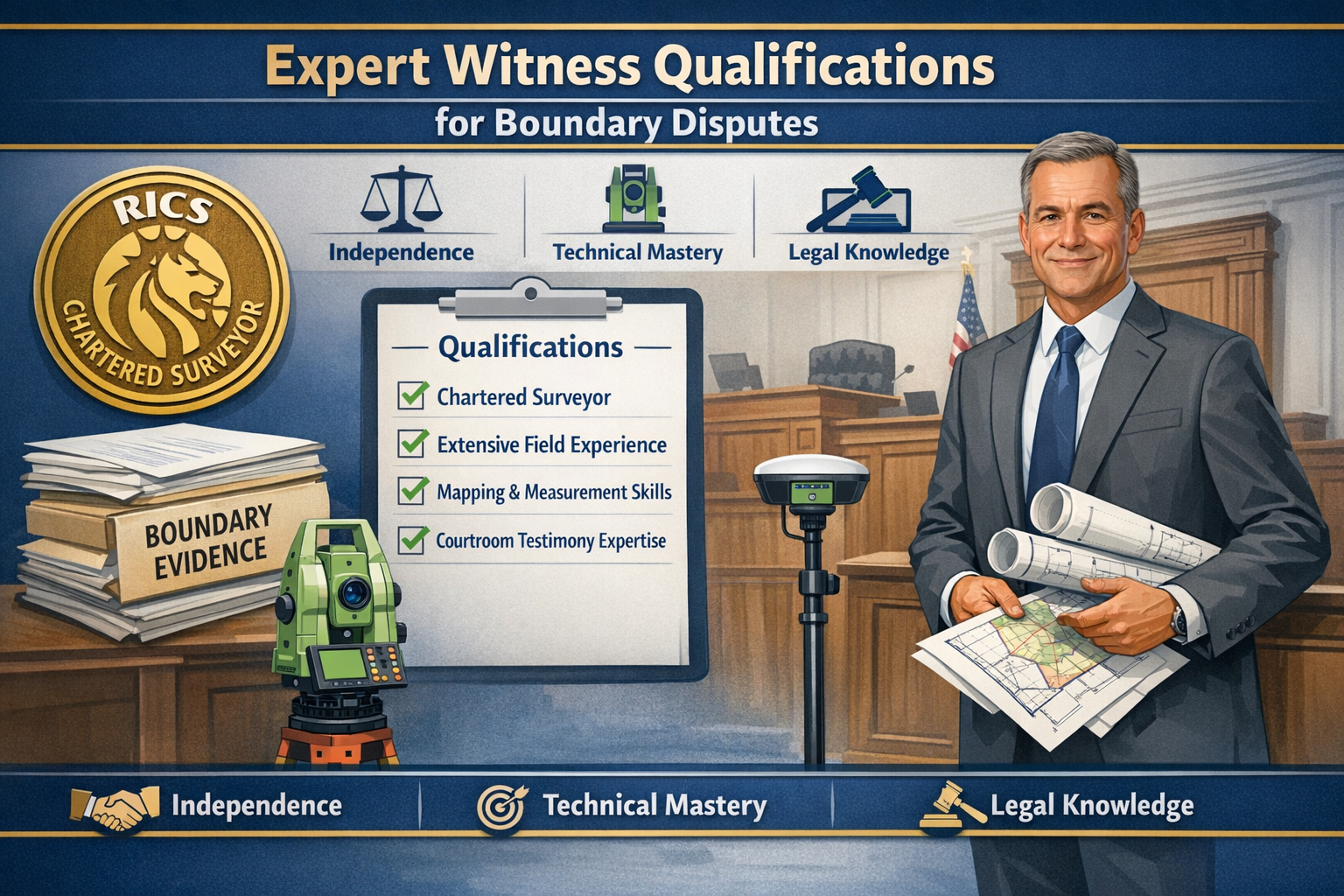
What Makes an Expert Witness in Boundary Disputes?
An expert witness in boundary disputes serves a fundamentally different role than a standard surveyor conducting routine property assessments. These professionals must possess specialized knowledge, extensive experience, and the ability to communicate complex technical information clearly in legal proceedings.
Core responsibilities include:
- 🔍 Identifying and authenticating relevant historical documents
- 📊 Explaining the relevancy of information used to fix boundary positions
- ⚖️ Providing conclusive opinions on boundary locations based on evidence
- 📝 Preparing comprehensive reports that withstand legal scrutiny
- 💬 Delivering clear, credible testimony under cross-examination
The distinction between a competent surveyor and a qualified expert witness cannot be overstated. Not every licensed land surveyor possesses the courtroom experience, legal knowledge, or communication skills necessary to serve effectively as an expert witness[2]. This reality has significant implications for property owners and attorneys selecting professionals for boundary dispute cases.
The Independence Requirement
One of the most critical aspects of serving as an expert witness is maintaining complete independence from client interests. Expert witnesses are obligated to perform unbiased analysis and arrive at opinions through fair and reasonable interpretation, regardless of client wishes or attorney influence[3].
This independence requirement means that expert witnesses:
- Must prioritize truth and accuracy over favorable outcomes for clients
- Cannot allow payment arrangements to influence their professional opinions
- Should resist pressure from attorneys to modify findings
- Must disclose any potential conflicts of interest
- Cannot be bound by nondisclosure agreements that prevent truthful testimony[8]
For property owners involved in boundary and party wall disputes, understanding this independence requirement helps set realistic expectations about what expert witnesses can and cannot do.
Expert Witness Essentials for 2026 Boundary Disputes: Qualification Standards
Essential Credentials and Experience
The 2026 property market recovery has heightened the importance of selecting properly qualified expert witnesses. Key qualifications include:
| Qualification Category | Requirements | Why It Matters |
|---|---|---|
| Professional Credentials | RICS chartered status, relevant licenses | Establishes baseline competency and professional standards |
| Boundary Expertise | Minimum 10+ years boundary surveying experience | Provides depth of knowledge for complex cases |
| Legal Experience | Previous expert witness testimony, courtroom familiarity | Ensures effective communication under pressure |
| Continuing Education | Current knowledge of surveying technology and legal standards | Maintains relevance in evolving field |
| Technical Proficiency | Modern surveying equipment, GIS systems, historical research methods | Enables comprehensive evidence gathering |
Hiring an inexperienced or inexpensive surveyor simply to save costs can prove catastrophic, potentially resulting in losing the entire case[2]. The financial stakes in boundary disputes often far exceed the cost difference between a qualified expert and a bargain-rate alternative.
Specialized Knowledge Areas
Expert witnesses in boundary disputes must demonstrate mastery across multiple knowledge domains:
Historical Research Capabilities: Understanding how to locate, interpret, and authenticate historical deeds, surveys, maps, and property records dating back decades or centuries.
Legal Framework Knowledge: Familiarity with property law, evidence rules, expert witness standards, and courtroom procedures relevant to boundary litigation.
Technical Survey Skills: Proficiency with modern surveying equipment, GPS technology, photogrammetry, and traditional measurement techniques.
Communication Excellence: Ability to explain complex technical concepts to judges, juries, and attorneys without specialized surveying knowledge.
For comprehensive property assessments that may reveal boundary issues, property owners should consider professional building surveys conducted by qualified chartered surveyors.
Strengthening Cases in a Recovering Property Market
The 2026 Market Context
The UK property market's recovery in 2026 has created unique challenges and opportunities for boundary dispute resolution. Several market factors are influencing boundary litigation:
Rising Transaction Volumes 📈: As more properties change hands, previously dormant boundary issues surface during conveyancing and survey processes.
Regional Price Variations: Significant price differences between adjacent properties increase the financial stakes of boundary disputes, particularly where small parcels of land represent substantial value.
Increased Development Activity: The recovering market has spurred renovation and extension projects, triggering disputes over party wall matters and boundary encroachments.
RICS Standards Evolution: Professional bodies have strengthened requirements for survey quality and expert witness conduct, raising the bar for admissible evidence.
Court-Admissible Evidence Standards
Expert witnesses must understand what constitutes court-admissible evidence in 2026 boundary disputes. The evidence must be:
✔️ Relevant: Directly related to establishing or disproving boundary positions
✔️ Reliable: Based on accepted surveying methodologies and sound technical principles
✔️ Authenticated: Properly verified and documented with clear chain of custody
✔️ Comprehensive: Addressing all material aspects of the boundary question
✔️ Understandable: Presented in a manner accessible to non-technical legal professionals
The RICS push for robust home surveys aligns with these evidence standards, emphasizing the importance of thorough documentation and professional rigor. Expert witnesses who fail to meet these standards risk having their testimony excluded or given minimal weight by courts.
Case Types Requiring Expert Witness Testimony
Property Disputes
Boundary disputes represent the most common scenario requiring expert witness testimony. These cases typically involve:
- Fence line disagreements: Neighbors disputing the correct location of boundary fences or walls
- Encroachment claims: Allegations that structures, driveways, or landscaping cross property lines
- Adverse possession: Claims of ownership through long-term occupation of disputed land
- Easement boundaries: Disputes over the extent and location of rights of way
Expert witnesses in these cases must identify and authenticate relevant documents, explain how historical evidence establishes boundary positions, and provide conclusive opinions on correct boundary locations[3].
Construction Disputes
The recovering property market has increased construction activity, leading to disputes involving:
- Foundation excavations allegedly crossing property lines
- Building setback violations
- Shared wall modifications affecting adjoining properties
- Drainage and grading issues impacting neighboring parcels
For property owners undertaking construction work, understanding party wall notice requirements can help prevent disputes before they escalate to litigation.
Land Use and Zoning Issues
Expert witnesses may be needed in cases involving:
- Disputes over property dimensions affecting permitted development rights
- Challenges to planning permissions based on incorrect boundary assumptions
- Conflicts between survey descriptions and legal descriptions in deeds
- Subdivision disputes and lot line adjustments
Environmental Litigation
Boundary expertise becomes essential in environmental cases where:
- Contamination responsibility depends on precise property boundaries
- Riparian rights along waterways are disputed
- Tree preservation orders affect boundary determinations
- Protected habitat boundaries intersect with property lines
Understanding the full scope of cases requiring expert testimony helps property owners recognize when to engage qualified professionals early in dispute resolution processes.
Expert Witness Essentials for 2026 Boundary Disputes: Preparation and Documentation
The Critical Importance of Early Engagement
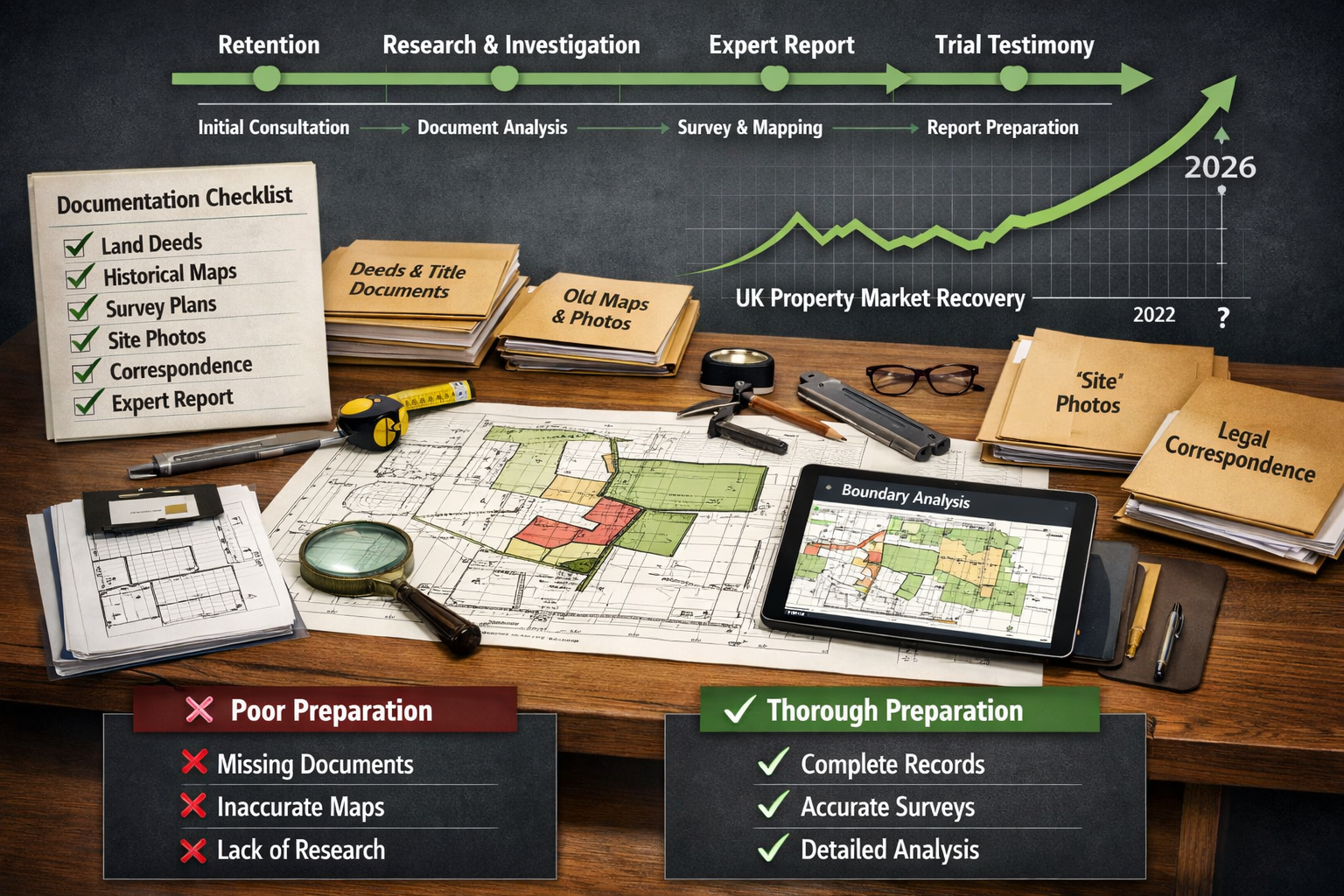
One of the most significant problems in boundary dispute litigation is inadequate preparation. Many cases proceed to trial with insufficient attorney investigation, and experts are often retained only shortly before trial[3]. This last-minute approach creates multiple problems:
⚠️ Insufficient time for comprehensive research: Locating and analyzing historical documents requires weeks or months, not days
⚠️ Limited site investigation opportunities: Weather, vegetation, and access issues may prevent thorough field surveys
⚠️ Rushed report preparation: Comprehensive expert reports require careful analysis and multiple revisions
⚠️ Inadequate attorney collaboration: Effective expert testimony requires coordination with legal strategy
Best practice recommendation: Engage expert witnesses during the initial investigation phase, ideally before litigation commences. This early involvement allows experts to:
- Conduct thorough historical research without time pressure
- Perform multiple site visits under varying conditions
- Identify and preserve evidence before it deteriorates
- Advise attorneys on case strengths and weaknesses
- Prepare comprehensive reports that withstand scrutiny
Essential Documentation Requirements
Expert witnesses must compile and organize extensive documentation to support their opinions. Core documentation categories include:
Historical Records:
- Original deeds and conveyances
- Historical surveys and plats
- Tax maps and assessor records
- Aerial photographs spanning multiple decades
- Municipal records and subdivision plans
Current Survey Data:
- Comprehensive boundary surveys using modern equipment
- GPS coordinate data with accuracy specifications
- Photographs of boundary markers, monuments, and physical features
- Measurements of existing structures and improvements
- Topographic information relevant to boundary determination
Research Documentation:
- Title search results and chain of ownership
- Adjoining property records for comparison
- Historical maps from multiple sources
- Previous survey work by other professionals
- Correspondence and statements from long-term property owners
For property owners seeking comprehensive property assessments, chartered surveyors can provide detailed documentation that may prove valuable if disputes arise.
Creating Compelling Expert Reports
The expert witness report serves as the foundation for testimony and case strategy. Effective reports include:
- Executive Summary: Clear statement of opinions and conclusions
- Qualifications Section: Detailed credentials demonstrating expertise
- Scope of Work: Description of investigation methods and materials reviewed
- Historical Analysis: Chronological examination of property ownership and boundary evidence
- Technical Findings: Survey results, measurements, and calculations
- Opinion Section: Conclusive statements on boundary location with supporting rationale
- Exhibits: Maps, photographs, diagrams, and document reproductions
- Assumptions and Limitations: Clear disclosure of any constraints on opinions
Reports must be written for non-technical audiences while maintaining technical accuracy. Judges and juries need to understand complex surveying concepts without specialized training.
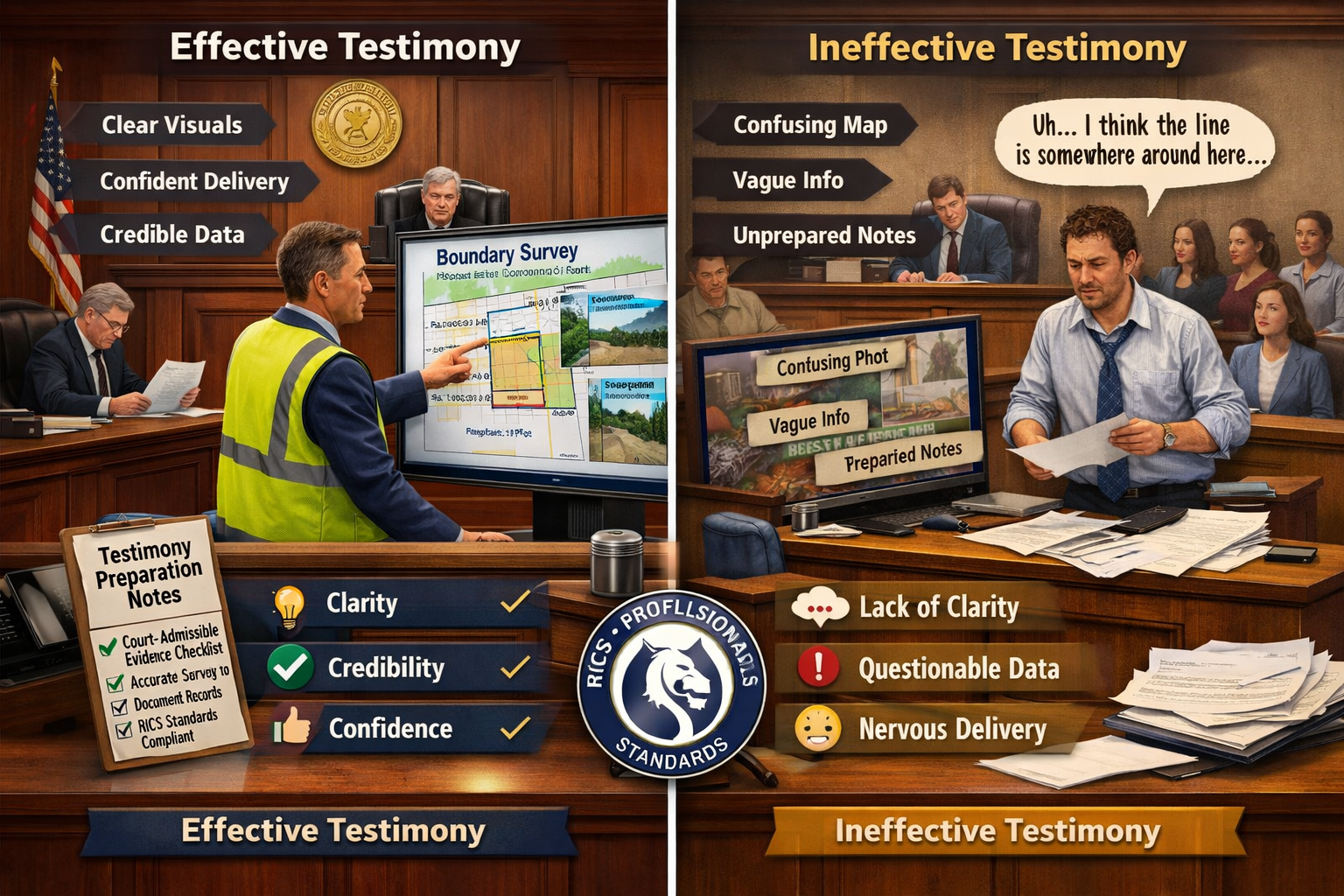
Testimony Skills and Courtroom Performance
Direct Examination Preparation
Direct examination represents the expert witness's opportunity to present findings to the court. Effective preparation involves:
Coordinating with Attorneys: Work closely with legal counsel to structure testimony that supports case theory while maintaining independence. Sample questions should be reviewed and refined[7].
Visual Aids Development: Create clear, compelling exhibits including:
- Enlarged boundary maps with color-coded features
- Comparison diagrams showing competing boundary theories
- Photographs with annotations highlighting key features
- Timeline graphics illustrating historical evidence
Practice Sessions: Rehearse testimony delivery to ensure:
- Clear, concise explanations of technical concepts
- Appropriate pacing and voice modulation
- Effective use of visual aids
- Professional demeanor and body language
Key Communication Principles:
- Use plain language whenever possible
- Define technical terms before using them
- Make eye contact with judge and jury
- Remain calm and professional regardless of questions
- Acknowledge limitations honestly
Cross-Examination Strategies
Cross-examination tests the expert witness's credibility, knowledge, and objectivity. Preparation strategies include:
Anticipate Challenges: Identify weaknesses in analysis and prepare honest, professional responses
Maintain Composure: Never become defensive or argumentative, even with aggressive questioning
Listen Carefully: Ensure you understand each question before answering; request clarification if needed
Answer Precisely: Respond to the specific question asked without volunteering unnecessary information
Admit Limitations: Acknowledge when questions fall outside your expertise or when evidence is inconclusive
Stand by Opinions: Defend well-founded conclusions while remaining open to legitimate alternative interpretations
The ability to withstand rigorous cross-examination often determines case outcomes. Experienced expert witnesses understand that credibility matters more than appearing to have all the answers.
Expert Witness Essentials for 2026 Boundary Disputes: Technology and Modern Methods
Advanced Surveying Technology
The 2026 landscape for boundary dispute resolution incorporates sophisticated technology that enhances evidence quality:
GPS and GNSS Systems: Modern satellite positioning provides centimeter-level accuracy for boundary determinations, creating objective data that strengthens expert testimony.
3D Laser Scanning: LiDAR technology captures comprehensive site data, creating detailed three-dimensional models that can be analyzed and presented in court.
Drone Surveys: Aerial photography and photogrammetry provide unique perspectives on boundary features, particularly useful for large parcels or difficult terrain. Property owners can learn more about drone survey capabilities for comprehensive property documentation.
Geographic Information Systems (GIS): Digital mapping platforms allow experts to overlay historical maps, modern surveys, and satellite imagery, revealing boundary evolution over time.
Digital Documentation: High-resolution photography, video documentation, and digital measurement tools create comprehensive records that can be easily presented and understood in court.
Historical Research Tools
Modern technology has revolutionized access to historical boundary evidence:
- Online Archives: Digital repositories of historical deeds, maps, and surveys
- Aerial Photo Libraries: Decades of aerial imagery available through government and commercial sources
- Title Plant Databases: Comprehensive property records accessible electronically
- Historical Map Collections: Digitized maps from various eras available for comparison and analysis
Expert witnesses who leverage these tools can conduct more thorough research in less time, uncovering evidence that might have been missed using traditional methods alone.
Ethical Considerations and Professional Standards
RICS Professional Conduct Requirements
Chartered surveyors serving as expert witnesses must adhere to strict professional standards established by RICS. These requirements emphasize:
Competence: Only accepting expert witness assignments within areas of genuine expertise
Independence: Maintaining objectivity regardless of client relationships or payment arrangements
Transparency: Disclosing all relevant information, including facts that may not support client positions
Integrity: Providing honest opinions based on evidence rather than desired outcomes
Continuing Professional Development: Maintaining current knowledge through ongoing education
Violations of these standards can result in professional discipline, loss of credentials, and exclusion of testimony from legal proceedings.
Avoiding Common Ethical Pitfalls
Expert witnesses must navigate several ethical challenges:
Fee Arrangements: Never agree to contingency fees or compensation tied to case outcomes. Professional fees should be based on time and expertise, not results.
Attorney Pressure: Resist attempts by attorneys to influence opinions or modify findings. The expert's duty is to the court and truth, not to the client's desired outcome.
Scope Creep: Stay within areas of genuine expertise. Decline to offer opinions on matters outside your professional competence.
Document Handling: Maintain proper custody and authentication of evidence. Never alter or selectively present documents to support preferred conclusions.
Disclosure Obligations: Reveal all relevant information to opposing counsel as required by court rules and professional standards.
For complex property disputes involving multiple technical issues, maintaining clear ethical boundaries becomes especially important.
Cost Considerations and Value Proposition
Investment in Quality Expert Testimony
The cost of qualified expert witnesses represents a significant litigation expense, but the investment typically proves worthwhile when compared to potential losses:
Typical Expert Witness Costs:
- Initial consultation and case assessment: £500-£1,500
- Comprehensive boundary survey and research: £3,000-£10,000
- Expert report preparation: £2,000-£5,000
- Court testimony preparation and appearance: £2,000-£5,000 per day
- Total case costs: £7,500-£25,000+ depending on complexity
Value Considerations:
- Property value at stake often exceeds £50,000-£500,000+
- Legal costs for retrial if inadequate expert testimony leads to loss
- Potential damages and court costs if case is lost
- Long-term property value impacts of adverse boundary determinations
Attempting to save money by hiring inexperienced or inexpensive surveyors creates false economy. The difference between qualified and unqualified experts may be £5,000-£10,000, while the difference in case outcomes may be hundreds of thousands of pounds[2].
Fee Structures and Agreements
Professional expert witnesses typically offer several fee arrangement options:
Hourly Rates: Most common structure, with rates ranging from £150-£400 per hour depending on experience and credentials
Fixed-Fee Arrangements: Agreed-upon fees for specific deliverables such as reports or testimony
Retainer Agreements: Upfront payments securing expert availability and covering initial work
Expense Reimbursement: Separate billing for travel, research costs, and specialized equipment
Clear written agreements should specify:
- Scope of work and deliverables
- Fee structure and payment terms
- Expense handling procedures
- Termination provisions
- Confidentiality requirements (subject to disclosure obligations)
Regional Considerations Across the UK
London and Southeast Market Dynamics
The 2026 property market recovery has affected different UK regions in varying ways, creating unique boundary dispute contexts:
London: High property values mean even small boundary adjustments represent substantial financial stakes. Expert witnesses must navigate complex historical records in densely developed areas. Property owners in London can access specialized chartered surveyors familiar with urban boundary challenges.
Southeast England: Rapid development and property value appreciation have increased boundary dispute frequency. Historical records may be scattered across multiple jurisdictions.
Regional Price Variations and Dispute Intensity
Areas Experiencing High Dispute Rates:
- West London: Intensive redevelopment creating boundary tensions (chartered surveyors in West London)
- Chelsea and Kensington: Extremely high property values making boundary disputes financially significant (Chelsea surveyors)
- Home Counties: Suburban expansion and garden development triggering neighbor disputes
Regional Expert Witness Considerations:
- Local knowledge of historical development patterns
- Familiarity with regional surveying practices and standards
- Understanding of local court procedures and preferences
- Access to regional historical archives and records
Selecting the Right Expert Witness for Your Case
Essential Selection Criteria
Choosing an expert witness requires careful evaluation across multiple dimensions:
1. Relevant Experience
- Minimum 10+ years boundary surveying experience
- Previous expert witness testimony (request case references)
- Familiarity with dispute types similar to your case
- Track record of successful outcomes
2. Professional Credentials
- RICS chartered status (essential)
- Relevant professional licenses and certifications
- Professional liability insurance coverage
- Clean disciplinary record
3. Communication Skills
- Ability to explain technical concepts clearly
- Professional presentation and demeanor
- Writing skills demonstrated in sample reports
- Comfort with courtroom testimony
4. Technical Capabilities
- Access to modern surveying equipment
- Proficiency with relevant technology and software
- Historical research skills and resources
- Comprehensive documentation practices
5. Independence and Objectivity
- Reputation for honest, unbiased analysis
- No conflicts of interest with parties involved
- Willingness to provide candid case assessment
- Professional references from attorneys and judges
Interview Questions for Prospective Experts
When evaluating potential expert witnesses, ask:
- How many boundary dispute cases have you worked on as an expert witness?
- What percentage of your cases have gone to trial versus settling?
- Can you provide references from attorneys you've worked with?
- What is your approach to historical research and document authentication?
- How do you handle situations where evidence is inconclusive?
- What technology and methods will you use for this case?
- What is your estimated timeline and fee structure?
- Have you ever had testimony excluded or significantly challenged?
Honest answers to these questions reveal whether the expert possesses the experience, skills, and integrity necessary for effective testimony.
Alternative Dispute Resolution and Expert Involvement
Mediation and Expert Witnesses
Not all boundary disputes require full litigation. Expert witnesses play valuable roles in alternative dispute resolution:
Mediation Benefits:
- Lower costs than full litigation
- Faster resolution timelines
- Preservation of neighbor relationships
- Flexible settlement options
- Expert input without formal testimony
Expert Roles in Mediation:
- Providing neutral technical analysis for both parties
- Explaining boundary evidence to facilitate understanding
- Offering range of reasonable boundary interpretations
- Helping parties evaluate settlement options realistically
Many boundary disputes settle once both parties receive objective expert analysis revealing the strengths and weaknesses of their positions.
Expert Determination
Some boundary disputes are resolved through expert determination, where:
- Parties agree to be bound by an independent expert's decision
- The expert conducts investigation and analysis
- A binding determination is issued without court involvement
- Costs and time are significantly reduced compared to litigation
This approach works well when parties genuinely seek truth rather than tactical advantage, and when legal issues are minimal compared to technical questions.
For guidance on dispute resolution approaches, property owners can consult resources on resolving party wall disputes which often involve similar principles.
Future Trends in Boundary Dispute Expert Testimony
Emerging Technologies
The landscape for expert witness testimony continues evolving with technological advancement:
Artificial Intelligence and Machine Learning: AI tools are beginning to assist with historical document analysis, pattern recognition in boundary evidence, and predictive modeling of boundary locations.
Blockchain Property Records: Some jurisdictions are exploring blockchain-based property registration systems that could provide more secure and accessible historical records.
Augmented Reality Presentations: AR technology allows experts to present boundary evidence in immersive, three-dimensional formats that enhance jury understanding.
Remote Testimony Capabilities: Virtual courtroom technology developed during recent years continues to evolve, allowing expert testimony without physical presence in some circumstances.
Regulatory Developments
The 2026 landscape includes several regulatory trends affecting expert witnesses:
Enhanced Disclosure Requirements: Courts are requiring more comprehensive disclosure of expert methodologies, data sources, and potential biases.
Stricter Qualification Standards: Judges are exercising greater gatekeeping authority to exclude testimony from inadequately qualified experts.
Professional Standards Evolution: RICS and other professional bodies continue refining standards for expert witness conduct and reporting.
Technology Admissibility Standards: Courts are developing frameworks for evaluating evidence generated by new surveying technologies.
Conclusion: Strengthening Your Boundary Dispute Case in 2026
The Expert Witness Essentials for 2026 Boundary Disputes: Strengthening Cases in a Recovering Property Market represent a critical intersection of professional expertise, legal standards, and market dynamics. As the UK property market continues its recovery trajectory, boundary disputes will remain a significant challenge for property owners, attorneys, and surveyors.
Key Success Factors
✅ Prioritize Qualifications Over Cost: The difference between qualified and unqualified experts may determine case outcomes worth hundreds of thousands of pounds.
✅ Engage Experts Early: Adequate preparation time allows comprehensive research, thorough site investigation, and strategic case development.
✅ Demand Independence and Objectivity: Expert witnesses must prioritize truth over favorable outcomes, maintaining professional integrity throughout proceedings.
✅ Leverage Modern Technology: Advanced surveying equipment and research tools enhance evidence quality and presentation effectiveness.
✅ Ensure Comprehensive Documentation: Court-admissible evidence requires meticulous organization, authentication, and presentation.
Actionable Next Steps
For Property Owners:
- Conduct preventive surveys before disputes arise, establishing clear boundary documentation
- Maintain property records including historical deeds, surveys, and correspondence
- Address boundary concerns early before they escalate to formal disputes
- Consult qualified professionals at the first sign of boundary disagreement
- Consider comprehensive building surveys when purchasing property to identify potential boundary issues
For Legal Professionals:
- Engage expert witnesses during initial case investigation, not weeks before trial
- Verify expert credentials thoroughly, including RICS status and previous testimony experience
- Collaborate closely with experts to develop cohesive case strategies
- Invest in quality visual aids that help judges and juries understand technical evidence
- Consider alternative dispute resolution when expert analysis suggests settlement is appropriate
For Surveyors Aspiring to Expert Witness Work:
- Develop specialized expertise in boundary determination and historical research
- Gain courtroom experience through observation and mentorship with experienced experts
- Maintain impeccable professional standards and RICS compliance
- Invest in continuing education covering legal procedures and testimony skills
- Build relationships with attorneys and other professionals in the litigation community
The Path Forward
The recovering property market of 2026 presents both challenges and opportunities in boundary dispute resolution. Rising transaction volumes, regional price variations, and increased development activity will continue generating disputes requiring expert resolution. Property owners who understand the importance of qualified expert witnesses and engage them appropriately will be well-positioned to protect their interests.
The RICS emphasis on robust surveys and court-admissible evidence reflects a broader trend toward professionalism and rigor in property dispute resolution. As courts demand higher standards and technology creates new possibilities for evidence gathering and presentation, the role of expert witnesses will only grow in importance.
"The expert witness's duty is not to the client who pays their fee, but to the court seeking truth and justice. This independence, combined with technical mastery and communication excellence, defines the difference between adequate and exceptional expert testimony."
Whether you are a property owner facing a boundary dispute, an attorney preparing for litigation, or a surveyor developing expert witness capabilities, understanding these essentials will strengthen your position in the evolving landscape of 2026 boundary dispute resolution.
For comprehensive surveying services and expert guidance on boundary matters, consult with RICS-qualified chartered surveyors who maintain the professional standards essential for effective dispute resolution.
References
[1] Mapping Surveying Expert Witness Case Summary – https://www.expertwitnessblog.com/mapping-surveying-expert-witness-case-summary/
[2] Watch – https://www.youtube.com/watch?v=oiLAZiAr5Vs
[3] Rules Of The Game The Surveyor As An Expert Witness – https://www.xyht.com/professional-surveyor-archives/rules-of-the-game-the-surveyor-as-an-expert-witness/
[4] jurispro – https://www.jurispro.com/category/mapping-and-surveying-s-3/CA
[5] Boundary Dispute Resolution – https://www.apexsurveyor.com/boundary-dispute-resolution
[6] High Court Ruling Could Block Expert 4378849 – https://www.jdsupra.com/legalnews/high-court-ruling-could-block-expert-4378849/
[7] Direct Examination Of Expert Witness Sample Questions – https://www.forensisgroup.com/resources/expert-legal-witness-blog/direct-examination-of-expert-witness-sample-questions
[8] Pls Act – https://www.bpelsg.ca.gov/laws/pls_act.pdf
