
{"cover":"Professional landscape format (1536×1024) hero image with bold text overlay: 'Valuation Expert Witness in Party Wall Damage Claims: Quantifying Losses & RICS Methodologies 2026' in extra large 70pt white bold sans-serif font with dark semi-transparent background panel, centered upper-third composition. Background shows a split-scene: left side a cracked Victorian terrace party wall with visible structural damage, right side a suited RICS chartered surveyor reviewing technical documents and valuation reports at a desk. Color palette: deep navy blue, white, gold accents. Magazine cover aesthetic, editorial quality, high contrast, professional lighting.","content":["Detailed landscape format (1536×1024) editorial illustration showing a RICS-accredited valuation expert witness standing beside a damaged party wall in a London terraced property, clipboard in hand with Schedule of Condition document visible, annotating crack patterns and displacement measurements. Background shows exposed brickwork with numbered damage markers, a measuring tape, and a professional camera on tripod. Color scheme: warm grey tones, navy blue accents, white annotation labels. Documentary photography style, technical precision aesthetic, sharp depth of field.","Landscape format (1536×1024) professional infographic-style image showing a structured RICS valuation methodology flowchart displayed on a large architectural drawing board, with three branching pathways labeled: Diminution in Value, Reinstatement Cost, and Consequential Loss. Surrounding elements include a calculator, RICS Red Book document, legal scales of justice icon, and property floor plan. Color scheme: dark teal, white, amber highlights. Clean technical diagram aesthetic overlaid on blurred London property background, editorial quality.","Landscape format (1536×1024) top-down aerial perspective of a negotiation table with two surveyors and a legal professional reviewing party wall damage compensation documents, with a laptop showing a property valuation report, printed cost schedules, sticky notes with figures like £15,000 and £42,000, and a third surveyor appointment letter visible. Color scheme: warm white desk surface, navy document folders, gold pen accents. Professional boardroom setting, editorial photography style, sharp focus on documents."]
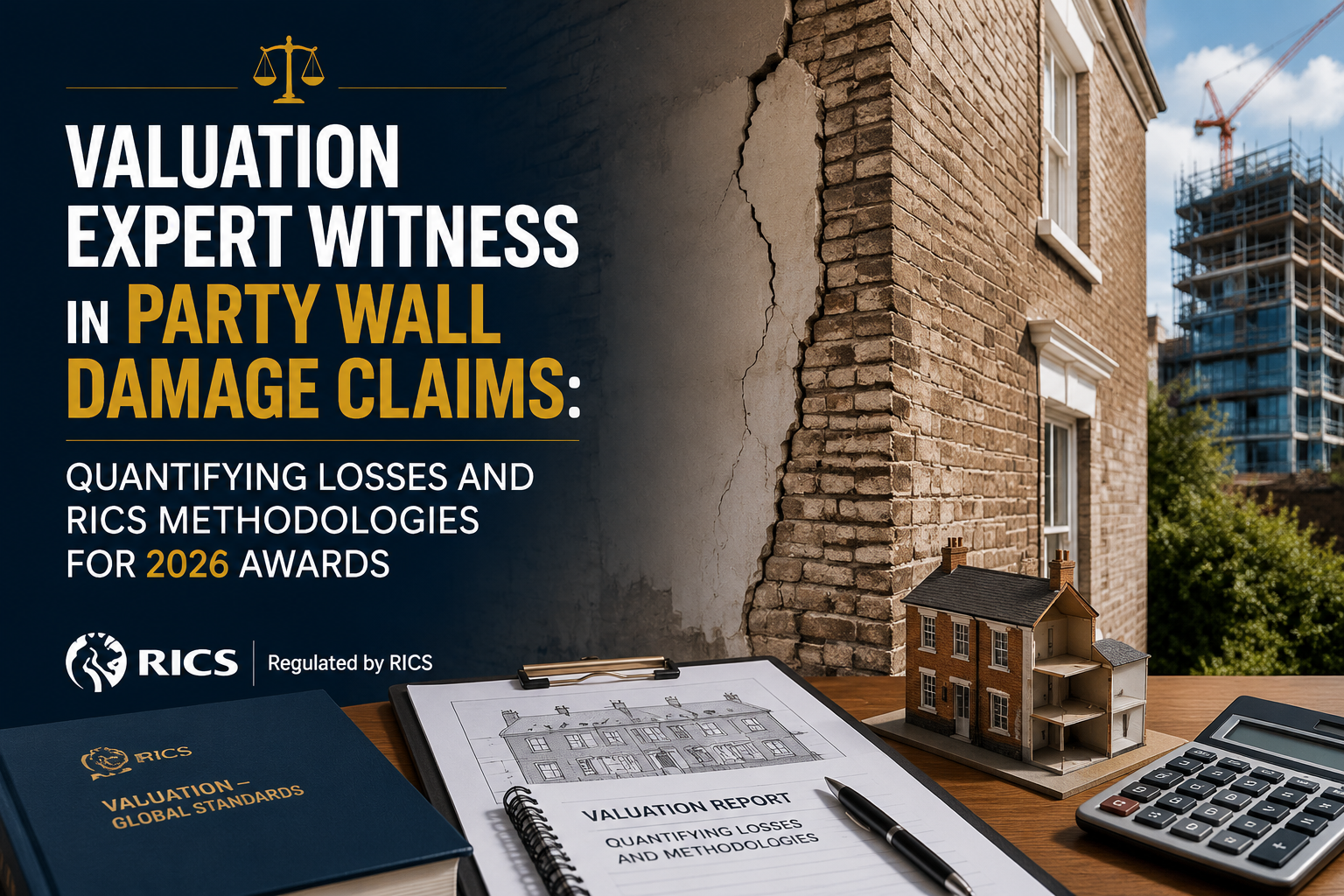
Structural damage from party wall works costs UK property owners tens of thousands of pounds every year — yet the majority of adjoining owners accept the first repair estimate they receive without ever understanding whether it truly reflects their loss. The role of a valuation expert witness in party wall damage claims: quantifying losses and RICS methodologies for 2026 awards has never been more critical. With London surveyor hourly rates reaching £400 and complex basement excavation disputes generating valuation fees of £4,000 or more [1], the financial stakes demand rigorous, evidence-based methodology — not guesswork.
This guide examines how RICS-accredited expert witnesses quantify property damage losses, which valuation approaches courts and surveyors favour in 2026, and how adjoining owners can protect their position through the entire party wall process.
Key Takeaways 📋
- A Schedule of Condition prepared before works begin is the single most important document for accurate damage quantification.
- RICS expert witnesses use three primary valuation methodologies: reinstatement cost, diminution in value, and consequential loss assessment.
- Adjoining owners have two compensation pathways: accepting the building owner's contractor estimates or commissioning an independent monetary valuation.
- Third surveyor determinations on valuation disputes typically cost £500–£1,500 [1], but fault-based cost allocation can shift this burden.
- Budgeting a 20–30% contingency above quoted surveyor fees is industry-standard practice for dispute escalation scenarios [1].
What a Valuation Expert Witness Does in Party Wall Damage Claims
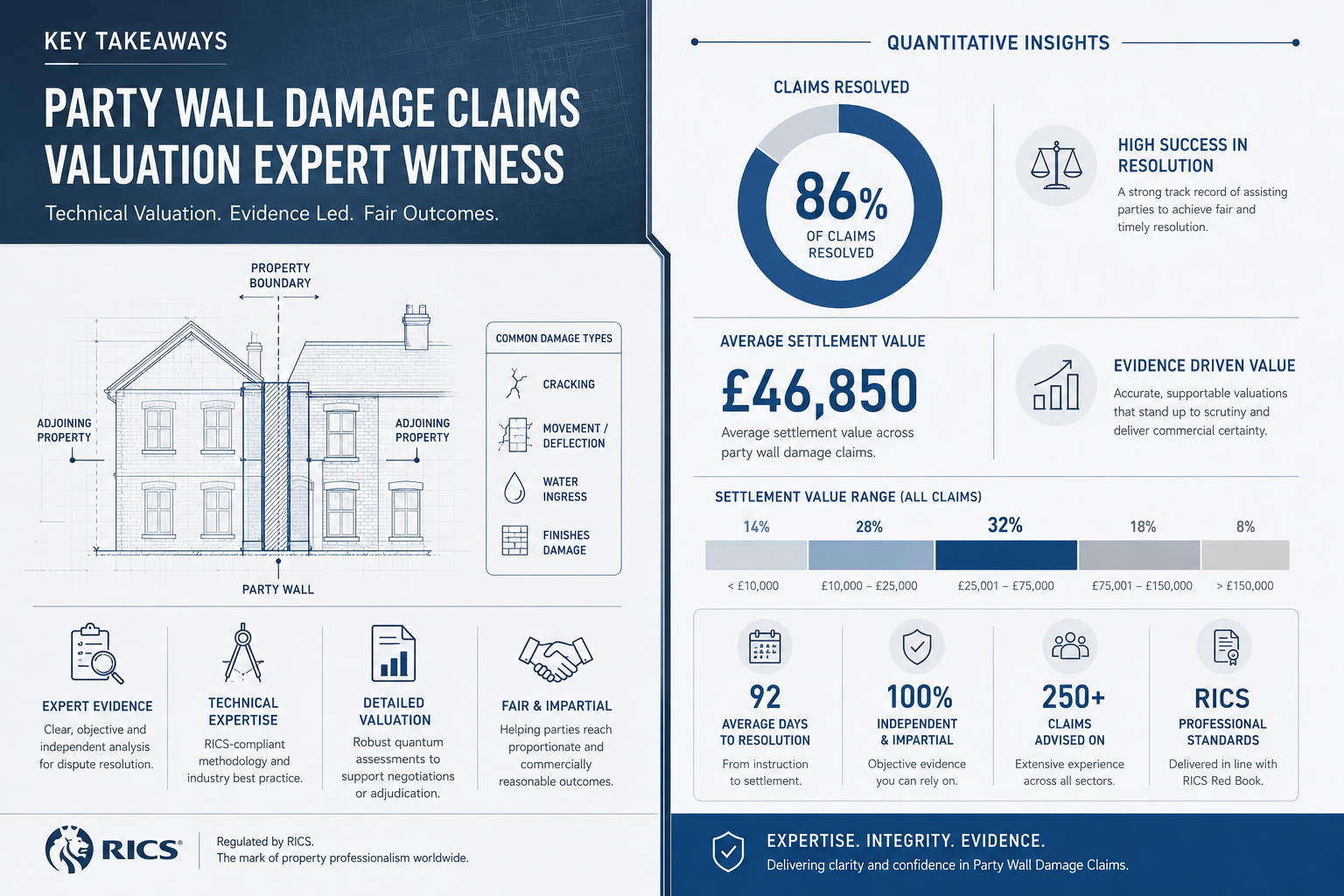
A valuation expert witness in party wall proceedings is not simply a surveyor who inspects cracks. Their role is forensic, analytical, and — critically — independent. Under the Party Wall etc. Act 1996, surveyors appointed by each party carry quasi-judicial responsibilities. When damage disputes escalate, an expert witness must be able to defend their valuation opinion under cross-examination, whether before a third surveyor, in the County Court, or in arbitration.
Core Responsibilities
Expert witnesses in party wall damage claims typically [2]:
- Assess notifiable works damage — cracks, settlement, vibration impact, and loss of support
- Adjudicate trespass claims — where works have encroached beyond permitted boundaries
- Specify working methods — to prevent further damage during ongoing construction
- Act as arbitrators — on construction-related matters beyond the strict party wall framework
The distinction between a standard party wall surveyor and a valuation expert witness matters enormously in contested claims. A surveyor producing a Schedule of Condition documents existing defects. An expert witness goes further — they must quantify the financial loss attributable specifically to the notifiable works, separating pre-existing defects from new damage with forensic precision.
Visible vs. Non-Visible Damage
Expert valuers must assess both categories [1]:
| Damage Type | Examples | Valuation Challenge |
|---|---|---|
| Visible | Cracks, open board joints, wallpaper tears, plaster loss | Straightforward reinstatement costing |
| Non-Visible | Vibration-induced loosening, foundation settlement, damp ingress pathways | Requires specialist engineer input |
| Consequential | Temporary accommodation, loss of rental income, professional fees | Requires documentary evidence |
Non-visible damage is where disputes most frequently arise — and where the valuation expert witness earns their fee.
RICS Methodologies for Quantifying Losses: The 2026 Framework
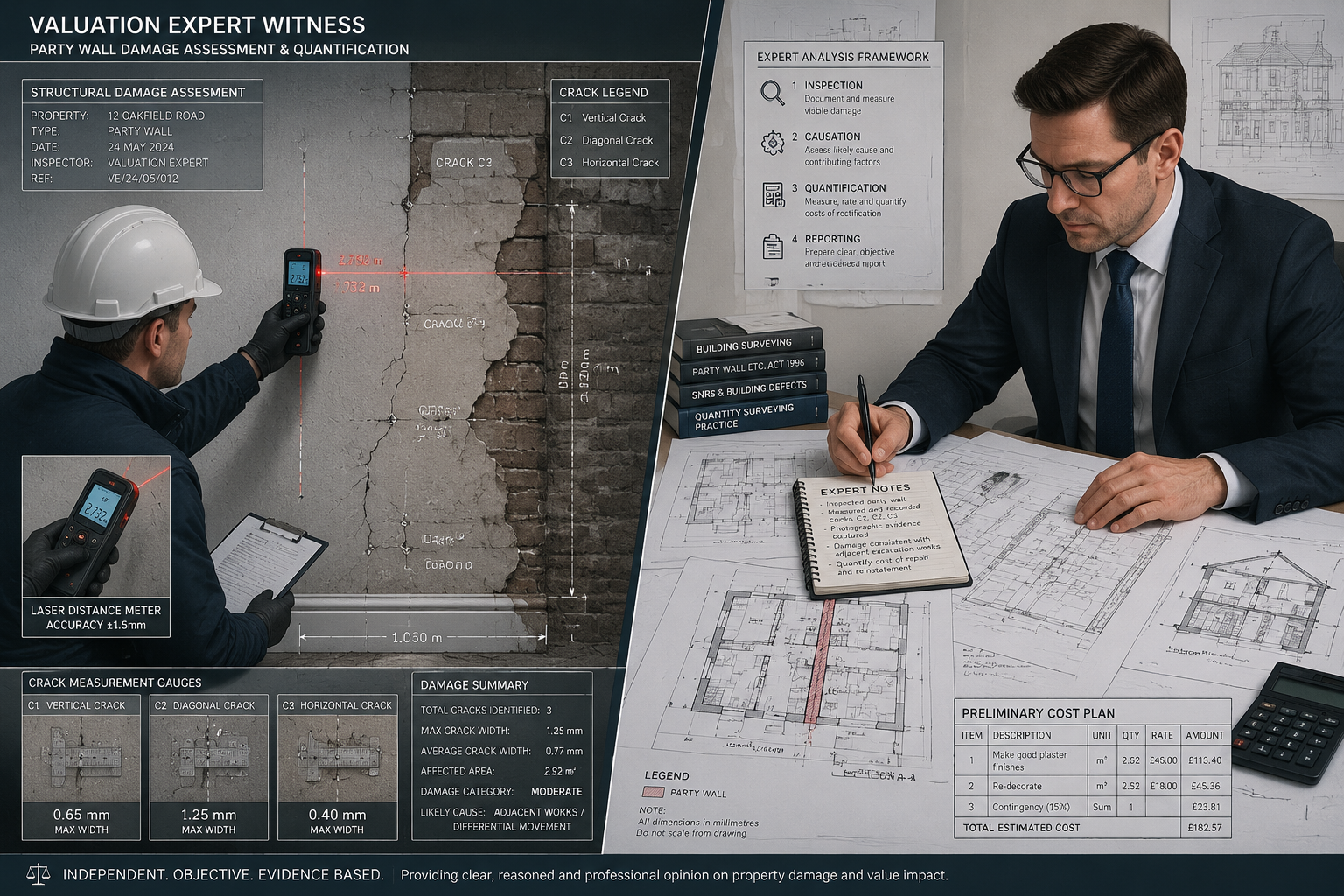
The valuation expert witness in party wall damage claims: quantifying losses and RICS methodologies for 2026 awards framework draws on RICS Valuation — Global Standards (the "Red Book") alongside the specific statutory context of the Party Wall etc. Act 1996. Three primary methodologies apply, and selecting the right one — or the right combination — is the first strategic decision in any damage claim.
1. Reinstatement Cost Method 🔨
This is the most commonly applied methodology for physical property damage. The expert witness calculates the actual cost of restoring the property to its pre-works condition, including:
- Labour and materials for crack repair, replastering, and redecoration
- Structural works (underpinning, lintel replacement, masonry repair)
- Specialist contractor costs for heritage or listed properties
- Supervision and project management fees
💬 "The reinstatement cost approach is only valid where repair is technically feasible and economically proportionate to the property's market value — where it is not, diminution in value becomes the appropriate measure."
For RICS reinstatement cost valuations, the expert must obtain competitive contractor quotes or use recognised cost databases (BCIS being the standard reference in the UK). In 2026, London construction cost inflation means reinstatement figures must be current — quotes more than three months old are routinely challenged.
2. Diminution in Value Method 📉
Where damage cannot be fully remediated, or where the stigma of past structural damage depresses market value even after repairs, the diminution in value approach applies. This requires the expert witness to:
- Establish the pre-works market value of the adjoining property
- Assess the post-damage market value (or post-repair value where stigma persists)
- Calculate the difference as the compensable loss
This methodology demands genuine valuation expertise — not just building surveying knowledge. The expert must be conversant with comparable sales evidence, yield analysis for investment properties, and the psychology of buyer behaviour in the affected market. For properties in prime London locations, even minor structural concerns can produce disproportionate diminution effects.
For context on how RICS valuations are structured in complex property scenarios, the Red Book's Market Value definition and the concept of the "prudent purchaser" are central reference points.
3. Consequential Loss Assessment 📋
Beyond physical damage, adjoining owners frequently suffer consequential losses that are equally compensable under the Act. These include:
- Temporary accommodation costs during major repair works
- Loss of rental income where the property is let
- Business interruption for commercial properties
- Professional fees (legal, surveying, engineering) reasonably incurred
- Distress and inconvenience (a more limited head of claim, but recognised)
Specialist engineer reports — which add £500–£2,000 to overall claim costs [1] — are often essential for consequential loss claims involving foundation movement or vibration-induced damage. These reports provide the technical foundation that an expert witness's financial quantification is built upon.
Dual Compensation Pathways
Adjoining owners face a fundamental choice in how compensation is structured [1]:
Pathway A — Building Owner's Contractor Estimates
The building owner's contractors assess and price the repair works. This is faster and avoids additional valuation costs, but carries an obvious conflict of interest risk.
Pathway B — Independent Monetary Valuation
The adjoining owner commissions an independent expert to value the loss, then engages their own contractors. This typically produces higher compensation figures but requires more time and upfront cost.
⚠️ Critical point: Adjoining owners who accept Pathway A without independent review frequently discover that repair specifications are inadequate or that consequential losses have been entirely ignored.
Negotiation Tactics, Dispute Escalation, and 2026 Award Considerations
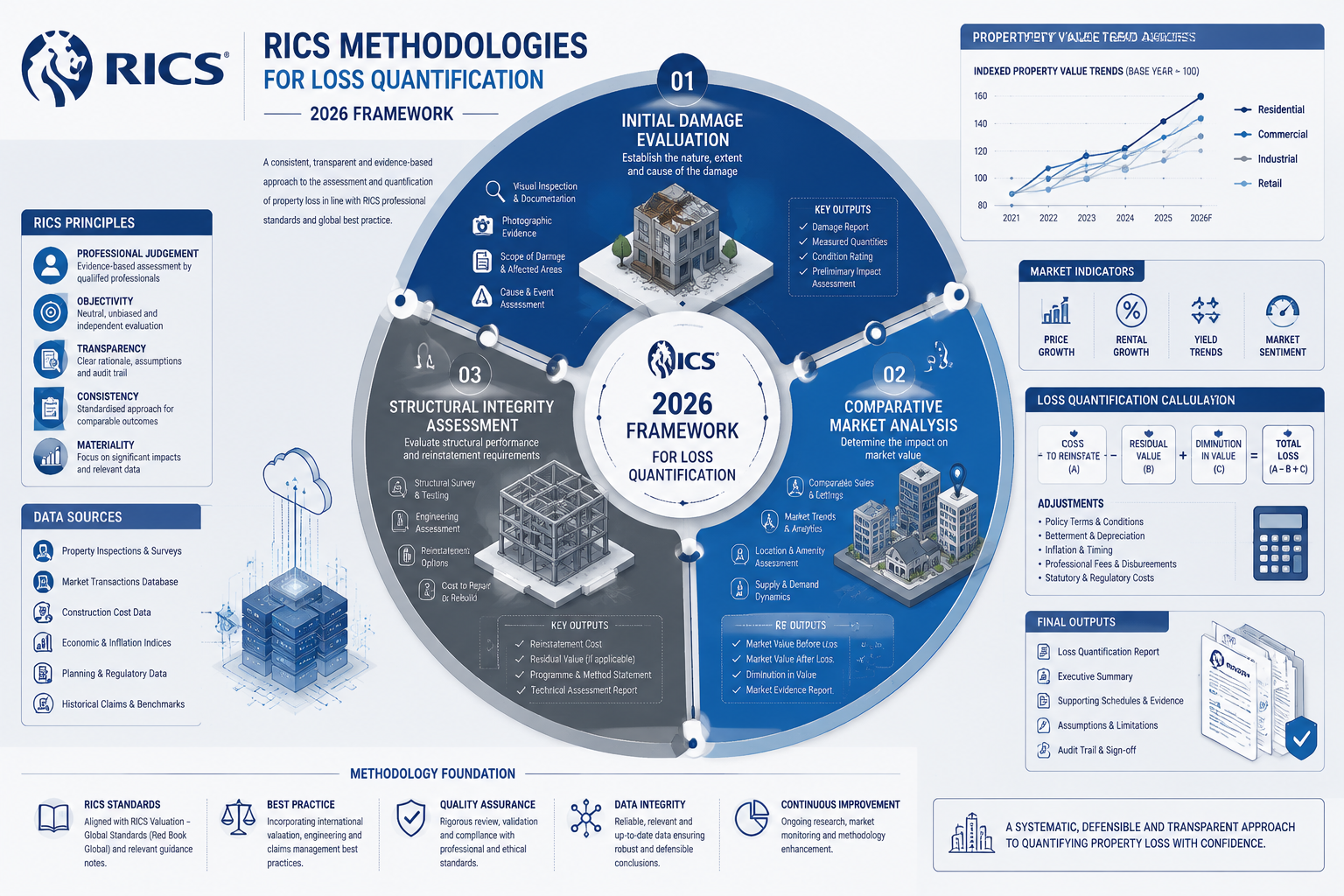
Understanding the valuation expert witness in party wall damage claims: quantifying losses and RICS methodologies for 2026 awards process requires equal attention to the procedural and tactical dimensions of dispute resolution — not just the technical valuation methodology.
The Schedule of Condition: Your Valuation Baseline
No discussion of damage quantification is complete without emphasising the Schedule of Condition. This pre-works inspection document is the critical baseline against which all post-works damage is measured [1]. Without it, attributing damage specifically to the notifiable works becomes an exercise in speculation — and speculation rarely succeeds in contested proceedings.
A properly prepared Schedule of Condition should include:
- Dated photographic evidence of all existing defects
- Written descriptions of crack widths, locations, and patterns
- Condition ratings for all affected rooms and external elements
- Baseline measurements for monitoring (e.g., crack gauges)
For guidance on how these documents are prepared and used in practice, see our Schedule of Condition guidance resource.
When Surveyors Reach Deadlock: The Third Surveyor
When appointed surveyors cannot agree on a damage valuation, the matter is referred to a third surveyor — a mechanism built into the Party Wall etc. Act 1996. The third surveyor's determination is binding on both parties.
2026 Third Surveyor Fee Ranges [1]:
| Dispute Complexity | Typical Fee Range |
|---|---|
| Simple valuation disagreement | £500 – £800 |
| Moderate complexity (multiple damage heads) | £800 – £1,200 |
| Complex (structural, consequential loss, multiple owners) | £1,200 – £1,500+ |
Critically, fee allocation follows fault-based principles [1]. If one party's unreasonable position caused the deadlock — for example, a building owner refusing to accept clear photographic evidence of damage — the third surveyor may award costs against that party. This creates a powerful incentive for both sides to engage constructively with valuation evidence.
For a deeper understanding of how party wall disputes are resolved, including the third surveyor mechanism, procedural timelines matter enormously.
Negotiation Tactics for Adjoining Owners 🎯
Adjoining owners in damage claims should consider the following tactical approaches:
1. Commission an independent Schedule of Condition immediately — even if the building owner's surveyor has already prepared one. Discrepancies between the two documents are themselves powerful evidence.
2. Document everything in real time — photograph new cracks as they appear, note dates and weather conditions, and keep a written diary of vibration events and working hours.
3. Obtain independent repair quotes early — before accepting any settlement offer. Multiple competitive quotes establish a credible market rate for reinstatement costs.
4. Don't overlook consequential losses — accommodation costs, professional fees, and even distress and inconvenience are legitimate heads of claim that building owners routinely fail to volunteer.
5. Budget for escalation — industry guidance recommends a 20–30% contingency above initial surveyor fee quotes [1]. In complex disputes, costs can escalate rapidly.
Fee Structures and Cost Responsibility in 2026
Under the Party Wall etc. Act 1996, the building owner bears responsibility for all reasonable party wall costs [1], including:
- Their own surveyor's fees
- The adjoining owner's surveyor's fees (where appointed)
- Party Wall Award preparation costs
- Third surveyor fees (subject to fault allocation)
- Additional site visit charges of £150–£400 per visit [1]
For complex projects — particularly those involving basement excavations or multiple adjoining owners — total surveyor costs can reach £4,000 or more [1]. Understanding how much a party wall surveyor costs in 2026 helps both parties budget realistically from the outset.
Case Study Scenarios: Common Damage Types in 2026 Claims
Scenario 1: Vibration-Induced Cracking (London Terrace)
A basement excavation project causes diagonal cracking in an adjoining Victorian terrace. The Schedule of Condition shows no pre-existing cracks at the affected locations. The valuation expert witness applies the reinstatement cost method, obtaining three contractor quotes averaging £18,500 for plasterwork, redecoration, and external repointing. A specialist structural engineer's report (cost: £1,400) confirms no ongoing movement. Total award: £19,900 plus professional fees.
Scenario 2: Foundation Settlement with Stigma (Prime London)
Underpinning works cause measurable settlement in an adjoining flat valued at £1.2 million. Repairs cost £22,000, but comparable sales evidence shows that disclosed structural history depresses values by 3–5% in the local market. The expert witness applies a combined reinstatement plus diminution approach, producing a total award of £22,000 (reinstatement) plus £36,000 (residual stigma diminution) — a figure the building owner's surveyor initially refused to accept before third surveyor referral.
Scenario 3: Commercial Property — Loss of Rental Income
Noisy demolition works breach agreed working hours, causing a commercial tenant to vacate temporarily. The adjoining owner's expert witness documents £8,200 in lost rent, £1,500 in legal fees, and £2,400 in temporary storage costs. The consequential loss claim totals £12,100, supported by lease documentation and accountant's confirmation.
Conclusion: Protecting Your Position in 2026 Party Wall Damage Claims
The quantification of losses in party wall damage claims is far more complex than simply obtaining a builder's quote. A skilled valuation expert witness applies RICS-recognised methodologies — reinstatement cost, diminution in value, and consequential loss — to produce defensible, evidence-based awards that hold up under scrutiny.
Actionable Next Steps ✅
- Before works begin: Insist on a comprehensive Schedule of Condition — this is your most important protective document.
- Appoint a qualified RICS surveyor with specific party wall expertise and experience in damage quantification, not just notice serving.
- Document damage in real time — photographs, dates, and written records are the foundation of any successful claim.
- Explore both compensation pathways before accepting any settlement — independent monetary valuation almost always produces more accurate and complete awards.
- Budget for the full process — including a 20–30% contingency for potential dispute escalation to third surveyor level.
- Seek specialist input early — where foundation movement or vibration damage is suspected, commission a structural engineer's report before any repair works begin.
Understanding the RICS party wall surveyor's role and engaging the right expert at the right stage can mean the difference between a fair award and a significant financial shortfall. In 2026, with construction costs at record levels and property values under pressure, getting the valuation right matters more than ever.
References
[1] Party Wall Dispute – https://onlinearchitecturalservices.com/party-wall-dispute/
[2] Party Wall Expert Witness Reports Lessons From Recent Uk Litigation And Rics Best Practices – https://nottinghillsurveyors.com/blog/party-wall-expert-witness-reports-lessons-from-recent-uk-litigation-and-rics-best-practices
[3] Property Damage Expert Witness – https://seakexperts.com/keywords/property-damage-expert-witness
[4] Construction Damages S 88 – https://www.jurispro.com/category/construction-damages-s-88
[5] Litigation Consulting – https://www.gciconsultants.com/building-envelope-services/litigation-consulting/
[6] Damages – https://www.experts.com/expert-witnesses/categories/damages
