
A single Reddit thread asking "do I need to notify my neighbour before chasing cables into our shared wall?" has been viewed tens of thousands of times — and the answers are almost universally wrong. Chasing Party Wall Works: When Structural Alterations Trigger Notifiable Rights Under the Party Wall Act 1996 is one of the most misunderstood areas of UK property law, leaving homeowners in terraced and semi-detached properties exposed to injunctions, common law claims, and costly disputes they never anticipated.
This article cuts through the confusion. It explains exactly which structural alterations trigger notifiable rights, what happens when notice is not served, and provides a practical checklist for property owners and surveyors alike.
Key Takeaways 📋
- Chasing into a party wall — cutting channels for pipes, cables, or conduits — can constitute notifiable work under the Party Wall etc. Act 1996 depending on depth, extent, and structural impact.
- No notice = no Act protections: The landmark Power and Kyson v Shah [2023] ruling confirmed that building owners who skip notice forfeit the Act's dispute resolution framework entirely. [8]
- Four main categories of work trigger notification requirements, including cutting into or altering the composition of a party wall. [7]
- Adjoining owners retain common law remedies — trespass, nuisance, negligence — when notice is not properly served. [8]
- Speed matters: Adjoining owners seeking injunctive relief must act promptly once unnotified works begin. [2]
What Is "Chasing" and Why Does It Matter Under the Party Wall Act?
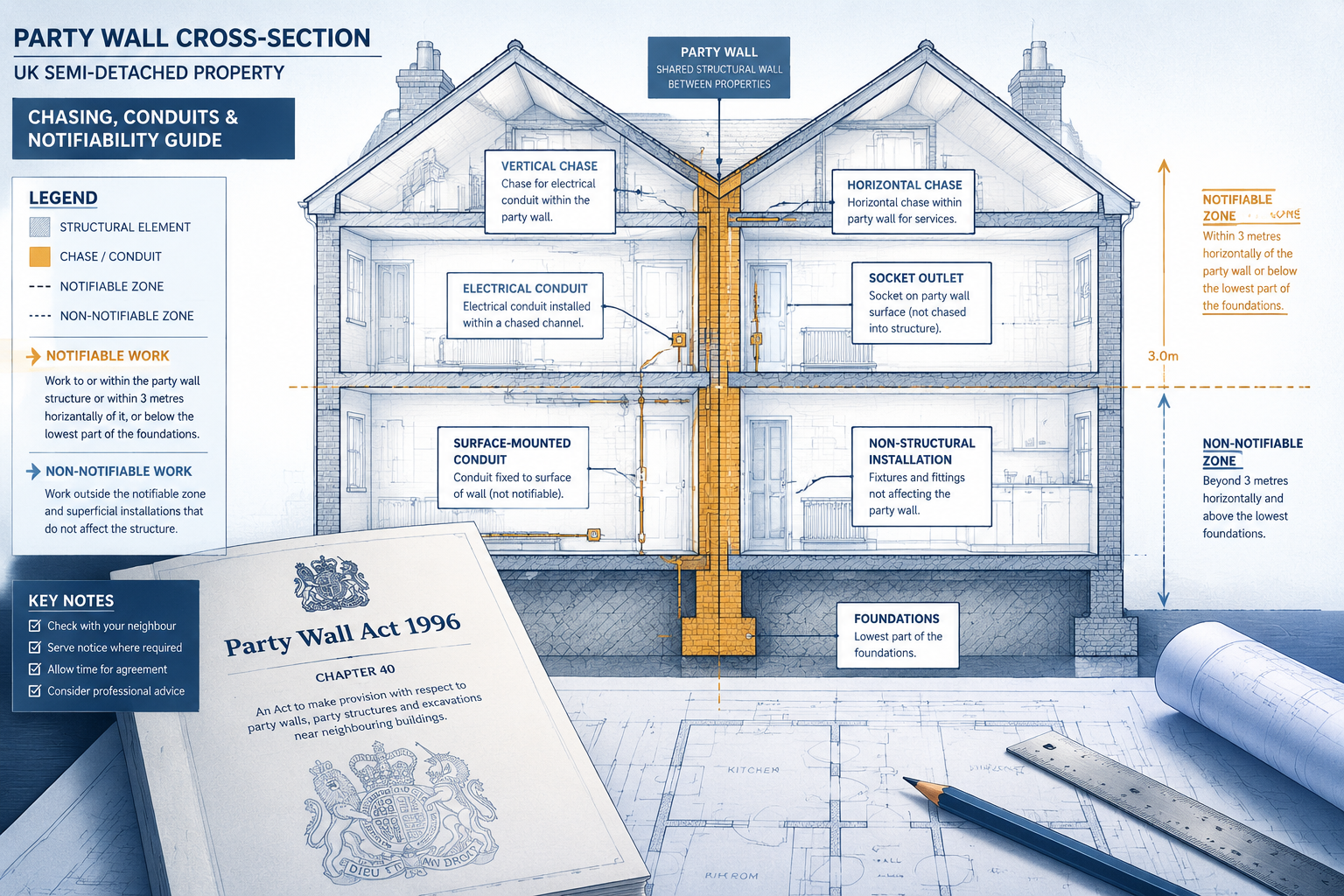
Chasing refers to cutting grooves or channels into a wall — typically to conceal electrical cables, water pipes, gas conduits, or heating pipework. In a standard internal wall, this is routine building work. But when that wall is a party wall shared with a neighbour, the legal picture changes dramatically.
The Party Wall etc. Act 1996 is the governing legislation in England and Wales for works affecting shared or boundary structures. [5] Its purpose is straightforward: to give adjoining owners advance notice of works that could affect their property, and to provide a structured framework for preventing and resolving disputes before they escalate. [7]
For a comprehensive foundation, see this understanding the Party Wall etc. Act 1996 guide which covers the Act's scope in detail.
What Counts as a Party Wall?
Before assessing whether chasing is notifiable, it is essential to confirm the wall in question is actually a party wall under the Act. A party wall is generally:
- A wall that stands on the boundary between two properties and is used by both owners
- A wall that forms part of one building but is built up to or astride the boundary
- A floor or ceiling separating flats in a building (a "party structure")
💡 Pull Quote: "Many homeowners assume that because the wall is 'inside their house,' they own it outright. In terraced and semi-detached properties, this is frequently incorrect."
Chasing Party Wall Works: When Structural Alterations Trigger Notifiable Rights Under the Party Wall Act 1996
The Act identifies four main categories of notifiable work. [7] Understanding where chasing sits within this framework is the critical first step.
The Four Notifiable Categories
| Category | Description | Typical Examples |
|---|---|---|
| 1. Line of junction works | New building on or at the boundary | New walls, extensions at the boundary |
| 2. Party structure works | Work to an existing party wall or structure | Cutting into, raising, lowering, demolishing |
| 3. Adjacent excavation | Digging below neighbour's foundation level | Basement conversions, underpinning |
| 4. Structural alterations | Altering composition or depth of party wall | Removing chimney breasts, inserting beams |
Chasing most directly engages Category 2: work to an existing party wall or party structure. The Act explicitly covers "cutting into a party wall" as a notifiable activity. [7] This is the provision that catches many homeowners off guard.
When Does Chasing Become Notifiable?
Not every scratch on a party wall triggers the Act. The key question is whether the chasing cuts into the party wall rather than merely affecting the surface plaster or render on the building owner's side.
Likely notifiable ⚠️:
- Cutting channels into the masonry or brick of the party wall itself
- Chasing that penetrates beyond the plaster into the structural fabric
- Installing conduits that require removal of mortar joints or brick courses
- Any cutting that could weaken or alter the structural integrity of the shared wall
Likely not notifiable ✅:
- Chasing into plaster or render on the building owner's own side only
- Surface-level works that do not affect the party wall structure
- Works entirely within the building owner's own non-party wall
The distinction between surface plaster and structural masonry is not always obvious. In older Victorian terraces — common across London and other UK cities — plaster can be thin, and the masonry begins almost immediately. A professional assessment is strongly advisable before any cutting begins.
Cutting Into vs. Cutting Through: Does It Matter?
Yes. Cutting into a party wall (creating a channel) is notifiable. Cutting through (creating an opening or aperture) is also notifiable and carries additional structural implications. Both trigger the requirement to serve a Party Structure Notice at least two months before works begin. [7]
For a detailed breakdown of this notice type, see this complete guide to party structure notices.
The "No Notice, No Act" Principle: What Happens Without Proper Notice?

The consequences of proceeding with notifiable chasing works without serving notice are serious and well-established in law.
Power and Kyson v Shah [2023]: A Landmark Warning
The Court of Appeal decision in Power and Kyson v Shah [2023] EWCA Civ 239 settled a long-running debate. The ruling confirmed that the Party Wall Act cannot be invoked retrospectively — surveyors cannot be appointed and the Act's dispute resolution machinery is unavailable if the building owner never served notice. [8]
This means:
- 🚫 No party wall award can be made
- 🚫 No statutory access rights exist
- 🚫 No immunity from common law claims
⚖️ Pull Quote: "Building owners who proceed without notice don't just face administrative inconvenience — they lose every protection the Act was designed to give them."
Common Law Remedies Remain Available
Where the Act has not been properly invoked, adjoining owners retain full access to common law remedies. [8] These include:
- Trespass — if works physically encroach on the adjoining owner's property
- Nuisance — for unreasonable interference with enjoyment of their property
- Negligence — if the works cause damage through careless execution
- Breach of statutory duty — for failing to serve the required notice
Critically, the Reeves v Blake [2009] decision established that party wall surveyors have no jurisdiction to make awards dealing with common law matters. [2] Once the Act's framework is bypassed, the courts — not surveyors — become the relevant forum.
Injunctions: Act Fast or Lose the Option
Adjoining owners who discover unnotified chasing works in progress have the option to seek an injunction to halt the works. However, injunctions are discretionary remedies and courts will consider how promptly the application was made. [2] Delay weakens the case considerably.
The practical advice: if unnotified structural works begin on a shared wall, seek legal advice immediately. For guidance on dispute resolution pathways, this comprehensive guide to resolving party wall disputes provides a useful overview.
Protections the Act Provides — But Only When Properly Invoked
The Party Wall etc. Act 1996 does not merely impose obligations — it also grants significant rights to building owners that would otherwise be unavailable under common law. [2]
These statutory permissions include:
- Projecting foundations over the legal boundary line
- Access over adjoining property to perform notifiable works
- Cutting away parts of the adjoining owner's property where necessary for the works
Each of these acts would ordinarily constitute trespass or nuisance. The Act legalises them — but only when notice has been properly served and the Act's procedures followed. [2]
This is the often-overlooked incentive for building owners to comply. Serving notice is not just a legal obligation; it is the gateway to rights that make complex structural works legally possible.
For loft conversions — which frequently involve party wall chasing and structural alterations — see this dedicated resource on party wall works for loft conversions.
Practical Checklist: Determining Notifiability for Chasing Works 🔍
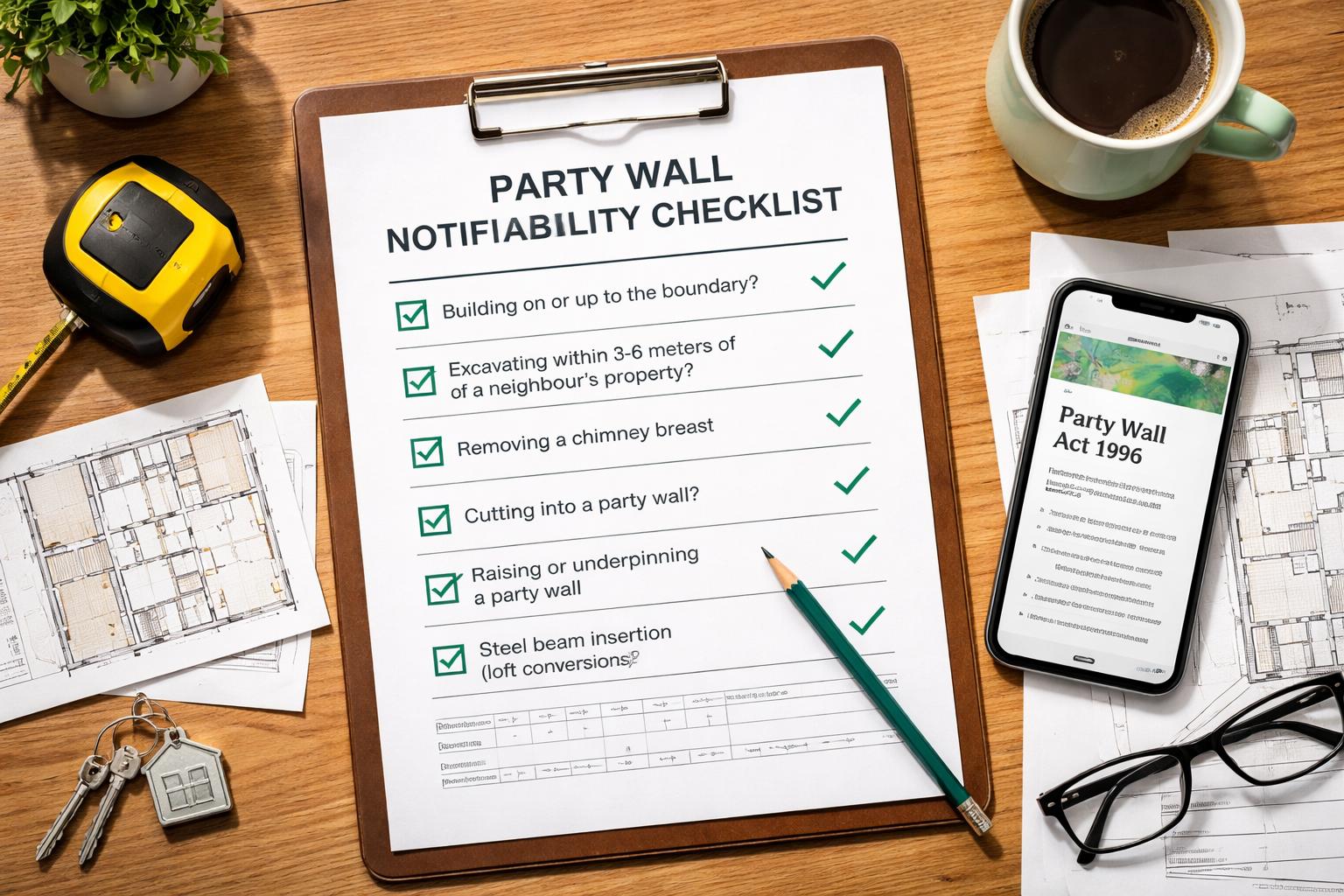
The following checklist is designed for property owners and surveyors assessing whether proposed chasing works require a Party Structure Notice.
Step 1: Identify the Wall Type
- Is the wall a party wall, party fence wall, or party structure under the Act?
- Does it stand on or astride the boundary between two separate properties?
- Is it used by both owners as a structural or enclosing element?
Step 2: Assess the Depth and Extent of Chasing
- Will the chasing penetrate beyond the plaster/render into masonry?
- Will it affect mortar joints, brick courses, or blockwork?
- Is the channel deep enough to reduce the structural thickness of the wall?
Step 3: Check the Location
- Is the chasing on the building owner's own (non-party) side only?
- Does it cross into the party wall structure itself?
- Are multiple channels proposed that could cumulatively weaken the wall?
Step 4: Consider the Structural Impact
- Could the works affect the load-bearing capacity of the wall?
- Is the wall already compromised (cracking, previous alterations)?
- Will the works require any removal of brick or block material?
Step 5: Confirm Notice Requirements
- If notifiable: serve a Party Structure Notice at least 2 months before works begin [7]
- Include a description of the proposed works, start date, and building owner's details
- Consider commissioning a schedule of condition before works begin to record the existing state of the adjoining property
✅ If in doubt, serve notice. The cost of serving notice is trivial compared to the cost of litigation, injunctions, or damage claims.
Common Pitfalls in Terraced and Semi-Detached Properties
Terraced and semi-detached properties present specific challenges because party walls are often load-bearing and may already carry the weight of floors, roofs, and upper storeys. Chasing into these walls carries greater structural risk than in detached properties.
Pitfall 1: Assuming Plaster Depth Equals Safety
In Victorian and Edwardian terraces, plaster coats are often only 10–15mm thick. A standard chasing depth for electrical conduit (typically 25mm or more) will almost certainly penetrate into the masonry. This makes the work notifiable in the vast majority of older terraced properties.
Pitfall 2: Cumulative Chasing
A single shallow chase may not be notifiable. But multiple chases — for example, running cables to every room on a party wall — can cumulatively affect the structural integrity of the wall. Surveyors should assess the total extent of proposed works, not individual channels in isolation.
Pitfall 3: Shared Chimney Breasts
Chimney breasts in terraced properties are almost always party structures. Chasing around or into a shared chimney breast is notifiable and requires particular care. For more on this specific issue, see this guide to party wall shared chimneys.
Pitfall 4: Retrospective Consent Is Not Available
Some building owners attempt to regularise unnotified works after the fact by seeking retrospective agreement from their neighbour. While neighbours can agree to overlook past works, the Act's formal protections cannot be applied retrospectively following Power and Kyson v Shah. [8] Retrospective goodwill is not the same as statutory protection.
Pitfall 5: Relying on Verbal Agreements
Verbal consent from a neighbour does not satisfy the Act's requirements. [4] Notice must be served in writing, and any consent or dissent must follow the statutory procedure. For guidance on drafting compliant notices, see this resource on how to write a party wall letter.
The Role of the Party Wall Surveyor in Chasing Disputes
When a dispute arises — or when a building owner wants certainty before proceeding — a qualified party wall surveyor is the appropriate professional to engage. [1]
Surveyors can:
- Assess whether proposed chasing works are notifiable
- Prepare and serve Party Structure Notices on behalf of building owners
- Act as agreed surveyor or appointed surveyor in the dispute resolution process
- Draft a Party Wall Award setting out the permitted works, working hours, and protective conditions
- Carry out or review a schedule of condition to protect both parties
The surveyor's role is not adversarial — the Act is designed to facilitate works while protecting neighbours, not to prevent construction. Understanding what a party wall surveyor does helps both building owners and adjoining owners engage with the process constructively.
Conclusion: Practical Next Steps for Property Owners in 2026
The question of whether chasing works require a Party Wall notice is not always simple — but the consequences of getting it wrong are clear and costly. The Power and Kyson v Shah ruling has removed any ambiguity: the Act's protections are only available to those who follow its procedures from the outset. [8]
Actionable next steps:
- Identify your wall type before any cutting begins. If it is a party wall, assume the Act applies until a professional confirms otherwise.
- Commission a professional assessment from a chartered party wall surveyor if there is any doubt about notifiability.
- Serve notice early — at least two months before proposed works — to avoid delays to your project.
- Commission a schedule of condition to document the state of the adjoining property before works begin, protecting both parties.
- If you are an adjoining owner and works have started without notice, seek legal advice immediately and act promptly if injunctive relief may be needed.
- Never rely on verbal agreements — all consents and dissents must follow the statutory written process.
The Party Wall etc. Act 1996 exists to make structural works between neighbours manageable and fair. Used correctly, it protects building owners and adjoining owners alike. Ignored, it creates exactly the disputes it was designed to prevent.
References
[1] The Party Wall Etc Act 1996 Explanatory Booklet – https://www.gov.uk/government/publications/preventing-and-resolving-disputes-in-relation-to-party-walls/the-party-wall-etc-act-1996-explanatory-booklet
[2] Is The Party Wall Act Now Obsolete – https://ww3.rics.org/uk/en/journals/built-environment-journal/is-the-party-wall-act-now-obsolete-.html
[4] The Party Wall Act Common Misunderstandings – https://www.peterbarry.co.uk/blog/the-party-wall-act-common-misunderstandings/
[5] Contents – https://www.legislation.gov.uk/ukpga/1996/40/contents
[7] Preventing And Resolving Disputes In Relation To Party Walls – https://www.gov.uk/government/publications/preventing-and-resolving-disputes-in-relation-to-party-walls
[8] Take Notice The Costly Implications Of Ignoring The Party Wall Etc Act 1996 – https://www.dtmlegal.com/legalupdates/take-notice-the-costly-implications-of-ignoring-the-party-wall-etc-act-1996/
