
The built environment is responsible for 40% of global carbon emissions — and a significant share of that figure sits squarely in the hands of surveyors, developers, and adjoining property owners navigating boundary works [4]. The RICS Sustainability Report 2025, informed by over 3,500 professionals across 36 countries, has fundamentally shifted expectations for how party wall surveyors approach retrofit and net zero projects [2]. Understanding the Party Wall Implications of RICS Sustainability Report 2025: Survey Protocols for Net Zero Boundary Works in 2026 is no longer optional for practitioners — it is a professional imperative.
Key Takeaways 📋
- The RICS Sustainability Report 2025 introduces whole-life carbon thinking into party wall survey practice, requiring surveyors to consider retrofit emissions on adjoining structures.
- The CLEAR Initiative (Coalition for Life Cycle Emissions Alignment and Reporting), launched in April 2026, provides a global framework for harmonising carbon measurement relevant to boundary works.
- PAS 2080 integration into party wall awards is becoming best practice for net zero boundary projects in 2026.
- A draft 8th edition of Party Wall Legislation and Procedure is under RICS consultation, signalling formal updates to survey protocols.
- Party wall surveyors must now document embodied carbon impacts on adjoining structures as part of schedule of condition and award drafting processes.
Why the RICS Sustainability Report 2025 Changes Everything for Party Wall Practice
For decades, party wall surveying operated within a relatively stable legal and technical framework anchored by the Party Wall etc. Act 1996. That framework remains the bedrock. But the RICS Sustainability Report 2025 has introduced a powerful new layer of professional obligation that practitioners cannot ignore [1].
The report, drawing on responses from more than 3,500 professionals across 36 countries, found that sustainability competency gaps remain widespread in the surveying profession — particularly in areas relating to whole-life carbon assessment, retrofit decision-making, and the carbon implications of construction works on neighbouring structures [2].
💬 "The built environment accounts for 40% of global carbon emissions. Every boundary works decision — from insulation to structural alterations — carries a carbon consequence that surveyors are now expected to quantify and document." [4]
For party wall surveyors, this translates into a clear professional direction: sustainability is not a separate discipline. It is woven into the fabric of how boundary works are assessed, how awards are drafted, and how adjoining owners' interests are protected in 2026 and beyond.
The CLEAR Initiative and Its Boundary Works Relevance
In April 2026, RICS and global partners launched the CLEAR Initiative — the Coalition for Life Cycle Emissions Alignment and Reporting — at the Sustainable Buildings and Construction Summit in Lausanne, Switzerland [5]. CLEAR is designed to harmonise whole-life carbon emissions measurement and reporting across the global built environment.
For party wall practice, CLEAR's significance is direct:
- It establishes a common language for carbon measurement that surveyors can reference in party wall awards.
- It supports the integration of embodied carbon assessments into pre-construction condition surveys.
- It aligns with PAS 2080 (the Carbon Management in Infrastructure standard), which is increasingly cited in net zero boundary works documentation.
The CLEAR framework does not override the Party Wall etc. Act 1996, but it provides surveyors with a credible, internationally recognised methodology for addressing sustainability obligations within award drafting [5].
Understanding the Party Wall Implications of RICS Sustainability Report 2025: Survey Protocols for Net Zero Boundary Works in 2026
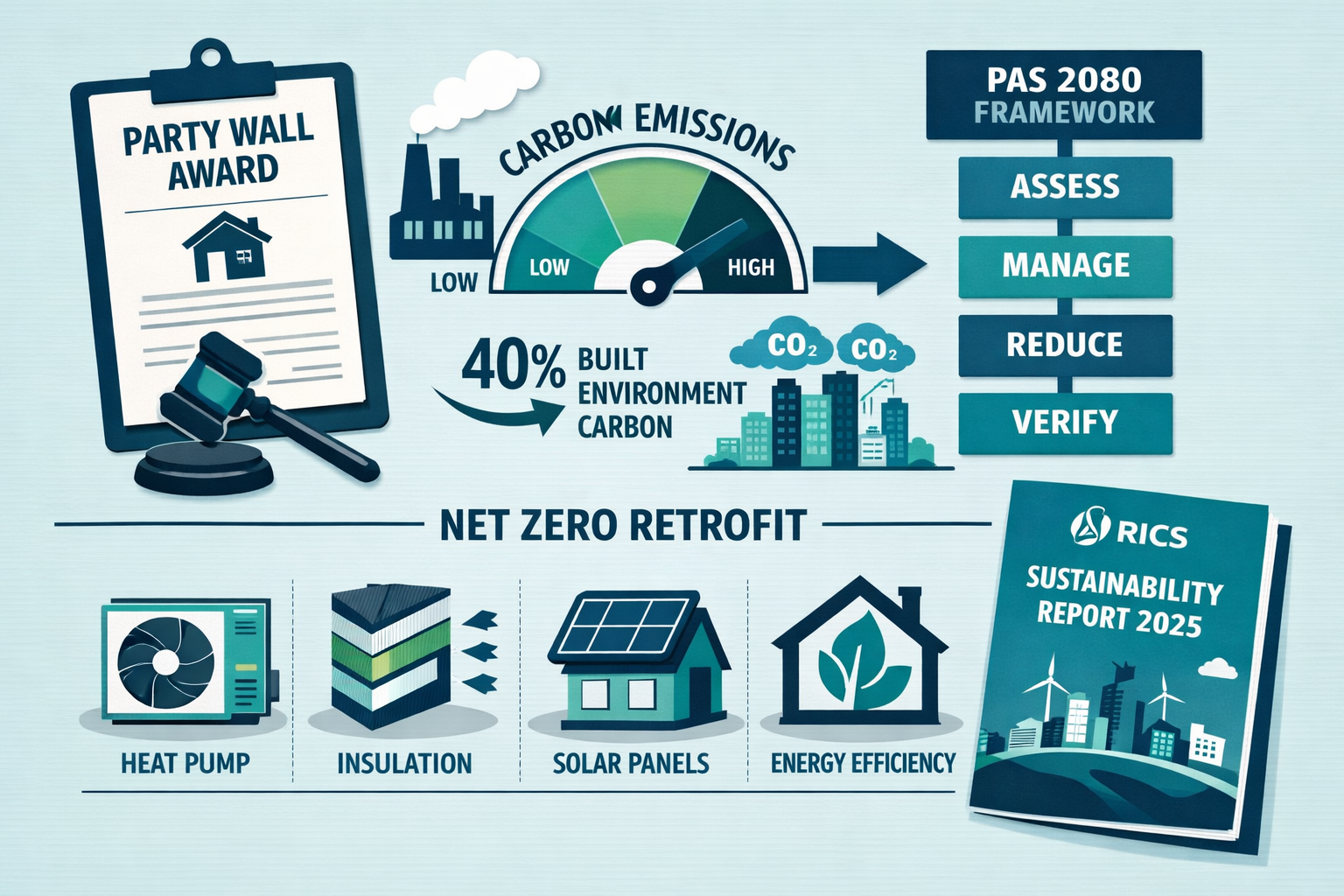
The practical survey protocols emerging from the Party Wall Implications of RICS Sustainability Report 2025 centre on three interconnected areas: pre-works carbon baseline documentation, retrofit impact assessment on adjoining structures, and award drafting aligned with PAS 2080.
1. Pre-Works Carbon Baseline Documentation
Traditional schedule of condition reports capture the physical state of an adjoining property before works begin. In 2026, best practice now extends this to include:
| Traditional Schedule of Condition | Net Zero Enhanced Protocol |
|---|---|
| Photographic record of existing defects | Photographic + thermal imaging baseline |
| Structural condition notes | Embodied carbon of existing materials noted |
| Dampness and cracking assessment | Existing insulation performance recorded |
| Party wall dimensions and materials | U-value and energy performance data captured |
This enhanced baseline serves two purposes. First, it protects the adjoining owner by documenting the thermal and energy performance of their property before any works affect the party wall. Second, it provides the building owner with defensible evidence should disputes arise about whether net zero works caused thermal bridging, condensation, or moisture ingress to the neighbour's side.
2. Retrofit Impact Assessment on Adjoining Structures
Net zero boundary works — including external wall insulation (EWI), internal wall insulation (IWI), heat pump installations, and airtightness measures — can have significant unintended consequences for adjoining properties. These include:
- 🌡️ Thermal bridging at the party wall junction
- 💧 Interstitial condensation risk where insulation meets an uninsulated adjoining wall
- 🔊 Acoustic performance changes from altered wall mass
- 🏗️ Structural loading changes from added insulation weight or mechanical fixings
A party wall surveyor's responsibilities now include assessing these retrofit risks and ensuring the party wall award includes adequate protective conditions. This may require collaboration with a structural engineer or energy assessor — a multidisciplinary approach that the RICS Sustainability Report 2025 actively encourages [6].
3. PAS 2080 Integration in Award Drafting
PAS 2080 (Carbon Management in Infrastructure, 2nd edition) provides a structured methodology for managing carbon across the lifecycle of construction projects. Its integration into party wall awards is a growing expectation in 2026, particularly for:
- Residential retrofit projects claiming green finance or energy efficiency grants
- Commercial boundary works where ESG reporting obligations apply
- Local authority and housing association works subject to net zero procurement policies
In practical terms, PAS 2080 integration means the party wall award should:
- Reference the carbon management plan for the proposed works
- Specify low-carbon material substitutions where technically feasible
- Include a post-works carbon verification clause to confirm compliance
- Document the whole-life carbon impact on the party wall structure
For surveyors unfamiliar with PAS 2080, the RICS Level 3 Building Survey framework provides a useful parallel — both require detailed, evidence-based assessments that go beyond surface-level observation.
The Draft 8th Edition: Party Wall Legislation and Procedure Under Consultation
RICS has launched a formal consultation on the draft 8th edition of Party Wall Legislation and Procedure, inviting input from surveyors, legal professionals, and dispute resolution practitioners across England and Wales [5]. This is the most significant update to the professional guidance framework in years, and sustainability is a central theme.
Key proposed changes relevant to net zero boundary works include:
- Expanded notice requirements for works involving significant thermal or energy performance alterations to party walls
- Updated award templates that accommodate carbon assessment clauses
- Clearer guidance on the surveyor's duty to consider whole-life impacts, not just immediate structural risk
- New provisions for resolving disputes arising from retrofit works affecting adjoining owners
Understanding when a party wall agreement is legally required remains foundational. The draft 8th edition does not change the fundamental triggers under the Act — but it significantly expands what a compliant award must address when those works involve net zero measures.
What Surveyors Should Do Now
The consultation period is an opportunity for practitioners to shape the final guidance. Surveyors working on net zero boundary projects in 2026 should:
- Review the draft 8th edition and submit responses to the RICS consultation
- Upskill in whole-life carbon assessment methodologies, including CLEAR and PAS 2080
- Update standard award templates to include sustainability clauses
- Engage energy assessors as part of the pre-award investigation process
Practical Survey Protocols for Net Zero Boundary Works in 2026
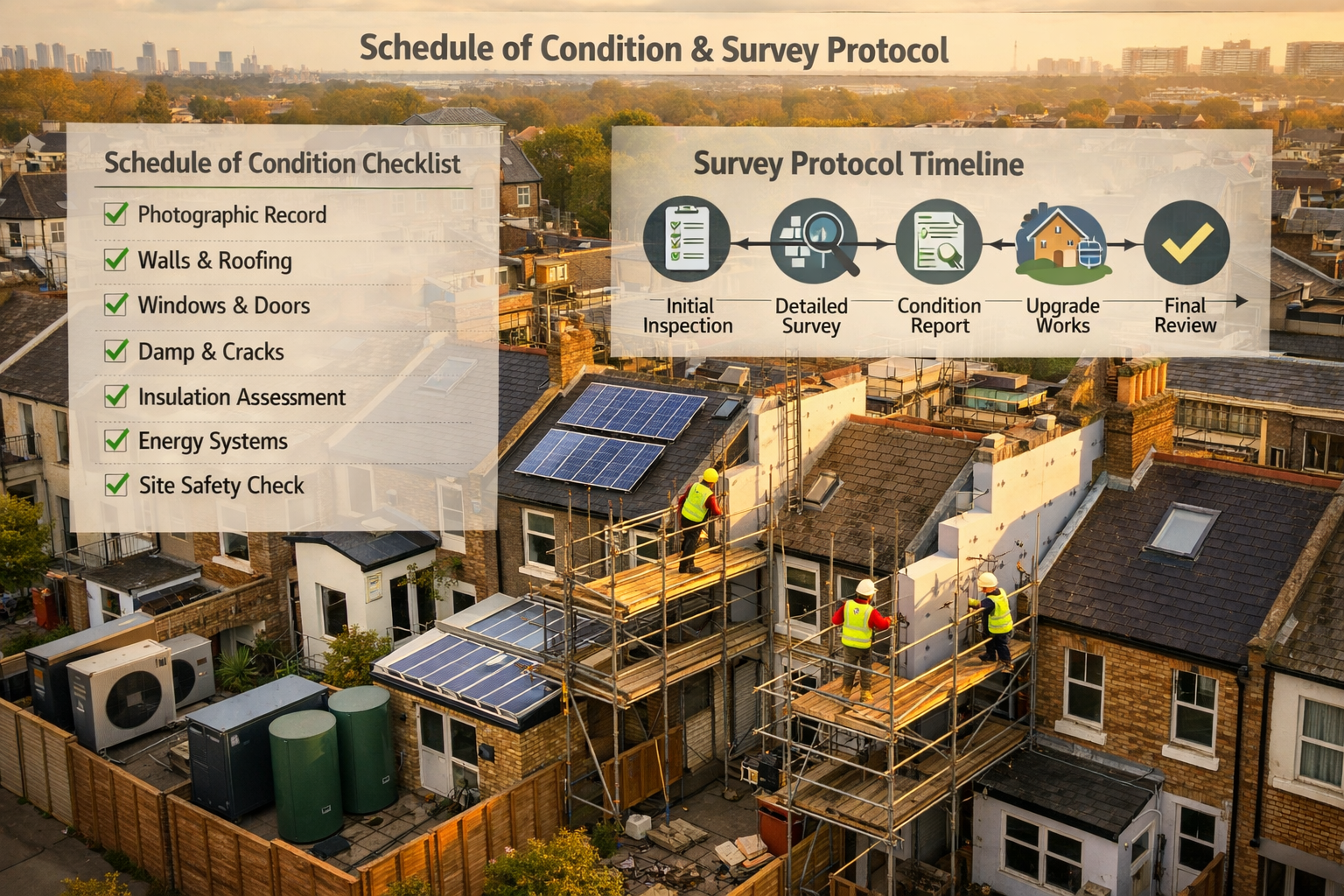
The Party Wall Implications of RICS Sustainability Report 2025: Survey Protocols for Net Zero Boundary Works in 2026 require a structured, step-by-step approach that integrates sustainability thinking at every stage of the party wall process.
Step-by-Step Protocol for Net Zero Party Wall Surveys
Step 1: Enhanced Notice Drafting 🏠
When serving a party wall notice, building owners undertaking net zero works should include:
- A description of the proposed insulation or energy measures
- Details of any materials that will be fixed to or affect the party wall
- A preliminary carbon impact summary if PAS 2080 applies
Step 2: Sustainability-Informed Schedule of Condition
The pre-works survey must capture thermal performance data alongside traditional condition recording. Thermal imaging cameras are now considered best practice equipment for net zero boundary surveys. This comprehensive condition survey approach protects both parties.
Step 3: Retrofit Risk Assessment
Before drafting the award, the surveyor must assess:
- Whether proposed works create thermal bridging at the party wall
- The moisture risk profile of the adjoining wall post-retrofit
- Any structural implications of added insulation mass or mechanical fixings
Step 4: Award Drafting with Carbon Clauses
The party wall award should now include:
| Award Clause | Net Zero Requirement |
|---|---|
| Working hours | Standard |
| Method of works | Include low-carbon material specifications |
| Protection measures | Include thermal bridge prevention details |
| Post-works survey | Include thermal performance verification |
| Dispute resolution | Include carbon impact dispute pathway |
Step 5: Post-Works Verification
A follow-up survey confirming that the party wall's thermal and structural performance has not been adversely affected is increasingly expected — particularly where the adjoining owner has raised sustainability concerns.
Common Net Zero Boundary Works Requiring Party Wall Agreements
The following works are most commonly triggering party wall obligations in the context of net zero retrofits in 2026:
- External Wall Insulation (EWI) — often requires a party structure notice where the wall is shared
- Internal Wall Insulation (IWI) — may affect the party wall's structural behaviour
- Airtightness membrane installation — can alter moisture dynamics in the party wall
- Heat pump flue or pipework — may require excavation near the boundary (triggering the 3-metre rule)
- Roof insulation at party wall junction — requires careful detailing to prevent cold bridging
Challenges and Disputes in Net Zero Party Wall Practice
The intersection of sustainability obligations and party wall law creates new dispute risks that surveyors must anticipate. The RICS Sustainability Report 2025 acknowledges that skills gaps in carbon literacy remain a significant challenge across the profession [1].
Top Dispute Triggers in 2026 Net Zero Boundary Works
- Thermal performance disagreements — Adjoining owners claiming that retrofit works have worsened their property's energy performance
- Moisture and condensation disputes — Arising from insulation changes that alter the party wall's hygrothermal behaviour
- Material specification conflicts — Where building owners choose lower-carbon materials that the adjoining owner considers structurally inferior
- Carbon credit and grant eligibility — Disputes over who benefits from energy improvements to a shared wall
Understanding how to resolve party wall disputes is essential for surveyors navigating these emerging conflict areas. The key is proactive communication, thorough documentation, and awards that anticipate sustainability-related concerns before works begin.
💬 "A well-drafted party wall award in 2026 is not just a legal document — it is a sustainability management tool that protects both parties across the whole life of the works."
Conclusion: Actionable Next Steps for Surveyors and Property Owners
The Party Wall Implications of RICS Sustainability Report 2025: Survey Protocols for Net Zero Boundary Works in 2026 represent a genuine paradigm shift in party wall practice. The report's findings, the launch of the CLEAR Initiative, and the draft 8th edition consultation all point in the same direction: sustainability competency is now a core requirement for party wall surveyors, not an optional extra [1][5].
Actionable Next Steps ✅
For Party Wall Surveyors:
- Invest in thermal imaging equipment and whole-life carbon training
- Update standard award templates to include PAS 2080-aligned clauses
- Engage with the RICS draft 8th edition consultation before it closes
- Build relationships with energy assessors and structural engineers for multidisciplinary projects
For Building Owners Undertaking Net Zero Works:
- Serve notices early and include sustainability documentation with your party wall notice
- Commission an enhanced schedule of condition that captures thermal baseline data
- Discuss carbon management plans with your surveyor before works begin
For Adjoining Owners:
- Request that the party wall award includes post-works thermal performance verification
- Understand your rights regarding retrofit impacts on your property's energy performance
- Seek a surveyor with demonstrated sustainability competency for net zero boundary projects
The convergence of party wall law and sustainability obligations is not a future challenge — it is the present reality of boundary works in 2026. Surveyors who embrace this shift will be better equipped to protect their clients, reduce disputes, and contribute meaningfully to the built environment's net zero transition.
References
[1] Sustainability Report 2025 – https://www.rics.org/news-insights/current-topics-campaigns/sustainability/sustainability-report-2025
[2] Sustainability Report 2025 Royal Institution Chartered Surveyors – https://build-up.ec.europa.eu/en/resources-and-tools/publications/sustainability-report-2025-royal-institution-chartered-surveyors
[4] Sustainability Report 2025 Infographic – https://www.rics.org/content/dam/ricsglobal/documents/reports/Sustainability-Report-2025-Infographic.pdf
[5] Rics And Global Partners Launch Clear – https://www.rics.org/news-insights/rics-and-global-partners-launch-clear
[6] Sustainability Report 2025 (Full Report) – https://www.rics.org/content/dam/ricsglobal/documents/reports/Sustainability-report-2025.pdf
