
Over 3,000 residential buildings in England still contain unsafe cladding or fire safety defects — and the government's answer is a landmark funding mechanism that shifts the financial burden squarely onto developers. From 1 October 2026, the Building Safety Levy comes into force, targeting an estimated £3.4 billion over a decade to fund remediation. If you are a leaseholder, freeholder, or developer in Notting Hill, Kensington, or Chelsea, the implications are significant — and the clock is already ticking.
The Building Safety Levy October 2026 leaseholders framework is designed so that residents are explicitly protected from bearing the cost of historical building safety failures. But protection is not automatic, and the gaps in coverage — particularly for buildings under 11 metres — remain a serious concern.
Key Takeaways 📋
- 🏗️ The Building Safety Levy launches 1 October 2026, charged to developers per square metre of new residential floorspace.
- 💷 The levy aims to raise £3.4 billion over 10 years to fund cladding and fire safety remediation.
- 🛡️ Leaseholders in buildings above 11 metres are legally protected from remediation costs under the Building Safety Act 2022.
- ⚠️ Buildings under 11 metres remain in a legal grey area — a gap the expected Remediation Bill (2026) may address.
- 🔍 Chartered building surveyors play a critical role in EWS1 forms, FRAEW assessments, and remediation oversight.
What Is the Building Safety Levy and How Does It Work?
The Building Safety Levy is a developer charge, not a tax on residents. It applies to all building control applications and initial notices submitted on or after 1 October 2026 for new residential developments. Pre-October 2026 applications avoid liability entirely, which is why many developers are rushing to submit before the deadline.
Who Pays?
Developers pay the levy — not leaseholders, freeholders, or local authorities. The charge is calculated per square metre of residential floorspace and must be paid before a development can be completed or occupied. Funds are collected by local authorities and passed directly to central government for remediation purposes.
Rates are not uniform. They vary by local authority area, with higher charges in high-value areas (which directly affects prime London boroughs like Kensington and Chelsea) and a notable premium on greenfield versus brownfield sites.
Who Is Exempt?
Not every developer will pay. Key exemptions include:
| Category | Exempt? |
|---|---|
| Affordable housing developments | ✅ Yes |
| Housing Associations (all homes, including open market sale) | ✅ Yes |
| Supported and care home developments | ✅ Yes |
| Developments under 10 dwellings (or under 30 PBSA bedspaces) | ✅ Yes |
| Standard private residential developments (10+ units) | ❌ No |
"The explicit purpose of the levy is to ensure the burden of paying to fix historical building safety defects does not fall on leaseholders or taxpayers." — MHCLG, Building Safety Levy guidance
Importantly, anti-avoidance rules prevent developers from splitting applications to fall below the 10-dwelling threshold. Regulators have built robust provisions to close this loophole.
Leaseholder Protections Under the Building Safety Act 2022
The Building Safety Act 2022 introduced the strongest leaseholder protections in a generation. For buildings above 11 metres (or five or more storeys), qualifying leaseholders cannot be charged for the remediation of:
- Unsafe cladding systems
- Structural defects linked to original construction
- Fire safety works where the developer or freeholder is responsible
These protections apply regardless of when the lease was granted, provided the leaseholder is not the developer and meets residency or ownership criteria.
The Under-11m Gap
Here lies the most pressing concern for many residents in converted Victorian and Edwardian mansion flats across Notting Hill and Chelsea. Buildings under 11 metres fall outside the statutory protections of the Building Safety Act 2022. Leaseholders in these properties can still, in principle, be billed for fire safety remediation through service charges.
The Remediation Bill, expected during 2026, is anticipated to address this gap — potentially extending some form of protection or funding route to lower-rise buildings. Until legislation is confirmed, leaseholders in sub-11m blocks should seek specialist surveying and legal advice as a priority.
Remediation Deadlines: What the Timeline Means for You
The government has set firm deadlines for completing fire safety remediation works:
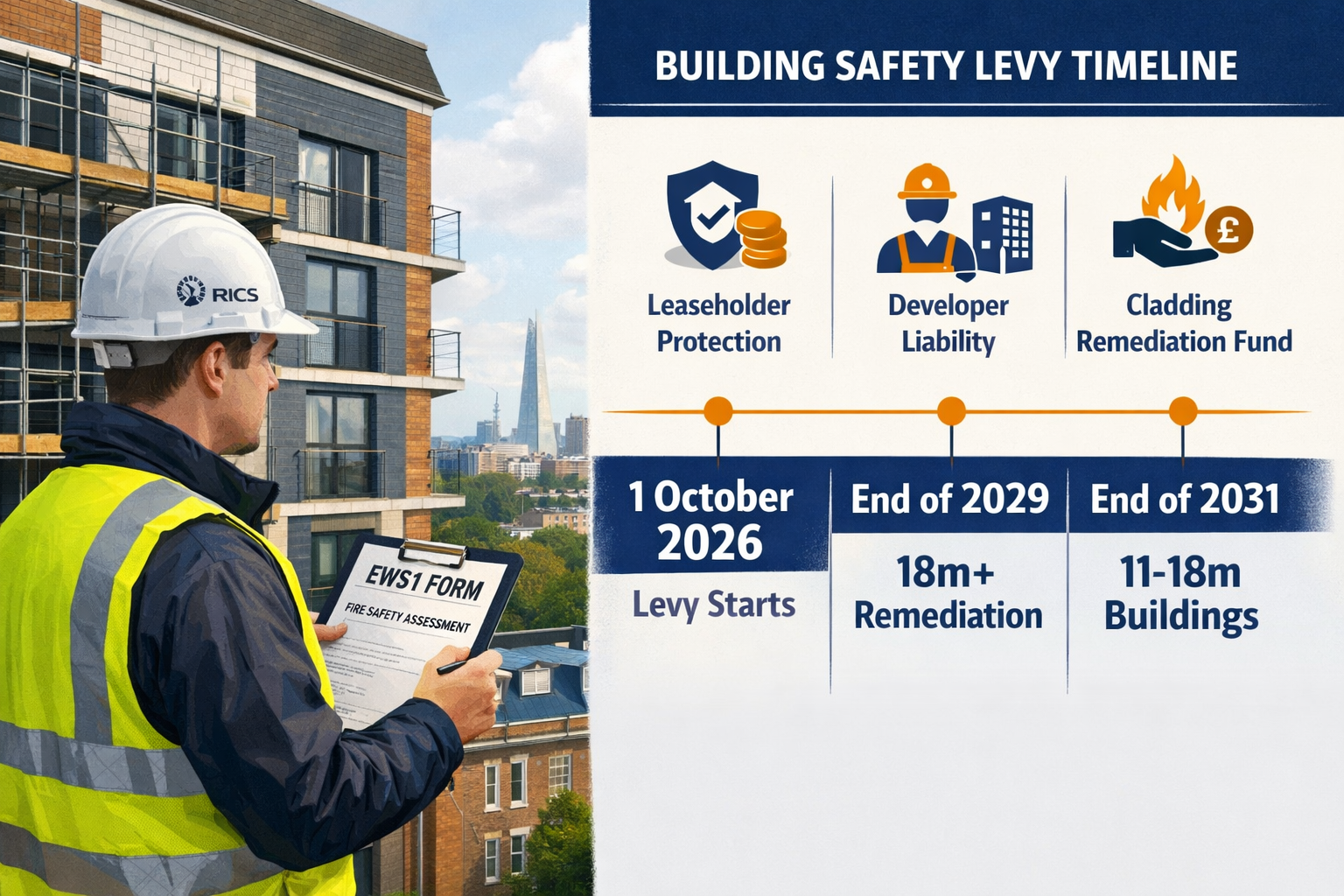
- 🏢 Buildings 18 metres and above: Remediation must be completed by end of 2029
- 🏠 Buildings 11–18 metres: Remediation must be completed by end of 2031
These deadlines create urgency for responsible parties — freeholders, developers, and building owners — to commission assessments and begin works without delay. Failure to meet these timelines risks enforcement action, reputational damage, and potential personal liability for building owners.
For leaseholders, these deadlines also affect mortgage availability and property saleability. Lenders continue to require EWS1 forms or equivalent evidence before approving mortgages on affected buildings.
The Role of Chartered Building Surveyors in the Levy Era
The Building Safety Levy October 2026 leaseholders landscape has significantly elevated the role of chartered building surveyors. Whether you are a leaseholder trying to understand your exposure, a freeholder managing a block, or a developer planning a new scheme, professional surveying expertise is now central to compliance and financial protection.
EWS1 Forms
The External Wall System (EWS1) form remains the primary tool for demonstrating that a building's external wall system has been assessed for fire safety. Without a valid EWS1, many lenders will not offer mortgages on flats in medium and high-rise buildings. A chartered surveyor or fire engineer with the appropriate qualifications must complete this assessment.
Our RICS building surveys service covers the full spectrum of residential building assessments, including pre-purchase advice on fire safety compliance status.
FRAEW Assessments
A Fire Risk Appraisal of External Walls (FRAEW) is the more detailed assessment underpinning the EWS1 process. Conducted under PAS 9980:2022, it evaluates the actual fire risk posed by external wall materials and construction. This is essential for buildings where the cladding type is uncertain or where previous assessments are out of date.
Defect Diagnosis and Remediation Oversight
Beyond cladding, many older blocks in Kensington and Chelsea have composite defects — inadequate cavity barriers, missing fire stops, or non-compliant balcony materials — that only a thorough survey will identify. Our RICS specific defect survey service is designed precisely for this purpose, providing a targeted, cost-effective diagnosis of known or suspected issues.
For developers and freeholders managing remediation programmes, a chartered surveyor can provide project monitoring and oversight — ensuring works are delivered to specification, on time, and within budget. This is particularly valuable given the 2029 and 2031 deadlines now embedded in law.
If you are a leaseholder considering a lease extension during this period of uncertainty, understanding how building safety status affects valuation is critical. Our lease extension valuation service accounts for these factors in full.
For those navigating the complexities of freehold ownership and shared ownership structures, our guide to whether you should buy a share of freehold provides practical, London-specific guidance.
Implications for Developers in Notting Hill, Kensington & Chelsea
For developers active in these prime London boroughs, the Building Safety Levy October 2026 leaseholders regime adds a new line to project cost models. Given the high average house prices in W8, W11, and SW3, levy rates here will sit at the upper end of the national scale.
Key planning considerations:
- Submit building control applications before 1 October 2026 where feasible to avoid levy liability on current schemes.
- Budget for levy costs on post-October 2026 projects — per-square-metre charges in prime London will be material.
- Brownfield development carries lower levy rates than greenfield, reinforcing the policy incentive to build on previously developed land.
- Affordable housing components are exempt, which may influence the tenure mix decisions on mixed-use schemes.
For a thorough pre-acquisition or pre-development assessment of any commercial or mixed-use asset, our commercial building surveys team can provide the due diligence you need.
Conclusion: Act Now, Not in 2029
The Building Safety Levy arriving on 1 October 2026 is not a distant policy concern — it is an imminent reality reshaping how new homes are funded, how existing defects are remediated, and how leaseholders are protected across London's most prestigious residential neighbourhoods.
Here are your actionable next steps:
- Leaseholders: Establish whether your building is above or below 11 metres, and whether a valid EWS1 or FRAEW assessment is in place. If not, request one from your freeholder immediately.
- Freeholders and building owners: Commission a RICS Level 3 building survey or specific defect assessment to identify any fire safety or structural issues before the remediation deadlines.
- Developers: Review your pipeline of building control applications and consider whether any can be submitted before 1 October 2026 to avoid levy liability.
- All parties: Monitor progress of the Remediation Bill through 2026 — its scope will determine whether sub-11m buildings finally receive the protection their residents deserve.
Notting Hill Surveyors are RICS-regulated chartered building surveyors with deep expertise in West London's residential and mixed-use market. From EWS1 guidance and defect diagnosis to remediation oversight and structural surveys, we provide the independent professional advice that leaseholders, freeholders, and developers need right now.
📞 Contact Notting Hill Surveyors today for a no-obligation consultation on how the Building Safety Levy and fire safety requirements affect your property.
