
Over 4.6 million households in England's private rented sector are now subject to one of the most sweeping expansions of landlord liability in living memory. With Awaab's Law extending beyond social housing to cover the private rented sector (PRS) in 2026—and encompassing damp, mould, and more than eight additional hazard categories—building surveyors and landlords face an urgent need for structured, evidence-based assessment frameworks that can withstand regulatory and legal scrutiny.
Building Survey Protocols for Damp and Mould Under Awaab's Law 2026 Extensions: Assessing Emergency and Significant Risk Hazards in PRS are no longer optional best practice. They are a legal necessity. This article sets out what those protocols must include, how surveyors should distinguish between emergency and significant-risk conditions, and what documentation is required to demonstrate genuine compliance.
Key Takeaways 📋
- Awaab's Law now applies to the PRS in 2026, requiring private landlords to investigate damp and mould complaints within strict legal timeframes.
- Emergency hazards must be repaired within 7 days; initial assessments must begin within 2 days of a complaint being received.
- Visual inspections alone do not meet compliance standards—investigations must identify root causes and produce evidence-based remediation plans.
- Structural surveys may be required when diagnosing underlying causes such as water ingress, insulation failure, or ventilation defects.
- Landlords are judged on demonstrable action, not intent—cosmetic fixes such as repainting over mould will not satisfy enforcement bodies.
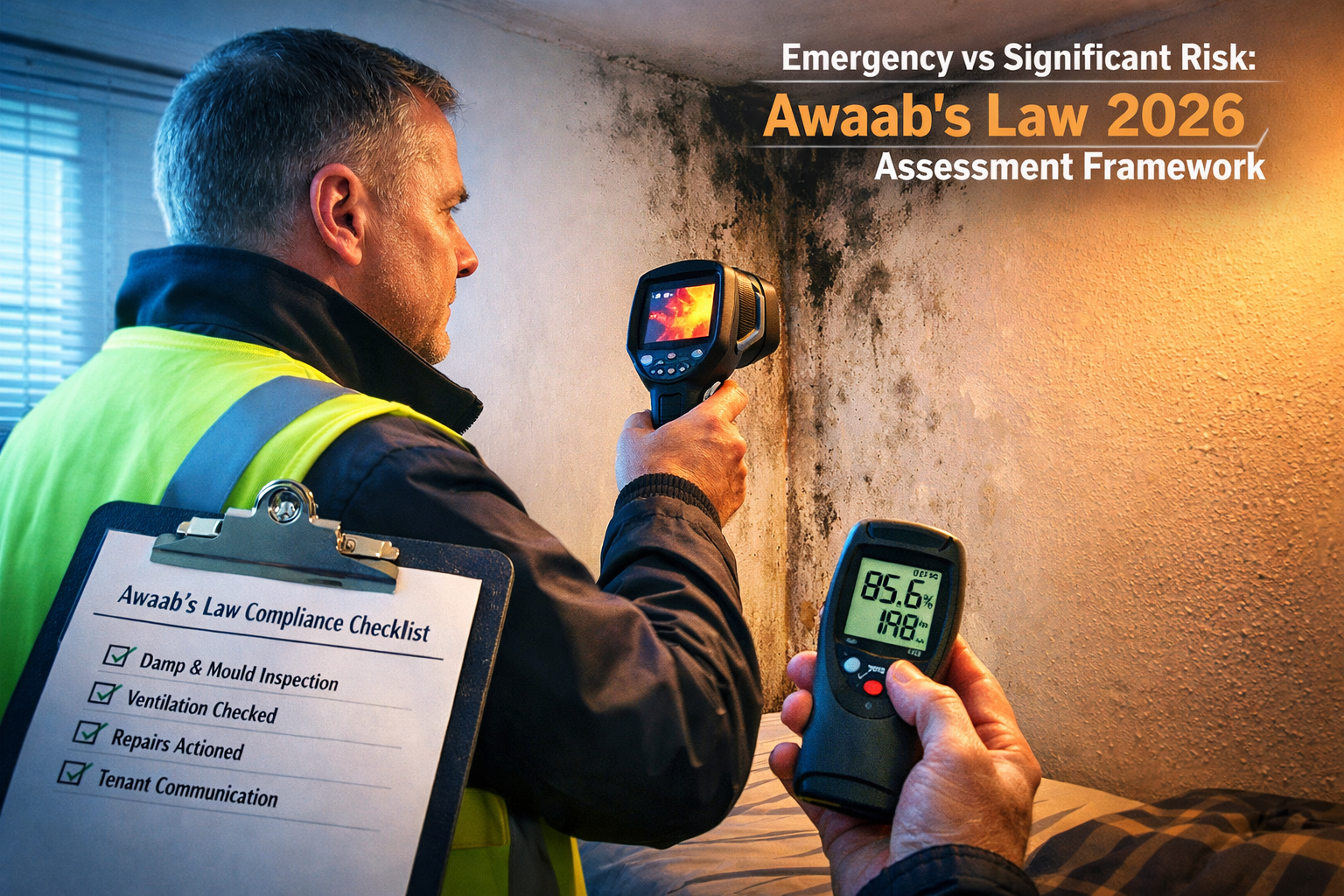
What Awaab's Law 2026 Actually Requires: The Legal Framework Explained
Awaab's Law was originally introduced following the tragic death of two-year-old Awaab Ishak in 2020, caused by prolonged exposure to severe mould in a social housing property. The Social Housing (Regulation) Act 2023 embedded the law's principles into statute, initially targeting registered social landlords. The 2026 extensions represent a fundamental shift: private landlords are now expected to fall fully within Awaab's Law scope, subject to mandatory investigation of complaints, defined timescales for action, and stronger enforcement by local authorities [5].
The Hazard Categories Covered in 2026
The 2026 regulations extend coverage beyond damp and mould to include eight or more additional hazard categories. However, damp and mould remain the most commonly reported and litigated issues in the PRS. Defined moisture-related hazards under the legislation include [5]:
| Hazard Type | Description |
|---|---|
| Visible mould growth | Black, green, or white mould on walls, ceilings, or soft furnishings |
| Persistent condensation | Recurring moisture on windows, walls, or cold surfaces |
| Damp patches | Staining on walls, ceilings, or floors from moisture ingress |
| Water ingress | Rain or groundwater penetrating the building envelope |
| Active leaks | Plumbing or roof failures causing water damage |
| Structural/ventilation issues | Underlying defects driving moisture accumulation |
Critically, the law's focus is on root causes, not surface appearance [5]. A landlord who paints over mould without addressing the underlying moisture source is not compliant—and enforcement bodies will look for evidence of genuine investigation.
The Legal Timeframes: A Non-Negotiable Framework
The timeframes under Awaab's Law are precise and legally binding [4][6]:
- ⏱️ Within 2 days: Initial assessment must commence following a tenant complaint
- 📋 Within 14 calendar days: Full investigation of damp and mould must be completed, with a written summary of findings provided within 48 hours of concluding the investigation
- 🔧 Within 7 days: Emergency repairs must be completed where a significant risk to health or safety is identified
- 🏠 If not practicable within 7 days: Landlords must take protective steps, including offering alternative accommodation where necessary
💬 "Landlords are judged on evidence-based action, not intent—requiring demonstrable proof that investigations were thorough, timely, and supported by specialist insight." [5]
Building Survey Protocols for Damp and Mould Under Awaab's Law 2026 Extensions: The Assessment Framework
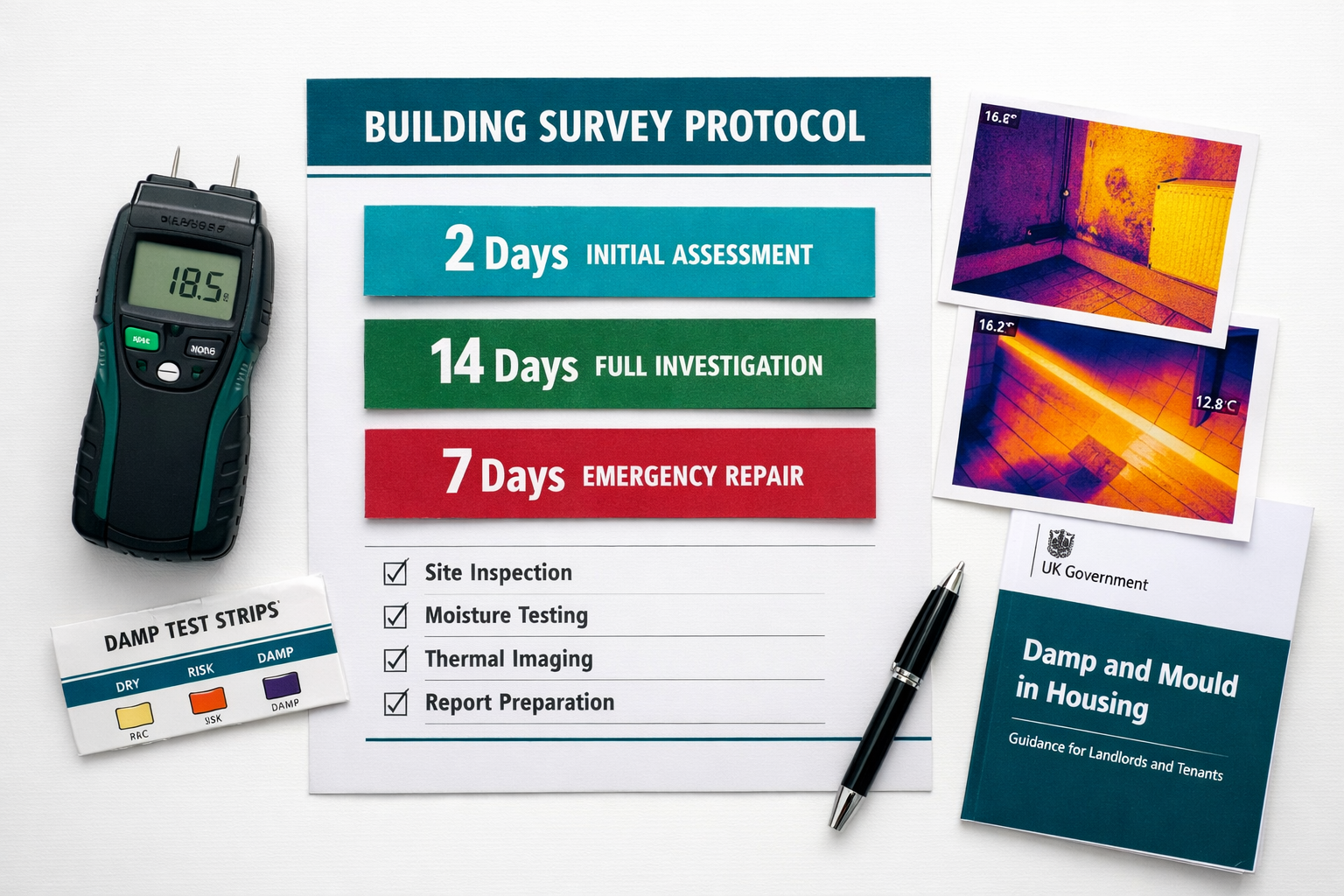
Effective compliance requires a structured, multi-stage assessment framework. Generic visual inspections are explicitly insufficient [5]. The following protocol reflects current regulatory expectations and professional surveying standards for the PRS in 2026.
Stage 1: Initial Triage Assessment (Within 2 Days)
The first stage is rapid triage—determining whether the reported hazard constitutes an emergency or a significant risk condition. This distinction drives every subsequent decision about timescales and remediation.
Emergency conditions (requiring action within 7 days) typically include [6]:
- Extensive black mould covering large surface areas, particularly in sleeping areas or rooms occupied by vulnerable persons
- Active water ingress causing structural saturation
- Leaks affecting electrical installations
- Mould or damp conditions that have triggered acute respiratory symptoms in occupants
Significant risk conditions (requiring full investigation within 14 days) include:
- Persistent condensation with localised mould growth
- Damp patches without active ingress
- Elevated humidity readings without visible mould
- Suspected but unconfirmed structural moisture pathways
During triage, surveyors should use calibrated moisture meters, hygrometers, and thermal imaging cameras to gather objective baseline data. Photographs must be date-stamped and referenced against room plans. If a tenant has requested an in-person inspection, this is a legal requirement—remote assessments cannot substitute for physical attendance [6].
For landlords managing properties across London and the South East, working with chartered surveyors who understand both the technical and legal dimensions of Awaab's Law compliance is strongly advisable.
Stage 2: Full Investigation Protocol (Within 14 Days)
The full investigation must go well beyond a visual walkthrough. Adequate investigations must include [5][6]:
- Professional damp and mould assessment using calibrated instruments
- Identification of all moisture sources—condensation, rising damp, penetrating damp, or plumbing failure
- HHSRS (Housing Health and Safety Rating System) hazard scoring to quantify risk
- Ventilation assessment—checking extract fan performance, trickle vent condition, and air change rates
- Thermal performance review—identifying cold bridges, inadequate insulation, or single-glazed windows driving condensation
- Structural investigation where water ingress or building fabric failure is suspected
🔑 Key point: Structural surveys may be mandated as part of investigation protocols when diagnosing underlying causes of damp [6]. A full building survey provides the depth of investigation required when standard damp assessments cannot identify the root cause.
The written report produced at this stage must include:
- A clear diagnosis of the moisture source(s)
- Evidence-based remediation recommendations
- A prioritised action plan with timelines
- Interim protective measures already implemented (e.g., dehumidifiers, specialist mould washing) [6]
Stage 3: Remediation and Evidence of Completion
Simple mould cleaning or repainting without addressing underlying moisture sources does not meet Awaab's Law compliance standards [5]. Remediation must address root causes such as:
- Ventilation: Installation or repair of mechanical extract ventilation (MEV) or heat recovery ventilation (MVHR) systems
- Insulation: Addressing cold bridges through internal or external wall insulation
- Building fabric: Repairing roof coverings, pointing, flashings, or drainage systems causing water ingress
- Plumbing: Fixing leaking pipes, overflows, or waste connections
A dilapidation survey or structural survey may be required to document pre- and post-remediation conditions, particularly where significant building defects have been identified. This creates a defensible evidence trail for enforcement purposes.
Documenting Findings for Compliance: What Enforcement Bodies Will Scrutinise

Documentation is where many landlords and surveyors fall short. Enforcement bodies—including local authority environmental health officers—will assess not just whether action was taken, but whether that action was timely, proportionate, and genuinely evidence-based [5][4].
The Evidence Pack: Minimum Requirements
A compliant investigation file for a damp and mould complaint in the PRS should contain:
- ✅ Date and time of complaint receipt
- ✅ Date and time of initial assessment commencement (must be within 2 days) [1]
- ✅ Instrument readings: moisture meter percentages, relative humidity levels, surface temperatures
- ✅ Thermal imaging photographs with date/time stamps
- ✅ HHSRS hazard scoring worksheet
- ✅ Written investigation report with root cause diagnosis
- ✅ Remediation plan with specific timelines and responsible parties
- ✅ Evidence of interim protective measures where repairs cannot be completed immediately
- ✅ Confirmation of repair completion with post-remediation readings
💬 "Temporary or cosmetic fixes are insufficient under scrutiny—landlords must provide demonstrable proof that investigations were thorough and supported by specialist insight." [5]
Distinguishing Emergency from Significant Risk in the Written Report
The written report must explicitly classify the hazard. Using HHSRS methodology, surveyors assign a likelihood of occurrence and spread of harm score to calculate a hazard rating. Band A and B hazards (scores above 1,000) are Category 1 hazards requiring immediate enforcement action. These typically align with Awaab's Law emergency conditions [6].
Practical classification guide:
| Condition | Classification | Timeframe |
|---|---|---|
| Extensive mould in bedroom, vulnerable occupant | Emergency | 7-day repair |
| Active roof leak causing ceiling saturation | Emergency | 7-day repair |
| Localised condensation mould in bathroom | Significant risk | 14-day investigation |
| Damp patch on external wall, no active ingress | Significant risk | 14-day investigation |
| Elevated humidity, no visible mould | Monitor/investigate | 14-day investigation |
Interim Protective Measures: What Counts
Where emergency repairs cannot be completed within 7 days, landlords must take appropriate protective steps [4]. These include:
- Providing industrial-grade dehumidifiers
- Arranging specialist mould washing with biocidal treatments
- Offering alternative accommodation where the property poses an acute health risk
- Sealing affected areas to prevent cross-contamination
All interim measures must be documented with dates, product specifications, and photographic evidence.
Practical Implications for PRS Landlords and Surveyors in 2026
The extension of Building Survey Protocols for Damp and Mould Under Awaab's Law 2026 Extensions: Assessing Emergency and Significant Risk Hazards in PRS to the private rented sector represents one of the most significant shifts in landlord responsibility for damp and mould in decades [5]. For surveyors, this creates both professional responsibility and commercial opportunity.
What Surveyors Need to Prepare
- Invest in calibrated equipment: Thermal imaging cameras, calibrated hygrometers, and pin/pinless moisture meters are now essential tools, not optional extras.
- Develop standardised report templates: Templates should be structured around the legal timeframes and include explicit hazard classification fields.
- Understand HHSRS scoring: Surveyors who cannot demonstrate HHSRS competency will struggle to produce reports that satisfy enforcement bodies.
- Build relationships with remediation specialists: Surveyors who can refer landlords to trusted contractors for ventilation, insulation, and structural repairs provide a more complete compliance service.
For those operating across London and surrounding areas, local expertise matters. Whether working in South West London, Battersea, Hammersmith, or Berkshire, understanding the specific building stock—Victorian terraces, post-war flats, converted houses—is essential for accurate damp diagnosis.
What Landlords Must Do Now
- Review all existing tenancy agreements for damp and mould complaint procedures
- Establish a complaint logging system that time-stamps all notifications
- Commission a baseline survey of properties with known damp history before complaints arise
- Engage qualified chartered surveyors for investigations—not just handymen or letting agents
- Retain all documentation for a minimum of six years
🔑 Understanding the different types of building surveys available is an important first step for landlords who need to match the right level of investigation to the hazard identified.
For properties where roof condition may be contributing to water ingress, a specialist roof survey can provide targeted evidence without the cost of a full structural investigation—though where multiple defects are suspected, a comprehensive building survey remains the gold standard.
Conclusion: Actionable Next Steps for Surveyors and Landlords
Awaab's Law in 2026 has fundamentally changed the compliance landscape for the private rented sector. Building Survey Protocols for Damp and Mould Under Awaab's Law 2026 Extensions: Assessing Emergency and Significant Risk Hazards in PRS must now be systematic, instrument-led, and fully documented—not reactive, visual, or superficial.
Actionable Next Steps ✅
- Surveyors: Update assessment templates to include explicit emergency vs. significant-risk classification, HHSRS scoring, and interim measure documentation fields.
- Landlords: Implement a formal complaint receipt and logging system immediately—the 2-day clock starts from the moment a complaint is received, not when it is acknowledged.
- Both parties: Understand that cosmetic remediation is not compliance. Root cause investigation and evidence-based repair are the only defensible standard.
- Property managers: Commission proactive baseline surveys of older or high-risk stock before complaints arise—prevention is significantly cheaper than enforcement.
- All stakeholders: Keep abreast of further regulatory extensions expected beyond 2026, as the government has signalled continued expansion of hazard categories.
The law is clear, the timescales are fixed, and enforcement is strengthening. The surveyors and landlords who invest in rigorous, structured assessment protocols now will be best placed to demonstrate compliance—and protect both their tenants and their businesses.
References
[1] Awaabs Law Damp Mould Survey Compliance Guide – https://www.swiftreporter.com/blog/awaabs-law-damp-mould-survey-compliance-guide
[2] Awaabs Law Extensions To Prs In 2026 Party Wall And Building Survey Protocols For New Hazard Categories – https://nottinghillsurveyors.com/blog/awaabs-law-extensions-to-prs-in-2026-party-wall-and-building-survey-protocols-for-new-hazard-categories
[3] Awaabs Law Technical Compliance Hvac Ventilation – https://www.arm-environments.com/resources/awaabs-law-technical-compliance-hvac-ventilation
[4] How Awaabs Law Will Be Stress Tested In 2026 – https://theintermediary.co.uk/2026/02/how-awaabs-law-will-be-stress-tested-in-2026/
[5] Awaabs Law Private Landlords 2026 – https://www.idealresponse.co.uk/blog/awaabs-law-private-landlords-2026/
[6] Awaabs Law Guidance For Social Landlords Timeframes For Repairs In The Social Rented Sector – https://www.gov.uk/government/publications/awaabs-law-guidance-for-social-landlords/awaabs-law-guidance-for-social-landlords-timeframes-for-repairs-in-the-social-rented-sector
[7] Awaabs Law Timeframes And The Dfg – https://www.foundations.uk.com/awaabs-law-timeframes-and-the-dfg/
