
}
The tragic death of two-year-old Awaab Ishak in 2020 sparked a revolution in UK housing safety standards. What began as legislation targeting damp and mould in social housing is now expanding dramatically in 2026. Awaab's Law Extensions to PRS in 2026: Party Wall and Building Survey Protocols for New Hazard Categories represents a seismic shift for private landlords, property managers, and surveyors across England. The extension introduces stringent timelines for investigating and remedying hazards that go far beyond moisture issues—encompassing electrical dangers, fire risks, structural failures, and thermal comfort standards.
For property professionals conducting party wall surveys and building inspections, 2026 marks a critical turning point. The legislation demands comprehensive assessment protocols, rapid response times, and documented compliance procedures that will fundamentally reshape how hazards are identified and addressed in rental properties.
Key Takeaways
✅ Phase 2 expansion in 2026 extends Awaab's Law beyond damp and mould to cover electrical hazards, fire risks, excess cold and heat, structural collapse, falls hazards, and hygiene issues in private rented sector properties [2]
✅ Strict compliance timelines require emergency hazard responses within 24 hours, investigations within 10 working days, tenant reporting within 3 days, and remediation commencement within 5 working days [2]
✅ Professional survey protocols must now integrate comprehensive hazard assessments into party wall awards and building surveys, with evidence-based documentation and clear remediation plans [3]
✅ Non-compliance consequences include enforcement orders, compensation payments to tenants, coverage of legal costs, and potential loss of rental income if properties become uninhabitable [2]
✅ Surveyor responsibilities expand significantly, requiring thermal imaging, electrical testing, structural assessments, and detailed reporting that goes beyond traditional visual inspections [4]
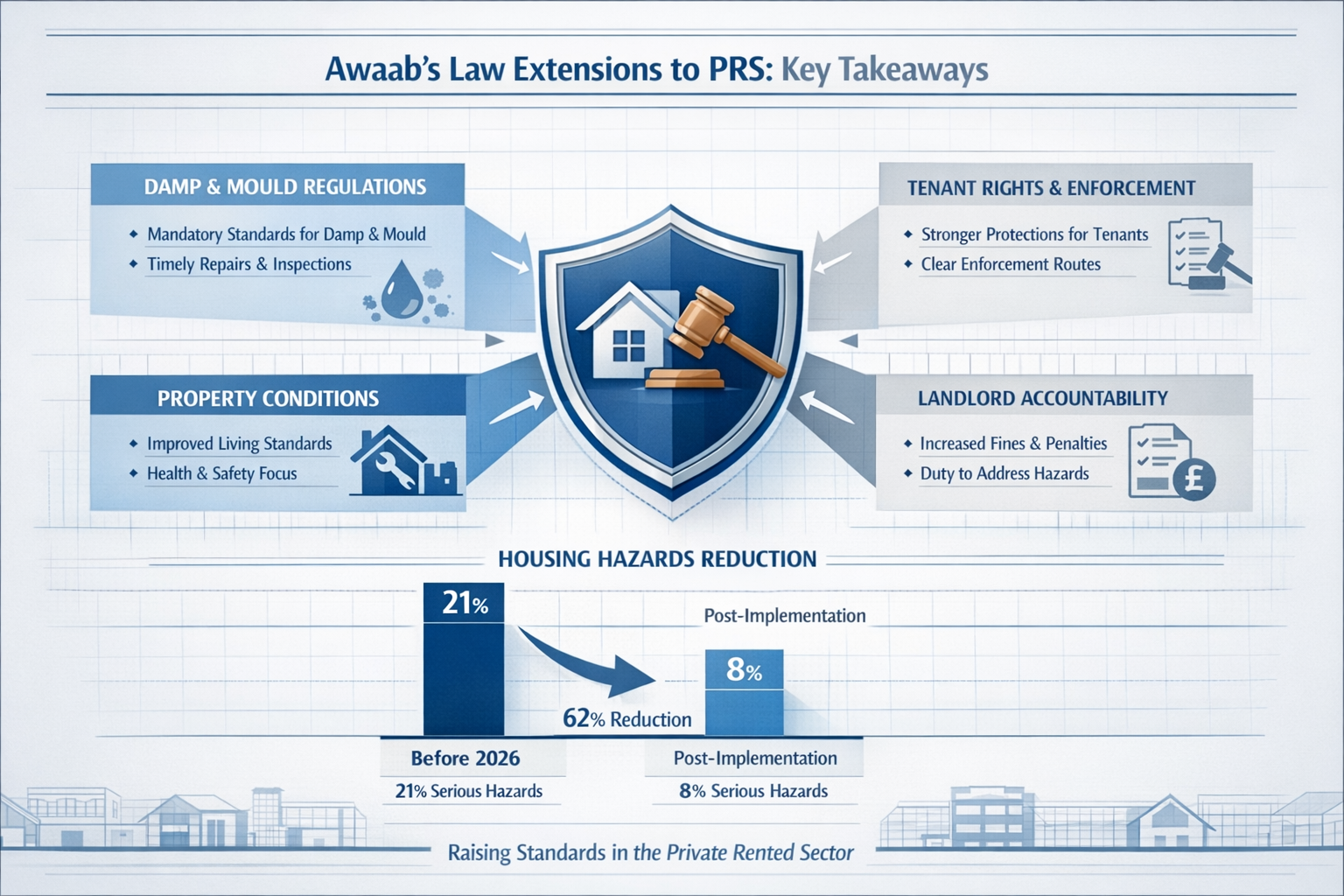
Understanding Awaab's Law Extensions to PRS in 2026: The Legislative Framework
The Journey from Social Housing to Private Rentals
Awaab's Law initially came into force for social housing providers in November 2023, establishing mandatory timeframes for investigating and fixing health hazards caused by damp and mould. This Phase 1 implementation focused exclusively on moisture-related issues that had proven fatal in Awaab Ishak's case [2].
The Renters' Rights Act 2025 (RRA), which received Royal Assent in early 2025, provides the legal framework for extending these protections to the private rented sector (PRS). However, secondary legislation is required to make this extension legally binding—meaning the PRS expansion is not yet automatically in force but is anticipated throughout 2026 [2].
Three-Phase Implementation Strategy
The government has structured Awaab's Law expansion into three distinct phases:
Phase 1 (2023-2025): Social housing only, covering damp and mould hazards exclusively [2]
Phase 2 (2026): Extension to private rented sector with expanded hazard categories including:
- Excess cold and excess heat
- Falls associated with baths, level surfaces, stairs, and between levels
- Structural collapse and explosions
- Fire hazards and electrical hazards
- Domestic hygiene, personal hygiene, and food safety issues [2]
Phase 3 (Future): Complete coverage of all remaining hazards in the Housing Health & Safety Rating System (HHSRS) except overcrowding [2]
Mandatory Response Timeframes
The legislation establishes four critical compliance deadlines that landlords and property managers must meet:
| Requirement | Timeframe | Description |
|---|---|---|
| Emergency Works | 24 hours | Immediate investigation and remediation of life-threatening hazards [2] |
| Investigation | 10 working days | Professional assessment must be completed from awareness of significant hazard [2] |
| Tenant Notification | 3 working days | Written summary of findings shared with affected tenants [2] |
| Remediation Start | 5 working days | Safety works must commence after investigation concludes [2] |
These timeframes represent a fundamental shift in how quickly property professionals must respond to hazard reports. For surveyors conducting party wall assessments, this means building rapid-response protocols into standard practice.
Awaab's Law Extensions to PRS in 2026: New Hazard Categories and Survey Protocols
Expanded Hazard Categories Requiring Assessment
The 2026 extensions dramatically broaden the scope of hazards that surveyors must identify and document during property inspections. Each category demands specific assessment techniques and equipment.
🔥 Fire Hazards
Surveyors must now evaluate:
- Fire door integrity and self-closing mechanisms
- Smoke alarm placement and functionality
- Escape route accessibility and signage
- Combustible material storage
- Fire-resistant construction between units (particularly relevant in party wall scenarios)
⚡ Electrical Hazards
Comprehensive electrical safety assessments include:
- Condition of consumer units and circuit breakers
- Exposed wiring or damaged outlets
- Overloaded circuits and extension cord usage
- Earthing and bonding adequacy
- Compliance with current wiring regulations
Professional electrical testing certificates should accompany building surveys, with particular attention to shared electrical services in party wall situations [4].
🏚️ Structural Collapse Risks
Structural assessments must identify:
- Load-bearing wall integrity
- Foundation settlement or subsidence indicators
- Roof structure deterioration
- Party wall stability and shared structural elements
- Corrosion of steel reinforcement in concrete structures
When conducting party wall awards, surveyors must now document pre-existing structural deficiencies that could constitute collapse hazards.
❄️ Excess Cold and 🔥 Excess Heat
Thermal comfort assessments require:
- Heating system capacity and functionality
- Insulation adequacy in walls, roofs, and floors
- Window and door thermal performance
- Ventilation effectiveness
- Temperature monitoring in occupied spaces
Thermal imaging cameras have become essential tools for identifying cold bridging, heat loss, and inadequate thermal barriers—particularly at party walls where thermal performance can vary significantly [1].
🚶 Falls Hazards
Fall risk assessments cover:
- Stair tread consistency and handrail security
- Level changes and trip hazards
- Bathroom slip resistance
- Window and balcony guard heights
- Lighting adequacy in circulation spaces
Professional Survey Protocol Requirements
The legislation mandates that "adequate investigations" must go far beyond simple visual inspections. According to industry guidance, compliant assessments must include [3]:
1. Professional Qualifications: Surveyors must demonstrate competence in hazard identification, ideally with RICS accreditation or equivalent professional standing.
2. Appropriate Equipment: Investigations require specialized tools including:
- Moisture meters and hygrometers
- Thermal imaging cameras
- Electrical testing equipment
- Structural assessment tools
- Air quality monitors
3. Root Cause Analysis: Identifying moisture sources, structural deficiencies, or electrical faults rather than merely documenting symptoms.
4. Clear Reporting: Written summaries must include:
- Detailed findings with photographic evidence
- Hazard severity ratings
- Specific remediation recommendations
- Estimated timelines for completion
- Cost implications
5. Evidence-Based Remediation Plans: Recommendations must be technically sound and achievable within the statutory timeframes [3].
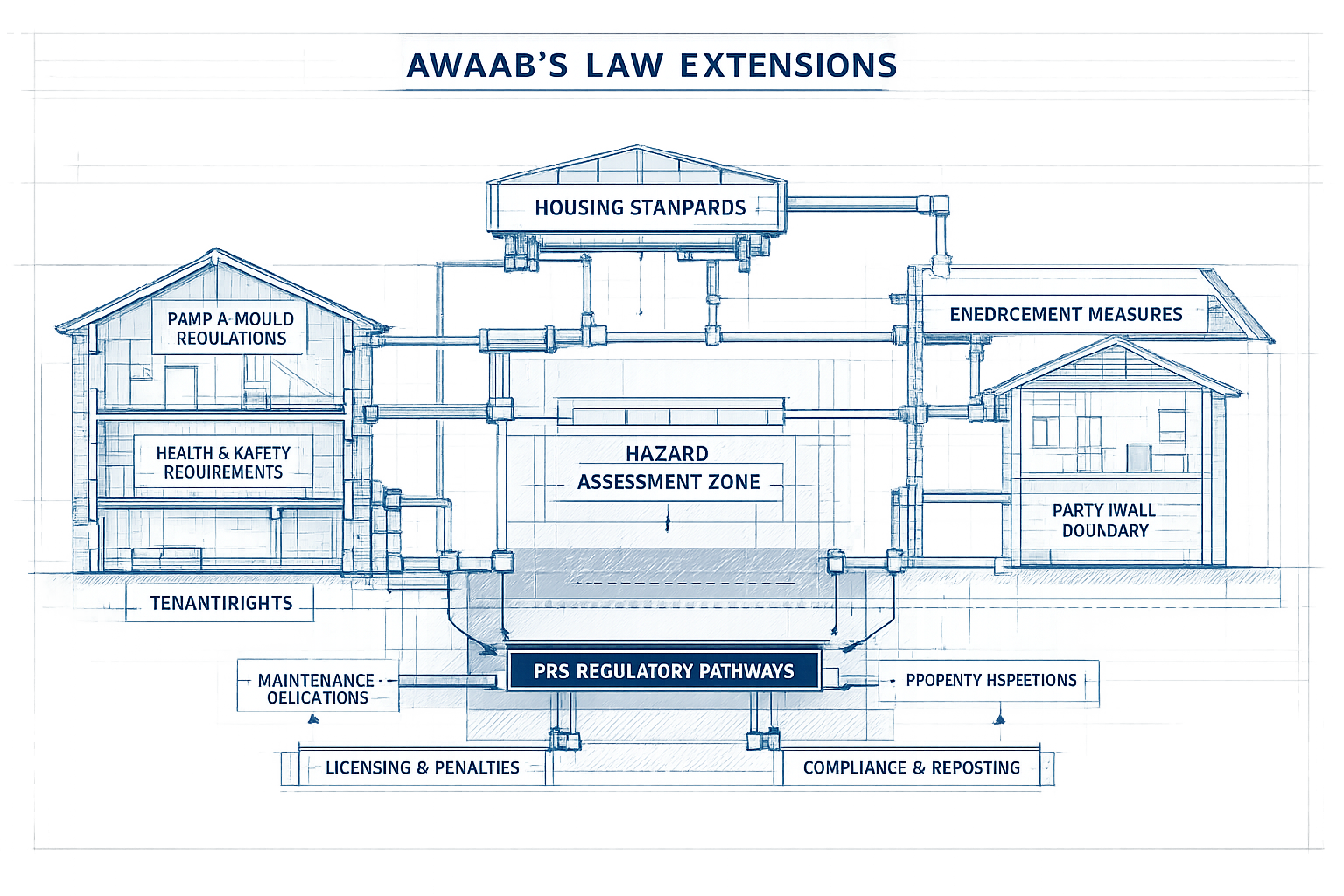
Awaab's Law Extensions to PRS in 2026: Party Wall Survey Integration and Compliance Checklists
Integrating Awaab's Law Requirements into Party Wall Procedures
Party wall surveyors face unique challenges when the 2026 extensions take effect. Traditional party wall surveys focus on documenting conditions before construction work begins and ensuring neighboring properties aren't damaged. Now, these assessments must also identify and report any hazards that fall under Awaab's Law categories [6].
Pre-Work Party Wall Assessments
When conducting initial party wall surveys under the Party Wall Act, surveyors should now include:
Structural Hazard Documentation:
- Existing cracks, bulging, or instability in party walls
- Evidence of previous structural movement
- Deterioration of load-bearing elements
- Inadequate support for chimneys or other shared structures
Fire Safety Evaluation:
- Fire resistance integrity of party walls
- Breaches in fire barriers (cable penetrations, gaps)
- Combustible materials in party wall cavities
- Adequacy of fire stopping at floor and ceiling junctions
Thermal Performance Assessment:
- Cold bridging at party wall junctions
- Inadequate insulation causing excess cold
- Thermal imaging of party wall interfaces
- Condensation risk areas
Electrical Safety Concerns:
- Shared electrical services crossing party walls
- Exposed wiring or damaged installations near party structures
- Compliance with current regulations for electrical work affecting party walls
This expanded scope means party wall surveys now serve dual purposes: protecting neighboring properties during construction work while simultaneously identifying hazards that trigger Awaab's Law compliance obligations [6].
Party Wall Awards with Hazard Remediation Clauses
When party wall awards are prepared, surveyors should now consider including specific clauses addressing:
- Hazard Disclosure Requirements: Mandating that building owners disclose any known hazards before work commences
- Remediation Responsibilities: Clarifying which party is responsible for addressing pre-existing hazards discovered during party wall work
- Compliance Timelines: Ensuring remediation schedules align with Awaab's Law statutory timeframes
- Access Provisions: Allowing surveyors access for follow-up hazard assessments during and after construction
Comprehensive Building Survey Checklists for 2026 Compliance
For surveyors conducting Level 3 building surveys or RICS building surveys, the following expanded checklists ensure Awaab's Law compliance:
📋 Electrical Hazards Checklist
- Consumer unit condition and labeling
- Presence of RCD protection on all circuits
- Evidence of DIY or non-compliant electrical work
- Overloaded sockets or inappropriate extension cord use
- Damaged switches, outlets, or light fittings
- Exposed wiring or inadequate cable protection
- Earthing and bonding to water and gas services
- Electrical installation certificate date and validity
- Smoke and carbon monoxide alarm wiring and functionality
📋 Fire Safety Hazards Checklist
- Fire door condition (self-closing, intumescent strips, gaps)
- Smoke alarm quantity, placement, and testing
- Escape route accessibility and width
- Fire-resistant construction between units
- Combustible material storage in escape routes
- Fire blanket and extinguisher provision
- Window escape options from upper floors
- Fire safety signage adequacy
📋 Structural Collapse Hazards Checklist
- Foundation movement or settlement indicators
- Structural cracking patterns and severity
- Load-bearing wall and beam condition
- Roof structure integrity and deterioration
- Party wall stability and shared structural elements
- Lintel adequacy over openings
- Floor deflection or bounce
- Wall bulging or leaning
- Previous structural alterations and building control approval
📋 Thermal Comfort Hazards Checklist
- Heating system type, age, and functionality
- Radiator or heating distribution adequacy
- Insulation presence in loft, walls, and floors
- Window glazing type and thermal performance
- Door draught proofing
- Ventilation adequacy and condensation control
- Thermal imaging of cold spots and heat loss
- Thermostat control and zoning
- Evidence of excess cold (mould, condensation)
- Overheating risk in summer months
📋 Falls Hazards Checklist
- Stair tread rise and going consistency
- Handrail presence, height, and security
- Level changes and trip hazards
- Bathroom slip-resistant surfaces
- Window sill heights and fall risk
- Balcony or terrace guard heights
- Lighting adequacy in circulation areas
- Floor surface condition and levelness
- Step edge visibility and marking
📋 Hygiene and Sanitation Hazards Checklist
- Kitchen food preparation surface condition
- Adequate hot water supply
- Bathroom and toilet ventilation
- Drainage functionality and odors
- Waste storage facilities
- Pest infestation evidence
- Water supply contamination risk
- Personal washing facilities adequacy
Documentation and Reporting Standards
To meet Awaab's Law requirements, survey reports must now include [4]:
Photographic Evidence: Clear images of all identified hazards with annotations
Hazard Severity Ratings: Classification using HHSRS categories (Category 1 or Category 2 hazards)
Immediate Action Items: Clear identification of emergency hazards requiring 24-hour response
Remediation Specifications: Detailed descriptions of required works, not vague recommendations
Cost Estimates: Realistic budgets for remediation works
Timeline Projections: Expected duration for investigation and remediation phases
Compliance Statements: Explicit confirmation of whether the property meets Awaab's Law standards
Surveyors should also consider whether disputes may arise regarding responsibility for hazard remediation, particularly in party wall scenarios where multiple property owners share structural elements.
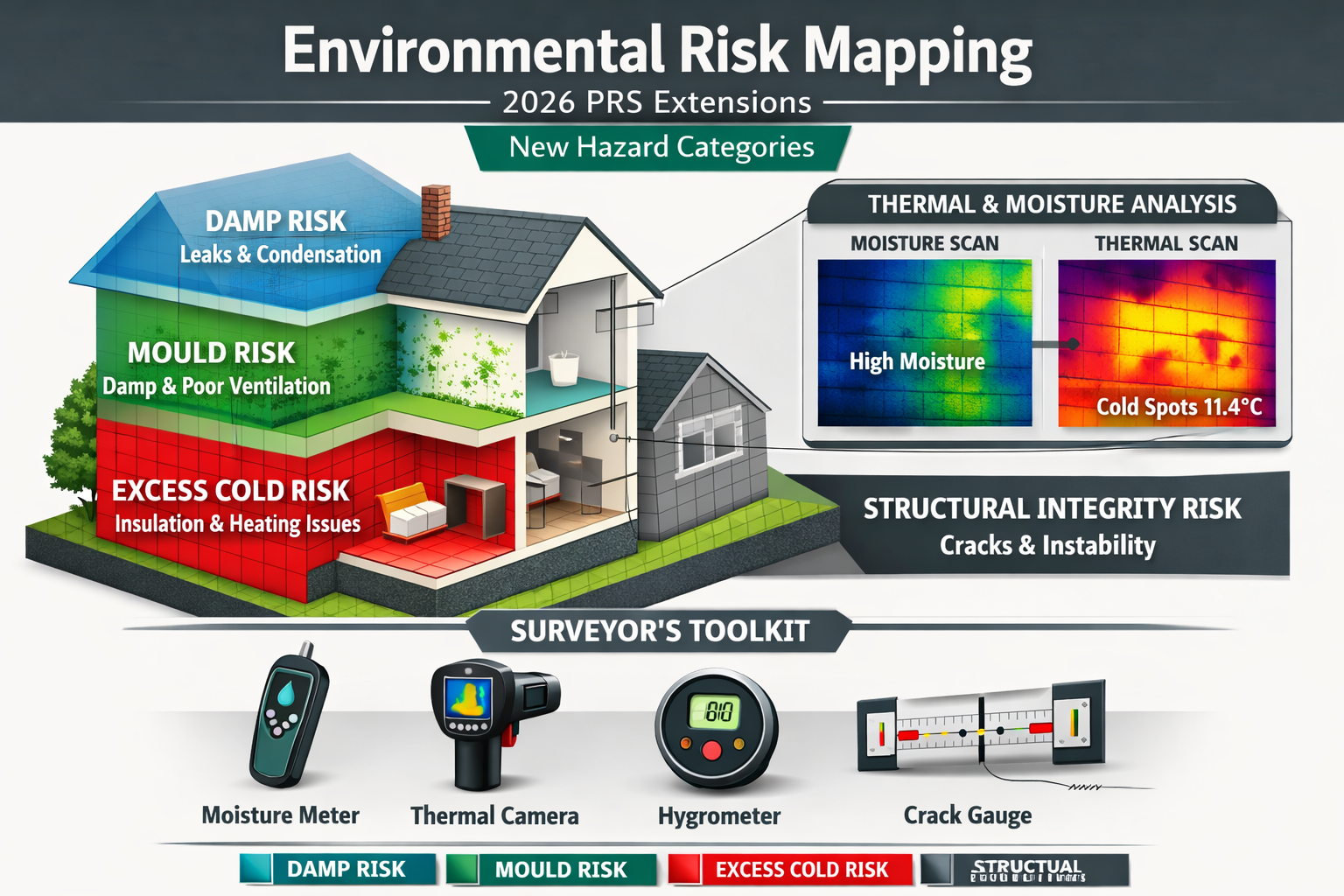
Case Studies: Damp, Mould, and Excess Cold Assessments in Practice
Case Study 1: Victorian Terraced Property with Party Wall Damp Penetration
Property Type: Victorian mid-terrace rental property in London
Issue: Tenant reported persistent damp and mould in first-floor bedroom adjacent to party wall
Initial Assessment (Day 1-2):
A qualified surveyor attended within 24 hours as the tenant reported respiratory symptoms. The assessment revealed:
- Moisture readings of 28% in plaster (normal is below 20%)
- Black mould growth covering approximately 2 square meters
- Cold surface temperatures at party wall junction (8°C below ambient)
- Evidence of condensation on windows
- Inadequate ventilation (no trickle vents, blocked airbricks)
Investigation Phase (Day 3-10):
Thermal imaging revealed significant cold bridging at the party wall junction where insulation had been compromised during previous renovation work. Moisture meter readings indicated the damp was primarily condensation-based rather than penetrating damp, though the party wall cavity showed elevated moisture levels.
The surveyor conducted a comprehensive assessment including:
- Thermal imaging of all external and party walls
- Moisture mapping of affected areas
- Ventilation airflow testing
- Heating system capacity evaluation
- Inspection of neighboring property's recent renovation work
Root Cause Identification:
The investigation determined that recent works by the neighboring property owner had removed cavity wall insulation from their side of the party wall, creating a thermal bridge. Combined with inadequate ventilation and intermittent heating, this created ideal conditions for condensation and mould growth [1].
Tenant Notification (Day 11):
A detailed written summary was provided to the tenant within the 3-working-day requirement, explaining:
- The condensation and thermal bridging causes
- Health implications and immediate mitigation steps
- Planned remediation works and timeline
- Temporary accommodation arrangements during works
Remediation Plan (Day 12-16):
Works commenced within 5 working days and included:
- Professional mould remediation and antimicrobial treatment
- Installation of insulated plasterboard on party wall
- Fitting of continuous mechanical ventilation with heat recovery
- Heating system upgrade to improve thermal comfort
- Coordination with neighboring owner to reinstate cavity insulation
Outcome:
The property achieved compliance within 3 weeks. Follow-up moisture readings after 6 weeks confirmed the issue was resolved. The landlord avoided enforcement action by meeting all statutory timeframes [3].
Case Study 2: Modern Flat with Electrical Hazards During Party Wall Works
Property Type: Purpose-built flat in converted building
Issue: Electrical hazards discovered during party wall excavation work
Discovery:
During a routine party wall survey before basement excavation, the surveyor identified:
- Consumer unit with outdated fuse box (pre-1990s)
- No RCD protection on circuits
- Evidence of DIY electrical work with non-compliant cable routing
- Damaged socket outlets with exposed wiring
- Inadequate earthing and bonding
Emergency Response (Day 1):
As exposed wiring presented an immediate shock risk, the surveyor classified this as an emergency hazard requiring 24-hour response. The landlord immediately:
- Isolated affected circuits
- Engaged a qualified electrician for emergency assessment
- Notified the tenant of safety precautions
Investigation and Remediation (Day 2-15):
A full electrical installation condition report (EICR) was commissioned, revealing multiple Category 1 hazards. The landlord implemented a comprehensive rewiring program, including:
- Complete consumer unit replacement with RCD protection
- Remediation of all non-compliant circuits
- Proper earthing and bonding installation
- Smoke and carbon monoxide alarm hardwiring
- Electrical installation certificate upon completion
Party Wall Implications:
The party wall award was amended to include provisions for electrical safety during excavation works, ensuring that:
- Electrical services crossing party walls were properly protected
- Fire-resistant barriers were maintained during construction
- Temporary electrical installations met safety standards
Outcome:
The landlord met all Awaab's Law timelines despite the extensive works required. The party wall surveyor's early identification prevented potential electrical fires during construction and ensured tenant safety [4].
Case Study 3: Excess Cold in Poorly Insulated Rental Property
Property Type: 1960s semi-detached house converted to rental
Issue: Tenant complaint of inadequate heating and excess cold during winter
Initial Assessment (Day 1-3):
The surveyor's assessment revealed:
- Internal temperatures of 14°C despite heating system running
- Single-glazed windows throughout
- No loft insulation (inspection revealed only 50mm original insulation)
- Solid walls with no insulation
- Inefficient storage heaters as primary heating source
- Significant draughts around doors and windows
Thermal Imaging Survey (Day 4-7):
Comprehensive thermal imaging documented:
- Heat loss through roof (30% of total heat loss)
- Cold bridging at window and door frames
- Thermal bypass at party wall junctions
- Inadequate floor insulation
Health Impact Documentation:
The tenant provided medical evidence of respiratory conditions exacerbated by cold, damp conditions. Room temperatures consistently below 18°C (the minimum for health) triggered Category 1 hazard classification under HHSRS [3].
Remediation Strategy (Day 8-60):
The landlord implemented a phased approach:
Phase 1 (Emergency measures – Days 8-12):
- Provision of additional electric heaters
- Draught-proofing of doors and windows
- Heavy curtain installation
Phase 2 (Permanent solutions – Days 13-60):
- Loft insulation upgrade to 270mm
- Secondary glazing installation
- External wall insulation system
- Replacement of storage heaters with modern gas central heating
- Floor insulation in ground floor rooms
Outcome:
Post-remediation thermal imaging confirmed significant improvement, with internal temperatures maintaining 20-21°C. Energy efficiency rating improved from E to C. The landlord's proactive response prevented enforcement action despite the extended timeline required for comprehensive works [1].
Key Lessons from Case Studies
These real-world examples demonstrate several critical points for surveyors and landlords:
⚡ Early Identification Saves Time and Money: Comprehensive initial assessments prevent repeated investigations and escalating costs
📸 Documentation Is Essential: Photographic evidence, thermal imaging, and moisture readings provide objective proof of hazards and remediation effectiveness
🤝 Communication Matters: Clear, timely tenant communication builds trust and demonstrates compliance
🔧 Professional Expertise Required: Adequate investigations demand qualified surveyors with appropriate equipment, not basic visual inspections
⏱️ Timeline Management: Understanding which hazards require 24-hour versus 10-day response prevents compliance failures
🏗️ Party Wall Coordination: Hazard identification during party wall works requires coordination between multiple surveyors and contractors
For property professionals seeking to understand who pays for party wall surveyors when hazard remediation is required, these case studies illustrate that responsibility typically falls to the building owner whose property contains the hazard, regardless of whether party wall works triggered the discovery.
Enforcement, Penalties, and Compliance Strategies
Consequences of Non-Compliance
The regulatory framework backing Awaab's Law includes substantial enforcement powers designed to ensure landlord compliance. Property owners who fail to meet the statutory timeframes or adequately address hazards face [2]:
🏛️ Enforcement Orders: Local housing authorities can issue improvement notices requiring specific works within defined timelines
💰 Financial Penalties: Compensation payments to affected tenants for health impacts, inconvenience, and alternative accommodation costs
⚖️ Legal Cost Coverage: Landlords may be required to pay tenants' legal costs when disputes arise
🚫 Rent Repayment Orders: Properties deemed uninhabitable due to unaddressed hazards may result in rent repayment to tenants for affected periods
📋 Prohibition Orders: Severe cases can result in properties being prohibited from occupation until hazards are remedied
🔍 Increased Scrutiny: Properties with compliance failures face more frequent inspections and reduced regulatory trust
The financial implications can be substantial. Beyond direct penalties, landlords face:
- Void periods while properties are uninhabitable
- Costs of temporary tenant accommodation
- Emergency contractor premiums for rapid-response works
- Reputational damage affecting future lettings
- Increased insurance premiums
Proactive Compliance Strategies for Landlords and Property Managers
Forward-thinking property professionals are implementing systematic approaches to ensure compliance before issues arise:
1️⃣ Preventative Survey Programs
Annual Comprehensive Inspections: Rather than reactive responses to tenant complaints, schedule annual building surveys that specifically assess all Awaab's Law hazard categories.
Seasonal Assessments: Conduct targeted inspections before winter (heating, insulation, excess cold) and summer (ventilation, excess heat) to identify seasonal hazards proactively.
Post-Tenancy Surveys: Comprehensive hazard assessments between tenancies allow remediation without time pressure from occupied property requirements.
2️⃣ Maintenance Management Systems
Digital Hazard Tracking: Implement property management software that tracks:
- Hazard identification dates
- Investigation timelines
- Remediation progress
- Compliance deadline alerts
- Tenant communication records
Preventative Maintenance Schedules: Regular servicing of heating systems, electrical installations, ventilation equipment, and structural elements prevents hazards from developing.
Contractor Relationships: Establish relationships with qualified contractors who can respond within the 24-hour emergency timeframe when required.
3️⃣ Tenant Communication Protocols
Clear Reporting Procedures: Provide tenants with simple, accessible methods to report potential hazards, including:
- 24-hour emergency contact numbers
- Online reporting portals
- Written guidance on what constitutes different hazard types
Regular Check-ins: Proactive tenant contact (quarterly or bi-annually) to identify emerging issues before they become serious hazards.
Educational Materials: Provide tenants with information about condensation prevention, proper ventilation use, and heating management to reduce hazard development.
4️⃣ Documentation and Record-Keeping
Maintain comprehensive records including:
- Initial property condition reports with hazard assessments
- All survey reports and inspection records
- Tenant hazard reports and response timelines
- Investigation findings and evidence
- Remediation specifications and completion certificates
- Tenant communication logs
- Contractor invoices and warranties
These records provide essential evidence of compliance if disputes arise or enforcement action is threatened.
5️⃣ Professional Surveyor Relationships
Establish ongoing relationships with qualified surveyors who understand Awaab's Law requirements. This ensures:
- Rapid response when hazards are reported
- Consistent assessment standards across your portfolio
- Familiarity with your properties' specific characteristics
- Streamlined communication and reporting
For properties with party walls, maintaining relationships with experienced party wall surveyors ensures that hazard assessments are integrated into party wall procedures from the outset.
Insurance Considerations
Landlord insurance policies are evolving to address Awaab's Law implications. Property owners should:
Review Policy Coverage: Ensure policies cover:
- Emergency remediation costs
- Tenant alternative accommodation
- Legal defense costs for compliance disputes
- Professional fees for required investigations
Disclose Known Hazards: Failure to disclose existing hazards may invalidate insurance claims
Maintain Compliance Evidence: Insurers may require proof of regular inspections and maintenance programs
Consider Specialist Coverage: Some insurers now offer specific Awaab's Law compliance insurance products
Future Developments and Preparing for Phase 3
Anticipated Phase 3 Expansions
While Phase 2 in 2026 represents a substantial expansion of Awaab's Law, Phase 3 will eventually extend coverage to virtually all hazards in the Housing Health & Safety Rating System (HHSRS) except overcrowding [2].
Additional hazard categories likely to be included in Phase 3:
Environmental Hazards:
- Noise disturbance
- Entry by intruders
- Lighting inadequacy
- Air quality issues beyond damp and mould
Biological Hazards:
- Pest infestations
- Domestic animal hazards
- Biocide contamination
Chemical Hazards:
- Asbestos exposure
- Lead contamination
- Volatile organic compounds
Radiation Hazards:
- Radon gas accumulation
Surveyors should begin developing expertise in these areas now to prepare for future regulatory requirements.
Technology and Innovation in Hazard Assessment
The surveying profession is embracing technological solutions to meet Awaab's Law's demanding requirements:
🔬 Advanced Diagnostic Tools:
- AI-powered thermal imaging analysis
- Continuous environmental monitoring sensors
- Moisture mapping with 3D visualization
- Drone-based external inspections
- Non-invasive structural assessment technologies
📱 Digital Reporting Platforms:
- Mobile survey apps with integrated checklists
- Cloud-based report generation with automatic compliance checking
- Tenant portals for real-time hazard reporting
- Automated timeline tracking and deadline alerts
🤖 Predictive Analytics:
- Machine learning models predicting hazard development
- Portfolio-wide risk assessment tools
- Maintenance optimization algorithms
These technologies enable surveyors to conduct more thorough assessments more efficiently, helping landlords meet the tight compliance timelines Awaab's Law demands.
Industry Training and Professional Development
Professional bodies including RICS are developing specialized training programs covering:
- Awaab's Law compliance requirements
- Advanced hazard identification techniques
- Thermal imaging and moisture assessment
- Electrical safety evaluation for surveyors
- Fire risk assessment fundamentals
- Report writing for regulatory compliance
Surveyors should pursue continuing professional development (CPD) in these areas to maintain competence as the regulatory landscape evolves.
Conclusion
The Awaab's Law Extensions to PRS in 2026: Party Wall and Building Survey Protocols for New Hazard Categories represent a fundamental transformation in how rental property safety is managed in England. What began as a response to tragic damp and mould deaths has evolved into comprehensive legislation addressing electrical hazards, fire risks, structural dangers, thermal comfort, and falls prevention.
For property surveyors, these changes demand significant adaptation. Traditional visual inspections are no longer adequate—comprehensive assessments require specialized equipment, professional expertise, and systematic protocols. Party wall surveyors must now integrate hazard identification into their standard procedures, while building surveyors must expand their assessment scope to cover all new hazard categories.
The strict compliance timelines—24 hours for emergencies, 10 days for investigations, 3 days for tenant reporting, and 5 days to commence remediation—leave no room for delay or inadequate assessment. Landlords and property managers who adopt proactive compliance strategies, maintain comprehensive documentation, and establish relationships with qualified professionals will navigate these requirements successfully.
Actionable Next Steps
For Landlords and Property Managers:
- Schedule comprehensive hazard assessments of all rental properties before the 2026 PRS extension takes effect
- Implement digital tracking systems for hazard identification, investigation timelines, and remediation progress
- Establish emergency response protocols with qualified contractors who can meet 24-hour requirements
- Review insurance coverage to ensure adequate protection for Awaab's Law compliance costs
- Develop tenant communication procedures that encourage early hazard reporting
For Surveyors:
- Invest in specialized equipment including thermal imaging cameras, moisture meters, and electrical testing tools
- Pursue professional development in expanded hazard categories and assessment techniques
- Update survey templates and checklists to incorporate all Awaab's Law hazard categories
- Develop rapid-response capabilities to meet emergency assessment timelines
- Establish clear reporting standards that provide evidence-based remediation recommendations
For Property Owners Planning Construction:
- Integrate hazard assessments into party wall procedures from the project outset
- Ensure party wall awards include hazard remediation clauses clarifying responsibilities
- Schedule pre-work surveys that identify existing hazards before construction begins
- Coordinate with neighboring property owners when shared structural elements may contain hazards
The 2026 extensions to Awaab's Law represent more than regulatory compliance—they're an opportunity to fundamentally improve housing quality and protect tenant health. Property professionals who embrace these standards proactively will not only avoid enforcement action but will also differentiate themselves in an increasingly quality-conscious rental market.
The legacy of Awaab Ishak demands nothing less than a complete transformation in how we identify, assess, and remedy housing hazards. The protocols and procedures outlined in this guide provide a roadmap for meeting that challenge with professionalism, competence, and genuine commitment to tenant safety.
References
[1] Awaabs Law Damp Mould Survey Compliance Guide – https://www.swiftreporter.com/blog/awaabs-law-damp-mould-survey-compliance-guide
[2] Awaabs Law Comes Into Force What Does It Mean For Construction – https://www.trowers.com/insights/2025/november/awaabs-law-comes-into-force-what-does-it-mean-for-construction
[3] Awaabs Law Private Landlords 2026 – https://www.idealresponse.co.uk/blog/awaabs-law-private-landlords-2026/
[4] Awaabs Law What Property Managers And Surveyors Must Know – https://www.howdengroup.com/uk-en/awaabs-law-what-property-managers-and-surveyors-must-know
[6] Party Wall Act Essentials For 2026 Uk Renewable Energy Retrofits Solar Panels And Heat Pumps On Shared Walls – https://nottinghillsurveyors.com/blog/party-wall-act-essentials-for-2026-uk-renewable-energy-retrofits-solar-panels-and-heat-pumps-on-shared-walls
